

Paper Menu >>
Journal Menu >>
 Creative Education 2012. Vol.3, No.5, 662-665 Published Online September 2012 in SciRes (http://www.SciRP.org/journal/ce) http://dx.doi.org/10.4236/ce.2012.35097 Copyright © 2012 SciR e s . 662 Waving Web in Tourism Higher Education—Case Study at Tourism School of GUBS Xuan Xiao, Jianhua Wu Tourism School, Gu a n g dong University of Business Studies, Guang z h o u , China Email: [email protected] Received August 6th, 2012; revised September 10th, 2012; accepted September 18th, 2012 Purpose: The purpose of this paper is to introduce some approaches to wave web in tourism higher edu- cation, with analyses on key successful factors. Design/methodology/approach—The methods of investi- gation used in this study include observation, in-depth interviews, survey and secondary data. Findings: A comparison study indicates that virtual learning environment is a good solution to massive course load in tourism higher education. The paper figures out three effective approaches based on Blackboard Sys- tem, and KSFs of online implementation, such as instructor preparation, course development, instructor accessibility, course monitoring and technology support. Originality/Value: This paper illustrates the contribution of computer aided instruction and virtual learning environment to tourism higher education through case study. Keywords: Online Education; Tourism Higher Education; Approaches; Key Successful Factors; Case Study Online education in mainland China was initiated in 1990s, and the market has witnesses a remarkable annual growth of about 20% since 2004. In 2009, online education achieved a market size of RMB 45.6 billion (US$7.15 billion) and 20 mil- lion registered users, with higher education accounted for over 80%1. This paper is to introduce some approaches to wave web in tourism higher education, with analyses on key successful factors, through a case study of Tourism School of GUBS. Introduction and Background As a part of Guangdong University of Business Studies (GUBS), Tourism School was founded in 1986, offering both undergraduate and graduate programs. With an enrolment of nearly 1,000 full-time degree candidates and 38 teachers, the School is sub-divided into three departments: International Tourism Department, Hospitality Management Department and MICE Management Department. Since GUBS adopted the Blackboard System in 2005, Tour- ism School has cultivated one web-based course and 47 web- enhanced courses, with over six thousand registered users ac- cumulatively. Literature Review Since the commercialization of the Internet, Internet tech- nologies have had profound impacts on learning industry. More and more traditional institutions of higher education, universi- ties and colleges, have realize the potential impact of these technologies, and many of them are now beginning to develop and deliver web-based courses (McCormick, 2000). Research- ers have claimed that “nothing will protect the business school from being swept into the current of technologically driven change” (Ives and Jarvenpaa, 1996: p. 39; Lenzner and Johnson, 1997). About the web applications in tourism higher education, a review of literature was conducted to identify the problems and issues most often encountered. A lot of researches have been done to prove the effectiveness of web-based courses compared to traditional classroom educa- tion (Selim, 2003; Martins & Kellermanns, 2004; Ong, Lai, & Wang, 2004; Pituch & Lee, 2006). Recent research suggests that technology-mediated learning environments may improve students’ achievement (Alavi, 1994; Hiltz 1995; Maki et al., 2000; Schutte, 1997; Wetzel, 1994), their attitudes toward learning (Schutte, 1997), and their evaluation of the learning experience (Alavi, 1994; Hiltz, 1995). Technology may also help to increase teacher/student interaction (Cradler, 1997; Hiltz, 1995; Schutte, 1997), and to make learning more stu- de n t- centered (Cradler, 1997). As the momentum of the change by which academic practice is defined and implemented (Atton, 1996) is probably based on the new educational space created by local and global information networks (Fowell & Levy, 1995). The second hot issue is “instructor”. It is a great challenge to find and train teachers to accommodate the new technologies (Pietras, 1995). Also some scholars study the impact of in- structors’ behaviors on web-based learning (Arbaugh, 2001; Saunders, 2002). The third most concerned issue is the evaluation of the effec- tiveness of online education. In his paper Web-Based Virtual Learning Environments: A Research Framework and A Pre- liminary Assessment to Effectiveness in Basic IT Skills Training, Gabriele Piccoli suggested an assessment framework of “per- formance, self-efficacy and satisfaction”. (2001) Later, the concept of TOM (Total Quality Management) was adopted in the evaluation (Pan, 2012). 1Data Resource: iResearch China Online Education Research Report (2008- 2009). The fourth most prevalent issue to emerge focused on the use 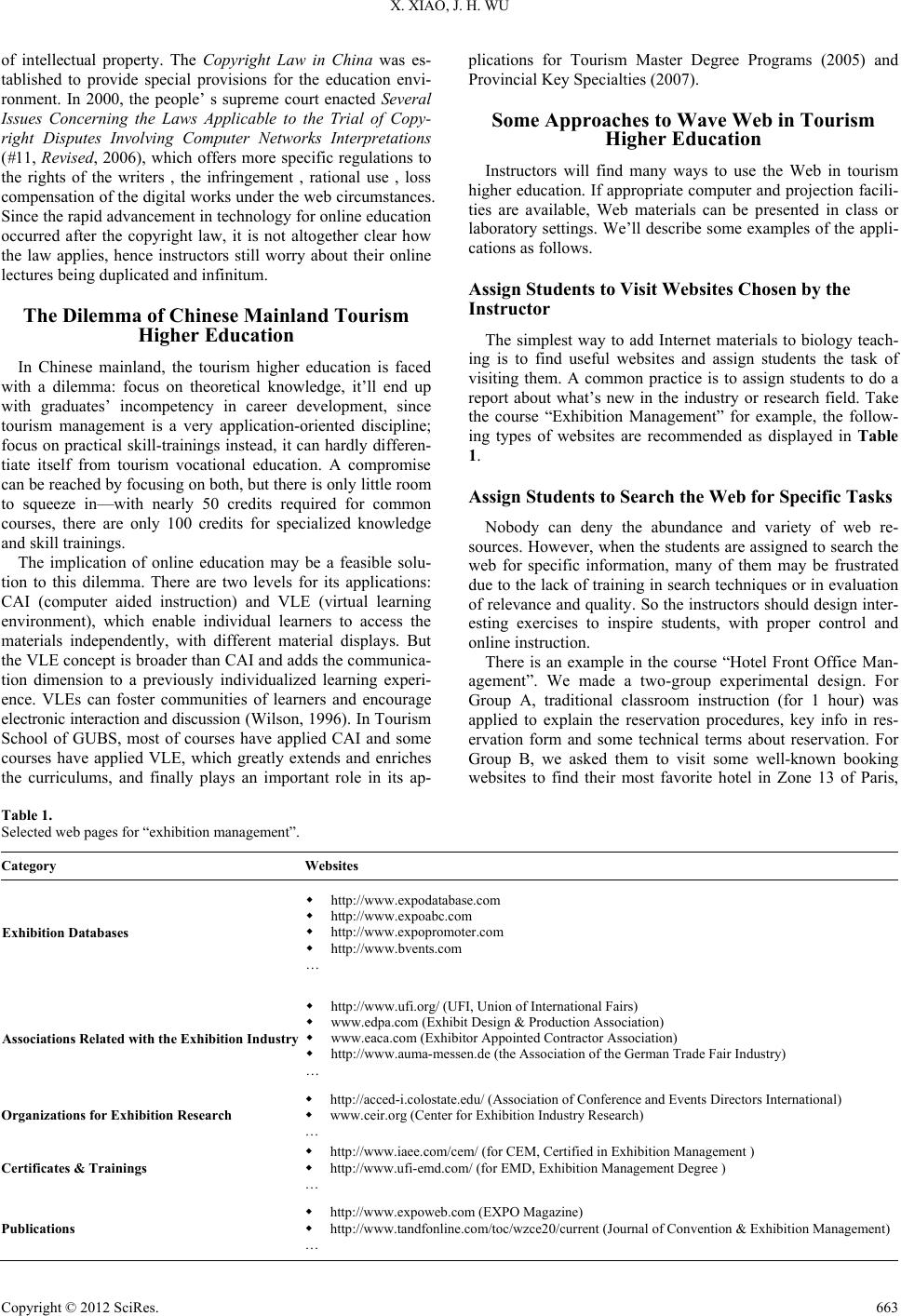 X. XIAO, J. H. WU of intellectual property. The Copyright Law in China was es- tablished to provide special provisions for the education envi- ronment. In 2000, the people’ s supreme court enacted Several Issues Concerning the Laws Applicable to the Trial of Copy- right Disputes Involving Computer Networks Interpretations (#11, Revised, 2006), which offers more specific regulations to the rights of the writers , the infringement , rational use , loss compensation of the digital works under the web circumstances. Since the rapid advancement in technology for online education occurred after the copyright law, it is not altogether clear how the law applies, hence instructors still worry about their online lectures being duplicated and infinitum. The Dilemma of Chinese Mainland Tourism Higher Education In Chinese mainland, the tourism higher education is faced with a dilemma: focus on theoretical knowledge, it’ll end up with graduates’ incompetency in career development, since tourism management is a very application-oriented discipline; focus on practical skill-trainings instead, it can hardly differen- tiate itself from tourism vocational education. A compromise can be reached by focusing on both, but there is only little room to squeeze in—with nearly 50 credits required for common courses, there are only 100 credits for specialized knowledge and skill trainings. The implication of online education may be a feasible solu- tion to this dilemma. There are two levels for its applications: CAI (computer aided instruction) and VLE (virtual learning environment), which enable individual learners to access the materials independently, with different material displays. But the VLE concept is broader than CAI and adds the communica- tion dimension to a previously individualized learning experi- ence. VLEs can foster communities of learners and encourage electronic interaction and discussion (Wilson, 1996). In Tourism School of GUBS, most of courses have applied CAI and some courses have applied VLE, which greatly extends and enriches the curriculums, and finally plays an important role in its ap- plications for Tourism Master Degree Programs (2005) and Provincial Key Specialties (2007). Some Approaches to Wave Web in Tourism Higher Education Instructors will find many ways to use the Web in tourism higher education. If appropriate computer and projection facili- ties are available, Web materials can be presented in class or laboratory settings. We’ll describe some examples of the appli- cations as follows. Assign Students to Visit Websites Chosen by the Instructor The simplest way to add Internet materials to biology teach- ing is to find useful websites and assign students the task of visiting them. A common practice is to assign students to do a report about what’s new in the industry or research field. Take the course “Exhibition Management” for example, the follow- ing types of websites are recommended as displayed in Table 1. Assign Students to Search the Web for Specific Tasks Nobody can deny the abundance and variety of web re- sources. However, when the students are assigned to search the web for specific information, many of them may be frustrated due to the lack of training in search techniques or in evaluation of relevance and quality. So the instructors should design inter- esting exercises to inspire students, with proper control and online instruction. There is an example in the course “Hotel Front Office Man- agement”. We made a two-group experimental design. For Group A, traditional classroom instruction (for 1 hour) was applied to explain the reservation procedures, key info in res- ervation form and some technical terms about reservation. For Group B, we asked them to visit some well-known booking websites to find their most favorite hotel in Zone 13 of Paris, Table 1. Selected web pages for “exhibition management”. Category Websites Exhibition Databases http://www.expodatabase.com http://www.expoabc.com http://www.expopromoter.com http://www.bvents.com … Associatio n s Related with the Exhib ition Industry http://www.ufi.org/ (UFI, Union of International Fairs) www.edpa.com (Exhibit Design & Production Associat ion) www.eaca.com (Exhibitor Appointed Cont ractor Association) http://www.auma-messen.de (the Association of the German Trade Fair Industry) … Organizatio ns for Exhibiti on Research http:// acced-i.co lostate.edu / (Association of Conference and Events Directors International) www.ceir.org (Center for Exhibition Industry Research) … Certificates & Trainings http:// www.iaee.com/c em/ (for CEM, Certified in Exhibition Management ) http://www.ufi-emd.com/ (for EMD, Exhibition Manage ment Degree ) … Publications http://www.expoweb.com (EXPO Magazine) http://www.tandfonline.com/toc/wzce20/current (Journal of Convention & Exhibition Management) … Copyright © 2012 SciRe s . 663  X. XIAO, J. H. WU with a budget of 80 euro per room per night (for 30 min); and later, we asked them to present their options (6 min) and dis- cuss about reservation procedures (7 min), key info in reserva- tion form (7 min), followed by a quiz of technical terms about reservation (10 min). Although only slight difference could be observed in a test right after the instruction for these two groups, another test 3 months later indicated that Group B had greater outcome—the average mark was 8.42 points over the compari- son group. Creating the Instructor’s Own Course Material Database Take “Development and Management of Tourism Resources” for example. The course material database is designed as dis- played in Table 2. Other Applications Offered by Blackboard System The Blackboard System also offers some tools to facilitate teaching, such as Instructor’s Lecture Notes, Announcement Page, Discussion Room, Quizzes/Exams, and Excellent Student Work, etc. Surveys on Waving Web in Tourism Higher Education—Based on surveys We designed surveys on the students’ reaction and KSFs (key successful factors) for online implementation of tourism higher education. Sample Profile The anonymous questionnaire was given to 748 students (three graders in Tourism School of GUBS), and got 674 re- sponses (response rate 90.11%). The sample profile is shown in Table 3. Students’ Reac tions to the Web-Enhanced Course The investigators surveyed students before the midterm and before the final exam. The result is displayed in Figure 1. The test-retest reliability coefficient is greater than 0.85, quite satis- factory. KSFs for Online Implementation The investigator firstly initiated in-depth interviews (with open options) to decide the factors, and then asked all students to give their percentage weight (on importance) and score the performance of Tourism School in the survey. The outcome (mean) is displayed in Table 4. Here “Course Development” means the attractiveness of course, without consideration of online or traditional way of instruction. This factor ranks first (38.54%) in the five KSFs, which indicates the performance of online education highly depends on the quality of course development. “Technology Support” is also important (27.63%), which can be represented by quantified indexes such as invested amount, Internet connection speed, etc. The School’s performance was not very good (43.57 pints out of 100 points), which indicates Table 3. Sample Profile of the Survey. Cohort Male Female Subtotal Y2009 103 112 215 Y2010 107 117 224 Y2011 117 118 235 Subtotal 327 347 674 Figure 1. Students’ reactions to the web-based course. Table 2. Course material dat aba se for “development and management of tourism resources”. Category Remarks Tourism resources2 A. Geologic landscape B. Water scene C. Biology D. Astronomical phenomena & climate E. Historic heritage F. Architecture & facil ities G. Tourist Goods H. Socio-cultural Activities Pictures, videos and PPT of various tourism resources, with a total size of over 3.5 GB. Case study in development e.g. Tourism p lanning of Qingxin County in Guang Dong (written by the instruct o r ) Case study in management e.g. Experience and lesson in the management of Lechan g Eco-tourism Attraction (written by t he instructor) Professional literature Over 200 art i cles 2The classification of tourism resources is made according to Classification, Investigation and Evaluation of Tourism Resources (GB/T 18972 — 2003 ) . Copyright © 2012 SciRe s . 664  X. XIAO, J. H. WU Table 4. A survey on KSFs of online implementation. KSF Percentage Weights of ImportancePerformance of Tourism School Weighted Scores Course Development 38.54% 82.66 31.86 Technology Support 27.63% 43.57 12.04 Instructor Accessibility 20.08% 63.08 12.67 Instructor Preparation 8.43% 77.56 6.54 Course Monitor ing 5.32% 42.08 2.24 Total 100% - 65.34 that there is still much room for improvement. For instance, the Internet connection is rather unstable, and the speed is under 1 M, too slow to download large files. The third most important factor is “Instructor Accessibility” (20.08%), which indicates teachers may have to devote more time, including late evenings and weekends, to interacting with students. Actually, online education may demand more working hours, since the teachers are supposed to check the system now and then, reply students’ questions and so on. These working hours are usually ignored by the School administrative office. “Instructor Preparation” means “how well are the instructors trained and prepared”, which may also be represented by quan- tified indexes such as orientation programs offered to teachers, compensation for each web-based or web-enhanced course, teachers’ scores in Internet knowledge and skills tests, etc. It is worthwhile to note that many teachers are concerned that once online their lectures could be duplicated ad infinitum, which greatly diminish their enthusiasm in course development. The orientation program and follow-up technical support may re- duce such worry though. “Course Monitoring” means teachers’ control and evaluation on students’ performance all through the web-based or web- enhanced courses, which are also concerned by the interview- ees (5.32%); the poor score (42.08 pints out of 100 points) of the School indicates that the monitoring system should be im- proved. More and more faculty is using Web to supplement and en- rich course content. Hundreds of universities are launching big programs and urging faculty to establish their courses on the Web and provide resources to support this requirement. How- ever, no matter what evolutions may occur in forms and chan- nels of knowledge transmission, the faculty remains the critical link in such programs; without their commitment, no programs can achieve objectives despite advanced media of knowledge transmission. REFERENCES Alavi, M. (1994). Computer-mediated collaborative learning: An em- pirical evaluation. MIS Quarterly, 18, 159-174. Alavi, M., Wheeler, B. C., & Vlacich, J. S. (1995). Using IT to re- engineer business education: An exploratory investigation of col- la- borative telelearning. MIS Quarterly, 1 9, 293-312. Ahmad, R., & Piccoli, G. (1998). Virtual learning environments: An information technology basic skills course on the Web. Proceedings of the 4th American Conference on Information Systems, Baltimore, 14-16. Bailey, E. K., & Cotlar, M. (1994). Teaching via the Internet. Commu- nication Education, 43, 184-193. doi:10.1080/03634529409378975 Clark, R. E. (1994). Media will never influence learning. Educational Technology Research and Development, 42, 21-29. Cooper, L. W. (2001). A co mparison of online and traditional computer applications classes. Journal of Industrial Te c h n o lo g y , 28, 52-58. Lander, S. E., Corkill, D. D., & Staley, S. M. (1996). Designing inte- grated engineering environments: Blackboard-based integration of design and analysis tools. Concurrent E ng in e er in g , 4, 59-71. Lieblein, E. (2000). Critical factors for successful delivery of online programs. Internet and Higher Education, 3, 161-174. doi:10.1016/S1096-7516(01)00036-7 Pan, Y. L. et al. (2012). A study on the paradigms of quality manage- ment in China’s distance education. Fudan Education Forum, 10, 76-81. Piccoli, G., Ahmad, R., & Ives, B. (2001). Web-based virtual learning environments: A research framework and a preliminary assessment of effectiveness in basic IT skills training. MIS Quarterly, 25, 401- 426. doi:10.2307/3250989 Copyright © 2012 SciRe s . 665 |