

Paper Menu >>
Journal Menu >>
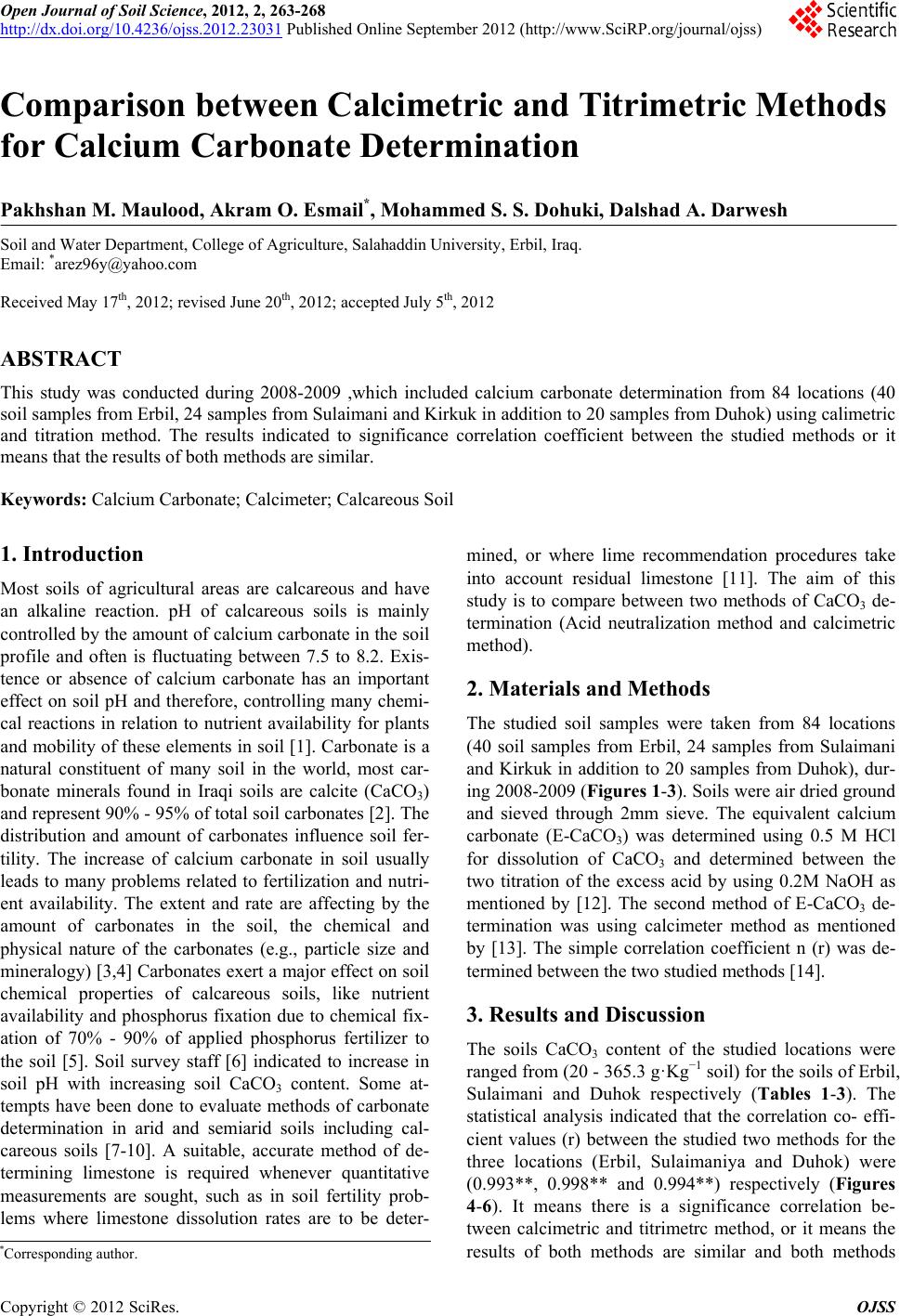 Open Journal of Soil Science, 2012, 2, 263-268 http://dx.doi.org/10.4236/ojss.2012.23031 Published Online September 2012 (http://www.SciRP.org/journal/ojss) 263 Comparison between Calcimetric and Titrimetric Methods for Calcium Carbonate Determination Pakhshan M. Maulood, Akram O. Esmail*, Mohammed S. S. Dohuki, Dalshad A. Darwesh Soil and Water Department, College of Agriculture, Salahaddin University, Erbil, Iraq. Email: *[email protected] Received May 17th, 2012; revised June 20th, 2012; accepted July 5th, 2012 ABSTRACT This study was conducted during 2008-2009 ,which included calcium carbonate determination from 84 locations (40 soil samples from Erbil, 24 samples from Sulaimani and Kirkuk in addition to 20 samples from Duhok) using calimetric and titration method. The results indicated to significance correlation coefficient between the studied methods or it means that the results of both methods are similar. Keywords: Calcium Carbonate; Calcimeter; Calcareous Soil 1. Introduction Most soils of agricultural areas are calcareous and have an alkaline reaction. pH of calcareous soils is mainly controlled by the amount of calcium carbonate in the soil profile and often is fluctuating between 7.5 to 8.2. Exis- tence or absence of calcium carbonate has an important effect on soil pH and therefore, controlling many chemi- cal reactions in relation to nutrient availability for plants and mobility of these elements in soil [1]. Carbonate is a natural constituent of many soil in the world, most car- bonate minerals found in Iraqi soils are calcite (CaCO3) and represent 90% - 95% of total soil carbonates [2]. The distribution and amount of carbonates influence soil fer- tility. The increase of calcium carbonate in soil usually leads to many problems related to fertilization and nutri- ent availability. The extent and rate are affecting by the amount of carbonates in the soil, the chemical and physical nature of the carbonates (e.g., particle size and mineralogy) [3,4] Carbonates exert a major effect on soil chemical properties of calcareous soils, like nutrient availability and phosphorus fixation due to chemical fix- ation of 70% - 90% of applied phosphorus fertilizer to the soil [5]. Soil survey staff [6] indicated to increase in soil pH with increasing soil CaCO3 content. Some at- tempts have been done to evaluate methods of carbonate determination in arid and semiarid soils including cal- careous soils [7-10]. A suitable, accurate method of de- termining limestone is required whenever quantitative measurements are sought, such as in soil fertility prob- lems where limestone dissolution rates are to be deter- mined, or where lime recommendation procedures take into account residual limestone [11]. The aim of this study is to compare between two methods of CaCO3 de- termination (Acid neutralization method and calcimetric method). 2. Materials and Methods The studied soil samples were taken from 84 locations (40 soil samples from Erbil, 24 samples from Sulaimani and Kirkuk in addition to 20 samples from Duhok), dur- ing 2008-2009 (Figures 1-3). Soils were air dried ground and sieved through 2mm sieve. The equivalent calcium carbonate (E-CaCO3) was determined using 0.5 M HCl for dissolution of CaCO3 and determined between the two titration of the excess acid by using 0.2M NaOH as mentioned by [12]. The second method of E-CaCO3 de- termination was using calcimeter method as mentioned by [13]. The simple correlation coefficient n (r) was de- termined between the two studied methods [14]. 3. Results and Discussion The soils CaCO3 content of the studied locations were ranged from (20 - 365.3 g·Kg−1 soil) for the soils of Erbil, Sulaimani and Duhok respectively (Tables 1-3). The statistical analysis indicated that the correlation co- effi- cient values (r) between the studied two methods for the three locations (Erbil, Sulaimaniya and Duhok) were (0.993**, 0.998** and 0.994**) respectively (Figures 4-6). It means there is a significance correlation be- tween calcimetric and titrimetrc method, or it means the results of both methods are similar and both methods *Corresponding author. Copyright © 2012 SciRes. OJSS 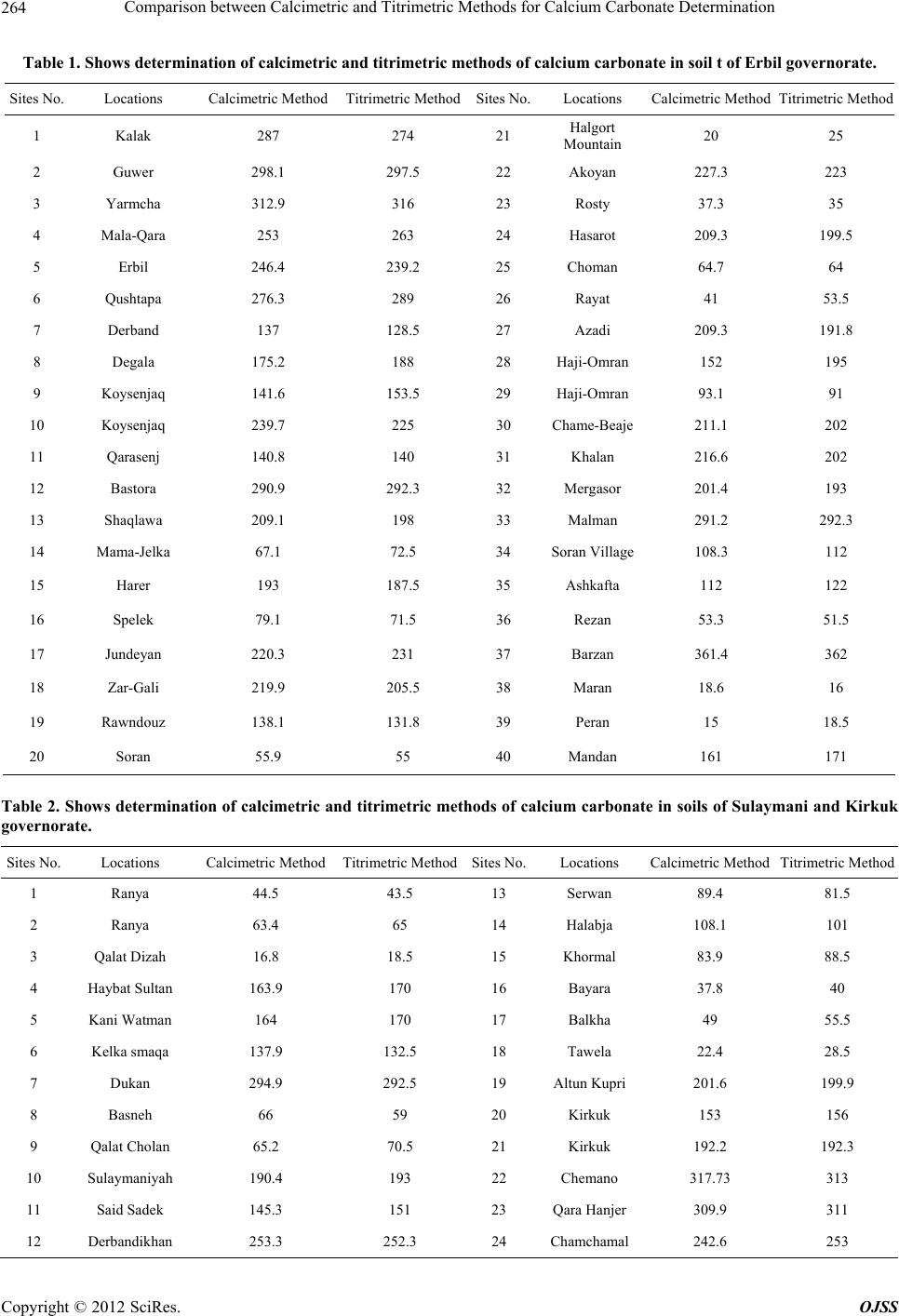 Comparison between Calcimetric and Titrimetric Methods for Calcium Carbonate Determination 264 Table 1. Shows determination of calcimetric and titrimetric methods of calcium carbonate in soil t of Erbil governorate. Sites No. Locations Calcimetric Method Titrimetric MethodSites No.Locations Calcimetric Method Titrimetric Method 1 Kalak 287 274 21 Halgort Mountain 20 25 2 Guwer 298.1 297.5 22 Akoyan 227.3 223 3 Yarmcha 312.9 316 23 Rosty 37.3 35 4 Mala-Qara 253 263 24 Hasarot 209.3 199.5 5 Erbil 246.4 239.2 25 Choman 64.7 64 6 Qushtapa 276.3 289 26 Rayat 41 53.5 7 Derband 137 128.5 27 Azadi 209.3 191.8 8 Degala 175.2 188 28 Haji-Omran 152 195 9 Koysenjaq 141.6 153.5 29 Haji-Omran 93.1 91 10 Koysenjaq 239.7 225 30 Chame-Beaje211.1 202 11 Qarasenj 140.8 140 31 Khalan 216.6 202 12 Bastora 290.9 292.3 32 Mergasor 201.4 193 13 Shaqlawa 209.1 198 33 Malman 291.2 292.3 14 Mama-Jelka 67.1 72.5 34 Soran Village108.3 112 15 Harer 193 187.5 35 Ashkafta 112 122 16 Spelek 79.1 71.5 36 Rezan 53.3 51.5 17 Jundeyan 220.3 231 37 Barzan 361.4 362 18 Zar-Gali 219.9 205.5 38 Maran 18.6 16 19 Rawndouz 138.1 131.8 39 Peran 15 18.5 20 Soran 55.9 55 40 Mandan 161 171 Table 2. Shows determination of calcimetric and titrimetric methods of calcium carbonate in soils of Sulaymani and Kirkuk governorate. Sites No. Locations Calcimetric Method Titrimetric MethodSites No.Locations Calcimetric Method Titrimetric Method 1 Ranya 44.5 43.5 13 Serwan 89.4 81.5 2 Ranya 63.4 65 14 Halabja 108.1 101 3 Qalat Dizah 16.8 18.5 15 Khormal 83.9 88.5 4 Haybat Sultan 163.9 170 16 Bayara 37.8 40 5 Kani Watman 164 170 17 Balkha 49 55.5 6 Kelka smaqa 137.9 132.5 18 Tawela 22.4 28.5 7 Dukan 294.9 292.5 19 Altun Kupri 201.6 199.9 8 Basneh 66 59 20 Kirkuk 153 156 9 Qalat Cholan 65.2 70.5 21 Kirkuk 192.2 192.3 10 Sulaymaniyah 190.4 193 22 Chemano 317.73 313 11 Said Sadek 145.3 151 23 Qara Hanjer 309.9 311 12 Derbandikhan 253.3 252.3 24 Chamchamal 242.6 253 Copyright © 2012 SciRes. OJSS 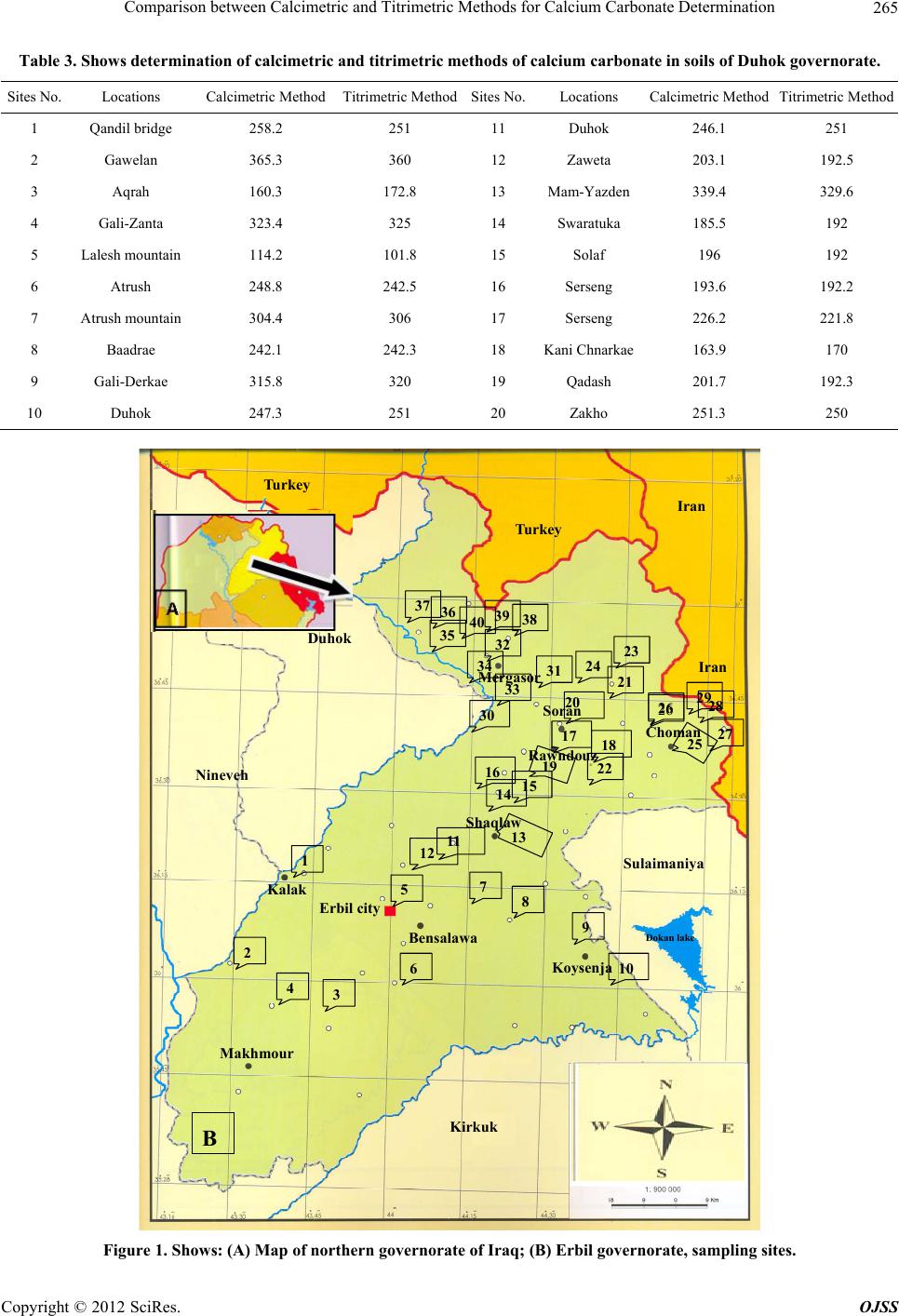 Comparison between Calcimetric and Titrimetric Methods for Calcium Carbonate Determination 265 Table 3. Shows determination of calcimetric and titrimetric methods of calcium carbonate in soils of Duhok governorate. Sites No. Locations Calcimetric Method Titrimetric MethodSites No.Locations Calcimetric Method Titrimetric Method 1 Qandil bridge 258.2 251 11 Duhok 246.1 251 2 Gawelan 365.3 360 12 Zaweta 203.1 192.5 3 Aqrah 160.3 172.8 13 Mam-Yazden339.4 329.6 4 Gali-Zanta 323.4 325 14 Swaratuka 185.5 192 5 Lalesh mountain 114.2 101.8 15 Solaf 196 192 6 Atrush 248.8 242.5 16 Serseng 193.6 192.2 7 Atrush mountain 304.4 306 17 Serseng 226.2 221.8 8 Baadrae 242.1 242.3 18 Kani Chnarkae163.9 170 9 Gali-Derkae 315.8 320 19 Qadash 201.7 192.3 10 Duhok 247.3 251 20 Zakho 251.3 250 Turke y Iran Iran Duhok Nineveh Sulaimani y a Dokan lake Erbil city Ko y sen j a Mergasor Shaqlaw Choman Makhmour Rawndouz Soran Bensalawa Turke y Kirkuk B 2 1 Kalak 4 3 6 578 9 10 12 11 13 14 16 15 19 17 18 20 30 37 36 35 32 40 39 38 34 33 31 24 23 21 26 25 27 28 29 26 22 Figure 1. Shows: (A) Map of northern governorate of Iraq; (B) Erbil governorate, sampling sites. Copyright © 2012 SciRes. OJSS 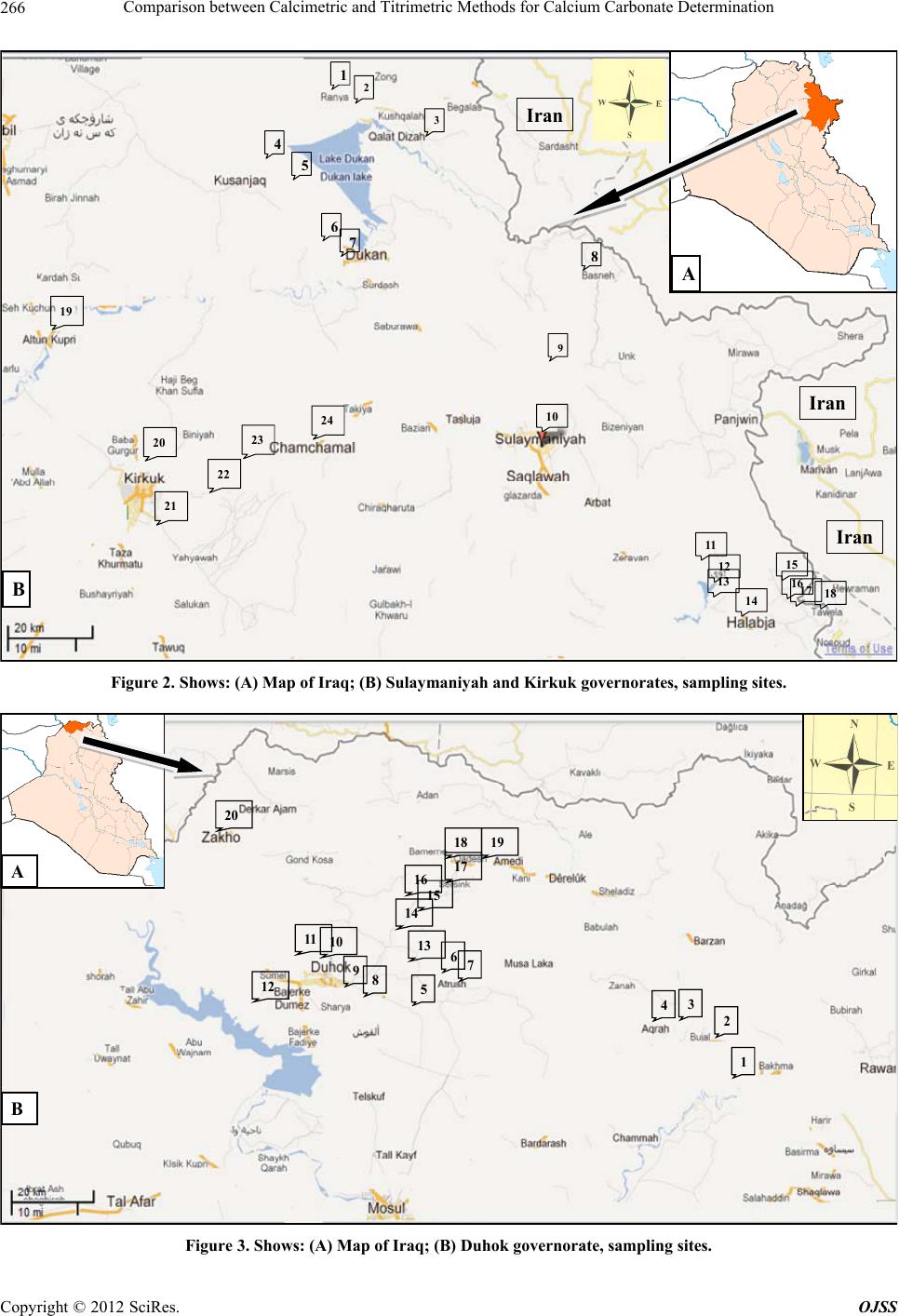 Comparison between Calcimetric and Titrimetric Methods for Calcium Carbonate Determination 266 A B 1 2 3 4 5 6 7 8 9 11 10 12 13 14 15 16 18 17 Iran Iran Iran 19 20 21 22 23 24 Figure 2. Shows: (A) Map of Iraq; (B) Sulaymaniyah and Kirkuk governorates, sampling sites. A B 1 2 3 4 6 5 7 8 9 10 11 12 13 14 15 16 17 18 19 20 Figure 3. Shows: (A) Map of Iraq; (B) Duhok governorate, sampling sites. Copyright © 2012 SciRes. OJSS 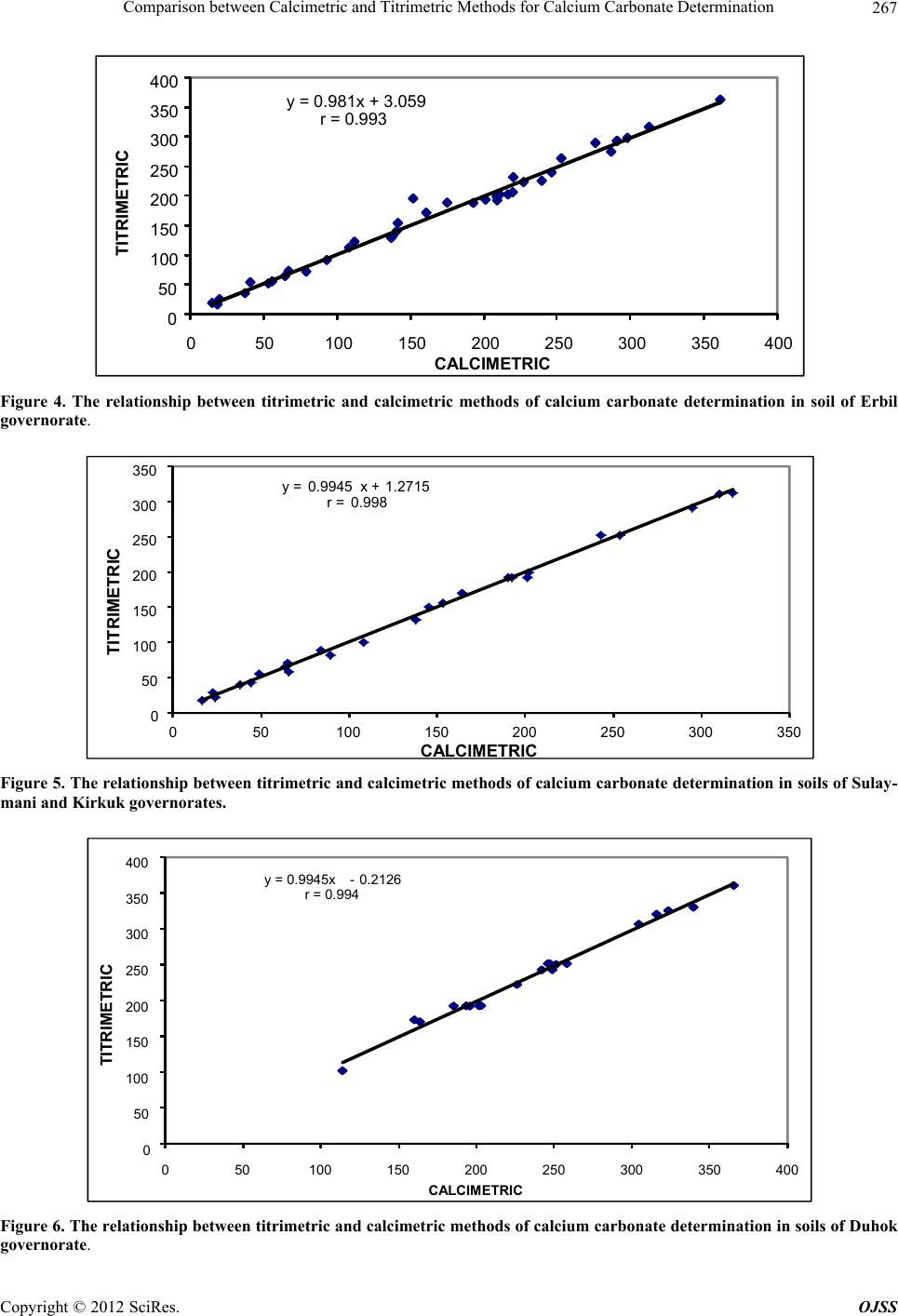 Comparison between Calcimetric and Titrimetric Methods for Calcium Carbonate Determination 267 y = 0.981x + 3.059 r = 0.993 0 50 100 150 200 250 300 350 400 0 50 100 150200 250300 350 400 CALCIMETRIC TITRIMETRIC Figure 4. The relationship between titrimetric and calcimetric methods of calcium carbonate determination in soil of Erbil governorate. y = 0.9945x + 1.2715 r = 0.998 0 50 100 150 200 250 300 350 0 50 100 150 200 250 300 350 CALCIMETRIC TITRIMETRIC Figure 5. The relationship between titrimetric and calcimetric methods of calcium carbonate determination in soils of Sulay- mani and Kirkuk governorates. y = 0.9945x -0.2126 r = 0.994 0 50 100 150 200 250 300 350 400 0 50 100 150 200 250 300 350 400 CALCIMETRIC TITRI ME TR IC Figure 6. The relationship between titrimetric and calcimetric methods of calcium carbonate determination in soils of Duhok governorate. Copyright © 2012 SciRes. OJSS 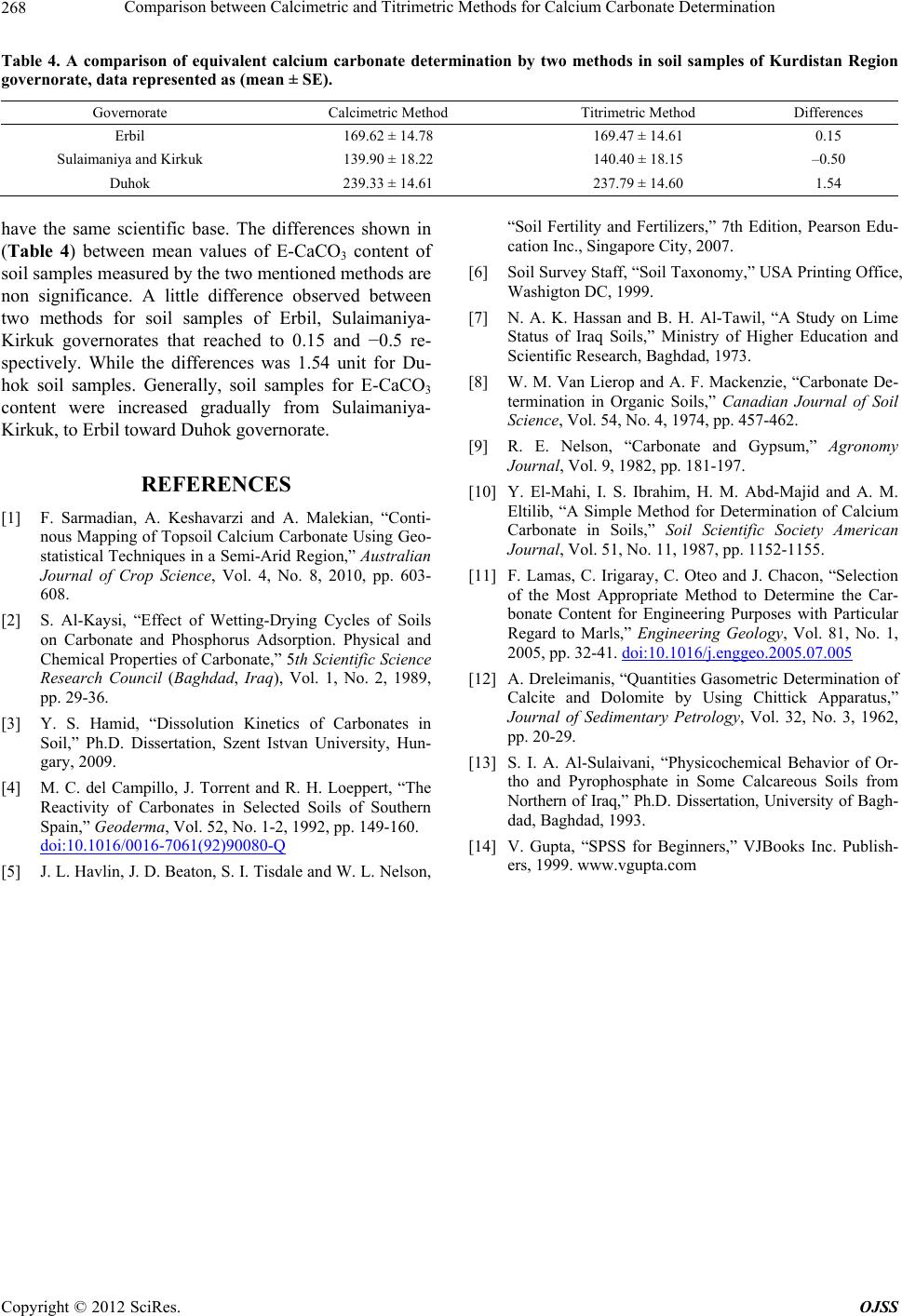 Comparison between Calcimetric and Titrimetric Methods for Calcium Carbonate Determination Copyright © 2012 SciRes. OJSS 268 Table 4. A comparison of equivalent calcium carbonate determination by two methods in soil samples of Kurdistan Region governorate, data represented as (mean ± SE). Governorate Calcimetric Method Titrimetric Method Differences Erbil 169.62 ± 14.78 169.47 ± 14.61 0.15 Sulaimaniya and Kirkuk 139.90 ± 18.22 140.40 ± 18.15 –0.50 Duhok 239.33 ± 14.61 237.79 ± 14.60 1.54 have the same scientific base. The differences shown in (Table 4) between mean values of E-CaCO3 content of soil samples measured by the two mentioned methods are non significance. A little difference observed between two methods for soil samples of Erbil, Sulaimaniya- Kirkuk governorates that reached to 0.15 and −0.5 re- spectively. While the differences was 1.54 unit for Du- hok soil samples. Generally, soil samples for E-CaCO3 content were increased gradually from Sulaimaniya- Kirkuk, to Erbil toward Duhok governorate. REFERENCES [1] F. Sarmadian, A. Keshavarzi and A. Malekian, “Conti- nous Mapping of Topsoil Calcium Carbonate Using Geo- statistical Techniques in a Semi-Arid Region,” Australian Journal of Crop Science, Vol. 4, No. 8, 2010, pp. 603- 608. [2] S. Al-Kaysi, “Effect of Wetting-Drying Cycles of Soils on Carbonate and Phosphorus Adsorption. Physical and Chemical Properties of Carbonate,” 5th Scientific Science Research Council (Baghdad, Iraq), Vol. 1, No. 2, 1989, pp. 29-36. [3] Y. S. Hamid, “Dissolution Kinetics of Carbonates in Soil,” Ph.D. Dissertation, Szent Istvan University, Hun- gary, 2009. [4] M. C. del Campillo, J. Torrent and R. H. Loeppert, “The Reactivity of Carbonates in Selected Soils of Southern Spain,” Geoderma, Vol. 52, No. 1-2, 1992, pp. 149-160. doi:10.1016/0016-7061(92)90080-Q [5] J. L. Havlin, J. D. Beaton, S. I. Tisdale and W. L. Nelson, “Soil Fertility and Fertilizers,” 7th Edition, Pearson Edu- cation Inc., Singapore City, 2007. [6] Soil Survey Staff, “Soil Taxonomy,” USA Printing Office, Washigton DC, 1999. [7] N. A. K. Hassan and B. H. Al-Tawil, “A Study on Lime Status of Iraq Soils,” Ministry of Higher Education and Scientific Research, Baghdad, 1973. [8] W. M. Van Lierop and A. F. Mackenzie, “Carbonate De- termination in Organic Soils,” Canadian Journal of Soil Science, Vol. 54, No. 4, 1974, pp. 457-462. [9] R. E. Nelson, “Carbonate and Gypsum,” Agronomy Journal, Vol. 9, 1982, pp. 181-197. [10] Y. El-Mahi, I. S. Ibrahim, H. M. Abd-Majid and A. M. Eltilib, “A Simple Method for Determination of Calcium Carbonate in Soils,” Soil Scientific Society American Journal, Vol. 51, No. 11, 1987, pp. 1152-1155. [11] F. Lamas, C. Irigaray, C. Oteo and J. Chacon, “Selection of the Most Appropriate Method to Determine the Car- bonate Content for Engineering Purposes with Particular Regard to Marls,” Engineering Geology, Vol. 81, No. 1, 2005, pp. 32-41. doi:10.1016/j.enggeo.2005.07.005 [12] A. Dreleimanis, “Quantities Gasometric Determination of Calcite and Dolomite by Using Chittick Apparatus,” Journal of Sedimentary Petrology, Vol. 32, No. 3, 1962, pp. 20-29. [13] S. I. A. Al-Sulaivani, “Physicochemical Behavior of Or- tho and Pyrophosphate in Some Calcareous Soils from Northern of Iraq,” Ph.D. Dissertation, University of Bagh- dad, Baghdad, 1993. [14] V. Gupta, “SPSS for Beginners,” VJBooks Inc. Publish- ers, 1999. www.vgupta.com |