

Paper Menu >>
Journal Menu >>
 American Journal of Plant Sciences, 2012, 3, 1219-1224 http://dx.doi.org/10.4236/ajps.2012.39147 Published Online September 2012 (http://www.SciRP.org/journal/ajps) 1219 Establishment and Growth of Potato Micro-Cuttings in Sand Trays Md. Jahangir Hossain1, Mosammat Shamsun Nahar1,2 1Research Wing, Bangladesh Agricultural Research Institute, Joydebpur, Bangladesh; 2Plant Pathology Section, Horticulture Re- search Center, Bangladesh Agricultural Research Institute, Joydebpur, Bangladesh. Email: [email protected] Received February 8th, 2012; revised March 16th, 2012; accepted April 19th, 2012 ABSTRACT Two separate experiments were conducted to evaluate the success of the establishment and growth of micro-cuttings of potato (5 - 6 cm tall) in sand trays [38 cm (L) × 28 cm (W) × 7.5 cm (H) plastic trays] under controlled environment (22˚C ± 2˚C, 60 - 75 μmo sm –1·s–1 light energy for 16 h daily). In the first experiment, micro-cuttings of potato cv. Dia- mant were planted at six populations (500, 600, 700, 800, 900 and 1000 cuttings per tray) in treated sand (sun dry, 1% formaldehyde, 0.2% Dithane M-45 and control). The mortality percentage of micro-cuttings was nil for sun dry sand while formaldehyde and dithane M-45 treated sand had 1% - 4% against 15% in the control with the highest population density. Mortality of micro-cuttings in formaldehyde and dithane M-45 treated sand trays were found not to be related to pathogenic organism rather toxic effect of these two chemicals. Micro-cuttings in Sun dry and control treatments showed better growth performance than these in chemically treated sand trays. In the second experiment, urea @ 1, 2 and 3 g per tray was applied as solid form after 15 days of planting the micro-cuttings and as liquid form @ 0.5, 1 and 2% solution sprayed in the micro-cuttings repeatedly after 15, 30, 45 and 60 days of planting. The micro-cuttings which received urea as solid state died within 2 - 3 days and 2% urea solution was also detrimental. Urea solution @ 0.5% found to be very effective for vegetative growth of micro-cuttings in sand trays. The control was also good for vegeta- tive growth but at a slower rate. Keywords: Sand Tray; Sun Dry; Fungicides; Urea Fertilizer; Plant Population; Growth; Potato Micro-Cuttings 1. Introduction Potato is an important food crop worldwide. It is mainly a temperate zone crop, though it is cultivated in many tropical countries during the winter season. It is reported that potato seed accounts for >50% of the total cost of production [1-3]. Moreover, better seed can produce bet- ter crop and higher yield. Availability of quality seed tubers is the important factor for better crop and tuber yield. Potato crop is prone to about 50 diseases [4-6], of which about 8 - 10 are major diseases though others caused considerable losses of this crop [7]. The fungal and bacterial diseases could be controlled or minimize by applying chemicals while viruses or viroids diseases are uncontrollable. Once a plant is infected by virus or viroid, it carried over generations through seed tubers and caused degeneration of this crop and yield loss. Many countries of the world are trying to use different planting materials as seeds for producing quality seed potatoes [8-11]. Production of nucleus seed stock with in vitro micro-plant is prime important as this material is patho- gen-tested (P.T.). The different planting materials like top shoot cutting [9,12,13], nodal cuttings [9,14], sprout cuttings [15] are used to increase the nucleus seed stock within the shortest period. Ewing [16] used “slips” in vermiculite to produce pathogen-tested minitubers, while Vietnamese farmers used pathogen tested micro-plants followed by repeated cuttings in Delat region in order to develop the low cost planting materials to be used in plains for seed potato production [17]. Commercial tissue culture laboratories rather used to propagate planting materials under ex vitro conditions under controlled en- vironment in order to save energy, money, chemicals, etc. The present work was aimed to standardize the methods for better establishment and growth of micro-cuttings of potato in sand trays under controlled environment. 2. Materials and Methods Micro-cuttings of three Dutch potato cultivars Cardinal, Diamant and Multa were used in two separate experi- ments to standardize the methods for better establishment and growth in sand trays under controlled environment during 2006 and 2007. Copyright © 2012 SciRes. AJPS 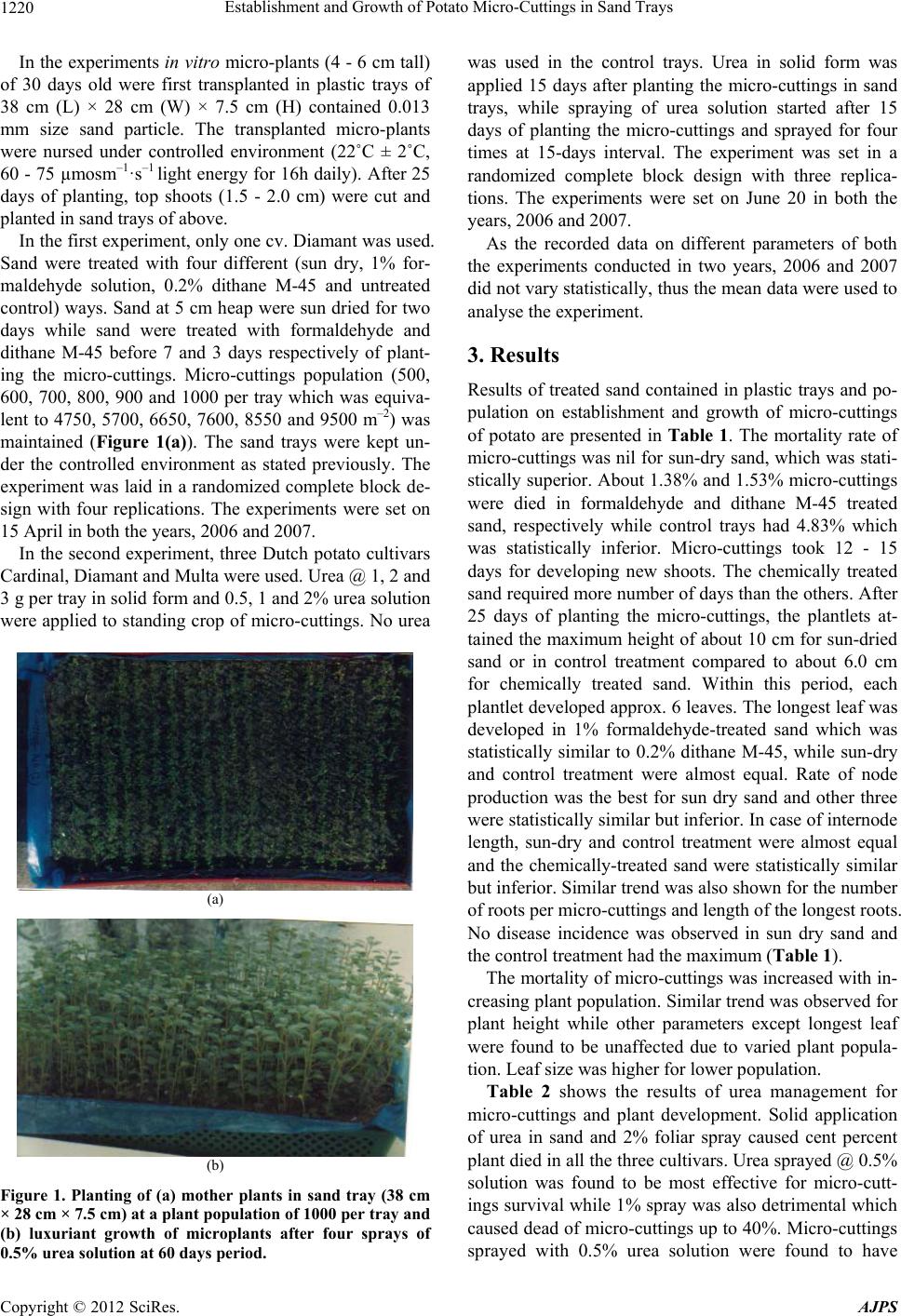 Establishment and Growth of Potato Micro-Cuttings in Sand Trays 1220 In the experiments in vitro micro-plants (4 - 6 cm tall) of 30 days old were first transplanted in plastic trays of 38 cm (L) × 28 cm (W) × 7.5 cm (H) contained 0.013 mm size sand particle. The transplanted micro-plants were nursed under controlled environment (22˚C ± 2˚C, 60 - 75 µmosm–1·s–1 light energy for 16h daily). After 25 days of planting, top shoots (1.5 - 2.0 cm) were cut and planted in sand trays of above. In the first experiment, only one cv. Diamant was used. Sand were treated with four different (sun dry, 1% for- maldehyde solution, 0.2% dithane M-45 and untreated control) ways. Sand at 5 cm heap were sun dried for two days while sand were treated with formaldehyde and dithane M-45 before 7 and 3 days respectively of plant- ing the micro-cuttings. Micro-cuttings population (500, 600, 700, 800, 900 and 1000 per tray which was equiva- lent to 4750, 5700, 6650, 7600, 8550 and 9500 m–2) was maintained (Figure 1(a)). The sand trays were kept un- der the controlled environment as stated previously. The experiment was laid in a randomized complete block de- sign with four replications. The experiments were set on 15 April in both the years, 2006 and 2007. In the second experiment, three Dutch potato cultivars Cardinal, Diamant and Multa were used. Urea @ 1, 2 and 3 g per tray in solid form and 0.5, 1 and 2% urea solution were applied to standing crop of micro-cuttings. No urea (a) (b) Figure 1. Planting of (a) mother plants in sand tray (38 cm × 28 cm × 7.5 cm) at a plant population of 1000 per tray and (b) luxuriant growth of microplants after four sprays of 0.5% urea solution at 60 days period. was used in the control trays. Urea in solid form was applied 15 days after planting the micro-cuttings in sand trays, while spraying of urea solution started after 15 days of planting the micro-cuttings and sprayed for four times at 15-days interval. The experiment was set in a randomized complete block design with three replica- tions. The experiments were set on June 20 in both the years, 2006 and 2007. As the recorded data on different parameters of both the experiments conducted in two years, 2006 and 2007 did not vary statistically, thus the mean data were used to analyse the experiment. 3. Results Results of treated sand contained in plastic trays and po- pulation on establishment and growth of micro-cuttings of potato are presented in Table 1. The mortality rate of micro-cuttings was nil for sun-dry sand, which was stati- stically superior. About 1.38% and 1.53% micro-cuttings were died in formaldehyde and dithane M-45 treated sand, respectively while control trays had 4.83% which was statistically inferior. Micro-cuttings took 12 - 15 days for developing new shoots. The chemically treated sand required more number of days than the others. After 25 days of planting the micro-cuttings, the plantlets at- tained the maximum height of about 10 cm for sun-dried sand or in control treatment compared to about 6.0 cm for chemically treated sand. Within this period, each plantlet developed approx. 6 leaves. The longest leaf was developed in 1% formaldehyde-treated sand which was statistically similar to 0.2% dithane M-45, while sun-dry and control treatment were almost equal. Rate of node production was the best for sun dry sand and other three were statistically similar but inferior. In case of internode length, sun-dry and control treatment were almost equal and the chemically-treated sand were statistically similar but inferior. Similar trend was also shown for the number of roots per micro-cuttings and length of the longest roots. No disease incidence was observed in sun dry sand and the control treatment had the maximum (Table 1). The mortality of micro-cuttings was increased with in- creasing plant population. Similar trend was observed for plant height while other parameters except longest leaf were found to be unaffected due to varied plant popula- tion. Leaf size was higher for lower population. Table 2 shows the results of urea management for micro-cuttings and plant development. Solid application of urea in sand and 2% foliar spray caused cent percent plant died in all the three cultivars. Urea sprayed @ 0.5% solution was found to be most effective for micro-cutt- ings survival while 1% spray was also detrimental which caused dead of micro-cuttings up to 40%. Micro-cuttings sprayed with 0.5% urea solution were found to have Copyright © 2012 SciRes. AJPS 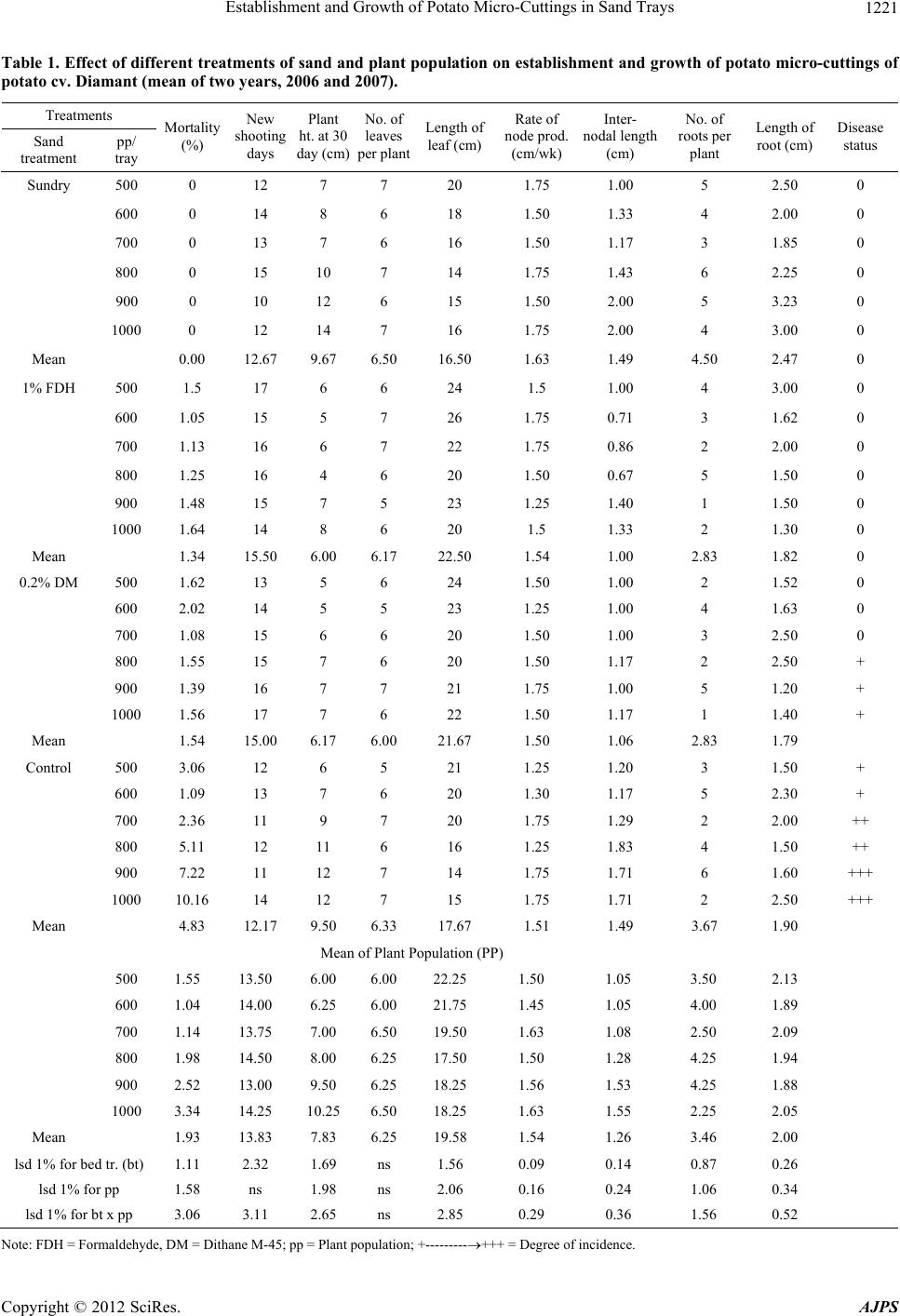 Establishment and Growth of Potato Micro-Cuttings in Sand Trays Copyright © 2012 SciRes. AJPS 1221 Table 1. Effect of different treatments of sand and plant population on establishment and growth of potato micro-cuttings of potato cv. Diamant (mean of two years, 2006 and 2007). Treatments Sand treatment pp/ tray Mortality (%) New shooting days Plant ht. at 30 day (cm) No. of leaves per plant Length of leaf (cm) Rate of node prod. (cm/wk) Inter- nodal length (cm) No. of roots per plant Length of root (cm) Disease status Sundry 500 0 12 7 7 20 1.75 1.00 5 2.50 0 600 0 14 8 6 18 1.50 1.33 4 2.00 0 700 0 13 7 6 16 1.50 1.17 3 1.85 0 800 0 15 10 7 14 1.75 1.43 6 2.25 0 900 0 10 12 6 15 1.50 2.00 5 3.23 0 1000 0 12 14 7 16 1.75 2.00 4 3.00 0 Mean 0.00 12.67 9.67 6.50 16.50 1.63 1.49 4.50 2.47 0 1% FDH 500 1.5 17 6 6 24 1.5 1.00 4 3.00 0 600 1.05 15 5 7 26 1.75 0.71 3 1.62 0 700 1.13 16 6 7 22 1.75 0.86 2 2.00 0 800 1.25 16 4 6 20 1.50 0.67 5 1.50 0 900 1.48 15 7 5 23 1.25 1.40 1 1.50 0 1000 1.64 14 8 6 20 1.5 1.33 2 1.30 0 Mean 1.34 15.50 6.00 6.17 22.50 1.54 1.00 2.83 1.82 0 0.2% DM 500 1.62 13 5 6 24 1.50 1.00 2 1.52 0 600 2.02 14 5 5 23 1.25 1.00 4 1.63 0 700 1.08 15 6 6 20 1.50 1.00 3 2.50 0 800 1.55 15 7 6 20 1.50 1.17 2 2.50 + 900 1.39 16 7 7 21 1.75 1.00 5 1.20 + 1000 1.56 17 7 6 22 1.50 1.17 1 1.40 + Mean 1.54 15.00 6.17 6.00 21.67 1.50 1.06 2.83 1.79 Control 500 3.06 12 6 5 21 1.25 1.20 3 1.50 + 600 1.09 13 7 6 20 1.30 1.17 5 2.30 + 700 2.36 11 9 7 20 1.75 1.29 2 2.00 ++ 800 5.11 12 11 6 16 1.25 1.83 4 1.50 ++ 900 7.22 11 12 7 14 1.75 1.71 6 1.60 +++ 1000 10.16 14 12 7 15 1.75 1.71 2 2.50 +++ Mean 4.83 12.17 9.50 6.33 17.67 1.51 1.49 3.67 1.90 Mean of Plant Population (PP) 500 1.55 13.50 6.00 6.00 22.25 1.50 1.05 3.50 2.13 600 1.04 14.00 6.25 6.00 21.75 1.45 1.05 4.00 1.89 700 1.14 13.75 7.00 6.50 19.50 1.63 1.08 2.50 2.09 800 1.98 14.50 8.00 6.25 17.50 1.50 1.28 4.25 1.94 900 2.52 13.00 9.50 6.25 18.25 1.56 1.53 4.25 1.88 1000 3.34 14.25 10.25 6.50 18.25 1.63 1.55 2.25 2.05 Mean 1.93 13.83 7.83 6.25 19.58 1.54 1.26 3.46 2.00 lsd 1% for bed tr. (bt) 1.11 2.32 1.69 ns 1.56 0.09 0.14 0.87 0.26 lsd 1% for pp 1.58 ns 1.98 ns 2.06 0.16 0.24 1.06 0.34 lsd 1% for bt x pp 3.06 3.11 2.65 ns 2.85 0.29 0.36 1.56 0.52 Note: FDH = Formaldehyde, DM = Dithane M-45; pp = Plant population; +---------+++ = Degree of incidence. 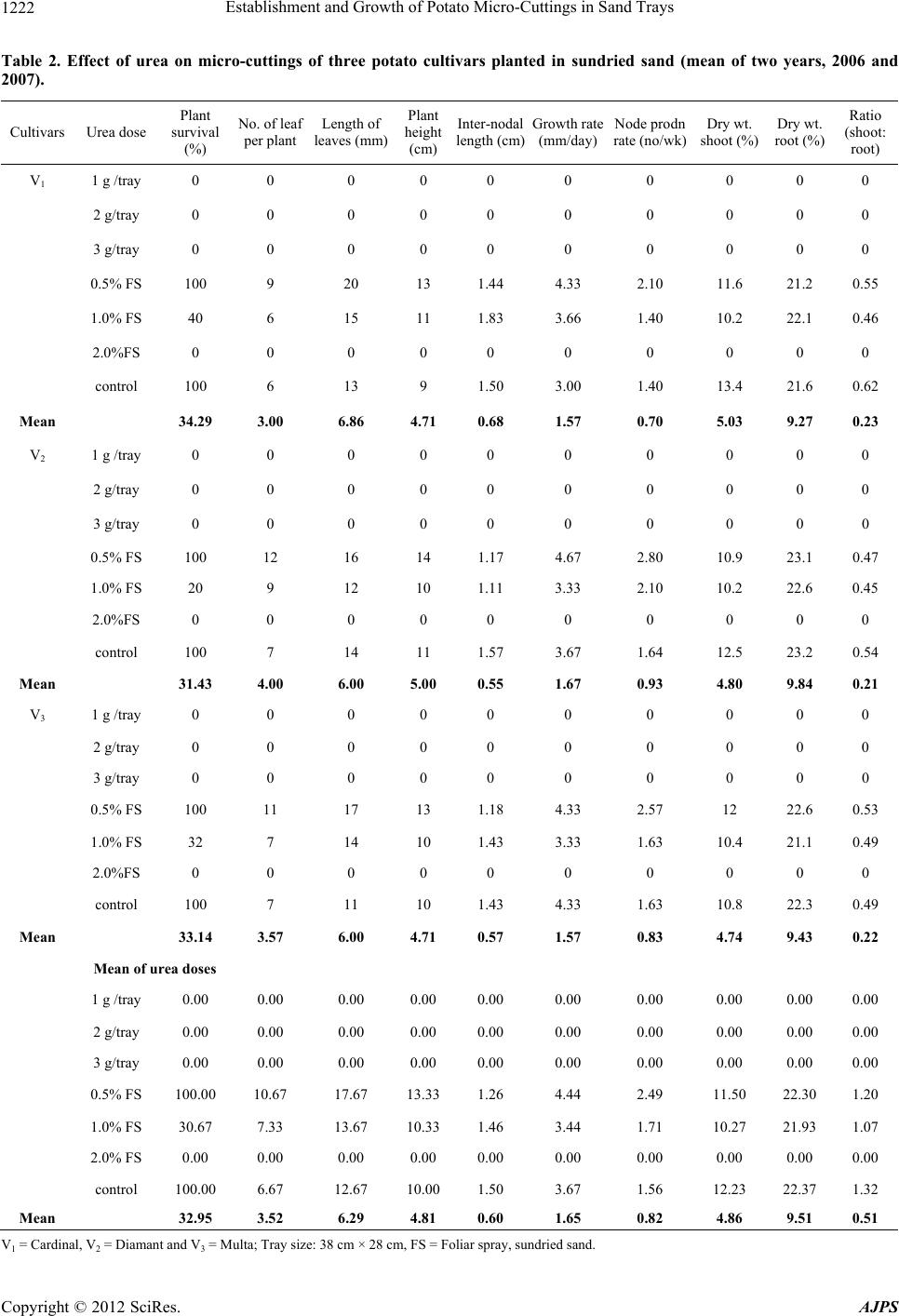 Establishment and Growth of Potato Micro-Cuttings in Sand Trays 1222 Table 2. Effect of urea on micro-cuttings of three potato cultivars planted in sundried sand (mean of two years, 2006 and 2007). Cultivars Urea dose Plant survival (%) No. of leaf per plant Length of leaves (mm) Plant height (cm) Inter-nodal length (cm) Growth rate (mm/day) Node prodn rate (no/wk) Dry wt. shoot (%) Dry wt. root (%) Ratio (shoot: root) V1 1 g /tray 0 0 0 0 0 0 0 0 0 0 2 g/tray 0 0 0 0 0 0 0 0 0 0 3 g/tray 0 0 0 0 0 0 0 0 0 0 0.5% FS 100 9 20 13 1.44 4.33 2.10 11.6 21.2 0.55 1.0% FS 40 6 15 11 1.83 3.66 1.40 10.2 22.1 0.46 2.0%FS 0 0 0 0 0 0 0 0 0 0 control 100 6 13 9 1.50 3.00 1.40 13.4 21.6 0.62 Mean 34.29 3.00 6.86 4.71 0.68 1.57 0.70 5.03 9.27 0.23 V2 1 g /tray 0 0 0 0 0 0 0 0 0 0 2 g/tray 0 0 0 0 0 0 0 0 0 0 3 g/tray 0 0 0 0 0 0 0 0 0 0 0.5% FS 100 12 16 14 1.17 4.67 2.80 10.9 23.1 0.47 1.0% FS 20 9 12 10 1.11 3.33 2.10 10.2 22.6 0.45 2.0%FS 0 0 0 0 0 0 0 0 0 0 control 100 7 14 11 1.57 3.67 1.64 12.5 23.2 0.54 Mean 31.43 4.00 6.00 5.00 0.55 1.67 0.93 4.80 9.84 0.21 V3 1 g /tray 0 0 0 0 0 0 0 0 0 0 2 g/tray 0 0 0 0 0 0 0 0 0 0 3 g/tray 0 0 0 0 0 0 0 0 0 0 0.5% FS 100 11 17 13 1.18 4.33 2.57 12 22.6 0.53 1.0% FS 32 7 14 10 1.43 3.33 1.63 10.4 21.1 0.49 2.0%FS 0 0 0 0 0 0 0 0 0 0 control 100 7 11 10 1.43 4.33 1.63 10.8 22.3 0.49 Mean 33.14 3.57 6.00 4.71 0.57 1.57 0.83 4.74 9.43 0.22 Mean of urea doses 1 g /tray 0.00 0.00 0.00 0.00 0.00 0.00 0.00 0.00 0.00 0.00 2 g/tray 0.00 0.00 0.00 0.00 0.00 0.00 0.00 0.00 0.00 0.00 3 g/tray 0.00 0.00 0.00 0.00 0.00 0.00 0.00 0.00 0.00 0.00 0.5% FS 100.00 10.67 17.67 13.331.26 4.44 2.49 11.50 22.30 1.20 1.0% FS 30.67 7.33 13.67 10.331.46 3.44 1.71 10.27 21.93 1.07 2.0% FS 0.00 0.00 0.00 0.00 0.00 0.00 0.00 0.00 0.00 0.00 control 100.00 6.67 12.67 10.001.50 3.67 1.56 12.23 22.37 1.32 Mean 32.95 3.52 6.29 4.81 0.60 1.65 0.82 4.86 9.51 0.51 V1 = Cardinal, V2 = Diamant and V3 = Multa; Tray size: 38 cm × 28 cm, FS = Foliar spray, sundried sand. Copyright © 2012 SciRes. AJPS 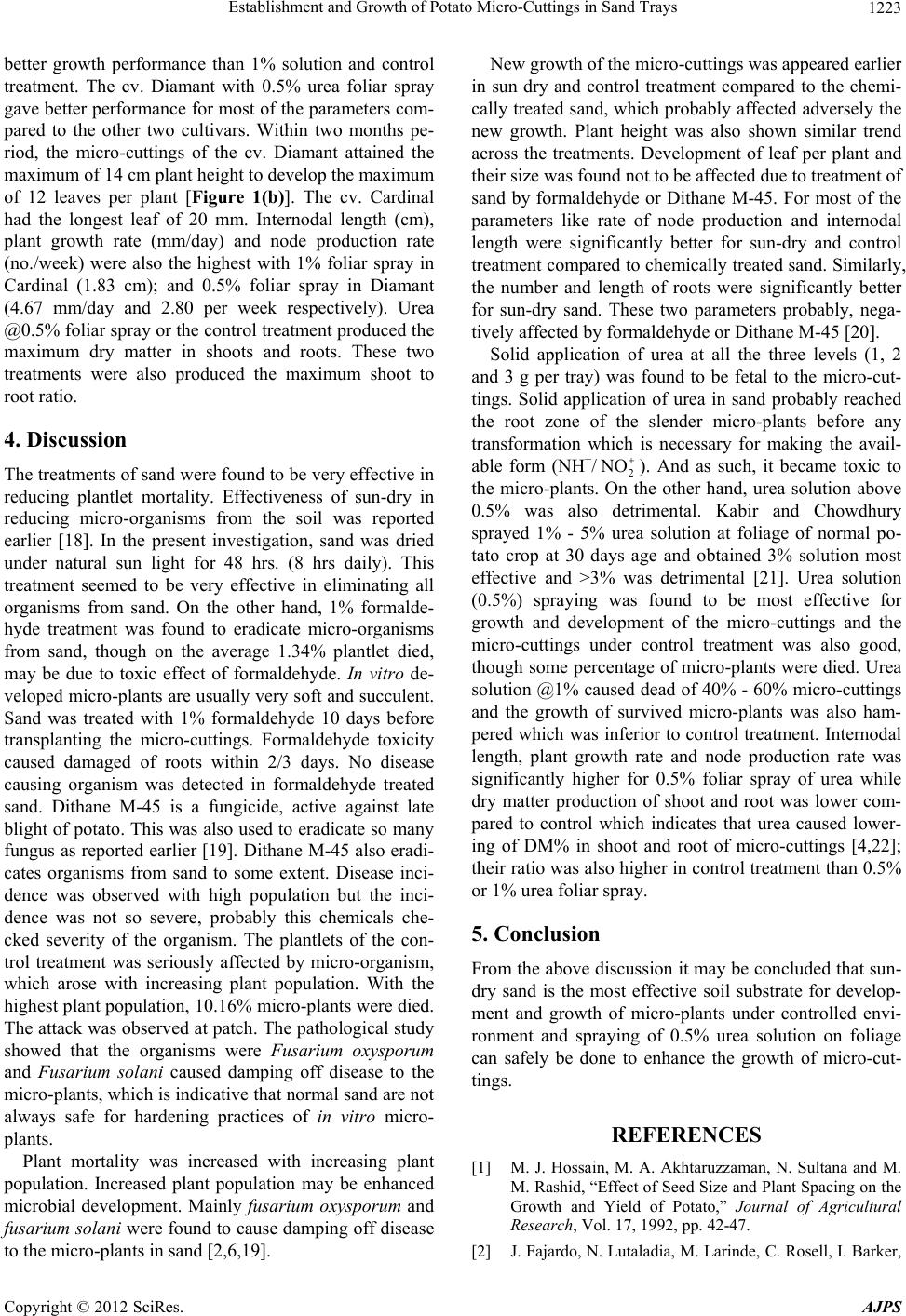 Establishment and Growth of Potato Micro-Cuttings in Sand Trays Copyright © 2012 SciRes. AJPS 1223 better growth performance than 1% solution and control treatment. The cv. Diamant with 0.5% urea foliar spray gave better performance for most of the parameters com- pared to the other two cultivars. Within two months pe- riod, the micro-cuttings of the cv. Diamant attained the maximum of 14 cm plant height to develop the maximum of 12 leaves per plant [Figure 1(b)]. The cv. Cardinal had the longest leaf of 20 mm. Internodal length (cm), plant growth rate (mm/day) and node production rate (no./week) were also the highest with 1% foliar spray in Cardinal (1.83 cm); and 0.5% foliar spray in Diamant (4.67 mm/day and 2.80 per week respectively). Urea @0.5% foliar spray or the control treatment produced the maximum dry matter in shoots and roots. These two treatments were also produced the maximum shoot to root ratio. New growth of the micro-cuttings was appeared earlier in sun dry and control treatment compared to the chemi- cally treated sand, which probably affected adversely the new growth. Plant height was also shown similar trend across the treatments. Development of leaf per plant and their size was found not to be affected due to treatment of sand by formaldehyde or Dithane M-45. For most of the parameters like rate of node production and internodal length were significantly better for sun-dry and control treatment compared to chemically treated sand. Similarly, the number and length of roots were significantly better for sun-dry sand. These two parameters probably, nega- tively affected by formaldehyde or Dithane M-45 [20]. Solid application of urea at all the three levels (1, 2 and 3 g per tray) was found to be fetal to the micro-cut- tings. Solid application of urea in sand probably reached the root zone of the slender micro-plants before any transformation which is necessary for making the avail- able form (NH+/2 NO ). And as such, it became toxic to the micro-plants. On the other hand, urea solution above 0.5% was also detrimental. Kabir and Chowdhury sprayed 1% - 5% urea solution at foliage of normal po- tato crop at 30 days age and obtained 3% solution most effective and >3% was detrimental [21]. Urea solution (0.5%) spraying was found to be most effective for growth and development of the micro-cuttings and the micro-cuttings under control treatment was also good, though some percentage of micro-plants were died. Urea solution @1% caused dead of 40% - 60% micro-cuttings and the growth of survived micro-plants was also ham- pered which was inferior to control treatment. Internodal length, plant growth rate and node production rate was significantly higher for 0.5% foliar spray of urea while dry matter production of shoot and root was lower com- pared to control which indicates that urea caused lower- ing of DM% in shoot and root of micro-cuttings [4,22]; their ratio was also higher in control treatment than 0.5% or 1% urea foliar spray. 4. Discussion The treatments of sand were found to be very effective in reducing plantlet mortality. Effectiveness of sun-dry in reducing micro-organisms from the soil was reported earlier [18]. In the present investigation, sand was dried under natural sun light for 48 hrs. (8 hrs daily). This treatment seemed to be very effective in eliminating all organisms from sand. On the other hand, 1% formalde- hyde treatment was found to eradicate micro-organisms from sand, though on the average 1.34% plantlet died, may be due to toxic effect of formaldehyde. In vitro de- veloped micro-plants are usually very soft and succulent. Sand was treated with 1% formaldehyde 10 days before transplanting the micro-cuttings. Formaldehyde toxicity caused damaged of roots within 2/3 days. No disease causing organism was detected in formaldehyde treated sand. Dithane M-45 is a fungicide, active against late blight of potato. This was also used to eradicate so many fungus as reported earlier [19]. Dithane M-45 also eradi- cates organisms from sand to some extent. Disease inci- dence was observed with high population but the inci- dence was not so severe, probably this chemicals che- cked severity of the organism. The plantlets of the con- trol treatment was seriously affected by micro-organism, which arose with increasing plant population. With the highest plant population, 10.16% micro-plants were died. The attack was observed at patch. The pathological study showed that the organisms were Fusarium oxysporum and Fusarium solani caused damping off disease to the micro-plants, which is indicative that normal sand are not always safe for hardening practices of in vitro micro- plants. 5. Conclusion From the above discussion it may be concluded that sun- dry sand is the most effective soil substrate for develop- ment and growth of micro-plants under controlled envi- ronment and spraying of 0.5% urea solution on foliage can safely be done to enhance the growth of micro-cut- tings. REFERENCES Plant mortality was increased with increasing plant population. Increased plant population may be enhanced microbial development. Mainly fusarium oxysporum and fusarium solani were found to cause damping off disease to the micro-plants in sand [2,6,19]. [1] M. J. Hossain, M. A. Akhtaruzzaman, N. Sultana and M. M. Rashid, “Effect of Seed Size and Plant Spacing on the Growth and Yield of Potato,” Journal of Agricultural Research, Vol. 17, 1992, pp. 42-47. [2] J. Fajardo, N. Lutaladia, M. Larinde, C. Rosell, I. Barker,  Establishment and Growth of Potato Micro-Cuttings in Sand Trays 1224 W. Roca and E. Chujoy, “Quality Declared Planting Ma- terial, Protocols and Standards for Vegetatively Propa- gated Crops,” FAO Plant Production and Protection Pa- per 195, 2010, pp. 71-78. [3] T. S. Roy, M. J. Hossain, S. Akhter, M. I. Akhter and T. Nishizawa, “Performance of Ten Promising True Potato Seed Progenies over Generations,” Journal of Agricul- tural Research, Vol. 30, 2005, pp. 159-166. [4] P. M. Harris, “The Potato Crop: The Scientific Basis for Improvement,” Chapman and Hall, London, 1982, pp. 546-573. [5] D. E. Vander Zaag, E. Asscheman, J. A. Bokx, H. Brink- man, C. B. Bus, P. H. Hotsma, C. P. Meijers, A. Mulder, K. Scholte, L. J. Turkensteen and R. Wustman, “Potato Diseases: Diseases, Pests and Defects,” Netherlands Po- tato Consultative Group (NIVAA), Holland, 1997, pp. 1-85. [6] F. Laemmlen, “Damping-Off Diseases,” University of California, ANR Publication 8041, 2001, pp. 1-4. [7] J. A. de Bokx, “Viruses of Potato and Seed Potato Pro- duction,” Centre for Agricultural Publishing and Docu- mentation, Wageningen, 1972. [8] Anonymous, “The Garden Helper: Planting Methods for Growing Potatoes (Part Two),” Manual for Potato Gar- dening, 2012, p. 1. [9] J. E. Bryan, M. G. Nelson and M. T. Jackson, “Stem Cut- tings, a Rapid Multiplication Technique for Potatoes,” CIP Slide Training Series, Guide-Book I (3), International Potato Center, Lima, 1981, p. 35. [10] M. J. Hossain, M. S. Nahar and A. U. Ahmed, “Sprout and Top-Shoot Cutting for Rapid Multiplication of Potato in Bangladesh,” The Journal of Agricultural Science, Vol. 132, No. 4, 1999, pp. 437-443. doi:10.1017/S0021859699006565 [11] Q. B. Miguel, J. E. Bryan, M. T. Jackson and M. G. Nel- son, “Leaf-Bud Cuttings: A Rapid Multiplication Tech- nique for Potatoes,” CIP Slide Training Series, Guide Book I (4), International Potato Center, Lima, 1981, p. 24. [12] M. J. Hossain and M. Zakaria, “Annual Research Report on Tuber Crops Tissue Culture of 1999-2000,” Tuber Crops Research Centre, BARI, Gazipur, 2000, pp. 1-14. [13] H. Wei and P. V. Zaag, “Potato (Solanum spp.) Apical Cutting Production and Their Agronomic Potential,” Asian Potato Journal, Vol. 2, No. 1, 1991, pp. 17-22. [14] M. J. Hossain, “Tubers from Leaf-Bud and Apical-Bud Cuttings: Methods for Rapid Clonal Propagation of Po- tato in Bangladesh,” Field Crops Research, Vol. 35, No. 2, 1993, pp. 147-148. [15] M. J. Hossain, and V. Vecchio, “Potential of Sprout Cut- ting on the Growth, Yield and Multiplication Rate of Po- tato,” Italian Journal of Agronomy, Vol. 3, No. 1, 1999, pp. 1-6. [16] E. E. Ewing, “Use of Potato Cuttings to Study Tuberisa- tion Stimulus in Andigena Population,” American Journal of Potato Research, Vol. 52, 1976, pp. 1-7. [17] N. V. Uyen and P. V. Zaag, “Vietnamese Farmers Use Tissue Culture for Commercial Potato Production,” American Journal of Potato Research, Vol. 60, No. 11, 1983, pp. 873-879. doi:10.1007/BF02853978 [18] T. K. Dey, A. H. M. Jafar, A. L. Khan and M. S. Ali, “Prevalence of Seed-Borne Fungi of True Potato Seed (TPS) in Bangladesh,” Journal of the Indian Potato Asso- ciation, Vol. 20, 1993. pp. 87-90. [19] Anonymous, “Annual Report of Tuber Crops Research Centre of 1996-97,” Bangladesh Agricultural Research Institute, Joydebpur, pp. 35-47. [20] R. C. Rowe, “Potato Health Management: The American Phytopathological Society,” APS Press, Minnesota, 1993, pp. 1-178. [21] M. H. Kabir and A. J. M. E. H. Chowdhury, “Foliar Spray of Urea Solution for Improving Growth and Yield of Po- tato,” Journal of the Indian Potato Association, Vol. 21, 1989, pp. 113-117. [22] M. S. Islam, S. Razia and K. M. Hossain, “Soil Test Crop Response Correlation Studies for Potato,” Proceedings of the 4th Workshop of Potato Research Workers, 8-10 Sep- tember 1981, pp. 44-48. Copyright © 2012 SciRes. AJPS |