

Paper Menu >>
Journal Menu >>
 Psychology 2012. Vol.3, Special Issue, 80 2-804 Published Online September 2012 in SciRes (http://www.SciRP.org/journal/psych) http://dx.doi.org/10.4236/psych.2012.329121 Copyright © 2012 SciRes. 802 Four-Week Self-Administered Acupressure Improves Depressive Mood Yasuhiro Honda1, Akira Tsuda1, Satoshi Horiuchi2,3 1Kurume University, Kurume, Japan 2Health Sciences University of Ho k k a i d o, Sapporo, Japan 3Japan Society of the Promotion of Science, Kojimac h i , Japan Email: [email protected] Received July 7th, 2012; re v ised August 9th, 2012; accepted September 3rd, 2012 Acupressure is a Chinese medical technique that involves application of pressure to acupuncture points on the body. This study aimed to examine whether a four-week self-administered acupressure course could reduce depressive mood. Sixteen male and nine female college students (33.2 ± 10.0 years) who majored in acupuncture and moxibustion medicine were randomly assigned to either a self-administered acupres- sure group or a control group. The participants in the self-administered acupressure group were instructed to conduct five acupressure sessions three times a day (morning, midday, and night). Each session in- cluded applying pressure on three points on the left and right side of the neck for five seconds. The con- trols were asked to continue their daily routine. Depressive mood levels were measured at baseline, two weeks later, and following intervention. Depressive mood levels were similar between both groups at baseline. It decreased two weeks later and remained constant until the end of the intervention. Depressive mood levels were significantly lower in the self-administered acupressure group than in the control group at two weeks from baseline and after intervention. These results provide initial evidence that self-admin- istered acupressure may improve depressive mood. Keywords: Acupressure; Depressive Mood; Self-Management; College Students Introduction Depression is a common mental disorder (Kessler, Chiu, Demler, Merikangas, & Walters, 2005), and it adversely affects quality of life and limits daily functioning (Wells, 1997). De- pressive disorders are thought to exist on a continuum (Cuijpers, de Graaf, & van Dorsselaer, 2004); therefore, it is important to not only manage depressive disorders but also symptoms such as subthreshold depression, which don’t meet the diagnostic criteria for mood disorders. Although professional treatments (e.g., pharmacological or psychological therapies) a re essential, many people diagnosed with major depression do not receive treatment (Andrews, Sanderson, Slade, & Issakidis, 2000). Self-management is a useful alternative to professional treatments (Morgan & Jorm, 2008) and is commonly employed in milder forms of depression (Jorm, Griffiths, Christensen, Parslow, & Rodgers, 2004; Jorm, Medway, Christensen, Korten, Jacomb, & Rodgers, 2000). Although the public considers this approach helpful (Jorm, Nakane, Christensen, Yoshioka, Griffiths, & Wata, 2005), some people may engage in non-effective or self-de- feating habits such as alcohol and substance use (Morgan & Jorm, 2008). Therefore, the authors believe that it is important to examine the efficacy of certain self-management methods before recommending them as new treatments. Morgan and Jorm (2008) reported a variety of self-manage- ment methods that are effective for depression. Unfortunately, no single method has been effective in all individuals. Individ- ual preferences and needs should be considered, and it is essen- tial to introduce newer self-management methods to improve depressive mood. Acupressure, which is a Chinese medical treatment, is a po- tentially useful method for self-management of depressive mood. The meridian theory proposes that the energy of the life, Qi, flows through meridians (invisible channels in the body). Energy flow that is too slow, fast, turbulent, or static (i.e., Qi imbalance) causes disturbances in mental and physical health. Acupressure involves applying pressure on the traditional acu- puncture points without puncturing the skin, and aims to correct Qi imbalance. Once an individual learns to accurately apply pressure to particular acupuncture points, acupressure can be self-administered. Self-administered acupressure is cost-free and can be used along with conventional treatment for depress- sion management, such as cognitive reframing (Honda, Tsuda, & Horiuchi, in press). Several studies have been conducted to examine efficacy of acupressure on depressive symptoms. Most of these studies reported that acupressure administered by professionals im- proved depressive symptoms (Cho & Tsay, 2004; Kang, Sok, & Kang, 2009; Tian & Krishnan, 2006; Tsay, Cho, & Chen, 2004), except the study of Mehling, Lown, Dvorak, Cowan, Horn, Dunn, Acree, Abrams, & Hecht (2012), which reported that acupressure administered by professionals did not improve de- pression. In contrast, a limited number of studies have been conducted to investigate the efficacy of self-administered acupressure on depressive symptoms (Elder, Gullion, Debar, Funk, Lindberg, Ritenbaugh, Meltesen, Gallison, & Stevens, 2012; Hyde, 1989). Hyde (1989) reported that acupressure wristbands, a self-man- agement tool, improved depression. However, Elder et al. (2012) found that the Tapas Acupressure Technique (TAT®), selfap- plied light pressure to specific points, did not improve depression. 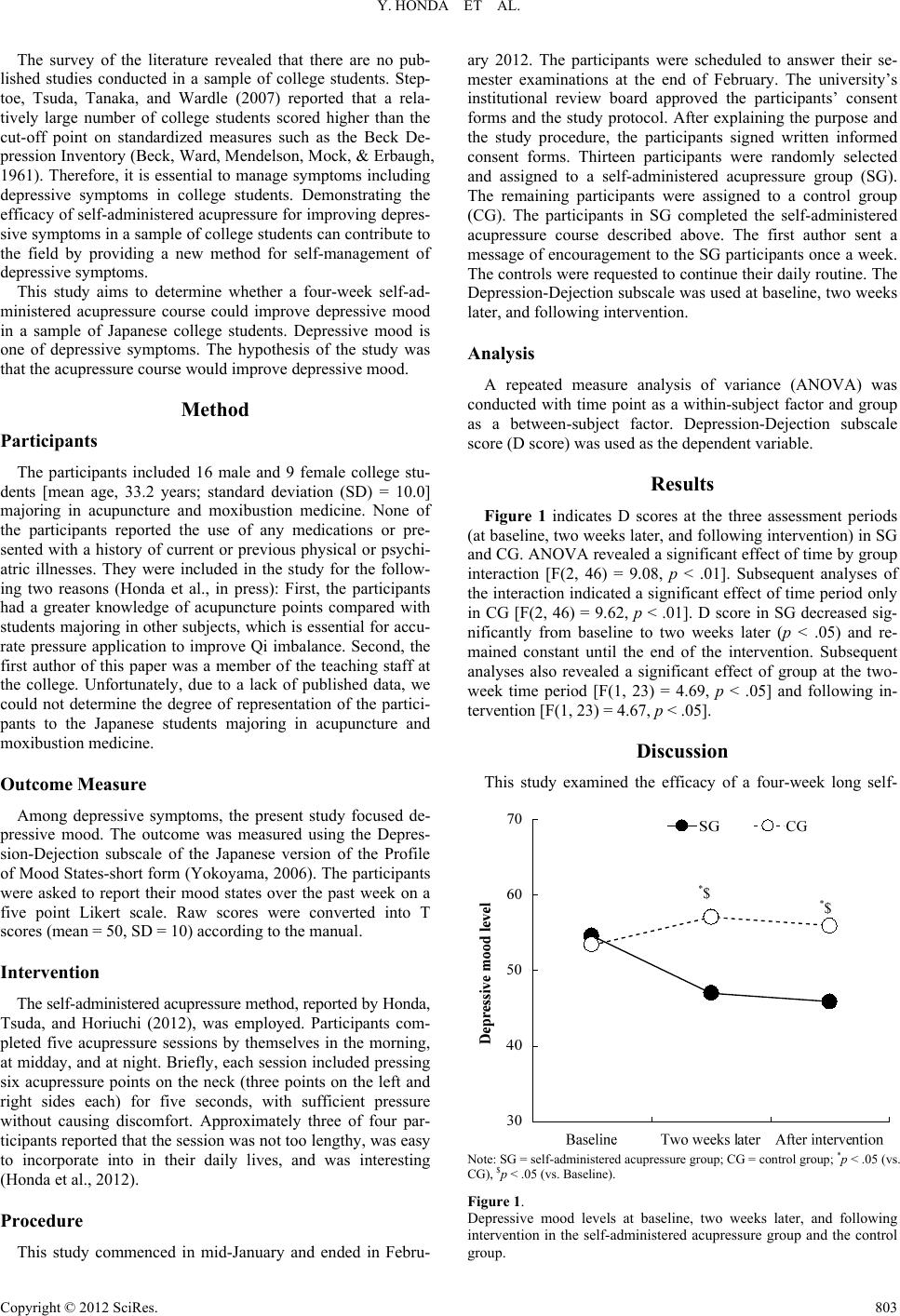 Y. HONDA ET AL. The survey of the literature revealed that there are no pub- lished studies conducted in a sample of college students. Step- toe, Tsuda, Tanaka, and Wardle (2007) reported that a rela- tively large number of college students scored higher than the cut-off point on standardized measures such as the Beck De- pression Inventory (Beck, Ward, Mendelson, Mock, & Erbaugh, 1961). Therefore, it is essential to manage symptoms including depressive symptoms in college students. Demonstrating the efficacy of self-administered acupressure for improving depres- sive sympt oms in a sample of college students can contribute to the field by providing a new method for self-management of depressive symptoms. This study aims to determine whether a four-week self-ad- ministered acupressure course could improve depressive mood in a sample of Japanese college students. Depressive mood is one of depressive symptoms. The hypothesis of the study was that the acupressure course would improve depressive mood. Method Participants The participants included 16 male and 9 female college stu- dents [mean age, 33.2 years; standard deviation (SD) = 10.0] majoring in acupuncture and moxibustion medicine. None of the participants reported the use of any medications or pre- sented with a history of current or previous physical or psychi- atric illnesses. They were included in the study for the follow- ing two reasons (Honda et al., in press): First, the participants had a greater knowledge of acupuncture points compared with students majoring in other subjects, which is essential for accu- rate pressure application to improve Qi imbalance. Second, the first author of this paper was a member of the teaching staff at the college. Unfortunately, due to a lack of published data, we could not determine the degree of representation of the partici- pants to the Japanese students majoring in acupuncture and moxibustion medicine. Outcome Measure Among depressive symptoms, the present study focused de- pressive mood. The outcome was measured using the Depres- sion-Dejection subscale of the Japanese version of the Profile of Mood States-short form (Yokoyama, 2006). The participants were asked to report their mood states over the past week on a five point Likert scale. Raw scores were converted into T scores (mean = 50, SD = 10) according to the manual. Intervention The self-administered acupres sure method, reporte d by Honda, Tsuda, and Horiuchi (2012), was employed. Participants com- pleted five acupressure sessions by themselves in the morning, at midday, and at night. Briefly, each session included pressing six acupressure points on the neck (three points on the left and right sides each) for five seconds, with sufficient pressure without causing discomfort. Approximately three of four par- ticipants reported that the session was not too lengthy, was easy to incorporate into in their daily lives, and was interesting (Honda et al., 2012). Procedure This study commenced in mid-January and ended in Febru- ary 2012. The participants were scheduled to answer their se- mester examinations at the end of February. The university’s institutional review board approved the participants’ consent forms and the study protocol. After explaining the purpose and the study procedure, the participants signed written informed consent forms. Thirteen participants were randomly selected and assigned to a self-administered acupressure group (SG). The remaining participants were assigned to a control group (CG). The participants in SG completed the self-administered acupressure course described above. The first author sent a message of encouragement to the SG participants once a week. The controls were requested to continue their daily routine. The Depression-Dejection subscale was used at baseline, two weeks later, and following intervention. Analysis A repeated measure analysis of variance (ANOVA) was conducted with time point as a within-subject factor and group as a between-subject factor. Depression-Dejection subscale score (D score) was used as the dependent variable. Results Figure 1 indicates D scores at the three assessment periods (at baseline, two weeks later, and following intervention) in SG and CG. ANOVA revealed a significant effect of time by group interaction [F(2, 46) = 9.08, p < .01]. Subsequent analyses of the interaction indicated a significant effect of time period only in CG [F(2, 46) = 9.62, p < .01]. D score in SG decreased sig- nificantly from baseline to two weeks later (p < .05) and re- mained constant until the end of the intervention. Subsequent analyses also revealed a significant effect of group at the two- week time period [F(1, 23) = 4.69, p < .05] and following in- tervention [F(1, 23) = 4.67, p < .05]. Discussion This study examined the efficacy of a four-week long self- * $ * $ Note: SG = self-administered acupressure group; CG = control group; *p < .05 (vs. CG), $p < .05 (vs. Baseline). Figure 1. Depressive mood levels at baseline, two weeks later, and following intervention in the self-administered acupressure group and the control group. Copyright © 2012 SciRes. 803  Y. HONDA ET AL. Copyright © 2012 SciRes. 804 administered acupressure course for decreasing the levels of depressive mood in a sample of Japanese college students. De- pressive mood levels decreased significantly in participants who self-administered acupressure; however, this change was not observed in the controls, which provides preliminary but important evidence that self-administered acupressure can de- crease depressive mood levels in Japanese college students. The provision of a new self-management method for depres- sive mood is important. The importance of self-management methods has been described by Morgan & Jorm in 2008. A limited number of depressed people receive medical treatments (Andrews et al., 2000), and self-management methods may be beneficial for these people. Some individuals engage in ineffec- tive or self-defeating activities to manage depressive symptoms, therefore, it is important to determine the efficacy of any new self-management method. Although a variety of methods/techniques are recommended for the self-management of depressive symp- toms, no single method is effective in all individ uals. There f or e , it is essential to identify a range of self-management methods to meet an individual’s specific needs and preferences. Moreover, self-administered acupressure is simple and cost-free. By dem- onstrating that self-administered acupressure potentially im- proves depressive mood, this study provides useful information regarding self-management of depressive mood in college stu- dents. This study focused on the depressive mood levels of Japa- nese college students. Managing depressive mood is important in this population because previous studies in Japan have re- ported that a relatively high number of college students scored above the cut-off point on standardized depression measures (Steptoe et al., 2007). Depression adversely affects productivity; therefore it is important to manage depressive mood and symp- toms in this population from a school health perspective. A limitation of this study was that participants were college students majoring in acupuncture and moxibustion medicine and were expected to have a more accurate and extensive knowledge of acupuncture points compared with college stu- dents majoring in other subjects. Moreover, the participants may have been pressurized to support the hypothesis of efficacy of acupressure because they were students of one of the authors and were majoring in acupuncture and moxibustion medicine. It is important to replicate the current findings in other popula- tions and groups of college students and to try to exclude these confounding factors. Finally, the sample size of this study was small. Thus, it is required to replicate the findings of this study in a future study with a larger number of the participants. Acknowledgements This research was supported by a Grant-in-Aid for Scientific Research (A) (18203035) and (B) (22330196) from Japanese Society for the promotion of Science to AT. REFERENCES Andrews, G., Sanderson, K., Slade, T., & Issakidis, C. (2000). Why does the burden of disease persist? Relating the burden of anxiety and depression to effectiveness of treatment. Bulletin of the World Health Organization, 78, 446-454. Beck, A. T., Ward, C. H., Mendelson, M., Mock, J., & Erbaugh, J. (1961). An inventory for measuring depression. Archives of General Psy- chiatry, 4, 561-571. doi:10.1001/archpsyc.1961.01710120031004 Cho, Y. C. & Tsay, S. L. (2004). The effect of acupressure with mas- sage on fatigue and depression in patients with end-stage renal dis- ease. Journal of Nursing Research, 12, 51-59. doi:10.1097/01.JNR.0000387488.63438.9a Cuijpers, P., de Graaf, R., & van Dorsselaer, S. (2004). Minor depress- sion: Risk profiles, functional disability, health care use and risk of developing major depression. Journal of Affective Disorders, 79, 71- 79. doi:10.1016/S0165-0327(02)00348-8 Elder, C. R., Gullion, C. M., Debar, L. L., Funk, K. L., Lindberg, N. M., Ritenbaugh, C., Meltesen, G., Gallison, C., & Stevens, V. J. (2012). Randomized trial of tapas acupressure technique for weight loss maintenance. BMC Complementary and Alternative Medicine, 12, 19. doi:10.1186/1472-6882-12-19 Hyde, E. (1989). Acupressure therapy for morning sickness: A con- trolled clinical trial. Journal of Nurse-Midwifery, 34, 171-178. doi:10.1016/0091-2182(89)90077-3 Honda, Y., Tsuda, A., & Horiuchi, S. (2012). A study on acute effects of the self-acupressure on mood and its usability. Kurume University Psychological Research, 1 1, 8-14. Honda, Y., Tsuda, A., & Horiuchi, S. (2012). Effect of a four-week self-administered acupressure intervention on perceived stress over the past month. Open Journal of Medical Psychology, 1, 20-24. doi:10.4236/ojmp.2012.13004 Jorm, A. F., Griffiths, K. M., Christensen, H., Parslow, R. A., Rodgers, B. (2004). Actions taken to cope with depression at different levels of severity: A community survey. Psychological Medicine, 34, 293- 299. doi:10.1017/S003329170300895X Jorm, A. F., Medway, J. , Christensen, H., Korten, A. E. , Jacomb, P. A., Rodgers, B. (2000). Public beliefs about the helpfulness of intervene- tions for depression: Effects on actions taken when experiencing anxiety and depression symptoms. Australian and New Zealand Journal of Psychiatr y, 34, 619-626. doi:10.1080/j.1440-1614.2000.00761.x Jorm, A. F., Nakane, Y., Christensen, H., Yoshioka, K., Griffiths, K. M., & Wata, Y. (2005). Public beliefs about treatment and outcome of mental disorders: A comparison of Australia and Japan. BMC Medi- cine, 3, 12. doi:10.1186/1741-7015-3-12 Kang, H. S., Sok, S. R., & Kang, J. S. (2009). Effects of Meridian acu- pressure for stroke patient s i n K orea. Journal of Clinical Nursing, 18, 2145-2152. doi:10.1111/j.1365-2702.2008.02522.x Kessler, R. C., Chiu, W. T., De mler, O., Merikangas, K . R., & Walters, E. E. (2005). Prevalence, severity, and comorbidity of 12-month DSM-IV disorders in the National Comorbidity Survey Replication. Archives of General Psychiatry, 62, 617-627. doi:10.1001/archpsyc.62.6.617 Mehling, W. E., Lown, E. A., Dv orak, C. C., Cowan, M. J., Horn, B. N., Dunn, E. A., Acree, M., Abrams, D. I., & Hecht, F. M. (2012). He- matopoietic cell transplant and use of massage for improved symp- tom management: results from a pilot randomized control trial. Evi- dence-Based Complementar y and Alternative Medicine, 450150. doi:10.1155/2012/450150 Morgan, A. J., & Jorm, A. F. (2008). Self-help interventions for de- pressive disorders and depressive symptoms: A systematic review. Annals of General Psychi a t ry, 7, 13. doi:10.1186/1744-859X-7-13 Steptoe, A., Tsuda, A., Tanaka, Y., & Wardle, J. (2007). Depressive symptoms, socio-economic background, sense of control, and cul- tural factors in university students from 23 countries. International Journal of Behavioral Medici ne , 14, 97-107. doi:10.1007/BF03004175 Tian , X., & Krishnan, S. (2006). Efficacy of auricular acupressure as an adjuvant therapy in substance abuse treatment: A pilot study. Al- ternative Therapies in Health an d Medicine, 12, 66-69. Tsay, S. L., Cho, Y. C., & Chen, M. L. (2004). Acupressure and trans- cutaneous electrical acupoint stimulation in improving fatigue, sleep quality and depression in hemodialysis patients. American Journal of Chinese Medicine, 32, 407-416. doi:10.1142/S0192415X04002065 Yokoyama, K. (2006). POMS short form. Tokyo: Kaneko-Shobo. Wells, K. B. (1997). Caring for depression in primary care: Defining and illustrating the policy context. Journal of Clinical Psychiatry, 11, 24-27. |