

Paper Menu >>
Journal Menu >>
 Psychology 2012. Vol.3, Special Issue, 79 5-801 Published Online September 2012 in SciRes (http://www.SciRP.org/journal/psych) http://dx.doi.org/10.4236/psych.2012.329120 Copyright © 2012 SciRes. 795 Improvements in Maternal Depression as a Mediator of Child Behaviour Change Judy Hutchings1, Tracey Bywater2, Margiad Elen Williams1, Eleanor Lane1, Christopher J. Whitaker3 1Centre for Evidence-Based Ea rly Intervention, Bangor University, Bangor, UK 2Institute for Effective Education, University of York, York, UK 3North Wales Organisation of Ran domised Controlled Trials in Health & Social Care, Bangor University, Bangor, UK Email: [email protected] Received June 5th, 2012; revised July 8th, 2012; accepted August 2nd, 2012 Depression is a common and debilitating illness and there is a strong association between maternal de- pression and childhood Conduct Disorder (CD). This paper examines the impact of maternal depression on the outcome of treatment for the prevention of CD. Data from the Hutchings et al. (2007) Randomised Controlled Trial (RCT) of a parenting programme for parents of high-risk three and four year olds are used to explore the potential role of change in maternal depression as a mediator of child behaviour out- come. The role of positive parenting as an additional mediator was also examined due to previous re- search findings. Improvement in maternal depression was found to be a significant partial mediator of improvement in child behaviour. Maternal depression continued to be a partial mediator when positive parenting was included in the mediation model. Parenting interventions for the prevention of CD are more likely to result in improved child behaviour when they also address the skill deficits known to be associ- ated with maternal depression. Keywords: Maternal Depression; Child Behaviour Problems; Parenting Intervention/Training; Mediator Introduction Maternal De pression and Childhood C onduct Problems There is substantial literature showing the co-occurrence of maternal depression and Conduct Disorder (CD) in children (Goodman et al., 2011; Gross, Shaw, & Moilanen, 2008). More than 50% of mothers of children with CD have clinical levels of depression (Alpern & Lyons-Ruth, 1993; Webster-Stratton & Hammond, 1988; Hutchings, 1996) and among parents of older CD children (aged eight and above) Hutchings et al. (2011) found that 79% of 300 parents reported clinically significant levels of depression. Some evidence suggests that maternal depression is causal in the development of CD (Patterson, 1982; Rutter, 1996). De- pressed mothers exhibit low rates of praise and failure in moni- toring their child’s behaviour, which are both associated with the development of CD (Webster-Stratton & Herbert, 1994). Even shortly after birth, coded videos of mother-infant interact- tions show differences in behaviour between depressed and non-depressed mothers (Field, 1995a, 1995b). Other research suggests that problematic child behaviour can precipitate ma- ternal depression, particularly if the child displays characteris- tics that make parenting difficult, such as temperament prob- lems and poor sleep patterns (Webster-Stratton & Spitzer, 1996). There can also be external predictors for both conditions such as socio-economic disadvantage that have been shown to be independently associated with both problems (Silberg & Rutter, 2002; Mensah & Kiernan, 2010). There are a number of skill deficits commonly associated with depression that have also been shown independently to describe parents of conduct problem children. These include poor problem solving and inability to recall specific events. De- pressed people display over-general rather than specific memo- ries (Williams et al., 2007; Williams, 1996) and this has been shown to be associated with poor problem solving (Evans, Wil- liams, O’Loughlin, & Howells, 1992; Pollock & Williams, 2001; van Vreeswijk & Wilde, 2004). Wahler and colleagues (Wahler & Dumas, 1989; Wahler & Sansbury, 1990), and Mc- Mahon & Frick (2005), found that, while mothers of children with CD tended to focus on their children’s deviant behaviours, their descriptions of behaviour were lacking in detail and over- general. Similarly, Hutchings et al. (1998) found that, compared to a non-referred sample, mothers of children referred to a child and adult mental health service with behavioural problems had significantly lower ability to recall specific events in relation to their child’s life. Parents of children with CD and depressed individuals also both show insensitivity to the cues of others and have poor observation skills (Cummings & Davies, 1994; Meunier, 2007). Hutchings, Smith, and Gilbert (2000) showed that their meas- ures of maternal observational style, autobiographical memory, and parental problem solving were highly correlated and dif- ferentiated well between the parents of children referred for treatment of CD and parents of non-referred children. Studies for the Treatment and Prevention of CD Intervention programmes that have been most effective with parents of children with CD address skill deficits that are com-  J. HUTCHINGS ET AL. mon in this population (Hutchings, Gardner, & Lane, 2005). In a review of parenting programmes, Barlow, Coren, and Stew- art-Brown (2009) found them to be effective at improving both child behaviour and a range of parental factors, including ma- ternal depression, anxiety, and self-esteem. While some studies have found that maternal depression can predict poor outcomes for interventions to address CD (Beauchaine, Webster-Stratton, & Reid, 2005; Forehand, Furey, & McMahon, 1984; Hinshaw, 2002) others have demonstrated that not only can gains be made for the child, despite maternal depression, but also that the depression itself improves significantly as a result of parent training (Hutchings, Appleton, Smith, Lane, & Nash, 2002; Hutchings et al., 2007; Hutchings, Lane, & Kelly, 2004). In one of the few studies to provide long-term data, Hutchings et al. (2002, 2004) compared the results of providing standard Child and Adolescent Mental Health Service (CAMHS) management advice with an intensive treatment programme involving coach- ing and rehearsing parents in relevant skills and incorporated observational skills training and realistic goal setting. While the CAMHS treatment resulted in short-term improvements in child behaviour, it did not impact on maternal mental health and the improvements in child behaviour were not maintained beyond the six-month follow-up. By contrast, the intensive treatment group significantly improved both child behaviour and maternal mental health at six months and these improve- ments were both still significantly better at a four-year follow up compared to baseline. Hutchings, Lane et al. (2004) suggest that the long-term improvements were due to the intensive treatment’s focus on helping parents to learn and practice effec- tive observation and problem solving skills as well as specific child management strategies. They concluded that for parents experiencing depression, without improvement of maternal depression, the benefits of parenting interventions may not be sustained. Maternal depression may be a mediating variable between intervention and child behaviour. That is, some, or all, of the effect of the intervention on child behaviour may be a result of a change in maternal depression. The identification of mediat- ing variables is important in gaining a better understanding of how parent programmes work, so that, in developing and im- proving interventions, special attention can be given to factors shown to have a significant effect on outcome (Laurenceau, Hayes, & Feldman, 2007; Goodman et al., 2011). The aim of this study is to examine the potential mediating effect of maternal depression on the outcome of a parent pro- gramme to reduce child behaviour problems using data from a Randomised Controlled Trial (RCT) of the Incredible Years (IY) Parent programme (Hutchings et al., 2007). In a recent evalua- tion of the IY Parent programme delivered as a preventive in- tervention to parents of children at risk of developing CD, sig- nificant improvements in parental depression, parenting skills and child behaviour were found at the six-month follow-up (see Table 1) (Hutchings et al., 2007). Improvements in parental de- pression, parenting skills, and child behaviour were maintained at 12-month and 18-month follow-up (Bywater et al., 2009). Additionally, a similar study using the same data set found that observed positive parenting partially mediated the relationship between intervention status and child behaviour problems, therefore this study aims to investigate whether maternal de- pression and positive parenting are joint mediators. Method Participants The RCT was conducted in 11 Sure Start areas in north and mid Wales. These areas had been identified by Local Authorities as having high levels of social and economical disadvantage and received government funding to support services for children under five years of age. Baseline characteristics of the children in the sample are presented in Table 2. One hundred and fifty three children and their primary care- givers were recruited to the trial and were randomised on a 2:1 basis to intervention or waiting list control conditions. Health visitors administered the Eyberg Child Behaviour Inventory (ECBI: Robinson, Eyberg, & Ross, 1980) to parents of pre- school children aged between 36 and 59 months. The ECBI measures levels of child behaviour problems. Participants were eligible if the child scored above the clinical cut-off on the ECBI problem or intensity scale, lived with the primary care- giver and the caregiver was able to attend an IY parenting group (Hutchings et al., 2007). Intervention The participating caregivers attended 12 weekly group ses- sions lasting 2 to 2.5 hours per week. The IY BASIC Parent programme (Webster-Stratton & Hancock, 1998) was delivered to each group by two trained leaders. Control families were offered the programme after the six-month follow-up. Measures The following measures were collected for the original evaluation during two home visits at each time point, at base- line and one at six-month follow up, by which time the inter- vention parents had received the programme. All measures are standardized measures typically used in the evaluation of par- enting interventions. Full details of all measures, scoring, ra- tionale for use, normative data, reliability and validity can be seen in the protocol of measures (Hutch i n g s , E a de et al., 2004). Measures of Child Problem Behaviour The Eyberg Child Behaviour Inventory (ECBI; Robinson et al., 1980). A 36-item inventory of child behaviours measured on two scales: a 7-point intensity scale and a Yes/No scale of whether the behaviour is viewed as a problem. The Yes/No problem scale was used for data analysis in this study. The ECBI demonstrates good stability and homogeneity, with reli- ability coefficients from .86 (test-retest) to .98 (internal consis- tency). The scale has also shown good convergent validity, with ECBI scores being significantly correlated with scores on the Child Behaviour Check List (CBCL; Achenbach & Edelbrock, Table 1. Baseline and six-month follow- u p measures. Intervention (n = 86) Mean (SD) Control (n = 47) Mean (SD) Measure Baseline F-up Baseline F-up ECBI-problem score16.6 (6.9)9.5 (7.9)*** 14.7 (7.7) 13.7 (8.3) BDI-II 17.7 (10.8)10.3 (10.2)*** 15.0 (9. 7) 13.7 (10.3) Positive parenting§23.0 (19.3)32.4 (19.3)** 21. 9 (15.4)21.7 (16.8) Note: §Frequency count in 30 minutes; **p < .01, ***p < .001, results of paired t tests to compare baseline and follow-up scores. Copyright © 2012 SciRes. 796 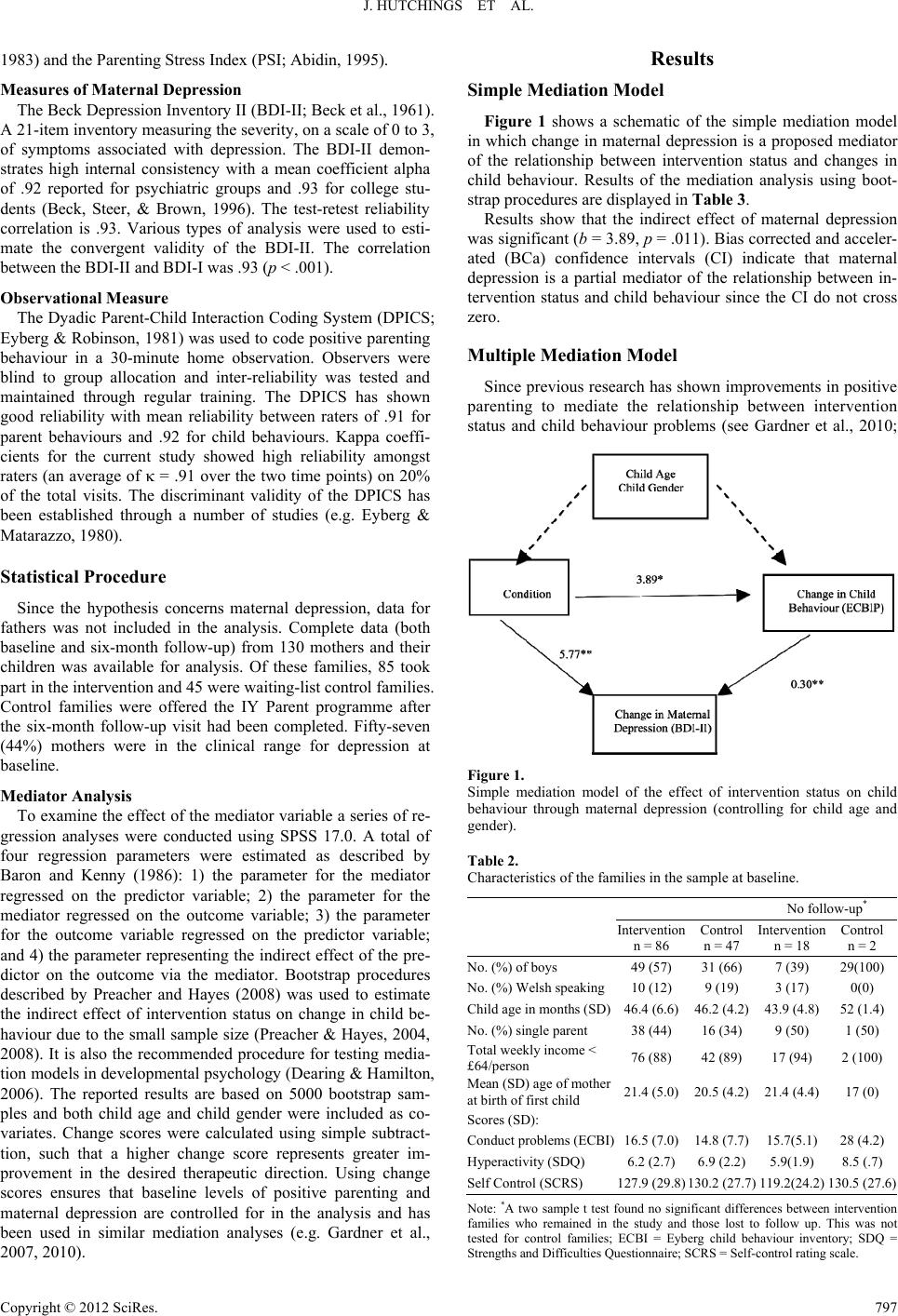 J. HUTCHINGS ET AL. 1983) and the Parenting Stress Index (PSI; Abidin, 1995). Measures of Maternal Depression The Beck Depression Inventory II (BDI-II; Beck et al., 1961). A 21-item inventory measuring the severity, on a scale of 0 to 3, of symptoms associated with depression. The BDI-II demon- strates high internal consistency with a mean coefficient alpha of .92 reported for psychiatric groups and .93 for college stu- dents (Beck, Steer, & Brown, 1996). The test-retest reliability correlation is .93. Various types of analysis were used to esti- mate the convergent validity of the BDI-II. The correlation between the BDI-II and BDI-I was .93 (p < .001). Observational Measure The Dyadic Parent-Child Interaction Coding System (DPICS; Eyberg & Robinson, 1981) was used to code positive parenting behaviour in a 30-minute home observation. Observers were blind to group allocation and inter-reliability was tested and maintained through regular training. The DPICS has shown good reliability with mean reliability between raters of .91 for parent behaviours and .92 for child behaviours. Kappa coeffi- cients for the current study showed high reliability amongst raters (an average of = .91 over the two time points) on 20% of the total visits. The discriminant validity of the DPICS has been established through a number of studies (e.g. Eyberg & Matarazzo, 1980). Statistical Procedure Since the hypothesis concerns maternal depression, data for fathers was not included in the analysis. Complete data (both baseline and six-month follow-up) from 130 mothers and their children was available for analysis. Of these families, 85 took part in the intervention and 45 were waiting-list control fami li e s. Control families were offered the IY Parent programme after the six-month follow-up visit had been completed. Fifty-seven (44%) mothers were in the clinical range for depression at baseline. Mediator Analysis To examine the effect of the mediator variable a series of re- gression analyses were conducted using SPSS 17.0. A total of four regression parameters were estimated as described by Baron and Kenny (1986): 1) the parameter for the mediator regressed on the predictor variable; 2) the parameter for the mediator regressed on the outcome variable; 3) the parameter for the outcome variable regressed on the predictor variable; and 4) the parameter representing the indirect effect of the pre- dictor on the outcome via the mediator. Bootstrap procedures described by Preacher and Hayes (2008) was used to estimate the indirect effect of intervention status on change in child be- haviour due to the small sample size (Preacher & Hayes, 2004, 2008). It is also the recommended procedure for testing media- tion models in developmental psychology (Dearing & Hamilton, 2006). The reported results are based on 5000 bootstrap sam- ples and both child age and child gender were included as co- variates. Change scores were calculated using simple subtract- tion, such that a higher change score represents greater im- provement in the desired therapeutic direction. Using change scores ensures that baseline levels of positive parenting and maternal depression are controlled for in the analysis and has been used in similar mediation analyses (e.g. Gardner et al., 2007, 2010). Results Simple Mediation Model Figure 1 shows a schematic of the simple mediation model in which change in maternal depression is a proposed mediator of the relationship between intervention status and changes in child behaviour. Results of the mediation analysis using boot- strap procedures are displayed in Table 3. Results show that the indirect effect of maternal depression was significant (b = 3.89, p = .011). Bias corrected and acceler- ated (BCa) confidence intervals (CI) indicate that maternal depression is a partial mediator of the relationship between in- tervention status and child behaviour since the CI do not cross zero. Multiple Mediation Model Since previous research has shown improvements in positive parenting to mediate the relationship between intervention status and child behaviour problems (see Gardner et al., 2010; Figure 1. Simple mediation model of the effect of intervention status on child behaviour through maternal depression (controlling for child age and gender). Table 2. Characteristics of the families in the sample at baseline. No follow-up* Intervention n = 86 Control n = 47 Intervention n = 18 Control n = 2 No. (%) of boys 49 (57) 31 (66) 7 (39) 29(100) No. (%) Welsh speaking10 (12) 9 (19) 3 (17) 0(0) Child age in months (SD)46.4 (6.6) 46.2 (4.2) 43.9 (4.8)52 (1.4) No. (%) single parent 38 (44) 16 (34) 9 (50) 1 (50) Total weekly income < £64/person 76 (88) 42 (89) 17 (94) 2 (100) Mean (SD) age of mother at birth of first child 21.4 (5.0) 20.5 (4.2) 21.4 (4.4)17 (0) Scores (SD): Conduct problems (EC BI)16.5 (7.0) 14.8 (7.7) 15.7(5. 1)28 (4.2) Hyperactivity (SDQ) 6.2 (2.7)6.9 (2.2) 5.9(1.9)8.5 (.7) Self Control (SCRS) 127.9 (29.8) 130.2 (27.7) 119. 2(24.2)130.5 (27.6) Note: *A two sample t test found no significant differences between int ervention families who remained in the study and those lost to follow up. This was not tested for control families; ECBI = Eyberg child behaviour inventory; SDQ = Strengths and Difficulties Questionnaire; SCRS = Self-control rating scale. Copyright © 2012 SciRes. 797 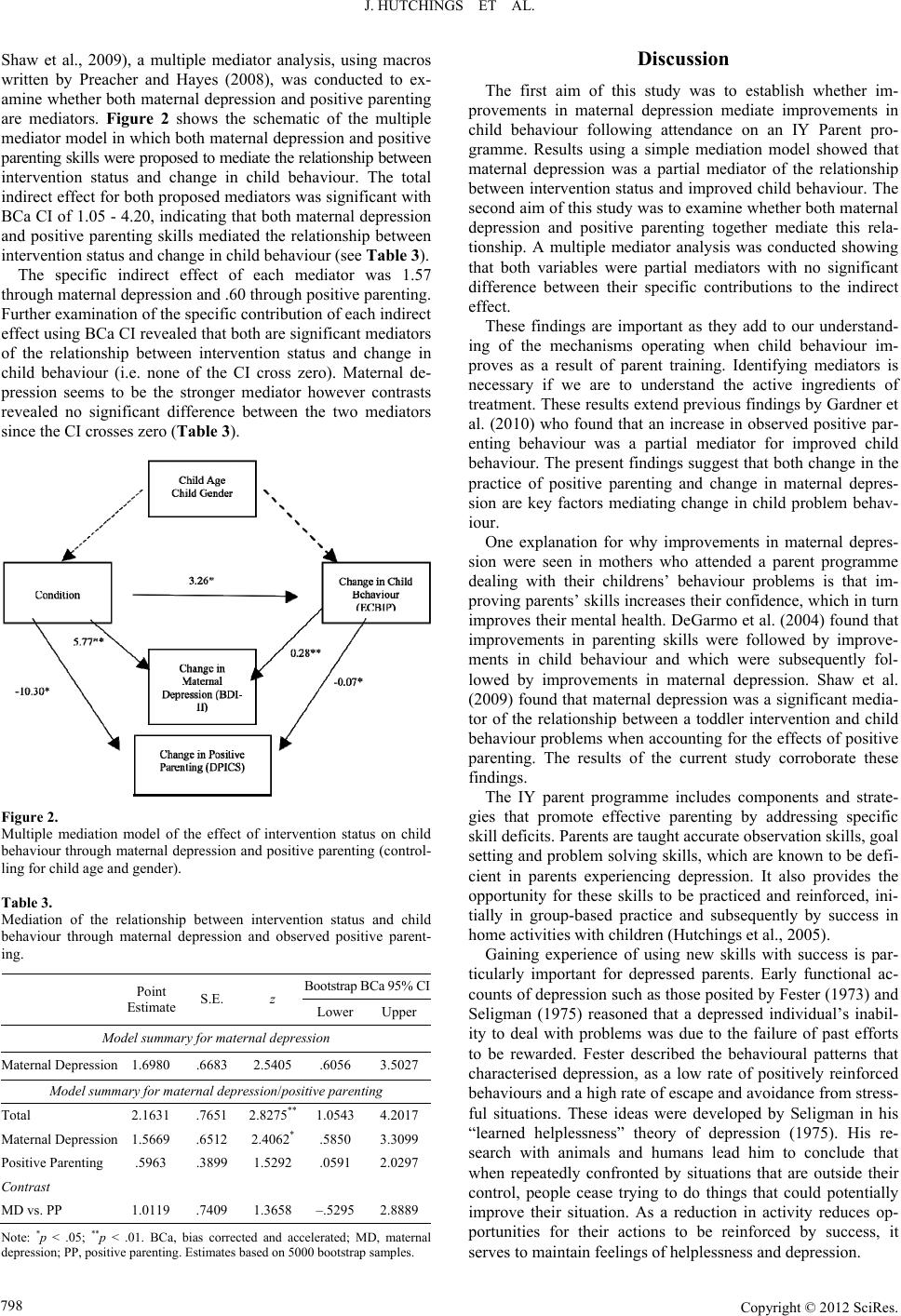 J. HUTCHINGS ET AL. Shaw et al., 2009), a multiple mediator analysis, using macros written by Preacher and Hayes (2008), was conducted to ex- amine whether both maternal depression and positive parenting are mediators. Figure 2 shows the schematic of the multiple mediator model in which both maternal depression and positive parenting skills were proposed to mediate the relation ship betwe en intervention status and change in child behaviour. The total indirect effect for both proposed mediators was significant with BCa CI of 1.05 - 4.20, indicating that both maternal depression and positive parenting skills mediated the relationship between intervention status and change in child behaviour (see Table 3). The specific indirect effect of each mediator was 1.57 through maternal depression and .60 through positive parenting. Further examination of the specific contribution of each indirect effect using BCa CI revealed that both are significant mediators of the relationship between intervention status and change in child behaviour (i.e. none of the CI cross zero). Maternal de- pression seems to be the stronger mediator however contrasts revealed no significant difference between the two mediators since the CI crosses zero (Table 3). Figure 2. Multiple mediation model of the effect of intervention status on child behaviour through maternal depression and positive parenting (control- ling for child age and gender). Table 3. Mediation of the relationship between intervention status and child behaviour through maternal depression and observed positive parent- ing. Bootstrap BCa 95% CI Point Estimate S.E. z LowerUpper Model summary for maternal depression Maternal Depression 1.6980 .6683 2.5405 .6056 3.5027 Model summary for maternal depression/positive parenting Total 2.1631 .7651 2.8275** 1.05434.2017 Maternal Depression 1.5669 .6512 2.4062* .5850 3.3099 Positive Parenting .5963 .3899 1.5292 . 0591 2.0297 Contrast MD vs. PP 1.0119 .7409 1.3658 –.52952.8889 Note: *p < .05; **p < .01. BCa, bias corrected and accelerated; MD, maternal depression; PP, positive parenting. Estimates based on 5000 bootstrap samples. Discussion The first aim of this study was to establish whether im- provements in maternal depression mediate improvements in child behaviour following attendance on an IY Parent pro- gramme. Results using a simple mediation model showed that maternal depression was a partial mediator of the relationship between intervention status and improved child behaviour. The second aim of this study was to examine whether both maternal depression and positive parenting together mediate this rela- tionship. A multiple mediator analysis was conducted showing that both variables were partial mediators with no significant difference between their specific contributions to the indirect effect. These findings are important as they add to our understand- ing of the mechanisms operating when child behaviour im- proves as a result of parent training. Identifying mediators is necessary if we are to understand the active ingredients of treatment. These results extend previous findings by Gardner et al. (2010) who found that an increase in observed positive par- enting behaviour was a partial mediator for improved child behaviour. The present findings suggest that both change in the practice of positive parenting and change in maternal depres- sion are key factors mediating change in child problem behav- iour. One explanation for why improvements in maternal depres- sion were seen in mothers who attended a parent programme dealing with their childrens’ behaviour problems is that im- proving parents’ skills increases their confidence, which in turn improves their mental health. DeGarmo et al. (2004) found that improvements in parenting skills were followed by improve- ments in child behaviour and which were subsequently fol- lowed by improvements in maternal depression. Shaw et al. (2009) found that maternal depression was a significant media- tor of the relationship between a toddler intervention and child behaviour problems when accounting for the effects of positive parenting. The results of the current study corroborate these findings. The IY parent programme includes components and strate- gies that promote effective parenting by addressing specific skill deficits. Parents are taught accurate observation skills, goal setting and problem solving skills, which are known to be defi- cient in parents experiencing depression. It also provides the opportunity for these skills to be practiced and reinforced, ini- tially in group-based practice and subsequently by success in home activities with children (Hut c h i n g s e t a l ., 2005). Gaining experience of using new skills with success is par- ticularly important for depressed parents. Early functional ac- counts of depression such as those posited by Fester (1973) and Seligman (1975) reasoned that a depressed individual’s inabil- ity to deal with problems was due to the failure of past efforts to be rewarded. Fester described the behavioural patterns that characterised depression, as a low rate of positively reinforced behaviours and a high rate of escape and av oida nce f rom st ress- ful situations. These ideas were developed by Seligman in his “learned helplessness” theory of depression (1975). His re- search with animals and humans lead him to conclude that when repeatedly confronted by situations that are outside their control, people cease trying to do things that could potentially improve their situation. As a reduction in activity reduces op- portunities for their actions to be reinforced by success, it serves to maintain feelings of helplessness and depression. Copyright © 2012 SciRes. 798  J. HUTCHINGS ET AL. Seligman (1975) suggested that “forced” exposure to success was the most effective strategy to overcome learned helpless- ness. The group based rehearsal and training for home activities encouraged in the IY programme may be doing just that. The emphasis on teaching observation, problem solving and realistic goal setting skills and rehearsal of these new skills increases the likelihood that the new behaviours will be reinforced by their success. This also impacts on parental depression, giving par- ents more confidence in their parenting abilities and their abil- ity to manage other aspects of their life. In the present study, 25 (61%) of the intervention parents who scored in the clinical range on the BDI-II at baseline, moved to the non-clinical range at follow-up. This compared with five (31%) of those in the control group. It is likely that the extent to which the skill deficits are ad- dressed contributes to the varying outcomes in both child be- haviour and maternal depression that are reported in the litera- ture. While some studies have found maternal depression to predict poor intervention outcome, almost 30 years of research of the IY programme using high quality RCT trials, has consis- tently demonstrated significant improvements in both parental mental health and outcomes for children. Evidence also sug- gests that improvements in child behaviour are more likely to be maintained over time when there are also improvements in maternal mental health (Hutchings, Lane et al. 2004). The find- ings of the present study add to the evidence that the aspects of the IY programme (training in observation skills, rehearsal and problem solving) that are also likely to impact on maternal mental health are important ingredients in improving child be- haviour. An alternative explanation for the improvements in maternal depression could be that the increased social support and access to a trained group facilitator lead to improvement in maternal mood. All the parents who attended the groups had children who scored above the clinical cut-off for behaviour problems and were considered to be socially disadvantaged based on number of risk factors (e.g. single parents, teenage parents, family poverty, history of drug/alcohol abuse, etc.). It is possi- ble that having access to a group of people with similar chal- lenges meant that parents no longer felt alone. Also having access to a trained professional to help with their children’s challenging behaviour may have lessened depressive symptoms and enabled parents to feel more in control of their lives. Sev- eral studies have found associations between poor maternal mental health and low social support (Sheppard, 1994, 1997, 2009). However there are many parent programmes that report that depressed people do less well in addressing child behaviour problems so the evidence suggests that it is the specific com- ponents of the IY programme described above that result in the changes found (Gardner et al., 2006; Hutchings et al., 2007). Limitations of the Study One limitation of this study concerns the use of parent-report for both child behaviour problems and maternal depressive symptoms. It is possible that the improvement in maternal de- pression changed mother’s view of their own parenting prac- tices, their child’s behaviour and their impression that their child’s behaviour was a problem. Previous research has found larger effect sizes for studies that relied on mother-report of child externalizing problems compared to child self-report, others’ reports, or independent observations (Goodman et al., 2011). However, a number of studies have shown the ECBI parent report measure to correlate significantly with independ- ent observation of child behaviour (Webster-Stratton, 1985; Webster-Stratton & Hammond, 1998; Webster-Stratton & Lind- say, 1999). Nevertheless, it is important for future research to include objective measures of both child behaviour and mater- nal depression. Another limitation is that, due to the design of this trial, tem- poral precedence for the mediators was not established. Both mediators (maternal depression and positive parenting) and the outcome variable (child behaviour) were assessed at the same time point meaning that it is not possible to see whether these potential mediators are actual causal agents or covariates of change (Laurenceau et al., 2007). Future research using a more appropriate design including several measurement time points for both child behaviour and maternal depression would solve this problem. Conclusion The co-occurrence of maternal depression and child conduct problems is well established. While this may be explained by a number of causal pathways, the findings of this mediator analy- sis show that improvements in child behaviour following the programme were partially but significantly mediated by im- provements in maternal depression. Findings also showed that both maternal depression and positive parenting together were mediators of intervention status on child behaviour. This sug- gests that, for interventions to be effective in reducing child conduct problems, they need to emphasise those aspects of the programme that are also likely to impact on maternal depres- sion such as the training in specific observation, problem solv- ing, realistic goal setting skills and rehearsal of effective be- haviours, thereby contributing to i mprovement in, and the longer term maintenance of, improvements in child behaviour. REFERENCES Abidin, R. R. (1995). Parenting stress index: Manual (3rd ed.). Odessa, FL: Psychological Asses sment Resources. Achenbach, T. M., & Edelbrock, C. (1983). Manual for the child be- havior checklist and revised child behavior profile. Burlington: Uni- versity of Vermont, Depar tm ent of Psychiatry. Alpern, L., & Lyons-Ruth, K. (1993). Pre-school children at social risk: Chronicity and timing of maternal depressive symptoms and child behaviour problems at school and at home. Development and Psy- chopathology, 5, 371- 387. doi:10.1017/S0954579400004478 Barlow, J., Coren, E., & Stewart-Brown, S. (2009). Parent-training pro- grammes for improving maternal psychosocial health. Cochrane Da- tabase of Systematic Re vi e ws , 1. Baron, R. M., & Kenny, D. A. (1986). The moderator-mediator variable distinction in social psychological research: Conceptual, strategic, and statistical considerations. Journal of Personality and Social Psy- chology, 51, 1173-1182. doi:10.1037/0022-3514.51.6.1173 Beauchaine, T., Webster-Stratton, C., & Reid, M. J. (2005). Mediators, moderators, and predictors of one-year outcomes among children treated for early-onset conduct problems: A latent growth curve analysis. Journal of Consulting and Clinical Psychology, 73, 371- 388. doi:10.1037/0022-006X.73.3.371 Beck, A. T., Steer, R. A. & Brown, G. K. (1996). Beck depression in- ventory (2nd ed.). San Antonio, TX: The Psychological Corporation. Beck, A. T., Ward, C. H., Mendelson, M., Mock, J. E., & Erbaugh, J. K. (1961). An inventory for measuring depression. Archives of General Psychiatry, 4, 561-571. doi:10.1001/archpsyc.1961.01710120031004 Bywater, T., Hutchings, J., Daley, D., Whitaker, C., Yeo, S. T., Jones, Copyright © 2012 SciRes. 799  J. HUTCHINGS ET AL. K., Eames, C., & Edwards, R. T. (2009). Long-term effectiveness of a parenting intervention in Sure Start services in Wales for children at risk of developing conduct disorder. British Journal of Psychiatry, 195, 318-324. doi:10.1192/bjp.bp.108.056531 Cummings, E. M., & Davies, P. T. (1994). Maternal depression and child development. Journal of Child Psychology and Psychiatry, 35, 73-112. doi:10.1111/j.1469-7610.1994.tb01133.x Dearing, E., & Hamilton, L. C. (2005). V. contemporary advances and classic advice for analyzing mediating and moderating variables. Monographs of the Society for Research in Child Development, 71, 88-104. doi:10.1111/j.1540-5834.2006.00406.x DeGarmo, D. S., Patterson, G. R., & Forgatch, M. S. (2004). Why do parent training intervention outcomes maintain or wane over time? Prevention Science, 5 , 73-89. doi:10.1023/B:PREV.0000023078.30191.e0 Evans, J., Williams, J. M. G, O’Loughlin, S., & Howells, K. (1992). Autobiographical memory and problem solving strategies of parasui- cide patients. P sy ch ol og ic al Me di ci ne, 22, 399-405. doi:10.1017/S0033291700030348 Eyberg, S. M., & Matarazzo, R. G. (1980). Training parents as thera- pists: A comparison between individual parent-child interaction training and parent group didactic training. Journal of Clinical Psy- chology, 36, 492-498. doi:10.1002/jclp.6120360218 Eyberg, S. M., & Robinson, E. A. (1981). Dyadic parent-child interact- tion coding system. Seattle, WA: Parenting Clin ic, Univ ersit y of Wash- ington. Ferster, C. B. (1973). A functional analysis of depression. American Psy- chologist, 28, 857-870. doi:10.1037/h0035605 Field, T. (1995a). Infants of depressed mothers. Infant Behaviour and Development, 18, 1-13. doi:10.1016/0163-6383(95)90003-9 Field, T. (1995b). Psychologically depressed patients. In: M. H. Born- stein (Ed.). Handbook of parenting, vol.4: Applied and practical par- enting. Mahwah, NJ: Erlbaum. Forehand, R., Furey, W. M., & McMahon, R. J. (1984). The role of maternal distress in a parent training programme. Behaviour Therapy, 11, 488-502. doi:10.1016/S0005-7894(80)80065-7 Gardner, F., Shaw, D. S., Dishion, T. J., Burton, J., & Supplee, L. (2007). Randomized prevention trial for early conduct problems: Ef- fects on proactive parenting and links to toddler disruptive behavior. Journal of Family Psychology, 2 1, 398-406. doi:10.1037/0893-3200.21.3.398 Gardner, F., Hutchings, J., & Bywater, T. (2010). Who benefits and how does it work? Moderators and mediators of outcome in an effec- tiveness trial of a parenting interventions in multiple ‘Sure Start’ ser- vices. Journal of Clinical Child and Adolescent Psychology, 39, 568- 580. doi:10.1080/15374416.2010.486315 Goodman, S. H., Rouse, M. H., Connell, A. M., Broth, M. R., Hall, C. M., & Heyward, D. (2011). Maternal depression and child psycho- pathology: A meta-analytic review. Clinical Child & Family Psy- chology Review, 14, 1-27. doi:10.1007/s10567-010-0080-1 Gross, H. E., Shaw, D. S., & Moilanen, K. L. (2008). Reciprocal asso- ciations between boys’ externalizing problems and mothers’ depress- sive symptoms. Journal of Abnormal Child Psychology, 36, 693-709. doi:10.1007/s10802-008-9224-x Hinshaw, S. P. (2002). Intervention research, theoretical mechanisms, and causal processes related to externalizing behaviour patterns. De- velopment and Psychopathology, 14, 789-818. doi:10.1017/S0954579402004078 Hutchings, J. (1996). Evaluating a behaviourally based parent training group: Outcomes for parents, children and health visitors. Behav- ioural and Cognitive Psyc hot her apy , 24, 150-171. doi:10.1017/S1352465800017410 Hutchings, J., Smith, M., & Gilbert, H. (2000). The Parent-Child Auto- biographical Memory Test (PCAMT). Identifying potential deficits in maternal observation style. Spotlight No. 43, Cardiff: Wales Office for Research and Development (WORD). Hutchings, J., Lane, E., & Kelly, J. (2004). Comparison of two treat- ments for children with severely disruptive behaviours: A four-year follow-up. Behavioural and Cognitive Psychotherapy, 32, 15-30. doi:10.1017/S1352465804001018 Hutchings, J., Gardner, F., & Lane, E. (2005). Chapter 5: Making evi- dence-based interventions work. In: C. Sutton, D. Utting, & D. Far- rington (Eds.), Support from the start: Working with young children and their families to reduce the risks of crime and anti-social behav- iour. Nottingham: Department for Education and Skills. Hutchings, J., Nash, S., Williams, J. M. G., & Nightingale, D. (1998). Parental autobiographical memory: Is this a helpful clinical measure in behavioural child management? British Journal of Clinical Psy- chology, 37, 303-312. doi:10.1111/j.2044-8260.1998.tb01387.x Hutchings, J., Eade, J., Jones, K. & Bywater, T. (2004) Protocol of measures for health foundation funded programme, “Evaluation of Webster-Stratton group parenting programme with parents of at-risk preschool children in Sure Start Centres across Wales”. Bangor, Wales: Bangor University. Hutchings, J., Appleton, P., Smith, M., Lane, E., & Nash, S. (2002). Evaluation of two treatments for children with severe behaviour problems: Child behaviour and maternal mental health outcomes. Behavioural and Cognitive Psych oth era py, 30, 279-295. doi:10.1017/S1352465802003041 Hutchings, J., Bywater, T., Williams, M. E., Whitaker, C. J. & Lane, E. (2011). The extended school aged incredible years parent programme. Child and Adolescent Mental Hea lth , 16, 136-143. doi:10.111/j.1475-3588.2010.00590.x Hutchings, J., Bywater, T., Daley, D., Gardner, F., Whitaker, C. J., Jones, K., Eames, C., & Edwards, R. T. (2007). Parenting interven- tion in sure start services for children at risk of developing conduct disorder: Pragmatic randomized controlled trial. British Medical Journal, 334, 678-685. doi:10.1136/bmj.39126.620799.55 Laurenceau, J.-P., Hayes, A. M., & Feld man, G. C. (2007). Some meth- odological and statistical issues in the study of change processes in psychotherapy. Clinical Psychology Review, 27, 682-695. doi:10.1016/j.cpr.2007.01.007 McMahon, R. J., & Frick, P. J. (2005). Evidence-based assessment of conduct problems in children and adolescents. Journal of Clinical Child & Adolescent Psychology, 34, 477-505. doi:10.1207/s15374424jccp3403_6 Mensah, F. K. & Kiernan, K. E. (2010). Parents’ mental health and children’s cognitive and social development. Social Psychiatry and Psychiatric Epidemiology, 45, 1023-1035. doi:10.1007/s00127-009-0137-y Meunier, L. J. (2007). Maternal depressive symptoms and parenting behavior: child behaviour as an activator of maternal responsiveness. Ph.D. Thesis, Austin: University of Texas. Patterson, G. R. (1982). Coercive family process. Eugene, OR: Castalia. Pollock, L. R., & Williams, J. M. G. (2001). Effective problem solving in suicide attempters depends on specific autobiographical recall. Suicide and Life-Threatening Behavior, 31, 386-396. doi:10.1521/suli.31.4.386.22041 Preacher, K. J., & Hayes, A. (2004). SPSS and SAS procedures for es- timating indirect effects in simple mediation models. Behavior Re- search Methods, Instruments, & Computers, 36, 717-731. doi:10.3758/BF03206553 Preacher, K. J., & Hayes, A. (2008). Asymptotic and resampling strate- gies for assessing and comparing indirect effects in multiple mediator models. Beha vior Res earc h M etho ds, 40, 879-891. doi:10.3758/BRM.40.3.879 Robinson, E. A., Eyberg, S. M., & Ross, A. W. (1980). The standardi- zation of an inventory of child conduct problem behaviors. Journal of Clinical Child Psychology, 9 , 22-29. doi:10.1080/15374418009532938 Rutter, M. (1996). Connections between child and adult psychopa- thology. European C hil d a nd Adolescent Psychiatry, 5, 4-7. doi:10.1007/BF00538535 Seligman, M. E. P. (1975). Helplessness: On depression, development and death. San Francisco: W. H. Freeman. Shaw, D. S., Connell, A., Dishion, T. J., Wilson, M. N., & Gardner, F. (2009). Improvements in maternal depression as a mediator of inter- vention effects on early childhood problem behavior. Development and Psychopathology, 21, 417-439. doi:10.1017/S0954579409000236 Sheppard, M. (1994). Childcare, social support and maternal depression: A review and application of findings. British Journal of Social Work, Copyright © 2012 SciRes. 800  J. HUTCHINGS ET AL. Copyright © 2012 SciRes. 801 24, 287-310. Sheppard, M. (1997). Social work practice in child and family care: A study of maternal depression. British Journal of Social Work, 27, 815-845. doi:10.1093/oxfordjournals.bjsw.a011281 Sheppard, M. (2009). Social support use as a parental coping strategy: Its impact on outcome of child and parenting problems—A six- month follow-up. British Journ al of Social Work, 3 9 , 1427-1446. doi:10.1093/bjsw/bcn084 Silberg, J., & Rutter, M. (2002). Nature-nurture interplay in the risks associated with parental depression. In S. H. Goodman & I. H. Gotlib (Eds.), Children of depressed parents: Mechanisms of risk and im- plications for treatment (pp. 13-36). Washington, DC: American Psy- chological Association. doi:10.1037/10449-001 van Vreeswijk, D. F., & de Wilde, E. J. (2004). Autobiographical memory specificity, psychopathology, depressed mood and the use of the Autobiographical Memory Test: A meta-analysis. Behaviour Research and Therapy, 42, 731-743. doi:10.1016/S0005-7967(03)00194-3 Wahler, R. G., & Dumas, J. E. (1989). Attentional problems in dys- functional mother-child interactions: An interbehavioral model. Psy- chological Bulletin, 1 0 5 , 116-130. doi:10.1037/0033-2909.105.1.116 Wahler, R. G., & Sansbury, L. E. (1990). The monitoring skills of troubled mothers: Their problems in defining child deviance. Journal of Abnormal Child Psychology, 18, 577-589. doi:10.1007/BF00911109 Webster-Stratton, C. (1985). Mother perceptions and mother-child in- teractions: Comparison of a clinic-referred and non-clinic group. Journal of Clinical Child Psychology, 14, 334-339. doi:10.1207/s15374424jccp1404_11 Webster-Stratton, C., & Hammond, M. (1988). Maternal depression and its relationship to life stress, perceptions of child behaviour prob- lems, parenting behaviours and child conduct problems. Journal of Abnormal and Clinical Psychology, 16, 31-35. Webster-Stratton, C., & Herbert, M. (1994). Troubled families: Prob- lem children. Chichester: Wiley. Webster-Stratton, C., & Spitzer, A. (1996). Parenting a young child with conduct problems: New insights using qualitative methods. Ad- vances in Clinical Child Psychology , 18, 1-62. doi:10.1007/978-1-4613-0323-7_1 Webster-Stratton, C., & Hammond, M. (1998). Conduct problems and level of social competence in head start children: Prevalence, perva- siveness, and associated risk factors. Clinical Child and Family Psy- chology Review, 1, 101-124. doi:10.1023/A:1021835728803 Webster-Stratton, C., & Hancock, L. (1998). Parent training for young children with conduct problems: Content, methods, and therapeutic process. In: C. E. Schaefer, (Ed.). Handbook of parent training. New York: Wiley. Webster-Stratton, C., & Lindsay, D. W. (1999). Social competence and conduct problems in young children: Issues in assessment. Journal of Clinical Child Psychology, 28, 25-43. doi:10.1207/s15374424jccp2801_3 Williams, J. M. G. (1996). Depression and the specificity of autobio- graphical memory. In: D. C. Rubin (Ed.) Remembering our past: Studies in autobiographical memory. Cambridge: Cambridge Uni- versity Press. Williams, J. M. G., Barnhofer, T., Crane, C., Herman, D., Raes, F., Watkins, E., & Dalgeish, T. (2007). Autobiographical memory speci- ficity and emot ional disorder. Pyshcological Bulletin, 133, 122-148. doi:10.1037/0033-2909.133.1.122 |