

Paper Menu >>
Journal Menu >>
 Open Journal of Nephrology, 2012, 2, 35-37 http://dx.doi.org/10.4236/ojneph.2012.23006 Published Online September 2012 (http://www.SciRP.org/journal/ojneph) Patient with Churg Strauss Syndrome and Myocarditis Treated with Cyclophosphamide Liam Mullen, Janice Harper, Sukumaran Binukrishnan Royal Liverpool University Hospital, Liverpool Heart an d Chest Hospital, Liverpool, UK Email: Liam.M[email protected] Received April 5, 2012; revised May 25, 2012; accepted June 10, 2012 ABSTRACT Cardiac involvement in Churg Strauss Syndrome is common and a poor prognostic indicator. Myocarditis in Churg Strauss Syndrome can present in different ways. It has been shown that basic cardiac investigations including echocar- diography can be normal even in symptomatic patients. More recently cardiac magnetic resonance imaging (MRI) has been shown to be more sensitive in its diagno sis. Our case report describes a 45 year old male who presented with pal- pitations and breathlessness. Echocardiography was normal but cardiac MRI demonstrated abnormalities consistent with Myocarditis. He was treated with Cyclophosphamide and follow up MRI imaging demonstrated complete resolu- tion of these abnormalities which was accompanied by resolution of symptoms. This case therefore supports the use of cardiac MRI in Churg Strauss Synd rome as a sensitiv e diag nostic too l and as a means of monito ring respon se to therapy. It also supports the therapeutic effectiveness of Cyclophosphamide therapy in Churg Strauss related Myocarditis, something that has yet to be assessed on a large scale. Keywords: Cardiac MRI; Cyclophosphamide; Myocarditis; Churg Strauss Syndrome 1. Introduction Cardiac involvement in Churg Strauss Syndrome is common, with a prevalence of up to 62% [1]. It is the leading cause of mortality in this disease [2]. The necro- tising granulomatous Myocarditis associated with Churg Strauss can manifest in different ways. Clear diagnosis is difficult without myocardial biopsy. Unlik e patients with renal disease, patients with cardiac involvement are usu- ally ANCA (perinuclear type) negative [3,4]. Further- more traditional cardiac investigations including echo- cardiography can be normal even in symptomatic pa- tients. More recently cardiac MRI has been proposed as a useful diagnostic and monitoring tool in this condition. Here we present a case of Churg Strauss Myocarditis in which cardiac MRI was utilised to good effect. 2. Case Report and Methods A 45 year old man, recently diagnosed with Churg Strauss Syndrome, presented with a two week history of palpita- tions, presyn cope and breathlessness on exertio n. He had been taking Prednisolone since 1999 when he had been initially diagnosed with chronic eosinophilic pneumonia, and was currently prescribed 30mg daily. He was admitted in January 2010 for investigation of his symptoms. Electrocardiography and serum Troponin T were normal. A 24 hour tape showed sinus rhythm with 22 isolated ventricular ectopics and 962 episodes of ven- tricular bigeminy. An echocardiogram demonstrated normal biventricular size and function, and no significant abnormalities. He was incidentally prescribed Myfortic (Mycopheno- lic Acid) 720 mg twice a day in February 2010, in addi- tion to Prednisolone, on the basis of persistent sinus symptoms. Based on his ongoing cardiac symptoms he subse- quently underwent cardiac MRI in April. This demon- strated a mildly reduced left ventricular ejection fraction (LVEF) of 46%. There was mild hypo kinesia of the basal septum with late contrast hyper-enhancement; consistent with Myocarditis (see Figure 1). There was no evidence of endocardial disease or myocardial hypert r op hy . Based on the MRI findings he was commenced on Cyclophosphamide in May and Myfortic therapy was withdrawn. He received 12 doses (at 15 mg/Kg body weight) as an intravenous infusion every 2 weeks. A cardiac MRI was repeated in August after 6 doses of Cyclophosphamide. This demonstrated clear improve- ment with a LVEF of 62%. There was very subtle hyper- enhancement in the basal septum but significantly less than previ o us ly. He was al so now asymptomati c . He received his last Cyclophsophamide dose in October 2010 and was then commenced on Azathioprine therapy at 150 mg a day. A third MRI was pe rfor med two mon th s C opyright © 2012 SciRes. OJNeph 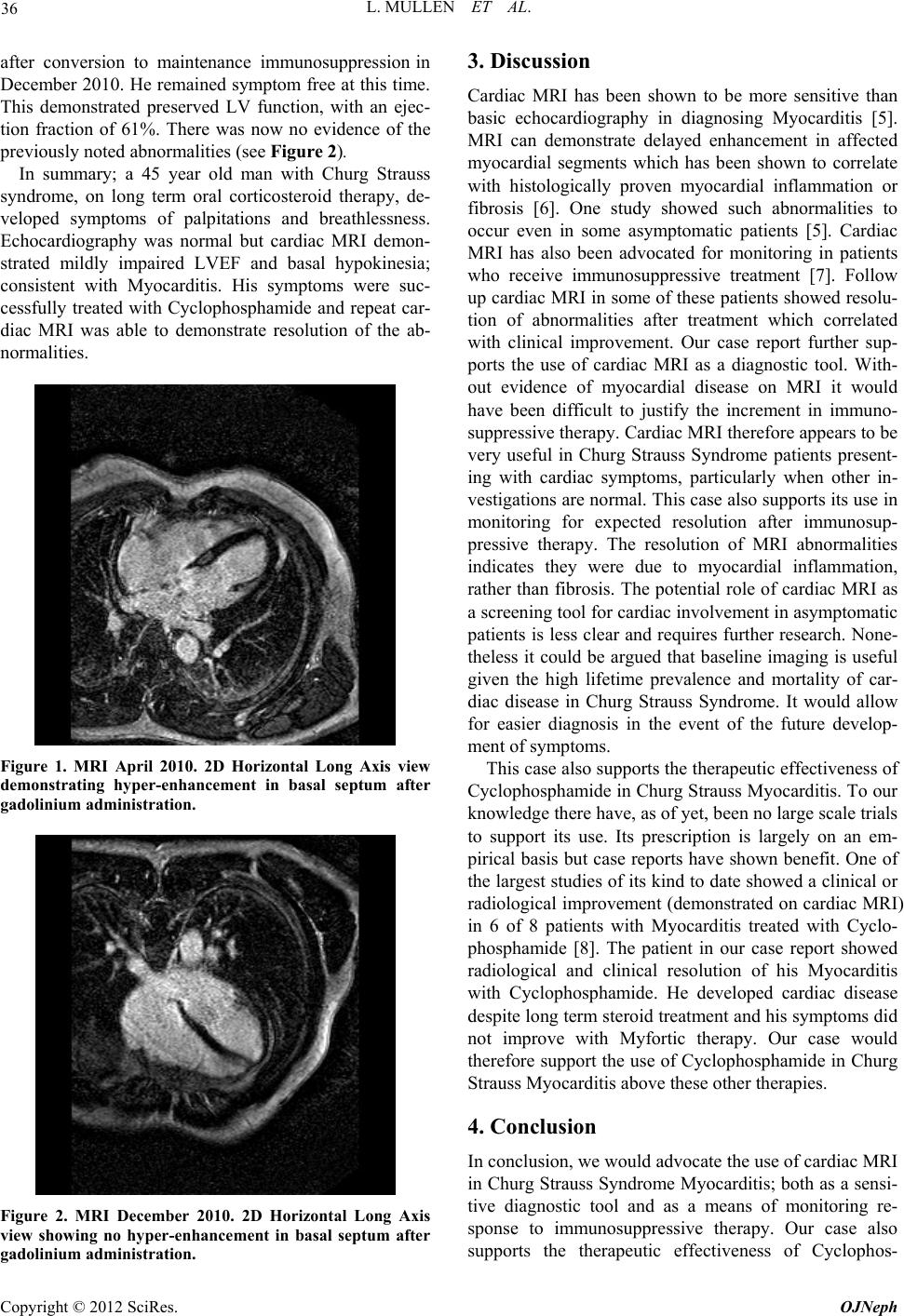 L. MULLEN ET AL. 36 after conversion to maintenance immunosuppression in December 2010. He remained symptom free at this time. This demonstrated preserved LV function, with an ejec- tion fraction of 61%. There was now no evidence of the previously no ted abnormalities (see Figure 2). In summary; a 45 year old man with Churg Strauss syndrome, on long term oral corticosteroid therapy, de- veloped symptoms of palpitations and breathlessness. Echocardiography was normal but cardiac MRI demon- strated mildly impaired LVEF and basal hypokinesia; consistent with Myocarditis. His symptoms were suc- cessfully treated with Cyclophosphamide and repeat car- diac MRI was able to demonstrate resolution of the ab- normalities. Figure 1. MRI April 2010. 2D Horizontal Long Axis view demonstrating hyper-enhancement in basal septum after gadolinium administration. Figure 2. MRI December 2010. 2D Horizontal Long Axis view showing no hyper-enhancement in basal septum after gadolinium administration. 3. Discussion Cardiac MRI has been shown to be more sensitive than basic echocardiography in diagnosing Myocarditis [5]. MRI can demonstrate delayed enhancement in affected myocardial segments which has been shown to correlate with histologically proven myocardial inflammation or fibrosis [6]. One study showed such abnormalities to occur even in some asymptomatic patients [5]. Cardiac MRI has also been advocated for monitoring in patients who receive immunosuppressive treatment [7]. Follow up cardiac MRI in some of these patients showed resolu- tion of abnormalities after treatment which correlated with clinical improvement. Our case report further sup- ports the use of cardiac MRI as a diagnostic tool. With- out evidence of myocardial disease on MRI it would have been difficult to justify the increment in immuno- suppressive therapy. Cardiac MRI therefore appears to be very useful in Churg Strauss Syndrome patients present- ing with cardiac symptoms, particularly when other in- vestigations are nor mal. This case also supports its use in monitoring for expected resolution after immunosup- pressive therapy. The resolution of MRI abnormalities indicates they were due to myocardial inflammation, rather than fibrosis. The potential role of cardiac MRI as a screening tool for cardiac involvement in asymptomatic patients is less clear and requires further research. None- theless it could be argued that baseline imaging is useful given the high lifetime prevalence and mortality of car- diac disease in Churg Strauss Syndrome. It would allow for easier diagnosis in the event of the future develop- ment of symptoms. This case also supports the therapeutic effectiveness of Cyclophosphamide in Churg Strauss Myocarditis. To our knowledge there have, as of yet, been no large scale trials to support its use. Its prescription is largely on an em- pirical basis but case reports have shown benefit. One of the largest studies of its kind to date showed a clinical or radiological improvement (demonstrated on cardiac MRI) in 6 of 8 patients with Myocarditis treated with Cyclo- phosphamide [8]. The patient in our case report showed radiological and clinical resolution of his Myocarditis with Cyclophosphamide. He developed cardiac disease despite long term steroid treatment and his symptoms did not improve with Myfortic therapy. Our case would therefore support th e use of Cyclophosphamide in Churg Strauss Myocarditis above these other therapies. 4. Conclusion In conclusion, we would advocate the use of cardiac MRI in Churg Strauss Syndrome Myocarditis; both as a sensi- tive diagnostic tool and as a means of monitoring re- sponse to immunosuppressive therapy. Our case also supports the therapeutic effectiveness of Cyclophos- Copyright © 2012 SciRes. OJNeph 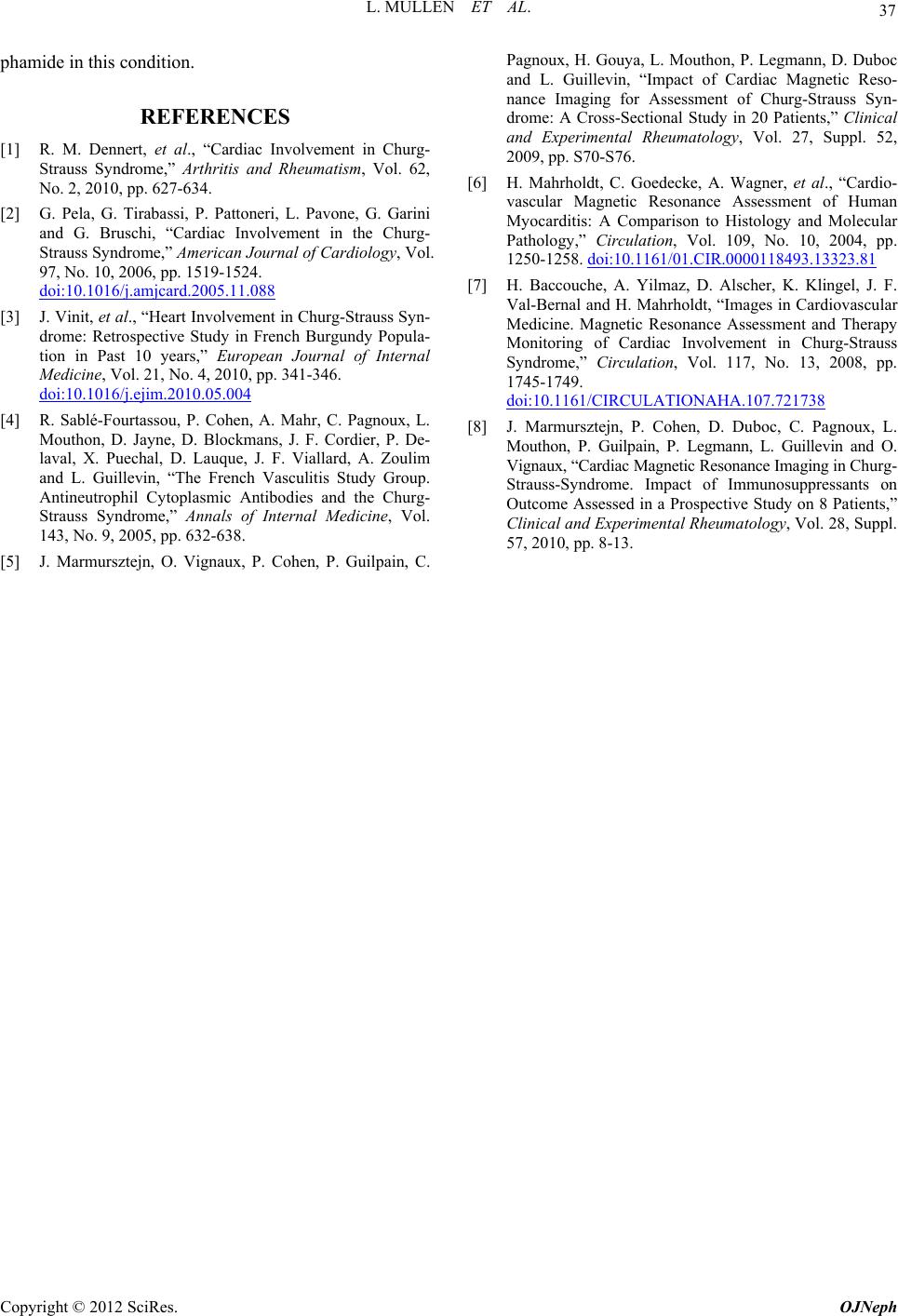 L. MULLEN ET AL. Copyright © 2012 SciRes. OJNeph 37 phamide in this condition. REFERENCES [1] R. M. Dennert, et al., “Cardiac Involvement in Churg- Strauss Syndrome,” Arthritis and Rheumatism, Vol. 62, No. 2, 2010, pp. 627-634. [2] G. Pela, G. Tirabassi, P. Pattoneri, L. Pavone, G. Garini and G. Bruschi, “Cardiac Involvement in the Churg- Strauss Syndrome,” American Journal of Cardiology, Vol. 97, No. 10, 2006, pp. 1519-1524. doi:10.1016/j.amjcard.2005.11.088 [3] J. Vinit, et al., “Heart Involvement in Churg-Strauss Syn- drome: Retrospective Study in French Burgundy Popula- tion in Past 10 years,” European Journal of Internal Medicine, Vol. 21, No. 4, 2010, pp. 341-346. doi:10.1016/j.ejim.2010.05.004 [4] R. Sablé-Fourtassou, P. Cohen, A. Mahr, C. Pagnoux, L. Mouthon, D. Jayne, D. Blockmans, J. F. Cordier, P. De- laval, X. Puechal, D. Lauque, J. F. Viallard, A. Zoulim and L. Guillevin, “The French Vasculitis Study Group. Antineutrophil Cytoplasmic Antibodies and the Churg- Strauss Syndrome,” Annals of Internal Medicine, Vol. 143, No. 9, 2005, pp. 632-638. [5] J. Marmursztejn, O. Vignaux, P. Cohen, P. Guilpain, C. Pagnoux, H. Gouya, L. Mouthon, P. Legmann, D. Duboc and L. Guillevin, “Impact of Cardiac Magnetic Reso- nance Imaging for Assessment of Churg-Strauss Syn- drome: A Cross-Sectional Study in 20 Patients,” Clinical and Experimental Rheumatology, Vol. 27, Suppl. 52, 2009, pp. S70-S76. [6] H. Mahrholdt, C. Goedecke, A. Wagner, et al., “Cardio- vascular Magnetic Resonance Assessment of Human Myocarditis: A Comparison to Histology and Molecular Pathology,” Circulation, Vol. 109, No. 10, 2004, pp. 1250-1258. doi:10.1161/01.CIR.0000118493.13323.81 [7] H. Baccouche, A. Yilmaz, D. Alscher, K. Klingel, J. F. Val-Bernal and H. Mahrholdt, “Images in Cardiovascular Medicine. Magnetic Resonance Assessment and Therapy Monitoring of Cardiac Involvement in Churg-Strauss Syndrome,” Circulation, Vol. 117, No. 13, 2008, pp. 1745-1749. doi:10.1161/CIRCULATIONAHA.107.721738 [8] J. Marmursztejn, P. Cohen, D. Duboc, C. Pagnoux, L. Mouthon, P. Guilpain, P. Legmann, L. Guillevin and O. Vignaux, “Cardiac Magnetic Resonance Imaging in Ch urg - Strauss-Syndrome. Impact of Immunosuppressants on Outcome Assessed in a Prospective Study on 8 Patients,” Clinical and Experimental Rheumatology, Vol. 28, Suppl. 57, 2010, pp. 8-13. |