

Paper Menu >>
Journal Menu >>
 Journal of Minerals and Materials Characterization and Engineering, 2012, 11, 919-923 Published Online September 2012 (http://www.SciRP.org/journal/jmmce) The Effect of Ageing Time on Some Mechanical Properties of Aluminum/0.5% Glass Reinforced Particulate Composite Aondona P. Ihom1*, Nyior G. Bem2, Emmanuel E. Anbua3, Joy N. Ogbodo4 1Department of M e t a l l urgy, National Metallurgical Development Center, Jos, Nigeria 2Department of Metallurgical and Materials Engineering, Ahmadu Bello University, Zaria, Nigeria, 3Department of Mechanical Engineering, Federal Polytechnic Bauchi, Bauchi, Nigeria 4Departmen t of Welding and Fabrication, Scientific Equipment Development Institute (SEDI), Enugu, Nigeria Email: *[email protected] Received June 23, 2012; revised July 31, 2012; accepted August 22, 2012 ABSTRACT A particulate-hardened composite usually known as cermets with aluminum matrix and reinforced with ceramic parti- cles from broken bottles was used to investigate the effect of ageing time on hard ness and tensile strength. Th e samples used for the work were produced using stir-cast method and the samples were cast in metal moulds to improve on the surface finish and to obtain good cooling rate. The composite composition used was Al/0.5% glass particles. The sam- ples were treated at 500˚C and quenched in water at 65˚C. They were then aged at various temperatures ranging from 150˚C - 210˚C. The result of the hardness test showed that within the range of the ageing time selected the hardness increased with the ageing for all the ageing temperatures used. Variations were observed but this is normal in ageing, particularly when coherent and incoherent precipitates are formed at a point in time, or when over-ageing occurs. The plot of the tensile strength tests and the hardness tests, with ageing time showed the trend as observed. The highest hardness value of 37.3 HRB occurred after 5 hours of ageing likewise the highest tensile strength value of 398.36 N/mm2 occurred after 5 hours of ageing at the same ageing temperature of 190˚C. The aged composite showed im- proved hardness and tensile strength when compared to as-cast value of 23.7 HRB for hardness and 253.12 N/mm2 for tensile strength respectively. Keywords: Al/0.5% Glass; Ageing Time; Particulate; Composite; Mechanical Properties 1. Introduction Composite materials are usually classified on the basis of the physical or chemical nature of the matrix phase e.g. polymer matrix, metal matrix, and ceramic composites. According to surappa [1] the term “composite” refers to a material system which is composed of a discrete con- stituent (the reinforcement), distributed in continuous phase (the matrix), and which derives its distinguishing characteristics from the properties of its con stituent, from the geometry and architecture of the constituents and from the properties of the boundaries (interfaces) be- tween different constituents. A composite can also be de- fined as a material that consists of constituents produced via a physical combination of preexisting ingredient ma- terials to obtain a new material with unique properties when compared to the monolith ic material p roperties [2]. Curran [3] pointed out that there are two main types of metal matrix composites, namely powder reinforced and fibre reinforced. In the production of metal matrix com- posites, one of the subjects of interest when choosing the suitable matrix/reinforcement is the interaction in its in- terface. For their production, oxide reinforcements have been used in particles or whiskers morphology, like Al2O3, ZrO2, or ThO2 in aluminum, magnesium and other metal matrix. Metal-matrix composites provide the opp- ortunity to combine metallic properties of the matrices with the ceramic properties of the reinforcements, lead- ing to greater modulus, strength, wear resistance and thermal stability. They are a new class of materials suita- ble for advanced structures, aerospace, automotive, elec- trical, thermal management and wear applications [4]. The transport of solutes through the matrix of a metal is accomplished by diffusion. Diffusion follows Fick’s first law: J Dcx (1) where J is flux, or amount of diffusing substance that passes through a unit cross-sectional area per unit time, *Corresponding author. Copyright © 2012 SciRes. JMMCE 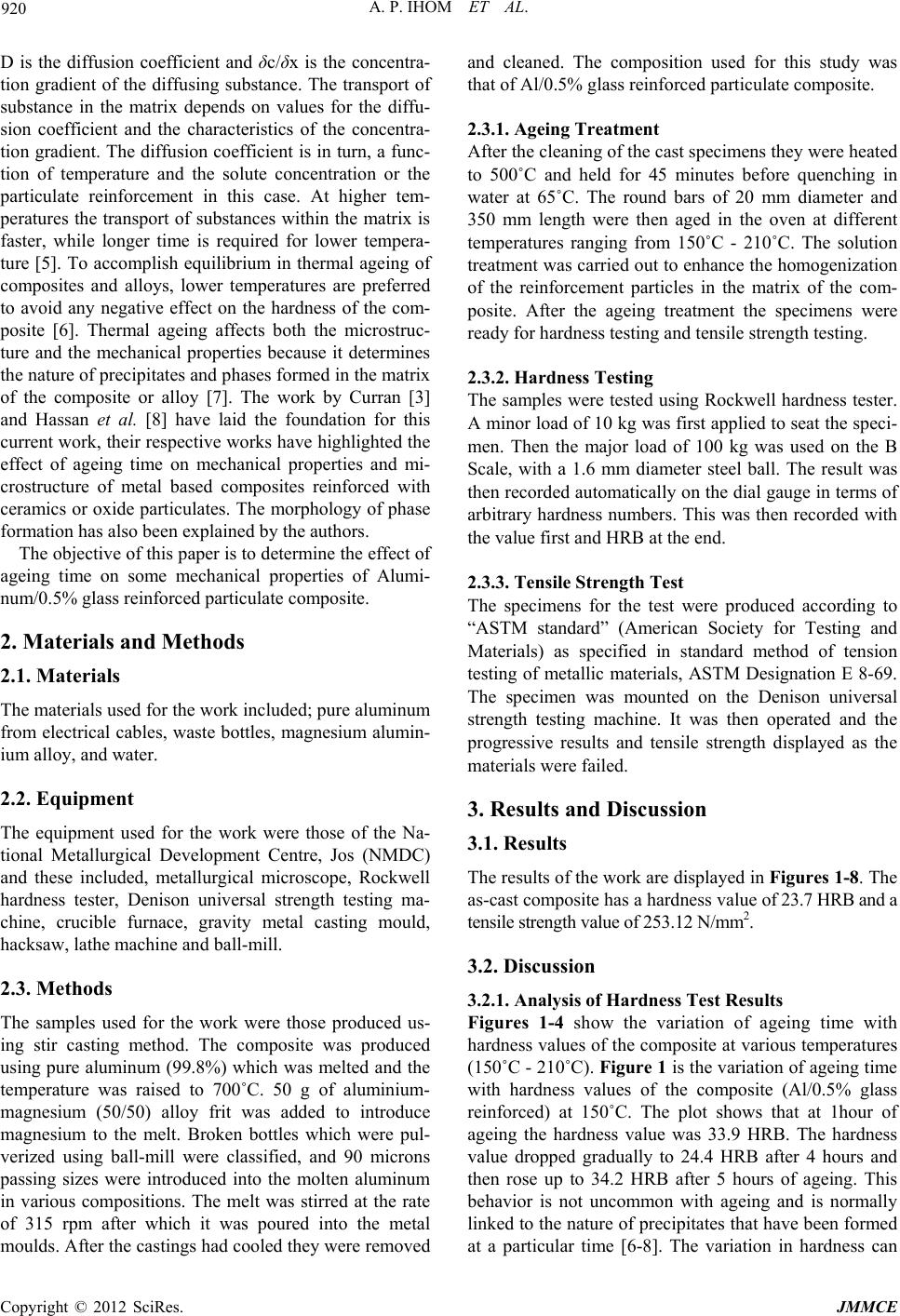 A. P. IHOM ET AL. 920 D is the diffusion coefficient and δc/δx is the concentra- tion gradient of the diffusing substance. The transport of substance in the matrix depends on values for the diffu- sion coefficient and the characteristics of the concentra- tion gradient. The diffusion coefficient is in turn, a func- tion of temperature and the solute concentration or the particulate reinforcement in this case. At higher tem- peratures the transport of substances within the matrix is faster, while longer time is required for lower tempera- ture [5]. To accomplish equilibrium in thermal ageing of composites and alloys, lower temperatures are preferred to avoid any negative effect on the hardness of the com- posite [6]. Thermal ageing affects both the microstruc- ture and the mechanical properties because it determines the nature of precipitates and phases formed in the matrix of the composite or alloy [7]. The work by Curran [3] and Hassan et al. [8] have laid the foundation for this current work, their respective works have highlighted the effect of ageing time on mechanical properties and mi- crostructure of metal based composites reinforced with ceramics or oxide particulates. The morphology of phase format i o n ha s also been explained by the autho r s. The objective of this paper is to d etermine the effect of ageing time on some mechanical properties of Alumi- num/0.5% glass reinforced particulate composite. 2. Materials and Methods 2.1. Materials The materials used for the work included; pure aluminum from electrical cables, waste bottles, magnesium alumin- ium alloy, and water. 2.2. Equipment The equipment used for the work were those of the Na- tional Metallurgical Development Centre, Jos (NMDC) and these included, metallurgical microscope, Rockwell hardness tester, Denison universal strength testing ma- chine, crucible furnace, gravity metal casting mould, hacksaw, lathe machine and ball-mill. 2.3. Methods The samples used for the work were those produced us- ing stir casting method. The composite was produced using pure aluminum (99.8%) which was melted and the temperature was raised to 700˚C. 50 g of aluminium- magnesium (50/50) alloy frit was added to introduce magnesium to the melt. Broken bottles which were pul- verized using ball-mill were classified, and 90 microns passing sizes were introduced into the molten aluminum in various compositions. The melt was stirred at the rate of 315 rpm after which it was poured into the metal moulds. After the castings had cooled they were removed and cleaned. The composition used for this study was that of Al/0.5% glass reinforced particulate composite. 2.3.1. A geing Treatment After the cleaning of the cast specimens they were heated to 500˚C and held for 45 minutes before quenching in water at 65˚C. The round bars of 20 mm diameter and 350 mm length were then aged in the oven at different temperatures ranging from 150˚C - 210˚C. The solution treatment was carried out to enhance the homogenization of the reinforcement particles in the matrix of the com- posite. After the ageing treatment the specimens were ready for hardness testing and tensile strength testing. 2.3.2. Hardness Testi ng The samples were tested using Rockwell hardness tester. A minor load of 10 kg was first applied to seat the speci- men. Then the major load of 100 kg was used on the B Scale, with a 1.6 mm diameter steel ball. The result was then recorded automatically on the dial gauge in terms of arbitrary hardness numbers. This was then recorded with the value first and HRB at the end. 2.3.3. Tensile Strength Test The specimens for the test were produced according to “ASTM standard” (American Society for Testing and Materials) as specified in standard method of tension testing of metallic materials, ASTM Designation E 8-69. The specimen was mounted on the Denison universal strength testing machine. It was then operated and the progressive results and tensile strength displayed as the materials were failed. 3. Results and Discussion 3.1. Results The results of the work are displayed in Figures 1- 8. The as-cast composite has a hardness value of 23.7 HRB and a tensile strength value of 253.12 N/mm 2. 3.2. Discussion 3.2.1. Analysis of Hardness Test Results Figures 1-4 show the variation of ageing time with hardness values of the composite at various temperatures (150˚C - 210˚C). Figure 1 is the variation of ageing time with hardness values of the composite (Al/0.5% glass reinforced) at 150˚C. The plot shows that at 1hour of ageing the hardness value was 33.9 HRB. The hardness value dropped gradually to 24.4 HRB after 4 hours and then rose up to 34.2 HRB after 5 hours of ageing. This behavior is not uncommon with ageing and is normally linked to the nature of precipitates that have been formed at a particular time [6-8]. The variation in hardness can Copyright © 2012 SciRes. JMMCE 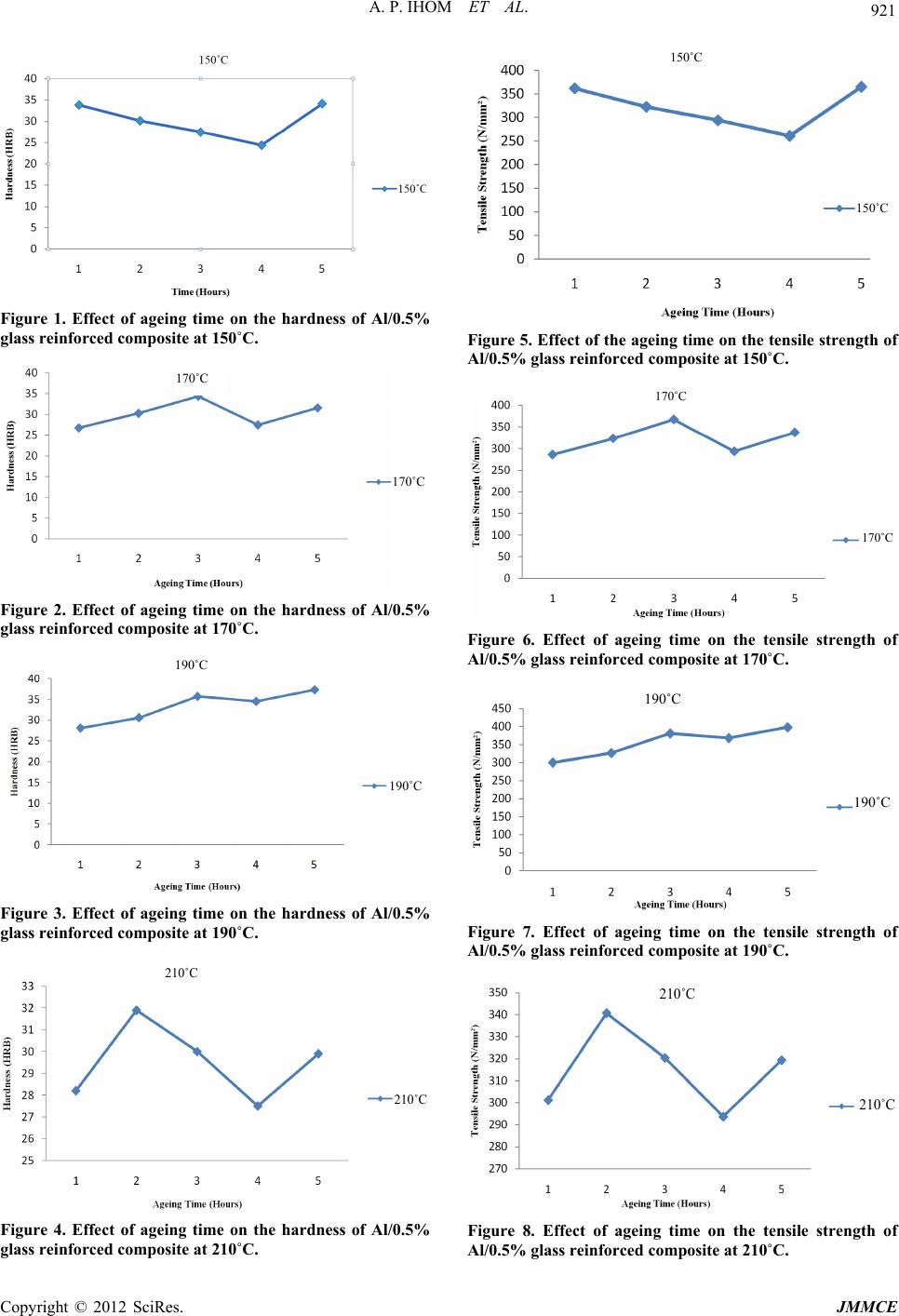 A. P. IHOM ET AL. 921 Figure 1. Effect of ageing time on the hardness of Al/0.5% glass reinforced composite at 150˚C. 170˚C 170˚C Figure 2. Effect of ageing time on the hardness of Al/0.5% glass reinforced composite at 170˚C. 190˚C 190˚C Figure 3. Effect of ageing time on the hardness of Al/0.5% glass reinforced composite at 190˚C. 210˚C 210˚C Figure 4. Effect of ageing time on the hardness of Al/0.5% glass reinforced composite at 210˚C. 150˚C 150˚C Figure 5. Effect of the ageing time on the tensile strength of Al/0.5% glass reinforced composite at 150˚C. 170˚C 170˚C Figure 6. Effect of ageing time on the tensile strength of Al/0.5% glass reinforced composite at 170˚C. 190˚C 190˚C Figure 7. Effect of ageing time on the tensile strength of Al/0.5% glass reinforced composite at 190˚C. 210˚C 210˚C Figure 8. Effect of ageing time on the tensile strength of Al/0.5% glass reinforced composite at 210˚C. Copyright © 2012 SciRes. JMMCE  A. P. IHOM ET AL. 922 also be linked to diffusion of the reinfo rcing agent as the ageing time progresses. This last explanation agrees with the fact that after ageing for 5 hours the hardness values peaked at 34 HRB. This same observation has been made by Hassan et al. [8] in precipitation hardening character- istics of Al-Si-Fe/SiC particulate composites. Figure 2 shows that the highest hardness value of 34.4 HRB was attained after 3 hours of ag eing as against as against 34.2 HRB in Figure 1 attained after 5 hours. This is not sur- prising because the ageing process is a diffusion con- trolled pro ocess and is controll ed by thi s e q uat i on: QRT O DDе (2) where D is the diffusion rate, DO is the diffusion coeffi- cient, Q is the activation energy required to move an atom, R is the gas constant and T is the temperature in Kelvin. At higher temperatures the movement of solute is faster because the activation energy required is met quickly [5,6]. Fick’s law has also explained that the quantity of the substance passing through a unit cross- sectional area in a unit time is proportional to the con- centration gradient (δc/δx) along the x-direction which is perpendicular to this cross-section as in Equation (1). Where D stands for coefficient of diffusion and de- pends on the type of alloy, the type of solid solution, grain size, and so much on the temperature as in the pre- ceding equation. Martin [6] has also predicted that the growth of spherical precipitates should obey an equation of the form r = α(Dt)1/2. Where, r is the particle radius after time t, D (assumed independent of composition) is the volume diffusion coefficient and α is a function of the super saturation. A similar calculation made for the growth of planar precipitates again predicted a parabolic relationship between thickness and time [5,6]. All these have helped in explaining the attainment of higher hard- ness at shorter time at higher temperatures and the growth of precipitates with time. Ageing takes place faster at higher ageing temperature but there is a problem of equilibrium and stability at h igh temperatures [7]. This could result into reduced hardness as can be seen in Fig- ures 3-4 compared. The aged composite has shown im- proved hardness from Figures 1-4 compared with the as-cast hardness value of 23.7 HRB. Figure 3, where ageing took place at 190˚C, however, had the highest hardness values with increase in ageing time [11,12]. 3.2.2. Tensile Strength Test The test has taken into consideration the ultimate strength of the composite at various ageing temperatures and age- ing time. Figure 1 showed that the composite at 150˚C ageing temperature had a tensile strength of 362.05 N/mm2 after been aged for 1 hour. This gradually de- creased to 260.59 N/mm2 and peaked again at 265.26 N/mm2 after 5 hours. The trend is in teresting and may be interpreted in terms of the progressive dispersion of pre- cipitates from the solid solution of the alloy with time [7,9]. The Martin equation also explains this [6]. The process is diffusion-controlled process and can also be observed from Figures 2-4. Figure 3, which ageing took place at 190˚C has high tensile strength when compared to the others. The highest tensile strength of 398.36 N/mm2 occurred at the ageing temperature of 190˚C after 5 hours. This may be due to higher or more homogene- ous dispersion of precipitates with time [8-12]. As the ageing time was increased the tensile strength was also increasing with a slight drop after 4 hours, but continued rising to peak at 398.36 N/mm2 after 5 hours, indicating that the tensile strength increases with the ageing time at a constant temperature of 190˚C. This agrees with Has- san et al. [8] in precipitation hardening characteristics of Al-Si-Fe/SiC particulate composites. Comparing the ten- sile strength of the age hardened composite at various temperature and time regimes it can be seen that most ageing times showed improved tensile streng th as against the as-cast tensile strength [11]. The as-cast tensile strength of the composite is 2 53.12 N/mm2 and the high- est tensile strength of 398.36 N/mm2 of the aged hard- ened composite occurred at 5 hours of ageing at 190˚C. This still confirms that ageing time has effect on this mechanical property of the composite. The general trend in Figures 1-4 is that the tensile strength increased with the ageing time of the composite at different tempera- tures covering the range 150˚C to 210˚C. This can be linked to the precipitation of a second phase during age- ing of the composite giving rise to increased tensile strength [8]. The strength is due to solid solution metal- ceramic bond formed at the interface leading to increased tensile strength. 4. Conclusions The study has been conducted and the following conclu- sions were drawn from the study: 1) The mechanical properties of the composite (Al/ 0.5% glass reinforced) are higher in the age-hardened samples than in the as-cast samples, most likely due to the precipitation of a second phase during ageing which cover the surface at the particles-matrix interfaces. 2) The hardness increased with ageing time. 3) The tensile strength of the composite also increased with ageing time. 4) The study has established that this grade of com- posite responded to ageing as shown in the improved mechanical properties tested. 5) The composite is a cermet composite with the in- creased strength arising from solid solution bonding at Copyright © 2012 SciRes. JMMCE  A. P. IHOM ET AL. Copyright © 2012 SciRes. JMMCE 923 the interface. 5. Acknowledgements The authors are seriously indeb ted to the management of the National Metallurgical Development Centre, Jos for providing their facilities for this research work. REFERENCES [1] M. K. Suprappa, “Aluminum Matrix Composites: Chal- lenges and Opportunities,” Sadhana, Vol. 28, No. 1-2, 2003, pp. 319-334. doi:10.1007/BF02717141 [2] Http:/umewww.epf/ch/people/cayron/Fichiers/thesebook- hap.2pdf [3] G. Curran, “MMCs, the Future,” Materials World, Vol. 6, No. 1, 1998, pp. 21-22. [4] M. Gupta, “Recycling of Aluminum Based Composite Using Disintegrated Melt Deposition Technique,” Na- tional University of Singapore, Engineering Research, Vol. 23, No. 1, 2008. [5] ASM Committee on Gas Carburizing, “Carburizing and Carbonitriding,” American Society for Metals, 1977, pp. 6-20. [6] J. W. Martin, “Precipitation Hardening,” 2nd Edition, Butterworth Heinemann, 1998. [7] R. A. Higgins, “Properties of Engineering Ma terials,” 5th Edition, Hodder and Stoughton, London, 1983. [8] S. B. Hassan, O. Aponbiede and V. S. Aigbodion, “Pre- cipitation Hardening Characteristics of Al-Si-Fe/SiC Par- ticulate Composite,” Journal of Alloys and Compounds, Vol. 466, No. 1-2, 2008, pp. 268-272. doi:10.1016/j.jallcom.2007.11.023 [9] S. B. Hassan and V. S. Aigbodion, “The Effect of Ther- mal Ageing on Microstructure and Mechanical Properties of Al-Si-Fe/Mg Alloys,” Journal of Alloys and Com- pounds, Vol. 486, No. 1-2, 2009, pp. 309-314. doi:10.1016/j.jallcom.2009.06.131 [10] G. E. Dieter, “Mechanical Metallurgy,” 3rd Edition, MCgraw-Hill Book Company, London, 1988. [11] M. H. Mohammad, T. M. Ahmad, M. H. Adel and T. H. Mohammad, “The Effect of Time, Percent of Copper and Nickel on Naturally Aged Al-Cu-Ni Cast Alloys,” Jour- nal of Minerals and Materials Characterization and En- gineering, Vol. 11, No. 2, 2012, pp. 117-131. [12] O. A. Alo, L. E. Umoru, J. A. Ajao and K. M. Oluwase- gun, “Thermal, Hardness, and Microstructural Charac- terization of Al-Si-SiCp Composites,” Journal of Miner- als and Materials Characterization and Engineering, Vol. 11, No. 2, 2012, pp. 159-168. |