

Paper Menu >>
Journal Menu >>
 Journal of Minerals and Materials Characterization and Engineering, 2012, 11, 904-907 Published Online September 2012 (http://www.SciRP.org/journal/jmmce) Growth, Structural, Optical and Hardness Studies of Lithium Potassium Sulphate Single Crystals— An Inorganic NLO Material G. Pasupathi*, P. Philominathan PG Research and Department of Physics, A. Veeriya Vandayar Memorial Sri Pushpam College, Thanjavur, India Email: *[email protected] Received May 25, 2012; revised June 27, 2012; accepted July 20, 2012 ABSTRACT Single crystal of lithium potassium sulphate, a nonlinear optical material, was grown from aqua solution by slow evapo- ration method at room temperature. The cell parameters were estimated by single crystal X-ray diffraction analysis. The optical transmittance of the crystal was recorded using the UV-Vis-NIR spectrophotometer and the optical band gap was calculated using this method. The second harmonic generation efficiency was measured by Kurtz and Perry powder technique and the phase-matching property was confirmed. The hardness of the material was measured by Vicker’s hardness test. Keywords: Crystal Growth; Lithium-Potassium Sulphate; Inorganic NLO Material; X-Ray Diffraction; SHG Efficiency 1. Introduction In the recent past, extensive studies have been made on the synthesis and crystal growth of nonlinear optical (NLO) materials due to their potential application in the field of telecommunication, photonics and opto electron- ics technology. Presently, numerous inorganic NLO ma- terials have been developed to increasing the variety of these applications by the researchers [1-3]. In this series, lithium potassium sulphate LiKSO4 (namely, LKS) be- longs to a family with the general structural formula 4 (M' = Li, Na; M'' = K, Cs, Rb ions, NH4, N2H5 group and AX4 = M'M''AX 2 4 SO , , BeF4). The sig- nificant attention is currently being paid to these crystals due to their physical properties such as ferroelectricity, piezoelectricity and ionic conductivity. During the past two decades, extensive studies have been carried out for the growth, structural and phase transition of LKS crystal. At room temperature, it exhibits a hexagonal system with P63 space group [4,5]. In addition, it undergoes several structural phase transitions below [6] and above room temperature [7]. 2 4 SeO In the present investigation is aimed at the growth of lithium potassium sulphate single crystals by slow evap- oration method at room temperature. The grown crystals have been subjected to single crystal X-ray diffraction analysis, UV-Vis-NIR spectral analysis, optical band gap measurements, second harmonic generation (SHG) mea- surement, phase matching and Vicker’s hardness test. 2. Experimental Procedure 2.1. Synthesis of the Material Lithium potassium sulphate was synthesized by the che- mical reaction of commercially available Lithium sul- phate (Analar grade-E. Merck) with Potassium sulphate (Analar grade-E. Merck) taken in the stoichiometric ratio 1:1 by dissolving double-distilled water (solvent) at room temperature and the chemical reaction is given below 242 2442 KSO HOLiSOLiKSO HO (1) 2.2. Growth of Single Crystals A saturated solution of LKS was prepared by double- distilled water. The solution was allowed to slow evapo- ration in the vibrational and dust free atmosphere. After the growth period of 25 days, colourless and transparent crystals were harvested. The harvested crystals were rec- rystallized repeatedly to achieve good quality as shown in Figure 1. 2.3. Characterization Technique The single crystal X-ray diffraction (XRD) studies of LKS were carried out using Enraf nonius CAD4 single X-ray diffractometer with MoKα (λ = 0.717 Å) radiation. The UV-Vis-NIR spectrum was recorded using Perkin elmmer Lamda 35 spectrophotometer in the range of 190 - *Corresponding author. Copyright © 2012 SciRes. JMMCE 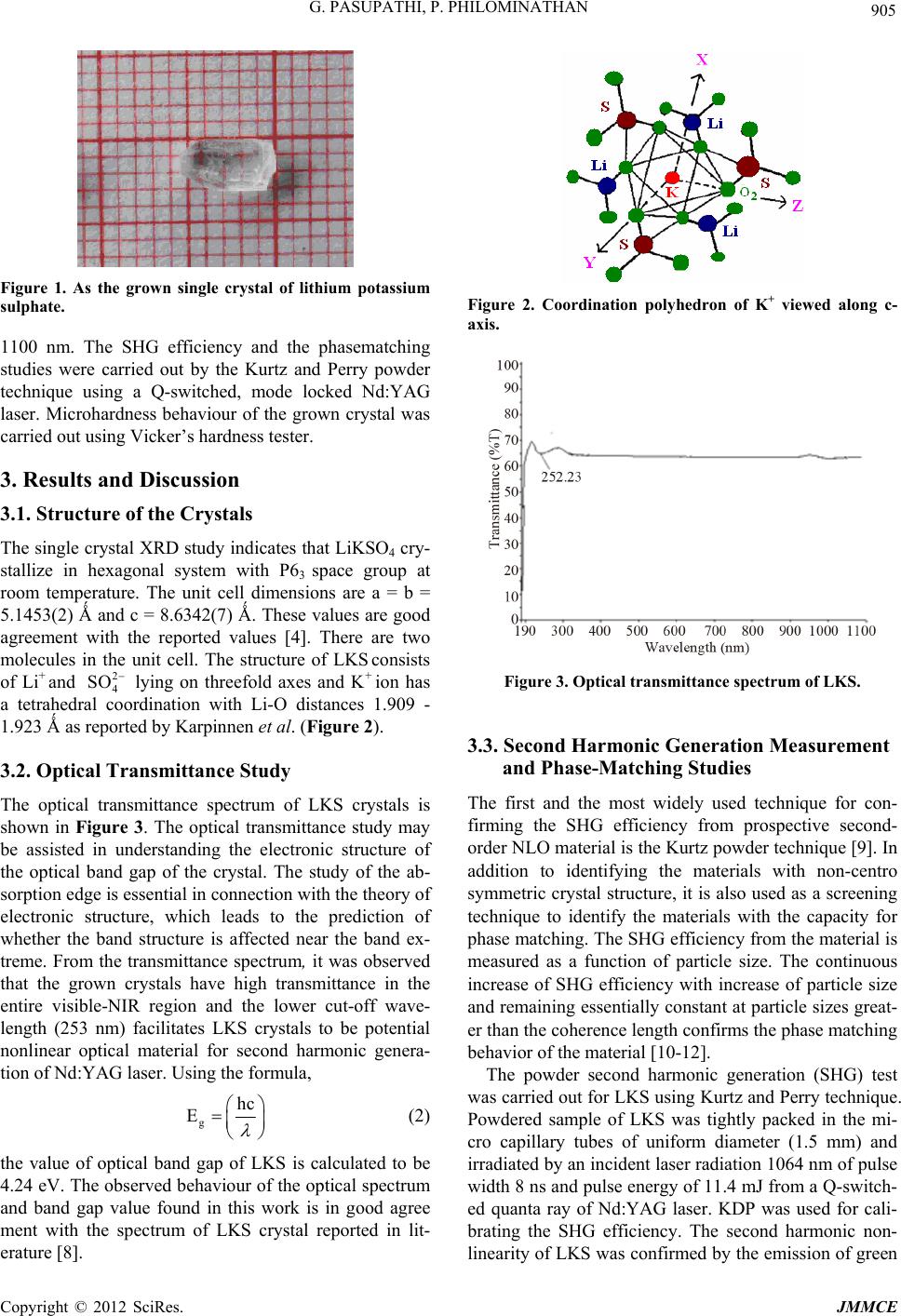 G. PASUPATHI, P. PHILOMINATHAN 905 Figure 1. As the grown single crystal of lithium potassium sulphate. 1100 nm. The SHG efficiency and the phasematching studies were carried out by the Kurtz and Perry powder technique using a Q-switched, mode locked Nd:YAG laser. Microhardness behaviour of the grown crystal was carried out using Vicker’s hardness tester. 3. Results and Discussion 3.1. Structure of the Crystals The single crystal XRD study indicates that LiKSO4 cry- stallize in hexagonal system with P63 space group at room temperature. The unit cell dimensions are a = b = 5.1453(2) Ǻ and c = 8.6342(7) Ǻ. These values are good agreement with the reported values [4]. There are two molecules in the unit cell. The structure of LKS consists of Li+ and lying on threefold axes and K+ ion has a tetrahedral coordination with Li-O distances 1.909 - 1.923 Ǻ as reported by Karpinnen et al. (Figure 2). 2 4 SO 3.2. Optical Transmittance Study The optical transmittance spectrum of LKS crystals is shown in Figure 3. The optical transmittance study may be assisted in understanding the electronic structure of the optical band gap of the crystal. The study of the ab- sorption edge is essential in connection with the theory of electronic structure, which leads to the prediction of whether the band structure is affected near the band ex- treme. From the transmittance spectrum, it was observed that the grown crystals have high transmittance in the entire visible-NIR region and the lower cut-off wave- length (253 nm) facilitates LKS crystals to be potential nonlinear optical material for second harmonic genera- tion of Nd:YAG laser. Using the formula, g hc E (2) the value of optical band gap of LKS is calculated to be 4.24 eV. The observed behaviour of the optical spectrum and band gap value found in this work is in good agree ment with the spectrum of LKS crystal reported in lit- erature [8]. Figure 2. Coordination polyhedron of K+ viewed along c- axis. Figure 3. Optical transmittance spectrum of LKS. 3.3. Second Harmonic Generation Measurement and Phase-Matching Studies The first and the most widely used technique for con- firming the SHG efficiency from prospective second- order NLO material is the Kurtz powder technique [9]. In addition to identifying the materials with non-centro symmetric crystal structure, it is also used as a screening technique to identify the materials with the capacity for phase matching. The SHG efficiency from the material is measured as a function of particle size. The continuous increase of SHG efficiency with increase of particle size and remaining essentially constant at particle sizes great- er than the coherence length confirms the phase matching behavior of the material [10-12]. The powder second harmonic generation (SHG) test was carried out for LKS using Kurtz and Perry technique. Powdered sample of LKS was tightly packed in the mi- cro capillary tubes of uniform diameter (1.5 mm) and irradiated by an incident laser radiation 1064 nm of pulse width 8 ns and pulse energy of 11.4 mJ from a Q-switch- ed quanta ray of Nd:YAG laser. KDP was used for cali- brating the SHG efficiency. The second harmonic non- linearity of LKS was confirmed by the emission of green Copyright © 2012 SciRes. JMMCE 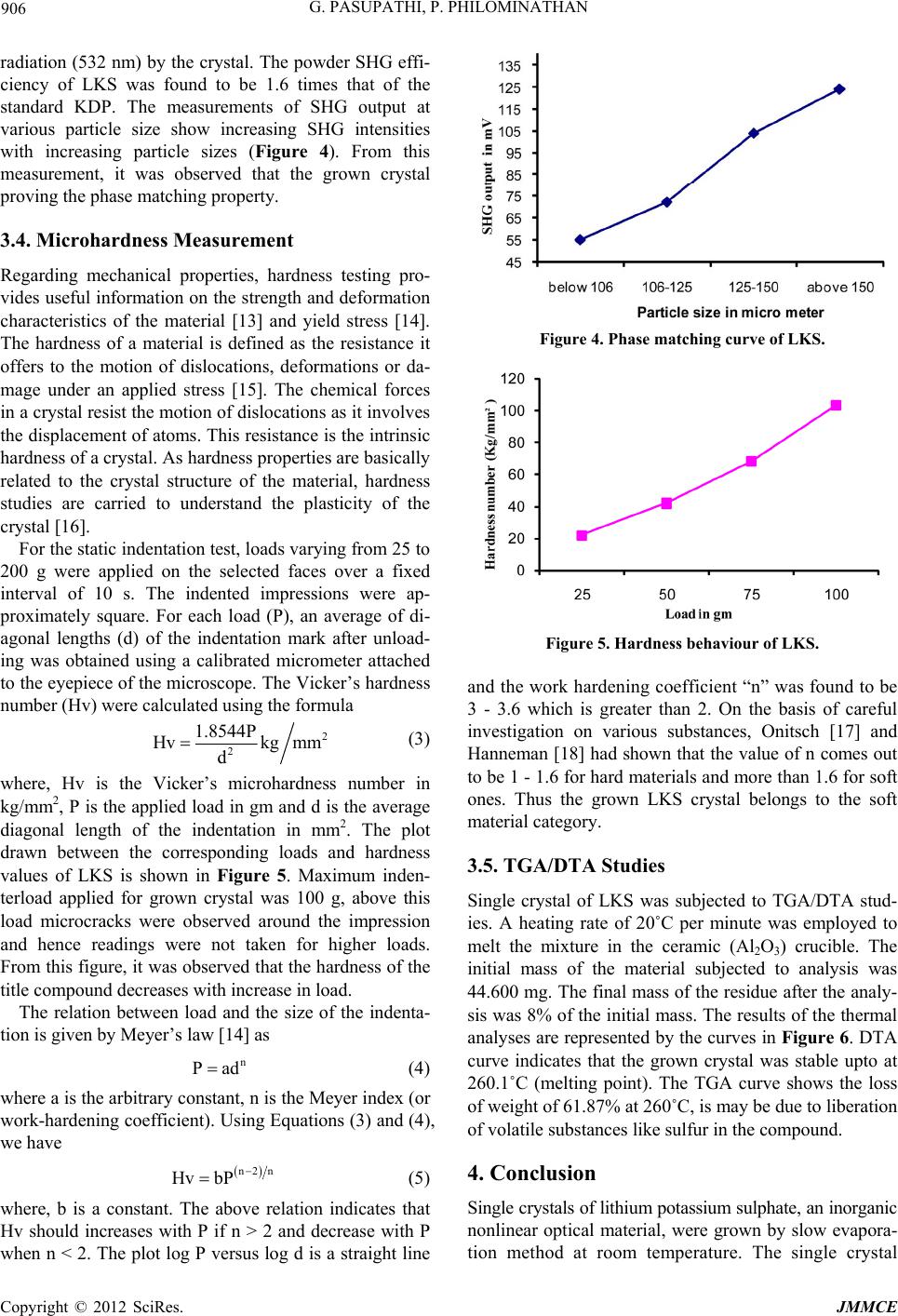 G. PASUPATHI, P. PHILOMINATHAN 906 radiation (532 nm) by the crystal. The powder SHG effi- ciency of LKS was found to be 1.6 times that of the standard KDP. The measurements of SHG output at various particle size show increasing SHG intensities with increasing particle sizes (Figure 4). From this measurement, it was observed that the grown crystal proving the phase matching property. 3.4. Microhardness Measurement Regarding mechanical properties, hardness testing pro- vides useful information on the strength and deformation characteristics of the material [13] and yield stress [14]. The hardness of a material is defined as the resistance it offers to the motion of dislocations, deformations or da- mage under an applied stress [15]. The chemical forces in a crystal resist the motion of dislocations as it involves the displacement of atoms. This resistance is the intrinsic hardness of a crystal. As hardness properties are basically related to the crystal structure of the material, hardness studies are carried to understand the plasticity of the crystal [16]. For the static indentation test, loads varying from 25 to 200 g were applied on the selected faces over a fixed interval of 10 s. The indented impressions were ap- proximately square. For each load (P), an average of di- agonal lengths (d) of the indentation mark after unload- ing was obtained using a calibrated micrometer attached to the eyepiece of the microscope. The Vicker’s hardness number (Hv) were calculated using the formula 2 2 1.8544P Hvkg mm d (3) where, Hv is the Vicker’s microhardness number in kg/mm2, P is the applied load in gm and d is the average diagonal length of the indentation in mm2. The plot drawn between the corresponding loads and hardness values of LKS is shown in Figure 5. Maximum inden- terload applied for grown crystal was 100 g, above this load microcracks were observed around the impression and hence readings were not taken for higher loads. From this figure, it was observed that the hardness of the title compound decreases with increase in load. The relation between load and the size of the indenta- tion is given by Meyer’s law [14] as n Pad (4) where a is the arbitrary constant, n is the Meyer index (or work-hardening coefficient). Using Equations (3) and (4), we have n2n HvbP (5) where, b is a constant. The above relation indicates that Hv should increases with P if n > 2 and decrease with P when n < 2. The plot log P versus log d is a straight line Figure 4. Phase matching curve of LKS. Figure 5. Hardness behaviour of LKS. and the work hardening coefficient “n” was found to be 3 - 3.6 which is greater than 2. On the basis of careful investigation on various substances, Onitsch [17] and Hanneman [18] had shown that the value of n comes out to be 1 - 1.6 for hard materials and more than 1.6 for soft ones. Thus the grown LKS crystal belongs to the soft material category. 3.5. TGA/DTA Studies Single crystal of LKS was subjected to TGA/DTA stud- ies. A heating rate of 20˚C per minute was employed to melt the mixture in the ceramic (Al2O3) crucible. The initial mass of the material subjected to analysis was 44.600 mg. The final mass of the residue after the analy- sis was 8% of the initial mass. The results of the thermal analyses are represented by the curves in Figure 6. DTA curve indicates that the grown crystal was stable upto at 260.1˚C (melting point). The TGA curve shows the loss of weight of 61.87% at 260˚C, is may be due to liberation of volatile substances like sulfur in the compound. 4. Conclusion Single crystals of lithium potassium sulphate, an inorganic nonlinear optical material, were grown by slow evapora- tion method at room temperature. The single crystal Copyright © 2012 SciRes. JMMCE  G. PASUPATHI, P. PHILOMINATHAN Copyright © 2012 SciRes. JMMCE 907 [4] M. Karppinnen, J. O. Lundgren and R. Liminga, “Struc- ture of Pyroelectric Lithium Potassium Sulphate, LiKSO4,” Acta Crystallographica Section C, Vol. 39, 1983, pp. 34- 38. doi:10.1107/S0108270183003509 [5] M. A. Pimenta, S. L. V. Vierira, F. O. V. Letelier, N. L. Speziali and M. S. Dantas, “Ionic Conductivity in LiK0.9Na0.1SO4 Single Crystals,” Solid State Communica- tions, Vol. 82, No. 10, 1992, pp. 758-757. doi:10.1016/0038-1098(92)90158-6 [6] A. Lunden and J. O. Thomas, “High Conductivity Solid State Conductors: Recent Trends and Applications,” World Scientific, Singapore City, 1986. [7] H. K. Liu, M. L. Hu, W. S. Tse, D. P. Wong and S. J. Lin, “Raman Studies of Low Temperature Phase Transition in LiKSO4,” Chinese Journal of Physics, Vol. 36, No. 3, 1998, pp. 542-548. Figure 6. TG/DTA spectrum of LKS crystal. X-ray diffraction analysis confirms the grown crystal belongs to hexagonal system. The optical transmittance study shows the crystal has good transmittance in the entire visible-NIR region and wide band gap. The Kurtz and Perry powder SHG method confirm the SHG effi- ciency of LKS is 1.6 times that of KDP and phase- matching property. The mechanical property of the mate- rial was studied by Vicker’s hardness measurement. [8] A. A. El-Fadl, M. A. Gaffar and M. H. Omar, “Absorp- tion Spectra and Optical Parameters of Lithium-Potas- sium Sulphate Single Crystals,” Physica B, Vol. 269, No. 3-4, 1999, pp. 403-408. [9] S. K. Kurtz and T. T. Perry, “A Second Harmonic Ana- lyzer for the Detection of Non-Centrosymmetry,” Journal of Applied Physics, Vol. 39, 1968, pp. 145-158. [10] R. L. Sutherland, “Handbook of Nonlinear Optics,” 2nd Edition, Dekker, New York, 2003. [11] M. Kiguchi, M. Kato, M. Okunak and Y. Taniguchi, “New Method of Measuring Second Harmonic Genera- tion Efficiecny Using Powder Crystals,” Applied Physics Letters, Vol. 60, No. 16, 1992, pp. 1933-1935. doi:10.1063/1.107155 5. Acknowledgements One of the authors Mr. G. Pasupathi, thankful to the Uni- versity Grant Commission, New Delhi for providing the funding agency through Minor Research Project. [12] A. Sonoc, M. Samoc and P. N. Prasad, “Second-Har- monic Generation in the Crystalline Complex Antimony Triiodide—Sulfur,” Journal of Optical Society of Ametica B, Vol. 9, No. 10, 1992, pp. 1819-1824. doi:10.1364/JOSAB.9.001819 REFERENCES [1] K. C. Zhang and X. M. Wang, “Structure Sensitive Prop- erties of KTP-Type Crystals,” Chinese Science Bulletin, Vol. 46, No. 24, 2001, pp. 2028-2036. doi:10.1007/BF02901124 [13] B. W. Mott, “Micro-Indentation Hardness Testing,” But- terworths, London, 1956. [14] J. H. Westbrook, “Flow in Rock Salt Structure,” Report 58-RL 2033 of the GE Research Laboratory, USA, 1958. [2] S. M. Ravi Kumar, N. Melikechi, S. Selvakumar and P. Sagayaraj, “Crystal Growth and Characterization of NLO Single Crystals Cd(IO3)2,” Journal of Crystal Growth, Vol. 311, No. 2, 2009, pp. 337-334. doi:10.1016/j.jcrysgro.2008.11.058 [15] N. A. Ashby, Journal of Nuclear Engineering, Vol. 6, 1951, p. 33. [16] K. K. Rao and D. B. Sirdeshmukh, “Microhardness and Interatomic Binding in Some Cubic Crystals,” Bulletin of Materials Science, Vol. 5, No. 5, 1983, pp. 449-452. doi:10.1007/BF02743923 [3] R. Robert, C. Justin Raj, S. Krishnan and S. Jerome Das, “Growth, Theoretical and Optical Studies on Potassium Dihydrogen Orthophosphate (KDP) Single Crystals by Modified Sankaranarayanan and Ramasamy (mSR) Me- thod,” Physica B: Condensed Matter Physics, Vol. 405, No. 1, 2010, pp. 20-24. [17] E. M. Onitsch, Mikroskopia, Vol. 2, 1947, p. 131. [18] M. Hanneman, Metallurgia Manchu, Vol. 23, 1941, p. 135. |