

Paper Menu >>
Journal Menu >>
 Journal of Minerals and Materials Characterization and Engineering, 2012, 11, 885-890 Published Online September 2012 (http://www.SciRP.org/journal/jmmce) Adsorpt ion and Thermo dynamics Study of the Inhibition of Corrosion of Mild Steel in H2SO4 Medium Using Vernonia amygdalina Joseph Tagbo Nwabanne*, Vincent Nwoye Okafor Department of Chemical Engineering, Nnamdi Azikiwe University, Awka, Nigeria Email: *[email protected] Received April 19, 2012; revised May 31, 2012; accepted June 19, 2012 ABSTRACT In this work, adsorption and thermodynamics study of the inhibition of corrosion of mild steel in H2SO4 medium using Vernonia amygdalina was carried out. The inhibitive and adsorptive properties of ethanol extract of Vernonia amygda- lina for the corrosion of mild steel in 0.2 M H2SO4 solutions was investigated using weight loss technique. The result has proved that that the extract is a good inhibitor of corrosion of mild steel in H2SO4. The inhibition efficiencies ranged from 23.37% to 38.59% and from 22.45% to 35.78% at 303 and 323 K respectively. The inhibition efficiency of the extract decreased as temperature and time of immersion increased but increased with increase in concentration of ex- tract. The adsorption of the inhibitor on surface of mild steel was found to be exothermic, spontaneous and consistent with the mechanism of physical adsorption as the value for heat of adsorption ranged from –2.12 to –4.87 KJ·mol–1. The adsorption data fitted well to Langmuir, Temkin, Frumkin and Flory-Huggins adsorption isotherms. Keywords: Adsorption; Corrosion; Mild Steel; Inhibition; Vernonia amygdalina 1. Introduction Mild steel is the most commonly used engineering mate- rial [1]. Oftentimes, mild steel is exposed to the attack of acid solutions during industrial processes such as acid cleaning, pickling and descaling. This results to easy corrosion of the mild steel, thereby necessitating the use of inhibitor [2-5]. There are numerous methods for con- trolling the corrosion of metals but the use of inhibitors is still one of the best methods of protecting metals against corrosion [6-8]. Many organic compounds are used as corrosion inhibitors for mild steel in acidic environments. Such compounds usually contain nitrogen, oxygen or sulphur in a conjugated system and function via adsorp- tion of the molecules on the metal surface, creating a barrier to the corrodant attack [3,5,8,9]. However, becau- se of the Sequel to toxic nature, high cost and increasing awareness and strict environmental regulations of some of these compounds, the use of natural product of plant origin as corrosion inhibitor is receiving attention [10, 11]. Corrosion inhibitors derived from plant extract are biodegradable and do not contain heavy metals or other toxic compounds [12]. Several researches have been done on the use of ex- tract of plant as inhibitor for metals against corrosion in different aggressive media [13,14]. However, not much has been reported on the use of the extract of Vernonia amygdalina plant as inhibitor against corrosion of mild steel in H2SO4. Vernonia amygdalina is a member of the Asteraceae family which is a small shrub that grows in the tropical Africa. Vernonia amygdalina is also called bitter leaf because of its bitter taste. The leaves are used either as a vegetable (macerated leaves in soups) or aque- ous extracts for treatment of various illnesses [15]. There- fore, the present work is aimed at investigating the po- tential of ethanol extract of Vernonia amygdalina leaves as corrosion inhibitor of mild steel in sulphuric acid. 2. Materials and Methods 2.1. Materials Preparation Mild steel of composition (wt%) Mn (0.6), P (0.36), C (0.15) and Si (0.03) and Fe (98.86) were used for the study. The sheet was cut to form different coupons of dimension, 4 × 3 × 0.1 cm. Each coupon was degreased by washing with ethanol, rinsed with acetone and al- lowed to dry in the air before preservation in a dessicator. All reagents used for the study were of analytical grade and double distilled water was used in this study. 2.2. Preparation of Plant Extract *Corresponding author. Stock solutions of the plant extract were prepared by Copyright © 2012 SciRes. JMMCE 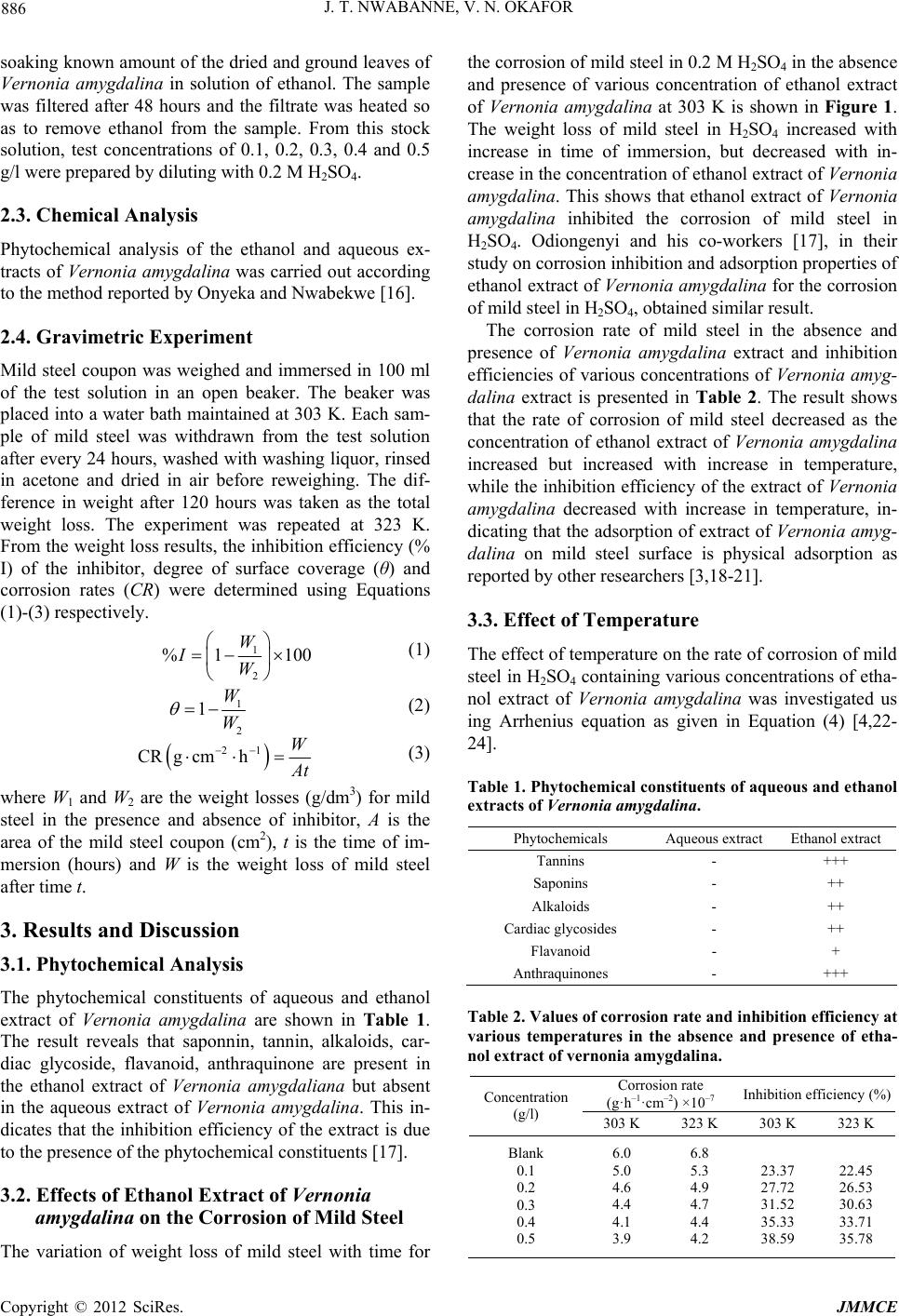 J. T. NWABANNE, V. N. OKAFOR 886 soaking known amount of the dried and ground leaves of Vernonia amygdalina in solution of ethanol. The sample was filtered after 48 hours and the filtrate was heated so as to remove ethanol from the sample. From this stock solution, test concentrations of 0.1, 0.2, 0.3, 0.4 and 0.5 g/l were prepared by diluting with 0.2 M H2SO4. 2.3. Chemical Analysis Phytochemical analysis of the ethanol and aqueous ex- tracts of Vernonia amygdalina was carried out according to the method reported by Onyeka and Nwabekwe [16]. 2.4. Gravimetric Experiment Mild steel coupon was weighed and immersed in 100 ml of the test solution in an open beaker. The beaker was placed into a water bath maintained at 303 K. Each sam- ple of mild steel was withdrawn from the test solution after every 24 hours, washed with washing liquor, rinsed in acetone and dried in air before reweighing. The dif- ference in weight after 120 hours was taken as the total weight loss. The experiment was repeated at 323 K. From the weight loss results, the inhibition efficiency (% I) of the inhibitor, degree of surface coverage (θ) and corrosion rates (CR) were determined using Equations (1)-(3) respectively. 1 2 % 1100 W IW (1) 1 2 1W W (2) 21 CRg cmhW A t (3) where W1 and W2 are the weight losses (g/dm3) for mild steel in the presence and absence of inhibitor, A is the area of the mild steel coupon (cm2), t is the time of im- mersion (hours) and W is the weight loss of mild steel after time t. 3. Results and Discussion 3.1. Phytochemical Analysis The phytochemical constituents of aqueous and ethanol extract of Vernonia amygdalina are shown in Table 1. The result reveals that saponnin, tannin, alkaloids, car- diac glycoside, flavanoid, anthraquinone are present in the ethanol extract of Vernonia amygdaliana but absent in the aqueous extract of Vernonia amygdalina. This in- dicates that the inhibition efficiency of the extract is due to the presence of the phytochemical constituents [17]. 3.2. Effects of Ethanol Extract of Vernonia amygdalina on the Corrosion of Mild Steel The variation of weight loss of mild steel with time for the corrosion of mild steel in 0.2 M H2SO4 in the absence and presence of various concentration of ethanol extract of Vernonia amygdalina at 303 K is shown in Figure 1. The weight loss of mild steel in H2SO4 increased with increase in time of immersion, but decreased with in- crease in the concentration of ethanol extract of Vernonia amygdalina. This shows that ethanol extract of Vernonia amygdalina inhibited the corrosion of mild steel in H2SO4. Odiongenyi and his co-workers [17], in their study on corrosion inhibition and adsorption properties of ethanol extract of Vernonia amygdalina for the corrosion of mild steel in H2SO4, obtained similar result. The corrosion rate of mild steel in the absence and presence of Vernonia amygdalina extract and inhibition efficiencies of various concentrations of Vernonia amyg- dalina extract is presented in Table 2. The result shows that the rate of corrosion of mild steel decreased as the concentration of ethanol extract of Vernonia amygdalina increased but increased with increase in temperature, while the inhibition efficiency of the extract of Vernonia amygdalina decreased with increase in temperature, in- dicating that the adsorption of extract of Vernonia amyg- dalina on mild steel surface is physical adsorption as reported by other researchers [3,18-21]. 3.3. Effect of Temperature The effect of temperature on the rate of corrosion of mild steel in H2SO4 containing various concentrations of etha- nol extract of Vernonia amygdalina was investigated us ing Arrhenius equation as given in Equation (4) [4,22- 24]. Table 1. Phytochemical constituents of aqueous and ethanol extracts of Vernonia amygdalina. Phytochemicals Aqueous extract Ethanol extract Tannins - +++ Saponins - ++ Alkaloids - ++ Cardiac glycosides - ++ Flavanoid - + Anthraquinones - +++ Table 2. Values of corrosion rate and inhibition efficiency at various temperatures in the absence and presence of etha- nol extract of vernonia amygdalina. Corrosion rate (g·h–1·cm–2) ×10–7 Inhibition efficiency (%) Concentration (g/l) 303 K 323 K 303 K 323 K Blank 0.1 0.2 0.3 0.4 0.5 6.0 5.0 4.6 4.4 4.1 3.9 6.8 5.3 4.9 4.7 4.4 4.2 23.37 27.72 31.52 35.33 38.59 22.45 26.53 30.63 33.71 35.78 Copyright © 2012 SciRes. JMMCE 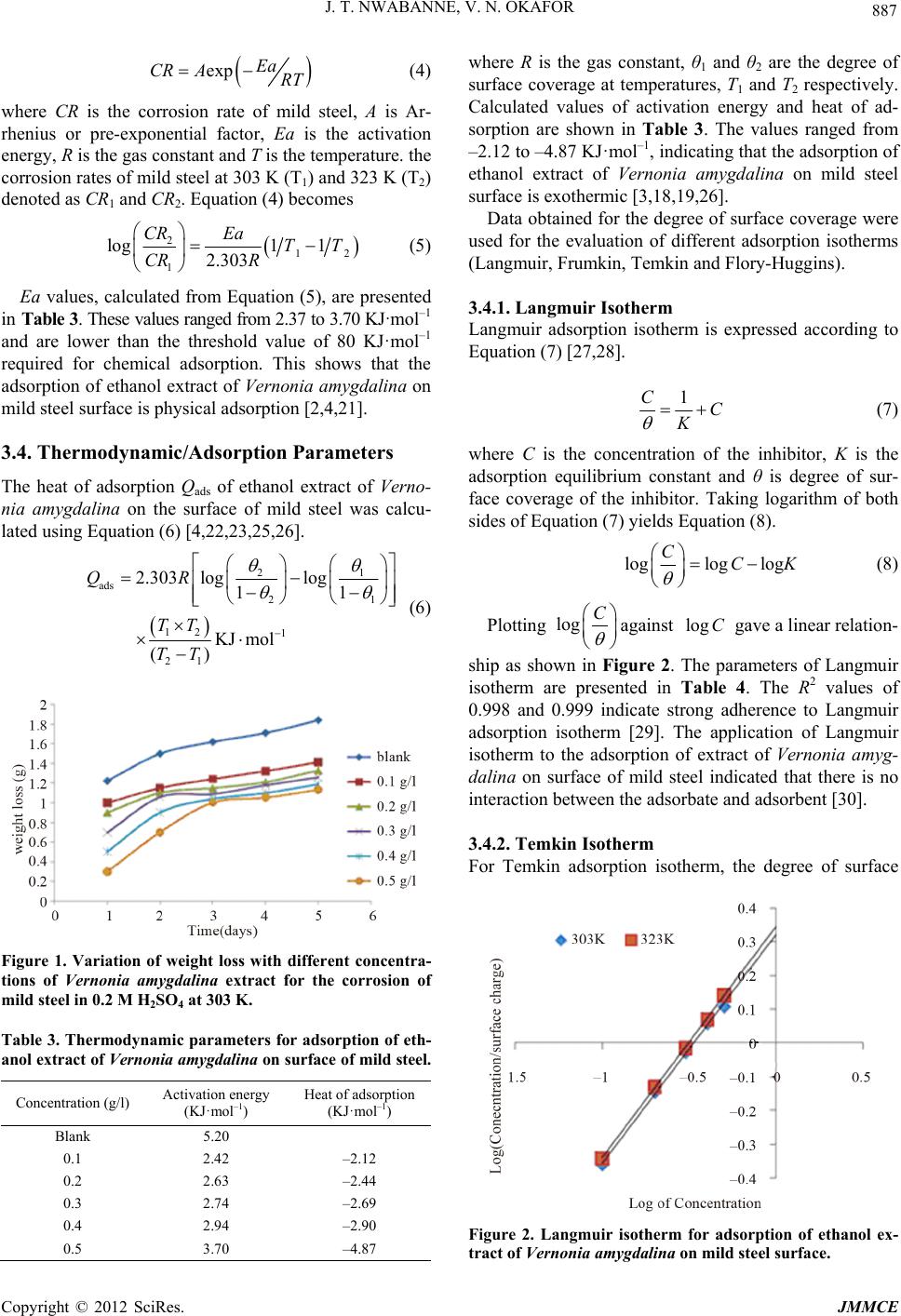 J. T. NWABANNE, V. N. OKAFOR 887 exp Ea CR ART (4) where CR is the corrosion rate of mild steel, A is Ar- rhenius or pre-exponential factor, Ea is the activation energy, R is the gas constant and T is the temperature. the corrosion rates of mild steel at 303 K (T1) and 323 K (T2) denoted as CR1 and CR2. Equation (4) becomes 2 1 21 log1 1 2.303 CR Ea TT CR R (5) Ea values, calculated from Equation (5), are presented in Table 3. These values ranged from 2.37 to 3.70 KJ·mol–1 and are lower than the threshold value of 80 KJ·mol–1 required for chemical adsorption. This shows that the adsorption of ethanol extract of Vernonia amygdalina on mild steel surface is physical adsorption [2,4,21]. 3.4. Thermodynamic/Adsorption Parameters The heat of adsorption Qads of ethanol extract of Verno- nia amygdalina on the surface of mild steel was calcu- lated using Equation (6) [4,22,23,25,26]. 21 ads 21 12 1 21 2.303 loglog 11 KJ mol () QR TT TT (6) Figure 1. Variation of weight loss with different concentra- tions of Vernonia amygdalina extract for the corrosion of mild steel in 0.2 M H2SO4 at 303 K. Table 3. Thermodynamic parameters for adsorption of eth- anol extract of Vernonia amygdalina on surface of mild steel. Concentration (g/l) Activation energy (KJ·mol–1) Heat of adsorption (KJ·mol–1) Blank 5.20 0.1 2.42 –2.12 0.2 2.63 –2.44 0.3 2.74 –2.69 0.4 2.94 –2.90 0.5 3.70 –4.87 where R is the gas constant, θ1 and θ2 are the degree of surface coverage at temperatures, T1 and T2 respectively. Calculated values of activation energy and heat of ad- sorption are shown in Table 3. The values ranged from –2.12 to –4.87 KJ·mol–1, indicating that the adsorption of ethanol extract of Vernonia amygdalina on mild steel surface is exothermic [3,18,19,26]. Data obtained for the degree of surface coverage were used for the evaluation of different adsorption isotherms (Langmuir, Frumkin, Temkin and Flory-Huggins). 3.4.1. Langmuir Isotherm Langmuir adsorption isotherm is expressed according to Equation (7) [27,28]. 1CC K (7) where C is the concentration of the inhibitor, K is the adsorption equilibrium constant and θ is degree of sur- face coverage of the inhibitor. Taking logarithm of both sides of Equation (7) yields Equation (8). loglog log CC K (8) Plotting log C against gave a linear relation- log C ship as shown in Figure 2. The parameters of Langmuir isotherm are presented in Table 4. The R2 values of 0.998 and 0.999 indicate strong adherence to Langmuir adsorption isotherm [29]. The application of Langmuir isotherm to the adsorption of extract of Vernonia amyg- dalina on surface of mild steel indicated that there is no interaction between the adsorbate and adsorbent [30]. 3.4.2. Temkin Isotherm For Temkin adsorption isotherm, the degree of surface Figure 2. Langmuir isotherm for adsorption of ethanol ex- tract of Vernonia amygdalina on mild steel surface. Copyright © 2012 SciRes. JMMCE 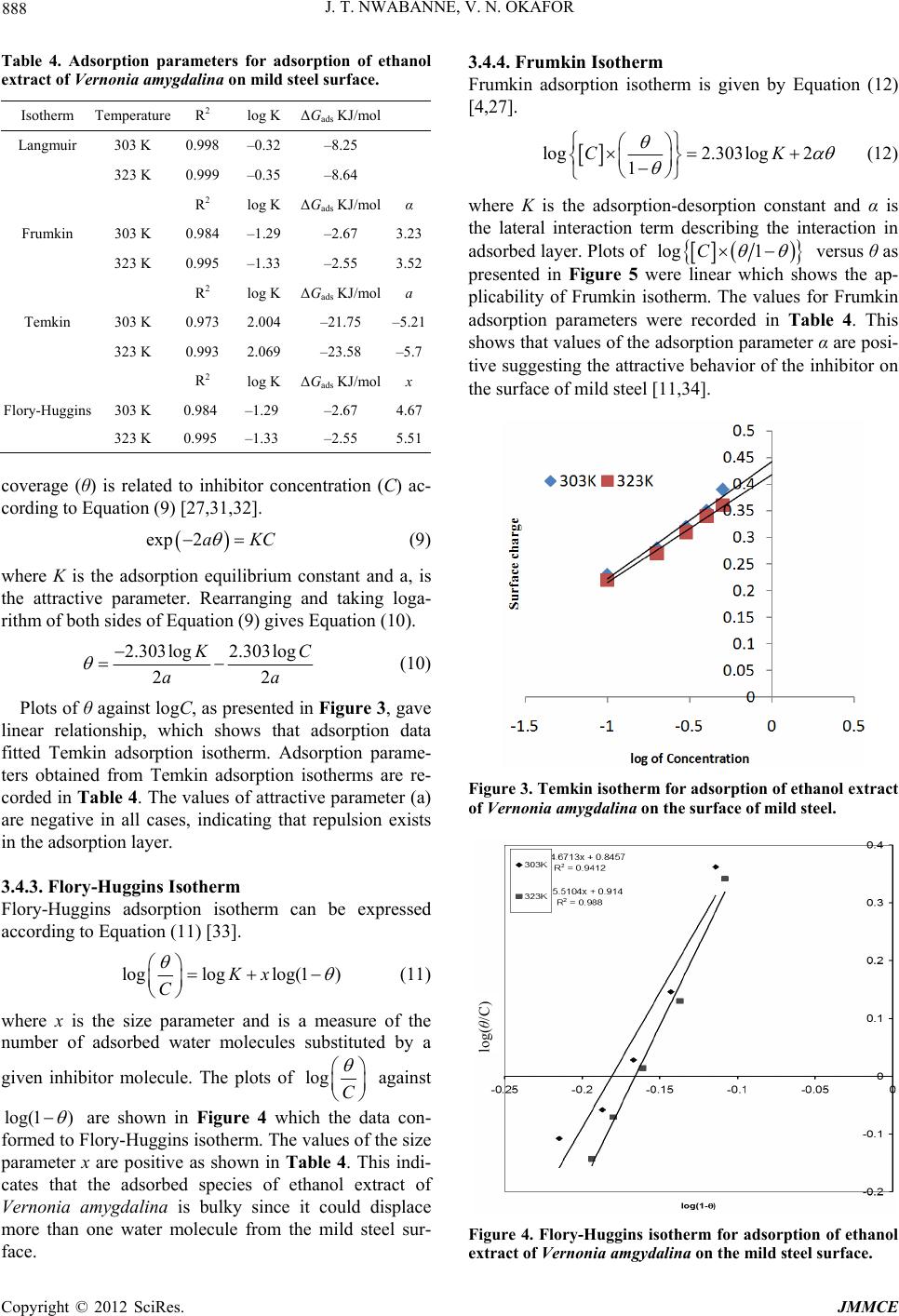 J. T. NWABANNE, V. N. OKAFOR 888 Table 4. Adsorption parameters for adsorption of ethanol extract of Vernonia amygdalina on mild steel surface. Isotherm Temperature R2 log K ΔGads KJ/mol Langmuir 303 K 0.998 –0.32 –8.25 323 K 0.999 –0.35 –8.64 R 2 log K ΔGads KJ/molα Frumkin 303 K 0.984 –1.29 –2.67 3.23 323 K 0.995 –1.33 –2.55 3.52 R 2 log K ΔGads KJ/mola Temkin 303 K 0.973 2.004 –21.75 –5.21 323 K 0.993 2.069 –23.58 –5.7 R 2 log K ΔGads KJ/molx Flory-Huggins 303 K 0.984 –1.29 –2.67 4.67 323 K 0.995 –1.33 –2.55 5.51 coverage (θ) is related to inhibitor concentration (C) ac- cording to Equation (9) [27,31,32]. exp 2aK C (9) where K is the adsorption equilibrium constant and a, is the attractive parameter. Rearranging and taking loga- rithm of both sides of Equation (9) gives Equation (10). 2.303log 2.303log 22 K C aa (10) Plots of θ against logC, as presented in Figure 3, gave linear relationship, which shows that adsorption data fitted Temkin adsorption isotherm. Adsorption parame- ters obtained from Temkin adsorption isotherms are re- corded in Table 4. The values of attractive parameter (a) are negative in all cases, indicating that repulsion exists in the adsorption layer. 3.4.3. Flory-Huggins Isotherm Flory-Huggins adsorption isotherm can be expressed according to Equation (11) [33]. logloglog(1 )Kx C (11) where x is the size parameter and is a measure of the number of adsorbed water molecules substituted by a given inhibitor molecule. The plots of log C against log(1) are shown in Figure 4 which the data con- formed to Flory-Huggins isotherm. The values of the size parameter x are positive as shown in Table 4. This indi- cates that the adsorbed species of ethanol extract of Vernonia amygdalina is bulky since it could displace more than one water molecule from the mild steel sur- face. 3.4.4. Fr um kin Isotherm Frumkin adsorption isotherm is given by Equation (12) [4,27]. log2.303log 2 1 CK (12) where K is the adsorption-desorption constant and α is the lateral interaction term describing the interaction in adsorbed layer. Plots of log 1C versus θ as presented in Figure 5 were linear which shows the ap- plicability of Frumkin isotherm. The values for Frumkin adsorption parameters were recorded in Table 4. This shows that values of the adsorption parameter α are posi- tive suggesting the attractive behavior of the inhibitor on the surface of mild steel [11,34]. Figure 3. Temkin isotherm for adsorption of ethanol extract of Vernonia amygdalina on the surface of mild steel. log(θ/C) Figure 4. Flory-Huggins isotherm for adsorption of ethanol extract of Vernonia amgydalina on the mild steel surface. Copyright © 2012 SciRes. JMMCE 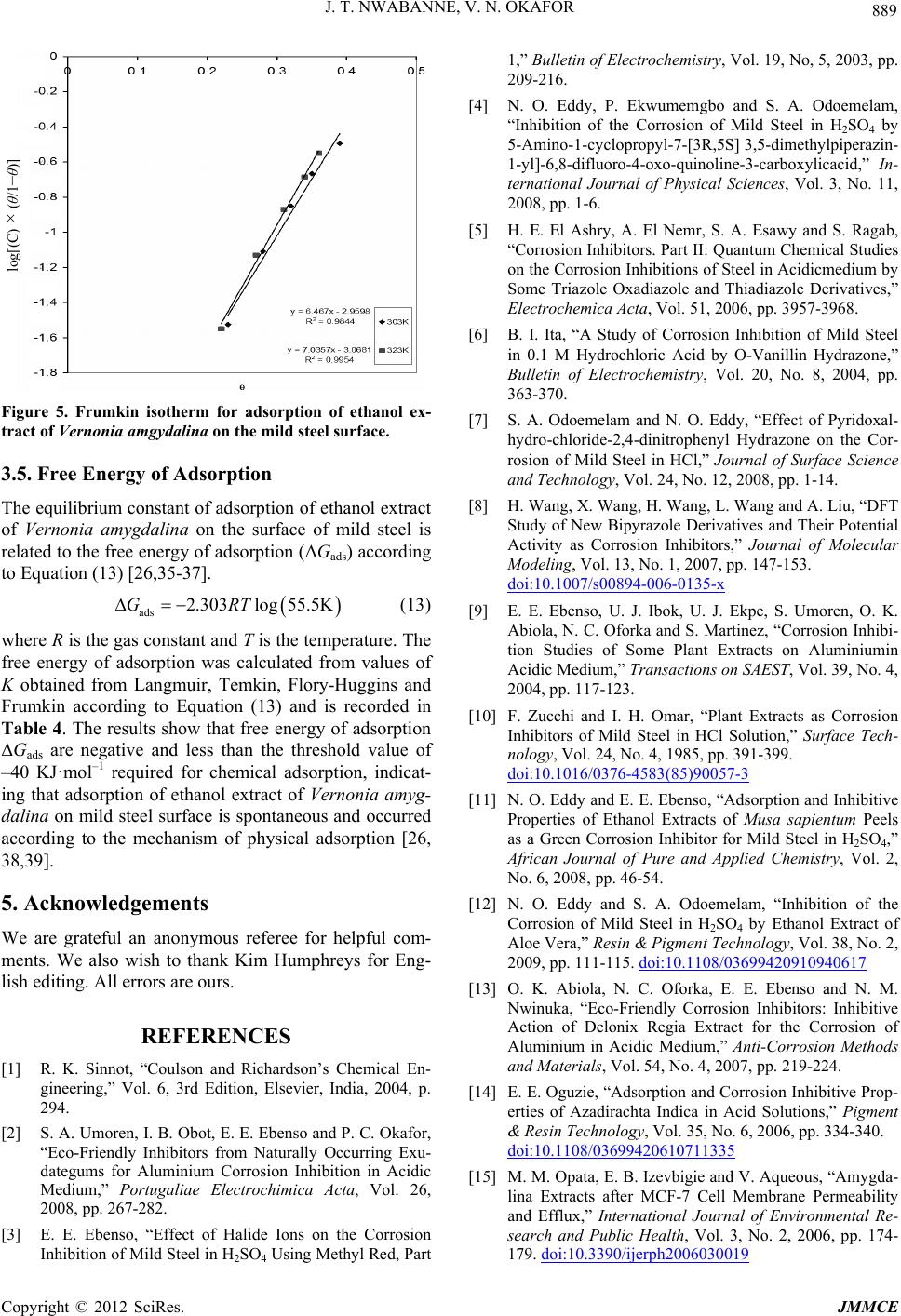 J. T. NWABANNE, V. N. OKAFOR 889 log[(C) × (θ/1 – θ)] Figure 5. Frumkin isotherm for adsorption of ethanol ex- tract of Vernonia amgydalina on the mild steel surface. 3.5. Free Energy of Adsorption The equilibrium constant of adsorption of ethanol extract of Vernonia amygdalina on the surface of mild steel is related to the free energy of adsorption (ΔGads) according to Equation (13) [26,35-37]. ads 2.303log 55.5KGRT (13) where R is the gas constant and T is the temperature. The free energy of adsorption was calculated from values of K obtained from Langmuir, Temkin, Flory-Huggins and Frumkin according to Equation (13) and is recorded in Table 4. The results show that free energy of adsorption ΔGads are negative and less than the threshold value of –40 KJ·mol–1 required for chemical adsorption, indicat- ing that adsorption of ethanol extract of Vernonia amyg- dalina on mild steel surface is spontaneous and occurred according to the mechanism of physical adsorption [26, 38,39]. 5. Acknowledgements We are grateful an anonymous referee for helpful com- ments. We also wish to thank Kim Humphreys for Eng- lish editing. All errors are ours. REFERENCES [1] R. K. Sinnot, “Coulson and Richardson’s Chemical En- gineering,” Vol. 6, 3rd Edition, Elsevier, India, 2004, p. 294. [2] S. A. Umoren, I. B. Obot, E. E. Ebenso and P. C. Okafor, “Eco-Friendly Inhibitors from Naturally Occurring Exu- dategums for Aluminium Corrosion Inhibition in Acidic Medium,” Portugaliae Electrochimica Acta, Vol. 26, 2008, pp. 267-282. [3] E. E. Ebenso, “Effect of Halide Ions on the Corrosion Inhibition of Mild Steel in H2SO4 Using Methyl Red, Part 1,” Bulletin of Electrochemistry, Vol. 19, No, 5, 2003, pp. 209-216. [4] N. O. Eddy, P. Ekwumemgbo and S. A. Odoemelam, “Inhibition of the Corrosion of Mild Steel in H2SO4 by 5-Amino-1-cyclopropyl-7-[3R,5S] 3,5-dimethylpiperazin- 1-yl]-6,8-difluoro-4-oxo-quinoline-3-carboxylicacid,” In- ternational Journal of Physical Sciences, Vol. 3, No. 11, 2008, pp. 1-6. [5] H. E. El Ashry, A. El Nemr, S. A. Esawy and S. Ragab, “Corrosion Inhibitors. Part II: Quantum Chemical Studies on the Corrosion Inhibitions of Steel in Acidicmedium by Some Triazole Oxadiazole and Thiadiazole Derivatives,” Electrochemica Acta, Vol. 51, 2006, pp. 3957-3968. [6] B. I. Ita, “A Study of Corrosion Inhibition of Mild Steel in 0.1 M Hydrochloric Acid by O-Vanillin Hydrazone,” Bulletin of Electrochemistry, Vol. 20, No. 8, 2004, pp. 363-370. [7] S. A. Odoemelam and N. O. Eddy, “Effect of Pyridoxal- hydro-chloride-2,4-dinitrophenyl Hydrazone on the Cor- rosion of Mild Steel in HCl,” Journal of Surface Science and Technology, Vol. 24, No. 12, 2008, pp. 1-14. [8] H. Wang, X. Wang, H. Wang, L. Wang and A. Liu, “DFT Study of New Bipyrazole Derivatives and Their Potential Activity as Corrosion Inhibitors,” Journal of Molecular Modeling, Vol. 13, No. 1, 2007, pp. 147-153. doi:10.1007/s00894-006-0135-x [9] E. E. Ebenso, U. J. Ibok, U. J. Ekpe, S. Umoren, O. K. Abiola, N. C. Oforka and S. Martinez, “Corrosion Inhibi- tion Studies of Some Plant Extracts on Aluminiumin Acidic Medium,” Transactions on SAEST, Vol. 39, No. 4, 2004, pp. 117-123. [10] F. Zucchi and I. H. Omar, “Plant Extracts as Corrosion Inhibitors of Mild Steel in HCl Solution,” Surface Tech- nology, Vol. 24, No. 4, 1985, pp. 391-399. doi:10.1016/0376-4583(85)90057-3 [11] N. O. Eddy and E. E. Ebenso, “Adsorption and Inhibitive Properties of Ethanol Extracts of Musa sapientum Peels as a Green Corrosion Inhibitor for Mild Steel in H2SO4,” African Journal of Pure and Applied Chemistry, Vol. 2, No. 6, 2008, pp. 46-54. [12] N. O. Eddy and S. A. Odoemelam, “Inhibition of the Corrosion of Mild Steel in H2SO4 by Ethanol Extract of Aloe Vera,” Resin & Pigment Technology, Vol. 38, No. 2, 2009, pp. 111-115. doi:10.1108/03699420910940617 [13] O. K. Abiola, N. C. Oforka, E. E. Ebenso and N. M. Nwinuka, “Eco-Friendly Corrosion Inhibitors: Inhibitive Action of Delonix Regia Extract for the Corrosion of Aluminium in Acidic Medium,” Anti-Corrosion Methods and Materials, Vol. 54, No. 4, 2007, pp. 219-224. [14] E. E. Oguzie, “Adsorption and Corrosion Inhibitive Prop- erties of Azadirachta Indica in Acid Solutions,” Pigment & Resin Technology, Vol. 35, No. 6, 2006, pp. 334-340. doi:10.1108/03699420610711335 [15] M. M. Opata, E. B. Izevbigie and V. Aqueous, “Amygda- lina Extracts after MCF-7 Cell Membrane Permeability and Efflux,” International Journal of Environmental Re- search and Public Health, Vol. 3, No. 2, 2006, pp. 174- 179. doi:10.3390/ijerph2006030019 Copyright © 2012 SciRes. JMMCE  J. T. NWABANNE, V. N. OKAFOR Copyright © 2012 SciRes. JMMCE 890 [16] E. U. Onyeka and I. O. Nwabekwe, “Phytochemical Pro- file of Some Green Leafy Vegetable in S.E. Nigeria,” Ni- gerian Food Journal, Vol. 25, No. 1, 2007, pp. 67-76. [17] A. O. Odiongenyi, S. A. Odoemelam and N. O. Eddy, “Corrosion Inhibition and Adsorption Properties of Etha- nol Extract of Vernonia amygdalina for the Corrosion of Mild Steel in H2SO4,” Portugalia Electrochimica Acta, Vol. 27, No. 1, 2009, pp. 33-45. doi:10.4152/pea.200901033 [18] E. E. Ebenso, “Synergistic Effect of Halides Ions on the Corrosion Inhibition of Aluminium in H2SO4 Using 2-Acetylphenothiazine,” Materials Chemistry and Phys- ics, Vol. 79, No. 1, 2003, pp. 58-70. doi:10.1016/S0254-0584(02)00446-7 [19] E. E. Ebenso, “Effect of Methyl Red and Halide Ions on the Corrosion of Aluminium in H2SO4. Part 2,” Bulletin of Electrochemistry, Vol. 12, 2004, pp. 551-559. [20] M. Abdallah, “Antibacterial Drugs as Corrosion Inhibi- tors for Corrosion of Aluminium in HCl Solution,” Cor- rosion Science, Vol. 46, No. 8, 2004, pp. 1981-1996. doi:10.1016/j.corsci.2003.09.031 [21] N. O. Eddy, U. J. Ibok, E. E. Ebenso, A. El Nemr and S. H. ElAshry, “Quantum Chemical Study of the Inhibition of the Corrosion of Mild Steel in H2SO4 by Some Antibi- otics,” Journal of Molecular Modeling, Vol. 15, No. 9, 2009, pp. 1085-1092. doi:10.1007/s00894-009-0472-7 [22] S. A. Umoren, O. Ogbobe, E. E. Ebenso and U. J. Ekpe, “Effect of Halideson the Corrosion Inhibition of Mild Steel in Acidic Medium Using Polyvinyl Alcohol,” Pig- ment & Resin Technology, Vol. 35, No. 5, 2006, pp. 284- 292. doi:10.1108/03699420610692896 [23] S. A. Umoren, E. E. Ebenso, P. C. Okafor, U. J. Ekpe, and O. Ogbobe, “Effect of Halides Ions on the Corrosion Inhibition of Aluminium Inalkaline Medium Using Poly- vinyl Alcohol,” Journal of Applied Polymer Science, Vol. 103, 2006, pp. 2810-2816. [24] N. O. Eddy and S. A. Odoemelam, “Effect of Pyridoxal Hydro-chloride-2,4-dinitrophenyl Hydrazone on the Cor- rosion of Mild Steel in HCl,” Journal of Surface Science and Technology, Vol. 24, No. 1-2, 2008, pp. 1-14. [25] N. O. Eddy, S. A. Odoemelam and N. W. Akpanudoh, “Synergistic Effect of Amoxicillin and Halides on the In- hibition of the Corrosion of Mild Steel in H2SO4,” Jour- nal of Chemical Technology, Vol. 4, 2008, pp. 1-10. [26] H. M. Bhajiwala and R. T. Vashi, “Ethanolamine, Di- ethanolamine Andtriethanolmine as Corrosion Inhibitors for Zinc in Binary Acid Mixture (HNO3 + H3PO4),” Bul- letin of Electrochemistry, Vol. 17, 2001, pp. 441-448. [27] S. Bilgic and N. Caliskan, “An Investigation of Some Schiff Bases Ascorrosion Inhibitors for Austenite Chro- mium-Nickel Steel in H2SO4,” Journal of Applied Elec- trochemistry, Vol. 31, No. 1, 2001, pp. 79-83. doi:10.1023/A:1004182329826 [28] H. Shockry, M. Yuasa, I. Sekine, R. M. Issa, H. Y. El-baradie and G. K. Gomma, “Corrosion Inhibition of Mild Steel by Schiff Base Compounds in Various Aque- ous Solutions. Part I,” Corrosion Science, Vol. 40, No. 12, 1998, pp. 2173-2186. doi:10.1016/S0010-938X(98)00102-4 [29] S. Acharya and S. N. Upadhyay, “The Inhibition of Cor- rosion of Mild Steel by Some Flouroquinolones in Sodi- umchloride Solution,” Transactions of the Indian Institute of Metals, Vol. 57, No. 3, 2004, pp. 297-306. [30] H. Ashassi-Sorkhabi, M. R. Majidi and K. Seyyedi, “In- vestigation of Inhibitive Action of Amino Acids against Steel Corrosion in HCl Solution,” Applied Surface Sci- ence, Vol. 225, No. 1-4, 2004, pp. 176-185. doi:10.1016/j.apsusc.2003.10.007 [31] A. Bouyanzer and B. Hammouti, “A Study of Anticorro- sion Effects of Artemisia Oil on Steel,” Pigment & Resin Technology, Vol. 33, No. 5, 2004, pp. 287-292. doi:10.1108/03699420410560489 [32] E. E. Ebenso, N. O. Eddy and A. O. Odiongenyi, “Inhibi- tion of the Corrosion of Mild Steel by Methocarbamol,” Portugaliae Electrochimica Acta, Vol. 27, No. 1, 2009, pp. 13-22. doi:10.4152/pea.200901013 [33] N. O. Eddy and P. A. P. Mamza, “Inhibitive and Adsorp- tion Properties of Ethanol Extract of Seeds and Leaves of Azardirachta Indica on the Corrosion of Mild Steel in H2SO4,” Portugaliae Electrochimica Acta, Vol. 27, No. 4, 2009, pp. 443-456. doi:10.4152/pea.200904443 [34] H. Ashassi-Sorkhabi, B. Shaabani, B. Aligholipour and D. Seifzadeh, “The Effect of Some Schiff Bases on the Cor- rosion of Aluminium in HCl Solution,” Applied Surface Science, Vol. 252, No. 12, 2006, pp. 4039-4047. doi:10.1016/j.apsusc.2005.02.148 [35] E. E. Oguzie, “Inhibition of Acid Corrosion of Mild Steel by Telfariaoccidentalis Extract,” Pigment and Resin Technology, Vol. 34, No. 6, 2005, pp. 321-326. doi:10.1108/03699420510630336 [36] S. T. Arab and A. M. Turkustuni, “Inhibition of the Cor- rosion of Steel in Phosphoric Acid by Phenacyl-Dime- thylsulfonium Bromide and Some of Its Para-Substituted Derivatives,” Portugalia Electrochimica Acta, Vol. 24, 2006, pp. 53-69. [37] S. Rajendran, M. R. Joany, B. V. Apparao and N. Palaniswamy, “Synergistic Effect of Calcium Gluconate and Zn2 on the Inhibition of Corrosion of Mild Steel In- neutral Aqueous Environment,” Transactions on SAEST, Vol. 35, No. 3-4, 2000, pp. 113-117. [38] S. Bilgic and M. Sahin, “The Corrosion Inhibition of Austenitic Chromium-Nickel Steel in H2SO4 by 2-Butyn- l-ol,” Materials Chemistry and Physics, Vol. 70, 2001, pp. 290-295. [39] N. O. Eddy and A. S. Ekop, “Inhibition of Corrosion of Zinc in 0.1 M H2SO4 by 5-Amino-1-cyclopropyl-7- [(3r,5s)dimethylpiperazin-1-yl]-6,8-difluoro-4-oxo-quinol ine-2-carboxylic Acid,” Journal of Materials Science, Vol. 4, No. 1, 2008, pp. 10-16. |