

Paper Menu >>
Journal Menu >>
 Advances in Microbiology, 2012, 2, 395-398 http://dx.doi.org/10.4236/aim.2012.23050 Published Online September 2012 (http://www.SciRP.org/journal/aim) Ethanol Tolerance in Aspergillus niger and Escherichia coli Phytase Edward J. Mullaney, Kandan Sethumadhavan, Stephanie Boone, Abul H. J. Ullah* Commodity Utilization, Southern Regional Research Center, Agricultural Research Service, United States Department of Agriculture, New Orleans, USA Email: *[email protected] Received July 9, 2012; revised August 10, 2012; accepted August 18, 2012 ABSTRACT Despite yeast having its own native phytase, the high levels of phytate found in DDGS, a byproduct of ethanol (ETOH) fermentation, suggest that its activity is diminished in the presence of ETOH. Ethanol, a product of grain fermentation, is known to inactivate several hydrolytic enzymes but its effect on phytases is relatively unknown. In this study, two phytases, Aspergillus niger (PhyA) and Escherichia coli (AppA2), were tested for ETOH tolerance. The E. coli phytase displayed greater ethanol tolerance over fungal phytase in the 5 to 10% range. However, ETOH inactivation was found to be reversible for both the enzymes. These differences in ETOH tolerance do suggest that there is a potential to achieve higher ETOH tolerance in phytases by “structure-function” studies to lower phytic acid levels in DDGS and for other applications. Keywords: Phytase; Ethanol; DDGS; Fermentation; Aspergillus niger 1. Introduction Phytate is the principal storage compound for phosphorus in plants. With the increased utilization of high phytate containing plant meals over the last several decades, extensive research has focused on the deployment of phytases as an animal feed additive. This is to allow monogastric animals (swine, poultry, etc.) which lack a digestive phytase to obtain the phytate’s ortho-phosphate groups, which otherwise will be unavailable. More recently, demands for additional bio-based fuels have spurred enhanced fermentation of corn and other grains such as sweet sorghum to produce ethanol in re- sponse to the growing demand. This has resulted in in- creased amounts of dried distillers grains with solubles (DDGS) emanating from this process. The DDGS is rich in nutrients and has much potential as an animal feed. However, recent studies have reported that DDGS con- tains high levels of phytate [1]. Moreover, ethanol is known to inhibit the activity of several hydrolytic en- zymes [2,3] and these results suggest that the phytase produced by the native yeast, Saccharomyces cerevisiae, [4] would be inhibited by increased concentration of ethanol. In this study, the ethanol tolerances of two phy- tases that are marketed as animal feed additive are de- termined. While both are histidine acid phosphatases (HAPs) and share the same active site geometry and catalytic mechanism, one is from Aspergillus niger and the other is produced by Escherichia coli, each has its own unique catalytic properties. While no information exist on ethanol tolerance in phytases, any differences in ethanol tolerance in the two enzymes can enhance our understanding of how ethanol interacts with this class of enzymes and this may contribute to the designing of phytases that retains more activity during fermentation and thus lower the phytic acid content of DDGS. In addi- tion, the achievement of a molecular modification to en- hance ethanol tolerance in phytase may also have further applications in enhancing the ethanol tolerance of other hydrolytic enzymes. 2. Materials and Methods 2.1. Source of Phytase Fungal phytase was obtained from the cloned Aspergillus niger phyA gene that was overexpressed in Pichia pas- toris. The recombinant phytase was purified using se- quential ion-exchange column chromatographies. E.coli phytase, the AppA2 gene product, was a gift from Phytex LLC, Portland, Maine, which was over- expressed in Pichia pastoris. The crude culture filtrate was dialyzed against 25 mM glycine, pH 2.8 buffer and loaded onto a MacroPrep™ S column and eluted as a single activity component in a linear salt (0 - 0.5 M sodium chloride) gradient. The final specific activity of the phytase was about 15,000 nkat/mg of protein at 55˚C. *Corresponding author. C opyright © 2012 SciRes. AiM 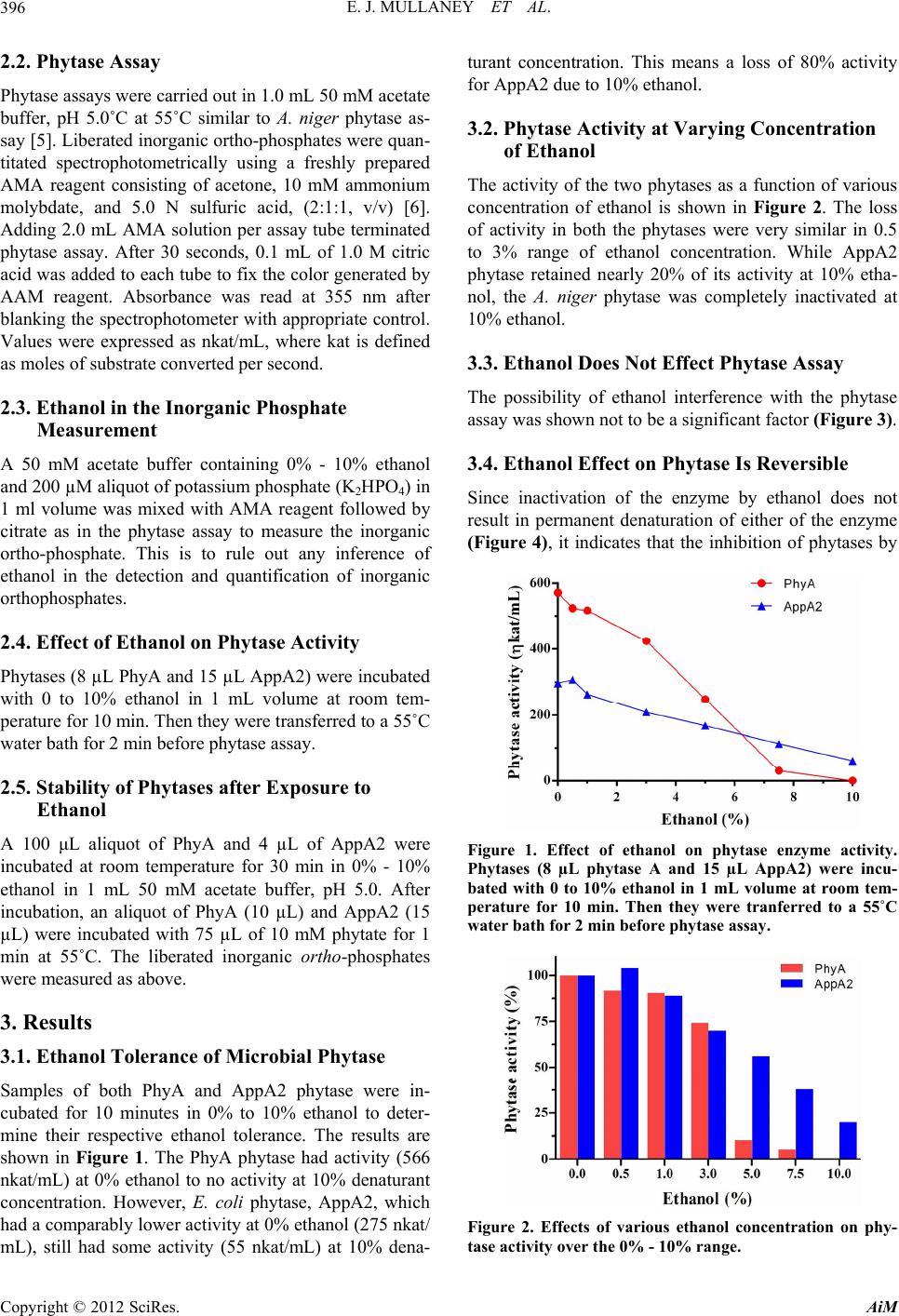 E. J. MULLANEY ET AL. 396 2.2. Phytase Assay Phytase assays were carried out in 1.0 mL 50 mM acetate buffer, pH 5.0˚C at 55˚C similar to A. niger phytase as- say [5]. Liberated inorganic ortho-phosphates were quan- titated spectrophotometrically using a freshly prepared AMA reagent consisting of acetone, 10 mM ammonium molybdate, and 5.0 N sulfuric acid, (2:1:1, v/v) [6]. Adding 2.0 mL AMA solution per assay tube terminated phytase assay. After 30 seconds, 0.1 mL of 1.0 M citric acid was added to each tube to fix the color generated by AAM reagent. Absorbance was read at 355 nm after blanking the spectrophotometer with appropriate control. Values were expressed as nkat/mL, where kat is defined as moles of substrate converted per second. 2.3. Ethanol in the Inorganic Phosphate Measurement A 50 mM acetate buffer containing 0% - 10% ethanol and 200 µM aliquot of potassium phosphate (K2HPO4) in 1 ml volume was mixed with AMA reagent followed by citrate as in the phytase assay to measure the inorganic ortho-phosphate. This is to rule out any inference of ethanol in the detection and quantification of inorganic orthophosphates. 2.4. Effect of Ethanol on Phytase Activity Phytases (8 µL PhyA and 15 µL AppA2) were incubated with 0 to 10% ethanol in 1 mL volume at room tem- perature for 10 min. Then they were transferred to a 55˚C water bath for 2 min before phytase assay. 2.5. Stability of Phytases after Exposure to Ethanol A 100 μL aliquot of PhyA and 4 µL of AppA2 were incubated at room temperature for 30 min in 0% - 10% ethanol in 1 mL 50 mM acetate buffer, pH 5.0. After incubation, an aliquot of PhyA (10 µL) and AppA2 (15 µL) were incubated with 75 µL of 10 mM phytate for 1 min at 55˚C. The liberated inorganic ortho-phosphates were measured as above. 3. Results 3.1. Ethanol Tolerance of Microbial Phytase Samples of both PhyA and AppA2 phytase were in- cubated for 10 minutes in 0% to 10% ethanol to deter- mine their respective ethanol tolerance. The results are shown in Figure 1. The PhyA phytase had activity (566 nkat/mL) at 0% ethanol to no activity at 10% denaturant concentration. However, E. coli phytase, AppA2, which had a comparably lower activity at 0% ethanol (275 nkat/ mL), still had some activity (55 nkat/mL) at 10% dena- turant concentration. This means a loss of 80% activity for AppA2 due to 10% ethanol. 3.2. Phytase Activity at Varying Concentration of Ethanol The activity of the two phytases as a function of various concentration of ethanol is shown in Figure 2. The loss of activity in both the phytases were very similar in 0.5 to 3% range of ethanol concentration. While AppA2 phytase retained nearly 20% of its activity at 10% etha- nol, the A. niger phytase was completely inactivated at 10% ethanol. 3.3. Ethanol Does Not Effect Phytase Assay The possibility of ethanol interference with the phytase assay was shown not to be a significant factor (Figure 3). 3.4. Ethanol Effect on Phytase Is Reversible Since inactivation of the enzyme by ethanol does not result in permanent denaturation of either of the enzyme (Figure 4), it indicates that the inhibition of phytases by Figure 1. Effect of ethanol on phytase enzyme activity. Phytases (8 µL phytase A and 15 µL AppA2) were incu- bated with 0 to 10% ethanol in 1 mL volume at room tem- perature for 10 min. Then they were tranferred to a 55˚C water bath for 2 min before phytase assay. Figure 2. Effects of various ethanol concentration on phy- tase activity over the 0% - 10% range. Copyright © 2012 SciRes. AiM 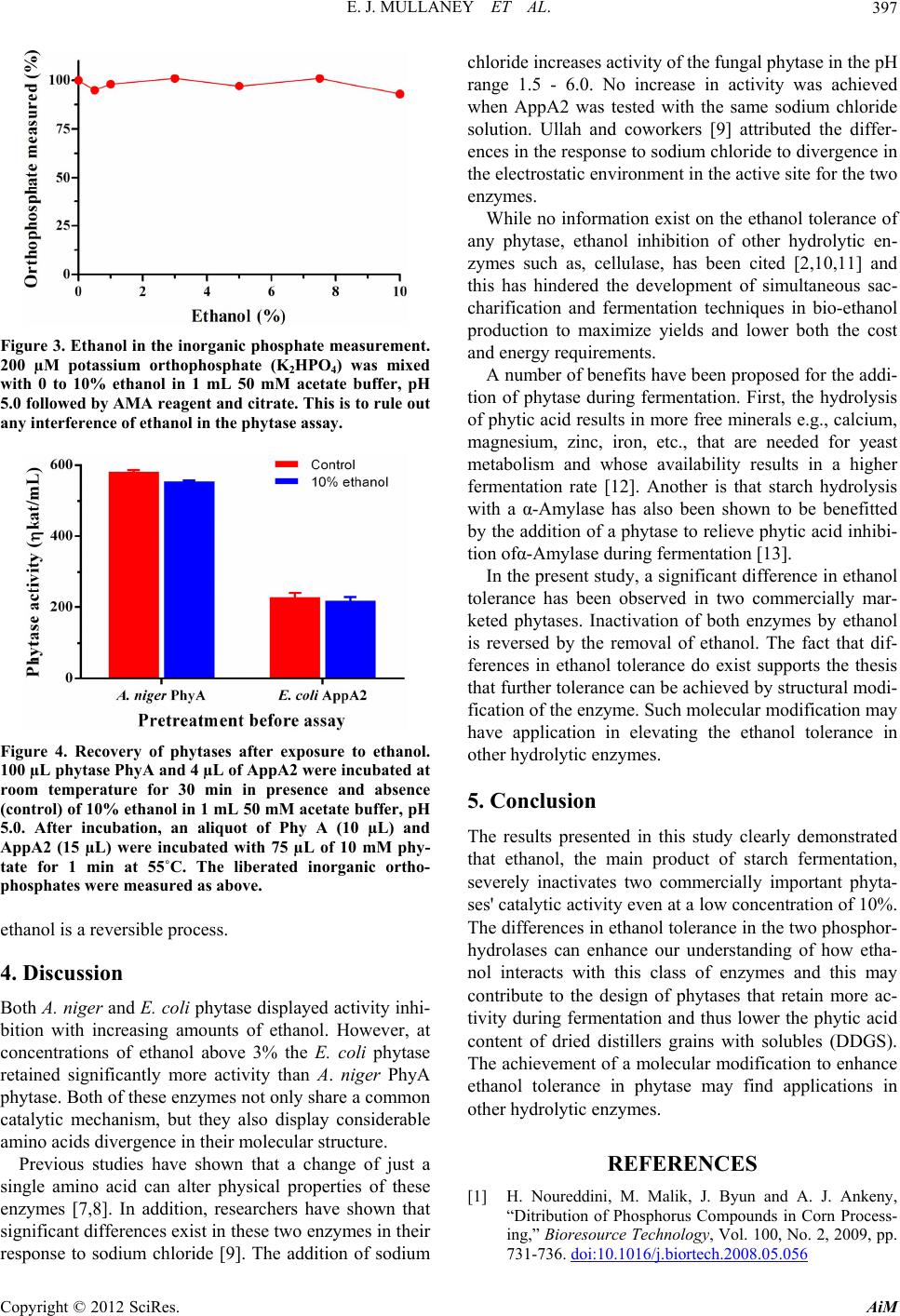 E. J. MULLANEY ET AL. 397 Figure 3. Ethanol in the inorganic phosphate measurement. 200 µM potassium orthophosphate (K2HPO4) was mixed with 0 to 10% ethanol in 1 mL 50 mM acetate buffer, pH 5.0 followed by AMA reagent and citrate. This is to rule out any interference of ethanol in the phytase assay. Figure 4. Recovery of phytases after exposure to ethanol. 100 µL phytase PhyA and 4 µL of AppA2 were incubated at room temperature for 30 min in presence and absence (control) of 10% ethanol in 1 mL 50 mM acetate buffer, pH 5.0. After incubation, an aliquot of Phy A (10 µL) and AppA2 (15 µL) were incubated with 75 µL of 10 mM phy- tate for 1 min at 55˚C. The liberated inorganic ortho- phosphates were me asur e d as above. ethanol is a reversible process. 4. Discussion Both A. niger and E. coli phytase displayed activity inhi- bition with increasing amounts of ethanol. However, at concentrations of ethanol above 3% the E. coli phytase retained significantly more activity than A. niger PhyA phytase. Both of these enzymes not only share a common catalytic mechanism, but they also display considerable amino acids divergence in their molecular structure. Previous studies have shown that a change of just a single amino acid can alter physical properties of these enzymes [7,8]. In addition, researchers have shown that significant differences exist in these two enzymes in their response to sodium chloride [9]. The addition of sodium chloride increases activity of the fungal phytase in the pH range 1.5 - 6.0. No increase in activity was achieved when AppA2 was tested with the same sodium chloride solution. Ullah and coworkers [9] attributed the differ- ences in the response to sodium chloride to divergence in the electrostatic environment in the active site for the two enzymes. While no information exist on the ethanol tolerance of any phytase, ethanol inhibition of other hydrolytic en- zymes such as, cellulase, has been cited [2,10,11] and this has hindered the development of simultaneous sac- charification and fermentation techniques in bio-ethanol production to maximize yields and lower both the cost and energy requirements. A number of benefits have been proposed for the addi- tion of phytase during fermentation. First, the hydrolysis of phytic acid results in more free minerals e.g., calcium, magnesium, zinc, iron, etc., that are needed for yeast metabolism and whose availability results in a higher fermentation rate [12]. Another is that starch hydrolysis with a α-Amylase has also been shown to be benefitted by the addition of a phytase to relieve phytic acid inhibi- tion ofα-Amylase during fermentation [13]. In the present study, a significant difference in ethanol tolerance has been observed in two commercially mar- keted phytases. Inactivation of both enzymes by ethanol is reversed by the removal of ethanol. The fact that dif- ferences in ethanol tolerance do exist supports the thesis that further tolerance can be achieved by structural modi- fication of the enzyme. Such molecular modification may have application in elevating the ethanol tolerance in other hydrolytic enzymes. 5. Conclusion The results presented in this study clearly demonstrated that ethanol, the main product of starch fermentation, severely inactivates two commercially important phyta- ses' catalytic activity even at a low concentration of 10%. The differences in ethanol tolerance in the two phosphor- hydrolases can enhance our understanding of how etha- nol interacts with this class of enzymes and this may contribute to the design of phytases that retain more ac- tivity during fermentation and thus lower the phytic acid content of dried distillers grains with solubles (DDGS). The achievement of a molecular modification to enhance ethanol tolerance in phytase may find applications in other hydrolytic enzymes. REFERENCES [1] H. Noureddini, M. Malik, J. Byun and A. J. Ankeny, “Ditribution of Phosphorus Compounds in Corn Process- ing,” Bioresource Technology, Vol. 100, No. 2, 2009, pp. 731-736. doi:10.1016/j.biortech.2008.05.056 Copyright © 2012 SciRes. AiM  E. J. MULLANEY ET AL. Copyright © 2012 SciRes. AiM 398 [2] P. Ghosh, N. B. Pamment and W. R. B. Martin, “Simul- taneous Saccharification and Fermentation of Cellulose: β-D-gluodidase Activity and Ethanol Inhibition of Cellu- lases,” Enzyme and Microbial Technology, Vol. 4, No. 6, 1982, pp. 425-430. doi:10.1016/0141-0229(82)90075-8 [3] Z. Wu and Y. Lee, “Inhibition of the Enzymatic Hydroly- sis of Cellulose by Ethanol,” Biotechnology Letters, Vol. 19, No. 10, 1997, pp. 977-979. doi:10.1023/A:1018487015129 [4] P. Kaur, G. Kunze and T. Satyanarayana, “Yeast Phytases: Present Scenario and Future Perspectives,” Critical Re- views in Biotechnology, Vol. 27, No. 2, 2007, pp. 93-109. doi:10.1080/07388550701334519 [5] A. Ullah and D. Gibson, “Extracellular Phytase (E. C. 3.1.3.8) from Aspergillus ficuum NRRL 3135: Purifica- tion and Characterization,” Preparative Biochemistry, Vol. 17, No. 1, 1987, pp. 63-91. doi:10.1080/00327488708062477 [6] J. K. Heinonen and R. J. Lahti, “A New and Convenient Colorimetric Determination of Inorganic Orthophosphate and Its Application to the Assay of Inorganic Pyrophos- phatase,” Analytical Biochemistry, Vol. 113, No. 2, 1981, pp. 313-317. doi:10.1016/0003-2697(81)90082-8 [7] T. Kim, E. Mullaney, J. Porres, K. Roneker, S. Crowe, S. Rice, T. Ko, A. Ullah, A, C. Daly, R. Welsh and X. Lei, “Shifting the pH Profile of Aspergillus niger PhyA to Match the Stomach pH Enhances Its Effectiveness as an Animal Feed Additive,” Applied and Environmental Mi- crobiology, Vol. 72, No. 6, 2006, pp. 4397-4403. doi:10.1128/AEM.02612-05 [8] J. Weaver, E. J. Mullaney and X. Lei, “Altering the Sub- strate Specificity Site of Aspergillus niger PhyB Shifts the pH Optimum to pH 3.2,” Applied Microbiology and Biotechnology, Vol. 76, No. 1, 2008, pp. 117-122. doi:10.1007/s00253-007-0975-z [9] A. Ullah, K. Sethumadhavan and E. Mullaney, “Salt Ef- fects on the pH Profile and Kinetic Parameters of Micro- bial Phytases,” Journal of Agricultural and Food Chem- istry, Vol. 56, No. 9, 2008, pp. 3398-3402. doi:10.1021/jf073137i [10] J. Szczodrak, and Z. Targonski, “Simultaneous Sacchari- fication and Fermentation of Cellulose: Effect of Ethanol and Cellulases on Particular Stages,” Acta Biotechnology, Vol. 6, No. 6, 1989, pp. 555-564. doi:10.1002/abio.370090613 [11] H. Chen and S. Jin, “Effect of Ethanol and Yeast on Cel- lulose Activity and Hydrolysis of Crystalline Cellulose,” Enzyme and Microbial Technology, Vol. 39, No. 7, 2006, pp. 1430-1432. doi:10.1016/j.enzmictec.2006.03.027 [12] C. Veit, C. Felby, L. Peckous, L and H. S. Olsen, “Fermentation with a Phytase,” US Patent Application 20020006647, 2001. [13] J. Shetty, S. Power, D. Ward, B. Paulson and S. Ramer, “Starch Hydrolysis Using Phytase with an Alpha Amy- lase,” US Patent Application 20080299622, 2007. |