

Paper Menu >>
Journal Menu >>
 Advances in Microbiology, 2012, 2, 364-367 http://dx.doi.org/10.4236/aim.2012.23045 Published Online September 2012 (http://www.SciRP.org/journal/aim) Influence of Micro-Encapsulated Probiotic Lactobacillus acidophilus R0052 on the Characteristics of Plain Yogurt Edwin Noland1, Kayanush J. Aryana1,2* 1School of Animal Science, Louisiana State University Agricultural Center, Baton Rouge, USA 2Department of Food Science, Louisiana State University Agricultural Center, Baton Rouge, USA Email: *[email protected] Received July 1, 2012; revised July 30, 2012; accepted August 10, 2012 ABSTRACT Micro-encapsulation is a method of providing probiotic living cells with a physical barrier against adverse environ- mental conditions. Lactobacillus acidophilus is one of the most effective forms of probiotic bacteria and is commer- cially available as pure culture and encapsulated form. It is not clear whether the use of micro-encapsulated L. aci- dophilus will result in yogurt of a better quality co mpared to non micro-en capsulated L. acidophilus. The objective was to determine the influence of micro-encapsulated L. acidophilus on the characteristics of fat free plain yogurt. Yogurt mixes were pasteurized and at 37˚C were inoculated with Streptococcus thermophilus, Lactobacillus delbrueckii subsp. bulgaricus and micro-encapsulated L. acidophilus R0052 or non micro-encapsulated L. acidophilus R0052. Yogurt manufacture was replicated three times. Yogurts with micro-encapsulated L. acidophilus R0052 had significantly (P < 0.05) high er flavor scor es, compared to yogurts with n on micro-en capsulated L. acidophilus R0052. The L. acidophilus counts, apparent viscosity, pH and syneresis, of the yogurts with micro-encapsulated L. acidophilus R0052 were not significantly (P < 0.05) different from those of the yogurts with non micro-encapsulated L. acidophilus R0052. Use of micro-encapsulated L. acidophilus R0052 resulted in better tasting yogurts probably because of the taste imparted by the trace amounts of the micro-encapsulating material. Keywords: Probiotic; Micro-Encapsulation; Fermented; Cultured; Shelf Life 1. Introduction Probiotics are defined as “live microorganisms which when administered in adequate amounts confer health benefits to host” [1]. There has been an increasing inter- est in the role of probiotic bacteria in human health. Health advantages associated with the probiotic intake include alleviation of symptoms of lactose malabsorption, increase in natural resistance to infectious diseases of the intestinal tract, suppression of cancer, redu ction in serum cholesterol concentrations, improved digestion, and sti- mulation of gastrointestinal immunity [2]. It is generally accepted that successful delivery and colonization of viable probiotic cells in the intestine are essential for probiotics to be efficacious [3]. As a guide, the Intl. Dairy Federation has recommended that the bacteria be viable and abundant in the product and be present at a population of at least 107 colony-forming units (CFU)/g until the date of co nsumption [4]. However, studies indi- cate that the bacteria may not survive in sufficient num- bers when incorporated into dairy products and during their passage through the gastrointestinal tract [5]. Sev- eral factors influence the survival and colonization of these bacteria, including resistance to low pH, bile acids, and digestive enzymes [1]. Micro-encapsulation is a method of providing probi- otic living cells with a physical barrier against adverse environmental conditions [6]. Micro-encapsulation helps to protect the beneficial bacteria from destruction by stomach acid for example and thereby enhances its vi- ability. Several methods of micro-encapsulation of pro- biotic bacteria include spray drying, extrusion, emulsion and phase separation [7]. The most commonly reported micro-encapsulation procedure is based on the calcium- alginate gel capsule formation, and materials for micro- encapsulation include alginates, kappa-carrageenan, gel- lan gum, gelatin and starch [7]. The two culture bacteria Streptococcus thermophilus and Lactobacillus bulgaricus are required in yogurt manufacture according to the legal description of yogurt [8]. Lactobacillus acidophilus is one of the most effec- tive forms of probiotic bacteria. Health benefits of Lac- tobacillus acidophilus include reduction in occurrence of diarrhea in humans, enhancement of the immune system, reduction in cholesterol and improved symptoms of lac- *Corresponding a uthor. C opyright © 2012 SciRes. AiM  E. NOLAND, K. J. ARYANA 365 tose intolerance [9] and antitumor effects [10]. Use of L. acidophilus in rats reduced the number of colon cancer cells in a dose dependent manner [11]. Lactobacillus acidophilus is widely used as an adjunct culture in yogurt manufacture in the United States [12] and these L. aci- dophilus cells are in the non micro-encapsulated form. It is not clear if the use of micro-encapsulated L. acidophi- lus cells would result in a yogu rt of a better quality com- pared to non micro-encapsulated L. acidophilus. The ob- jective was to study the influence of micro-encapsulated L. acidophilus on the characteristics of fat free plain yo- gurt. 2. Materials and Methods 2.1. Yogurt Manufacture Yogurts were manufactured using standard procedure [13, 14] with slight alteration. Yogurt mixes were homoge- nized, pasteurized and temperature lowered to 40˚C and inoculated with yogurt culture bacteria Streptococcus thermophilus and Lactobacillus delbrueckii ssp. bulga- ricus (Chr. Hansen Milwaukee, WI) at a constant rate of 20 g per gallon (3.785 L). Encapsulated L. acidophilus R0052 or non encapsulated L. acidophilus R0052 (Insti- tut Rosell-Lallemand Inc. Montreal, Quebec, Canada) were individually incorporated in the yogurt mixes at the same rate of 20 g per 3.785 L. Inoculated yogurt mixes were poured into 355 mL containers (Reynolds RD C212— Del-Pak Combo-Pak, Alcoa, Inc., Pittsburgh, PA) and in- cubated at 40˚C to pH 4.5 before cooling to 4˚C. Samples were stored at 4˚C until analyzed. Product manufacture was replicated three times. 2.2. Lactobacillus acidophilus Enumerations Counts of L. acidophilus were enumerated as reported earlier [15] but with modifications. The appropriate amount of distilled water was added to a 500 mL or 1 L graduated cylinder. MRS base medium without dextrose was prepared by weighing the appropriate proportion of 10.0 g of proteose peptone #3 (United States Biological, Swampscott, MA), 10.0 g of beef extract (Becton, Dick- inson and Co., Sparks, MD), 5.0 g of yeast extract (Bec- ton, Dickinson and Co., Sparks, MD), 1.0 g of polysor- bate 80 (Tween 80) (Sigma-Aldrich Inc., St. Louis, MO), 2.0 g of ammonium citrate (Fisher Scientific, Fair Lawn, NJ), 5.0 g of sodium acetate, anhydrous (EMD Chemi- cals Inc., Gibbstown, NJ), 0.1 g of magnesium sulfate, anhydrous (EMD Chemicals Inc., Gibbstown, NJ), 0.05 g of manganese sulfate, monohydrate (Sigma-Aldrich Inc., St. Louis, MO), 2.0 g of dipotassium phosphate (Fisher Scientific, Fair Lawn, NJ), and 15.0 g of agar (EMD Chemicals Inc., Gibbstown, NJ) and diluting these ingre- dients to the appropriate proportion of 1 L with distilled water. This mixture was heated to boiling with agitation before autoclaving at 121˚C for 15 min. A 10% (w/v) sorbitol (EMD Chemicals Inc., Gibbstown, NJ) solution was prepared and filtered sterilized with Nalgene Mem- brane Filter Units (Nalge Co., Rochester, NY), and the appropriate amount of this so lution was aseptically add ed to the MRS base medium to form a 10% sorbitol solution (final concentration of 1 % sorbitol i.e. 1 g sorbitol in 100 mL of final medium) and 90% MRS base medium mix- ture immediately before pouring the plates. The appro- priate dilutions of yogurt were made with 99 mL of ster- ilized peptone (or sterilized Butterfield buffer in pre- filled dilution bottles (Weber Scientific, Hamilton, NJ)). The pour plate method with this MRS-sorbitol agar was performed. Petri dishes were placed in BBL GasPaks (BBL, Becton, Dickinson and Co., Cockeysville, MD) and incubated anaerobically at 37˚C for 72 h. A Quebec Darkfield Colony Counter (Leica Inc., Buffalo, NY) was used to assist in enumerating the colonies. 2.3. pH The pH of the yogurts at 4˚C was determined using an UltraBasic B e nchtop pH Meter (Denver Inst rument Com p- any, Arvada, CO, USA) calibrated using commercial pH 4.00 and 7.00 bu ffer solution s . 2.4. Apparent Viscosity The apparent viscosities were determined at 4˚C using a Brookfield DV II+ viscometer (Brookfield Engineering Lab Inc., Stoughton, MA, USA) with a helipath stand. A T-C spindle was used at 10 rpm. The data were acquired using the Wingather® software (Brookfield Engineering Lab Inc., Stoughton, MA, USA). One hundred data poin ts were averaged per sample. 2.5. Syneresis The release of whey from the yogurt samples was meas- ured by inverting a 300 g sample at 4˚C on a fin e cheese cloth placed on top of a funnel. The quantity of whey collected in a graduated cylinder after 2 h of drainage was used as an index of syneresis. 2.6. Sensory Evaluation Sensory evaluations were conducted using a seven mem- ber experienced panel. The panelists had over 4 months of training in judg ing yogurts. Samples were provided to panelists in three digit random number co ded plastic cups. Water was provided to panelists to rinse their palate be- tween samples. Panelists were instructed not to talk dur- ing the sensory evaluation. The official American Dairy Science Association intercollegiate dairy products evalua- tion contest score card was used to evaluate flavor on a 1 Copyright © 2012 SciRes. AiM 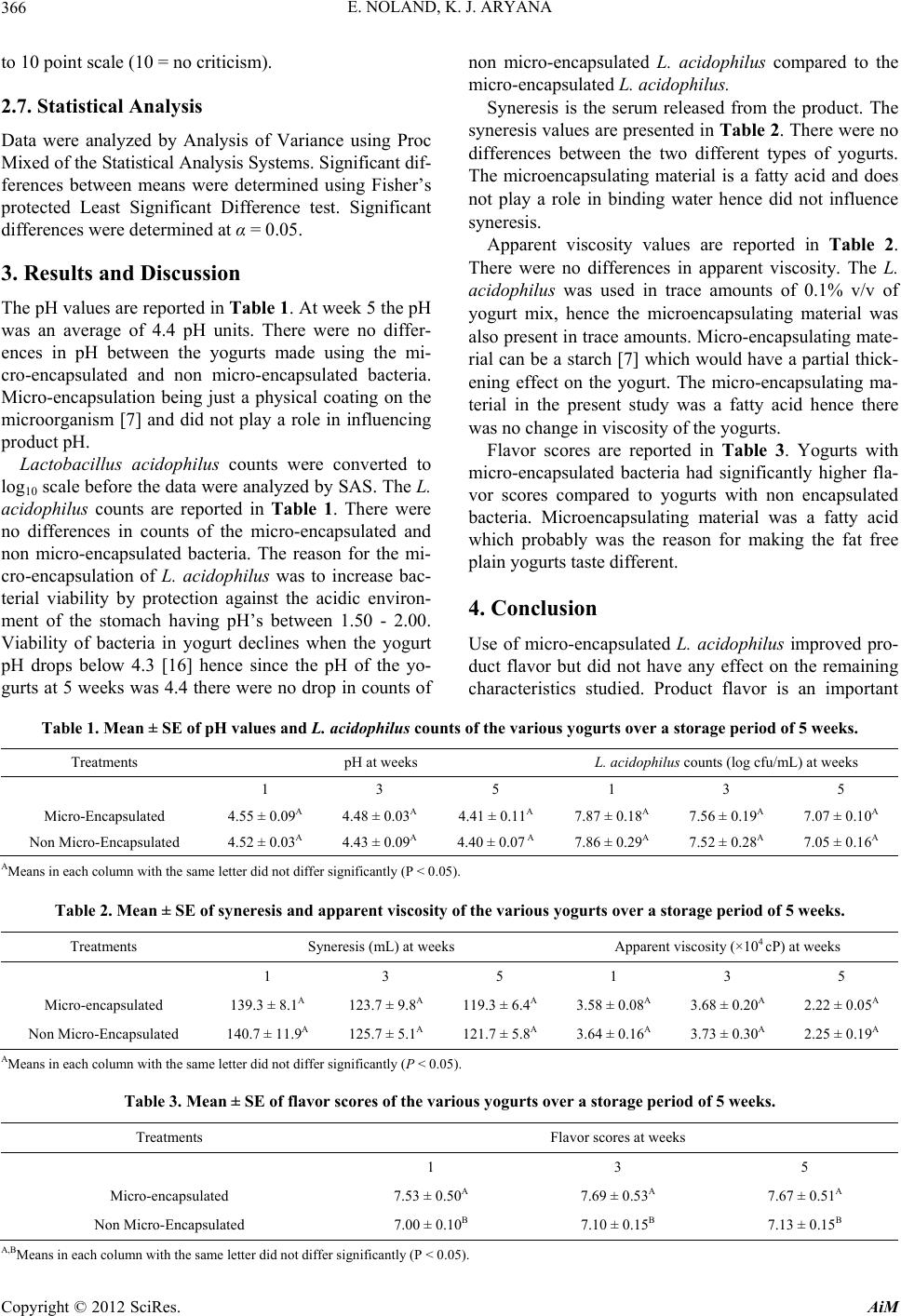 E. NOLAND, K. J. ARYANA Copyright © 2012 SciRes. AiM 366 to 10 point scale (10 = no criticism). 2.7. Statistical Analysis Data were analyzed by Analysis of Variance using Proc Mixed of the Statistical Analysis Systems. Significant dif- ferences between means were determined using Fisher’s protected Least Significant Difference test. Significant differences we re determined at α = 0.05. 3. Results and Discussion The pH values are reported in Table 1. At week 5 the pH was an average of 4.4 pH units. There were no differ- ences in pH between the yogurts made using the mi- cro-encapsulated and non micro-encapsulated bacteria. Micro-encapsulation being just a physical coating on the microorganism [7] and did not play a role in influencing product pH. Lactobacillus acidophilus counts were converted to log10 scale before the data were analyzed by SAS. The L. acidophilus counts are reported in Table 1. There were no differences in counts of the micro-encapsulated and non micro-encapsulated bacteria. The reason for the mi- cro-encapsulation of L. acidophilus was to increase bac- terial viability by protection against the acidic environ- ment of the stomach having pH’s between 1.50 - 2.00. Viability of bacteria in yogurt declines when the yogurt pH drops below 4.3 [16] hence since the pH of the yo- gurts at 5 weeks was 4.4 there were no drop in counts of non micro-encapsulated L. acidophilus compared to the micro-encapsulated L. acidophilus. Syneresis is the serum released from the product. The syneresis values are presented in Tab le 2. There were no differences between the two different types of yogurts. The microencapsulating material is a fatty acid and does not play a role in binding water hence did not influence syneresis. Apparent viscosity values are reported in Table 2. There were no differences in apparent viscosity. The L. acidophilus was used in trace amounts of 0.1% v/v of yogurt mix, hence the microencapsulating material was also present in trace amounts. Micro-encapsulating mate- rial can be a starch [7] which would have a partial thick- ening effect on the yogurt. The micro-encapsulating ma- terial in the present study was a fatty acid hence there was no change in viscosity of the yogurts. Flavor scores are reported in Table 3. Yogurts with micro-encapsulated bacteria had significantly higher fla- vor scores compared to yogurts with non encapsulated bacteria. Microencapsulating material was a fatty acid which probably was the reason for making the fat free plain yogurts taste diff erent. 4. Conclusion Use of micro-encapsulated L. acidophilus improved pro- duct flavor but did not have any effect on the remaining characteristics studied. Product flavor is an important Table 1. Mean ± SE of pH values and L. acidophilus counts of the various yogurts over a storage period of 5 weeks. Treatments pH at weeks L. acidophilus counts ( log cfu/mL) at weeks 1 3 5 1 3 5 Micro-Encaps ulated 4.55 ± 0.09A 4.48 ± 0.03A 4.41 ± 0.11A 7.87 ± 0.18A 7 .56 ± 0.19A 7.07 ± 0.10A Non Micro-Enc apsulated 4.52 ± 0.03A 4.43 ± 0.09A 4.40 ± 0.07 A 7.86 ± 0.29A 7.52 ± 0.28A 7.05 ± 0.16A AMeans in each column with the same letter did not differ significantly (P < 0.05). Table 2. Mean ± SE of syneresis and apparent viscosity of the various yogurts over a storage period of 5 weeks. Treatments Syneresis (mL) at weeks Apparent viscosity (×104 cP) at weeks 1 3 5 1 3 5 Micro-encapsulated 139.3 ± 8.1A 123.7 ± 9.8A 119.3 ± 6.4A 3.58 ± 0.08A 3.68 ± 0.20A 2.22 ± 0.05A Non Micro-Enc apsulated 140.7 ± 11.9A 125. 7 ± 5.1A 121.7 ± 5.8A 3.64 ± 0.16A 3.73 ± 0.30A 2.25 ± 0.19A AMeans in each column with the same letter did not differ significantly (P < 0.05). Table 3. Mean ± SE of flavor scores of the various yogurts over a storage period of 5 weeks. Treatments Flavor scores at weeks 1 3 5 Micro-encapsulated 7.53 ± 0.50A 7.69 ± 0.53A 7. 67 ± 0 .51A Non Micro-Enc apsulated 7.00 ± 0.10B 7.10 ± 0.15B 7.13 ± 0.15B A,BMeans in each column with the same letter did not differ significantly (P < 0.05).  E. NOLAND, K. J. ARYANA 367 characteristic hence the use of micro-encapsulated bacte- ria should be considered in yogurt manufacture. REFERENCES [1] G. G Reid, M. E. Sanders and H. R. Gaskins “New Scien- tific Paradigms for Probiotics and Prebiotics,” Journal of Clinical Gastroenterology, Vol. 37, No. 2, 2003, pp. 105- 118. doi:10.1097/00004836-200308000-00004 [2] K. Kailasapathy and J. C. Chin, “Survival and Therapeu- tic Potential of Probiotics Organisms with Reference to Lactobacillus acidophilus and Bifidobacterium spp,” Im- munology and Cell Biology, Vol. 78, No. 1, 2000, pp. 80- 88. doi:10.1046/j.1440-1711.2000.00886.x [3] P. L. Conway, “Selection Criteria for Probiotic Microor- ganisms,” Asia Pacific Journal of Clinical Nutrition, Vol. 5, 1996, pp. 10-14. [4] A. C. Ouwehand and S. J. Salminen, 1998. “The Health Effects of Cultured Milk Products with Viable and Non- Viable Bacteria,” International Dairy Journal, Vol. 8, No. 9, pp. 749-758. doi:10.1016/S0958-6946(98)00114-9 [5] R. I. Dave and N. P. Shah, “Evaluation of Media for Se- lective Enumeration of Streptococcus, Lactobacillus del- brueckii spp. bulgaricus, Lactobacillus acidophilus, and Bifidobacteria,” Journal of Dairy Science, Vol. 79, No. 9, 1996, pp. 1529-1536. doi:10.3168/jds.S0022-0302(96)76513-X [6] W. Krasaekoopt, B. Bhandari and H. Deeth, “Evaluation of Encapsulation Techniques of Probiotics for Yoghurt: A Review,” International Dairy Journal, Vol. 13, No. 1, 2003, pp. 3-13. doi:10.1016/S0958-6946(02)00155-3 [7] K. Sultana, G. Godward, N. Reynolds, R. Arumugas- wamy, P. Peiris and K. Kailasapathy, “Encapsulation of Probiotic Bacteria with Alginate-Starch and Evaluation of Survival in Simulated Gastrointestinal Conditions in Yo- gurt,” International Journal of Food Microbiology, Vol. 62, No. 1-2, 2000, pp. 47-55. [8] US Food and Drug Administration, “Requirements for Specific Standardized Milk and Cream: Yogurt,” 2009. http://www.accessdata.fda.gov/scripts/cdrh/cfdocs/cfcfr/C FRSearch.cfm?fr=131.200 [9] M. E. Sanders, “Consideration for Use of Probiotic Bac- teria to Modulate Human Health,” Journal of Nutrition, Vol. 130, No. 2S, 2000, pp. 384S-390S. [10] Goldin and Gorbach, “The Effect of Milk and Lactoba- cillus Feeding in Human Intestinal Bacterial Enzyme Ac- tivity,” The American Journal of Clinical Nutrition, Vol. 39, 1984, pp. 756-761. [11] C. V. Rao, M. E. Sanders, C. Indranine, B. Simi and B. S. Reddy, “Preservation of Colonic Preneoplastic Lesions by the Probiotic Lactobacillus acidophilus NCFMTM in F344 Rats,” International Journal of Oncology, Vol. 14, 1999, p. 939. [12] R. Hutkins, “Probiotics and Health to Drive US Yogurt Market,” 2006. http://www.foodnavigator-usa.com/Financial-Industry/Pr obiotics-and-health-to-drive-US-yogurt-market [13] F. V. Kosikowski, “Cheese and Fermented Milk Foods,” 2nd Edition, Edwards Brothers, Inc., Ithaca, 1982. [14] K. J. Aryana, “Folic Acid Fortified Fat Free Plain Set Yogurts,” International Journal of Dairy Technology, Vol. 56, No. 4, 2003, pp. 219-222. doi:10.1046/j.1471-0307.2003.00105.x [15] K. J. Aryana, S., Pluche, R. M. Rao, P. McGre w and N. P. Shah, “Fat Free Plain Yogurt Manufactured with Inulins of Various Chain Lengths and Lactobacillus acidophi- lus,” Journal of Food Science, Vol. 72, No. 3, 2007, pp. M79-M84. doi:10.1111/j.1750-3841.2007.00302.x [16] W. E. V. Lankaputhra, N. P. Shah and M. L. Britz, “Sur- vival of Bifidobacteria during Refrigerated Storage in the Presence of Acid and Hydrogen Peroxide,” Milchwissen- schaft, Vol. 51, No. 2, 1996, pp. 65-70. Copyright © 2012 SciRes. AiM |