

Paper Menu >>
Journal Menu >>
 Journal of Sustainable Bioenergy Systems, 2012, 2, 60-64 http://dx.doi.org/10.4236/jsbs.2012.23009 Published Online September 2012 (http://www.SciRP.org/journal/jsbs) The Direct Use of Post-Processing Wood Dust in Gas Turbines Alîne Doherty1, Eilín Walsh1*, Kevin P. McDonnell2 1School of Biosystems Engineering, University College Dublin, Dublin, Ireland 2Animal and Crop Sciences, School of Agriculture, Food Science and Veterinary Medicine, University College Dublin, Dublin, Ireland Email: *[email protected] Received April 5, 2012; revised May 7, 2012; accepted May 15, 2012 ABSTRACT Woody biomass is a widely-used and favourable material for energy production due to its carbon neutral status. Energy is generally derived either through direct combustion or gasification. The Irish forestry sector is forecasted to expand significantly in coming years, and so the opportunity exists for the bioenergy sector to take advantage of the material for which there will be no demand from current markets. A by-product of wood processing, wood dust is the cheapest form of wood material available to the bioenergy sector. Currently wood dust is primarily processed into wood pellets for energy generation. Research was conducted on post-processing birch wood dust; the calorific value and the Wobbe In- dex were determined for a number of wood particle sizes and wood dust concentrations. The Wobbe Index determined for the upper explosive concentration (4000 g/m3) falls within range of that of hydrogen gas, and wood dust-air mix- tures of this concentration could therefore behave in a similar manner in a gas turbine. Due to its slightly lower HHV and higher particle density, however, alterations to the gas turbine would be necessary to accommodate wood dust to prevent abrasive damage to the turbine. As an unwanted by-product of wood processing the direct use of wood dust in a gas turbine for energy generation could therefore have economic and environmental benefits. Keywords: Wood Dust; Wood Processing; Gasification; Renewable Energy 1. Introduction Woody biomass is a widely-used material for energy production. Energy from wood is generally derived from direct combustion or gasification of wood in pellet or chip form. Due to its carbon neutral status, wood is a very desirable alternative to the use of fossil fuels as a source of primary energy. In addition to its environ- mental advantages, utilising woody material as a primary energy fuel can increase security of supply if the wood material is obtained from a domestic source. The potential for wood to be used as a primary energy fuel in Ireland will be investigated, with particular em- phasis placed on the feasibility of using wood dust to generate heat and electrical energy. The current use of wood as an energy source will be outlined, the volumes of wood dust potentially available as a fuel source will be explored, and how this material can be used as a fuel, taking into consideration any amendments to existing equipment that may be necessary, will be examined. In 2004 Sustainable Energy Ireland conducted a sur- vey of the bioenergy potential in Ireland and reported that the forestry sector had undergone significant expan- sion in previous years [1]. COFORD forecasted the Irish forestry sector to further expand to 5 million cubic me- tres by 2015 [2]: this expansion is evident in the almost 750,000 ha of forestry planted in 2010 [3]. It was con- sidered unlikely that the increased availability of wood material would be met by demand within current markets which means an alternative outlet must be found for the additional volume of woody material available. This ad- ditional material could be used to great benefit by the bioenergy industry to generate renewable energy from an indigenous fuel source. To take advantage of the in- creased availability and energetic potential of woody biomass from the expansion of the Irish forestry sector, a significant target for the integration of renewable electri- cal energy has been set: 30% co-firing in three peat- burning power stations by 2015 [4]. Wood-based bioenergy can take one of three forms: direct biomass, for example chipping of trees removed during thinning; indirect biomass, for example wood by-products such as sawdust and bark recovered from primary and secondary processing; or recovered waste wood, for example construction and demolition waste *Corresponding author. C opyright © 2012 SciRes. JSBS  A. DOHERTY ET AL. 61 wood, old pallets, etc. Recovered wood generally has a lower moisture content than fresh biomass as a result of the original processing [1], which increases the effi- ciency of energy recovery from wood. Wood energy is currently used in Ireland for heat and electricity genera- tion: heat energy is primarily obtained from small-scale combustion in domestic boilers while electricity is gen- erated either by co-firing in power stations or by gasifi- cation or pyrolysis to generate a synthetic gas or liquid to be burned in a gas or steam turbine [1]. In Ireland energy is derived from wood material pri- marily by direct combustion in either pellet or chip form. Wood pellets are usually made from unprocessed, dry, waste wood which can be either hardwood or softwood in nature. Softwoods are more suitable than hardwoods for pellet production due to the higher content of lignin which acts as a binding agent; pellets made from hard- woods such as willow require the addition of a binding agent for durability [5]. Pellets have lower moisture con- tent and higher energy density than chips (17.0 GJ/t vs. 13.4 GJ/t, [6]) and produce a predictable fuel with mini- mum residual ash material [1], however processing costs are higher when producing wood pellets. Wood chips are usually produced from forestry logging residues and purpose-grown energy crops [6]. Wood chip production is more economical than pelleting as the required level of processing is lower and can be carried out on a small- scale, localised basis. Due to their lower energy density and higher moisture content [6], wood chips must un- dergo a degree of either active or passive drying prior to use in a boiler [6]. The higher moisture content must also be taken into consideration during storage to prevent degradation of the feedstock [7]. The cheapest form of woody material for energy gen- eration is wood dust produced as a by-product of proc- essing as there is essentially no further pre-treatment required. Wood dust is the most unfavoured by-product in current wood industries as it is difficult to handle and has the lowest energy density [2], so has the greatest po- tential as an available bioenergy feedstock for Ireland. Processing by-products including wood dust are cur- rently consumed on-site by a number of sawmills in Ire- land for the production of heat [1] to dry the incoming wood. In addition, the two largest pellet producers in Ireland convert approximately 200,000 tonnes of wood dust material into wood pellets for direct combustion for energy generation. Pellets can also be gasified or pyro- lysed rather than combusted; gasification is a more effi- cient process than combustion and therefore extracts more utilisable energy [8]. Wood dust itself can be gas- ified or pyrolysed to produce gas or liquid which can then be combusted to generate power. One potential problem with gasification of wood dust, however, is the transportation of ungasified particles into the turbine along with the produced gas [9]. Particulate matter mov- ing through the turbine can cause disruption of the tur- bine blades and can cause abrasion to the inner surfaces of the turbine [10]. Wood dust is comprised of cellulose, hemicellulose, lignin, and extractives. Lignin and extractives tend to be more prominent in softwoods than hardwoods, translat- ing into a higher heating value in softwoods [11]. Wood dust has a relatively high volatiles content (60% - 70%) and low heating value (17 - 18 MJ/kg) and thus does not combust efficiently in conventional combustors [12]. From an ignition point of view, the ignition temperature of wood dust is lower than for whole wood: between 204˚C and 260˚C [13] and between 350˚C and 600˚C [14], respectively. Ignition point is influenced by multi- ple factors including wood source, moisture content, par- ticle size, molecular composition, dispersion, and con- centration [13]. The smaller particle size associated with dust is therefore advantageous for ignition, hence the lower ignition point. Moisture content is one of the most important factors when considering wood dust as a fuel, both with regard to the potential extractable energy and with regard to the ignition point. The higher the moisture content of a feed- stock for energy generation, the greater the required ini- tial energy input to evaporate the moisture [15]. Fresh wood dust has much higher moisture content than indus- try-derived wood dust due to drying during preparation for industrial use. The moisture content of fresh wood material can be as high as 60% compared to approxi- mately 10% for industry-dried wood dust [11]. Wood dust moisture content influences five main characteristics of wood dust explosions: maximum explosion pressure (Pmax); maximum rate of pressure rise (KSt); minimum ignition energy (MIE); minimum explosible dust concen- tration (MEC); and minimum ignition temperature (MIT). Increasing moisture content and particle size decrease the maximum explosion pressure and maximum rate of pres- sure rise and increase the minimum ignition energy [15]. In addition, increasing moisture content and particle size increase minimum explosible dust concentration and minimum ignition temperature. The forecasted expansion of the forestry sector has positive implications for biomass-based bioenergy in Ireland. Due to the high volumes of wood dust produced as a result of wood processing and therefore available without additional treatment such as the necessary proc- essing to produce wood pellets, it is considered that wood dust is an under-exploited source of bioenergy ma- terial in Ireland. The aim of this research, therefore, is to investigate the potential use of wood dust directly in gas turbines, i.e. the use of wood dust to generate energy without first producing wood pellets. Copyright © 2012 SciRes. JSBS 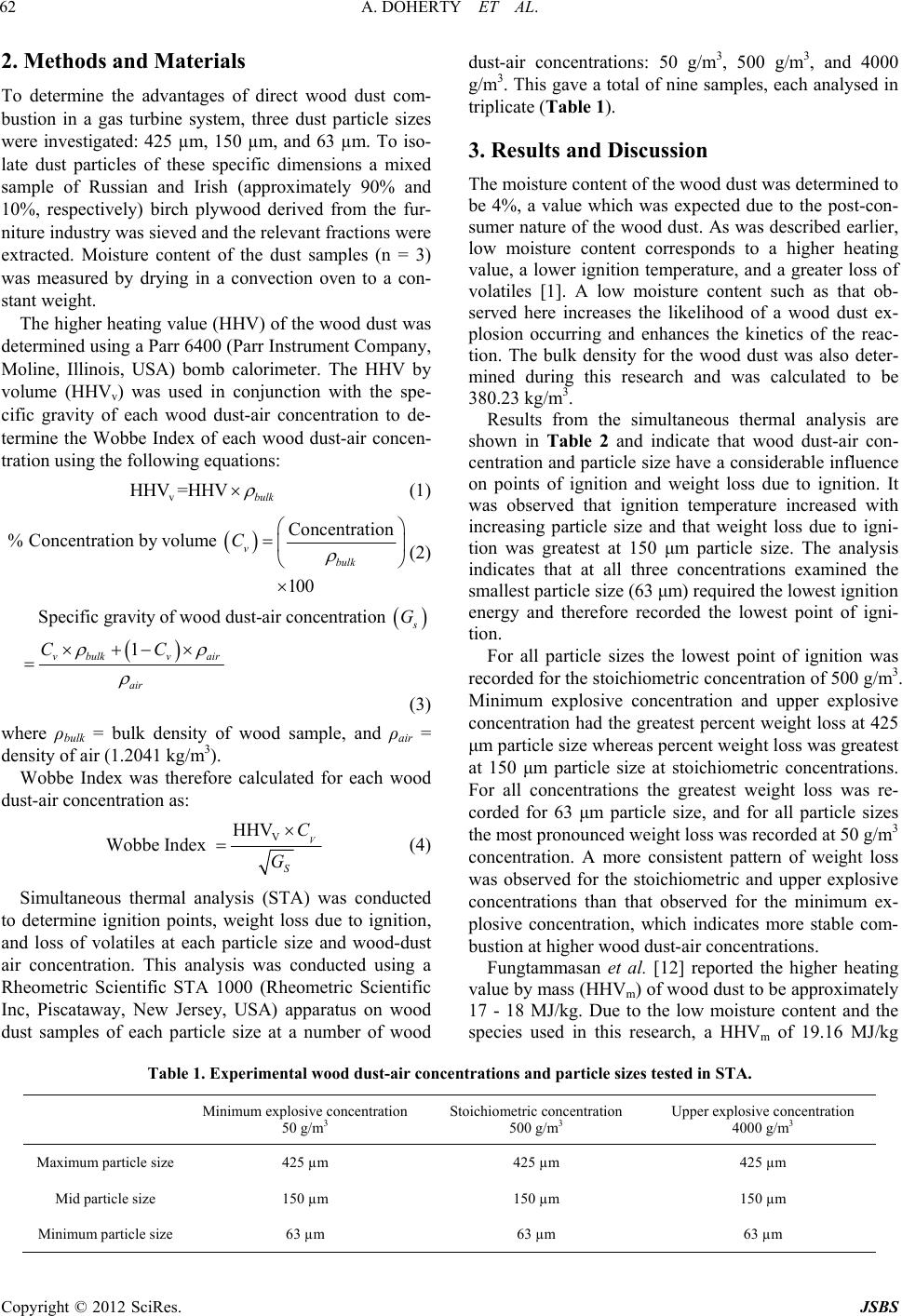 A. DOHERTY ET AL. Copyright © 2012 SciRes. JSBS 62 HHV =HHVbulk 2. Methods and Materials To determine the advantages of direct wood dust com- bustion in a gas turbine system, three dust particle sizes were investigated: 425 µm, 150 µm, and 63 µm. To iso- late dust particles of these specific dimensions a mixed sample of Russian and Irish (approximately 90% and 10%, respectively) birch plywood derived from the fur- niture industry was sieved and the relevant fractions were extracted. Moisture content of the dust samples (n = 3) was measured by drying in a convection oven to a con- stant weight. The higher heating value (HHV) of the wood dust was determined using a Parr 6400 (Parr Instrument Company, Moline, Illinois, USA) bomb calorimeter. The HHV by volume (HHVv) was used in conjunction with the spe- cific gravity of each wood dust-air concentration to de- termine the Wobbe Index of each wood dust-air concen- tration using the following equations: v (1) Concentration 0 bulk % Concentration by volume 10 v C (2) Specific gravity of wood dust-air concentration 1 s vbulkv air air CC G (3) where ρbulk = bulk density of wood sample, and ρair = density of air (1.2041 kg/m3). Wobbe Index was therefore calculated for each wood dust-air concentration as: V HHV V S C G Wobbe Index (4) Simultaneous thermal analysis (STA) was conducted to determine ignition points, weight loss due to ignition, and loss of volatiles at each particle size and wood-dust air concentration. This analysis was conducted using a Rheometric Scientific STA 1000 (Rheometric Scientific Inc, Piscataway, New Jersey, USA) apparatus on wood dust samples of each particle size at a number of wood dust-air concentrations: 50 g/m3, 500 g/m3, and 4000 g/m3. This gave a total of nine samples, each analysed in triplicate (Table 1). 3. Results and Discussion The moisture content of the wood dust was determined to be 4%, a value which was expected due to the post-con- sumer nature of the wood dust. As was described earlier, low moisture content corresponds to a higher heating value, a lower ignition temperature, and a greater loss of volatiles [1]. A low moisture content such as that ob- served here increases the likelihood of a wood dust ex- plosion occurring and enhances the kinetics of the reac- tion. The bulk density for the wood dust was also deter- mined during this research and was calculated to be 380.23 kg/m3. Results from the simultaneous thermal analysis are shown in Table 2 and indicate that wood dust-air con- centration and particle size have a considerable influence on points of ignition and weight loss due to ignition. It was observed that ignition temperature increased with increasing particle size and that weight loss due to igni- tion was greatest at 150 μm particle size. The analysis indicates that at all three concentrations examined the smallest particle size (63 μm) required the lowest ignition energy and therefore recorded the lowest point of igni- tion. For all particle sizes the lowest point of ignition was recorded for the stoichiometric concentration of 500 g/m3. Minimum explosive concentration and upper explosive concentration had the greatest percent weight loss at 425 μm particle size whereas percent weight loss was greatest at 150 μm particle size at stoichiometric concentrations. For all concentrations the greatest weight loss was re- corded for 63 μm particle size, and for all particle sizes the most pronounced weight loss was recorded at 50 g/m3 concentration. A more consistent pattern of weight loss was observed for the stoichiometric and upper explosive concentrations than that observed for the minimum ex- plosive concentration, which indicates more stable com- bustion at higher wood dust-air concentrations. Fungtammasan et al. [12] reported the higher heating value by mass (HHVm) of wood dust to be approximately 17 - 18 MJ/kg. Due to the low moisture content and the species used in this research, a HHVm of 19.16 MJ/kg Table 1. Experimental wood dust-air concentrations and partic le sizes teste d in STA. Minimum explosive concentration 50 g/m3 Stoichiometric concentration 500 g/m3 Upper explosive concentration 4000 g/m3 Maximum particle size 425 µm 425 µm 425 µm Mid particle size 150 µm 150 µm 150 µm Minimum particle size 63 µm 63 µm 63 µm 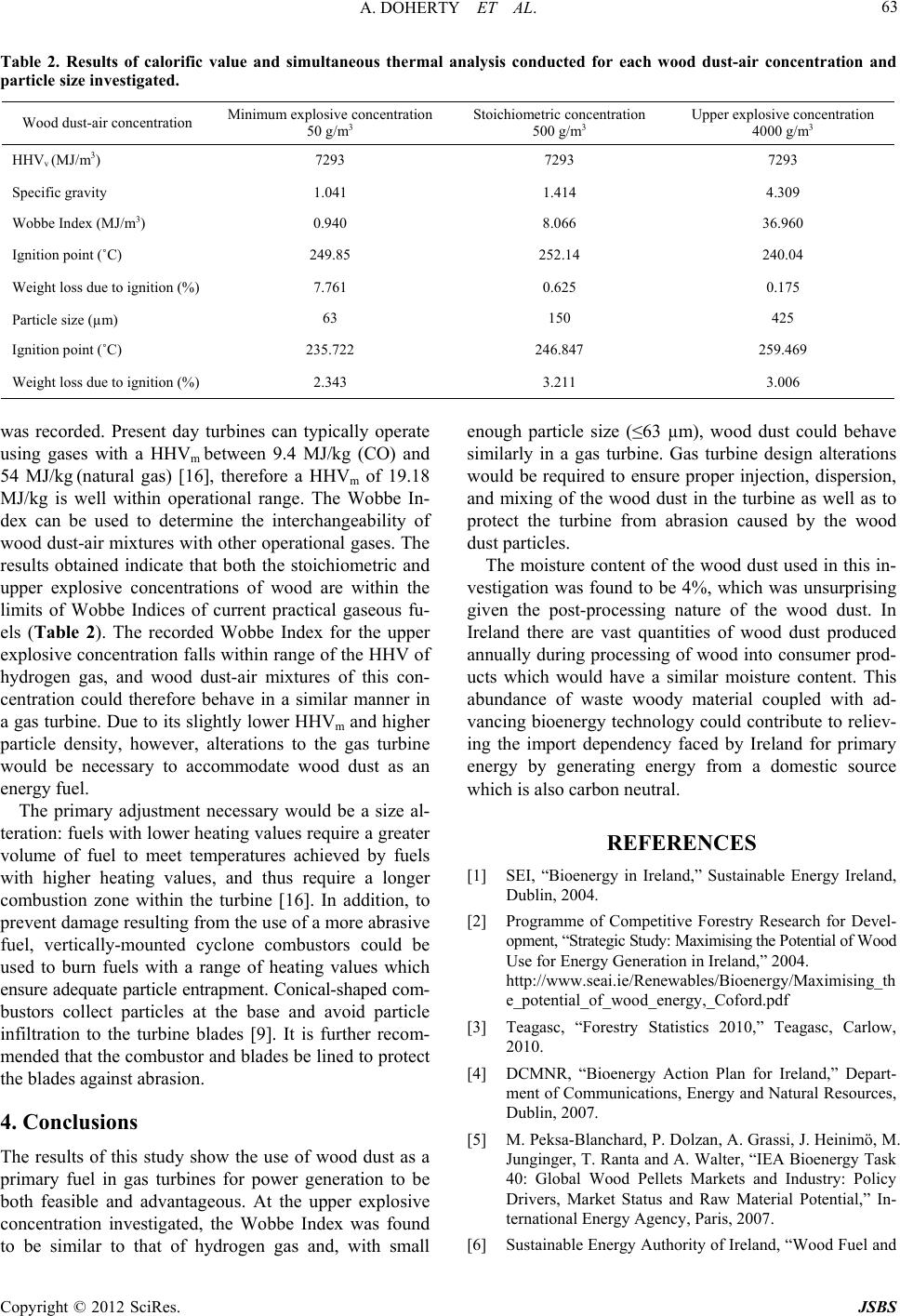 A. DOHERTY ET AL. 63 Table 2. Results of calorific value and simultaneous thermal analysis conducted for each wood dust-air concentration and particle size investigated. Wood dust-air concentration Minimum explosive concentration 50 g/m3 Stoichiometric concentration 500 g/m3 Upper explosive concentration 4000 g/m3 HHVv (MJ/m3) 7293 7293 7293 Specific gravity 1.041 1.414 4.309 Wobbe Index (MJ/m3) 0.940 8.066 36.960 Ignition point (˚C) 249.85 252.14 240.04 Weight loss due to ignition (%) 7.761 0.625 0.175 Particle size (µm) 63 150 425 Ignition point (˚C) 235.722 246.847 259.469 Weight loss due to ignition (%) 2.343 3.211 3.006 was recorded. Present day turbines can typically operate using gases with a HHVm between 9.4 MJ/kg (CO) and 54 MJ/kg (natural gas) [16], therefore a HHVm of 19.18 MJ/kg is well within operational range. The Wobbe In- dex can be used to determine the interchangeability of wood dust-air mixtures with other operational gases. The results obtained indicate that both the stoichiometric and upper explosive concentrations of wood are within the limits of Wobbe Indices of current practical gaseous fu- els (Table 2). The recorded Wobbe Index for the upper explosive concentration falls within range of the HHV of hydrogen gas, and wood dust-air mixtures of this con- centration could therefore behave in a similar manner in a gas turbine. Due to its slightly lower HHVm and higher particle density, however, alterations to the gas turbine would be necessary to accommodate wood dust as an energy fuel. The primary adjustment necessary would be a size al- teration: fuels with lower heating values require a greater volume of fuel to meet temperatures achieved by fuels with higher heating values, and thus require a longer combustion zone within the turbine [16]. In addition, to prevent damage resulting from the use of a more abrasive fuel, vertically-mounted cyclone combustors could be used to burn fuels with a range of heating values which ensure adequate particle entrapment. Conical-shaped com- bustors collect particles at the base and avoid particle infiltration to the turbine blades [9]. It is further recom- mended that the combustor and blades be lined to protect the blades against abrasion. 4. Conclusions The results of this study show the use of wood dust as a primary fuel in gas turbines for power generation to be both feasible and advantageous. At the upper explosive concentration investigated, the Wobbe Index was found to be similar to that of hydrogen gas and, with small enough particle size (≤63 µm), wood dust could behave similarly in a gas turbine. Gas turbine design alterations would be required to ensure proper injection, dispersion, and mixing of the wood dust in the turbine as well as to protect the turbine from abrasion caused by the wood dust particles. The moisture content of the wood dust used in this in- vestigation was found to be 4%, which was unsurprising given the post-processing nature of the wood dust. In Ireland there are vast quantities of wood dust produced annually during processing of wood into consumer prod- ucts which would have a similar moisture content. This abundance of waste woody material coupled with ad- vancing bioenergy technology could contribute to reliev- ing the import dependency faced by Ireland for primary energy by generating energy from a domestic source which is also carbon neutral. REFERENCES [1] SEI, “Bioenergy in Ireland,” Sustainable Energy Ireland, Dublin, 2004. [2] Programme of Competitive Forestry Research for Devel- opment, “Strategic Study: Maximising the Potential of Wood Use for Energy Generation in Ireland,” 2004. http://www.seai.ie/Renewables/Bioenergy/Maximising_th e_potential_of_wood_energy,_Coford.pdf [3] Teagasc, “Forestry Statistics 2010,” Teagasc, Carlow, 2010. [4] DCMNR, “Bioenergy Action Plan for Ireland,” Depart- ment of Communications, Energy and Natural Resources, Dublin, 2007. [5] M. Peksa-Blanchard, P. Dolzan, A. Grassi, J. Heinimö, M. Junginger, T. Ranta and A. Walter, “IEA Bioenergy Task 40: Global Wood Pellets Markets and Industry: Policy Drivers, Market Status and Raw Material Potential,” In- ternational Energy Agency, Paris, 2007. [6] Sustainable Energy Authority of Ireland, “Wood Fuel and Copyright © 2012 SciRes. JSBS  A. DOHERTY ET AL. 64 Supply Chain,” 2011. http://www.seai.ie/Renewables/Bioenergy /Sources/ Wood_ Energy_and_Supply_Chain/Fuel_and_Supply_Chain/ [7] M. R. Wu, D. L. Schott and G. Lodewijks, “Physical Properties of Solid Biomass,” Biomass and Bioenergy, Vol. 35, No. 5, 2011, pp. 2093-2105. doi:10.1016/j.biombioe.2011.02.020 [8] GTC, “Gasification: The Waste-to-Energy Solution,” Gasifi- cation Technologies Council, Arlington, 2012. [9] C. Syred, A. Griffiths and N. Syred, “Gas Turbine Com- bustor with Integrated Ash Removal for Fine Particu- lates,” Proceedings ASME Turbo Expo, Vienna, 14-17 June 2004, pp. 1-9. [10] D. J. Flynn, J. J. Dillon, P. B. Desch and T. S. Lai, “The NALCO Guide to Boiler Failure Analysis,” 2nd Edition, McGraw Hill, Inc., New York, 2011. [11] K. W. Ragland, D. J. Aerts and A. J. Baker, “Properties of Wood for Combustion Analysis,” Bioresource Technol- ogy, Vol. 37, 1991, pp. 161-168. doi:10.1016/0960-8524(91)90205-X [12] B. Fungtammasan, P. Jittreepit, J. Torero and P. Joulain, “An Experimental Study of the Combustion Characteris- tics of Sawdust in a Cyclone Combustor,” Proceedings European—ASEAN Conference on Combustion of Solids and Treatment of Products, Hua Hin, 16-17 February 1995, pp. 1-18. [13] Weyerhaeuser Company, “Wood and Wood Dust (With- out Chemical Treatments or Resins/Adhesives). Material Safety Data Sheet,” Weyerhaeuser Company, Washington, 2010. [14] V. Babrauskas, “Ignition of Wood: A Review of the State of the Art,” Proceedings Interflam, 9th International Fire Science and Engineering Conference, Edinburgh, 17-19 September 2001, pp. 71-88. [15] R. K. Eckhoff, “Dust Explosions in the Process Industry,” Gulf Professional Publishing, Massachusetts, 2003. [16] M. P. Boyce, “Gas Turbine Engineering Handbook,” Vol. 4, Butterworth-Heinemann, Woburn, 2011. Copyright © 2012 SciRes. JSBS |