

Paper Menu >>
Journal Menu >>
 Journal of Sustainable Bioenergy Systems, 2012, 2, 33-36 http://dx.doi.org/10.4236/jsbs.2012.23005 Published Online September 2012 (http://www.SciRP.org/journal/jsbs) Study on Temperature Gradients and Protein Enrichment by Aspergillus oryzae in Solid-State Fermentation on Packed Bed Bioreactor Using Jowar (Sorghum) Straw as Substrate Ganesh A. Bathe1*, Vilas S. Patil1, Ashish S. Chaurasia2* 1School of Chemical Technology, North Maharashtra University, Jalgaon, India 2Department of Chemical Engineering, Jaypee University of Engineering and Technology, Guna, India Email: *[email protected], *[email protected] Received July 18, 2012; revised August 20, 2012; accepted August 29, 2012 ABSTRACT The packed bed solid state bioreactor designated as PBSSB is constructed in the present study. The experiments are carried out in packed bed bioreactor with jowar straw and inoculated with Aspergillus oryzae. Temperature gradient has been measured at different axial po sitions. It is found that the organisms grew rap idly during the p eriod from 20 to 30 h during which heat generation is more. These results are in agreement with other researchers. The fermented jowar straw shows threefold in crease in protein content. This can be utilized as high value nutritional feed to animals. Keywords: Solid-State Fermentation; Packed-Bed Bioreactor; Aspergillus oryzae; Jowar Straw; Temperature Gradient 1. Introduction India is an agrarian country. Around 60% - 65% of the people directly or indirectly depend upon agriculture. The Indian farmer community is facing very serious eco- nomic crises due to unpredictable monsoon, low market value for agro-product, etc. Pressure of economic crises on agro-based industries can be reduced up to certain level if scientific research will be concentrated more in these areas. Solid state fermentation can be a potential solution for upgrading the nutritive value of agricultural products and has the possibility of having it carried out on farms [1]. If solid state fermentation (SSF) can be used efficiently for large capacity then we can serve in better way for society. Overall efficiency of the solid state fermentation (SSF) basically depends on three fac- tors i.e. Energy, Economy and Environment. Submerged fermentation (SmF) and solid state fer- mentation (SSF) are the two bioconversion methods in operation. Submerged fermentation (SmF) is well estab- lished while the solid state fermentation (SSF) is still in evolutionary state and under intensive research. Solid state fermentation has been defined as the fermentation on moist substrate and is carried out in the absence or near ab sence of fre e water [2,3]. In this process, water is present in the solid substrate whose capacity for liquid retention varies with the type of biomass material. The bioreactors for solid-state fermentation can be di- vided into four types, based on type of aeration or the mixed system employed [4]. These are tray column, packed-bed column, rotating drum and fluidized bed column. Heat accumulation is the serious problem in the solid state fermentor an d is the major co ns ideration in the design of large scale packed bed solid state bioreactor (PBSSB). Several reasons are responsible for heat accu- mulation in PBSSB includes low thermal conductivity of biomass, absence of free water, channeling, etc. [5]. Channeling occurs when the fluid/gas flowing through the packed bed and find a ‘preferred or fix path’ thr ough the bed. The current research work focuses on novel design of PBSSB. Experiments are carried out to study the heat accumulation at different heights of PBSSB and to ana- lyze the C:N ratio and protein content of unfermented and fermented samples. Aspergillus oryzae is chosen to be the micro-organism growing on jowar straw. 2. Experimental Setup The experimental setup of a packed bed solid state fer- mentor is shown in Figure 1. It consists of a cylindrical unit (1) with a capacity of 4.4 litres. It is 25 cm long ver- tical cylinder with internal diameter of 15 cm. The mate- rial used for the construction of fermentor system is *Corresponding authors. C opyright © 2012 SciRes. JSBS 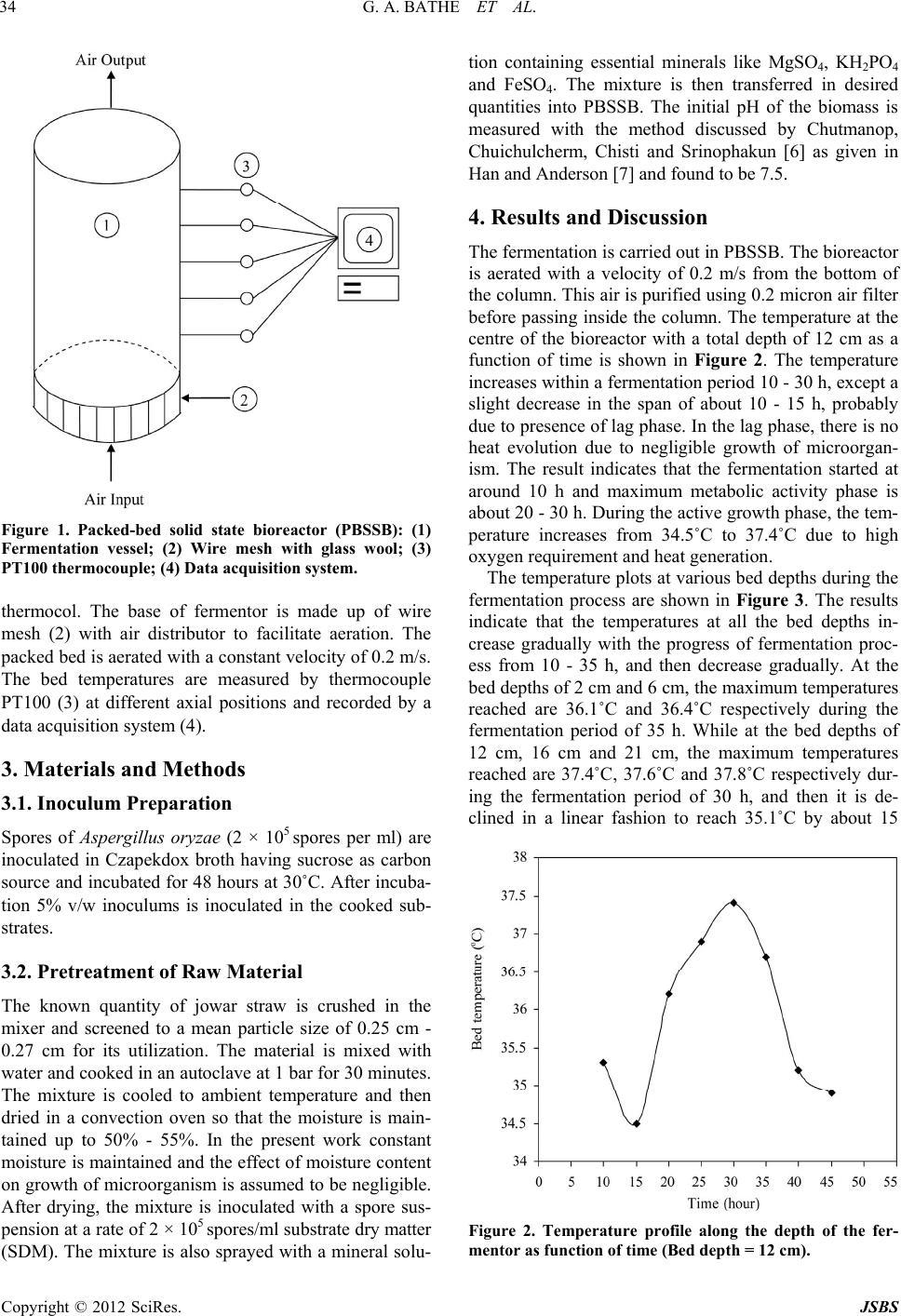 G. A. BATHE ET AL. 34 Figure 1. Packed-bed solid state bioreactor (PBSSB): (1) Fermentation vessel; (2) Wire mesh with glass wool; (3) PT100 thermocouple; (4) Data acquisition system. thermocol. The base of fermentor is made up of wire mesh (2) with air distributor to facilitate aeration. The packed bed is aerated with a constant velocity of 0.2 m/s. The bed temperatures are measured by thermocouple PT100 (3) at different axial positions and recorded by a data acquisition system (4). 3. Materials and Methods 3.1. Inoculum Preparation Spores of Aspergillus oryzae (2 × 10⁵ spores per ml) are inoculated in Czapekdox broth having sucrose as carbon source and incubated for 48 hours at 30˚C. After incuba- tion 5% v/w inoculums is inoculated in the cooked sub- strates. 3.2. Pretreatment of Raw Material The known quantity of jowar straw is crushed in the mixer and screened to a mean particle size of 0.25 cm - 0.27 cm for its utilization. The material is mixed with water and cooked in an autoclave at 1 bar for 30 minutes. The mixture is cooled to ambient temperature and then dried in a convection oven so that the moisture is main- tained up to 50% - 55%. In the present work constant moisture is maintained and the effect of moisture content on growth of microorganism is assumed to be negligible. After drying, the mixture is inoculated with a spore sus- pension at a rate of 2 × 10⁵ spores/ml substrate dry matter (SDM). The mixture is also sprayed with a mineral solu- tion containing essential minerals like MgSO4, KH2PO4 and FeSO4. The mixture is then transferred in desired quantities into PBSSB. The initial pH of the biomass is measured with the method discussed by Chutmanop, Chuichulcherm, Chisti and Srinophakun [6] as given in Han and Anderson [7] and found to be 7.5. 4. Results and Discussion The fermentation is carried out in PBSSB. The bioreactor is aerated with a velocity of 0.2 m/s from the bottom of the column. This air is purified us ing 0.2 micron air filter before passing inside the column. The temperature at the centre of the bioreactor with a total depth of 12 cm as a function of time is shown in Figure 2. The temperature increases within a fermentation period 10 - 30 h, except a slight decrease in the span of about 10 - 15 h, probably due to presence of lag phase. In the lag phase, there is no heat evolution due to negligible growth of microorgan- ism. The result indicates that the fermentation started at around 10 h and maximum metabolic activity phase is about 20 - 30 h. D uring the activ e grow th phase, th e tem- perature increases from 34.5˚C to 37.4˚C due to high oxygen requirement and heat generation. The temperature plots at various bed depths during the fermentation process are shown in Figure 3. The results indicate that the temperatures at all the bed depths in- crease gradually with the progress of fermentation proc- ess from 10 - 35 h, and then decrease gradually. At the bed depths of 2 cm and 6 cm, the maximum temperatures reached are 36.1˚C and 36.4˚C respectively during the fermentation period of 35 h. While at the bed depths of 12 cm, 16 cm and 21 cm, the maximum temperatures reached are 37.4˚C, 37.6˚C and 37.8˚C respectively dur- ing the fermentation period of 30 h, and then it is de- clined in a linear fashion to reach 35.1˚C by about 15 Figure 2. Temperature profile along the depth of the fer- mentor as function of time (Bed depth = 12 cm). Copyright © 2012 SciRes. JSBS 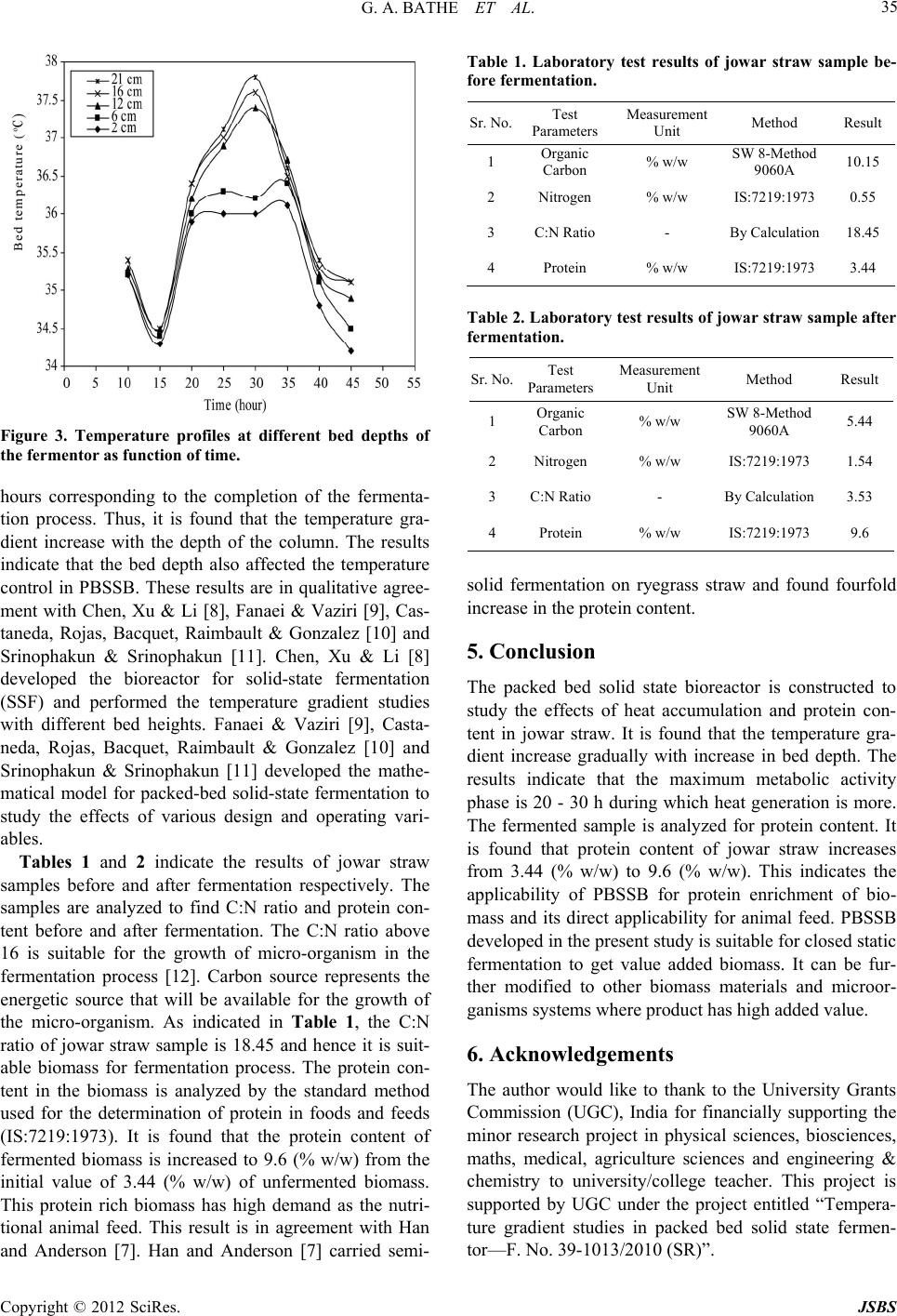 G. A. BATHE ET AL. 35 Figure 3. Temperature profiles at different bed depths of the fermentor as function of time. hours corresponding to the completion of the fermenta- tion process. Thus, it is found that the temperature gra- dient increase with the depth of the column. The results indicate that the bed depth also affected the temperature control in PBSSB. These results are in qualitative agree- ment with Chen, Xu & Li [8], Fanaei & Vaziri [9], Cas- taneda, Rojas, Bacquet, Raimbault & Gonzalez [10] and Srinophakun & Srinophakun [11]. Chen, Xu & Li [8] developed the bioreactor for solid-state fermentation (SSF) and performed the temperature gradient studies with different bed heights. Fanaei & Vaziri [9], Casta- neda, Rojas, Bacquet, Raimbault & Gonzalez [10] and Srinophakun & Srinophakun [11] developed the mathe- matical model for packed-bed solid-state fermentation to study the effects of various design and operating vari- ables. Tables 1 and 2 indicate the results of jowar straw samples before and after fermentation respectively. The samples are analyzed to find C:N ratio and protein con- tent before and after fermentation. The C:N ratio above 16 is suitable for the growth of micro-organism in the fermentation process [12]. Carbon source represents the energetic source that will be available for the growth of the micro-organism. As indicated in Table 1, the C:N ratio of jowar straw sample is 18.45 and hence it is suit- able biomass for fermentation process. The protein con- tent in the biomass is analyzed by the standard method used for the determination of protein in foods and feeds (IS:7219:1973). It is found that the protein content of fermented biomass is increased to 9.6 (% w/w) from the initial value of 3.44 (% w/w) of unfermented biomass. This protein rich biomass has high demand as the nutri- tional animal feed. This result is in agreement with Han and Anderson [7]. Han and Anderson [7] carried semi- Table 1. Laboratory test results of jowar straw sample be- fore fermentation. Sr. No.Test Parameters Measurement Unit Method Result 1 Organic Carbon % w/w SW 8-Method 9060A 10.15 2 Nitrogen % w/w IS:7219:1973 0.55 3 C:N Ratio - By Calculation18.45 4 Protein % w/w IS:7219:1973 3.44 Table 2. Laboratory test results of jowar straw sample after fermentation. Sr. No.Test Parameters Measurement Unit Method Result 1 Organic Carbon % w/w SW 8-Method 9060A 5.44 2 Nitrogen % w/w IS:7219:1973 1.54 3 C:N Ratio - By Calculation3.53 4 Protein % w/w IS:7219:1973 9.6 solid fermentation on ryegrass straw and found fourfold increase in the protein content. 5. Conclusion The packed bed solid state bioreactor is constructed to study the effects of heat accumulation and protein con- tent in jowar straw. It is found that the temperature gra- dient increase gradually with increase in bed depth. The results indicate that the maximum metabolic activity phase is 20 - 30 h during which heat generation is more. The fermented sample is analyzed for protein content. It is found that protein content of jowar straw increases from 3.44 (% w/w) to 9.6 (% w/w). This indicates the applicability of PBSSB for protein enrichment of bio- mass and its direct applicability for animal feed. PBSSB developed in the presen t study is su itable f or clo sed static fermentation to get value added biomass. It can be fur- ther modified to other biomass materials and microor- ganisms systems where product has high added value. 6. Acknowledgements The author would like to thank to the University Grants Commission (UGC), India for financially supporting the minor research project in physical sciences, biosciences, maths, medical, agriculture sciences and engineering & chemistry to university/college teacher. This project is supported by UGC under the project entitled “Tempera- ture gradient studies in packed bed solid state fermen- tor—F. No. 39-1013/2010 (SR)”. Copyright © 2012 SciRes. JSBS 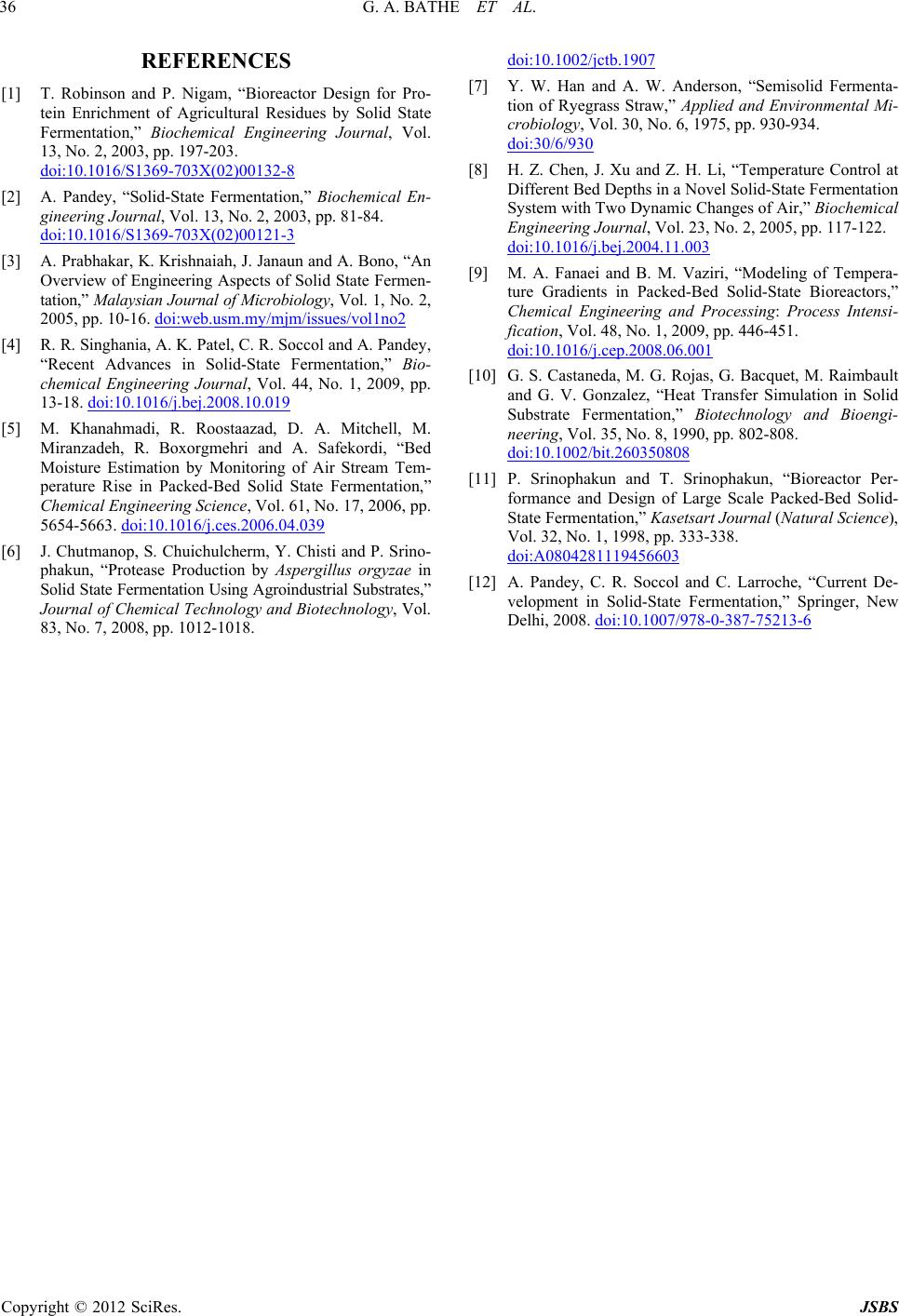 G. A. BATHE ET AL. Copyright © 2012 SciRes. JSBS 36 REFERENCES [1] T. Robinson and P. Nigam, “Bioreactor Design for Pro- tein Enrichment of Agricultural Residues by Solid State Fermentation,” Biochemical Engineering Journal, Vol. 13, No. 2, 2003, pp. 197-203. doi:10.1016/S1369-703X(02)00132-8 [2] A. Pandey, “Solid-State Fermentation,” Biochemical En- gineering Journal, Vol. 13, No. 2, 2003, pp. 81-84. doi:10.1016/S1369-703X(02)00121-3 [3] A. Prabhakar, K. Krishnaiah, J. Janaun and A. Bono, “An Overview of Engineering Aspects of Solid State Fermen- tation,” Malay sian Journal of Microbiology, Vol. 1, No. 2, 2005, pp. 10-16. doi:web.usm.my/mjm/issues/vol1no2 [4] R. R. Singhania, A. K. Patel, C. R. Soccol and A. Pandey, “Recent Advances in Solid-State Fermentation,” Bio- chemical Engineering Journal, Vol. 44, No. 1, 2009, pp. 13-18. doi:10.1016/j.bej.2008.10.019 [5] M. Khanahmadi, R. Roostaazad, D. A. Mitchell, M. Miranzadeh, R. Boxorgmehri and A. Safekordi, “Bed Moisture Estimation by Monitoring of Air Stream Tem- perature Rise in Packed-Bed Solid State Fermentation,” Chemical Engineering Science, Vol. 61, No. 17, 2006, pp. 5654-5663. doi:10.1016/j.ces.2006.04.039 [6] J. Chutmanop, S. Chuichulcherm, Y. Chisti and P. Srino- phakun, “Protease Production by Aspergillus orgyzae in Solid State Fermentation Using Agroindustrial Substrate s,” Journal of Chemical Technology and Biotechnology, Vol. 83, No. 7, 2008, pp. 1012-1018. doi:10.1002/jctb.1907 [7] Y. W. Han and A. W. Anderson, “Semisolid Fermenta- tion of Ryegrass Straw,” Applied and Environmental Mi- crobiology, Vol. 30, No. 6, 1975, pp. 930-934. doi:30/6/930 [8] H. Z. Chen, J. Xu and Z. H. Li, “Temperature Control at Different Bed Depths in a Novel Solid-State Fermentation System with Two Dynamic Changes of Air,” Biochemical Engineering Journal, Vol. 23, No. 2, 2005, pp. 117-122. doi:10.1016/j.bej.2004.11.003 [9] M. A. Fanaei and B. M. Vaziri, “Modeling of Tempera- ture Gradients in Packed-Bed Solid-State Bioreactors,” Chemical Engineering and Processing: Process Intensi- fication, Vol. 48, No. 1, 2009, pp. 446-451. doi:10.1016/j.cep.2008.06.001 [10] G. S. Castaneda, M. G. Rojas, G. Bacquet, M. Raimbault and G. V. Gonzalez, “Heat Transfer Simulation in Solid Substrate Fermentation,” Biotechnology and Bioengi- neering, Vol. 35, No. 8, 1990, pp. 802-808. doi:10.1002/bit.260350808 [11] P. Srinophakun and T. Srinophakun, “Bioreactor Per- formance and Design of Large Scale Packed-Bed Solid- State Fermentation,” Kasetsart Journal (Natural Science), Vol. 32, No. 1, 1998, pp. 333-338. doi:A0804281119456603 [12] A. Pandey, C. R. Soccol and C. Larroche, “Current De- velopment in Solid-State Fermentation,” Springer, New Delhi, 2008. doi:10.1007/978-0-387-75213-6 |