

Paper Menu >>
Journal Menu >>
 Journal of Sustainable Bioenergy Systems, 2012, 2, 27-32 http://dx.doi.org/10.4236/jsbs.2012.23004 Published Online September 2012 (http://www.SciRP.org/journal/jsbs) Using Magnetic Nanoparticles to Eliminate Oscillations in Saccharomyces cerevisiae Fermentation Processes Lakshmi N. Sridhar Chemical Engineering Department, University of Puerto Rico, Mayaguez, Puerto Rico Email: lakshmin[email protected] Received June 4, 2012; revised July 11, 2012; accepted July 23, 2012 ABSTRACT This article provides computational evidence to show that functionalized magnetic nanoparticles can eliminate the wasteful oscillatory behavior in fermentation processes involving Saccharomyces cerevisiae. There has been a consid- erable amount of work demonstrating the existence of oscillations in fermentation processes. Recently reference [1] computationally demonstrated very simple strategies to eliminate the oscillations in the fermentation process. In the case of the of the Saccharomyces cerevisiae fermentation process it was shown that the addition of a little bit of oxygen would be successful in eliminatin g the oscillation causing Hopf bifurcation s. The work of [2,3] demonstrated that oxy- gen mass transfer could be enhanced by using functionalized magnetic nanoparticles. The aim of this work is to incor- porate the model used by [3] regarding the enhancement of oxygen mass transfer in the cybernetic Jones Kompala model [4] describing the dynamics of the Saccharomnyces cerevisiae fermentation process and demonstrate that using the functionalized magnetic nanoparticles can by altering the mass transfer coefficient actually succeed in eliminating the oscillatory behavior that plagues the Saccharomyces cerevisiae fermentation process. This occurs because the oscil- lation causing Hopf bifurcations are sensitive to the amount of input oxygen and increasing the oxygen mass transfer coefficient causes the disappearance of the Hopf bifurcation points. Keywords: Nanoparticles; Fermentation; Oscillations 1. Introduction Production of ethanol from a variety of biomass feed- stocks, solid and liquid waste resources is a national pri- ority for a variety of reasons but most importantly for energy independence and sustain ability. The biggest hur- dle in the commercialization of any of the processes for making ethanol is the cost of production. Hence, it is important to develop strategies to produce clean ethanol with the least amount of expense avoiding all unnec- essary expenses and wastage during ethanol production. Continuous fermentation processes used for ethanol production has been known to exhibit oscillatory behav- ior and this has been confirmed both theoretically and experimentally. Fermentation processes involving both Saccharomyces cerevisiae and Zymomonas mobilis have been shown to exhibit oscillatory behavior [5-11]. The oscillatory behavior was linked to the combination of substrate excess and product inhibitions by reference [8] while reference [10] conclude that the oscillations take place at high values of feed substrate concentrations. References [9,10,12,13] have demonstrated the exis- tence of oscillatory behavior in con tinuous fermentations of Saccharomyces cerevisiae. While there have been a lot of modeling work regarding fermentation processes, the most sophisticated model available is the Jones Kompala model [4]. This model has demonstrated the observed oscillatory behavior [14,15]. Reference [4] discusses the effect of oxygen mass transfer on the Saccharomyces cerevisiae fermentation in a section in their paper titled “Effect of oxygen mass transfer on yeast oscillations”. The oscillatory behavior that has been demonstrated numerically and experimentally by several workers ad- versely affects the fermentation process and the ethanol production. Hence one must develop strategies to avoid or eliminate the oscillations. Reference [1] recently compu- tationally demonstrated some techniques for eliminat- ing oscillations in fermentation processes involving both Zymomonas mobilis and Saccharomyces cerevisiae. Spe- cifically, it was shown that in the case of the Saccharo- myces cerevisiae fermentation that a small increase in the input oxygen concentration would eliminate the oscilla- tion causing Hopf bifurcation. This increase in oxygen mass transfer can also be observed if the mass transfer coefficient for the oxygen mass transfer can be enhanced. Recently, [2,3] investigated the use of functionalized magnetic nanoparticles with flourinated polymer coating to enhance oxygen mass transfer in bioreactors. The C opyright © 2012 SciRes. JSBS 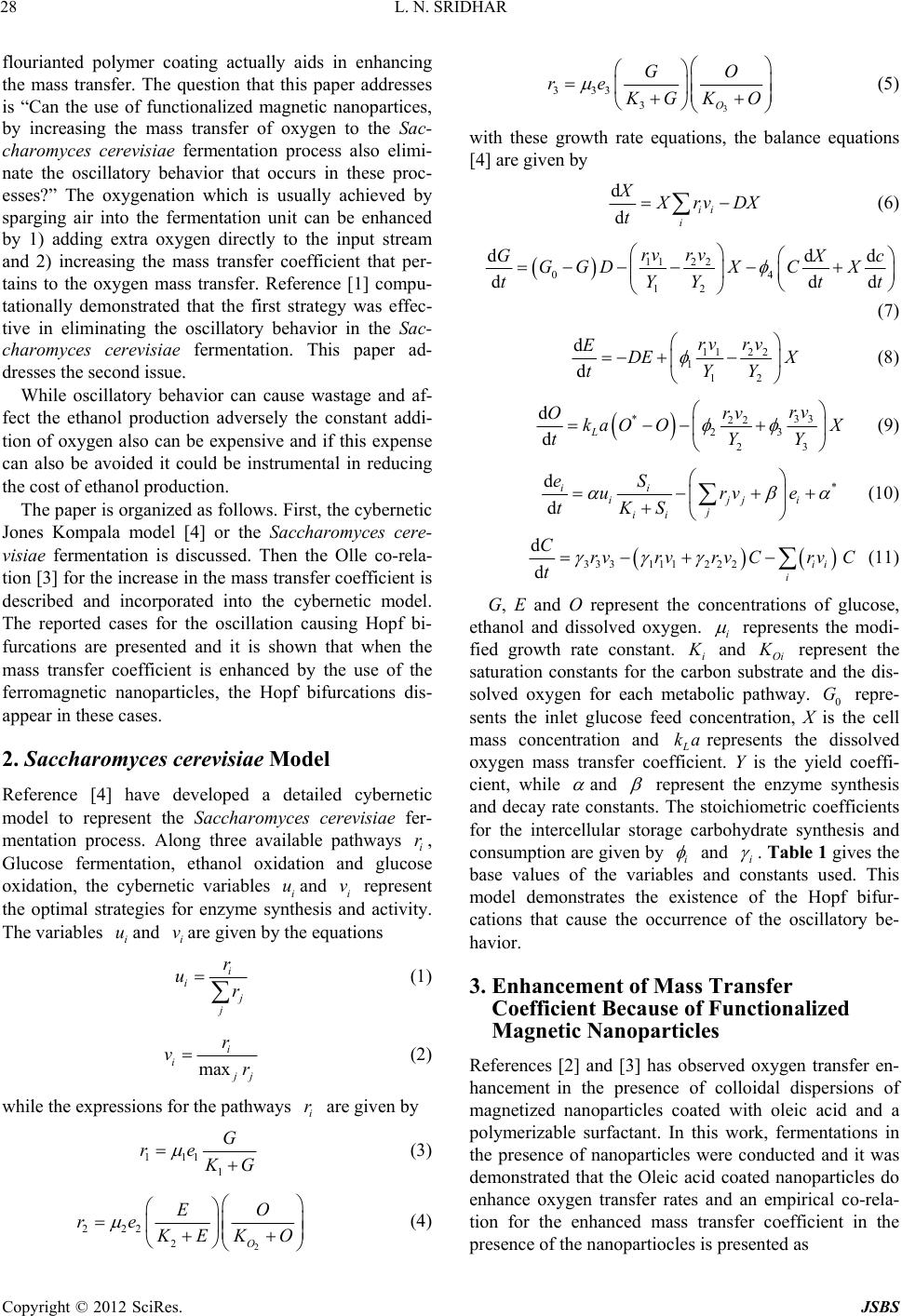 L. N. SRIDHAR 28 flourianted polymer coating actually aids in enhancing the mass transfer. The question that this paper addresses is “Can the use of functionalized magnetic nanopartices, by increasing the mass transfer of oxygen to the Sac- charomyces cerevisiae fermentation process also elimi- nate the oscillatory behavior that occurs in these proc- esses?” The oxygenation which is usually achieved by sparging air into the fermentation unit can be enhanced by 1) adding extra oxygen directly to the input stream and 2) increasing the mass transfer coefficient that per- tains to the oxygen mass transfer. Reference [1] compu- tationally demonstrated that the first strategy was effec- tive in eliminating the oscillatory behavior in the Sac- charomyces cerevisiae fermentation. This paper ad- dresses the second issue. While oscillatory behavior can cause wastage and af- fect the ethanol production adversely the constant addi- tion of oxygen also can be expensive and if this expense can also be avoided it could be instrumental in reducing the cost of ethanol production. The paper is organized as follows. First, the cybernetic Jones Kompala model [4] or the Saccharomyces cere- visiae fermentation is discussed. Then the Olle co-rela- tion [3] for the increase in th e mass transfer coefficient is described and incorporated into the cybernetic model. The reported cases for the oscillation causing Hopf bi- furcations are presented and it is shown that when the mass transfer coefficient is enhanced by the use of the ferromagnetic nanoparticles, the Hopf bifurcations dis- appear in these cases. 2. Saccharomyces cerevisiae Model Reference [4] have developed a detailed cybernetic model to represent the Saccharomyces cerevisiae fer- mentation process. Along three available pathways i, Glucose fermentation, ethanol oxidation and glucose oxidation, the cybernetic variables iand i represent the optimal strategies for enzyme synthesis and activity. The variables and are given by the equa t ions r u v i ui v i i j j r ur (1) max i i j j r vr i r (2) while the expressions for th e pathways are given by 111 1 G re K G (3) 2 O EO 222 2 re K EK O (4) 3 333 3O GO re K GKO (5) with these growth rate equations, the balance equations [4] are give n b y d dii i X X rv DX t (6) 112 2 04 12 ddd ddd rv rv GXc GGDX CX tYYtt (7) 112 2 112 d d rv rv EDE X tYY (8) *33 22 23 23 d dL rv rv OkaOOX tYY (9) * d dii ijji j ii eS urve tKS (10) 33 3111222 d dii i Crvrvrv CrvC t (11) G, E and O represent the concentrations of glucose, ethanol and dissolved oxygen. i represents the modi- fied growth rate constant. i K and Oi K represent the saturation constants for the carbon substrate and the dis- solved oxygen for each metabolic pathway. 0 repre- sents the inlet glucose feed concentration, X is the cell mass concentration and G L karepresents the dissolved oxygen mass transfer coefficient. Y is the yield coeffi- cient, while and represent the enzyme synthesis and decay rate constants. The stoichiometric coefficients for the intercellular storage carbohydrate synthesis and consumption are given by i and i . Table 1 giv es the base values of the variables and constants used. This model demonstrates the existence of the Hopf bifur- cations that cause the occurrence of the oscillatory be- havior. 3. Enhancement of Mass Transfer Coefficient Because of Functionalized Magnetic Nanoparticles References [2] and [3] has observed oxygen transfer en- hancement in the presence of colloidal dispersions of magnetized nanoparticles coated with oleic acid and a polymerizable surfactant. In this work, fermentations in the presence of nanoparticles were conducted and it was demonstrated that the Oleic acid coated nanoparticles do enhance oxygen transfer rates and an empirical co-rela- tion for the enhanced mass transfer coefficient in the presence of the nanopartiocles is presented as Copyright © 2012 SciRes. JSBS 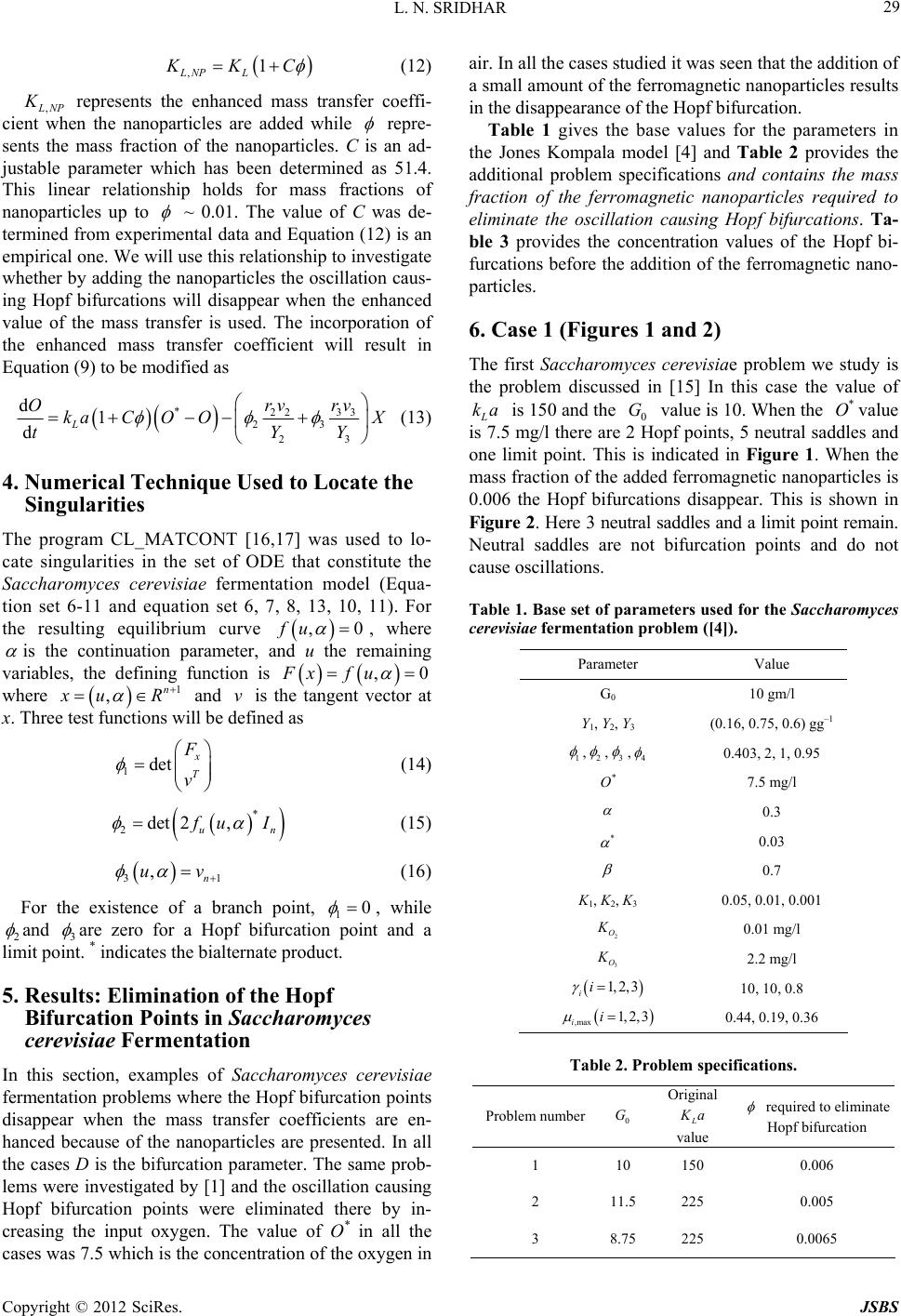 L. N. SRIDHAR 29 1 L,LNP K KC (12) , L NP represents the enhanced mass transfer coeffi- cient when the nanoparticles are added while K repre- sents the mass fraction of the nanoparticles. C is an ad- justable parameter which has been determined as 51.4. This linear relationship holds for mass fractions of nanoparticles up to ~ 0.01. The value of C was de- termined from experimental data and Equation (12) is an empirical one. We will use this relationship to investigate whether by adding the nanoparticles the oscillatio n caus- ing Hopf bifurcations will disappear when the enhanced value of the mass transfer is used. The incorporation of the enhanced mass transfer coefficient will result in Equation (9) to be modified as *22 d1 dLrv Oka CO O t 33 23 23 rv X YY ,0fu (13) 4. Numerical Technique Used to Locate the Singularities The program CL_MATCONT [16,17] was used to lo- cate singularities in the set of ODE that constitute the Saccharomyces cerevisiae fermentation model (Equa- tion set 6-11 and equation set 6, 7, 8, 13, 10, 11). For the resulting equilibrium curve , where is the continuation parameter, and u the remaining variables, the defining function is ,0fu ,Fx where 1n x u 1det R v and is the tangent vector at x. Three test functions will be defined as x T F v * , un (14) 2det 2 f uI 31n v 0 ,u (15) (16) For the existence of a branch point, 1 , while 2 and 3 are zero for a Hopf bifurcation point and a limit poin t . * indicates the bialternate product. 5. Results: Elimination of the Hopf Bifurcation Points in Saccharomyces cerevisiae Fermentation In this section, examples of Saccharomyces cerevisiae fermentation problems where the Ho pf bifurcation poin ts disappear when the mass transfer coefficients are en- hanced because of the nanoparticles are presented. In all the cases D is the bifurcation parameter. The same prob- lems were investigated by [1] and the oscillatio n causing Hopf bifurcation points were eliminated there by in- creasing the input oxygen. The value of O* in all the air. In all the cases studied it was seen that the addition of a small amount of the ferromagnetic nanoparticles results in the disappearance of the Hopf bifurcation. Table 1 gives the base values for the pa cases was 7.5 which is the concentration of the oxygen in rameters in th 6. Case 1 (Figures 1 and 2) problem we study is e Jones Kompala model [4] and Table 2 provides the additional problem specifications and contains the mass fraction of the ferromagnetic nanoparticles required to eliminate the oscillation causing Hopf bifurcations. Ta- ble 3 provides the concentration values of the Hopf bi- furcations before the addition of the ferromagnetic nano- particles. The first Saccharomyces cerevisiae the problem discussed in [15] In this case the value of L ka is 150 and the 0 G va lue is 1 0. Wh en the * Ovalue 5 mg/l there are 2opf points, 5 neutral sads and one limit point. This is indicated in Figure 1. When the mass fraction of the added ferromagnetic nanoparticles is 0.006 the Hopf bifurcations disappear. This is shown in Figure 2. Here 3 neutral saddles and a limit point remain. Neutral saddles are not bifurcation points and do not cause oscillations. is 7. Hdle able 1. Base set of parameters used for the Saccharomyces e T cerevisiae fermentation problem ([4]). Parameter Valu G0 10 gm/l Y1Y3 (0.16,) gg–1 1 , Y2, 0.75, 0.6 ,2 ,3 ,4 * 0.403, 2, 1, 0.95 O7.5 mg/l * 0.3 0.03 0.7 K1, K2K3 0.05, 0001 , .01, 0. 2 O K 0.01 mg/l 3 O K 2.2 mg/l 1, 3 ii 1 2, 0, 10, 0.8 3 ,max 1,2, ii 0.6 44, 0.19, 0.3 Table 2. Problem specifications. Problem number0 G Original required to eliminate Hopf bifurcation L K a e valu 1 10 0.006 150 2 11.5225 0.005 3 8.75225 0.0065 Copyright © 2012 SciRes. JSBS 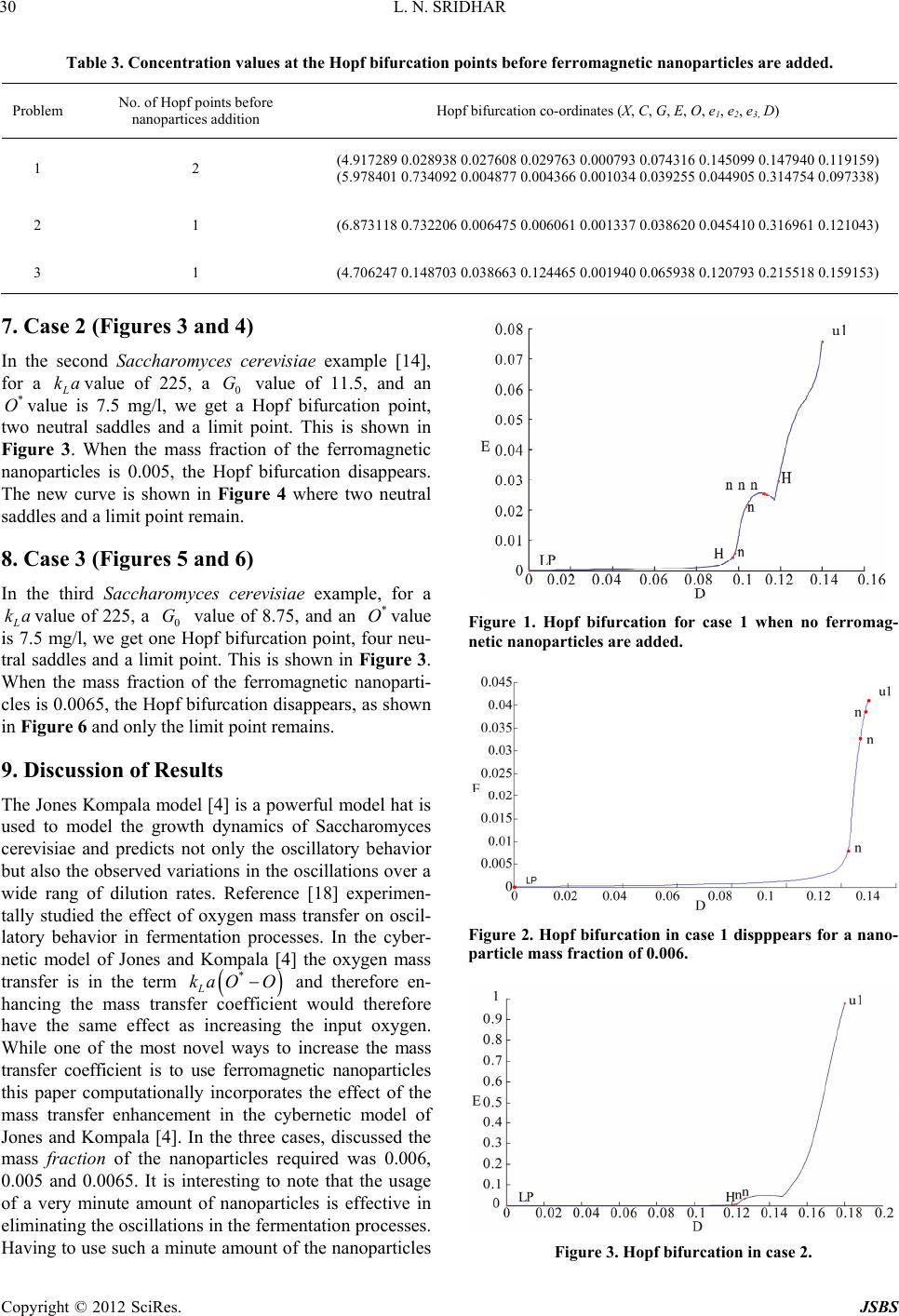 L. N. SRIDHAR JSBS 30 ble 3. Ctration values at theifurcation points before ferromagnetic nanoparticles ar e added. Problem nanopartices addition Taoncen Hopf b No. of Hopf points before Hopf bifurcation co-ordinates (X, C, G, E, O, e1, e2, e3, D) 1 2 (4.917289 0.0287940 0.119159) (5.978401 0.734092 0.004877 0. 004366 0.001034 0.039255 0.044905 0.314754 0.097338) 938 0.027608 0.029763 0.000793 0.074316 0.14 50 99 0.14 2 1 (6.873118 0.732206 0.006475 0.006061 0.001337 0. 038620 0.045410 0.316961 0.121043) 3 1 (4.706247 0.148703 0.038663 0.124465 0.001940 0. 065938 0.120793 0.215518 0.159153) d 4) evisiae example [14], 7. Case 2 (Figures 3 an In the second Saccharomyces cer for a L kavalue of 225, a 0 G value of 11.5, and an * Ovalue is 7.5 mg/l, we get a Hopf bifurcation point, two neutral saddles and a limit point. This is shown in Figure 3. When the mass fraction of the ferromagnetic nanoparticles is 0.005, the Hopf bifurcation disappears. The new curve is shown in Figure 4 where two neutral saddles and a limit point remain. 8. Case 3 (Figures 5 and 6) In the third Saccharomyces cerevisiae example, for a Figure 1. Hopf bifurcation for case 1 when no ferromag- netic nanoparticles are added. L kavalue of 225, a 0 G valu of 8.75, and an Ovalue is 7.5 mg/l, we get one Hopf bifurcation point, four neu- tral saddles and a limit point. This is shown in Figure 3. When the mass fraction of the ferromagnetic nanoparti- cles is 0.0065, the Hopf bifurcation disappears, as shown in Figure 6 and only the limit point remains. 9. Discussion of Results e* s a powerful model hat is The Jones Kompala model [4] i used to model the growth dynamics of Saccharomyces cerevisiae and predicts not only the oscillatory behavior but also the observed variations in the oscillations over a wide rang of dilution rates. Reference [18] experimen- tally studied the effect of oxygen mass transfer on oscil- latory behavior in fermentation processes. In the cyber- netic model of Jones and Kompala [4] the oxygen mass transfer is in the term * L kaO O and therefore en- hancing the mass transfer coefficient would therefore have the same effect as increasing the input oxygen. While one of the most novel ways to increase the mass transfer coefficient is to use ferromagnetic nanoparticles this paper computationally incorporates the effect of the mass transfer enhancement in the cybernetic model of Jones and Kompala [4]. In the three cases, discussed the mass fraction of the nanoparticles required was 0.006, 0.005 and 0.0065. It is interesting to note that the usage of a very minute amount of nanoparticles is effective in eliminating the oscillatio ns in the fermentation processes. Having to use such a minute amount of the nanoparticles Figure 2. Hopf bifurcation in case 1 dispppears for a nano- particle mass fraction of 0.006. Figure 3. Hopf bifurcation in case 2. Copyright © 2012 SciRes. 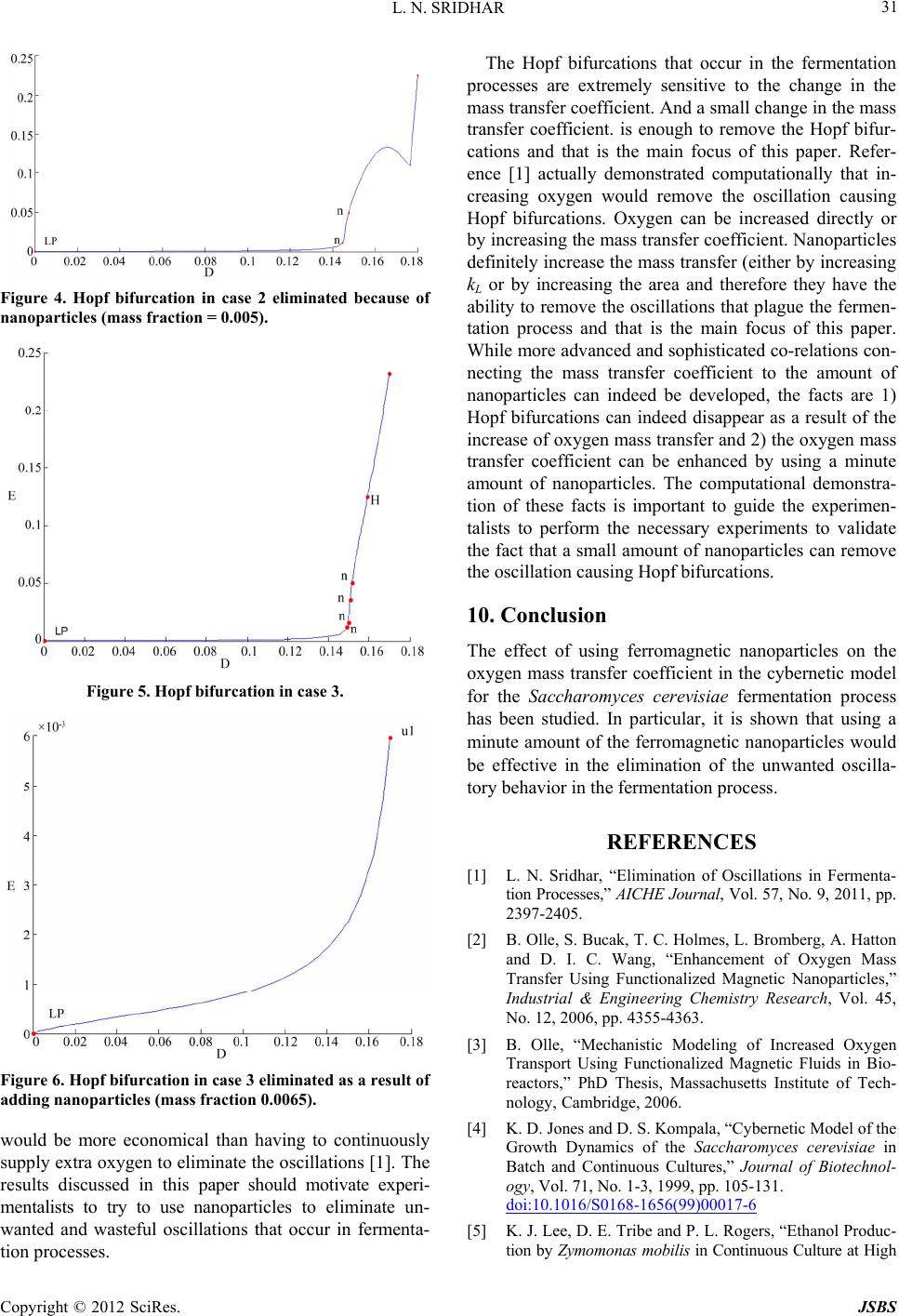 L. N. SRIDHAR 31 Figure 4. Hopf bifurcation in case 2 eliminated because of nanoparticl es (mass fraction = 0.005). Figure 5. Hopf bifurcation in case 3. Figure 6. Hopf bifurcation in case 3 eliminated as a result of adding nanoparticles (mass fraction 0.0065). would be more economical than having to continuously supply extra oxygen to elimi nate the oscillation s [1]. The results discussed in this paper should motivate experi- mentalists to try to use nanoparticles to eliminate un- wanted and wasteful oscillations that occur in fermenta- tion processes. The Hopf bifurcations that occur in the fermentation processes are extremely sensitive to the change in the mass transfer coefficient. And a small change in the mass transfer coefficient. is enough to remove the Hopf bifur- cations and that is the main focus of this paper. Refer- ence [1] actually demonstrated computationally that in- creasing oxygen would remove the oscillation causing Hopf bifurcations. Oxygen can be increased directly or by increasing the mass transfer coefficient. Nanoparticles definitely increase the mass transfer (either by increasing kL or by increasing the area and therefore they have the ability to remove the oscillations that plague the fermen- tation process and that is the main focus of this paper. While more advanced and sophisticated co-relations con- necting the mass transfer coefficient to the amount of nanoparticles can indeed be developed, the facts are 1 gen mass tic Model of the cs of the Saccharomyces cerevisiae in Journal of Biotechnol- ) Hopf bifurcations can indeed disappear as a result of the increase of oxygen mass transfer and 2) the oxy transfer coefficient can be enhanced by using a minute amount of nanoparticles. The computational demonstra- tion of these facts is important to guide the experimen- talists to perform the necessary experiments to validate the fact that a small amount of nanoparticles can remove the oscillation causing Hopf bifurcations. 10. Conclusion The effect of using ferromagnetic nanoparticles on the oxygen mass transfer coefficient in the cybernetic model for the Saccharomyces cerevisiae fermentation process has been studied. In particular, it is shown that using a minute amount of the ferromagnetic nanoparticles would be effective in the elimination of the unwanted oscilla- tory behavior in the fermentation process. REFERENCES [1] L. N. Sridhar, “Elimination of Oscillations in Fermenta- tion Processes,” AICHE Journal, Vol. 57, No. 9, 2011, pp . 2397-2405. [2] B. Olle, S. Bucak, T. C. Holmes, L. Bromberg, A. Hatton and D. I. C. Wang, “Enhancement of Oxygen Mass Transfer Using Functionalized Magnetic Nanoparticles,” Industrial & Engineering Chemistry Research, Vol. 45, No. 12, 2006, pp. 4355-4363. [3] B. Olle, “Mechanistic Modeling of Increased Oxygen Transport Using Functionalized Magnetic Fluids in Bio- reactors,” PhD Thesis, Massachusetts Institute of Tech- nology, Cambridge, 2006. [4] K. D. Jones and D. S. Kompala, “Cyberne Growth Dynami Batch and Continuous Cultures,” ogy, Vol. 71, No. 1-3, 1999, pp. 105-131. doi:10.1016/S0168-1656(99)00017-6 [5] K. J. Lee, D. E. Tribe and P. L. Rogers, “Ethanol Produc- tion by Zymomo nas mobilis in Continuous Culture at High Copyright © 2012 SciRes. JSBS  L. N. SRIDHAR Copyright © 2012 SciRes. JSBS 32 l. 2, No. 8, 1980 pp. 339-344. doi:10.1007/BF00138666 Glucose Concentrations,” Biotechnology Letters, Vol. 1, No. 10, 1979, pp. 421-426. [6] K. J. Lee, M. L. Skotnicki, D. E. Tribe and P. L. Rogers, “Kinetic Studies on a Highly Productive Strain of Zymo- monas mobilis,” Biotechnology Letters, Vo, [7] I. M. L. Jobse. C. A. M. Luyben 6, 1986, pp. 868-877. s, G. T. C. Egbertsa, K and J. A. Roels, “Fermentation Kinetics of Zymomonas mobilis at High Ethanol Concentrations; Oscillations in Continuous Cultures,” Biotechnology and Bioengineering, Vol. 28, No. [8] C. Ghommidh, J. Vaija, S. Bolarinwa and J. M. Navarro, “Oscillatory Behavior of Zymomonas mobilis in Con- tinuous Cultures: A Simple Stochastic Model,” Biotech- nology Letters, Vol. 11, No. 9, 1989, pp. 659-664. [9] L. J. Bruce, D. B. Axford, B. Ciszek and J. A. Daugulis, “Extractive Fermentation by Zymomonas mobilis and the Control of Oscillatory Behavior,” Biotechnology Letters, Vol. 13, No. 4, 1991, pp. 291-296. doi:10.1007/BF01041487 [10] L. Perego, J. M. Cabral, S. Dias, L. H. Koshimizu, M. R. De Melo Cruz, W. Borzani and M. L. R. Vairo, “Influ- ence of Temperature, Dilution Rate and Sugar Concentra- tion on the Establishment of Steady-State Ethanol Fermentation of Molasses,” Bio in Continuous mass, Vol. 6, No. 3, 1985, pp. 247-256. doi:10.1016/0144-4565(85)90044-7 [11] A. Mulchandani and B. Volesky, “Modelling of the Ace- tone-Butanol Fermentation with Cell Retention,” Cana- dian Journal of Chemical Engineering, Vol. 64, No. 4, nchronization of Sac- wn in Continuous Culture, II. 1986, pp. 625-631. [12] C. Strassle, B. Sonnleitner and A. A. Fiechter, “A Predic- tive Model for the Spontaneous Sy charomyces cerevisiae Gro Experimental Verification,” Journal of Biotechnol ogy, Vol. 9, No. 3, 1989, pp. 191-208. doi:10.1016/0168-1656(89)90108-9 [13] H. K. Von Meyenberg, “Stable Synchrony Oscillations in Continuous Culture of Saccharomyces cerevisiae under Glucose Limitation,” In: B. Chance, E. K. Pye, A. K. Shosh and B. Hess, Eds., Biological and Biochemical Oscilla- tors, Academic Press, New York, 1973, pp. 411-417. [14] Y. Zhang and M. A. Henson, “Bifurcation Analysis of Continuous Biochemical Reactor Models,” Biotechnology Progress, Vol. 17, No. 4, 2001, pp. 647-660. doi:10.1021/bp010048w [15] D. J. W. Simpson, D. S. Kompala and J. D. Meiss, “Dis- continuity Induced Bifurcations in a Model of Saccharo- myces cerevisiae,” Mathemati No. 1, 2009, pp. 40-49. cal Biosciences, Vol. 218, .mbs.2008.12.005doi:10.1016/j [16] A. Dhooge, W. Govearts and A. Y. Kuznetsov, “MAT- CONT: A Matlab Package for Numerical Bifurcation Analysis of ODEs,” ACM Transactions on Mathematical Software, Vol. 29, No. 2, 2003, pp. 141-164. doi:10.1145/779359.779362 [17] A. Dhooge, W. Govaerts, Y. A. Kuznetsov, W. Mestrom, A. M. Riet and CL_MATCONT, “A Continuation Tool- box in Matlab,” 2004. [18] S. J. Parulekar, G. B. Se mones, M. J. Rolf, J. C. Lievense and H. C. Lim, “Introduction and Elimination of Oscil- lations in Continuous Cultures of Saccharomyces cere- visiae”, Biotechnology and Bioengineering, Vol. 28, No. 5, 1986, pp. 700-710. doi:10.1002/bit.260280509 Nomenclature C: Intracellular Carbohydrate Mass Fraction Storage; D: Dilution Rate; V: Volume; E: Ethanol Concentration; X: Cell Mass Concentration; O: Oxygen Concentration; O*: Oxygen Solubility Limit (7.5); th Yi: i Pathway Yield Coefficient. |