

Paper Menu >>
Journal Menu >>
 Vol.2, No.7, 769-772 (2010) doi:10.4236/health.2010.27116 Copyright © 2010 SciRes. Openly accessible at http://www.scirp.org/journal/HEALTH/ Health Alternations in salivary glucose during ramadan fasting Reyhaneh Sariri1*, Abdolali V arasteh1, Ali Erfani2 1Department of Biochemistry, The University of Guilan, Rasht, Iran; *Corresponding Author: [email protected] 2Department of Interna l Medicine, Iran University of Medical Sciences, Tehran, Iran Received. 21 October 2009; revised 7 December 2009; accepted 9 December 2009. ABSTRACT During the holly month of Ramadan, Muslims fast every day from dawn to sunset. Although the effect of Ramadan fasting on general health has been widely studied, the impact of fasting on oral health and possible changes in salivary biochemicals, such as glucose, has not re- ceived much attentiom. The aim of our study was to evaluate the influence of fasting on the level of glucose in the saliva of healthy indi- viduals. Salivary glucose was measured using an enzymatic method based on oxidation of glucose by glucoseoxidase followed by deter- mination of resulting H2O2 in the presence of peroxidase. A reduction in mean concentration of glucose was observed in the saliva of all fasting subjects as compared to the control group. It was concluded that reduction in salivary glucose is mostly due to reduced food intake and may be beneficial to dental health. Keywords: Saliva; Glucose Level; Diabetes; Fasting 1. INTRODUCTION Several of the world’s great religions recommend a pe- riod of fasting or abstinence from certain foods. Of these, the Islamic fast during the Muslim month of Ramadan is strictly observed every year. During the month of Ramadan, Muslims fast every day from dawn to sunset. Muslims observing the fast are required to abstain not only from eating and drinking, but also from consuming oral medications and in travenous nutritional fluids. It has been found that, in the healthy subject, Rama- dan fasting does not appreciably affect one’s health. However, it may induce some complications in patients with important metabo lic disorders su ch as diabetes. Th e effect of experimental short-term fasting on carbohy- drate metabolism has been extensively studied [1,2]. Mean normal blood glucose levels in humans are about 90 mg/dl, equivalent to 5 mM (mmol/l). It has been found that a slight decrease in serum glucose (60-70 mg/dl, 3.3-3.9 mM) occurs in normal adults a few hours after fasting has begun. However, the reduction in serum glucose ceases due to increased gluconeogenesis in the liver [3]. Saliva is the first biological fluid to encounter any change in eating habits as well as any environmental or physical changes. Saliva influences oral health both through its non-specific physico-chemical properties, as well as through more specific effects [4]. Saliva is well known for its highly protective functions against deterious agents such as microorganisms, toxines and various oxidants [5,6]. The antioxidant capacity and reducing power of saliva may diminish to a high degree due to various factors [7]. It has been shown that in vitro exposure to cigarette smoke could significantly decrease some enzymatic activities, both in plasma and in saliva [8,9]. The research reports in this area are few and almost limited to the changes of glucose concentrations in plasma. This study reports alternations in glucose con- tent of saliva during one month fasting in Ramadan 1428 (Sept. 22nd-Oct 12th 2007). 2. MATERIALS AND METHODS 2.1. Materials The level of glucose in saliva was measured using an enzymatic method based on oxidation of glucose by glucoseoxidase followed by determination of resulting H2O2 in the presence of peroxidase. An enzymatic assay glucose kit was purchased from Pars Azmoon™. The kit consisted of a standard glucose and a colour reagent. The concentration of standard glucose was 100 mg/dl and the colour reagent was a mixture of the following chemicals: 250 mmol/l phosphate buffer pH 7.5, 5.0 mmol/l phenol, 0.5 mmol/l 4-aminoantipyrine 10 ku/l glucose oxidase and 1 ku/l peroxidase. 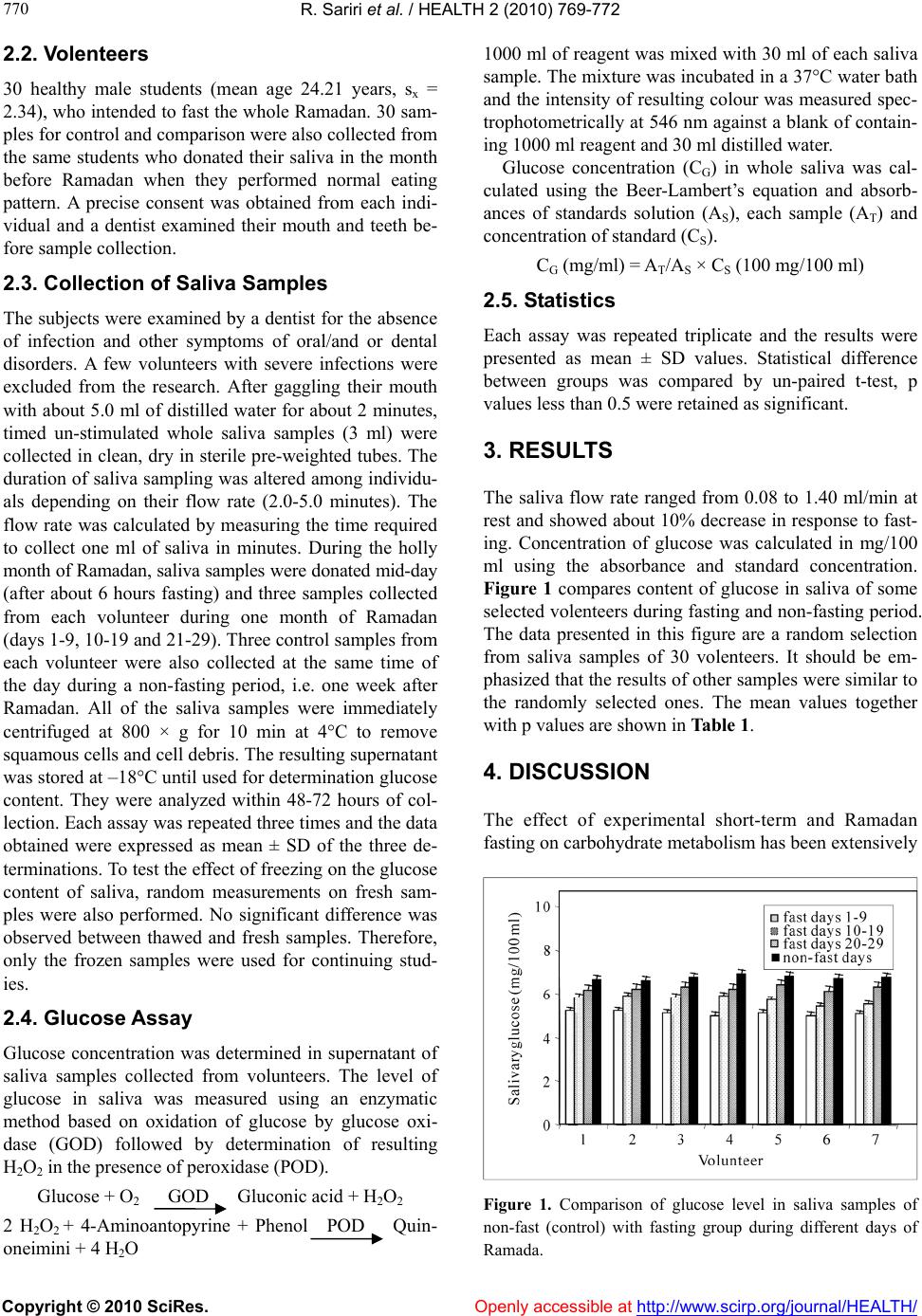 R. Sariri et al. / HEALTH 2 (2010) 769-772 Copyright © 2010 SciRes. Openly accessible at http://www.scirp.org/journal/HEALTH/ 770 2.2. Volenteers 30 healthy male students (mean age 24.21 years, sx = 2.34), who intended to fast the whole Ramadan. 30 sam- ples for control and comparison were also collected from the same students who donated their saliva in the month before Ramadan when they performed normal eating pattern. A precise consent was obtained from each indi- vidual and a dentist examined their mouth and teeth be- fore sample collection. 2.3. Collection of Saliva Samples The subjects were examined by a dentist for the absence of infection and other symptoms of oral/and or dental disorders. A few volunteers with severe infections were excluded from the research. After gaggling their mouth with about 5.0 ml of distilled water for abou t 2 minutes, timed un-stimulated whole saliva samples (3 ml) were collected in clean, dry in sterile pre-weighted tubes. The duration of saliva sampling was altered among individu- als depending on their flow rate (2.0-5.0 minutes). The flow rate was calculated by measuring the time required to collect one ml of saliva in minutes. During the holly month of Ramadan, saliva samples were donated mid-day (after about 6 hours fasting) and three samples collected from each volunteer during one month of Ramadan (days 1-9, 10-19 and 21-29). Three control samples from each volunteer were also collected at the same time of the day during a non-fasting period, i.e. one week after Ramadan. All of the saliva samples were immediately centrifuged at 800 × g for 10 min at 4°C to remove squamous cells and cell debr is. Th e resu lting supern atan t was stored at –18°C until used for determination glucose content. They were analyzed within 48-72 hours of col- lection. Each assay was repe ated th ree ti mes and th e data obtained were expressed as mean ± SD of the three de- terminations. To test the effect of freezing on the glucose content of saliva, random measurements on fresh sam- ples were also performed. No significant difference was observed between thawed and fresh samples. Therefore, only the frozen samples were used for continuing stud- ies. 2.4. Glucose Assay Glucose concentration was determined in supernatant of saliva samples collected from volunteers. The level of glucose in saliva was measured using an enzymatic method based on oxidation of glucose by glucose oxi- dase (GOD) followed by determination of resulting H2O2 in the presence of peroxidase (POD). Glucose + O2 GOD Gluconic acid + H2O2 2 H2O2 + 4-Aminoantopyrine + Phenol POD Quin- oneimini + 4 H2O 1000 ml of reagent was mixed with 30 ml of each saliva sample. The mixture was incubated in a 37°C water bath and the intensity of resu lting colour was measured spec- trophotometrically at 546 nm against a blank of contain- ing 1000 ml reagent and 30 ml distilled water. Glucose concentration (CG) in whole saliva was cal- culated using the Beer-Lambert’s equation and absorb- ances of standards solution (AS), each sample (AT) and concentration of standar d (C S). CG (mg/ml) = AT/AS × CS (100 mg/100 ml) 2.5. Statistics Each assay was repeated triplicate and the results were presented as mean ± SD values. Statistical difference between groups was compared by un-paired t-test, p values less than 0.5 were retained as significant. 3. RESULTS The saliva flow rate ranged from 0.08 to 1.40 ml/min at rest and showed about 10% decrease in response to fast- ing. Concentration of glucose was calculated in mg/100 ml using the absorbance and standard concentration. Figure 1 compares content of glucose in saliva of some selected volenteers during fasting and non-fasting period. The data presented in this figure are a random selection from saliva samples of 30 volenteers. It should be em- phasized that the results of other samples were similar to the randomly selected ones. The mean values together with p values are shown in Table 1. 4. DISCUSSION The effect of experimental short-term and Ramadan fasting on carbohydrate metabolism has been extensively Figure 1. Comparison of glucose level in saliva samples of non-fast (control) with fasting group during different days of Ramada. 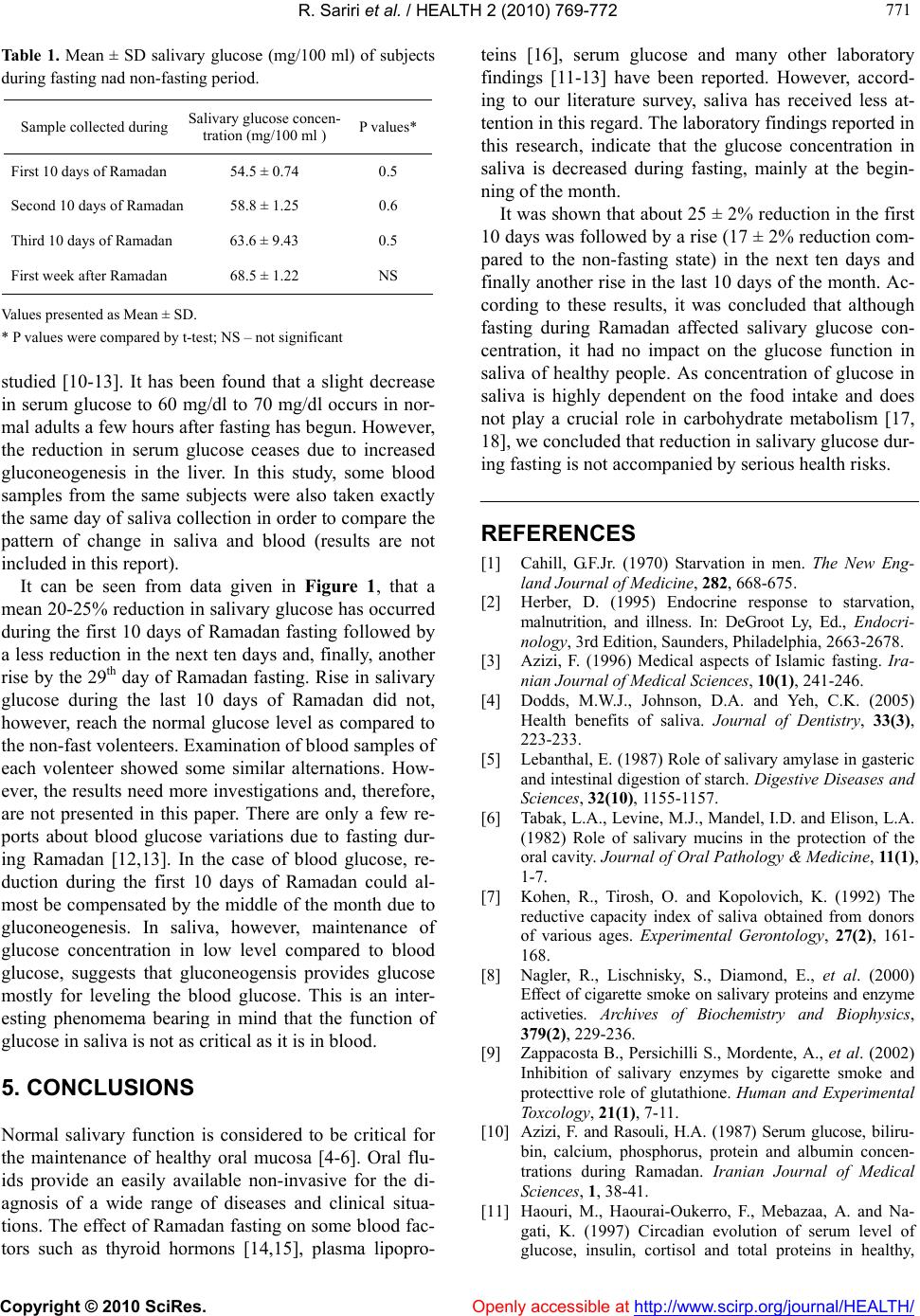 R. Sariri et al. / HEALTH 2 (2010) 769-772 Copyright © 2010 SciRes. Openly accessible at http://www.scirp.org/journal/HEALTH/ 771 771 Ta bl e 1 . Mean ± SD salivary glucose (mg/100 ml) of subjects during fasting nad non-fasting period. Sample collected during Salivary glucose concen- tration (mg/100 ml ) P values* First 10 days of Ramadan 54.5 ± 0.74 0.5 Second 10 days of Ramad an 58.8 ± 1.25 0.6 Third 10 days of Ramadan 63.6 ± 9.43 0.5 First week after Ramadan 68.5 ± 1.22 NS Values presented as Mean ± SD. * P values were compared by t-test; NS – not significant studied [10-13]. It has been found that a slight decrease in serum glucose to 60 mg/dl to 70 mg/dl occurs in nor- mal adults a few hours after fasting has begun. However, the reduction in serum glucose ceases due to increased gluconeogenesis in the liver. In this study, some blood samples from the same subjects were also taken exactly the same day of saliva collection in order to compare the pattern of change in saliva and blood (results are not included in this report). It can be seen from data given in Figure 1, that a mean 20-25% reduction in salivary glucose has occurred during the first 10 days of Ramadan fasting followed by a less reduction in the next ten days and, finally, another rise by the 29th day of Ramadan fasting. Rise in salivary glucose during the last 10 days of Ramadan did not, however, reach the normal glucose level as compared to the non-fast volenteers. Examination of blood samples of each volenteer showed some similar alternations. How- ever, the results need more investig ations and, therefore, are not presented in this paper. There are only a few re- ports about blood glucose variations due to fasting dur- ing Ramadan [12,13]. In the case of blood glucose, re- duction during the first 10 days of Ramadan could al- most be compensated by the middle of the month due to gluconeogenesis. In saliva, however, maintenance of glucose concentration in low level compared to blood glucose, suggests that gluconeogensis provides glucose mostly for leveling the blood glucose. This is an inter- esting phenomema bearing in mind that the function of glucose in saliva is not as critical as it is in blood. 5. CONCLUSIONS Normal salivary function is considered to be critical for the maintenance of healthy oral mucosa [4-6]. Oral flu- ids provide an easily available non-invasive for the di- agnosis of a wide range of diseases and clinical situa- tions. The effect of Ramadan fasting on some b lood fac- tors such as thyroid hormons [14,15], plasma lipopro- teins [16], serum glucose and many other laboratory findings [11-13] have been reported. However, accord- ing to our literature survey, saliva has received less at- tention in this regard . The labo ratory findings repo rted in this research, indicate that the glucose concentration in saliva is decreased during fasting, mainly at the begin- ning of the month. It was shown that about 25 ± 2% reduction in the fir st 10 days was follo wed by a r ise (17 ± 2% reduction co m- pared to the non-fasting state) in the next ten days and finally another rise in the last 10 days of the month. Ac- cording to these results, it was concluded that although fasting during Ramadan affected salivary glucose con- centration, it had no impact on the glucose function in saliva of healthy people. As concentration of glucose in saliva is highly dependent on the food intake and does not play a crucial role in carbohydrate metabolism [17, 18], we concluded that reduction in salivary glucose dur- ing fasting is not accompanied by serious health risks. REFERENCES [1] Cahill, G.F.Jr. (1970) Starvation in men. The New Eng- land Journal of Medicine, 282, 668-675. [2] Herber, D. (1995) Endocrine response to starvation, malnutrition, and illness. In: DeGroot Ly, Ed., Endocri- nology, 3rd Edition, Saunders, Philadelphia, 2663-2678. [3] Azizi, F. (1996) Medical aspects of Islamic fasting. Ira- nian Journal of Medical Sciences, 10(1), 241-246. [4] Dodds, M.W.J., Johnson, D.A. and Yeh, C.K. (2005) Health benefits of saliva. Journal of Dentistry, 33(3), 223-233. [5] Lebanthal, E. (1987) Role of salivary amylase in gasteric and intestinal digestion of starch. Digestive Diseases and Sciences, 32(10), 1155-1157. [6] Tabak, L.A., Levine, M.J., Mandel, I.D. and Elison, L.A. (1982) Role of salivary mucins in the protection of the oral cavity. Journal of Oral Pathology & Medicine, 11(1), 1-7. [7] Kohen, R., Tirosh, O. and Kopolovich, K. (1992) The reductive capacity index of saliva obtained from donors of various ages. Experimental Gerontology, 27(2), 161- 168. [8] Nagler, R., Lischnisky, S., Diamond, E., et al. (2000) Effect of cigarette smoke on salivary proteins and enzy me activeties. Archives of Biochemistry and Biophysics, 379(2), 229-236. [9] Zappacosta B., Persichilli S., Mordente, A., et al. (2002) Inhibition of salivary enzymes by cigarette smoke and protecttive role of glutathione. Human and Experimental Toxcology, 21(1), 7-11. [10] Azizi, F. and Rasouli, H.A. (1987) Serum glucose, biliru- bin, calcium, phosphorus, protein and albumin concen- trations during Ramadan. Iranian Journal of Medical Sciences, 1, 38-41. [11] Haouri, M., Haourai-Oukerro, F., Mebazaa, A. and Na- gati, K. (1997) Circadian evolution of serum level of glucose, insulin, cortisol and total proteins in healthy,  R. Sariri et al. / HEALTH 2 (2010) 769-772 Copyright © 2010 SciRes. http://www.scirp.org/journal/HEALTH/Openly accessible at 772 fasting volunteers. Second International Congress on Health and Ramadan, Istanbul. [12] Scott, T.G. (1994) The effect of Muslim fast of Ramadan on routine laboratory investigation. Journal of King Ab- dulaziz University, 1(4), 23-35. [13] Bagraicik, N., Yumuk, V., Damei, T. and Ozyazar, M. (1992) The effect of fasting on blood glucose, fructosa- mine, insulin and C-peptide levels in Ramadan. First In- ternational Congress on Health and Ramadan, Casa- blanca, Morocco. [14] Sajid, K.M., Akhtar, M. and Malik, G.Q. (1991) Ramadan fasting and thyroid hormone profile. Juvenile Products Manufactur ers Association, 41(9), 213-216. [15] Sulimani, R.A. (1988) Effect of Ramadan fasting on thyroid function in healthy male individuals. Nutrition Research, 8(5), 549-552. [16] Shoukry, M.I. (1986) Effect of fasting in Ramadan on plasma lipoproteins and apoproteins. Saudi Medical Journal, 7(6), 561-567. [17] Mayes, P.A. (2000) Digestion and absorption. Harpers, Biochemistry, In: Murray, R.K. Granner, D.K. Mayes, P.A. and Rodwell, V.W. Eds., 25th Edtion, Appleton and Lange, New York, 666-674. [18] Negoro, M., et al. (2000) Oral glucose retention, saliva viscosity and flow rate in 5-year-old children. Archives of Oral Biology, 45(1), 1005-1011. |