

Paper Menu >>
Journal Menu >>
 Advances in Microbiology, 2012, 2, 263-267 http://dx.doi.org/10.4236/aim.2012.23031 Published Online September 2012 (http://www.SciRP.org/journal/aim) Determination of Antibiotic Sensitivity Pattern of Helicobacter pylori Isolates from South India Population by Epsilometer Test (E-Test) Khawaja Shakeel Ahmed1*, Anghesom Ambesajir Ghebremedhin1, Aleem Ahmed Khan2, Santosh K. Tiwari2, J. D. Ahi3, Irshad Ahmed2 1Microbiology Unit, Department of Clinical Laboratory Sciences, Asmara College of Health Sciences, Asmara, Eritrea 2Centre for Liver Research and Diagnostics, Hyderabad, India 3Dr. Hari Singh Gour University, Sagar, India Email: *[email protected] Received March 15, 2012; revised April 5, 2012; accepted April 24, 2012 ABSTRACT Introduction: The importance of H. pylori as an etiological agent in gastroduodenal disease had suggested antibiotic treatment as a main target for the elimination of infection. The successful eradication of H. pylori infection was shown to resolve the gastritis, dramatically accelerate ulcer healing, reduce ulcer recurrence and the prophylactic effect on the recurrence of ulcer bleeding. Materials and Methods: In the present study a total six antimicrobial agents such as Ciprofloxacin, Metronidazole, Norfloxacin, Tetracyclin, Amoxycillin and Clarithromycin were used against 100 clinical isolates from patients with peptic ulcer, and non-ulcer dyspepsia. H. pylori was isolated from the gastric biopsies ob- tained from the clinical subjects. Results: Results of our study showed 100% resistance to Metronidazole (MIC > 256 μg/ml). 97% of the isolates were observed sensitive to Ciprofloxacin (MIC 0.38 μg), whereas Tetracyclin showed 96% sensitivity (MIC 0.25 μg - 0.125 μg). Resistance to amoxycillin, Norfloxacin, and Clarithromycin were 80%, 38% and 76% respectively (MIC > 256 μg/ml). Conclusion: It is observed that 96% - 97% of the clinical isolates were sensitive to Tetracycline and ciprofloxacin, where all isolates were found to be resistant to Metronidazole. Resistance to Amoxy- cillin and Clarithromycin were 80% and 76% respectively. Studies attributed the high level of resistance to the frequent use of the drugs to treat various other infections and ineffective drug control policy. Keywords: Helicobacter pylori; Culture; Metronidazole; Tetracycline; Clarithromycin 1. Introduction The importance of H. pylori as an etiological agent in gastroduodenal disease had suggested antibiotic treat- ment as a main target for the elimination of infection. The successful eradication of H. pylori infection was shown to resolve the gastritis, dramatically accelerate ulcer healing and reduce ulcer recurrence and the pro- phylactic effect of the recurrence of ulcer bleeding [1]. Several studies were carried out to find an effective and well tolerated antibiotic regime for the treatment of H. pylori associated diseases. Despite the common avail- ability of various treatment regimes for H. pylori infec- tion, eradication regime of choice has not yet been ac- cepted. Few studies suggested that combined antibiotic regime with two antibiotics and one acid suppressive agent to be effective but its efficacy was observed to vary significantly when the regime was tested in different geographical regions, suggesting a need for a universally effective antibiotic regime of choice. The most com- monly used antibiotics in combination therapies world- wide are Metronidazole, Ciprofloxacin, Amoxycillin, Clarithromycin, and Tetracyclin. But the antibiotic sensi- tivity pattern against these antimicrobials from various geographical regions shows diversified results particu- larly from the developing countries. Studies ascribed several factors that could lead to the treatment failure [2]. Presence of resistant organism or acquiring resistance to the antibiotics are the most important variables for an observed diversified cure rate [3,4]. Bacterial heteroge- neity [5], dietary habits could also be shown to contribute significantly in several Asian and European countries, where resistance to antibiotics particularly for the Met- ronidazole and Clarithromycin through out 1990s. It is reported to vary between 10% - 80% among the different geographic regions [6,7]. Mollison et al. 1998 [8] re- ported 36% and 11% resistance to Metronidazole and Clarithromycin. Alarcon et al. (1999) [6] determined the *Corresponding author. C opyright © 2012 SciRes. AiM  K. S. AHMED ET AL. 264 frequency of resistance to Metronidazole, tetracycline, Amoxyicilin and Clarithromycin in 282 H. pylori clinical isolates from spain and evaluated the evolution of resis- tance over five years of their study. Data infers a steady increase in the metronidazole resistance from 9% to 33%. Similarl increase of resistance to Clarithromycin and Tetracycline was observed. Mendonca et al. (2000) [9] reported 42% resistance to Metronidazole, 29% to Amo- xycillin and 7% for Clarithromycin and tetracycline. Similarly Mijaji et al. 1997 [10] reported a very high acquired resistance to Metronidazole 66.7% and 70.6% for Clarithromycin after the dual and triple therapy. In India studies reported a relatively high resistance to Metronidazole and Clarithromycin i.e. between 90% - 100% and 30 - 50 respectively [11]. Resistance to Amo- xycillin was reported to be 40%. Thus as a result of changing patterns of antibiotic sensitivity between dif- ferent geographic regions and also within the same re- gion it is suggested valuable to test the sensitivity regu- larly before deciding the therapeutic regime. Additional limitations to the treatment failure could be the inaccessibility of the antibacterial agent to the organ- ism residing deep at the inter cellular junction, or inside the gastric mucous cell hence it re-establishes the infec- tion after the treatment, as suggested by the transmission electron microscopy and similar DNA patterns of the H. pylori strains before and after treatment [12,13]. The bioavailibity and stability of the drug at gastric pH is an important factor for determining the choice of eradication therapy. Metronidazole is very stable at pH ranging from 2.0 - 7.0 but increasing prevalence of pretreatment resis- tant strain hampered its use as a drug of choice [14]. Re- sistance to Amoxycillin though not reported commonly, the drug is less stable particularly at low pH. Clarithro- mycin is the most acid labile drug commonly used to eradicate the H. pylori. However significant increase in the efficacy of these drugs is observed by the co-admini- stration of Proton Pump Inhibitors [15]. Thus in vitro antimicrobial susceptibility test helps in predicting the clinical response to treatment and prevalence of antibi- otic resistant strains between the different geographic regions and also among the sub groups within the study population and guide the selection of antibiotics. The Minimum Inhibitory Concentration (MIC) of an organism is the lowest concentration of an antibiotic that will inhibit its growth. Bacteria are classified as sensitive, intermediate or resistant based on the breakpoint MIC values that are arbitrarily defined and reflect the achiev- able levels of the antibiotic, the distribution of MIC’s for the organism and their correlation with clinical outcome. Disk diffusion, agar dilution and Epsilometer test (E- Test), where the two fold serial dilution of antibiotics were in-corporated in to tubes of broth, agar plates or on a paper strip respectively, are different methods to meas- ure the MIC of the organism. The Epsilometer test (E-Test AB Biodisk, solna, Swe- den) is a recently developed technique for the quantita- tive determination of susceptibility to antimicrobial agents in a variety of bacteria and fungi [16]. The test is based on the combination of concepts of both the agar dilution and disk diffusion methods but differs from the conven- tional disk diffusion method by the use of the predefined exponential gradient of antibiotics with the concentration minimum (least concentration) and the concentration maximum (highest concentration). The gradients cover a continuous concentration range depending on the antibi- otic, which corresponds to 15 two old dilution in a con- ventional MIC method. The E test is also much less labor intensive and is easier to perform than agar dilution and broth dilution method, which also allows the test to be quickly and economically adapted into the laboratory work flow. The MIC value is read from the scale in terms of μg/ml where the ellipse edge intersects the strips. Studies have assayed several antimicrobials commonly used to treat infection using E-Test and reported a good correla- tion with standard methods. The resistance breakpoint used for is Metronidazole > 8 μg, Clarithromycin > 1 μg, Tetracyclin > 2 μg, Amoxycillin > 8 μg, Norfloxacin > 8.0 μg and Ciprofloxacin > 1.0 μg [17]. The Present study was designed to determine the sen- sitivity pattern of various commonly used antimicrobial agents to treat the infection. In this study a total of six antimicrobial agents such as Ciprofloxacin, Metronida- zole, Norfloxacin, Tetracyclin, Amoxycillin and Clari- thromycin were tested by E-Test against 100 clinical isolates from patients with peptic ulcer, and non-ulcer dyspepsia. Having established the prevalence of H. pylori infection, patients are currently treated (with a view to eradication) with combination therapy (amoxicillin, cipro- floxacin and a proton pump inhibitor/bismuth). The rela- tionship between antimicrobial resistance and the suc- cessful treatment of H. pylori infection has dictated that a study of the incidence of acquired antimicrobial resistance among H. pylori isolates obtained within our environ- ment be determined hence the importance of this study. 2. Materials and Methods 2.1. Media Preparation 1.4 gm of Brucella Agar media was dissolved in 100 ml of distilled water and the media was autoclaved at 120 lbs for 15 minutes. The medium was supplemented with 7% sheep blood. 2.2. Procedure In the present study a total of six antimicrobial agents Copyright © 2012 SciRes. AiM 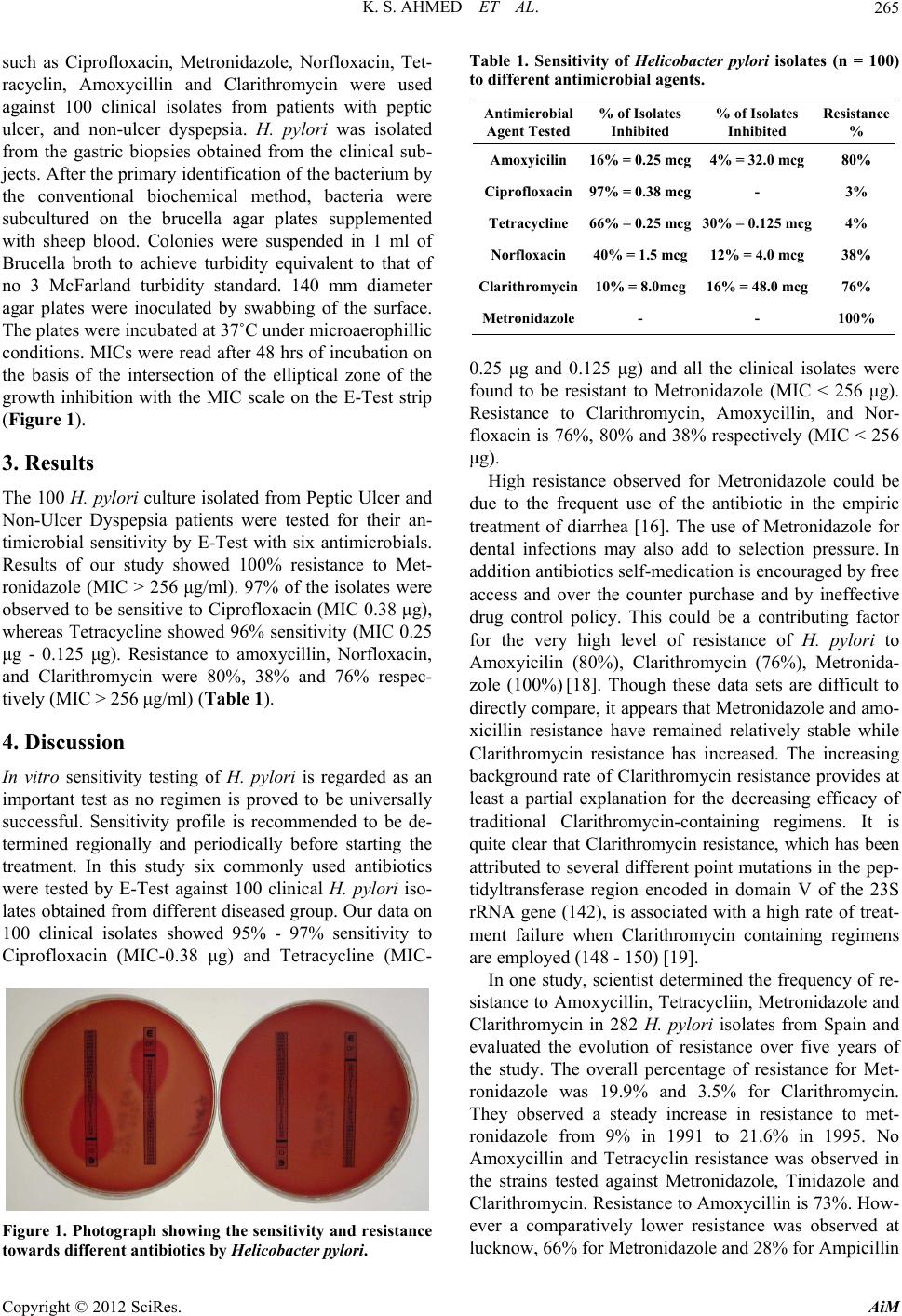 K. S. AHMED ET AL. 265 such as Ciprofloxacin, Metronidazole, Norfloxacin, Tet- racyclin, Amoxycillin and Clarithromycin were used against 100 clinical isolates from patients with peptic ulcer, and non-ulcer dyspepsia. H. pylori was isolated from the gastric biopsies obtained from the clinical sub- jects. After the primary identification of the bacterium by the conventional biochemical method, bacteria were subcultured on the brucella agar plates supplemented with sheep blood. Colonies were suspended in 1 ml of Brucella broth to achieve turbidity equivalent to that of no 3 McFarland turbidity standard. 140 mm diameter agar plates were inoculated by swabbing of the surface. The plates were incubated at 37˚C under microaerophillic conditions. MICs were read after 48 hrs of incubation on the basis of the intersection of the elliptical zone of the growth inhibition with the MIC scale on the E-Test strip (Figure 1). 3. Results The 100 H. pylori culture isolated from Peptic Ulcer and Non-Ulcer Dyspepsia patients were tested for their an- timicrobial sensitivity by E-Test with six antimicrobials. Results of our study showed 100% resistance to Met- ronidazole (MIC > 256 μg/ml). 97% of the isolates were observed to be sensitive to Ciprofloxacin (MIC 0.38 μg), whereas Tetracycline showed 96% sensitivity (MIC 0.25 μg - 0.125 μg). Resistance to amoxycillin, Norfloxacin, and Clarithromycin were 80%, 38% and 76% respec- tively (MIC > 256 μg/ml) (Table 1). 4. Discussion In vitro sensitivity testing of H. pylori is regarded as an important test as no regimen is proved to be universally successful. Sensitivity profile is recommended to be de- termined regionally and periodically before starting the treatment. In this study six commonly used antibiotics were tested by E-Test against 100 clinical H. pylori iso- lates obtained from different diseased group. Our data on 100 clinical isolates showed 95% - 97% sensitivity to Ciprofloxacin (MIC-0.38 μg) and Tetracycline (MIC- Figure 1. Photograph showing the sensitivity and resistance towards different antibiotics by Helicobacter pylori. Table 1. Sensitivity of Helicobacter pylori isolates (n = 100) to different antimicrobial agents. Antimicrobial Agent Tested% of Isolates Inhibited % of Isolates Inhibited Resistance % Amoxyicilin 16% = 0.25 mcg 4% = 32.0 mcg 80% Ciprofloxacin97% = 0.38 mcg - 3% Tetracycline 66% = 0.25 mcg 30% = 0.125 mcg4% Norfloxacin 40% = 1.5 mc g 12% = 4.0 mcg 38% Clarithromycin10% = 8.0mcg 16% = 48.0 mcg 76% Metronidazole- - 100% 0.25 μg and 0.125 μg) and all the clinical isolates were found to be resistant to Metronidazole (MIC < 256 μg). Resistance to Clarithromycin, Amoxycillin, and Nor- floxacin is 76%, 80% and 38% respectively (MIC < 256 μg). High resistance observed for Metronidazole could be due to the frequent use of the antibiotic in the empiric treatment of diarrhea [16]. The use of Metronidazole for dental infections may also add to selection pressure. In addition antibiotics self-medication is encouraged by free access and over the counter purchase and by ineffective drug control policy. This could be a contributing factor for the very high level of resistance of H. pylori to Amoxyicilin (80%), Clarithromycin (76%), Metronida- zole (100%) [18]. Though these data sets are difficult to directly compare, it appears that Metronidazole and amo- xicillin resistance have remained relatively stable while Clarithromycin resistance has increased. The increasing background rate of Clarithromycin resistance provides at least a partial explanation for the decreasing efficacy of traditional Clarithromycin-containing regimens. It is quite clear that Clarithromycin resistance, which has been attributed to several different point mutations in the pep- tidyltransferase region encoded in domain V of the 23S rRNA gene (142), is associated with a high rate of treat- ment failure when Clarithromycin containing regimens are employed (148 - 150) [19]. In one study, scientist determined the frequency of re- sistance to Amoxycillin, Tetracycliin, Metronidazole and Clarithromycin in 282 H. pylori isolates from Spain and evaluated the evolution of resistance over five years of the study. The overall percentage of resistance for Met- ronidazole was 19.9% and 3.5% for Clarithromycin. They observed a steady increase in resistance to met- ronidazole from 9% in 1991 to 21.6% in 1995. No Amoxycillin and Tetracyclin resistance was observed in the strains tested against Metronidazole, Tinidazole and Clarithromycin. Resistance to Amoxycillin is 73%. How- ever a comparatively lower resistance was observed at lucknow, 66% for Metronidazole and 28% for Ampicillin Copyright © 2012 SciRes. AiM  K. S. AHMED ET AL. 266 [11]. This difference in the sensitivity pattern observed in western as well as in Asian isolates could be due to the frequent use of the antibiotics to treat other infections. Moreover, ineffective drug control policy also has a con- tribution. Another Possibility could be due to infection with different strains of H. pylori. Results of our study support that Tetracyclin and Ciprofloxacin could be the antibiotics of choice in the eradication of H. pylori. It would be necessary to inves- tigate ciprofloxacin in any eradication treatment regime in our setting, since it appears to be the most active anti- biotic in eradicating H. pylori in this environment. 5. Conclusion It is observed that 96% - 97% of the clinical isolates were sensitive to Tetracycline and Ciprofloxacin, where all isolates were found to be resistant to Metronidazole. The same resistance to metronidazole has also been reported from other geographic regions. Resistance to Amoxycil- lin and Clarithromycin were 80% and 76% respectively. Studies attribute the high level of resistance to the fre- quent use of the drugs to treat various other infections, ineffective drug control policy and infection with differ- ent strains of H. pylori. The relationship between antim- icrobial resistance and the successful treatment of H. pylori infection has dictated that a study of the incidence of acquired antimicrobial resistance among H. pylori isolates obtained within our environment be determined hence the importance of this study. The ministry of health should have an effective drug control policy. Fur- thermore, there is the need to continue the evaluation of new treatment agents such as NE-2001 [20], older agents such as nitrofurantoin [21] or introduction of herbal management in order to eradicate Helicobacter pylori. Future case-control studies employing larger sample size are needed to demonstrate the effectiveness or otherwise of therapy in the different patient groups. A long-term follow-up of our patients will also contribute to the de- velopment of guidelines on the issues of referral, diag- nostic methods and treatment of H. pylori. 6. Acknowledgements We would like to thank our colleagues at our department for their fruitful discussion during the research and their technical assistance during manuscript preparation. REFERENCES [1] J. D. Penston, “Review Article: Helicobacter pylori Era- dication under Standable Caution but No Excuse for Iner- tia,” Alimentary Pharmacology and Therapeutics, Vol. 8, No. 4, 1994, pp. 369-389. doi:10.1111/j.1365-2036.1994.tb00304.x [2] R. J. Laheij, L. G. Rossum, J. B. Jansen, H. Straatman and A. L. Verbeek, “Evaluation of Treatment Regimens to Cure Helicobacter pylori Infection—A Meta-Analy- sis,” Alimentary Pharmacology and Therapeutics, Vol. 13, No. 7, 1999, pp. 857-864. doi:10.1046/j.1365-2036.1999.00542.x [3] F. Mégraud, “Problems Caused by Antibiotic Resistance of Helicobacter pylori,” La Presse Médicale, Vol. 26, No. 37, 1997, pp. 1775-1780. [4] D. Y. Graham, “Antibiotic Resistance in Helicobacter pylori: Implications for Therapy,” Gastroenterology, Vol. 115, No. 5, 1998, pp. 1272-1277. doi:10.1016/S0016-5085(98)70100-3 [5] J. F. Weel, R. W. van der Hulst, et al., “Heterogeneity in Susceptibility to Metronidazole among Helicobacter py- lori Isolates from Patients with Gastritis or Peptic ulcer Disease,” Journal of Clinical Microbiology, Vol. 34, No. 9, 1996, pp. 2158-2162. [6] T. Alarcón, D. Domingo and M. López-Brea, “Antibiotic Resistance Problems with Helicobacter pylori,” Interna- tional Journal of Antimicrobial Agents, Vol. 12 No. 1, 1999, pp. 19-26. doi:10.1016/S0924-8579(99)00051-5 [7] R. G. Lahaie and C. Gaudreau, “Helicobacter pylori An- tibiotic Resistance: Trends over Time,” Canadian Journal of Gastroenterology, Vol. 14, No. 10, 2000, pp. 895-899. [8] L. C. Mollison, N. Stingemore, et al., “Antibiotic resis- tance in Helicobacter pylori,” Medical Journal of Austra- lia, Vol. 173, No. 10, 2000, pp. 521-523. [9] S. Mendonça, C. Ecclissato, et al., “Prevalence of Helicobacter pylori Resistance to Metronidazole, Clarith- romycin, Amoxicillin, Tetracycline, and Furazolidone in Brazil,” Helicobacter, Vol. 5 No. 2, 2000, pp. 79-83. doi:10.1046/j.1523-5378.2000.00011.x [10] H. Miyaji, T. Azuma, et al., “Susceptibility of Helico- bacter pylori Isolates to Metronidazole, Clarithromycin and Amoxycillin in Vitro and in Clinical Treatment in Japan,” Alimentary Pharmacology and Therapeutics, Vol. 11, No. 6, 1997, pp. 1131-1136. doi:10.1046/j.1365-2036.1997.00258.x [11] D. K. Bhasin, B. C. Sharma and P. Ray, “Drug Resistance in Helicobacter pylori Infection,” Indian Journal of Gas- troenterology, Vol. 19, Suppl. 1, 2000, pp. 29-32. [12] M. A. Daw, P. Deegan, E. Leen and C. O’Moráin, “Short Report: The Effect of Omeprazole on Helicobacter pylori and Associated Gastritis,” Alimentary Pharmacology and Therapeutics, Vol. 5, No. 4, 1991, pp. 435-439. doi:10.1111/j.1365-2036.1991.tb00047.x [13] A. G. Fraser, J. Bickley, R. J. Owen and R. E. Pounder, “DNA Fingerprints of Helicobacter pylori before and af- ter Treatment with Omeprazole,” Journal of Clinical Pa- thology, Vol. 45, No. 12, 1992, pp. 1062-1065. doi:10.1136/jcp.45.12.1062 [14] R. J. Adamek, S. Suerbaum, et al., “Primary and Ac- quired Helicobacter pylori Resistance to Clarithromycin, Metronidazole, and Amoxicillin-Influence on Treatment Outcome,” American Journal of Gastroenterology, Vol. 93, No. 3, 1998, pp. 386-389. [15] T. J. Borody, P. Andrews, G. Fracchia, et al., “Omepra- Copyright © 2012 SciRes. AiM  K. S. AHMED ET AL. Copyright © 2012 SciRes. AiM 267 zole Enhances Efficacy of Triple Therapy in Eradicating Helicobacter pylori,” Gut, Vol. 37, No. 4, 1995, pp. 477- 481. doi:10.1136/gut.37.4.477 [16] G. Cederbrant, G. Kahlmeter and A. Ljungh, “The E Test for Antimicrobial Susceptibility Testing of Helicobacter pylori,” Journal of Antimicrobial Chemotherapy, Vol. 31, No. 1, 1993, pp. 65-71. doi:10.1093/jac/31.1.65 [17] M. López-Brea, D. Domingo, I. Sánchez, et al., “Study of the Combination of Ranitidine Bismuth Citrate and Met- ronidazole against Metronidazole-Resistant Helicobacter pylori Clinical Isolates,” Journal of Antimicrobial Che- motherapy, Vol. 42, No. 3, 1998, pp. 309-314. doi:10.1093/jac/42.3.309 [18] A. O. Aboderin, et al., “Antibiotic Resistance of Helico- bacter pylori from Patients in Ile-Ife, South-West, Nige- ria,” Africa Health Sciences, Vol. 7, No. 3, 2007, pp. 143- 147. [19] W. D. Chey, et al., “American College of Gastroenterol- ogy Guideline on the Management of Helicobacter pylori Infection,” American Journal of Gastroenterology, Vol. 102, 2007, pp. 1808-1825. doi:10.1111/j.1572-0241.2007.01393.x [20] G. Dai, N. Cheng, L. Dong, et al., “Bactericidal and Mor- phological Effects of NE-2001, a Novel Synthetic Agent Directed against Helicobacter pylori,” Antimicrobial Agents and Chemotherapy, Vol. 49, 2005, pp. 3468-3473. doi:10.1128/AAC.49.8.3468-3473.2005 [21] E. M. Quintana-Guzman, M. L. Arias-Echandi, et al., “Helicobacter pylori: Susceptibility to Amoxycillin, Ery- thromycin, Tetracycline, Ciprofloxacin, Nitrofurantoin and Metronidazole in Costa Rica,” Revista Biomédica, Vol. 9, 1998, pp. 92-96. |