

Paper Menu >>
Journal Menu >>
 Advances in Microbiology, 2012, 2, 234-240 http://dx.doi.org/10.4236/aim.2012.23028 Published Online September 2012 (http://www.SciRP.org/journal/aim) Depth Integrated Microbial Community and Physico-Chemical Properties in Mangrove Soil of Sundarban, India Subhajit Das1, Minati De2, Dipnarayan Ganguly1, Tushar Kanti Maiti3, Abhishek Mukherjee1, Tapan Kumar Jana1, Tarun Kuma De1* 1Department of Marine Science, Calcutta University, Kolkata, India 2Maniktala Siksha Bhavan, Kolkata, India 3Microbiology Laboratory, Department of Botany, Burdwan University, Burdwan, India Email: *[email protected], [email protected] Received January 18, 2012; revised March 20, 2012; accepted June 5, 2012 ABSTRACT In the Sundarban Mangrove forest microbial activities are dominantly involved in both the mineralization and decom- position processes that regulate nutrient profile in soil of different depth. It was found that besides changing the water and soil quality, monsoonal cycle plays a crucial role in regulating microbial population distribution in the mangrove soil. Statistical analyses revealed that organic carbon was the most significant factor that regulated the total microbial population. The cellulose degrading bacteria, [mean value of CFU 14.32 × 10⁶ (gm dry weight of soil)–1] was dominant throughout the year. The sulfate reducing bacteria showed an increasing trend along depth with a minimum value at the surface i.e. 6.113 × 10⁶ (gm dry weight of soil)–1 and 12.312 × 10⁶ (gm dry weight of soil)–1 at a depth of 60 cm. Inten- sification of monsoonal cycle could heavily affect microbe dominated soil biogeochemistry and subsequent change in the regional ecology of the Sundarban Mangrove Forest. Keywords: Sundarban Mangrove; Microbial Population; Monsoonal Cycle; Nutrient Concentration 1. Introduction Mangroves are highly productive marine ecosystem where bacteria actively take part in biomineralization and biotransformation of minerals [1]. The distribution of microbial activities in estuarine systems is clearly com- plex and variable. Much research remains to be done in order to define the distributions of microbial activities and the major factors involved in controlling these dis- tributions in estuaries. Leaves and wood provided by mangrove plants to the soil are degraded primarily by large variety of microbes which actively participate in the heterotrophic food chain [2-4]. Major products of general recycling of organic matter are detritus which is rich in enzymes and proteins and contains large micro- bial population [5]. Bacteria are the major participants in the carbon, sulfur, nitrogen and phosphorous cycles in mangrove forest [6,7]. Bacterial activity is responsible for most of the carbon recycling in mangrove soil under both oxic and anoxic conditions. Many species of phos- phate solubilizing rhizosphere bacteria associated with black mangrove roots were found. The mechanism for phosphate solubilization probably involves the produc- tion of several organic acids [8]. Saprophytic fungi are fundamental to many aspects of decomposition and en- ergy flow in mangrove forests [9]. Most investigations of anaerobic metabolism in natural ecosystem have dealt with sulfate rich marine soils where sulfate reduction is the dominating process or eutrophic lake soils where sul- fate and nitrate are depleted in the hypolimnionn and in the superficial soil layers leaving terminal carbon miner- alization principally to methane producing bacteria [10-12]. Sulfate reduction, methane production, denitri- fication are the important processes for the terminal elec- tron removal during decomposition of organic matter in anoxic environment. The methanogens are characterized by their ability to produce methane from hydrogen and carbon di oxide, formate, acetate, methanol etc. [13]. Methanotrophs are a subset of a physiological group of bacteria known as methylotrophs. They are unique in their ability to utilize methane as a source of carbon and energy [14]. Nitrogen fixing bacteria are the other group of bacteria that are involved in formation of ammonia or organic nitrogen from atmospheric nitrogen. They may be free-living or symbiotic in Nature. It has been studied *Corresponding author. C opyright © 2012 SciRes. AiM 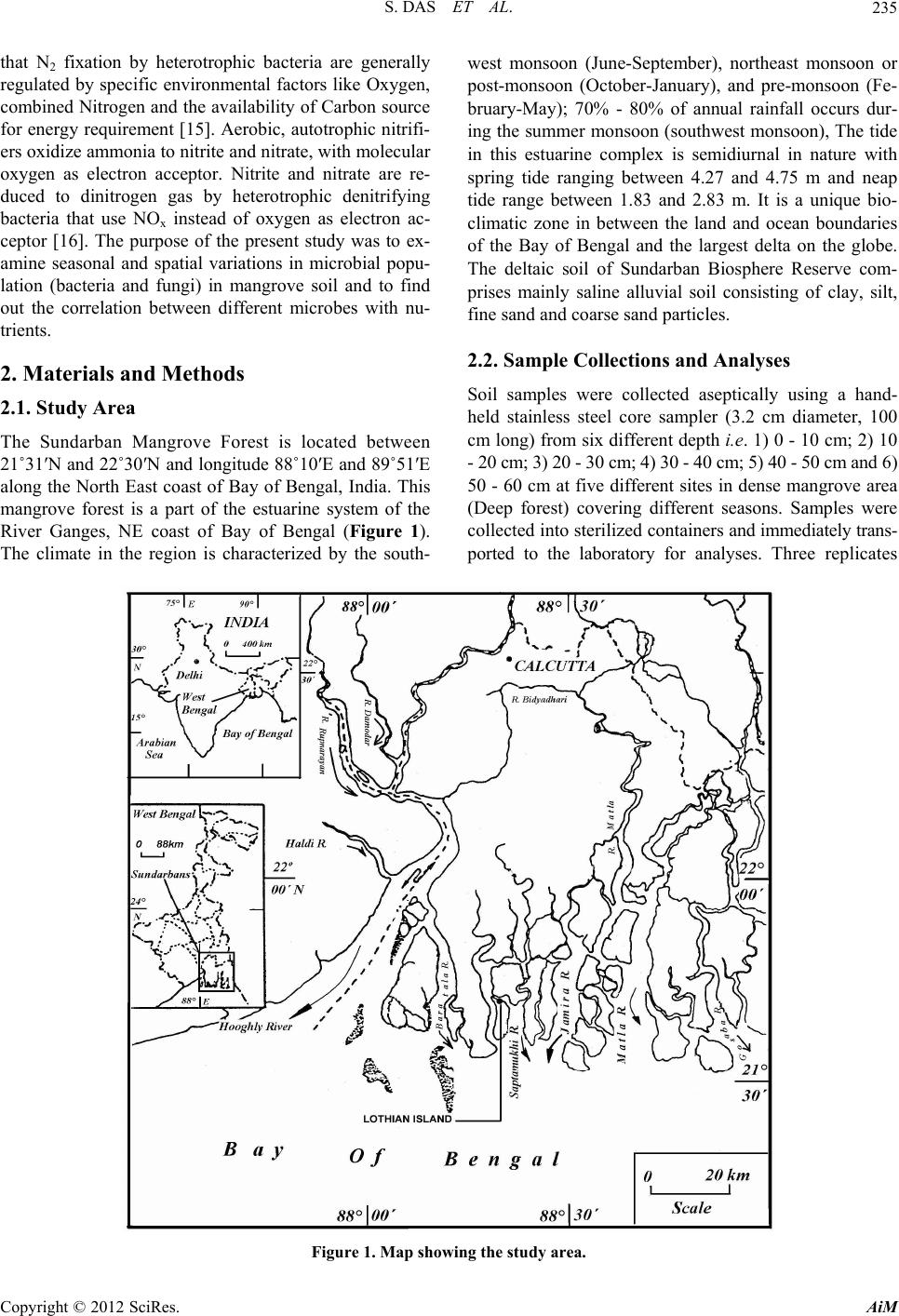 S. DAS ET AL. 235 that N2 fixation by heterotrophic bacteria are generally regulated by specific environmental factors like Oxygen, combined Nitrogen and the availability of Carbon source for energy requirement [15]. Aerobic, autotrophic nitrifi- ers oxidize ammonia to nitrite and nitrate, with molecular oxygen as electron acceptor. Nitrite and nitrate are re- duced to dinitrogen gas by heterotrophic denitrifying bacteria that use NOx instead of oxygen as electron ac- ceptor [16]. The purpose of the present study was to ex- amine seasonal and spatial variations in microbial popu- lation (bacteria and fungi) in mangrove soil and to find out the correlation between different microbes with nu- trients. 2. Materials and Methods 2.1. Study Area The Sundarban Mangrove Forest is located between 21˚31′N and 22˚30′N and longitude 88˚10′E and 89˚51′E along the North East coast of Bay of Bengal, India. This mangrove forest is a part of the estuarine system of the River Ganges, NE coast of Bay of Bengal (Figure 1). The climate in the region is characterized by the south- west monsoon (June-September), northeast monsoon or post-monsoon (October-January), and pre-monsoon (Fe- bruary-May); 70% - 80% of annual rainfall occurs dur- ing the summer monsoon (southwest monsoon), The tide in this estuarine complex is semidiurnal in nature with spring tide ranging between 4.27 and 4.75 m and neap tide range between 1.83 and 2.83 m. It is a unique bio- climatic zone in between the land and ocean boundaries of the Bay of Bengal and the largest delta on the globe. The deltaic soil of Sundarban Biosphere Reserve com- prises mainly saline alluvial soil consisting of clay, silt, fine sand and coarse sand particles. 2.2. Sample Collections and Analyses Soil samples were collected aseptically using a hand- held stainless steel core sampler (3.2 cm diameter, 100 cm long) from six different depth i.e. 1) 0 - 10 cm; 2) 10 - 20 cm; 3) 20 - 30 cm; 4) 30 - 40 cm; 5) 40 - 50 cm and 6) 50 - 60 cm at five different sites in dense mangrove area (Deep forest) covering different seasons. Samples were collected into sterilized containers and immediately trans- ported to the laboratory for analyses. Three replicates Figure 1. Map showing the study area. Copyright © 2012 SciRes. AiM 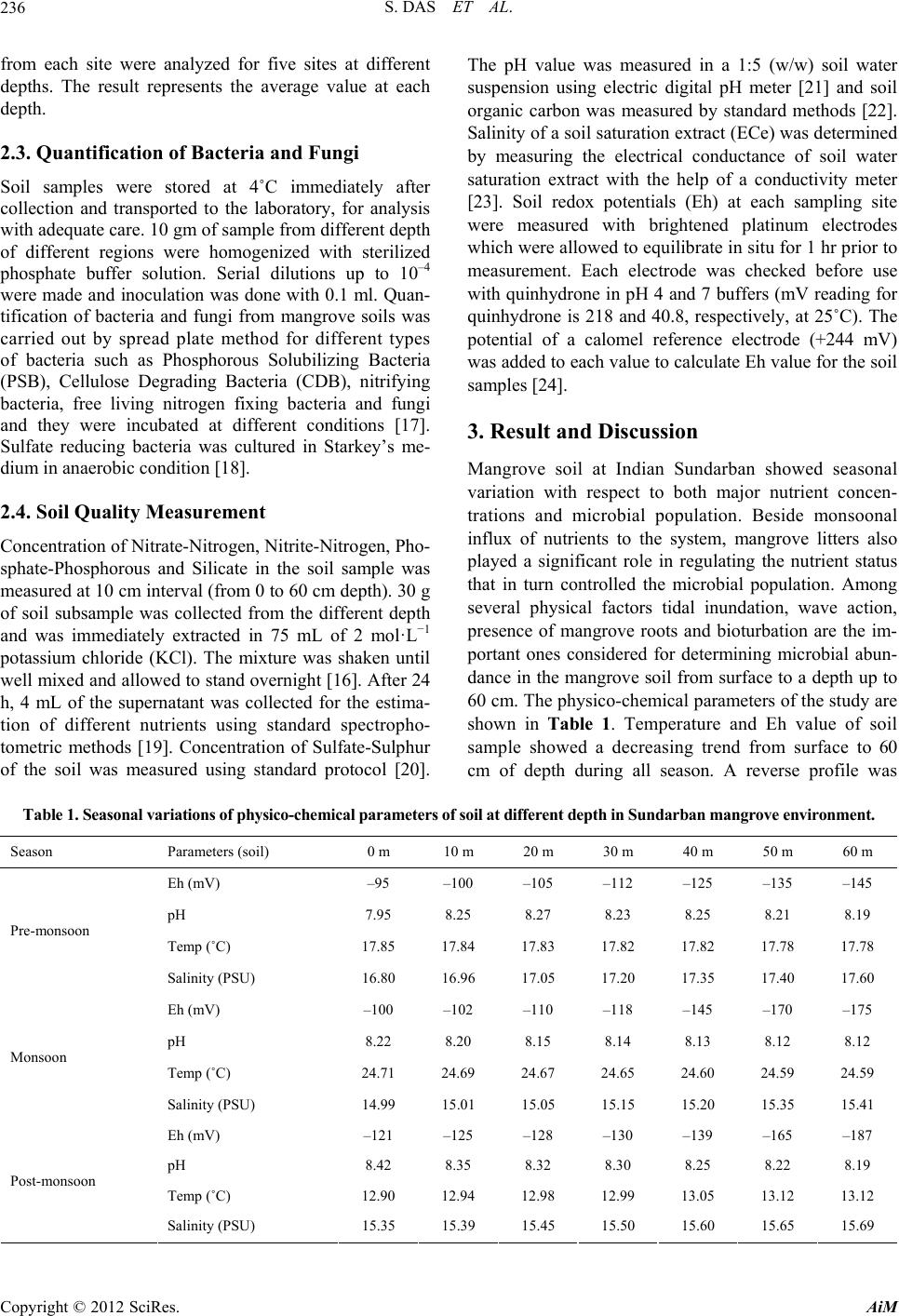 S. DAS ET AL. 236 from each site were analyzed for five sites at different depths. The result represents the average value at each depth. 2.3. Quantification of Bacteria and Fungi Soil samples were stored at 4˚C immediately after collection and transported to the laboratory, for analysis with adequate care. 10 gm of sample from different depth of different regions were homogenized with sterilized phosphate buffer solution. Serial dilutions up to 10–4 were made and inoculation was done with 0.1 ml. Quan- tification of bacteria and fungi from mangrove soils was carried out by spread plate method for different types of bacteria such as Phosphorous Solubilizing Bacteria (PSB), Cellulose Degrading Bacteria (CDB), nitrifying bacteria, free living nitrogen fixing bacteria and fungi and they were incubated at different conditions [17]. Sulfate reducing bacteria was cultured in Starkey’s me- dium in anaerobic condition [18]. 2.4. Soil Quality Measurement Concentration of Nitrate-Nitrogen, Nitrite-Nitrogen, Pho- sphate-Phosphorous and Silicate in the soil sample was measured at 10 cm interval (from 0 to 60 cm depth). 30 g of soil subsample was collected from the different depth and was immediately extracted in 75 mL of 2 mol·L−1 potassium chloride (KCl). The mixture was shaken until well mixed and allowed to stand overnight [16]. After 24 h, 4 mL of the supernatant was collected for the estima- tion of different nutrients using standard spectropho- tometric methods [19]. Concentration of Sulfate-Sulphur of the soil was measured using standard protocol [20]. The pH value was measured in a 1:5 (w/w) soil water suspension using electric digital pH meter [21] and soil organic carbon was measured by standard methods [22]. Salinity of a soil saturation extract (ECe) was determined by measuring the electrical conductance of soil water saturation extract with the help of a conductivity meter [23]. Soil redox potentials (Eh) at each sampling site were measured with brightened platinum electrodes which were allowed to equilibrate in situ for 1 hr prior to measurement. Each electrode was checked before use with quinhydrone in pH 4 and 7 buffers (mV reading for quinhydrone is 218 and 40.8, respectively, at 25˚C). The potential of a calomel reference electrode (+244 mV) was added to each value to calculate Eh value for the soil samples [24]. 3. Result and Discussion Mangrove soil at Indian Sundarban showed seasonal variation with respect to both major nutrient concen- trations and microbial population. Beside monsoonal influx of nutrients to the system, mangrove litters also played a significant role in regulating the nutrient status that in turn controlled the microbial population. Among several physical factors tidal inundation, wave action, presence of mangrove roots and bioturbation are the im- portant ones considered for determining microbial abun- dance in the mangrove soil from surface to a depth up to 60 cm. The physico-chemical parameters of the study are shown in Table 1. Temperature and Eh value of soil sample showed a decreasing trend from surface to 60 cm of depth during all season. A reverse profile was Table 1. Seasonal variations of phys ico-chemical parameters of soil at d ifferent d epth in Sundarban mangrove environment. Season Parameters (soil) 0 m 10 m 20 m 30 m 40 m 50 m 60 m Eh (mV) –95 –100 –105 –112 –125 –135 –145 pH 7.95 8.25 8.27 8.23 8.25 8.21 8.19 Temp (˚C) 17.85 17.84 17.83 17.82 17.82 17.78 17.78 Pre-monsoon Salinity (PSU) 16.80 16.96 17.05 17.20 17.35 17.40 17.60 Eh (mV) –100 –102 –110 –118 –145 –170 –175 pH 8.22 8.20 8.15 8.14 8.13 8.12 8.12 Temp (˚C) 24.71 24.69 24.67 24.65 24.60 24.59 24.59 Monsoon Salinity (PSU) 14.99 15.01 15.05 15.15 15.20 15.35 15.41 Eh (mV) –121 –125 –128 –130 –139 –165 –187 pH 8.42 8.35 8.32 8.30 8.25 8.22 8.19 Temp (˚C) 12.90 12.94 12.98 12.99 13.05 13.12 13.12 Post-monsoon Salinity (PSU) 15.35 15.39 15.45 15.50 15.60 15.65 15.69 Copyright © 2012 SciRes. AiM 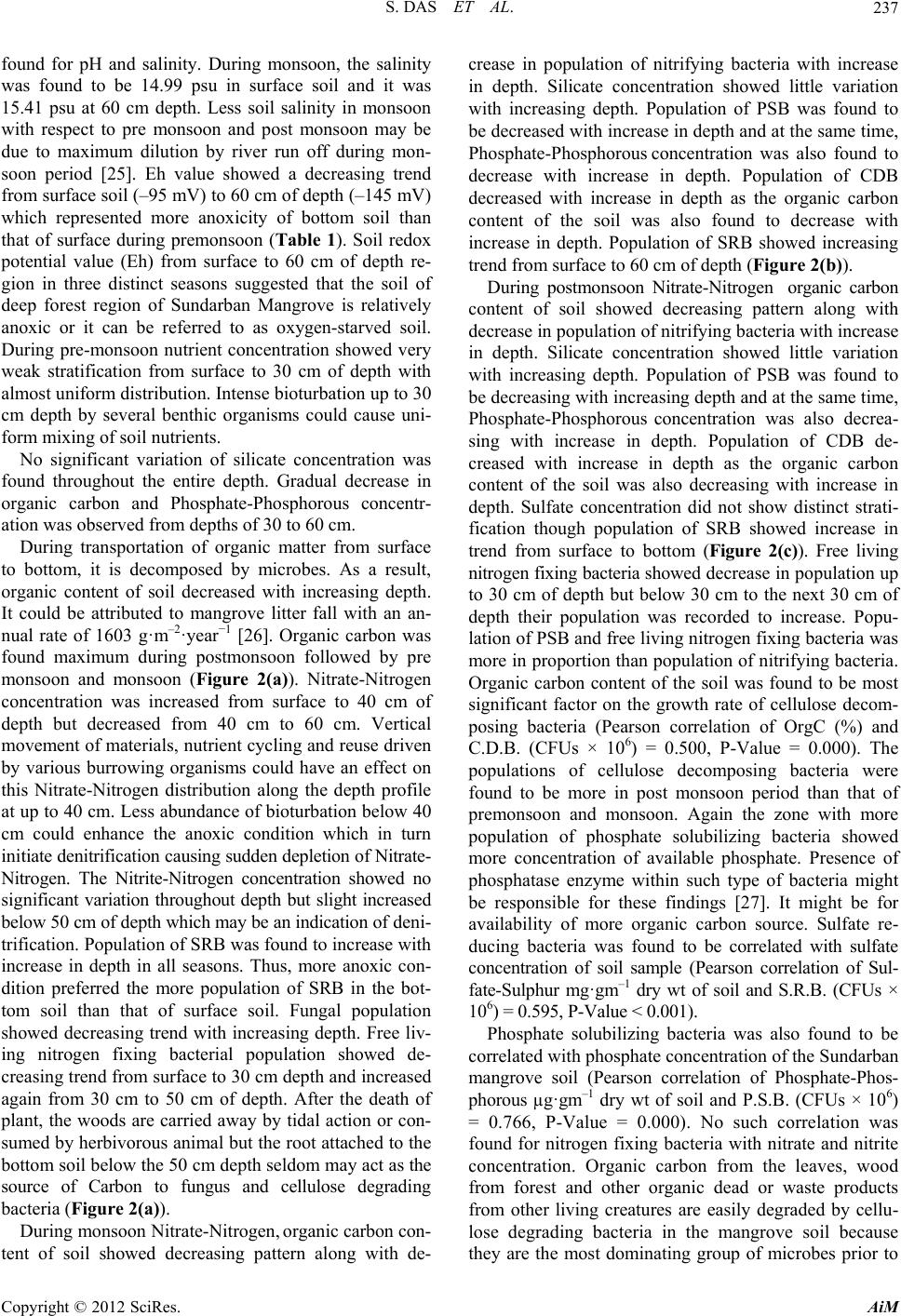 S. DAS ET AL. 237 found for pH and salinity. During monsoon, the salinity was found to be 14.99 psu in surface soil and it was 15.41 psu at 60 cm depth. Less soil salinity in monsoon with respect to pre monsoon and post monsoon may be due to maximum dilution by river run off during mon- soon period [25]. Eh value showed a decreasing trend from surface soil (–95 mV) to 60 cm of depth (–145 mV) which represented more anoxicity of bottom soil than that of surface during premonsoon (Table 1). Soil redox potential value (Eh) from surface to 60 cm of depth re- gion in three distinct seasons suggested that the soil of deep forest region of Sundarban Mangrove is relatively anoxic or it can be referred to as oxygen-starved soil. During pre-monsoon nutrient concentration showed very weak stratification from surface to 30 cm of depth with almost uniform distribution. Intense bioturbation up to 30 cm depth by several benthic organisms could cause uni- form mixing of soil nutrients. No significant variation of silicate concentration was found throughout the entire depth. Gradual decrease in organic carbon and Phosphate-Phosphorous concentr- ation was observed from depths of 30 to 60 cm. During transportation of organic matter from surface to bottom, it is decomposed by microbes. As a result, organic content of soil decreased with increasing depth. It could be attributed to mangrove litter fall with an an- nual rate of 1603 g·m–2·year−1 [26]. Organic carbon was found maximum during postmonsoon followed by pre monsoon and monsoon (Figure 2(a)). Nitrate-Nitrogen concentration was increased from surface to 40 cm of depth but decreased from 40 cm to 60 cm. Vertical movement of materials, nutrient cycling and reuse driven by various burrowing organisms could have an effect on this Nitrate-Nitrogen distribution along the depth profile at up to 40 cm. Less abundance of bioturbation below 40 cm could enhance the anoxic condition which in turn initiate denitrification causing sudden depletion of Nitrate- Nitrogen. The Nitrite-Nitrogen concentration showed no significant variation throughout depth but slight increased below 50 cm of depth which may be an indication of deni- trification. Population of SRB was found to increase with increase in depth in all seasons. Thus, more anoxic con- dition preferred the more population of SRB in the bot- tom soil than that of surface soil. Fungal population showed decreasing trend with increasing depth. Free liv- ing nitrogen fixing bacterial population showed de- creasing trend from surface to 30 cm depth and increased again from 30 cm to 50 cm of depth. After the death of plant, the woods are carried away by tidal action or con- sumed by herbivorous animal but the root attached to the bottom soil below the 50 cm depth seldom may act as the source of Carbon to fungus and cellulose degrading bacteria (Figure 2(a)). During monsoon Nitrate-Nitrogen, organic carbon con- tent of soil showed decreasing pattern along with de- crease in population of nitrifying bacteria with increase in depth. Silicate concentration showed little variation with increasing depth. Population of PSB was found to be decreased with increase in depth and at the same time, Phosphate-Phosphorou s concentration was also found to decrease with increase in depth. Population of CDB decreased with increase in depth as the organic carbon content of the soil was also found to decrease with increase in depth. Population of SRB showed increasing trend from surface to 60 cm of depth (Figure 2(b)). During postmonsoon Nitrate-Nitrogen organic carbon content of soil showed decreasing pattern along with decrease in population of nitrifying bacteria with increase in depth. Silicate concentration showed little variation with increasing depth. Population of PSB was found to be decreasing with increasing depth and at the same time, Phosphate-Phosphorou s concentration was also decrea- sing with increase in depth. Population of CDB de- creased with increase in depth as the organic carbon content of the soil was also decreasing with increase in depth. Sulfate concentration did not show distinct strati- fication though population of SRB showed increase in trend from surface to bottom (Figure 2(c)). Free living nitrogen fixing bacteria showed decrease in population up to 30 cm of depth but below 30 cm to the next 30 cm of depth their population was recorded to increase. Popu- lation of PSB and free living nitrogen fixing bacteria was more in proportion than population of nitrifying bacteria. Organic carbon content of the soil was found to be most significant factor on the growth rate of cellulose decom- posing bacteria (Pearson correlation of OrgC (%) and C.D.B. (CFUs × 106) = 0.500, P-Value = 0.000). The populations of cellulose decomposing bacteria were found to be more in post monsoon period than that of premonsoon and monsoon. Again the zone with more population of phosphate solubilizing bacteria showed more concentration of available phosphate. Presence of phosphatase enzyme within such type of bacteria might be responsible for these findings [27]. It might be for availability of more organic carbon source. Sulfate re- ducing bacteria was found to be correlated with sulfate concentration of soil sample (Pearson correlation of Sul- fate-Sulphur mg·gm–1 dry wt of soil and S.R.B. (CFUs × 106) = 0.595, P-Value < 0.001). Phosphate solubilizing bacteria was also found to be correlated with phosphate concentration of the Sundarban mangrove soil (Pearson correlation of Phosphate-Phos- phorous µg·gm–1 dry wt of soil and P.S.B. (CFUs × 106) = 0.766, P-Value = 0.000). No such correlation was found for nitrogen fixing bacteria with nitrate and nitrite concentration. Organic carbon from the leaves, wood from forest and other organic dead or waste products from other living creatures are easily degraded by cellu- lose degrading bacteria in the mangrove soil because they are the most dominating group of microbes prior to Copyright © 2012 SciRes. AiM 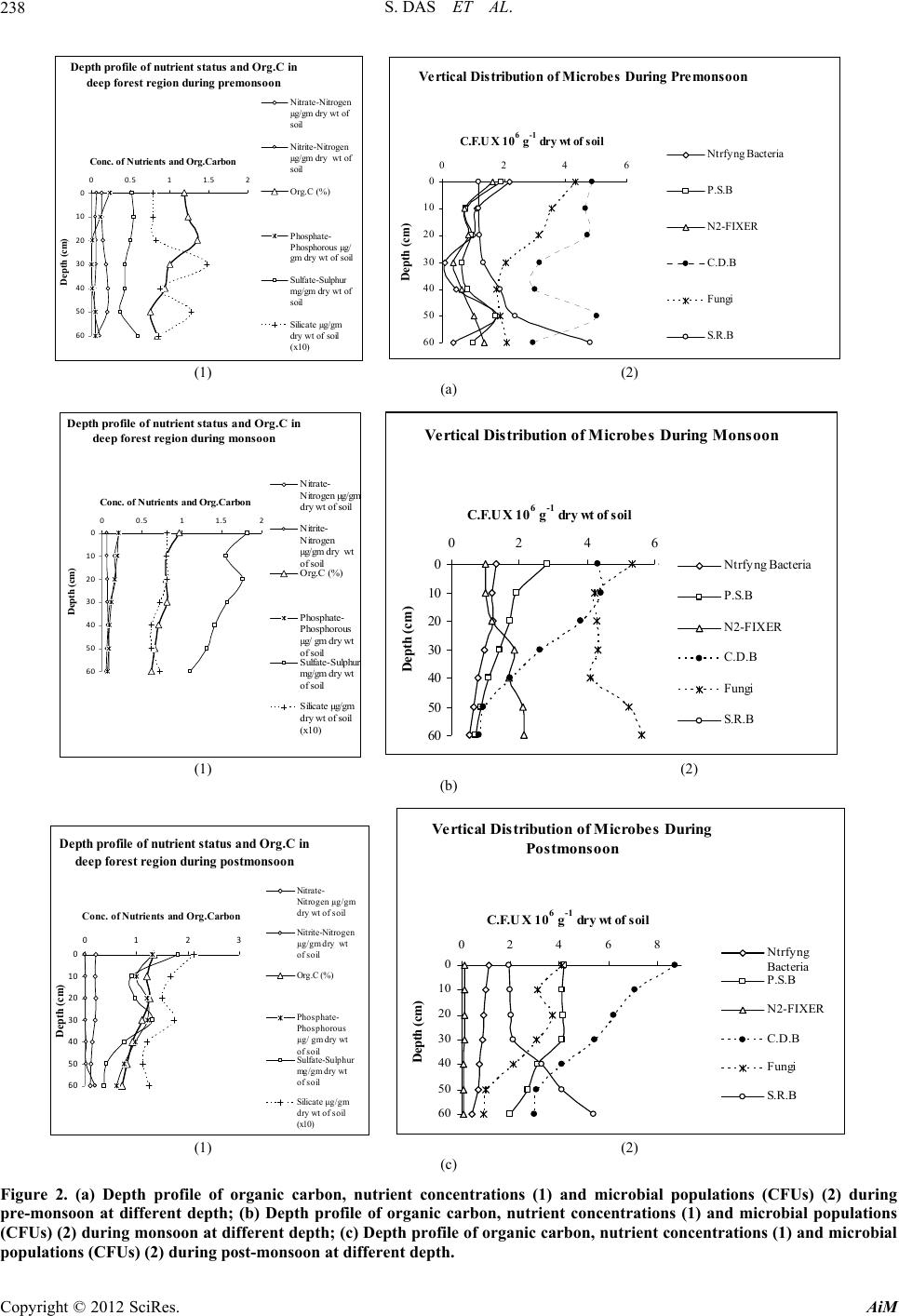 S. DAS ET AL. 238 D epth pro f ile of nutrient status and Org deep forest region during premonsoon 0 10 20 30 40 50 60 00.511.52 Conc. of Nutrients and Org.Carbon Depth (cm) . C in Nitrate-Nitrogen µg/gm dry wt of soil Nitrite-Nitrogen µg/gm dry wt o f soil Org.C (%) Phosphate- Phosphorous µg/ gm dry wt of soi l Sulfate-Sulphur mg/gm dry wt o f soil Silicate µg/gm dry wt of soil (x10) Verti cal Di stribut ion of Micro bes D uring Premonso on 0 10 20 30 40 50 60 0246 C.F.U X 10 6 g -1 dry wt of soil Depth (cm) Ntrfyng Bacteria P.S.B N2-FIXER C.D.B Fungi S.R.B (1) (2) (a) D epth profi l e of nutri ent st atus and O r deep forest region during monsoon 0 10 20 30 40 50 60 00.5 11.52 Conc. of Nutrients and Org.Carbon Depth (cm) g. C i n Nitrate- Nitrogen µg/g m dry wt of soil Nitrite- Nitrogen µg/gm dry wt of soil Org.C (%) Phosphate- Phosphorous µg/ gm dry wt of soil Sulfate- Sulp hu r mg/gm dry wt of soil Silicate µg/gm dry wt of soil (x10) Vert ical Di stribu tion of Microbes Du rin g Monsoon 0 10 20 30 40 50 60 0246 C.F.U X 10 6 g -1 d ry w t of soil Depth (cm) Ntrfyng Bacteria P.S.B N2-FIXER C.D.B Fungi S.R.B (1) (2) (b) Vertical D i stribution of Microbes During Postmonsoon 0 10 20 30 40 50 60 02468 C.F.U X 10 6 g -1 dry wt of soil Depth (cm) D epth pr ofil e of nutri ent status and Or g deep forest r egi on during postmonso 0 10 20 30 40 50 60 0123 Conc. of Nutrients and Org .C arbo n Depth (cm) . C i n o n Nitrate- N itrogen µg/g m dry wt of soil N itrite-Nitrogen µg/gm dry wt of soil Org.C (%) Phosphate- Phosphorous µg/ gm dry wt of soil Su lfa te -Sulphur mg/g m dry wt of soil Silicate µg/gm dry wt of soil (x10) Ntrfyng Bacteria P.S.B N2-FIXER C.D.B Fungi S.R.B (1) (2) (c) Figure 2. (a) Depth profile of organic carbon, nutrient concentrations (1) and microbial populations (CFUs) (2) during pre-monsoon at different depth; (b) Depth profile of organic carbon, nutrient concentrations (1) and microbial populations (CFUs) (2) during monsoon at different depth; (c) Depth profile of organic carbon, nutrient concentrations (1) and microbial opulations (CFUs) (2) during post-monsoon at different depth. p Copyright © 2012 SciRes. AiM  S. DAS ET AL. 239 fungi. Other groups of microbes have also shown sig- nificant population which is a good sign for a mangrove forest with respect to mineralization of organic debris and as a result mangrove plants can easily get nutrients in their simplest forms. From seasonal perspective, the monsoon period was significantly different (Student’s t test, P < 0.01) than other periods of the year in terms of total bacterial abundance and other key parameters. Sea level rise due to global warming may hamper the stable ecological zone of Sundarban mangrove forest which may ultimately reflect to net flux of several biologically active trace gases between soil and atmosphere. Intro- duction of huge amount of nutrients during monsoon have a positive feedback on the bacterial population of mangrove sediment. Beside the changes in several phys- icochemical parameters, transport of huge amount of aquatic microbes could lead to the significant increase in the microbial population in the soil of this mangrove eco- system. This may contribute to the aquatic biogeochem- istry of this tropical wetland. 4. Acknowledgements The financial assistance from DOEn, Govt. of West Bengal and U.G.C., New Delhi are gratefully acknowl- edged. The authors are also grateful to the Forest De- partment, Govt. of West Bengal for assisting the research team in collecting data and providing all infrastructural facilities to reach the remote island. REFERENCES [1] B. Gonzalez-Acosta, Y. Bashan, N. Y. Hernandez-Sa- avedra, F. Ascenaio and G. Cruz-Aguero, “Seasonal Seawater Temperature as the Major Determinant for Populations of Culturable Bacteria in the Soils of an In- tact Mangrove in an Arid Region,” FEMS Microbiology Ecology, Vol. 55, No. 2, 2006, pp. 311-321. doi:10.1111/j.1574-6941.2005.00019.x [2] D. M. Alongi, K. G. Boto and F. Tirendi, “Effect of Ex- ported Mangrove Litter on Bacterial Productivity and Dissolved Organic Carbon Fluxes in Adjacent Tropical Nearshore Soils,” Marine Ecology Progress Series, Vol. 56, 1989, pp. 133-144. doi:10.3354/meps056133 [3] D. M. Alongi, P. Christofferson and F. Tirendi, “The Influence of Forest Type on Microbial-Nutrient Rela- tionship in Tropical Mangrove Soil,” Journal of Experi- mental Marine Biology and Ecology, Vol. 171, No. 2, 1993, pp. 201-223. doi:10.1016/0022-0981(93)90004-8 [4] D. M. Alongi, “The Role of Bacteria in Nutrient Recy- cling in Tropical Mangrove and Other Coastal Benthic Ecosystems,” Hydrobiologia, Vol. 285, No. 1-3, 1994, pp. 19-32. doi:10.1007/BF00005650 [5] G. Holguin, Y. Bashan and P. Vazavez, “The Role of Soil Microorganism in the Productivity, Conservation and Rehabilitation of Mangrove Ecosystem: An Overview,” Biology of Fertile Soils, Vol. 33, No. 4, 2001, pp. 265- 278. doi:10.1007/s003740000319 [6] G. Toledo, Y. Bashan and A. Soeldner, “Cyanobacteria and Black Mangroves in Northwestern Mexico: Coloni- zation, and Diurnal and Seasonal Nitrogen Fixation on Aerial Roots,” Canadian Journal of Microbiology, Vol. 41, No. 11, 1995, pp. 999-1011. doi:10.1139/m95-139 [7] A. Rojas, G. Holguin, B. R. Glick and Y. Bashan, “Syn- ergism between Phyllobacterium sp. (N2-Fixer) and Ba- cillus licheniformis (P-Solubilizer), both from a Semiarid Mangrove Rhizosphere,” FEMS Microbiology Ecology, Vol. 35, 2001, pp. 181-187. doi:10.1111/j.1574-6941.2001.tb00802.x [8] P. Vazquez, G. Holguin, M. E. Puente, A. Lopez-Cortes and Y. Bashan, “Phosphate-Solubilizing Microorganisms Associated with the Rhizosphere of Mangroves in a Semiarid Coastal Lagoon,” Biology and Fertility of Soils, Vol. 30, No. 5-6, 2000, pp. 460-468. doi:10.1007/s003740050024 [9] D. B. Nedwell, T. H. Blackburn and W. J. Wiebe, “Dy- namic Nature of the Turnover of Organic Carbon, Nitro- gen and Sulpher in the Soil of a Jamaican Mangrove For- est,” Marine Ecology Progress Series, Vol. 110, No. 9, 1994, pp. 223-231. doi:10.3354/meps110223 [10] E. Senior, E. B. Lindstrom, I. M. Banat and D. B. Ned- well, “Sulfate Reduction and Methanogenesis in the Sediment of a Saltmarsh on the East Coast of the United Kingdom,” Applied Environmental Microbiology, Vol. 43, 1982, pp. 987-996. [11] J. Sorensen, B. B. Jorgensen and N. P. Revsbech, “A Comparison of Oxygen, Nitrate and Sulfate Respiration in Coastal Marine Soil,” Microbial Ecology, Vol. 5, No. 2, 1979, pp. 105-111. doi:10.1007/BF02010501 [12] D. R. Lovley and M. J. Klug, “Intermediary Metabolism of Organic Matter in the Soil of a Eutrophic Lake,” Ap- plied Environmental Microbiology, Vol. 43, 1982, pp. 552-560. [13] R. Mohanraju and R. Natarajan, “Methanogenic Bacteria in Mangrove Soils,” Hydrobiologia, Vol. 247, No. 1-3, 1992, pp. 187-193. doi:10.1007/BF00008218 [14] C. R. Wang, Y. Shi, X. M. Yang, J. Wu and J. Yue, “Ad- vances of Study on Atmospheric Methane Oxidation (Consumption) in Forest Soil,” Journal of Forestry Re- search, Vol. 14, No. 3, 2003, pp. 230-238. doi:10.1007/BF02856837 [15] C. B. Teri and K. F. Mary, “Linking Microbial Com- munity Composition and Soil Processes in a California Annual Grassland and Mixed Conifer Forest,” Biogeo- chemistry, Vol. 73, No. 2, 2005, pp. 395-415. doi:10.1007/s10533-004-0372-y [16] R. H. Riley, M. Peter and P. M. Vitousek, “Nutrient Dy- namics and Nitrogen Trace Gas Flux during Ecosystem Development in Montane Rain Forest,” Ecology, Vol. 76, No. 1, 1995, pp. 292-304. doi:10.2307/1940650 [17] A. L. Ramanathan, G. Singh, J. Majumder, A. C. Samal, R. Chowhan, R. K. Rayan, K. Roykumar and S. C. Santra, Copyright © 2012 SciRes. AiM  S. DAS ET AL. 240 “A Study of Microbial Diversity and Its Interaction with Nutrients in the Soils of Sundarban Mangroves,” Indian Journal of Marine Science, Vol. 37, No. 2, 2008, pp. 159-165. [18] F. K. Sahrani, Z. Ibrahim, A. Yahya and M. Aziz, “Isola- tion and Identification of Marine Sulfate Reducing Bacte- ria Desulfovibrio sp and Citrobacter freundii from Pasir Gudang, Malaysia,” Sains Malyasiana, Vol. 37, No. 4, 2008, pp. 365-371. [19] K. Grasshoff, M. Ehrhardt and K. Kremling, “Standard Methods for Sea Water Analysis,” 2nd Edition, Wiley- VCH, Weinheim, 1983. [20] S. A. B. Mussa, H. S. Elferjani, F. A. Haroun and F. F. Abdelnabi, “Determination of Available Nitrate, Phos- phate and Sulfate in Soil Samples” International Journal of PharmTech Research, Vol. 1, 2009, pp. 598-604. [21] S. C. Tiwari, B. K. Tiwari and R. R. Mishra, “Microbial Community, Enzyme Activity and CO2 Evolution in Pineapple Orchard Soil,” Tropical Ecology, Vol. 30, No. 2, 1989, pp. 265-273. [22] A. Walkley and J. A. Black, “An Examination of Degtja- reff Method for Determining Soil Organic Matter, and a Proposed Modification of the Chromic Acid Titration Method,” Soil Science, Vol. 37, No. 1, 1934, pp. 29-38. doi:10.1097/00010694-193401000-00003 [23] L. A. Richards, “Diagnosis and Improvement of Saline and Alkali Soils,” USDA Hand Book No. 60, Oxford and IBH Publishing Co., New Delhi, 1968. [24] A. Pidello and L. J. Monrozier, “Inoculation of the Redox Effector Pseudomonas Fluorescens C7R12 Strain Affects Soil Redox Status at the Aggregate Scale,” Soil Biology & Biochemistry, Vol. 38, No. 6, 2006, pp. 1396-1402. doi:10.1016/j.soilbio.2005.10.010 [25] S. M. Wahid, M. S. Babel and A. R. Bhuiyan, “Hydro- logic Monitoring and Analysis in the Sundarbans Man- grove Ecosystem, Bangladesh,” Journal of Hydrology, Vol. 332, No. 3-4, 2007, pp. 381-395. doi:10.1016/j.jhydrol.2006.07.016 [26] P. B. Ghosh, B. N. Singh, C. Chakroborty, A. Saha, R. L. Das and A. Choudhury, “Mangrove Litter Production in a Tidal Creek of Lothian Island of Sundarbans, India,” In- dian Journal of Marine Sciences, Vol. 19, 1990, pp. 292- 293. [27] C. Hu and Z. P. Cao, “Size and Activity of the Soil Mi- crobial Biomass and Soil Enzyme Activity in Long Term Field Experiments,” World Journal of Agricultural Sci- ences, Vol. 3, No. 1, 2007, pp. 63-70. Copyright © 2012 SciRes. AiM |