

Paper Menu >>
Journal Menu >>
 Open Journal of Leadership 2012. Vol.1, No.3, 13-16 Published Online September 2012 in SciRes (http://www.SciRP.org/journal/ojl) http://dx.doi.org/10.4236/ojl.2012.13003 Copyright © 2012 SciRes. 13 Retail Managers: Laissez-Faire Leadership Is Synonymous with Unsuccessful Conflict Management Styles Etta C. Gray1, James Arthur Williams2 1University of Phoenix, Phoenix, USA 2James Madison Unive rsity, Harrisonburg, USA Email: [email protected], will22 [email protected] Received July 9th, 2012; revised August 12th, 2012; accepted August 21st, 2012 Retail managers were examined to determine their leadership styles and any potential correlations to con- flict management styles. Research findings suggest that successful retail managers exhibit transforma- tional leadership styles, and those that exhibit laissez-faire leadership is strongly correlated with avoid- ance conflict management style. The Conflict Management Style (CMS) and Multi Leadership Question- naire (MLQ) instruments were used to survey participants in this study. A MLQ scoring manual was used to identify leadership styles, and a CMS scoring manual was used to determine conflict management styles. Pearson correlation (SPSS, version 17.0) was used to correlate between MLQ and CMS findings. Keywords: Transformational Leadership; Conflict Management; Retail Managers; MLQ; Avoidance Conflict Management Introduction Conflict has a profound effect on leaders attempting to lead within complex and convoluted work environments, but suc- cessful leaders embrace conflict to create inspirational leader- ship styles in these challenging situations (Runde & Flanagan, 2008). Some conflicts that might occur in the retail work envi- ronment can stem from opposing management perspectives, turnover, and fractured work relationships. Leaders in the retail industry may change the conflict culture of their organizations through recognizing behavioral patterns of employees. Accord- ing to Runde and Flanagan (2008), managers can change con- flict culture by aligning constructive conflict responses to the organization’s vision, policies, and performance measures. Effective leadership styles are essential to the success of intri- cate organizations (Latham & Vinyard, 2004). Improperly or poorly, managing conflicts in retail work en- vironments can create financial losses that impede the progres- sion of productive retail entities (Kanchier, 2005). According to Katz (2006), unresolved conflict has become an unrecognizing cost factor in many organizations. Multiple conflicts shift the strategic planning from production and employee performance to combating potential contingencies among internal relation- ships (Sherman, 2009). Korkmaz (2007) indicated that manag- ers could resolve internal conflict when those managers under- stood the concerns of their employees. An examination of lead- ership styles and how to resolve conflict in small retail busi- nesses is pertinent to improving work environments because leaders must know when and how to take action (Danley, 2006). Managing conflict is an opportunity for organizations to expand the contextual aspects of conflict while decreasing the conse- quences (Bruk-Lee, 2007). Conflict is characterized as a difference among two or more individuals, involving no bonding to create tension, disagree- ment, emotion, or polarization (Korkmaz, 2007). Assessing numerous research studies pertaining to managing conflict, there are a few research studies that focus on correlation be- tween leadership styles and conflict management styles in the retail environment. This research study aims to investigate re- tail managers’ effective leadership styles and any correlations to effectual conflict management styles. The results can present patterns of leadership behaviors needed to combat present and future issues that might impede the progression of complex retail work environments. Literature Review Leadership is essential to the development and maturation of diversified workforce populations (Latham & Vinyard, 2004). Effective leadership is in demand for retail organizations in a competitive, fast-moving environment (Sheard & Kakabadse, 2002). To be effective, leaders must display consistent core beliefs and behaviors; yet at the same time simultaneously adopt his or her style to mesh with the culture of their organiza- tion (Sheard & Kakabadse, 2002). Effective leadership is used to manage organization’s goals and objectives (Tubbs & Schulz, 2006). Successful leaders used a transformational leadership style to motivate and inspire constituents to align their behav- iors and actions to accomplish organizational goals and objec- tives (Ackoff, 1999). Transformational leadership sets the standard level of human interaction between the leader and follower. This can be ac- complished by the relationship the leader develops with fol- lowers wanting to exceed to the next level; therefore creating a new era of leaders (Banerji & Krishnan, 2000). Transforma- tional leadership is the ability of a leader to build trust, loyalty, and admiration in followers, and express his or her individual interests to the entire group (Eagly, Johannesen-Schmidt, & Van Engen, 2003). Managing conflict may come easy to trans- formational leaders, the leadership style is a behavior process comprised charisma, intellectual stimulation, and individualized consideration (Bass & Avolio, 2004). Conflict not effectively  E. C. GRAY, J. A. WILLIAMS managed and resolved, reflects a leader’s lack ability to build strong relationships with followers that affect team morale and satisfaction (Newman & Grigg, 2008). Compromise conflict management is used to generate will- ingness between both parties to relinquish some control or power for the benefit of the organization (Bruk-Lee, 2007). The retail industry presents new conflicts in the form of diversified cultures and ethnic groups, poorly trained workforce, and a fluctuating economy that impacts retail sales (Reynolds, How- ard, Cuthbertson, & Hristov, 2007; Hinckley, 2009). Compro- mise conflict resolution strategies are necessary to turn a com- pany around or to resolve issues about an employee’s role (Goyal, Maruping, & Robert, 2008; Hinckley, 2009). Trans- formational leaders have the charisma and interpersonal skills needed to incite followers to compromise on conflict resolution tactics (Bass & Avolio, 2004; Bruk-Lee, 2007). Laissez-Faire leadership is considered as an ineffective style when applied to conflict management situations (Bass & Avolio, 2004; Bruk-Lee, 2007). Managers used an avoidance conflict management style to evade challenging issues within their retail work environment (Newman & Grigg, 2008). Some researchers might view laissez-faire leaders to display leader- ship skills that attract an avoidance conflict management style. Today’s retail leaders are expected to use effective leadership strategies to mediate and facilitate conflicts that impact the internal work environment (Newman & Grigg, 2008). When retail organizations choose a conflict resolution strategy, such as compromise conflict management, leaders must make sure that the right strategies are chosen and beneficial to all vested parties (Goyal, Maruping, & Robert, 2008). The present study addresses the following research questions: Do successful retail managers exhibit a leadership style that promotes collaborative work efforts? Does the advantageous leadership style correlate with a collaborative conflict management style? Does poor leadership correlate with ineffective conflict management styles? Methodology The instruments used for this study were MLQ and CMS; MLQ was used to test retail managers’ leadership styles, and CMS was used to test their conflict management resolution style. Researcher obtained permission to use both instruments for the sole purpose of this research study. MLQ is one of the most validated and reliable instruments used to test managers’ leadership styles (Bass & Avoilo, 2004). The MLQ is a com- prehensive survey that is composed of 45-items, and uses a Likert-type scale to determine the transformational, transac- tional, and laissez-faire leadership styles (Bass & Avolio, 2004). There are 12 leadership style scales: idealized influence (attrib- uted), idealized influence (behavior), inspirational motivation, intellectual stimulation, individualized consideration; contin- gent reward, management-by-exception (active), management- by-exception (passive), laissez-faire leadership, extra effort, effectiveness, and satisfaction. The CMS instrument provided information about an indi- vidual’s approach to managing conflict. The survey data as- sisted individuals with an understanding of behaviors in con- flicting situations. Conflicts that occur in interpersonal, group, and intergroup settings were addressed in the grid format, pro- viding a five-fold conflict management profile. An effective tool to identify outcomes of conflict is the CMS (Teleometrics, 2007). Retail companies in the Louisville, Kentucky demo- graphic area were randomly selected. Participants who partici- pated in this study consisted of retail managers and employees in Louisville, Kentucky. Respondents were asked to assess the leadership styles (MLQ) and conflict management styles (CMS) of successful retail managers in their organizati on. For this study purpose, results from the two instruments can be used to determine leadership styles and conflict management styles used among successful retail managers. Respondents volunteered and signed a consent form to participate in this research study. Data were collected and analyzed by the re- searcher and with the assistance of SPSS (17.0). Descriptive and a Pearson Correlation analysis were used to present the research findings. Data Collection The CMS and MLQ survey instruments were paper-and-pencil self-administered surveys that were mailed to participating organizations in Louisville, KY. Within each packet were in- structions for the executive manager to distribute the sealed survey envelopes that were labeled manager and employee, to the participating managers and employees. The packets con- tained the researchers contact information, demographic ques- tionnaire, instructions for completing and returning the surveys, and a stamped envelope with the researchers mailing address to return the completed surveys. Two follow-up phone calls were made to the participating retail establishments within two-week intervals: two weeks after acknowledgement of receiving the packets and a final call was made two weeks later. Results The profile of respondents provides an insight into the poten- tial benefit of transformational leadership combined with com- promise conflict management. There was a small paucity of respondents (32) used for this research compared to the targeted number of respondents (100), to indicate a 32% response rate. Only usable surveys were statistically analyzed, and surveys were deemed unusable from incompleteness or failure to mail back to the researcher. According to Creswell (2002), mailed surveys have a low-response rate, and it may have impacted the response rate of this research study. The sample population consisted of 56.3% male and 43.8% female, so the sample population was fairly balanced for this study in Table 1. The most common age categories were 22 to 25 (21.9%) and 31 to 40 (21.9%), and only 9.4% of the respondents were over 50 years of age at the time of this study. The results also indicated that respondents were most likely to have a high school diploma or GED (31.3%) followed by some college (28.1%). Respondents were not likely to have an advanced degree with only two people (6.3%) having a mas- ter’s degree; both were managers. Table 1 indicated that re- spondents were most likely to be Caucasian (46.9%) followed by African American (43.8%). Only two participants were Hispanic (6.3%), none were Asian or Native American, and one person identified himself as other (3.1%). The findings indi- cated 37.5% of the sample identified themselves as managers while 62.5% of the sample identified themselves as sales asso- ciates. Table 2 provides the descriptive statistics for the three lead- Copyright © 2012 SciRes. 14 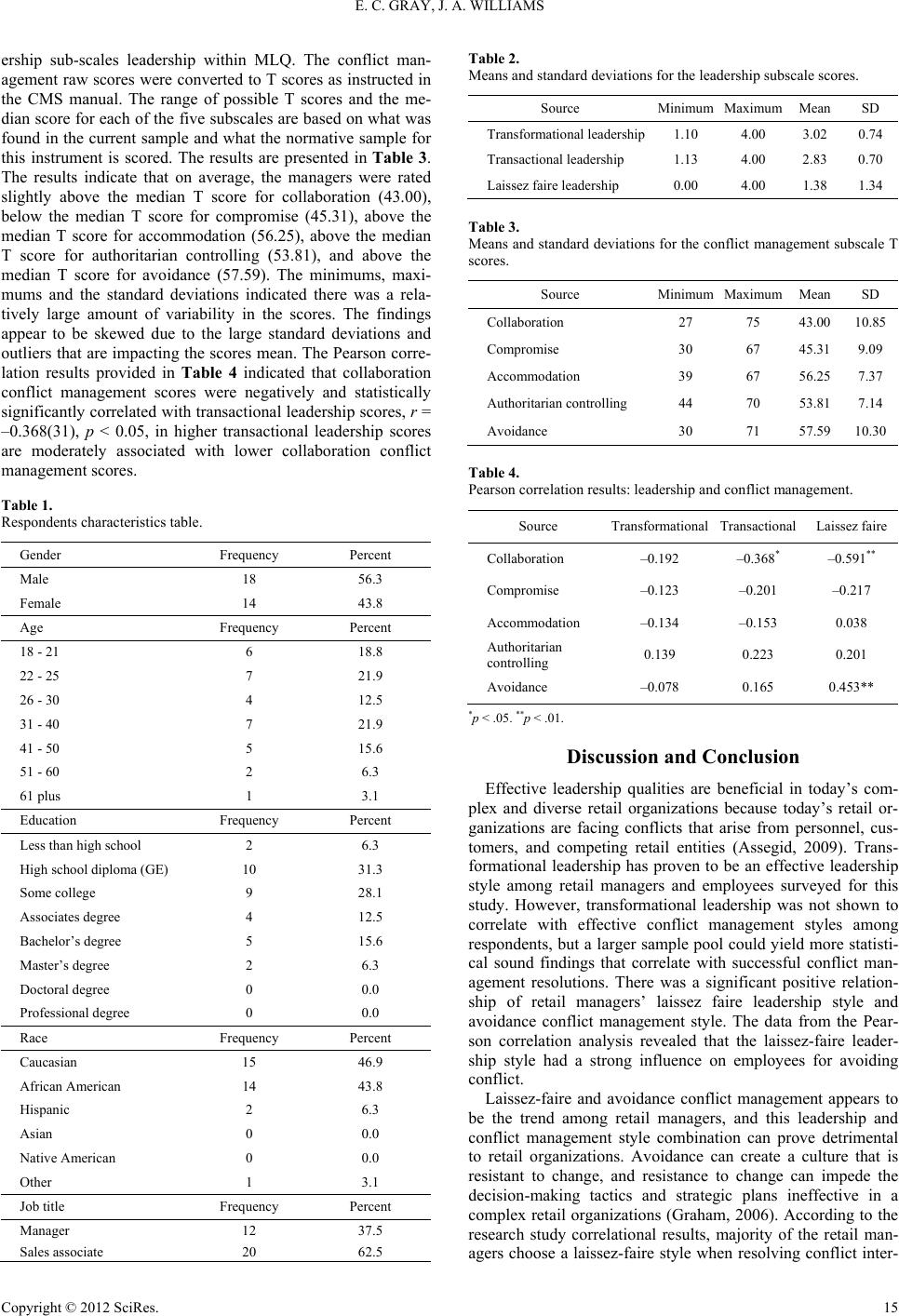 E. C. GRAY, J. A. WILLIAMS ership sub-scales leadership within MLQ. The conflict man- agement raw scores were converted to T scores as instructed in the CMS manual. The range of possible T scores and the me- dian score for each of the five subscales are based on what was found in the current sample and what the normative sample for this instrument is scored. The results are presented in Table 3. The results indicate that on average, the managers were rated slightly above the median T score for collaboration (43.00), below the median T score for compromise (45.31), above the median T score for accommodation (56.25), above the median T score for authoritarian controlling (53.81), and above the median T score for avoidance (57.59). The minimums, maxi- mums and the standard deviations indicated there was a rela- tively large amount of variability in the scores. The findings appear to be skewed due to the large standard deviations and outliers that are impacting the scores mean. The Pearson corre- lation results provided in Table 4 indicated that collaboration conflict management scores were negatively and statistically significantly correlated with transactional leadership scores, r = –0.368(31), p < 0.05, in higher transactional leadership scores are moderately associated with lower collaboration conflict management scores. Table 1. Respondents characteristics table. Gender Frequency Percent Male 18 56.3 Female 14 43.8 Age Frequency Percent 18 - 21 6 18.8 22 - 25 7 21.9 26 - 30 4 12.5 31 - 40 7 21.9 41 - 50 5 15.6 51 - 60 2 6.3 61 plus 1 3.1 Education Frequency Percent Less than high school 2 6.3 High school diploma (GE) 10 31.3 Some college 9 28.1 Associate s degree 4 12.5 Bachel o r’s d egree 5 15.6 Master’s degree 2 6.3 Doctoral de gree 0 0.0 Professional degree 0 0.0 Race Frequency Percent Caucasian 15 46.9 African American 14 43.8 Hispanic 2 6.3 Asian 0 0.0 Native American 0 0.0 Other 1 3.1 Job title Frequency Percent Manager 12 37.5 Sales assoc i ate 20 62.5 Table 2. Means and standard deviations for the leadership subscale scores. Source Minimum Maximum MeanSD Transformational leadership1.10 4.00 3.02 0.74 Transactional leadership 1.13 4.00 2.83 0.70 Laissez faire leadership 0.00 4.00 1.38 1.34 Table 3. Means and standard deviations for the conflict management subscale T scores. Source Minimum Maximum MeanSD Collaboration 27 75 43.0010.85 Compromise 30 67 45.319.09 Accommodation 39 67 56.257.37 Authoritarian controlling 44 70 53.817. 1 4 Avoidance 30 71 57.5910.30 Table 4. Pearson correlation results: leade rship and conflict management. Source Transformational Transactional Laissez faire Collaboration –0.192 –0.368* –0.591** Compromise –0.123 –0.201 –0.217 Accommodation –0.134 –0.153 0.038 Authoritarian controlling 0.139 0.223 0.201 Avoidance –0.078 0.165 0.453** *p < .05. **p < .01. Discussion and Conclusion Effective leadership qualities are beneficial in today’s com- plex and diverse retail organizations because today’s retail or- ganizations are facing conflicts that arise from personnel, cus- tomers, and competing retail entities (Assegid, 2009). Trans- formational leadership has proven to be an effective leadership style among retail managers and employees surveyed for this study. However, transformational leadership was not shown to correlate with effective conflict management styles among respondents, but a larger sample pool could yield more statisti- cal sound findings that correlate with successful conflict man- agement resolutions. There was a significant positive relation- ship of retail managers’ laissez faire leadership style and avoidance conflict management style. The data from the Pear- son correlation analysis revealed that the laissez-faire leader- ship style had a strong influence on employees for avoiding conflict. Laissez-faire and avoidance conflict management appears to be the trend among retail managers, and this leadership and conflict management style combination can prove detrimental to retail organizations. Avoidance can create a culture that is resistant to change, and resistance to change can impede the decision-making tactics and strategic plans ineffective in a complex retail organizations (Graham, 2006). According to the research study correlational results, majority of the retail man- agers choose a laissez-faire style when resolving conflict inter- Copyright © 2012 SciRes. 15  E. C. GRAY, J. A. WILLIAMS Copyright © 2012 SciRes. 16 nal and external conflicts. However, retail human resource managers are seeking managers who provide guidance, en- courage employees to take ownership of issues and solve prob- lems, and to think critically before resolving solutions (McGrane, Wilson, & Cammock, 2005). When leaders fail to act proactively to resolve conflicts, it can create a work atmosphere that is reluctant to change and fosters internal conflicts (Hinckley, 2009). Based on the con- tinuous research of leadership, transformational seems to be the most effective leadership style when resolving conflict. In the retail industry, leaders must equip themselves with skills and knowledge to manage conflict effectively (Bennett, 2009). The current findings suggest that most successful retail leaders ex- hibit transformational leadership traits, but they fail to incorpo- rate those skills when attempting to manage conflicts. The cur- rent findings presented failed to fully support previous research findings, and it could be due to the small sample size; a larger sample size should be used to build on these research results. The results can be applied in retailing industry by imple- menting training programs that inspire retail managers to de- velop and use transformational leadership skills when manag- ing turnover or conflicts among co-workers. This approach can be used to improve the high turnover in the retail industry and conflict deriving from low-morale in this complex industry. Training programs that teach managers to be proactive can help to dispel a laissez-faire leadership style among retail managers. Academia can use the results by emphasizing the importance of proactively addressing issues rather than relying on avoidance techniques. Academia can implement group assignments and projects that force students to proactively resolve daily issues in the retail industry. Case studies can also be used in senior-level courses to promote effective leadership styles and successful conflict management styles. Future studies can be used to explore why transformational leaders regress to an avoidance conflict management style when attempting to resolve conflicts. Another future recommendation is to examine male managers versus female managers and the differences of leadership styles when managing conflict. A larger sample size should be used to strengthen the research findings of this study. Future studies can also be used to exam- ine the leadership and conflict management traits among spe- cific age groups. For example, more and more young managers are entering the career field, and those individuals are expected to manage potential contingencies on a daily basis. REFERENCES Ackoff, R. (1999). Transformational leadership. Strategy & Leadership, 27, 20-25. doi:10.1108/eb054626 Assegid, Y. (2009). What sets true leaders apart? Integral Leadership Review, 9, 1-11. Banerji, P., & Krishnan, V. R. (2000). Ethical preferences of transfor- mational leaders: An empirical investigation. Leadership and Or- ganization Development Journal, 21, 405-413. doi:10.1108/01437730010358161 Bass, B. M., & Avolio, B. J. (2004). Multifactor leadership question- naire: Manual and sampler set (3rd ed.). CA: Mind Garden, Inc. Bennett, T. (2009). A study of the management leadership style pre- ferred by it subordinates. Journal of Organizational Culture, Com- munication, and Conflict, 13, 1-25. Bruk-Lee, V. (2007). Conflict management. Encyclopedia of Industrial and Organizational Psychology, 1, 94- 99. Creswell, J. W. (2005). Educational research: Planning, conducting, and evaluating quantitative and qualitative research. Upper Saddle River, NJ: Pearson. Danley, J. (2006). Ethical behavior for today’s workplace. College and University Educational Journal, 81, 53. Eagly, A. H., Johannesen-Schmidt, M. C., & Van Engen, M. L. (2003). Transformational, transactional, and laissez faire leadership styles: A meta-analysis comparing men and women. Psychological Bulletin, 129, 569-591. doi:10.1037/0033-2909.129.4.569 Graham, S. (2006). Diversity: Leaders not labels—A new plan for the 21st century. New York: Free Press. Goyal, S., Maruping, L., & Robert, L. (2008). Diversity and conflict in teams: A fault line model perspective. Academy of Management Proceedings, 6. Hinckley, P. (2009). Making change work. American School Board Journal, 196, 27-28. Kanchier, C. (2005). Dealing with difficult people. The Gazette, p. B6. Katz, R. (2005). Motivating technical professionals today. Research Technology Management, 48, 19-27. Korkmaz, M. (2007). The effects of leadership styles on organizational health. Educational Research Quarterly, 30, 22-53. Latham, J., & Vinyard, J. (2004). Baldrige user’s guide: Organization diagnosis, design, and transformation. New York: Wiley. McGrane, F., Wilson, J., & Cammock, T. (2005). Leading employees in one-to-one dispute resolution. Leading & Organization Development Journal, 26, 263-279. doi:10.1108/01437730510600643 Newman, J., & Griggs, D. (2008). Productivity affected by the way teams handle conflict . The Vancouver Sun, F6. Reynolds, J., Howard, E., Cuthbertson, C., & Hristov, L. (2007). Per- spectives on retail format innovation: Relating theory and practice. International Journal of Retail and Distribution Management, 35, 647-660. doi:10.1108/09590550710758630 Runde, C., & Flanagan, T. (2008). Conflict competent leadership. Leader to Leader, 47, 46-51. Sheard, A. G., & Kakabadse, A. P. (2002). Key roles of the leadership landscape. Journal of Managerial Psychology, 17, 129. doi:10.1108/02683940210417058 Teleometrics, (2007). Leadership management. http://www.teleometrics.com Tubbs, S. L., & Schulz, E. (2006). Exploring a taxonomy of global leadership competencies and meta-competencies. Journal of Ameri- can Academy of Business, Ca mb r i dge, 8, 29-34. |