

Paper Menu >>
Journal Menu >>
 World Journal of AIDS, 2012, 2, 265-269 doi:10.4236/wja.2012.23035 Published Online September 2012 (http://www.SciRP.org/journal/wja) 1 Autonomic Neuropathy in HIV: A Case Report and Review of Potential Symptoms in an Advanced-Stage, HIV Cohort Jessica Robinson-Papp, Kathryn J. Elliott, Maria Pizzirusso, Susan Morgello Department of Neurology, Mount Sinai School of Medicine, New York, USA. Email: jessica.rob[email protected] Received July 19th, 2012; revised August 19th, 2012; accepted August 27th, 2012 ABSTRACT A woman with a seventeen-year history of HIV infection on effective antiretroviral therapy presented with signs and symptoms of distal symmetric polyneuropathy (DSP). She developed significant side effects (dizziness, nausea, edema) with medications for pain management. Chart review revealed a history of similar intolerance to multiple antiretrovirals, which was not explained by known cardiac or gastrointestinal disease or psychological factors. Specialized testing re- vealed the presence of an autonomic neuropathy, which provided an explanation for her medication intolerance. The patient was educated on the symptoms of autonomic neuropathy and its relationship to DSP and subsequent symptom- matic medications were initiated at the lowest possible doses. Although symptom management remained challenging, the patient exhibited lower frustration and greater acceptance of medication trials. Review of 168 advanced stage HIV infected individuals demonstrated that 81% experienced at least one, and 33% three or more, symptoms potentially at- tributable to autono mic neuropathy. Potentially autono mic symptoms were significantly associated with the presence of symptomatic DSP. Autonomic neuropathy is difficult to diagnose without specialized testing, as its symptoms are non-specific and overlap with a large number of somatic disorders. The high prevalence of autonomic-type symptoms in chronic HIV, and their association with peripheral neuropathy, may warrant further investigation of the potential for autonomic dysfunction in individuals with HIV-related symptomatic DSP. Keywords: HIV; Neuropathy; Autonomic 1. Introduction HIV-associated distal symmetric polyneuropathy (HIV- DSP) is a common complication of HIV, and its symp- toms include pain, paresthesias and numbness, usually beginning symmetrically in the feet [1,2]. Recent publi- cations have documented the continued high prevalence of HIV-DSP and its impact on quality of life. It is esti- mated that between 30% - 60% of HIV-infected indi- viduals have signs of HIV-DSP and that neuropathic pain is associated with unemployment, poorer quality of life and reduced ability to perform activities of daily living [1,3]. Dysfunction of small caliber nociceptive nerve fibers (c-fibers) is thought to underlie the pain of HIV- DSP, and loss of small fibers has been demonstrated in skin biopsies [4]. Autonomic nerves are also comprised of small fibers, and are responsible for control of crucial homeostatic mechanisms such as regulation of heart rate and blood pressure, gastrointestinal motility, urination and thermoregulation. Autonomic neuropathy is well- known to accompany DSP in other diseases such as dia- betes. However, symptoms of autonomic neuropathy su ch as orthostatic dizziness or fainting, nausea or vomiting especially with meals, diarrhea and/or constipation, uri- nary incontinence, sexual dysfunction, and changes in sweating, are not typically though t of as part of the HIV- DSP symp tom c ompl ex. These symp toms seld om el ici t a diagnostic work up for autonomic dysfunction, as they are thought to more commonly be aspects of systemic illnesses or medication intolerance occurring in the con- text of HIV. Herein, we present a patient with HIV-DSP, who was subsequently found to have an associated, un- recognized autonomic neuropathy that may have ac- counted for her systemic symptoms and intolerance to multiple medications. We review potentially autonomic symptoms and their relationship to HIV-DSP in 168 pa- tients followed by the Manhattan HIV Brain Bank, a lon- gitudinal study of advanced-stage, chronically HIV-in- fected individuals with high prevalence of antiretroviral therapy and HIV-DSP. 2. Case Report The patient was a 46 year-old HIV-infected woman who Copyright © 2012 SciRes. WJA  Autonomic Neuropathy in HIV: A Case Report and Review of Potential Symptoms in an Advanced-Stage, HIV Cohort 266 had acquired HIV 17 years previously via heterosexual transmission. She was adherent to her antiretroviral regimen of abacavir-lamivudine and atazanavir, which had been unchanged for about 18 months. She had been on multiple previous antiretroviral regimens (over 15 different agents), which had to be discontinued due to side effects, the most severe of which was intractable nausea and vomiting. No specific diagnostic evaluation had been performed because the symptoms were pre- sumed to be medication related. Current CD4+ count was 257 cells/mm3 and HIV-1 viral load was undetectable, CD4+ nadir was 164 cells/mm3 at the time of initial HIV diagnosis. She had mild hypertension, but no other active medical co-morbidities, and did not use alcohol or other substances. Over the course of one year the patient de- veloped worsening pain in her feet, for which she was referred to the neurology clinic. Neurologic examination revealed hyperalgesia and allodynia in the soles of both feet and decreased pinprick sensation up to the distal calf bilaterally, and was otherwise normal. Nerve conduction studies and electromyography were normal. Laboratory testing revealed no evidence of diabetes mellitus, hypo- thyroidism, vitamin B12 deficiency, or monoclonal gammopathy. A presumptive diagnosis of small fiber neuropathy was made and the patient was started on a low dose of gabapentin (100 mg PO TID) because of the history of difficulty tolerating medications. She devel- oped lower extremity edema and dizziness. Gabapentin was discontinued and duloxetine 20 mg daily was started. The patient developed intolerable nausea and dizziness. Duloxetine was discontinued and nortiptyline 10 mg QHS was started, with hydrocodone-acetaminophen 5 - 500 mg once a day in the afternoon. She developed marked constipation, but this was resolved with oral senna and docusate. Due to the difficulty in treating her, additional testing was pursued to confirm the diagnosis of small fiber neuropathy. An au tonomic r ef lex scr een was ch o sen over skin biopsy because it is a non-invasive measure of small fiber function. Testing included the quantitative sudomotor axon reflex test (QSART), heart rate response to deep breathing (HRDB), Valsalva maneuver (VM) and tilt table testing. [5] All measures were abnormal indi- cating moderately severe autonomic neuropathy involv- ing sudomotor, sympathetic and parasympathetic systems. During the tilt table she exhibited ortho static hypo tension, without adequate compensatory tachycardia and was nearly syncopal (see Figure 1). In light of these results, further inquiry was made for possible autonomic symp- toms that could have been overlooked, and her records over the past 3 years were reviewed. Chart review con- firmed intolerance to multiple medications with symp- toms of dizziness or nausea and vomiting, as well as un- controllable diarrhea in response to darunavir and teno- fovir/emtricitabine two years prior to her neurologic presentation. Earlier that year, she had been diagnosed with “dyspepsia” and started on esomeprazole. Current symptoms elicited by interview and administration of the Autonomic Symptoms Profile [6], a validated question- naire, included: lightheadedness, dry mouth, changes in sweating, nausea and bloating after a small meal, urinary urgency with stress incontinence, and light sensitivity. Following the diagnosis of autonomic neuropathy, the patient was educated on its signs and symptoms and its relationship to DSP. Subsequent symptomatic medica- tions were initiated at the lowest possible doses with close follow-up for worsen ing of orthostatic hypotension or nausea. Although her neuropathic pain symptoms re- mained difficult to treat, understanding the underlying autonomic neuropathy provided the patient some reas- surance and enhanced her acceptance of medication trials. If a tolerable neuropathic pain treatment cannot be found, the next step in management will be the addition of an- cillary treatments specifically directed at side effects such as lower extremity compression stockings to combat venous pooling and edema, reduction of antihyperten- sives to reduce orthostatic hypotension, and addition of prokinetic agents to enhance gastric motility and reduce nausea and vomitin g. 3. Potentially Autonomic Symptoms: Prevalence in an Advanced Stage, HIV Cohort The Manhattan HIV Brain Bank (MHBB) is an ongoing, Figure 1. Data from a tilt table test reveals orthostatic hy- potension, without adequate compensatory tachycardia, in a patient presenting with painful HIV-associated distal sym- metric polyneuropathy. The patient was upright in the time period between the triangles (minutes 5 - 7). This was one of four autonomic reflex tests performed. All were abnormal, confirming the presence of autonomic neuropath y. Copyright © 2012 SciRes. WJA 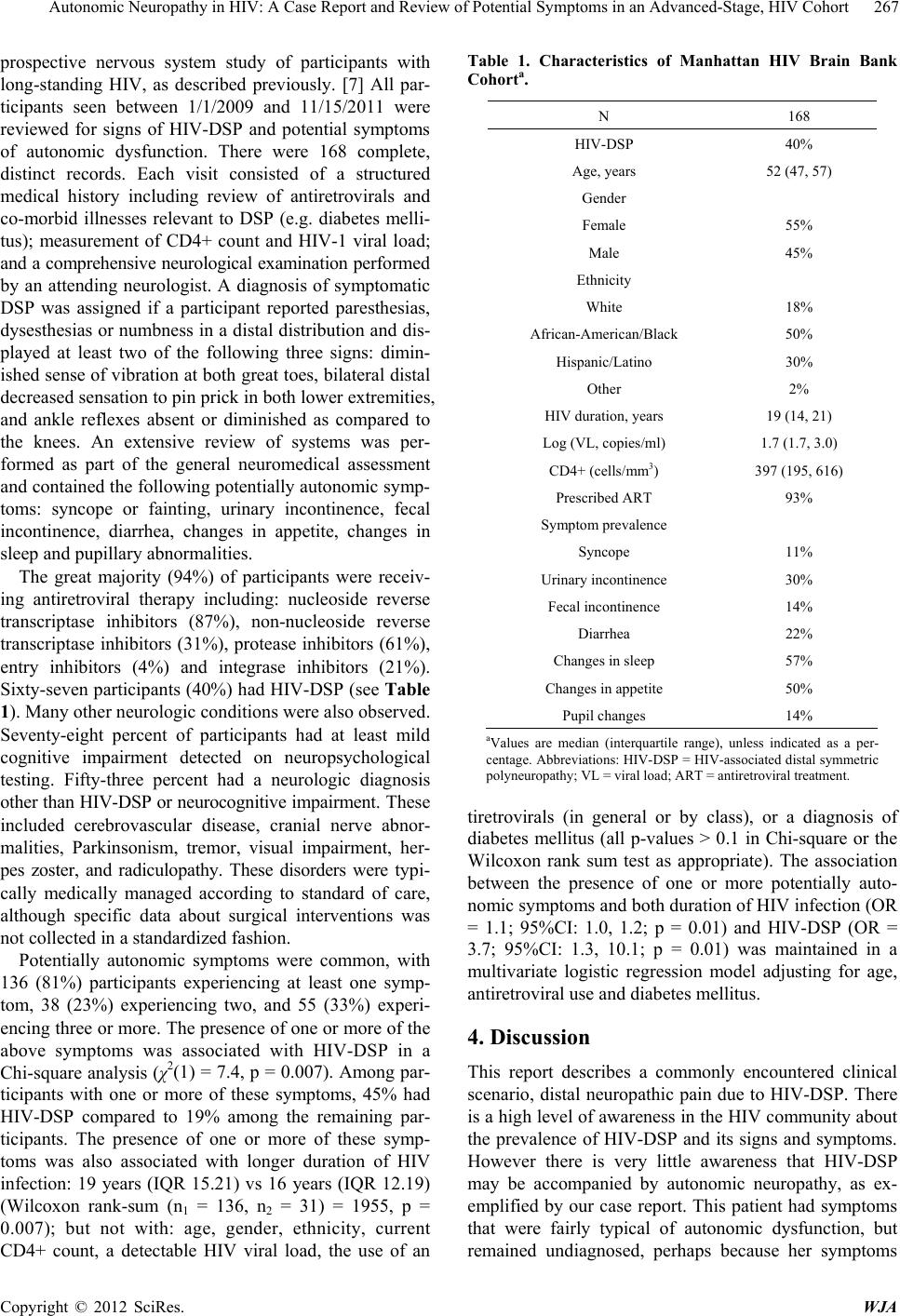 Autonomic Neuropathy in HIV: A Case Report and Review of Potential Symptoms in an Advanced-Stage, HIV Cohort 267 prospective nervous system study of participants with long-standing HIV, as described previously. [7] All par- ticipants seen between 1/1/2009 and 11/15/2011 were reviewed for signs of HIV-DSP and potential symptoms of autonomic dysfunction. There were 168 complete, distinct records. Each visit consisted of a structured medical history including review of antiretrovirals and co-morbid illnesses relevant to DSP (e.g. diabetes melli- tus); measurement of CD4+ count and HIV-1 viral load; and a comprehensive neurological examination perfor med by an attending neurologist. A diagnosis of symptomatic DSP was assigned if a participant reported paresthesias, dysesthesias or numbness in a distal distribution and dis- played at least two of the following three signs: dimin- ished sense of vibration at both gr eat toes, bilateral distal decreased sensation to pin prick in both lower extremities, and ankle reflexes absent or diminished as compared to the knees. An extensive review of systems was per- formed as part of the general neuromedical assessment and contained the following potentially autonomic symp- toms: syncope or fainting, urinary incontinence, fecal incontinence, diarrhea, changes in appetite, changes in sleep and pupillary abnormalities. The great majority (94%) of participants were receiv- ing antiretroviral therapy including: nucleoside reverse transcriptase inhibitors (87%), non-nucleoside reverse transcriptase inhibitors (31%), protease inhibitors (61%), entry inhibitors (4%) and integrase inhibitors (21%). Sixty-seven participants (40%) had HIV-DSP (see Table 1). Many other neurologic conditions were also observed. Seventy-eight percent of participants had at least mild cognitive impairment detected on neuropsychological testing. Fifty-three percent had a neurologic diagnosis other than HIV-DSP or neurocog nitive impairment. The se included cerebrovascular disease, cranial nerve abnor- malities, Parkinsonism, tremor, visual impairment, her- pes zoster, and radiculopathy. These disorders were typi- cally medically managed according to standard of care, although specific data about surgical interventions was not collected in a standardized fashion. Potentially autonomic symptoms were common, with 136 (81%) participants experiencing at least one symp- tom, 38 (23%) experiencing two, and 55 (33%) experi- encing three or more. The presence of one or more of the above symptoms was associated with HIV-DSP in a Chi-square analysis (χ2(1) = 7.4, p = 0.007). Among par- ticipants with one or more of these symptoms, 45% had HIV-DSP compared to 19% among the remaining par- ticipants. The presence of one or more of these symp- toms was also associated with longer duration of HIV infection: 19 years (IQR 15.21) vs 16 years (IQR 12.19) (Wilcoxon rank-sum (n1 = 136, n2 = 31) = 1955, p = 0.007); but not with: age, gender, ethnicity, current CD4+ count, a detectable HIV viral load, the use of an Table 1. Characteristics of Manhattan HIV Brain Bank Cohorta. N 168 HIV-DSP 40% Age, years 52 (47, 57) Gender Female 55% Male 45% Ethnicity White 18% African-American/Black 50% Hispanic/Latino 30% Other 2% HIV duration, years 19 (14, 21) Log (VL, copies/ml) 1.7 (1.7, 3.0) CD4+ (cells/mm3) 397 (195, 616) Prescribed ART 93% Symptom prevalence Syncope 11% Urinary incontinence 30% Fecal incontinence 14% Diarrhea 22% Changes in sleep 57% Changes in appetite 50% Pupil changes 14% aValues are median (interquartile range), unless indicated as a per- centage. Abb reviation s: HIV-DSP = HI V-associat ed distal symmetric polyneuropathy; VL = viral load; AR T = antiretroviral treatment. tiretrovirals (in general or by class), or a diagnosis of diabetes mellitus (all p-values > 0.1 in Chi-square or the Wilcoxon rank sum test as appropriate). The association between the presence of one or more potentially auto- nomic symptoms and both duration of HIV infection (OR = 1.1; 95%CI: 1.0, 1.2; p = 0.01) and HIV-DSP (OR = 3.7; 95%CI: 1.3, 10.1; p = 0.01) was maintained in a multivariate logistic regression model adjusting for age, antiretroviral use and diabetes mellitus. 4. Discussion This report describes a commonly encountered clinical scenario, distal neuropathic pain due to HIV-DSP. There is a high level of awareness in the HIV community about the prevalence of HIV-DSP and its signs and symptoms. However there is very little awareness that HIV-DSP may be accompanied by autonomic neuropathy, as ex- emplified by our case report. This patient had symptoms that were fairly typical of autonomic dysfunction, but remained undiagnosed, perhaps because her symptoms Copyright © 2012 SciRes. WJA  Autonomic Neuropathy in HIV: A Case Report and Review of Potential Symptoms in an Advanced-Stage, HIV Cohort 268 were relatively mild until exacerbated by medication. In her case, the development of painful HIV-DSP finally led to the diagnosis of her autonomic neuropathy. It is unknown what proportion of patients with HIV- DSP have autonomic neuropathy, although recent studies have documented an association between autonomic neuropathy and HIV [8-10] and studies from early in the HIV epidemic suggested that autonomic neuropathy was in fact quite common [11,12]. In our review of partici- pants in the MHBB, potentially autonomic symptoms were found far more frequently in participants with symptomatic HIV-DSP than those without. Without for- mal autonomic testing it is impossible to say whether or not these symptoms were truly due to autonomic neu- ropathy. However the symptoms were not associated with current disease severity as measured by CD4+ count and HIV-1 viral load, suggesting that they were not read- ily explained by HIV alone. Similarly, the lack of asso- ciation with antiretrovirals suggests that these symptoms cannot be explained by toxicity alone. Raising awareness about the symptoms of autonomic neuropathy is complicated by the diverse and non-spe- cific nature of autonomic symptoms, and the difficulty in proving that any g iven symptom is autonomic. The com- plexity of assessing autonomic symptoms is illustrated by the Autonomic Symptom Profile (ASP), the most exten- sively used measure of autonomic symptoms [6]. The ASP contains 169 items which query a wide variety of symptoms including: positional and situational dizziness and syncope; skin changes including color changes (due to vasomotor instability) and changes in sweat output; dry eyes and mouth; gastrointestinal symptoms such as nausea, vomiting or bloating (particularly after eating), diarrhea or constipation; urinary incontinence or hesi- tancy; sexual dysfunction; sensitivity to light or blurry vision (due to dysfunction of pupillary constriction); and sleep disturbance. Even patients with florid autonomic failure do not typically experience all of these sympto ms and patients with milder disease may have only one or two, which may make appreciation of an underlying autonomic disorder particularly challenging. In the case of our patient, autonomic neuropathy likely predated her HIV-DSP symptoms and could have ac- counted for the numerous side effects she experienced from antiretrovirals. This would have been important information for her care providers that might have altered their prescribing strategy and led to exposure to fewer antiretrovirals and greater attention to providing symp- tomatic relief. Further research is needed to determine the prevalence of autonomic neuropathy in HIV and its relationship to HIV-DSP. 5. Acknowledgements The authors thank the staff and participants of the Man- hattan HIV Brain Bank. Dr. Robinson-Papp receives funding from NINDS (K23NS066789) and Dr. Morgello receives funding from NIMH and NINDS (U01MH- 083501, R24MH59724). REFERENCES [1] R. J. Ellis, D. Rosario, D. B. Clifford, et al., “Continued High Prevalence and Adverse Clinical Impact of Human Immunodeficiency Virus-Associated Sensory Neuropathy in the Era of Combination Antiretroviral Therapy: The CHARTER Study,” Archives of Neurology, Vol. 67, No. 5, 2010, pp. 552-558. doi:10.1001/archneurol.2010.76 [2] J. Robinson-Papp, B. Gelman, I. Grant, E. Singer, G. Gensler and S. Morgello, “Substance Abuse Increases the Risk of Neuropathy in an HIV-Infected Cohort,” Muscle Nerve, Vol. 45, No. 4, 2012, pp. 471-476. doi:10.1002/mus.23231 [3] S. R. Evans, R. J. Ellis, H. Chen, et al., “Peripheral Neu- ropathy in HIV: Prevalence and Risk Factors,” AIDS, Vol. 25, No. 7, 2011, pp. 919-928. doi:10.1097/QAD.0b013e328345889d [4] M. Polydefkis, C. T. Yiannoutsos, B. A. Cohen, et al., “Reduced Intraepidermal Nerve Fiber Density in HIV- Associated Sensory Neuropathy,” Neurology, Vol. 58, No. 1, 2002, pp. 115-119. doi:10.1212/WNL.58.1.115 [5] P. A. Low, “Composite Autonomic Scoring Scale for Laboratory Quantification of Generalized Autonomic Failure,” Mayo Clinic Proceedings, Vol. 68, No. 8, 1993, pp. 748-752. [6] G. A. Suarez, T. L. Opfer-Gehrking, K. P. Offord, E. J. Atkinson, P. C. O’Brien and P. A. Low, “The Autonomic Symptom Profile: A New Instrument to Assess Auto- nomic Symptoms,” Neurology, Vol. 52, No. 3, 1999, pp. 523-528. doi:10.1212/WNL.52.3.523 [7] S. Morgello, L. Estanislao, D. Simpson, et al., “HIV- Associated Distal Sensory Polyneuropathy in the Era of Highly Active Antiretroviral Therapy: The Manhattan HIV Brain Bank,” Archives of Neurology, Vol. 61, No. 4, 2004, pp. 546-551. doi:10.1001/archneur.61.4.546 [8] C. Compostella, L. Compostella and R. D’Elia, “Cardio- vascular Autonomic Neuropathy in HIV-Positive African Patients,” Minerva Cardioangiologica, Vol. 56, No. 4, 2008, pp. 417-428. [9] D. C. Chow, R. Wood, J. Choi, et al., “Cardiovagal Auto- nomic Function in HIV-Infected Patients with Unsup- pressed HIV Viremia,” HIV Clinical Trials, Vol. 12, No. 3, 2011, pp. 141-150. doi:10.1310/hct1203-141 [10] G. Askgaard, U. S. Kristoffersen, J. Mehlsen, G. Kron- borg, A. Kjaer and A. M. Lebech, “Decreased Heart Rate Variability in HIV Positive Patients Receiving Antiretro- viral Therapy: Importance of Blood Glucose and Choles- terol,” PLoS One, Vol. 6, No. 5, 2011, Article ID: e20196. doi:10.1371/journal.pone.0020196 [11] R. Freeman, M. S. Roberts, L. S. Friedman and C. Broad- bridge, “Autonomic Function and Human Immunodefi- ciency Virus Infection,” Neurology, Vol. 40, No. 4, 1990, pp. 575-580. doi:10.1212/WNL.40.4.575 Copyright © 2012 SciRes. WJA  Autonomic Neuropathy in HIV: A Case Report and Review of Potential Symptoms in an Advanced-Stage, HIV Cohort Copyright © 2012 SciRes. WJA 269 [12] S. Ruttimann, P. Hilti, G. A. Spinas and U. C. Dubach, “High Frequency of Human Immunodeficiency Virus- Associated Autonomic Neuropathy and More Severe In- volvement in Advanced Stages of Human Immunodefi- ciency Virus Disease,” Archives of Internal Medicine, Vol. 151, No. 12, 1991, pp. 2441-2443. doi:10.1001/archinte.1991.00400120079013 |