

Paper Menu >>
Journal Menu >>
 World Journal of AIDS, 2012, 2, 259-264 doi:10.4236/wja.2012.23034 Published Online September 2012 (http://www.SciRP.org/journal/wja) 1 Highly Active Antiretroviral Treatment (HAART) for the Prevention of HIV Mother to Child Transmission (PMTCT) at Roosevelt Hospital’s Infectious Diseases Clinic in Guatemala: The Role of (LPV/r) Standard Dose Carlos Mejia Villatoro¹, Maria Eugenia Luarte1, Guillermo Villatoro Natareno1, Julio Werner Juárez1, Claudia Maria Rodríguez1, Aura Bertila Gonzalez1, Claudia Marleny Pérez1, Marisol Martinez2 1Infectious Diseases Unit, Roosevelt Hospital, Guatemala City, Guatemala; 2Medical Division, Abbott Laboratories, Chicago, USA. Email: [email protected] Received July 2nd, 2012; revised August 3rd, 2012; accepted August 10th, 2012 ABSTRACT Introduction: The transmission of HIV from mother to child is reported from 30% to 40% without any intervention [1]. When all the measures for prevention are implemented, in cluding treatment with HAART (Highly Active Antiretroviral Treatment), the rate of infection can be reduced between 1% and 2% [2]. In Guatemala, the statistics demonstrated an estimated of 20,000 women living with HIV virus infection during the period of 2009. In this scenario, mother to child HIV transmission is an important public health fact. In preliminary reports, there is strong evidence of the impact of preventing mother to child transmission with Lopinavir/Ritonavir in Guatemala is showing a small incidence of new HIV infections and good to lerance [3,4]. Objective: To evaluate the effect of HAART with Lopinavir/Ritonavir on the prevention of mother to child transmission (PMCT) in HIV-positive pregnant women at Roosevelt Hospital in Guate- mala City. Methods: A retrospective cohort analysis study. The detection of pregnant HIV positive women and the fol- low up period was from January 2003 to December 2009, and a total of 219 women completed the follow up time. The HIV diagnosis and follow up for the ch ild was made with molecular testi ng an d antibody testing up to 18 months of age or until testing was negative. Adherence was quantified by pill counts. The interventions where offered to all the women in the cohort. Results: Regarding the pregnancy outcome, the study cohort gave a rate of abortion of 2.3%; 10.6% of preterm births and 79.6% normal births. Of the 202/219 children born, there was a 1.4% rate of transmission (n = 3). The three infected children were born from mothers with high basal viral loads (50,000 C/mL or higher). There were no serious adverse events related to antiretroviral therapy with Lopinavir/Ritonavir, with a 6.1% of non serious adverse events, most of them of gastroin testinal type, and anemia. Conclusions: The rate of transmission of HIV from mother to child was low in this population (1.4%), comparable to findings from similar studies [4]. Lopinavir/Ritonavir was well tolerated in this cohort and no serious adverse events in this populatio n were reported. Keywords: HIV; Antiretroviral; Pregnancy; Lopinavir-Ritonavir 1. Introduction The prevalence of HIV/AIDS in Guatemala proves to be the estimated of 0.9% in 2011 in the general population [1]. From January 1984 to December 2010, the national Guatemala STDs/HIV/AIDS program reported 22,647 cases of HIV/AIDS, of whom 38% (n = 8553) were women. An important note is that 5% of the cases relate to children under the age of 4 years. Mother to child transmission (MTCT) represents 5.1% of the infections. In pregnant women the prevalence is between 0.4 and 0.5%; in urban areas the range varies between 0.26 and 1.40%, at the rural areas between 0.13% and 0.16% [4,5]. Prevention of mother to child transmission (PMTCT) programs have been implemented since 2002 in the na- tional hospitals in Guatemala, at that time also has been developing the first national guide for the management of pregnant HIV positive women. Starting in 2005, the ser- vices of PMTCT were expanded to cover also rural hos- pitals; specially in those areas where greater number of cases were reported, with the support of non-govern- mental organizations (NGOs), the Global AIDS Founda- tion UNICEF and other international organizations [6,7]. Highly active antiretroviral therapy (HAART) has been shown over the past decade to have a great impact in preventing MTCT in developed countries. The stan- Copyright © 2012 SciRes. WJA  Highly Active Antiretroviral Treatment (HAART) for the Prevention of HIV Mother to Child Transmission (PMTCT) at Roosevelt Hospital’s Infectious Diseases Clinic in Guatemala: The Role of (LPV/r) Standard Dose 260 dard of care to prevent mother to child transmission has changed over the years, from single dose nevirapine (NVP) to HAART. There are several specific evaluations of large numbers of pregnant patients who have been taken different HAART schemes, but there is still dis- cussion about potential side effects of some of the anti- retroviral drugs dur ing the pregnancy. The ver tical trans- mission of HIV in children whose mothers were exposed to various schemes of HAART has been reduced to less than 1% - 2% [2,8,9], when using all of the associated preventive measures that are considered effective ac- cording to current scientific evidence. These measures include: active detection of HIV infection in antenatal care and at the time of delivery, timely initiation of HAART during pregnancy and/or labor, emergency ce- sarean section (ECS, clear efficacy in patients with viral loads higher than 1000 copies/ml), prophylactic use of antiretrovirals in the exposed children and avoidance of breastfeeding when possible [8-10]. In this study, a cohort w ith more than 500 patients who received HAART during the years of 2003-2010, inclu- ding 219 pregnant women exposed to lopinavir/ritona- vir (LPV/rtv), The results allowed the Guatemalan inves- tigators to have a better understanding of the impact of this drug, both in pregnant women and in their children [9-11]. 2. Methods 2.1. Study Design Retrospective analysis of a Cohort of HIV positive pr eg- nant women, from January 2003 to January 2010. All pa- tients attended the Infectious Diseases Clinic from Roose- velt Hospital, located in Guatemala City, Guatemala. All pregnant women diagnosed with HIV infection from January 2003 to January 2010were included. The total number of LPV/rtv treated patients was 219. Inclusion criteria: Any patient who received antiret- roviral therapy during pregnancy by certain time, includ- ing combined HAART with LPV/rtv, standard dose, for at least 15 days prior to the resolution of the pregnancy. Exclusion criteria: Patients who after the diagnosis did not continue the follow up and in whom the devel- opment of the newborn was unknown and/or patients who did not re ceive HAART durin g pre gnancy. Data sources: All data was obtained from the clinical records from the patients, at the Infectious Disease Clinic, from Roosevelt Hospital, in a retrospective time. Phar- macy information was collected during each visit to de- termine the level of adherence, and adverse events data were obtained from the clinical records and a specific database used for recording pharmacy events. The evaluation of both acute and chronic adverse events was based on the classification of the US Division of Acquired Immunodeficiency Syndrome (DAIDS), at the National Institute of Allergy and Infectious Diseases (NIAD). All serious adverse events were reported within 24 hours of awareness, to Pharmacological vigilance au- thorities. The adherence was calculated by pill counts in each clinical visit by a pharmacist. The research protocol was approved by the Committee for Teaching and Research of the Roosevelt Hospital and the Hospital authorities. The writing consent, was not required given the retrospective nature of the study. All data were tabulated and analyzed taking into account patient confidentiality. Data Analysis: The data collected were analyzed ac- cording to the following scenarios that could have oc- curred during pregnancy: 1) initial diagnosis of HIV in pregnant women and initiation of antiretroviral therapy during this period; and 2) diagnosis of pregnancy in women who were already taking antiretroviral therapy. All the pharmaceutical related information, including tolerance, adherence rates, and incidence of adverse events was obtained from the records of the patients. All the data were tabulated and analyzed using descriptive statistics. For assessment of risks, the relative risk ratio (RR) was determined; and the chi square test was calcu- lated for categorical variables to assess statistical signifi- cance, with a 95% confidence. All analyses were done using the EpiInf o 3.5.1 software. Laboratory Testing: The serological diagnosis of the patients, adults and children, was made according to the national protocols from Guatemala. The CD4 cell count was determined using FACSCoun t, from Beckton Dickinson (San José, California). When available, viral load was determined using COBAS Am- pliprep/COBAS Taqman from Roche Molecular Diag- nostics (Alameda, Californi a) version 1.0. Definitions: Seroumreversion was considered in a child, born from an HIV positive mother, with a rapid test for HIV 12 positive, and with a follow up period of 9 to 18 months until the rapid test became negative. At this moment, a second test, in this case immune enzy- matic, was done to confirm the negative result. 3. Results Cohort Description: From January of 2003 to January of 2010, 219 HIV-positiv e preg nant women, were treated with LPV/rtv, of which 179/219 (81.7%) patients remain in the program with regular follow-ups, after the preg- nancy resolution, at the end of the year 2010. 3.7% (8/219) were already HIV patients in HAART at the moment of the pregnancy detection. All the other patients were newly HIV diagnosed with the screening test in antenatal care. The average age of the cohort was 26 years (range 16 - 43). Regarding educational status, 12.8% of the cohort reported to be illiterate; and 87% had Copyright © 2012 SciRes. WJA 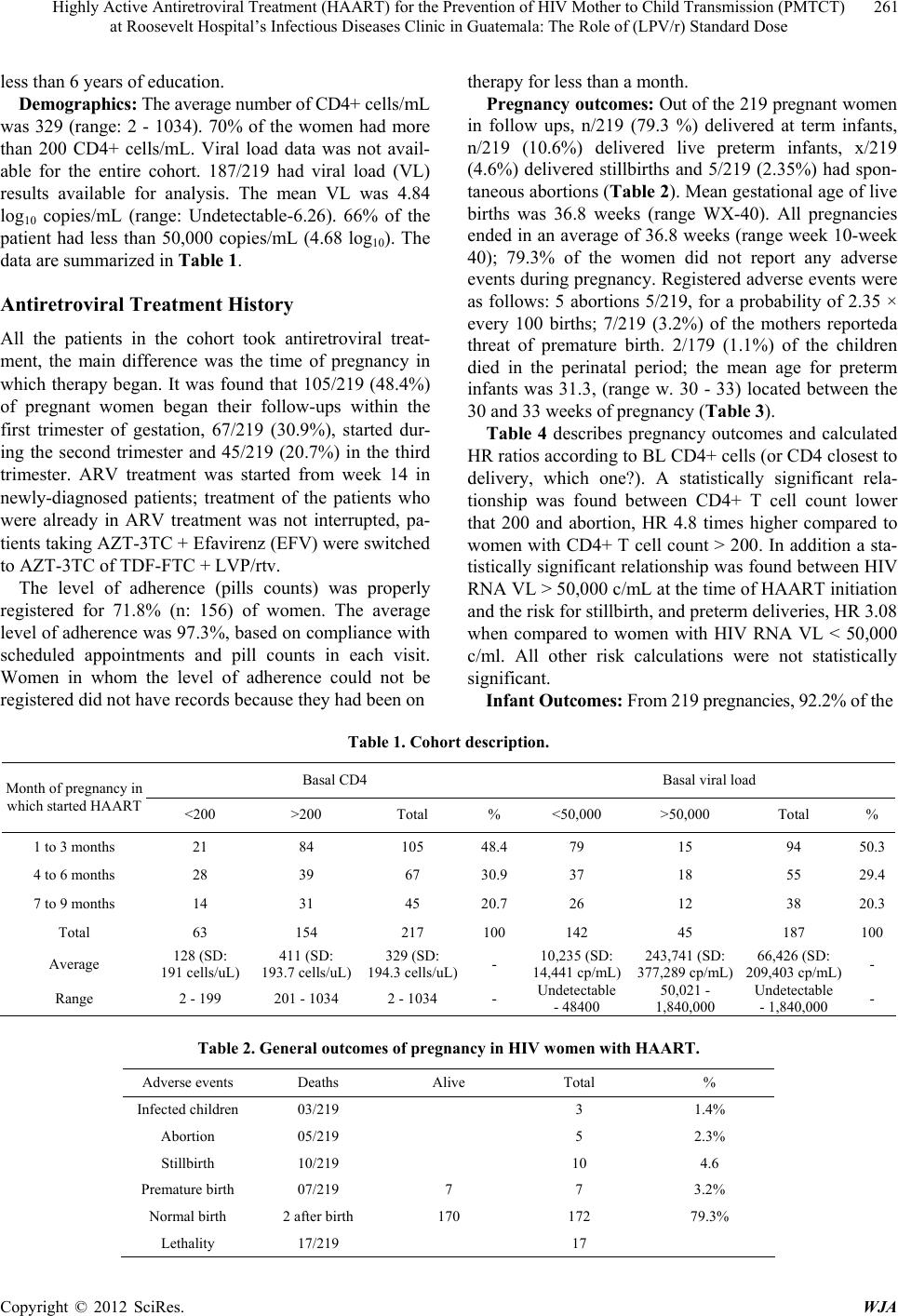 Highly Active Antiretroviral Treatment (HAART) for the Prevention of HIV Mother to Child Transmission (PMTCT) at Roosevelt Hospital’s Infectious Diseases Clinic in Guatemala: The Role of (LPV/r) Standard Dose Copyright © 2012 SciRes. WJA 261 less than 6 years of education. Demographics: The average number of CD4+ cells/mL was 329 (range: 2 - 1034). 70% of the women had more than 200 CD4+ cells/mL. Viral load data was not avail- able for the entire cohort. 187/219 had viral load (VL) results available for analysis. The mean VL was 4.84 log10 copies/mL (range: Undetectable-6.26). 66% of the patient had less than 50,000 copies/mL (4.68 log10). The data are summarized in Table 1. Antiretroviral Treatment History All the patients in the cohort took antiretroviral treat- ment, the main difference was the time of pregnancy in which therapy began. It was found that 105/219 (48.4%) of pregnant women began their follow-ups within the first trimester of gestation, 67/219 (30.9%), started dur- ing the second trimester and 45/219 (20.7%) in the third trimester. ARV treatment was started from week 14 in newly-diagnosed patients; treatment of the patients who were already in ARV treatment was not interrupted, pa- tients taking AZT-3TC + Efavirenz (EFV) were switched to AZT-3TC of TDF-FTC + LVP/rtv. The level of adherence (pills counts) was properly registered for 71.8% (n: 156) of women. The average level of adherence was 97.3%, based on compliance with scheduled appointments and pill counts in each visit. Women in whom the level of adherence could not be registered did not have records because the y had bee n o n therapy for less than a month. Pregnancy outcomes: Out of the 219 pregnant wome n in follow ups, n/219 (79.3 %) delivered at term infants, n/219 (10.6%) delivered live preterm infants, x/219 (4.6%) delivered stillbirths and 5/219 (2.35%) had spon- taneous abortions (Table 2). Mean gestational ag e of live births was 36.8 weeks (range WX-40). All pregnancies ended in an average of 36.8 weeks (range week 10-week 40); 79.3% of the women did not report any adverse events during pregnancy. Registered adverse events were as follows: 5 abortions 5/219, for a probability of 2.35 × every 100 births; 7/219 (3.2%) of the mothers reporteda threat of premature birth. 2/179 (1.1%) of the children died in the perinatal period; the mean age for preterm infants was 31.3, (range w. 30 - 33) located between the 30 and 33 weeks of pregnancy (Table 3). Table 4 describes pregnancy outcomes and calculated HR ratios according to BL CD4+ cells (or CD4 closest to delivery, which one?). A statistically significant rela- tionship was found between CD4+ T cell count lower that 200 and abortion, HR 4.8 times higher compared to women with CD4+ T cell count > 200. In addition a sta- tistically significant relationship was found between HIV RNA VL > 50,000 c/mL at the time of HAART initiation and the risk for stillbirth, and pr eterm deliveries, HR 3.08 when compared to women with HIV RNA VL < 50,000 c/ml. All other risk calculations were not statistically significant. Infant Outcomes: From 219 pregnancies, 92.2% of the Table 1. Cohort description. Basal CD4 Basal viral load Month of pregnancy in which started HAART <200 >200 Total % <50,000 >50,000 Total % 1 to 3 months 21 84 105 48.4 79 15 94 50.3 4 to 6 months 28 39 67 30.9 37 18 55 29.4 7 to 9 months 14 31 45 20.7 26 12 38 20.3 Total 63 154 217 100 142 45 187 100 Average 128 (SD: 191 cells/uL) 411 (SD: 193.7 cells/uL) 329 (SD: 194.3 cells/uL)- 10,235 (SD: 14,441 cp/mL)243,741 (SD: 377,289 cp/mL) 66,426 (SD: 209,403 cp/mL)- Range 2 - 199 201 - 1034 2 - 1034 - Undetectable - 48400 50,021 - 1,840,000 Undetectable - 1,840,000 - Table 2. General outcomes of pregnancy in HIV women with HAART. Adverse events Deaths Alive Total % Infected children 03/219 3 1.4% Abortion 05/219 5 2.3% Stillbirth 10/219 10 4.6 Premature birth 07/219 7 7 3.2% Normal birth 2 after birth 170 172 79.3% Lethality 17/219 17 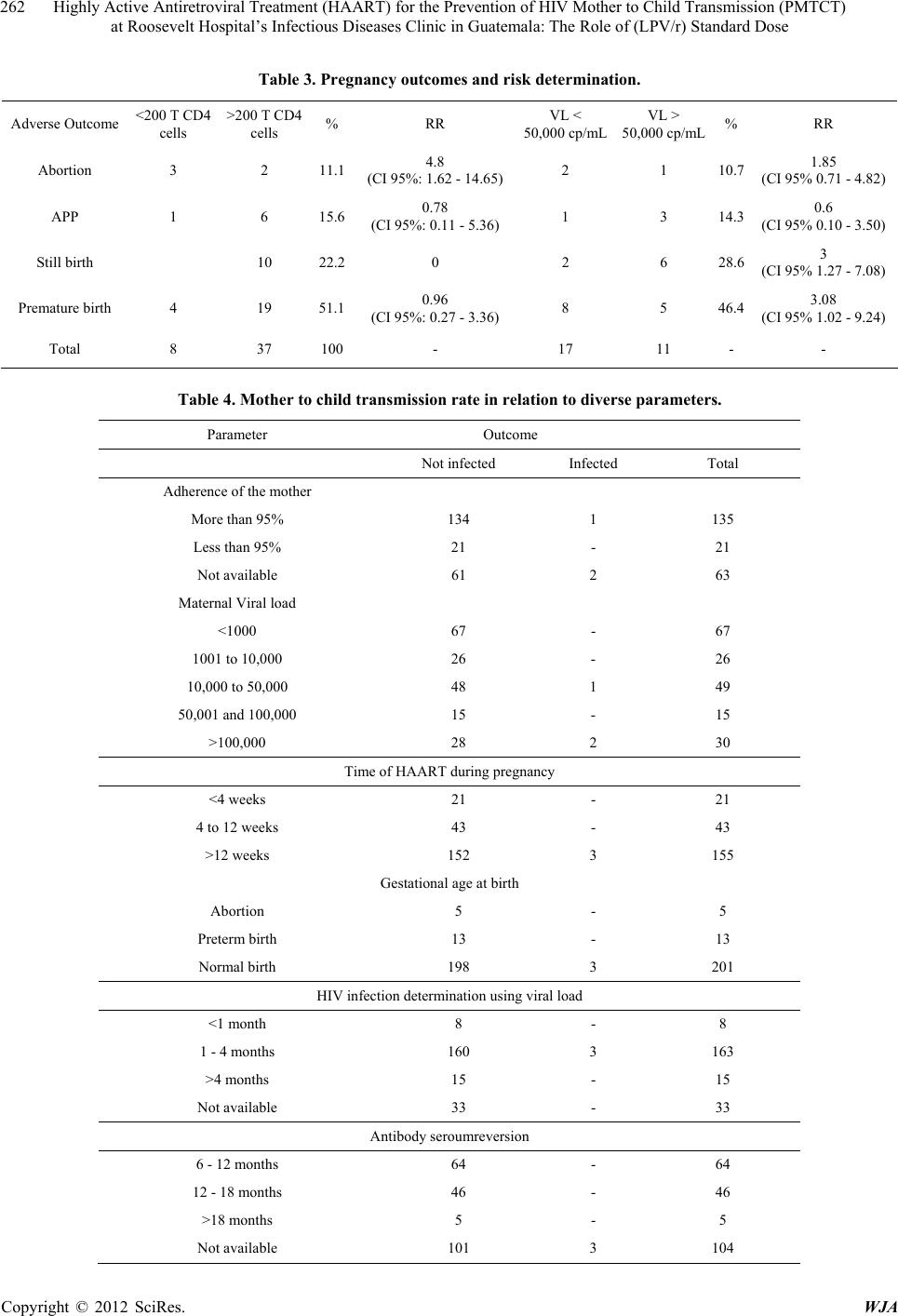 Highly Active Antiretroviral Treatment (HAART) for the Prevention of HIV Mother to Child Transmission (PMTCT) at Roosevelt Hospital’s Infectious Diseases Clinic in Guatemala: The Role of (LPV/r) Standard Dose 262 Table 3. Pregnancy outcomes and r i sk determination. Adverse Outcome <200 T CD4 cells >200 T CD4 cells % RR VL < 50,000 cp/mLVL > 50,000 cp/mL % RR Abortion 3 2 11.1 4.8 (CI 95%: 1.62 - 14.65)2 1 10.7 1.85 (CI 95% 0.71 - 4.82) APP 1 6 15.6 0.78 (CI 95%: 0.11 - 5.36 ) 1 3 14.3 0.6 (CI 95% 0.10 - 3.50) Still birth 10 22.2 0 2 6 28.6 3 (CI 95% 1.27 - 7.08) Premature bi rth 4 19 51.1 0.96 (CI 95%: 0.27 - 3.36 ) 8 5 46.4 3.08 (CI 95% 1.02 - 9.24) Total 8 37 100 - 17 11 - - Table 4. Mother to child transmission rate in relation to diverse parameters. Parameter Outcome Not infected Infected Total Adherence of the mother More than 95% 134 1 135 Less than 95% 21 - 21 Not available 61 2 63 Maternal Viral load <1000 67 - 67 1001 to 10,000 26 - 26 10,000 to 50,000 48 1 49 50,001 and 100,000 15 - 15 >100,000 28 2 30 Time of HAART during pregnancy <4 weeks 21 - 21 4 to 12 weeks 43 - 43 >12 weeks 152 3 155 Gestational age at birth Abortion 5 - 5 Preterm birth 13 - 13 Normal birth 198 3 201 HIV infection determination using viral load <1 month 8 - 8 1 - 4 months 160 3 163 >4 months 15 - 15 Not available 33 - 33 Antibody seroumreversion 6 - 12 months 64 - 64 12 - 18 months 46 - 46 >18 months 5 - 5 Not available 101 3 104 Copyright © 2012 SciRes. WJA 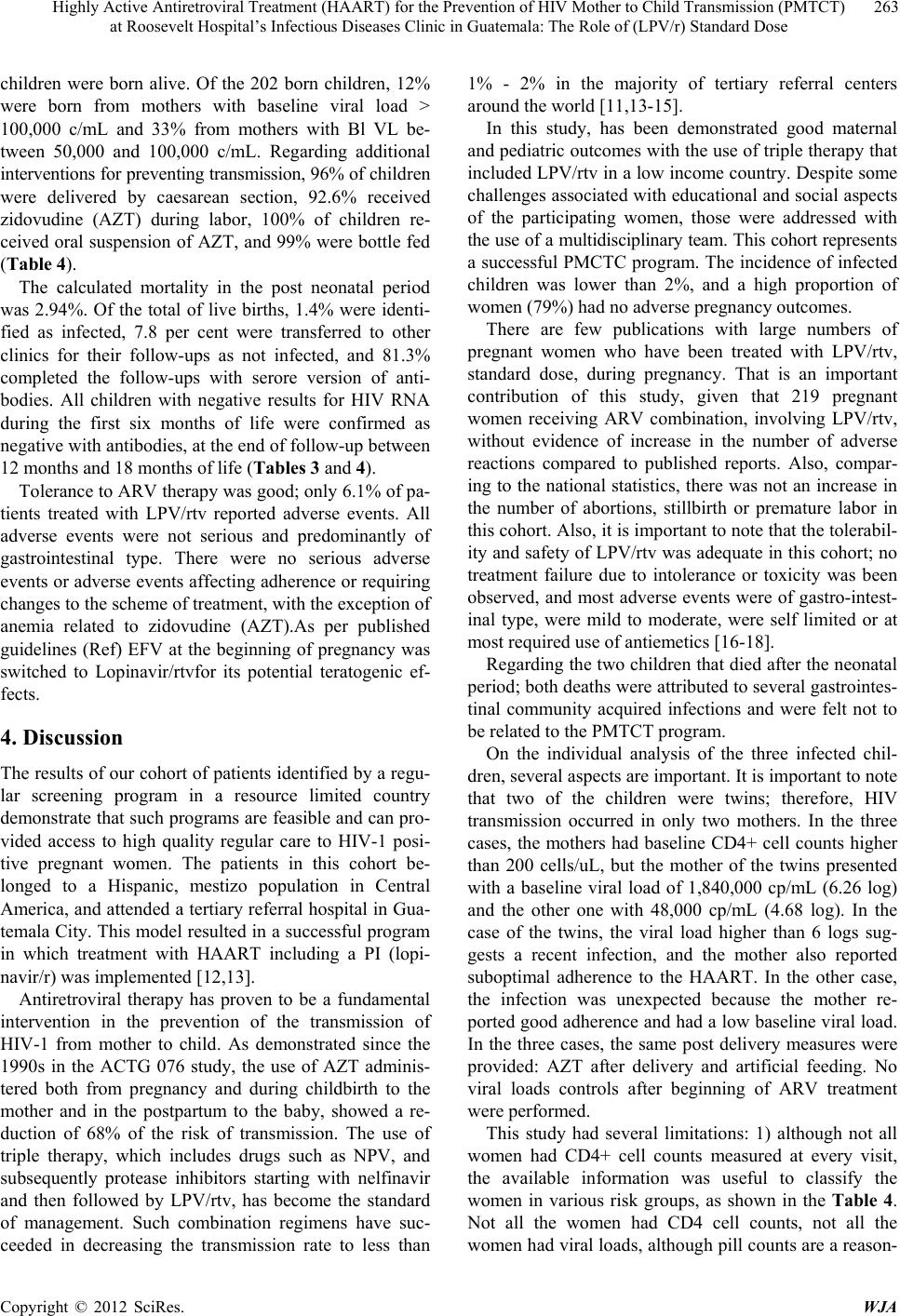 Highly Active Antiretroviral Treatment (HAART) for the Prevention of HIV Mother to Child Transmission (PMTCT) at Roosevelt Hospital’s Infectious Diseases Clinic in Guatemala: The Role of (LPV/r) Standard Dose Copyright © 2012 SciRes. WJA 263 children were born alive. Of the 202 born children, 12% were born from mothers with baseline viral load > 100,000 c/mL and 33% from mothers with Bl VL be- tween 50,000 and 100,000 c/mL. Regarding additional interventions for preventing transmission, 96% of chil dr en were delivered by caesarean section, 92.6% received zidovudine (AZT) during labor, 100% of children re- ceived oral suspension of AZT, and 99% were bottle fed (Table 4). The calculated mortality in the post neonatal period was 2.94%. Of the total of live births, 1.4% were identi- fied as infected, 7.8 per cent were transferred to other clinics for their follow-ups as not infected, and 81.3% completed the follow-ups with serore version of anti- bodies. All children with negative results for HIV RNA during the first six months of life were confirmed as negative with antib odies, at the end of fo llow-up between 12 months and 18 months of life (Tables 3 and 4). Tolerance to ARV therapy was good; only 6.1% of pa- tients treated with LPV/rtv reported adverse events. All adverse events were not serious and predominantly of gastrointestinal type. There were no serious adverse events or adverse events affecting adherence or requiring changes to the scheme of treatment, with the exception of anemia related to zidovudine (AZT).As per published guidelines (Ref) EFV at the beginning of pregnancy was switched to Lopinavir/rtvfor its potential teratogenic ef- fects. 4. Discussion The results of our cohort of patients identified by a regu- lar screening program in a resource limited country demonstrate that such programs are feasible and can pro- vided access to high quality regular care to HIV-1 posi- tive pregnant women. The patients in this cohort be- longed to a Hispanic, mestizo population in Central America, and attended a tertiary referral hospital in Gua- temala City. This model resulted in a successfu l program in which treatment with HAART including a PI (lopi- navir/r) was implemented [12,13]. Antiretroviral therapy has proven to be a fundamental intervention in the prevention of the transmission of HIV-1 from mother to child. As demonstrated since the 1990s in the ACTG 076 study, the use of AZT adminis- tered both from pregnancy and during childbirth to the mother and in the postpartum to the baby, showed a re- duction of 68% of the risk of transmission. The use of triple therapy, which includes drugs such as NPV, and subsequently protease inhibitors starting with nelfinavir and then followed by LPV/rtv, has become the standard of management. Such combination regimens have suc- ceeded in decreasing the transmission rate to less than 1% - 2% in the majority of tertiary referral centers around the world [11,13-15]. In this study, has been demonstrated good maternal and pediatric outcomes with the use of triple therapy that included LPV/rtv in a low income country. Despite some challenges associated with educational and social aspects of the participating women, those were addressed with the use of a multidisciplinary team. This cohort represents a successful PMCTC program. The incidence of infected children was lower than 2%, and a high proportion of women (79%) had no adverse pregnancy outcomes. There are few publications with large numbers of pregnant women who have been treated with LPV/rtv, standard dose, during pregnancy. That is an important contribution of this study, given that 219 pregnant women receiving ARV combination, involving LPV/rtv, without evidence of increase in the number of adverse reactions compared to published reports. Also, compar- ing to the national statistics, there was not an increase in the number of abortions, stillbirth or premature labor in this cohort. Also, it is important to note th at the tolerabil- ity and safety of LPV/rtv was adequate in this cohort; no treatment failure due to intolerance or toxicity was been observed, and most adverse events were of gastro-intest- inal type, were mild to moderate, were self limited or at most required use of antiemetics [16-18]. Regarding the two children that died after the n eonatal period; both deaths were attributed to several gastrointes- tinal community acquired infections and were felt not to be related to the PMTCT program. On the individual analysis of the three infected chil- dren, several aspects are important. It is importan t to note that two of the children were twins; therefore, HIV transmission occurred in only two mothers. In the three cases, the mothers had baseline CD4+ cell counts higher than 200 cells/uL, but the mother of the twins presented with a baseline viral load of 1,840,000 cp/mL (6.26 log) and the other one with 48,000 cp/mL (4.68 log). In the case of the twins, the viral load higher than 6 logs sug- gests a recent infection, and the mother also reported suboptimal adherence to the HAART. In the other case, the infection was unexpected because the mother re- ported good adherence and had a low baseline viral load. In the three cases, the same post delivery measures were provided: AZT after delivery and artificial feeding. No viral loads controls after beginning of ARV treatment were performed. This study had several limitations: 1) although not all women had CD4+ cell counts measured at every visit, the available information was useful to classify the women in various risk groups, as shown in the Table 4. Not all the women had CD4 cell counts, not all the women had viral loads, although p ill counts are a reason-  Highly Active Antiretroviral Treatment (HAART) for the Prevention of HIV Mother to Child Transmission (PMTCT) at Roosevelt Hospital’s Infectious Diseases Clinic in Guatemala: The Role of (LPV/r) Standard Dose 264 able measure of adherence, no other adeherence meas- ures were used, and there was no control arm. This is an important perspective for a low income country; it shows that triple combination therapy with a PI is feasible and better than alternative interventions such as single dose nevirapine, that can led to higher lev- els of infections and antiretroviral resistance. The favor- able maternal and pediatric outcomes and the positive safety and tolerability of the regimens reported in this cohort in this setting should be replicated by other groups. REFERENCES [1] World Health Organization, “WHO HIV and Infant Feeding Technical Consultation Consensus Statement Held on Behalf of the Inter-Agency Task Team (IATT) on Prevention of HIV Infections in Pregnant Women, Mothers and their Infants,” WHO, 2006. http://www.who.int/hiv/mediacentre/Infantfeedingconsen susstatement.pf.pdf [2] A. P. Kourtis, C. H. Schmid, D. J. Jamieson, et al., “Use of Antiretroviral Therapy in HIV-Infected Pregnant Women and the Risk of Premature Delivery: A Meta- Analysis,” AIDS, Vol. 21, No. 13, 2007, pp. 1831-1832. doi:10.1097/QAD.0b013e3282748e97 [3] P. Brocklehurst and J. Volmink, “Antiretrovirals for Re- ducing the Risk of Mother-to Child Transmission of HIV Infection,” C ochrane Data base of Systematic R ev i e ws , Vol. 2, 2007, Article ID: CD003510. [4] Centro Nacional de Epidemiología, “Estadísticas VIH y VIH Avanzado Guatemala enero 1984 —Diciembre 2010,” Guatemala City, 2011. [5] Estadísticas de Clínica de Enfermedades Infecciosas, “Hospital Roosevelt. Memoria de Labores, año 2009,” Guatemala City, 2009. www.infecciosashr.org [6] World Health Organization, “Antiretroviral Drugs for Treating Pregnant Women and Preventing HIV Infection in Infants: Guidelines on Care, Treatment and Support for Women Living with HIV/AIDS and Their Children in Resource-Constrained Settings,” World Health Organiza- tion, Geneva, 2012. [7] United Nations Joint Programme on HIV/AIDS-UN- AIDS-2009, “AIDS Epidemic Update NAIDS,” 2009. http://www.unaids.org/en/media/unaids/contentassets/dat aimport/pub/report/2009/jc1700_epi_update_2009_en.pdf [8] C. Mejia, N. Urbizo and V. Gularte, “Lopinavir-Ritonavir Use in HAART for Pregnant Women in Guatemala, a Useful and Well Tolerated Option in the PMTC of HIV: Preliminary Report,” 12th International Congress on In- fectious Diseases, Lisbon, 15-18 June 2006. [9] K. M. De Cock, M. G. Fowler, E. Mercier, et al., “Pre- vention of Mother-to-Child HIV Transmission in Re- source-Poor Countries: Translating Research into Policy and Practice,” JAMA, Vol. 283, No. 9, 2000, pp. 1175- 1182. doi:10.1001/jama.283.9.1175 [10] Grupo de Estudio de SIDA, “Recomendaciones de la SPNS/GESIDA/SEGO/AEP Para el Seguimiento de la Infección por el VIH con Relación a la Reproducción, el Embarazo y la Prevención de la Transmisión Vertical,” Madrid, 2007. [11] R. E. Tuomala and S. Yawetz, “Protease Inhibitor Use during Pregnancy: Is There an Obstetrical Risk?” Journal of Infectious Diseases, Vol. 193, No. 9, 2006, pp. 1191- 1201. doi:10.1086/503049 [12] C. Mejia, J. Romero, D. Rodriguez, et al., “HAART un- der Restricted Circumstances in the Capital of Guate- mala, ” The 3rd IAS Conference on HIV Pathogenesis and Treatment, Rio de Janeiro, 24-27 July 2005. [13] E. R. Cooper, M. Charurat, L. Mofenson, et al., “Combi- nation Antiretroviral Strategies for the Treatment of Pre- gnant HIV-1-Infected Women and Prevention of Perinatal HIV-1 Transmission,” Journal of Acquired Immune Defi- ciency Syndromes, Vol. 29, No. 5, 2002, pp. 484-494. [14] J. S. Read and M. K. Newell, “Efficacy and Safety of Cesarean Delivery for Prevention of Mother-to-Child Transmission of HIV-1,” Cochrane Database of System- atic Reviews, Vol. 4, 2005, Article ID: CD005479. [15] T. Horvath, B. C. Madi, I. M. Iuppa, et al., “Interventions for Preventing Late Postnatal Mother-to-Child Transmis- sion of HIV,” Cochrane Database of Systematic Reviews, Vol. 1, 2009, Article ID: CD006734. doi:10.1002/14651858.CD006734.pub2 [16] R. E. Tuomala, D. E. Shapiro, L. M. Mofenson, et al., “Antiretroviral Therapy during Pregnancy and the Risk of an Adverse Outcome,” New England Journal of Medicine, Vol. 346, No. 24, 2002, pp. 1863-1870. doi:10.1056/NEJMoa991159 [17] A. P. Kourtis, C. H. Schmid, D. Jamieson, et al ., “Use of Antiretroviral Therapy in HIV-Infected Pregnant Women and the Risk of Premature Delivery: A Meta-Analysis,” AIDS, Vol. 21, No. 5, 2007, pp. 607-615. doi:10.1097/QAD.0b013e32802ef2f6 [18] C. Perez, A. Galician, E. Luarte and C. Mejia, “Obstetric Complications and Vertical Transmission in Pregnancy in Women Who Are HIV Positive, at the Roosevelt Hospital in 2010,” Gazeta Panamericana de Infectología, Vol. 2, No. 1, 2012, pp. 43-50. Copyright © 2012 SciRes. WJA |