

Paper Menu >>
Journal Menu >>
 Vol.2, No.7, 705-707 (2010) doi:10.4236/health.2010.27107 Copyright © 2010 SciRes. Openly accessible at http://www.scirp.org/journal/HEALTH/ Health Pharmacotherapeutic aspects of treating knee osteoarthritis with glucosamine sulfate Steven Simoens*, Gert Laekeman Research Cent re for Pharma ceut ic al Ca re an d Phar maco-ec onomic s, Katholie ke Univ er sitei t Leu ven , Onde rwij s en Navo rsi ng, Leuven, Belgium; *Corresponding Author: [email protected] Received 5 February 2010; revised 11 March 2010; accepted 15 March 2010. ABSTRACT Glucosamine sulfate is a natural constituent of cartilage and is used in the treatment of knee osteoarthritis. The aim of this study is to pro- vide a short but comprehensive pharmaco- therapeutic update on treating knee osteoarthri- tis with glucosamine sulfate. A literature search was conducted of PubMed, Centre for Reviews and Dissemination databases, Cochrane Re- views and EconLit up to January 2010. The lit- erature review indicated that the mechanism of action of glucosamine sulfate is based on hy- pothesis, but its treatment effects in knee os- teoarthritis are symptomatic. With steady-state peak concentrations at the 1,500 mg dosage in the range of 10 µM, it is estimated that only 2% of glucosamine is incorporated in the cartilage. A once-daily dosage of 1,500 mg of glucosa- mine sulfate is licensed for the treatment of symptomatic osteoart hritis and has been shown to reduce pain, improve function and exhibit similar safety to placebo. Glucosamine sulfate is likely to be a cost-effective treatment of knee osteoarthritis. In conclusion, a once-daily dos- age of 1,500 mg of glucosamine sulfate is likely to be a safe, effective and cost-effective treat- ment of knee osteoarthritis as compared to placebo. Keywords: Pharmacotherapy; Glucosamine Sulfate, Knee Osteoarthritis; Pharmacokinetics; Indication; Safety; Effectiveness; Cost-Effectiveness 1. INTRODUCTION Knee osteoarthritis is associated with significant mor- bidity, impaired quality of life, and sub stantial health care costs [1]. Pharmacological treatment of knee osteoarthri- tis includes analgesics, non-steroidal anti-inflammatory drugs (NSAIDs), corticosteroids and opiods, and gluco- samine sulfate. Glucosamine sulfate is a natural subs- tance that is a constituent of cartilage. Glucosamine sul- fate is sold as a dietary supplement in the United States, but is registered as a medicine throughout much of Europe. To date, there is uncertainty over various pharmaco- therapeutic aspects of treating knee osteoarthritis with glucosamine sulfate. Therefore, the aim of this study is to provide a short but comprehensive pharmacothera- peutic update on treating knee osteoarthritis with gluco- samine sulfate. 2. METHOD 2.1. Search Strategy A literature search was conducted of PubMed, Centre for Reviews and Dissemination databases, Cochrane Data- base of Systematic Reviews and EconLit up to January 2010. Additionally, the bibliography of included studies was checked for other relevant studies. Search terms included “knee osteoarthritis”, “knee joint”, “glucosa- mine sulfate”, “pharmacokinetics”, “bioavailability”, “in- dications”, “dosage”, “safety”, “effectiveness”, “cost- effectiveness”, “economic evaluation” alone and in com- bination wi t h each ot her. The literature search included articles published in peer-reviewed journals and congress abstracts. Also, the researchers contacted manufacturers of glucosamine sulfate for any unpublished studies. The review was lim- ited to studies published in English for practical reasons. 2.2. Inclusion and Exclusion Criteria The review was limited to the use of glucosamine sulfate in its indication of knee osteoarthritis. To explore the pharmacotherapy of glucosamine sul- fate from a multidisciplinary perspective, the literature review assessed the following aspects: pharmacokinetics, 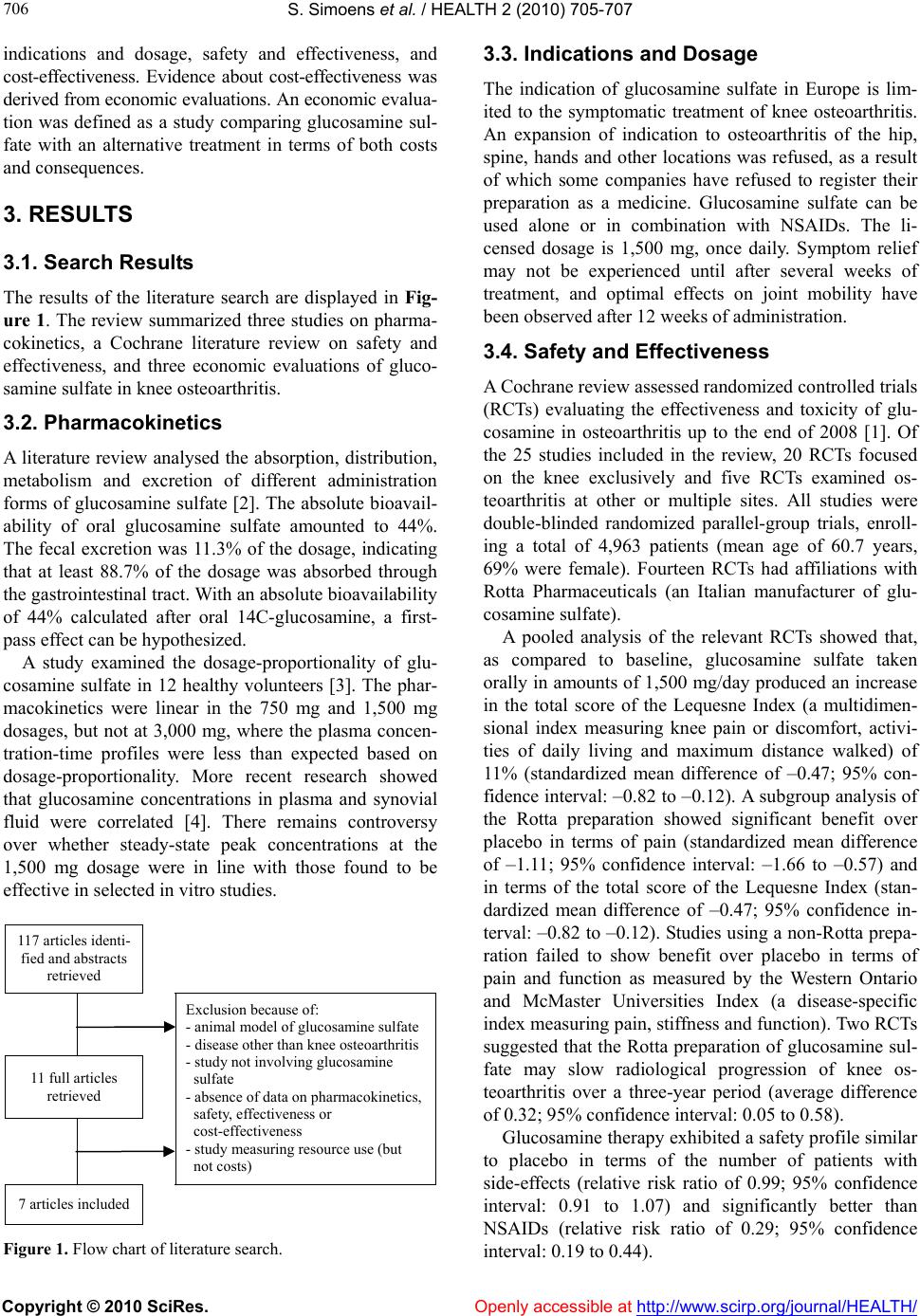 S. Simoens et al. / HEALTH 2 (2010) 705-707 Copyright © 2010 SciRes. Openly accessible at http://www.scirp.org/journal/HEALTH/ 706 indications and dosage, safety and effectiveness, and cost-effectiveness. Evidence about cost-effectiveness was derived from economic evaluations. An economic ev alu a - tion was defined as a study comparing glucosamine sul- fate with an alternative treatment in terms of both costs and consequences. 3. RESULTS 3.1. Search Results The results of the literature search are displayed in Fig- ure 1. The review summarized three studies on pharma- cokinetics, a Cochrane literature review on safety and effectiveness, and three economic evaluations of gluco- samine sulfate in knee osteoarthritis. 3.2. Pharmacokinetics A literature review analysed the absorption, distribution, metabolism and excretion of different administration forms of glucosamine sulfate [2]. The absolute bioavail- ability of oral glucosamine sulfate amounted to 44%. The fecal excretion was 11.3% of the dosage, indicating that at least 88.7% of the dosage was absorbed through the gastrointestinal tract. With an absolute bioavailability of 44% calculated after oral 14C-glucosamine, a first- pass effect can be hypothe sized. A study examined the dosage-proportionality of glu- cosamine sulfate in 12 healthy volunteers [3]. The phar- macokinetics were linear in the 750 mg and 1,500 mg dosages, but not at 3,000 mg, where the plasma concen- tration-time profiles were less than expected based on dosage-proportionality. More recent research showed that glucosamine concentrations in plasma and synovial fluid were correlated [4]. There remains controversy over whether steady-state peak concentrations at the 1,500 mg dosage were in line with those found to be effective in selected in vitro studies. 117 articles identi- fied and abstracts retrieved 11 full articles retrieved Exclusion because of: - animal model of glucosamine sulfate - disease other than knee osteoarthritis - study not involving glucosamine sulfate - absence of data on pharmacokinetics, safety, effectiveness or cost-effectiveness - study measuring resource use (but not costs) 7 articles included Figure 1. Flow chart of literature search. 3.3. Indications and Dosage The indication of glucosamine sulfate in Europe is lim- ited to the symptomatic treatment of knee osteoarthritis. An expansion of indication to osteoarthritis of the hip, spine, hands and other locations was refused, as a result of which some companies have refused to register their preparation as a medicine. Glucosamine sulfate can be used alone or in combination with NSAIDs. The li- censed dosage is 1,500 mg, once daily. Symptom relief may not be experienced until after several weeks of treatment, and optimal effects on joint mobility have been observed aft e r 12 wee ks of administrat ion . 3.4. Safety and Effectiveness A Cochrane review assessed randomized controlled trials (RCTs) evaluating the effectiveness and toxicity of glu- cosamine in osteoarthritis up to the end of 2008 [1]. Of the 25 studies included in the review, 20 RCTs focused on the knee exclusively and five RCTs examined os- teoarthritis at other or multiple sites. All studies were double-blinded randomized parallel-group trials, enroll- ing a total of 4,963 patients (mean age of 60.7 years, 69% were female). Fourteen RCTs had affiliations with Rotta Pharmaceuticals (an Italian manufacturer of glu- cosamine sulfate). A pooled analysis of the relevant RCTs showed that, as compared to baseline, glucosamine sulfate taken orally in amounts of 1,500 mg/day produced an increase in the total score of the Lequesne Index (a multidimen- sional index measuring knee pain or discomfort, activi- ties of daily living and maximum distance walked) of 11% (standardized mean difference of –0.47; 95% con- fidence interval: –0.82 to –0.12). A subgroup analysis of the Rotta preparation showed significant benefit over placebo in terms of pain (standardized mean difference of –1.11; 95% confidence interval: –1.66 to –0.57) and in terms of the total score of the Lequesne Index (stan- dardized mean difference of –0.47; 95% confidence in- terval: –0.82 to –0.12). Studies using a non-Rotta prep a- ration failed to show benefit over placebo in terms of pain and function as measured by the Western Ontario and McMaster Universities Index (a disease-specific index measuring pain, stiffness and function). Two RCTs suggested that the Rotta preparation of glucosamine sul- fate may slow radiological progression of knee os- teoarthritis over a three-year period (average difference of 0.32; 95% confiden ce interval: 0.05 to 0.58). Glucosamine therapy exhibited a safety profile similar to placebo in terms of the number of patients with side-effects (relative risk ratio of 0.99; 95% confidence interval: 0.91 to 1.07) and significantly better than NSAIDs (relative risk ratio of 0.29; 95% confidence interval: 0.19 to 0.44).  S. Simoens et al. / HEALTH 2 (2010) 705-707 Copyright © 2010 SciRes. http://www.scirp.org/journal/HEALTH/ 707 707 3.5. Cost-Effectiveness A Belgian economic evaluation indicated that treatment of knee osteoarthritis with glucosamine sulfate for at least one year and up to three years was associated with a lower incidence of total knee replacement over an ob- servation period of eight years [5]. Costs of glucosamine sulfate treatment were offset by lower hospitalization costs, resulting in overall savings. To tal costs per patient amounted to € 1,103 in the placebo group and € 901 in the glucosamine sulfate group. In other words, treatment of knee osteoarthritis with glucosamine sulfate for up to three years is associated with savings of € 202 per pa- tient during the over all observation period of eight years (i.e. up to three years of treatment and five years of fol- low-up). This study indicated that glucosamine sulfate treatment was more effective and less expensive than placebo in knee osteoarthritis. If costs of other os- teoarthritis medicines and other health care resource use are taken into account, the cost-effectiveness of gluco- samine sulfate would even be more favourable. Openly accessible at The National Institute for Health and Clinical Excel- lence in England and Wales compared the likely cost- effectiveness of selected treatments for knee osteoarthri- tis [6]. This study did not provide a full economic evaluation, but presented UK healthcare costs alongside the effectiveness of each treatment option. The scope of costs was limited to treatment costs (such as medicine costs), but did not include other healthcare costs such as adverse event costs or decreased use of other medical resources. The results suggested that glucosamine sulfate (1,500 mg/day) is likely to be cost-effective as compared with placebo. A recent US analysis explored the cost-effectiveness of glucosamine sulfate treatment versus placebo in a hypothetical cohort of 100,000 patients who were 65 years old and had knee osteoarthritis for five years [7]. A hybrid Markov-decision tree model was constructed us- ing published effectiveness data and US fee schedules. Treatment with a daily dosage of 1,500 mg of glucosa- mine sulfate turned out to be more effective and less expensive than placebo by delaying time to joint re- placement surgery. However, cost-effectiveness results were sensitive to changes in several input parameters and the authors recommended additional research to inform decision making. 4. CONCLUSIONS This study provided a pharmacotherapeutic update on treating knee osteoarthritis with glucosamine sulfate. Additionally, an economic evaluation explored the cost- effectiveness of treating knee osteoarthritis with gluco- samine sulfate in Belgium. The main messages can be summarized as follows. The mechanism of action of glucosamine sulfate is based on hypothesis, but its treatment effects in knee osteoarthritis are symptomatic. A once- daily dosage of 1,500 mg of glucosamine sulfate has been licensed for the symptomatic treatment of knee osteoarthritis. Glucosamine sulfate has been shown to reduce pain and improve function of patients with knee osteoarthritis. Glucosamine sulfate therapy exhibits a safety profile similar to placebo and significantly better than NSAIDs. Finally, glucosamine sulfate is likely to be a cost-effective treatment of knee osteoarthritis. 5. ACKNOWLEDGEMENTS No funding was provided to support this study. The authors have no conflicts of interest that are relevant to the content of this manuscript. REFERENCES [1] Towheed, T., Maxwell, L., Anastassiades, T.P., Shea, B., Houpt, J.B., Welch, V., Hochberg, M.C. and Wells, G.A. (2005) Glucosamine therapy for treating osteoarthritis. Cochrane Database of Systematic Reviews, 18(2). [2] Setnikar, I. and Rovati, L.C. (2001) Absorption, distribu- tion, metabolism and excretion of glucosamine sulfate. A review. Arzneimittelforschung, 51(9), 699-725. [3] Persiani, S., Roda, E., Rovati, L.C., Locatelli, M., Gi- acovelli, G. and Roda, A. (2005) Glucosamine oral bioavailability and plasma pharmacokinetics after in- creasing doses of crystalline glucosamine sulfate in man. Osteoarthritis and Cartilage, 13(12), 1041-1049. [4] Persiani, S., Rotini, R., Trisolino, G., Rovati, L.C., Loca- telli, M., Paganini, D., Antonioli, D. and Roda, A. (2007) Synovial and plasma glucosamine concentrations in os- teoarthritic patients following oral crystalline glucosa- mine sulfate at therapeutic dose. Osteoarthritis and Car- tilage, 15(7), 764-772. [5] Simoens, S. (2009) Economic evaluation of glucosamine sulphate treatment in knee osteoarthritis. ISPOR’s 12th Annual Eur opean Congress , Paris. [6] National Institute for Health and Clinical Excellence. (2009) Osteoarthritis: The care and management of osteoarthritis in adults: NICE clinical guideline 59. http://www.nice.org.uk/nicemedia/pdf/CG59NICEguideli ne.pdf [7] Ku, L.J.E. and Biddle, A. (2009) Cost-effectiveness of glucosamine sulfate treatment among elderly knee os- teoarthritis patients. 7th World IHEA Congress on Health Economics, Beijing. |