

Paper Menu >>
Journal Menu >>
 Vol.3, No.5, 669-673 (2012) Agricultural Sciences http://dx.doi.org/10.4236/as.2012.35081 Assessment of cadmium, mercury and lead contents of frozen Eurorean sea bass (Dicentrarchus labrax L., 1758) and gilthead sea bream (Sparus aurata L., 1758) fillets from Turkey Murat Yabanli*, Yunus Alparslan, Tacnur Baygar Muğla Sıtkı Koçman University, Faculty of Fisheries, Mugla, Turkey; *Corresponding Author: [email protected] Received 16 June 2012; revised 17 July 2012; accepted 30 July 2012 ABSTRACT In this study, trace metals [cadmium (Cd), mer- cury (Hg) and lead (Pb)] consentration of 76 pieces of frozen European sea bass (Dicen- trarchus labrax Linnaeus-1758) and gilthead sea bream (Sparus aurata Linnaeus-1758) fillets, produced and marketed in Turkey, were deter- mined using Inductively Coupled Plasma Mass Spectrometry (ICP-MS) after microwave damp burning process, and results obtained were as- sessed in terms of public health. This study was conducted from June 2010 to July 2011. At the end of study, maximum heavy metal levels for sea bass and sea bream fillets were determined as 256.50, 216.22 µg/kg for Cd; 414.79, 338.46 µg/kg for Hg ve 1047.61, 147.14 µg/kg for Pb, respectively. At the end of the study, the levels of cadmium (for 3 samples) and lead (for 1 sam- ples) were higher than the recommended legal limits of the European Union for human con- sumption. It was detected that the fillets which were analyzed was good quality from the point of cadmium, mercury and lead contents. Keywords: Europ ean Sea Bass Fillet; Gilthead Sea Bream Fillet; Cadmium; Mercury; Lead; Turkey 1. INTRODUCTION The effects of heavy metals on human health and the environment is of great interest today, especially for aquatic products [1]. Toxic elements can be very harmful even at low concentration when ingested over a long time period. The essential metals can also produce toxic effects when their intake is excessive [2]. Levels of trace elements including cadmium, mercury and lead in fish and fishery products from many areas in Turkey have been reported [2,3]. In many countries, significant al- terations in industrial development lead to an increased discharge of chemical effluents into the ecosystem, lead- ing to damage of marine habitats. Heavy metal dis- charged into the marine environment can damage both marine species diversity and ecosystems, due to their toxicity and accumulative behaviour [4]. Heavy metals are present in the aquatic environment where they bio accumulate along the food chain. Accumulation occurs in the tissues of aquatic animals and may become toxic for fish and also for people when it reaches a substantially high level [5]. Fish has been the main supply of cheap and healthy protein to a large percentage of the world’s population [6]. The proper human diet should satisfy the require- ments for energy and nutritive components including: essential polyunsaturated fatty acids, exogenous amino acids being the component of standart proteins, mineral components, fat and water-soluble vitamins [7]. In addi- tion to the key nutrients mentioned, fish can accumulate substantial concentrations of heavy metals in their tissues. Fish is therefore a product for which suitable measures should be taken to provide chemical monitoring of the risks derived from its consumption [8]. High metal con- centrations in food can provoke serious health hazards in humans (Table 1). Turkey is surrounded by four different seas with 8333 km long coastal line and fishing is one of the biggest income sources for the country. The four seas around Turkey each reflect a different ecological characters, for instance salinity is 18 per thousand in the Black Sea, 23 per thousand in the Marmara Sea, 32 per thousand in the Aegean Sea and 38 per thousand in the Mediterranean Sea. The aim of this study was to determine ranges of toxic trace metals (Cd, Hg and Pb) in the fisheries pro- ducts (frozen European sea bass and gilthead sea bream illets) produced and marketed in Turkey. f Copyright © 2012 SciRes. OPEN ACCESS 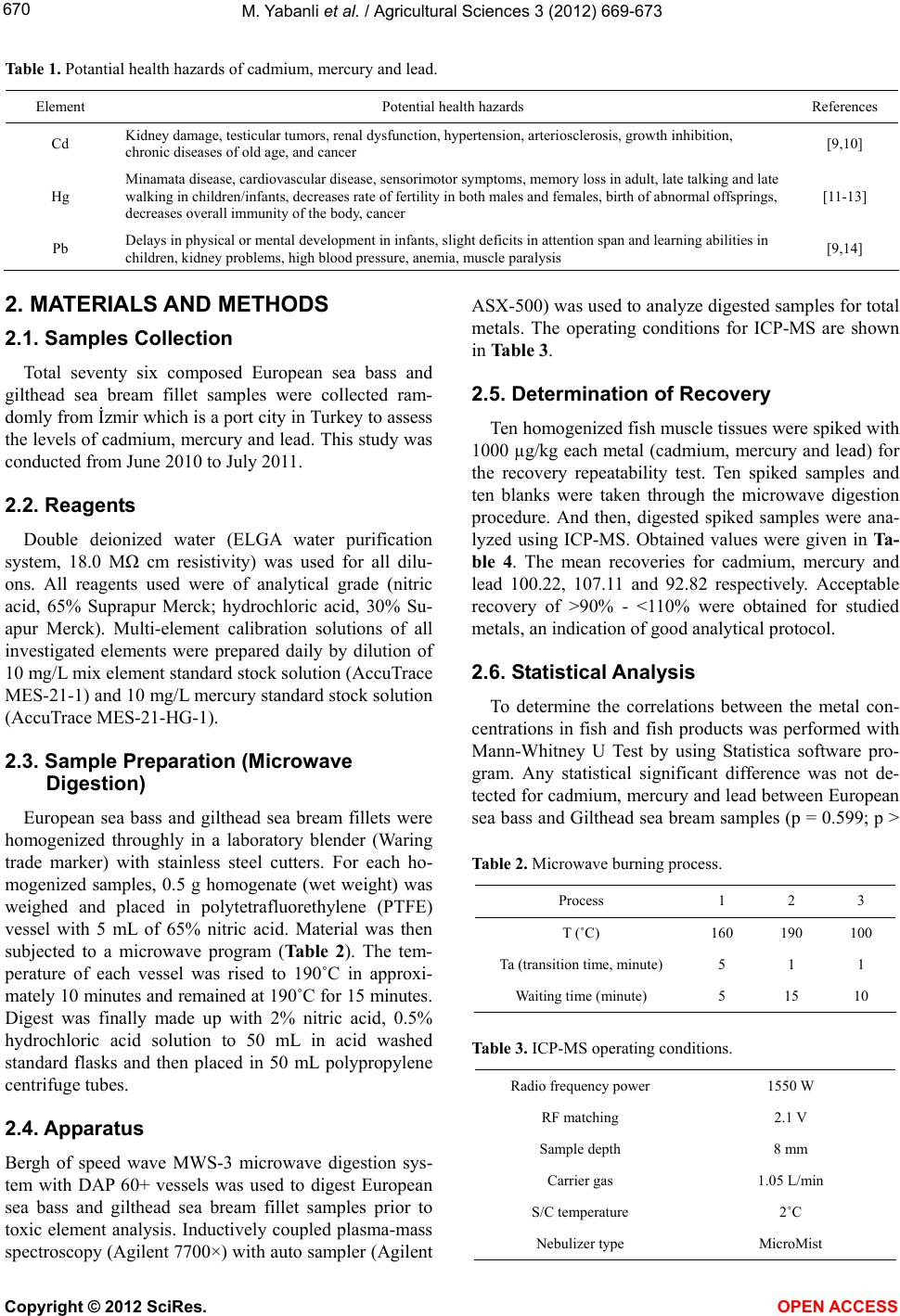 M. Yabanli et al. / Agricultural Sciences 3 (2012) 669-673 670 Table 1. Potantial health hazards of cadmium, mercury and lead. Element Potential health hazards References Cd Kidney damage, testicular tumors, renal dysfunction, hypertension, arteriosclerosis, growth inhibition, chronic diseases of old age, and cancer [9,10] Hg Minamata disease, cardiovascular disease, sensorimotor symptoms, memory loss in adult, late talking and late walking in children/infants, decreases rate of fertility in both males and females, birth of abnormal offsprings, decreases overall immunity of the body, cancer [11-13] Pb Delays in physical or mental development in infants, slight deficits in attention span and learning abilities in children, kidney problems, high blood pressure, anemia, muscle paralysis [9,14] 2. MATERIALS AND METHODS 2.1. Samples Collection Total seventy six composed European sea bass and gilthead sea bream fillet samples were collected ram- domly from İzmir which is a port city in Turkey to assess the levels of cadmium, mercury and lead. This study was conducted from June 2010 to July 2011. 2.2. Reagents Double deionized water (ELGA water purification system, 18.0 MΩ cm resistivity) was used for all dilu- ons. All reagents used were of analytical grade (nitric acid, 65% Suprapur Merck; hydrochloric acid, 30% Su- apur Merck). Multi-element calibration solutions of all investigated elements were prepared daily by dilution of 10 mg/L mix element standard stock solution (AccuTrace MES-21-1) and 10 mg/L mercury standard stock solution (AccuTrace MES-21-HG-1). 2.3. Sample Preparation (Microwave Digestion) European sea bass and gilthead sea bream fillets were homogenized throughly in a laboratory blender (Waring trade marker) with stainless steel cutters. For each ho- mogenized samples, 0.5 g homogenate (wet weight) was weighed and placed in polytetrafluorethylene (PTFE) vessel with 5 mL of 65% nitric acid. Material was then subjected to a microwave program (Ta ble 2 ). The tem- perature of each vessel was rised to 190˚C in approxi- mately 10 minutes and remained at 190˚C for 15 minutes. Digest was finally made up with 2% nitric acid, 0.5% hydrochloric acid solution to 50 mL in acid washed standard flasks and then placed in 50 mL polypropylene centrifuge tubes. 2.4. App aratus Bergh of speed wave MWS-3 microwave digestion sys- tem with DAP 60+ vessels was used to digest European sea bass and gilthead sea bream fillet samples prior to toxic element analysis. Inductively coupled plasma-mass spectroscopy (Agilent 7700×) with auto sampler (Agilent ASX-500) was used to analyze digested samples for total metals. The operating conditions for ICP-MS are shown in Table 3. 2.5. Determination of Recovery Ten homogenized fish muscle tissues were spiked with 1000 µg/kg each metal (cadmium, mercury and lead) for the recovery repeatability test. Ten spiked samples and ten blanks were taken through the microwave digestion procedure. And then, digested spiked samples were ana- lyzed using ICP-MS. Obtained values were given in Ta- ble 4. The mean recoveries for cadmium, mercury and lead 100.22, 107.11 and 92.82 respectively. Acceptable recovery of >90% - <110% were obtained for studied metals, an indication of good analytical protocol. 2.6. Statistical Analysis To determine the correlations between the metal con- centrations in fish and fish products was performed with Mann-Whitney U Test by using Statistica software pro- gram. Any statistical significant difference was not de- tected for cadmium, mercury and lead between European sea bass and Gilthead sea bream samples (p = 0.599; p > Table 2. Microwave burning process. Process 1 2 3 T (˚C) 160 190 100 Ta (transition time, minute) 5 1 1 Waiting time (minute) 5 15 10 Table 3. ICP-MS operating conditions. Radio frequency power 1550 W RF matching 2.1 V Sample depth 8 mm Carrier gas 1.05 L/min S/C temperature 2˚C Nebulizer type MicroMist Copyright © 2012 SciRes. OPEN ACCESS 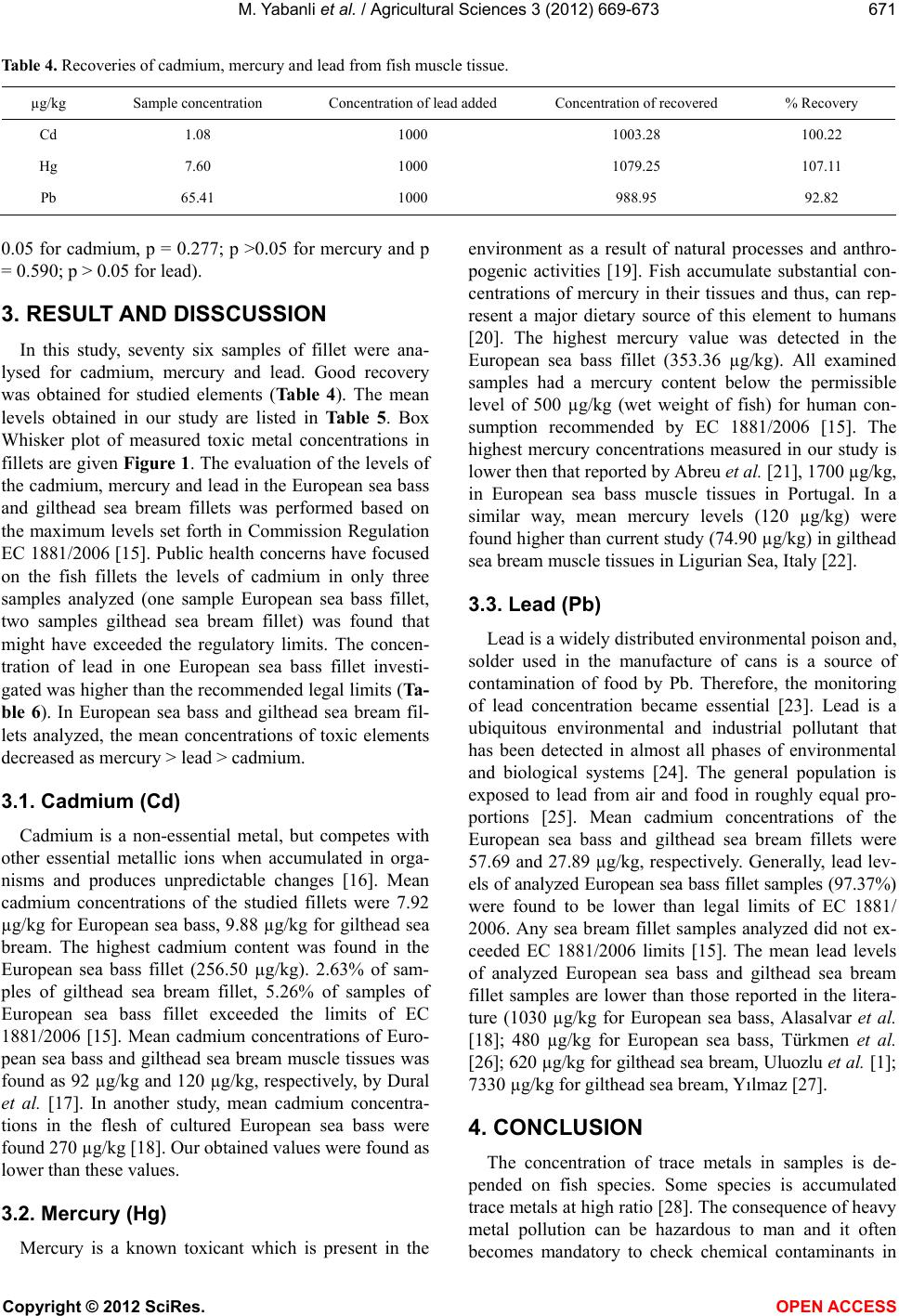 M. Yabanli et al. / Agricultural Sciences 3 (2012) 669-673 671 Table 4. Recoveries of cadmium, mercury and lead from fish muscle tissue. µg/kg Sample concentration Concentration of lead added Concentration of recovered % Recovery Cd 1.08 1000 1003.28 100.22 Hg 7.60 1000 1079.25 107.11 Pb 65.41 1000 988.95 92.82 0.05 for cadmium, p = 0.277; p >0.05 for mercury and p = 0.590; p > 0.05 for lead). 3. RESULT AND DISSCUSSION In this study, seventy six samples of fillet were ana- lysed for cadmium, mercury and lead. Good recovery was obtained for studied elements (Ta ble 4). The mean levels obtained in our study are listed in Table 5. Box Whisker plot of measured toxic metal concentrations in fillets are given Figure 1. The evaluation of the levels of the cadmium, mercury and lead in the European sea bass and gilthead sea bream fillets was performed based on the maximum levels set forth in Commission Regulation EC 1881/2006 [15]. Public health concerns have focused on the fish fillets the levels of cadmium in only three samples analyzed (one sample European sea bass fillet, two samples gilthead sea bream fillet) was found that might have exceeded the regulatory limits. The concen- tration of lead in one European sea bass fillet investi- gated was higher than the recommended legal limits (Ta- ble 6). In European sea bass and gilthead sea bream fil- lets analyzed, the mean concentrations of toxic elements decreased as mercury > lead > cadmium. 3.1. Cadmium (Cd) Cadmium is a non-essential metal, but competes with other essential metallic ions when accumulated in orga- nisms and produces unpredictable changes [16]. Mean cadmium concentrations of the studied fillets were 7.92 µg/kg for European sea bass, 9.88 µg/kg for gilthead sea bream. The highest cadmium content was found in the European sea bass fillet (256.50 µg/kg). 2.63% of sam- ples of gilthead sea bream fillet, 5.26% of samples of European sea bass fillet exceeded the limits of EC 1881/2006 [15]. Mean cadmium concentrations of Euro- pean sea bass and gilthead sea bream muscle tissues was found as 92 µg/kg and 120 µg/kg, respectively, by Dural et al. [17]. In another study, mean cadmium concentra- tions in the flesh of cultured European sea bass were found 270 µg/kg [18]. Our obtained values were found as lower than these values. 3.2. Mercury (Hg) Mercury is a known toxicant which is present in the environment as a result of natural processes and anthro- pogenic activities [19]. Fish accumulate substantial con- centrations of mercury in their tissues and thus, can rep- resent a major dietary source of this element to humans [20]. The highest mercury value was detected in the European sea bass fillet (353.36 µg/kg). All examined samples had a mercury content below the permissible level of 500 µg/kg (wet weight of fish) for human con- sumption recommended by EC 1881/2006 [15]. The highest mercury concentrations measured in our study is lower then that reported by Abreu et al. [21], 1700 µg/kg, in European sea bass muscle tissues in Portugal. In a similar way, mean mercury levels (120 µg/kg) were found higher than current study (74.90 µg/kg) in gilthead sea bream muscle tissues in Ligurian Sea, Italy [22]. 3.3. Lead (Pb) Lead is a widely distributed environmental poison and, solder used in the manufacture of cans is a source of contamination of food by Pb. Therefore, the monitoring of lead concentration became essential [23]. Lead is a ubiquitous environmental and industrial pollutant that has been detected in almost all phases of environmental and biological systems [24]. The general population is exposed to lead from air and food in roughly equal pro- portions [25]. Mean cadmium concentrations of the European sea bass and gilthead sea bream fillets were 57.69 and 27.89 µg/kg, respectively. Generally, lead lev- els of analyzed European sea bass fillet samples (97.37%) were found to be lower than legal limits of EC 1881/ 2006. Any sea bream fillet samples analyzed did not ex- ceeded EC 1881/2006 limits [15]. The mean lead levels of analyzed European sea bass and gilthead sea bream fillet samples are lower than those reported in the litera- ture (1030 µg/kg for European sea bass, Alasalvar et al. [18]; 480 µg/kg for European sea bass, Türkmen et al. [26]; 620 µg/kg for gilthead sea bream, Uluozlu et al. [1]; 7330 µg/kg for gilthead sea bream, Yılmaz [27]. 4. CONCLUSION The concentration of trace metals in samples is de- pended on fish species. Some species is accumulated trace metals at high ratio [28]. The consequence of heavy metal pollution can be hazardous to man and it often becomes mandatory to check chemical contaminants in Copyright © 2012 SciRes. OPEN ACCESS 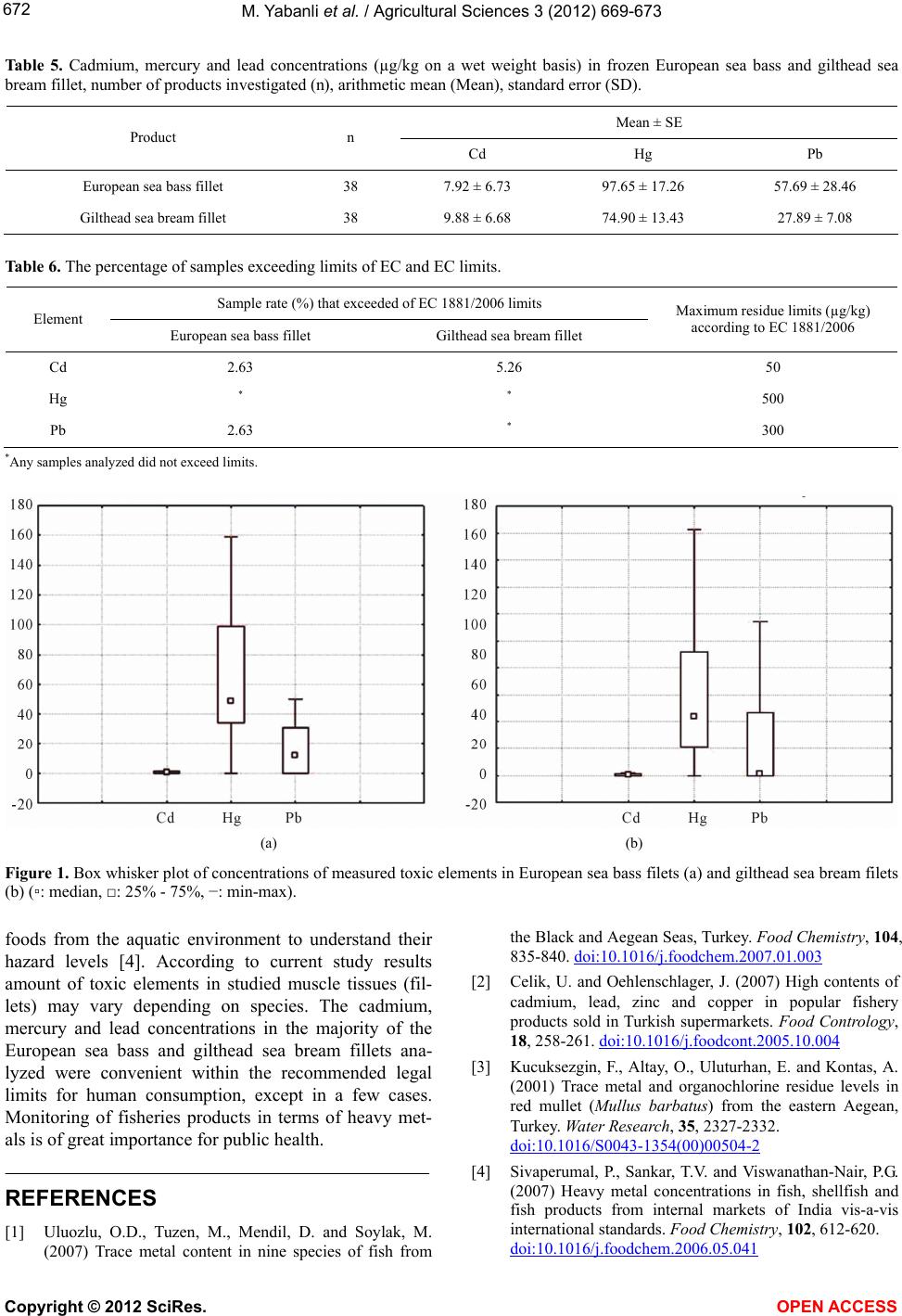 M. Yabanli et al. / Agricultural Sciences 3 (2012) 669-673 672 Table 5. Cadmium, mercury and lead concentrations (µg/kg on a wet weight basis) in frozen European sea bass and gilthead sea bream fillet, number of products investigated (n), arithmetic mean (Mean), standard error (SD). Mean ± SE Product n Cd Hg Pb European sea bass fillet 38 7.92 ± 6.73 97.65 ± 17.26 57.69 ± 28.46 Gilthead sea bream fillet 38 9.88 ± 6.68 74.90 ± 13.43 27.89 ± 7.08 Table 6. The percentage of samples exceeding limits of EC and EC limits. Sample rate (%) that exceeded of EC 1881/2006 limits Element European sea bass fillet Gilthead sea bream fillet Maximum residue limits (µg/kg) according to EC 1881/2006 Cd 2.63 5.26 50 Hg * * 500 Pb 2.63 * 300 *Any samples analyzed did not exceed limits. (a) (b) Figure 1. Box whisker plot of concentrations of measured toxic elements in European sea bass filets (a) and gilthead sea bream filets (b) (▫: median, □: 25% - 75%, −: min-max). foods from the aquatic environment to understand their hazard levels [4]. According to current study results amount of toxic elements in studied muscle tissues (fil- lets) may vary depending on species. The cadmium, mercury and lead concentrations in the majority of the European sea bass and gilthead sea bream fillets ana- lyzed were convenient within the recommended legal limits for human consumption, except in a few cases. Monitoring of fisheries products in terms of heavy met- als is of great importance for public health. REFERENCES [1] Uluozlu, O.D., Tuzen, M., Mendil, D. and Soylak, M. (2007) Trace metal content in nine species of fish from the Black and Aegean Seas, Turkey. Food Chemistry, 104, 835-840. doi:10.1016/j.foodchem.2007.01.003 [2] Celik, U. and Oehlenschlager, J. (2007) High contents of cadmium, lead, zinc and copper in popular fishery products sold in Turkish supermarkets. Food Contrology, 18, 258-261. doi:10.1016/j.foodcont.2005.10.004 [3] Kucuksezgin, F., Altay, O., Uluturhan, E. and Kontas, A. (2001) Trace metal and organochlorine residue levels in red mullet (Mullus barbatus) from the eastern Aegean, Turkey. Water Research, 35, 2327-2332. doi:10.1016/S0043-1354(00)00504-2 [4] Sivaperumal, P., Sankar, T.V. and Viswanathan-Nair, P.G. (2007) Heavy metal concentrations in fish, shellfish and fish products from internal markets of India vis-a-vis international standards. Food Chemistry, 102, 612-620. doi:10.1016/j.foodchem.2006.05.041 Copyright © 2012 SciRes. OPEN ACCESS  M. Yabanli et al. / Agricultural Sciences 3 (2012) 669-673 673 [5] Dural, M., Lugal-Goksu, M.Z. and Ozak, A.A. (2007) Investigation of heavy metal levels in economically important fish species captured from the Tuzla lagoon. Food Chemistry, 102, 415-421. doi:10.1016/j.foodchem.2006.03.001 [6] Hajeb, P., Jinap, S., Ismail, A., Fatimah, A.B., Jamilah, B. and Rahim, M.A. (2009) Assessment of mercury level in commonly consumed marine fishes in Malaysia. Food Control, 20, 79-84. doi:10.1016/j.foodcont.2008.02.012 [7] Usydus, Z., Szlinder-Richert, J., Polak-Juszczak, L., Komar, K., Adamczyk, M., Malesa-Ciecwierz, M. and Ruczynska, W. (2009) Fish products available in Polish market—Assessment of the nutritive value and human exposure to dioxins and other contaminants. Chemo- sphere, 74, 1420-1428. doi:10.1016/j.chemosphere.2008.12.023 [8] Cabañero, A.I., Madrid, Y. and Cámara, C. (2004) Sele- nium and mercury bioaccessibility in fish samples: An in vitro digestion method. Analytica Chimica Acta, 526, 51- 61. doi:10.1016/j.aca.2004.09.039 [9] Anonymous (2009) Drinking water contaminants. United States Environmental Protection Agency, EPA 816-F- 09-004. [10] Flick, D.F., Kraybill, H.F. and Dlmitroff, J.M. (1971) Toxic effects of cadmium: A review. Environmental Re- search, 4, 71-85. doi:10.1016/0013-9351(71)90036-3 [11] M. Hutton. (1987) Human health concerns of lead, mer- cury, cadmium and arsenic. In: Hutchinson, T.C. and Meema, K.M., Eds., Lead, Mercury, Cadmium and Ar- senic in the Environment, John Wiley and Sons Ltd., New York, 53-68. [12] Mozaffarian, D. and Rimm, E.B. (2006) Fish intake, contaminants, and human health, evaluating the risk and the benefits. The Journal of the American Medical Asso- ciation, 296, 1885-1899. doi:10.1001/jama.296.15.1885 [13] Zahir, F., Rizwi, S.J., Haq, S.K. and Khan, R.H. (2005) Low dose mercury toxicity and human health. Environ- mental Toxicolo gy and Pharmacology, 20, 351-360. doi:10.1016/j.etap.2005.03.007 [14] Chen, C.T. and Huang, W.P. (2002) A high selective flu- orescent chemosensor for lead ions. Journal of the Ame- rican Chemical Society, 124, 6246-6247. doi:10.1021/ja025710e [15] Anonimous (2006) Setting maximum levels for certain contaminants in foodstuffs. Commission Regulation (EC) No 1881/2006. [16] Dutta, T.K. and Kaviraj, A. (2001) Acute toxicity of cadmium to fish Labeo rohite and copepod Diaptomus forbesi pre-exposed to CaO and KMnO4. Chemosphere, 42, 955-958. doi:10.1016/S0045-6535(00)00166-1 [17] Dural, M., Lugal-Goksu, M.Z., Ozak, A.A. and Derici, B. (2006) Bioaccumulation of some heavy metals in dif- ferent tissues of Dicentrarchus labrax L., 1758, Sparus aurata L., 1758 and Mugil cephalus L., 1758 from the Çamlık Lagoon of the Eastern Cost of Mediterranean (Turkey). Environmental Monitoring and Assessment, 118, 65-74. doi:10.1007/s10661-006-0987-7 [18] Alasalvar, C., Taylor, K.D.A., Zubcov, E., Shahidi, F. and Alexis, M. (2002) Differentiation of cultured and wild sea bass (Dicentrarchus labrax): Total lipid content, fatty acid and trace mineral composition. Food Chemistry, 79, 145-150. doi:10.1016/S0308-8146(02)00122-X [19] Voegborlo, R.B. and Adimado, A.A. (2010) A simple classical wet digestion technique fort he determination of total mercury in fish tissue by cold-vapour atomic absorp tion spectrometry in a low technology environment. Food Chemistry, 123, 936-940. doi:10.1016/j.foodchem.2010.04.059 [20] Voegborlo, R.B., El-Methnani, A.M. and Abedin, M.Z. (1999) Mercury, cadmium and lead content of canned tuna fish. Food Chemistry, 67, 341-345. doi:10.1016/S0308-8146(98)00008-9 [21] Abreu, S.N., Pereira, E., Vale, C. and Duarte, A.C. (2000) Accumulation of mercury in sea bass from a conta- minated lagoon (Ria de Aveiro, Portugal). Marine Pollu- tion Bulletin, 40, 293-297. doi:10.1016/S0025-326X(99)00187-3 [22] Minganti, V., Drava, G., Pellegrini, R. and Siccardi, C. (2010) Trace elements in farmed and wild gilthead sea- bream, Sparus aurata. Marine Pollution Bulletin, 60, 2022-2025. doi:10.1016/j.marpolbul.2010.07.023 [23] Mol, S. (2011) Determination of trace metals in canned anchovies and canned rainbow trouts. Food and Chemical Toxicology, 49, 348-351. doi:10.1016/j.fct.2010.11.005 [24] Hsu, P.-C. and Guo, Y.L. (2002) Antioxidant nutrients and lead toxicity. Toxicology, 180, 33-34. doi:10.1016/S0300-483X(02)00380-3 [25] Järup, L. (2003) Hazards of heavy metal contamination. British Medical Bulletin, 68, 167-182. doi:10.1093/bmb/ldg032 [26] Türkmen, M., Türkmen, A., Tepe, Y., Töre, Y. and Ateş, A. (2009) Determination of metals in fish species from Ae- gean and Mediterranean seas. Food Chemistry, 11 3, 233- 237. doi:10.1016/j.foodchem.2008.06.071 [27] Yılmaz, A.B. (2005) Comparison of heavy metal levels of grey mullet (Mugil cephalus L.) and sea bream (Sparus aurata L.) caught in İskenderun Bay (Turkey). Turkish Journal of Veterinary and Animal Sciences, 29, 257-262. [28] Mendil, D., Demirci, Z., Tuzen, M. and Soylak, M. (2010) Seasonal investigation of trace element contents in com- mercially valuable fish species from the Black Sea, Turkey. Food and Chemical Toxicology, 48, 865-870. doi:10.1016/j.fct.2009.12.023 Copyright © 2012 SciRes. OPEN ACCESS |