

Paper Menu >>
Journal Menu >>
 Vol.3, No.5, 674-677 (2012) Agricultural Sciences http://dx.doi.org/10.4236/as.2012.35082 Reducing toxic effect of seed-soaked Cu fertilizer on germination of wheat* Sukhdev S. Malhi#, D. Leach Agriculture and Agri-Food Canada, Melfort, Canada; #Corresponding Author: [email protected] Received 3 June 2012; revised 3 July 2012; accepted 23 July 2012 ABSTRACT A laboratory incubation experiment (20˚C) was conducted to find if the detrimental effects of seed-soaked Cu on wheat seedlings can be mi- nimized by reducing time duration of seed in contact with Cu EDTA fertilizer solution. The 24 treatments in a 6 × 4 factorial arrangement in- cluded 6 rates/amounts of Cu (0, 15, 30, 60, 120 and 240 g·Cu·100 kg−1 seed) and 4 seed-soaking time durations (0, 4, 8 and 16 h). The germination of wheat seed was 100% in the zero-Cu control treatments, irrespective of the duration of seed soaking time. However, seed germination de- creased with increasing amount of fertilizer Cu in the seed-soaking solution, and the magnitude of reduction in seed germination due to Cu tox- icity increased with increasing duration of seed- soaking time in the Cu fertilizer solution. For the seed-soaked treatments, the detrimental effect of Cu on germination was greatest with 16 h soaking, where only 13% - 18% of the seeds germinated with Cu applied at 15 to 30 g·Cu·100 kg−1 seed. For the 4 and 8 h seed soaking treatments, germination of wheat seed ranged from 73% to 83% with 15 g·Cu·100 kg−1 seed treatment and 42% to 62% with 30 g·Cu·100 kg−1 seed. The findings suggest that the detrimental effect of Cu on germination of wheat seed soaked in Cu EDTA solution can be decreased by reducing duration of soaking time from 16 h to 4h or 8 h, but this needs further investigation using soil under growth chamber and/or field conditions in order to make valid recommenda- tions for use of this new technology on a com- mercial scale. Keywords: Amount/Rate of Cu; Seed-Soaked Cu; Soaking Time/Duration; Solution Cu 1. INTRODUCTION Wheat is a very sensitive crop to Cu deficiency [1]. In the Canadian Prairie Provinces, research has suggested the use of 3 to 5.6 kg·Cu·ha−1, when granular Cu fertiliz- ers are incorporated into the surface soil, to prevent Cu deficiency in crops grown on Cu-deficient soils [2]. For economic reasons, producers were more interested in methods of Cu fertilizer application that required low Cu rates. However, in research studies in Alberta and Sas- katchewan, granular Cu fertilizers at low rates, either incorporated into soil up to 2 kg·Cu·ha−1 or seedrow- placed up to 1 kg·Cu·ha−1, were not effective in prevent- ing Cu deficiency in wheat in the year of application [3,4]. This was most likely that the granular Cu fertilizer applied at low rates did not provide enough “feeding sites” for optimum wheat growth and seed yield due to sporadic placement of Cu fertilizer granules in relation to the growing roots. Previous research has also suggested the use of low rates of two foliar applications of Cu fer- tilizers at 0.25 to 0.28 kg·Cu·ha−1 to correct Cu defi- ciency on wheat in order to maximize seed yield, if it occurs during the growing season [5]. In order to avoid the inconvenience of foliar applica- tion, crop damage during in-crop Cu fertilizer application and for most economic benefits, producers in the Prairie Provinces were interested in using much lower rates of Cu fertilizers than previously recommended for foliar or soil applications. Because Cu is needed in very small quantities for optimum crop growth, “feeding sites” can be increased by soaking the seed in dilute Cu fertilizer solution. Our recent field research showed that Cu defi- ciency in wheat can be prevented and seed yield in- creased by soaking wheat seed in Cu EDTA solution for 12 h [6]. However, in that study there was also a signifi- cant reduction in seedling emergence due to seed-soaked Cu treatments in many cases, suggesting further investi- gation to minimize damage to seedling emergence due to seed-soaked Cu treatments. Earlier research has suggested *Trade names in this publication are used only in the interest of accu- rate reporting. No endorsement of a product to the exclusion of othe r similar products is implied by Agriculture and Agri-Food Canada or its researchers. that seedrow-placed Cu fertilizer can occasionally reduce plant stand due to its toxic effect to germinating seed- Copyright © 2012 SciRes. OPEN ACCESS 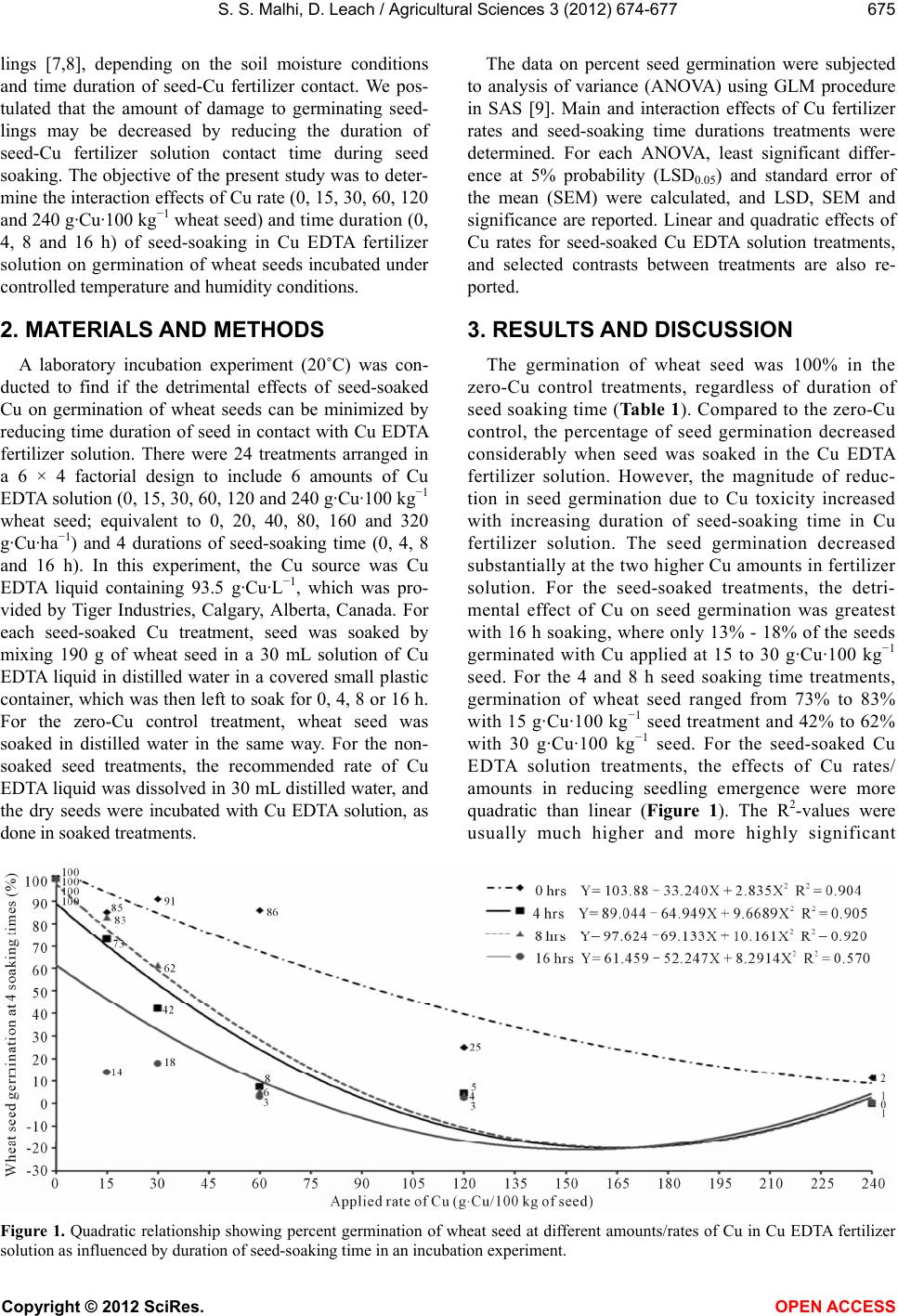 S. S. Malhi, D. Leach / Agricultural Sciences 3 (2012) 674-677 675 lings [7,8], depending on the soil moisture conditions and time duration of seed-Cu fertilizer contact. We pos- tulated that the amount of damage to germinating seed- lings may be decreased by reducing the duration of seed-Cu fertilizer solution contact time during seed soaking. The objective of the present study was to deter- mine the interaction effects of Cu rate (0, 15, 30, 60, 120 and 240 g·Cu·100 kg−1 wheat seed) and time duration (0, 4, 8 and 16 h) of seed-soaking in Cu EDTA fertilizer solution on germination of wheat seeds incubated under controlled temperature and humidity conditions. 2. MATERIALS AND METHODS A laboratory incubation experiment (20˚C) was con- ducted to find if the detrimental effects of seed-soaked Cu on germination of wheat seeds can be minimized by reducing time duration of seed in contact with Cu EDTA fertilizer solution. There were 24 treatments arranged in a 6 × 4 factorial design to include 6 amounts of Cu EDTA solution (0, 15, 30, 60, 120 and 240 g·Cu·100 kg−1 wheat seed; equivalent to 0, 20, 40, 80, 160 and 320 g·Cu·ha−1) and 4 durations of seed-soaking time (0, 4, 8 and 16 h). In this experiment, the Cu source was Cu EDTA liquid containing 93.5 g·Cu·L−1, which was pro- vided by Tiger Industries, Calgary, Alberta, Canada. For each seed-soaked Cu treatment, seed was soaked by mixing 190 g of wheat seed in a 30 mL solution of Cu EDTA liquid in distilled water in a covered small plastic container, which was then left to soak for 0, 4, 8 or 16 h. For the zero-Cu control treatment, wheat seed was soaked in distilled water in the same way. For the non- soaked seed treatments, the recommended rate of Cu EDTA liquid was dissolved in 30 mL distilled water, and the dry seeds were incubated with Cu EDTA solution, as done in soaked treatments. The data on percent seed germination were subjected to analysis of variance (ANOVA) using GLM procedure in SAS [9]. Main and interaction effects of Cu fertilizer rates and seed-soaking time durations treatments were determined. For each ANOVA, least significant differ- ence at 5% probability (LSD0.05) and standard error of the mean (SEM) were calculated, and LSD, SEM and significance are reported. Linear and quadratic effects of Cu rates for seed-soaked Cu EDTA solution treatments, and selected contrasts between treatments are also re- ported. 3. RESULTS AND DISCUSSION The germination of wheat seed was 100% in the zero-Cu control treatments, regardless of duration of seed soaking time (Table 1). Compared to the zero-Cu control, the percentage of seed germination decreased considerably when seed was soaked in the Cu EDTA fertilizer solution. However, the magnitude of reduc- tion in seed germination due to Cu toxicity increased with increasing duration of seed-soaking time in Cu fertilizer solution. The seed germination decreased substantially at the two higher Cu amounts in fertilizer solution. For the seed-soaked treatments, the detri- mental effect of Cu on seed germination was greatest with 16 h soaking, where only 13% - 18% of the seeds germinated with Cu applied at 15 to 30 g·Cu·100 kg−1 seed. For the 4 and 8 h seed soaking time treatments, germination of wheat seed ranged from 73% to 83% with 15 g·Cu·100 kg−1 seed treatment and 42% to 62% with 30 g·Cu·100 kg−1 seed. For the seed-soaked Cu EDTA solution treatments, the effects of Cu rates/ amounts in reducing seedling emergence were more quadratic than linear (Figure 1). The R2-values were usually much higher and more highly significant Figure 1. Quadratic relationship showing percent germination of wheat seed at different amounts/rates of Cu in Cu EDTA fertilizer olution as influenced by duration of seed-soaking time in an incubation experiment. s Copyright © 2012 SciRes. OPEN ACCESS 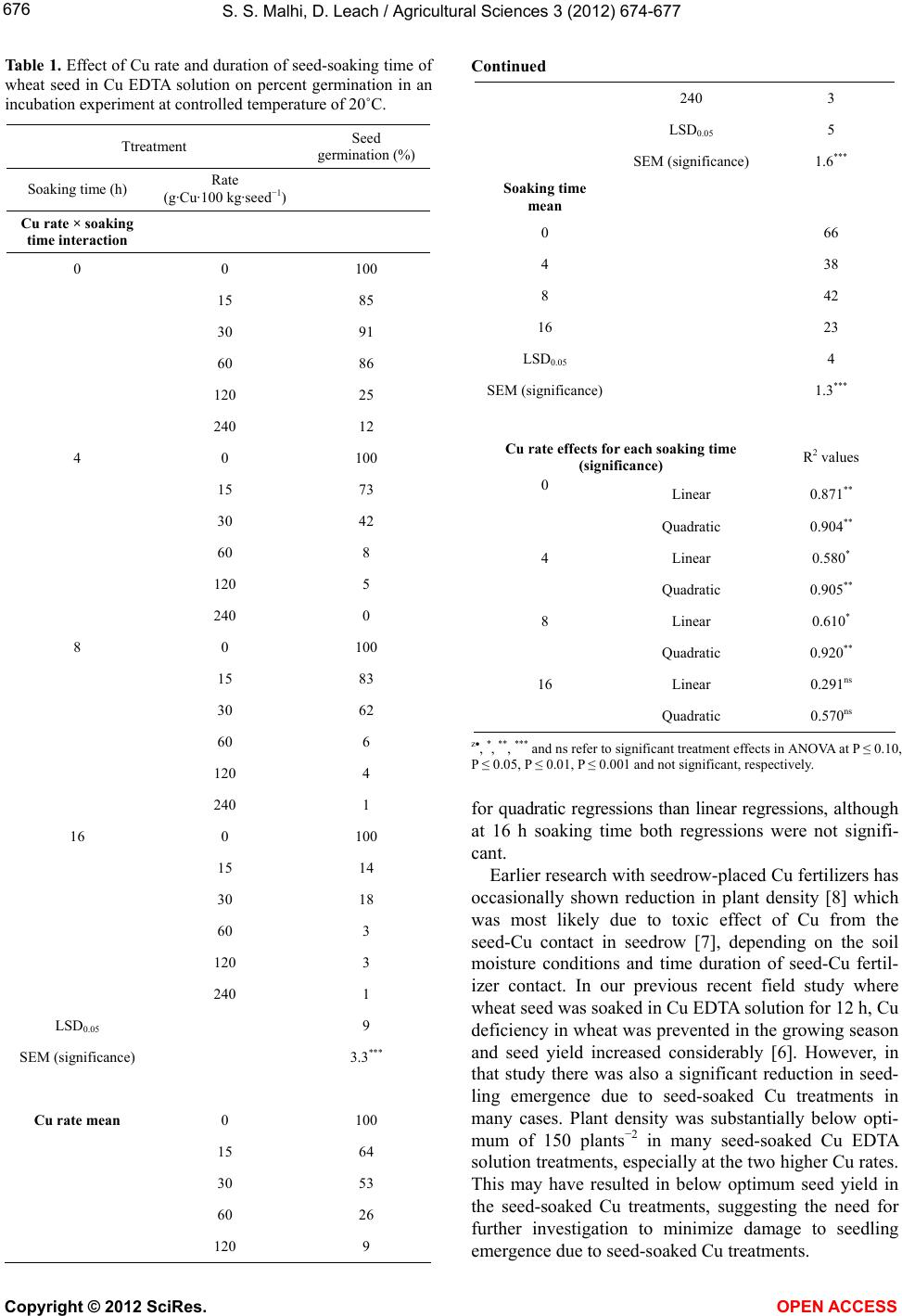 S. S. Malhi, D. Leach / Agricultural Sciences 3 (2012) 674-677 676 Tabl e 1. Effect of Cu rate and duration of seed-soaking time of wheat seed in Cu EDTA solution on percent germination in an incubation experiment at controlled temperature of 20˚C. Ttreatment Seed germination (%) Soaking time (h) Rate (g·Cu·100 kg·seed−1) Cu rate × soaking time interaction 0 0 100 15 85 30 91 60 86 120 25 240 12 4 0 100 15 73 30 42 60 8 120 5 240 0 8 0 100 15 83 30 62 60 6 120 4 240 1 16 0 100 15 14 30 18 60 3 120 3 240 1 LSD0.05 9 SEM (significance) 3.3*** Cu rate mean 0 100 15 64 30 53 60 26 120 9 Continued 240 3 LSD0.05 5 SEM (significance) 1.6*** Soaking time mean 0 66 4 38 8 42 16 23 LSD0.05 4 SEM (significance) 1.3*** Cu rate effects for each soaking time (significance) R2 values 0 Linear 0.871** Quadratic 0.904** 4 Linear 0.580* Quadratic 0.905** 8 Linear 0.610* Quadratic 0.920** 16 Linear 0.291ns Quadratic 0.570ns z, *, **, *** and ns refer to significant treatment effects in ANOVA at P ≤ 0.10, P ≤ 0.05, P ≤ 0.01, P ≤ 0.001 and not significant, respectively. for quadratic regressions than linear regressions, although at 16 h soaking time both regressions were not signifi- cant. Earlier research with seedrow-placed Cu fertilizers has occasionally shown reduction in plant density [8] which was most likely due to toxic effect of Cu from the seed-Cu contact in seedrow [7], depending on the soil moisture conditions and time duration of seed-Cu fertil- izer contact. In our previous recent field study where wheat seed was soaked in Cu EDTA solution for 12 h, Cu deficiency in wheat was prevented in the growing season and seed yield increased considerably [6]. However, in that study there was also a significant reduction in seed- ling emergence due to seed-soaked Cu treatments in many cases. Plant density was substantially below opti- mum of 150 plants−2 in many seed-soaked Cu EDTA solution treatments, especially at the two higher Cu rates. This may have resulted in below optimum seed yield in the seed-soaked Cu treatments, suggesting the need for further investigation to minimize damage to seedling emergence due to seed-soaked Cu treatments. Copyright © 2012 SciRes. OPEN ACCESS  S. S. Malhi, D. Leach / Agricultural Sciences 3 (2012) 674-677 677 4. CONCLUSION The detrimental effect of Cu on germination of wheat seed soaked in Cu EDTA solution can be decreased by reducing duration of soaking time from 16 h to 4 h or 8 h, but this needs further investigation in soil under growth chamber and/or field conditions before using this new technology on a commercial scale. 5. ACKNOWLEDGEMENTS The authors thank K. Strukoff for technical help. REFERENCES [1] Alberta Agriculture, Food and Rural Development (1995) Copper deficiency in cereal crops. Agri-Fax, Edmonton, 5 p. [2] Saskatchewan Agriculture and Food (2000) Micronutri- ents in crop production. Farm Facts, Saskatchewan Agri- culture and Food, Regina, 6 p. [3] Karamanos, R.E., Walley, F.L. and Flaten, P.L. (2005) Ef- fectiveness of seedrow placement of granular copper pro- ducts for wheat. Canadian Journal of Soil Science, 85, 295-306. doi:10.4141/S04-038 [4] Malhi, S.S., Cowell, L. and Kutcher, H.R. (2005) Relative effectiveness of various sources, methods, times and rates of copper fertilizers in improving grain yield of wheat on a Cu-deficient soil. Canadian Journal of Plant Science, 85, 59-65. doi:10.4141/P04-089 [5] Karamanos, R.E., Pomarenski, Q., Goh, T.B. and Flore, N.A. (2004) The effect of foliar copper application on grain yield and quality of wheat. Canadian Journal of Plant Science, 84, 47-56. doi:10.4141/P03-090 [6] Malhi, S.S. (2009) Effectiveness of seed-soaked Cu, au- tumn-versus spring-applied Cu, and Cu-coated P fertilizer on seed yield of wheat and residual soil nitrate-N on a Cu-deficient soil. Canadian Journal of Plant Science, 89, 1017-1030. doi:10.4141/CJPS08189 [7] Robson, A.D. and Reuter, D.J. (1981) Diagnosis of cop- per deficiency and toxicity. In: Loneragan, J.F., Robson, A.D. and Graham, R.D., Eds., Copper in Soils and Plants, Academic Press, Sydney, 287-312. [8] Solberg, E., DeMulder, J. and Hoar, B. (1996) Copper de- ficiency, diagnosis, crops, symptoms, diseases, fertilizers, AARI-M260; and Copper deficiency, crop variety re- sponse, disease and herbicide interactions, FFF-92032. Final Report, Alberta Agriculture, Food and Rural De- velopment, Edmonton, 130 p. [9] SAS Institute, Inc. (2004) Online documentation for SAS, version 8. http://support.sas.com/documentation/onlinedoc/index.ht ml Copyright © 2012 SciRes. OPEN ACCESS |