

Paper Menu >>
Journal Menu >>
 Vol.3, No.5, 755-758 (2012) Agricultural Sciences http://dx.doi.org/10.4236/as.2012.35091 Response of winter wheat (Triticum aestivum L.) to autumn applied saflufenacil Lynette R. Brown, Nader Soltani*, Christy Shropshire, Peter H. Sikkema University of Guelph Ridgetown Campus, Ridgetown, Canada; *Corresponding Author: [email protected] Received 29 May 2012; revised 30 June 2012; accepted 16 July 2012 ABSTRACT There is limited information on the effect of saflufenacil application timing when applied in autumn to winter wheat. Five field experiments were conducted over a three-year period (2007- 2009) at two locations (Ridgetown and Exeter, Ontario) to evaluate the tolerance of winter wheat to autumn applications of saflufenacil applied pre-plant (PP), pre-emergence (PRE), or post-emergence (POST) at 25, 50, 100 and 200 g a.i. ha−1. As the dose of saflufenacil increased, the amount of injury observed also increased. By May of the following spring, injury ranged from 11% to 20% at the 25 to 200 g a.i. ha−1 doses of saflufenacil. Saflufenacil applied PP and PRE caused little to no injury in winter wheat. Saf- lufenacil applied POST and POST + Merge in the autumn caused up to 41% injury with the POST + Merge application being the most injurious. However, this injury was transient with no effect on winter wheat height or yield the following summer. Keywords: Cereals; Injury; Height; Herbicide; Tolerance; Yield 1. INTRODUCTION Herbicide application timing is influenced by tillage system (no-tillage, reduced tillage, conventional tillage), weed species (annual, biennial or perennial) and type of crop (wheat, maize or soybean). Spring is a very busy time of the year for many growers. Consequently, poste- mergence (POST) herbicide application in winter wheat may be delayed beyond the optimum application timing resulting in yield losses due to early weed interference. Most growers apply herbicides for broadleaf weed con- trol in winter wheat in the spring, however, by exploring autumn applied herbicides, growers may be able to 1) spread out their work load; 2) obtain improved control of winter annual, biennial and perennial broadleaf weeds; and 3) increase winter wheat yield due to reduced weed interference. Saflufenacil is a herbicide used for broadleaf weed control that is being investigated in a number of different crops including maize, soybean, cereal and pulse crops [1-5]. It has a different mode of action from other com- monly used herbicides for weed control in winter wheat. As a result, there have been a number of recent studies looking at the tolerance of saflufenacil in cereal crops. However, there is minimal research that has studied the effect of saflufenacil application timing [pre-plant (PP), pre-emergence (PRE) and POST] in the autumn. Research has shown that saflufenacil can be used as an effective tool to control winter annual weeds such as Chorispora tenella Pallas (blue mustard), Descurainia Sophia L. (flixweed), Capsella bursa-pastoris L. (shep- herd’s purse), Thlaspi arvense L. (field pennycress), La- mium amplexicaule L. (henbit) and perennials such as Convolvulus arvensis L. (field bindweed) and Taraxacum officinale Weber (dandelion) [6-8]. There is potential for saflufenacil to be used with glyphosate as an enhanced burndown prior to planting wheat as well as providing residual control of annual broadleaf weeds the following spring. Since glyphosate-resistant weeds have been docu- mented in some areas of Ontario, growers will need her- bicide options other than glyphosate for burndown in winter wheat. If there is adequate tolerance in winter wheat to autumn applications of saflufenacil, it may eli- minate the need for broadleaf herbicides in the spring. Therefore, the objective of this study was to determine the sensitivity of winter wheat to autumn applications (PP, PRE and POST) of saflufenacil at various doses. 2. MATERIALS AND METHODS A total of five field trials were established over a three-year period (2007-2009) at the Huron Research Station near Exeter, ON and the University of Guelph Ridgetown Campus, Ridgetown, ON. The soil character- ristics for each field trial are presented in Table 1. The experiments were established as a 2-way factorial and plots were arranged in n RCBD with four replica- a Copyright © 2012 SciRes. OPEN ACCESS 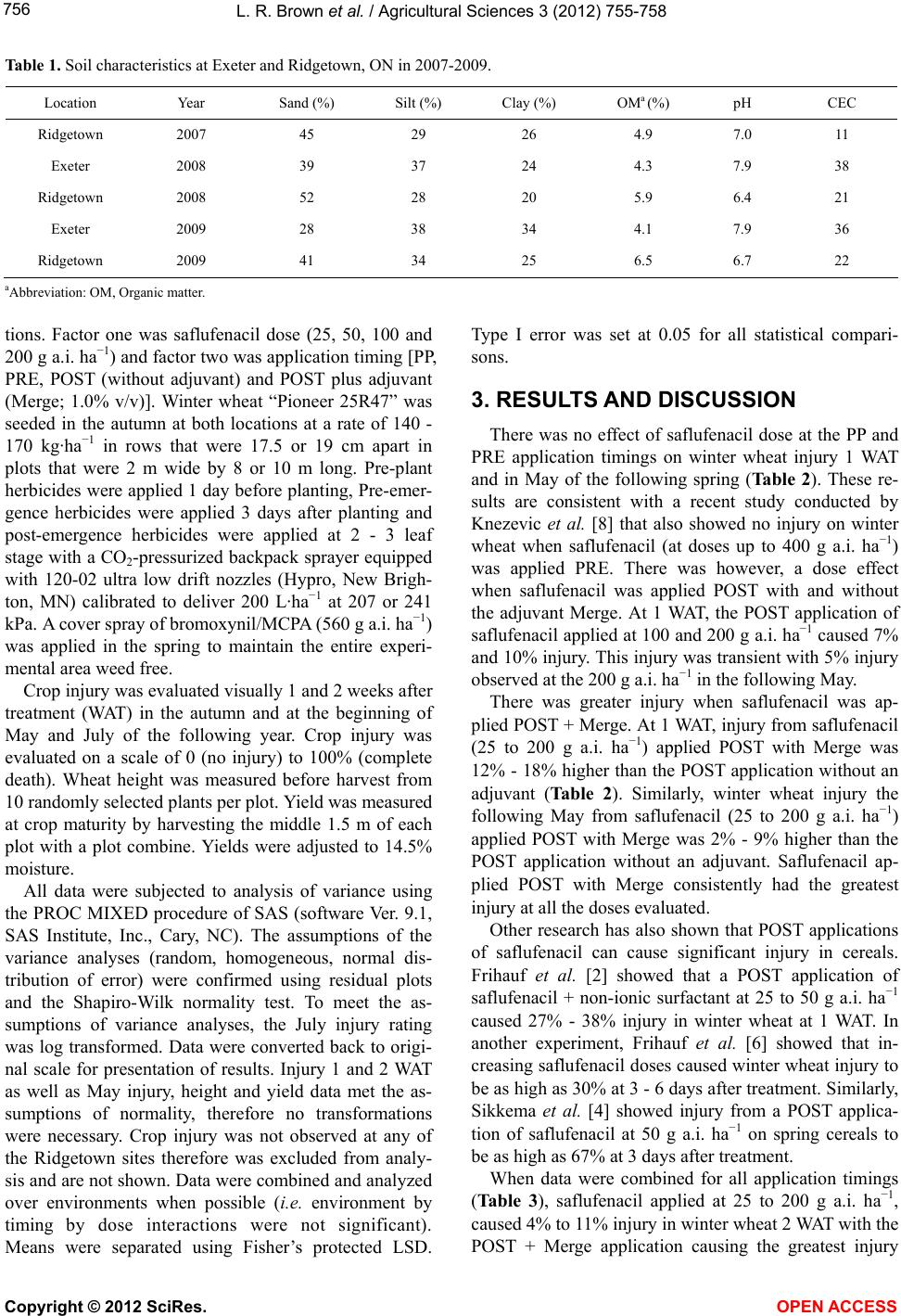 L. R. Brown et al. / Agricultural Sciences 3 (2012) 755-758 756 Table 1. Soil characteristics at Exeter and Ridgetown, ON in 2007-2009. Location Year Sand (%) Silt (%) Clay (%) OMa (%) pH CEC Ridgetown 2007 45 29 26 4.9 7.0 11 Exeter 2008 39 37 24 4.3 7.9 38 Ridgetown 2008 52 28 20 5.9 6.4 21 Exeter 2009 28 38 34 4.1 7.9 36 Ridgetown 2009 41 34 25 6.5 6.7 22 aAbbreviation: OM, Organic matter. tions. Factor one was saflufenacil dose (25, 50, 100 and 200 g a.i. ha−1) and factor two was application timing [PP, PRE, POST (without adjuvant) and POST plus adjuvant (Merge; 1.0% v/v)]. Winter wheat “Pioneer 25R47” was seeded in the autumn at both locations at a rate of 140 - 170 kg·ha−1 in rows that were 17.5 or 19 cm apart in plots that were 2 m wide by 8 or 10 m long. Pre-plant herbicides were applied 1 day before planting, Pre-emer- gence herbicides were applied 3 days after planting and post-emergence herbicides were applied at 2 - 3 leaf stage with a CO2-pressurized backpack sprayer equipped with 120-02 ultra low drift nozzles (Hypro, New Brigh- ton, MN) calibrated to deliver 200 L·ha−1 at 207 or 241 kPa. A cover spray of bromoxynil/MCPA (560 g a.i. ha−1) was applied in the spring to maintain the entire experi- mental area weed free. Crop injury was evaluated visually 1 and 2 weeks after treatment (WAT) in the autumn and at the beginning of May and July of the following year. Crop injury was evaluated on a scale of 0 (no injury) to 100% (complete death). Wheat height was measured before harvest from 10 randomly selected plants per plot. Yield was measured at crop maturity by harvesting the middle 1.5 m of each plot with a plot combine. Yields were adjusted to 14.5% moisture. All data were subjected to analysis of variance using the PROC MIXED procedure of SAS (software Ver. 9.1, SAS Institute, Inc., Cary, NC). The assumptions of the variance analyses (random, homogeneous, normal dis- tribution of error) were confirmed using residual plots and the Shapiro-Wilk normality test. To meet the as- sumptions of variance analyses, the July injury rating was log transformed. Data were converted back to origi- nal scale for presentation of results. Injury 1 and 2 WAT as well as May injury, height and yield data met the as- sumptions of normality, therefore no transformations were necessary. Crop injury was not observed at any of the Ridgetown sites therefore was excluded from analy- sis and are not shown. Data were combined and analyzed over environments when possible (i.e. environment by timing by dose interactions were not significant). Means were separated using Fisher’s protected LSD. Type I error was set at 0.05 for all statistical compari- sons. 3. RESULTS AND DISCUSSION There was no effect of saflufenacil dose at the PP and PRE application timings on winter wheat injury 1 WAT and in May of the following spring (Table 2 ). These re- sults are consistent with a recent study conducted by Knezevic et al. [8] that also showed no injury on winter wheat when saflufenacil (at doses up to 400 g a.i. ha−1) was applied PRE. There was however, a dose effect when saflufenacil was applied POST with and without the adjuvant Merge. At 1 WAT, the POST application of saflufenacil applied at 100 and 200 g a.i. ha−1 caused 7% and 10% injury. This injury was transient with 5% injury observed at the 200 g a.i. ha−1 in the following May. There was greater injury when saflufenacil was ap- plied POST + Merge. At 1 WAT, injury from saflufenacil (25 to 200 g a.i. ha−1) applied POST with Merge was 12% - 18% higher than the POST application without an adjuvant (Table 2). Similarly, winter wheat injury the following May from saflufenacil (25 to 200 g a.i. ha−1) applied POST with Merge was 2% - 9% higher than the POST application without an adjuvant. Saflufenacil ap- plied POST with Merge consistently had the greatest injury at all the doses evaluated. Other research has also shown that POST applications of saflufenacil can cause significant injury in cereals. Frihauf et al. [2] showed that a POST application of saflufenacil + non-ionic surfactant at 25 to 50 g a.i. ha−1 caused 27% - 38% injury in winter wheat at 1 WAT. In another experiment, Frihauf et al. [6] showed that in- creasing saflufenacil doses caused winter wheat injury to be as high as 30% at 3 - 6 days after treatment. Similarly, Sikkema et al. [4] showed injury from a POST applica- tion of saflufenacil at 50 g a.i. ha−1 on spring cereals to be as high as 67% at 3 days after treatment. When data were combined for all application timings (Table 3), saflufenacil applied at 25 to 200 g a.i. ha−1, caused 4% to 11% injury in winter wheat 2 WAT with the POST + Merge application ausing the greatest injury c Copyright © 2012 SciRes. OPEN ACCESS 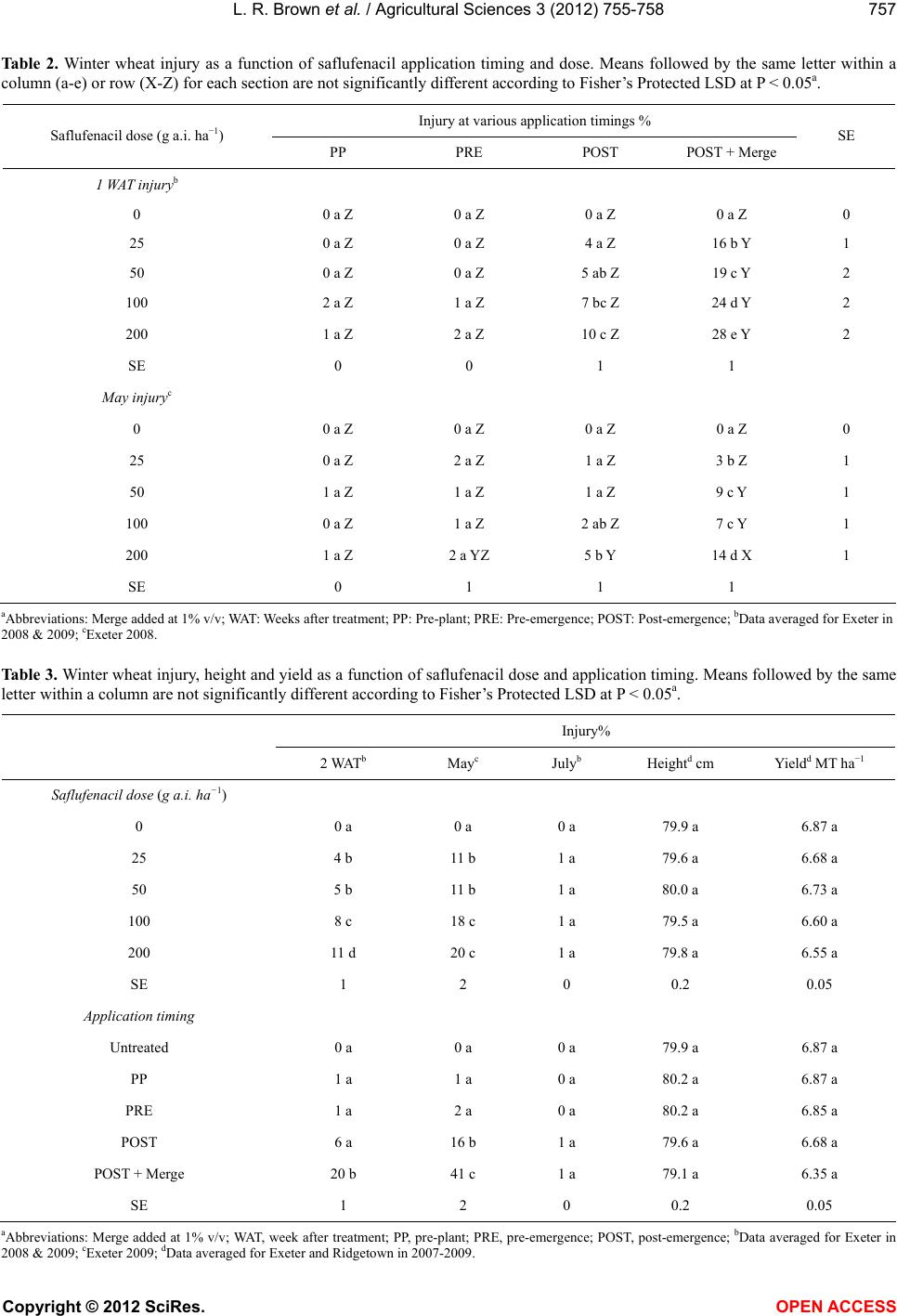 L. R. Brown et al. / Agricultural Sciences 3 (2012) 755-758 757 Table 2. Winter wheat injury as a function of saflufenacil application timing and dose. Means followed by the same letter within a column (a-e) or row (X-Z) for each section are not significantly different according to Fisher’s Protected LSD at P < 0.05a. Injury at various application timings % Saflufenacil dose (g a.i. ha−1) PP PRE POST POST + Merge SE 1 WAT injuryb 0 0 a Z 0 a Z 0 a Z 0 a Z 0 25 0 a Z 0 a Z 4 a Z 16 b Y 1 50 0 a Z 0 a Z 5 ab Z 19 c Y 2 100 2 a Z 1 a Z 7 bc Z 24 d Y 2 200 1 a Z 2 a Z 10 c Z 28 e Y 2 SE 0 0 1 1 May injuryc 0 0 a Z 0 a Z 0 a Z 0 a Z 0 25 0 a Z 2 a Z 1 a Z 3 b Z 1 50 1 a Z 1 a Z 1 a Z 9 c Y 1 100 0 a Z 1 a Z 2 ab Z 7 c Y 1 200 1 a Z 2 a YZ 5 b Y 14 d X 1 SE 0 1 1 1 aAbbreviations: Merge added at 1% v/v; WAT: Weeks after treatment; PP: Pre-plant; PRE: Pre-emergence; POST: Post-emergence; bData averaged for Exeter in 2008 & 2009; cExeter 2008. Table 3. Winter wheat injury, height and yield as a function of saflufenacil dose and application timing. Means followed by the same letter within a column are not significantly different according to Fisher’s Protected LSD at P < 0.05a. Injury% 2 WATb Mayc Julyb Heightd cm Yieldd MT ha−1 Saflufenacil dose (g a.i. ha−1) 0 0 a 0 a 0 a 79.9 a 6.87 a 25 4 b 11 b 1 a 79.6 a 6.68 a 50 5 b 11 b 1 a 80.0 a 6.73 a 100 8 c 18 c 1 a 79.5 a 6.60 a 200 11 d 20 c 1 a 79.8 a 6.55 a SE 1 2 0 0.2 0.05 Application timing Untreated 0 a 0 a 0 a 79.9 a 6.87 a PP 1 a 1 a 0 a 80.2 a 6.87 a PRE 1 a 2 a 0 a 80.2 a 6.85 a POST 6 a 16 b 1 a 79.6 a 6.68 a POST + Merge 20 b 41 c 1 a 79.1 a 6.35 a SE 1 2 0 0.2 0.05 aAbbreviations: Merge added at 1% v/v; WAT, week after treatment; PP, pre-plant; PRE, pre-emergence; POST, post-emergence; bData averaged for Exeter in 008 & 2009; cExeter 2009; dData averaged for Exeter and Ridgetown in 2007-2009. 2 Copyright © 2012 SciRes. OPEN ACCESS  L. R. Brown et al. / Agricultural Sciences 3 (2012) 755-758 758 (20%). Saflufenacil caused 11% (25 and 50 g a.i. ha−1), 18% (100 g a.i. ha−1) and 20% (200 g a.i. ha−1) injury in May of the following spring in winter wheat with the greatest injury occurring with the POST (16%) and POST + Merge (41%) applications (Table 3). As the season progressed into July, there was little to no injury from saflufenacil application the previous autumn. There was no effect of saflufenacil on winter wheat height or yield (Table 3). Even though saflufenacil ap- plied POST and POST + Merge caused up to 16% and 41% injury respectively, this injury was transient with no effect on winter wheat height or yield. These results dif- fer from studies conducted by Knezevic et al. [8] who reported a significant yield reduction (up to 66%) with autumn POST applications of saflufenacil and up to 67% with spring POST applications in winter wheat. 4. CONCLUSION This study concludes that there is an acceptable mar- gin of crop safety in winter wheat to PP and PRE appli- cations of saflufenacil. The POST applications caused injury that would be unacceptable to growers even though in this study it did not result in a yield loss. There was greater injury when saflufenacil was applied POST + Merge. Injury was the greatest at higher doses. Since this research has shown that saflufenacil can be applied safely to winter wheat either PP or PRE future research should focus on the control of winter annual, biennial and perennial broadleaf weeds. The autumn application of saflufenacil may eliminate the need for spring applied herbicides for broadleaf weed control. 5. ACKNOWLEDGEMENTS The authors would like to acknowledge Todd Cowan for his exper- tise and technical assistance in these studies. Funding for this project was provided in part by the Grain Farmers of Ontario (GFO) and BASF. REFERENCES [1] Frihauf, J.C., Stahlman, P.W. and Geier, R.W. (2010) Winter wheat and weed response to postemergence saflu- fenacil alone and in mixtures. Weed Science Society of America, 24, 262-268. doi:10.1614/WT-D-09-00020.1 [2] Lyon, D.J. and Kniss, A.R. (2010) Proso millet tolerance to saflufenacil. Weed Science Society of America, 24, 349- 355. doi:10.1614/WT-D-10-00001.1 [3] Moran, M.E. (2010) Preemergence and postemergence interactions of saflufenacil in corn (Zea mays L.). MSc thesis, University of Guelph, Guelph. [4] Sikkema, P.H., Shropshire, C. and Soltani, N. (2008) Tolerance of spring barley (Hordeum vulgare L.), oats (Avena sativa L.) and wheat (Triticum aestivum L.) to saflufenacil. Crop Protection, 27, 1495-1497. doi:10.1016/j.cropro.2008.07.009 [5] Soltani, N., Shropshire, C. and Sikkema, P.H. (2010) Sen- sitivity of leguminous crops to saflufenacil. Weed Science Society of America, 24, 143-146. doi:10.1614/WT-09-029.1 [6] Frihauf, J.C., Stahlman, P.W., Geier, P.W. and Peterson, D.E. (2010) Winter annual broadleaf weeds and winter wheat response to post emergence application of two sa- flufenacil formulations. Weed Science Society of America, 24, 416-424. doi:10.1614/WT-D-09-00049.1 [7] Geier, P.W., Stahlman, P.W. and Charvat, L.D. (2009) Dose responses of five broadleaf weeds to saflufenacil. Weed Science Society of America, 23, 313-316. doi:10.1614/WT-08-085.1 [8] Knezevic, S.Z., Datta, A., Scott, J. and Charvat, L.D. (2010) Tolerance of winter wheat (Triticum aestivum L.) to pre-emergence and post-emergence application of sa- flufenacil. Crop Protection, 29, 148-152. doi:10.1016/j.cropro.2009.08.017 Copyright © 2012 SciRes. OPEN ACCESS |