

Paper Menu >>
Journal Menu >>
 World Journal of AIDS, 2012, 2, 122-125 http://dx.doi.org/10.4236/wja.2012.23017 Published Online September 2012 (http://www.SciRP.org/journal/wja) 1 Driving Skills in HIV-Infected Patients Well Controlled with Antiretroviral Therapy Carlos Tornero1, Inmaculada Poquet1, Marine Bourguet1, Fernando Gomis-Pajares2* 1Ana Ventura, Maricarmen Mafé, Internal Medicine Department, Hospital Francisco de Borja, Gandia, España; 2Preventive Service, Hospital Francisco de Borja, Gandia, España. Email: *[email protected], [email protected] Received June 5th, 2012; revised July 2nd, 2012; accepted July 13th, 2012 ABSTRACT A study was made to determine whether HIV-infected patients with prolonged virological control suffer subclinical neurocognitive problems capable of interfering with driving skills, compared with the general population, and to ex- plore the possible existence of differences between those treated with and without efavirenz. Material and Methods: We included 40 patients without history of neoplasm, psychiatric disorders or infections of the central nervous system associated or not to HIV, with stable and effective antiretroviral therapy during at least 48 months. Use was made of the ASDE DRIVER TEST N-845 standardized by the Spanish traffic authorities, and for which data corresponding to the Spanish general population were obtained from the manufacturer of the test battery. The Student t-test was used to compare the different variables with the population standards, and the comparison of proportions Z-statistic was used to determine the proportion of subjects above the accepted limit of normality cutoff point. These analyses were replicated for the two sub-samples (with or without efavirenz therapy), with a 95% confidence level. The SPSS version 15 statis- tical package and Epidat 3.1 program were used. Resu lts: The scores obtained in the HIV group were significantly poorer in the anticipation speed tests and in one of the multiple reactions test, though better results were obtained in the bimanual visual-motor coordination test. There were no differences in the percentages of patients with scores below the recommended limits. On comparing the treatment subgroups (efavirenz versus protease inhibitor), no differences were recorded in any of the study va riables, and the differences with respect to the general population were the same as those described for the global group. Conclusions: Little differences were observed in driving skills in HIV well controlled HIV patients of minor clinical significance, and no differences were found in driving skills between the patien ts admin- istered Efavirenz and those receiving protease inhibitor treatments. Keywords: Driving Skills; Efavirenz; Neurocognitive Disorders 1. Introduction Infection produced by the human immunodeficiency vi- rus (HIV) has become a treatable chronic disease in which the current therapies aim to secure virological control and immunological recovery, but also to preserve patient quality of life with a view to allowing the return to normal social and occupational life. The preferential treatment protocols often include efavirenz (EFV). This drug has effects upon the central nervous system (CNS) that are particularly intense in the first weeks of therapy, bu t which become attenuated over time. Nevertheless, some authors have reported sleep and mood disturbances, apathy and concentration difficulties in patients subjected to chronic treatment with EFV [1-3]. On the other hand, there is great interest in exploring the neurocognitive disorders experienced by HIV-in- fected patients under conditions of virological control and immunological recovery. Subcortical and cortical disorders have been described in 30% - 70% of all well controlled patients, mostly in the form of asymptomatic alterations or minor neurocognitive disorders. Such al- terations have been associated to factors such as CD4 nadir, antiviral drug penetration of the CNS, or immune activetion [4,5]. Some studies have described increased patient driving risk as a result of these alterations [6,7]. The present study aims to determine whether HIV-in- fected patients with prolonged virological control suffer subclinical neurocognitive problems capable of interfer- ing with driving skills, compared with the general popu- lation, and to explore the possible existence of differ- ences between those treated with and without efavirenz. 2. Material and Methods An analytical study was carried out, comparing a sample *Corresponding a uthor. Copyright © 2012 SciRes. WJA  Driving Skills in HIV-Infected Patients Well Controlled with Antiretroviral Therapy 123 of HIV-infected patients with the data referred to the general population. Those patients meeting the following criteria were consecutively included until and estimated sample size of 40 was reached: A diagnosis of HIV infection. Stable and effective antiretroviral therapy (ART) maintaining viremias below the limit of detection for at least 48 months. Viral blips were not excluded, provided viremia returned to u ndetectable lev els, with no appearance of resistances or need for modifica- tions in ART. Maintenance during the mentioned time of the same treatment with EFV or with one of the protease in- hibitors (PIs). Compilation of a full clinical history. Patients with a history of neoplasms or infections of the CNS associated or not to HIV were excluded, as were patients suffering psychiatric disorders and subjected to treatments capable of interfering with the results (neuro- leptics, benzodiazepines, hypnotics, or active drug abuse). Non-sedating antidepressants and stable maintenance therapy with methadon e were allowed. The exposure variables were assignation to the HIV infection group or the general population, while the out- come variables were those obtained after applying the psycho-technical ASDE DRIVER TEST N-845 stan- dardized by the Spanish traffic authorities, and which comprises four groups of tests: Anticipation speed: Measu res subject capacity to per- ceive speeds. Bimanual visual-motor coordination: Evaluates sub- ject coordination of both hands simultaneously and independently. Multiple reaction times: Evaluates time and precision in responding to a stimulus of the four extremities. Concentration alteration and resistance to monotony test. All tests were preceded by a learning phase to ensure motivation and understanding of the test. The data cor- responding to the Spanish general population were ob- tained from the manufacturer of the test battery. In addition, information was collected referred to edu- cational level, the use of methadone, alcohol abuse, and CD4 current count and nadir. Regarding the statistical analysis, we first made a de- scriptive study of the HIV-infected patient group—quan- titative variables being reported as their central tendency (mean and median) and dispersion measures (standard deviation), and qualitative v ariables as absolute and rela- tive (%) frequencies. The Student t-test was used to compare the different variables with the population stan- dards in the cases of quantitative variables (after con- firming normal distribution). For each outcome variable we likewise used the Z-statistic to determine the propor- tion of subjects above the accepted limit of normality cutoff point. These analyses were applied to both sub- samples (with or without EFV therapy). A 95% confi- dence level was considered in all contrasts. Creation of the HIV-infected patient database and calculation of the descriptive parameters were based on the SPSS version 15 statistical package, while the Epidat 3.1 program was used for the bivariate analysis. A p < 0.05 was consid- ered of statistic significance. 3. Results The baseline characteristics of the patients are shown in Table 1. Compared with th e general population data, the Table 1. Characteristics of the study patients. Categorical variables are expressed as n (%), while quantitative variables are expressed as mean (standard deviation). Total HIV (N = 40) HIV-efavirenz HIV-No efavirenz (n = 19) Male gender 28 (70.0) 16 (76.2) 12 (63.2) Risk group Intravenous drug abuse 18 (45.0) 6 (28.6) 12 (63.2) Heterosexual 14 (35.0) 11 (52.4) 3 (15.8) Homosexual 6 (15.0) 3 (14.3) 3 (15.8) Not known 2 (5.0) 1 (4.8) 1 (5.3) Methadone treatment 2 ( 2. 2) 1 (4.8) 1 (5.3) Alcohol abuse 3 (2.2) 1 (4.8) 2 (10.5) Educational level Primary 25 (62.5) 9 (42.9) 16 (84.2) Secondary 8 (20.0) 6 (28.6) 2 (10.5) University 7 (17.5) 6 (28.6) 1 (5.3 Age (years) 45.5 (6.7) 46.4 (8.5) 44.4 (3.8) Undetectable VL (years) 7.7 (2.2) 7.9 (2.3) 7.5 (2.0) Current CD4 (cells/mm3) 676.1 (291.2) 769.6 (284.4) 572.6 (268.9) CD4 nadir (cells/mm3) 181.1 (178.4) 233.7 (190.0) 122.9 (140.6) Copyright © 2012 SciRes. WJA 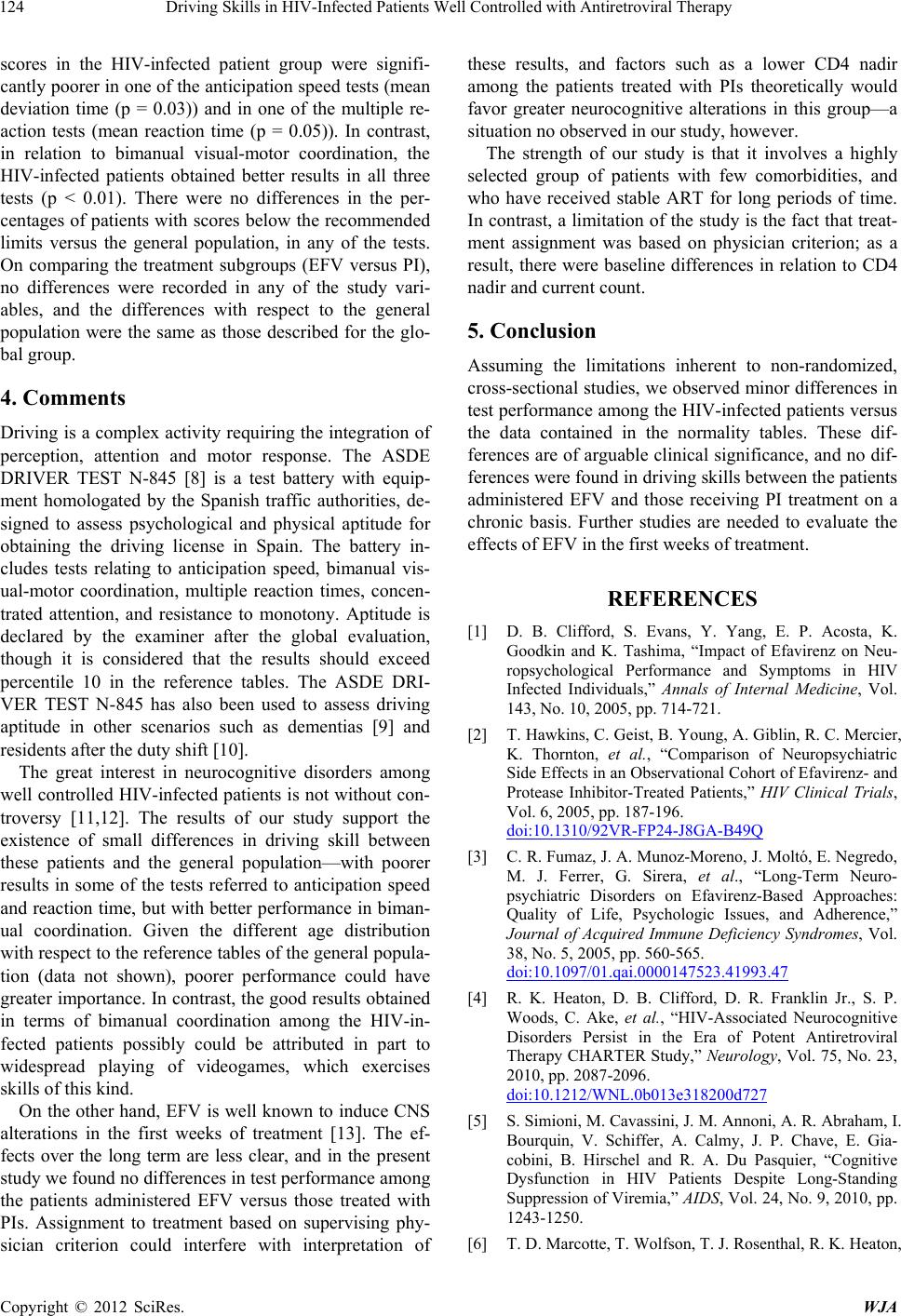 Driving Skills in HIV-Infected Patients Well Controlled with Antiretroviral Therapy 124 scores in the HIV-infected patient group were signifi- cantly poorer in one of th e anticipation speed tests (mean deviation time (p = 0.03)) and in one of the multiple re- action tests (mean reaction time (p = 0.05)). In contrast, in relation to bimanual visual-motor coordination, the HIV-infected patients obtained better results in all three tests (p < 0.01). There were no differences in the per- centages of patients with scores below the recommended limits versus the general population, in any of the tests. On comparing the treatment subgroups (EFV versus PI), no differences were recorded in any of the study vari- ables, and the differences with respect to the general population were the same as those described for the glo- bal group. 4. Comments Driving is a complex activity requ iring the integration of perception, attention and motor response. The ASDE DRIVER TEST N-845 [8] is a test battery with equip- ment homologated by the Spanish traffic authorities, de- signed to assess psychological and physical aptitude for obtaining the driving license in Spain. The battery in- cludes tests relating to anticipation speed, bimanual vis- ual-motor coordination, multiple reaction times, concen- trated attention, and resistance to monotony. Aptitude is declared by the examiner after the global evaluation, though it is considered that the results should exceed percentile 10 in the reference tables. The ASDE DRI- VER TEST N-845 has also been used to assess driving aptitude in other scenarios such as dementias [9] and residents after the duty shift [10]. The great interest in neurocognitive disorders among well controlled HIV-infected patients is not without con- troversy [11,12]. The results of our study support the existence of small differences in driving skill between these patients and the general population—with poorer results in some of the tests referred to anticipation speed and reaction time, but with better performance in biman- ual coordination. Given the different age distribution with respect to the reference tables of the general popula- tion (data not shown), poorer performance could have greater importance. In contrast, th e good results obtained in terms of bimanual coordination among the HIV-in- fected patients possibly could be attributed in part to widespread playing of videogames, which exercises skills of this kind. On the other hand, EFV is well known to induce CNS alterations in the first weeks of treatment [13]. The ef- fects over the long term are less clear, and in the present study we found no differences in test performance among the patients administered EFV versus those treated with PIs. Assignment to treatment based on supervising phy- sician criterion could interfere with interpretation of these results, and factors such as a lower CD4 nadir among the patients treated with PIs theoretically would favor greater neurocognitive alterations in this group—a situation no observed in our study, however. The strength of our study is that it involves a highly selected group of patients with few comorbidities, and who have received stable ART for long periods of time. In contrast, a limitation of the study is the fact that treat- ment assignment was based on physician criterion; as a result, there were baseline differences in relation to CD4 nadir and current count. 5. Conclusion Assuming the limitations inherent to non-randomized, cross-sectional studies, we observed minor differences in test performance among the HIV-infected patients versus the data contained in the normality tables. These dif- ferences are of arguable clinical significance, and no dif- ferences were found in driving skills b etween th e pa tien ts administered EFV and those receiving PI treatment on a chronic basis. Further studies are needed to evaluate the effects of EFV in the first weeks of treatment. REFERENCES [1] D. B. Clifford, S. Evans, Y. Yang, E. P. Acosta, K. Goodkin and K. Tashima, “Impact of Efavirenz on Neu- ropsychological Performance and Symptoms in HIV Infected Individuals,” Annals of Internal Medicine, Vol. 143, No. 10, 2005, pp. 714-721. [2] T. Hawkins, C. Geist, B. Young, A. Giblin, R. C. Mercier, K. Thornton, et al., “Comparison of Neuropsychiatric Side Effects in an Observational Cohort of Efavirenz- and Protease Inhibitor-Treated Patients,” HIV Clinical Trials, Vol. 6, 2005, pp. 187-196. doi:10.1310/92VR-FP24-J8GA-B49Q [3] C. R. Fumaz, J. A. Munoz-Moreno, J. Moltó, E. Negredo, M. J. Ferrer, G. Sirera, et al., “Long-Term Neuro- psychiatric Disorders on Efavirenz-Based Approaches: Quality of Life, Psychologic Issues, and Adherence,” Journal of Acquired Immune Deficiency Syndromes, Vol. 38, No. 5, 2005, pp. 560-565. doi:10.1097/01.qai.0000147523.41993.47 [4] R. K. Heaton, D. B. Clifford, D. R. Franklin Jr., S. P. Woods, C. Ake, et al., “HIV-Associated Neurocognitive Disorders Persist in the Era of Potent Antiretroviral Therapy CHARTER Study,” Neurology, Vol. 75, No. 23, 2010, pp. 2087-2096. doi:10.1212/WNL.0b013e318200d727 [5] S. Simioni, M. Cavassini, J. M. Annoni, A. R. Abraham, I. Bourquin, V. Schiffer, A. Calmy, J. P. Chave, E. Gia- cobini, B. Hirschel and R. A. Du Pasquier, “Cognitive Dysfunction in HIV Patients Despite Long-Standing Suppression of Viremia,” AIDS, Vol. 24, No. 9, 2010, pp. 1243-1250. [6] T. D. Marcotte, T. Wolfson, T. J. Rosenthal, R. K. Heaton, Copyright © 2012 SciRes. WJA  Driving Skills in HIV-Infected Patients Well Controlled with Antiretroviral Therapy 125 R. Gonzalez, R. J. Ellis and I. Grant, “HIV Neurobeha- vioral Research Center Group A Multimodal Assessment of Driving Performance in HIV Infection,” Neurology, Vol. 63, No. 8, 2004, pp. 1417-1422. doi:10.1212/01.WNL.0000141920.33580.5D [7] T. D. Marcotte, D. Lazzaretto, J. C. Scott, E. Roberts, S. P. Woods, S. Letendre and HNRC Group, “Visual Attention Deficits Are Associated with Driving Accidents in Cog- nitively-Impaired HIV-Infected Individuals,” Journal of Clinical and Experimental Neuropsychology, Vol. 28, No. 1, 2006, pp. 13-28. doi:10.1080/13803390490918048 [8] H. Monterde, “Real Decreto 772/97 ASDE Driver-Test N-845,” Examen Psicológico de Conductores en España con Equipos Normalizados, 2005. [9] D. Badenes Guia, “Discriminación de la Valoración de la Capacidad de Conducción de Vehículos en Personas con Diagnóstico de Deterioro Cognitivo Ligero y Demencia en los Exámenes de Conducción Normalizados,” MAP- FRE Medicina, Vol. 8, No. 2, 2007, pp. 98-107. [10] C. Tornero, A. Ventura, M. Bourguet and I. Poquet, “Evaluation of Driving Ability among Residents after the Duty Shift,” Accident Analysis & Prevention, Vol. 7, 2012, pp. 182-183. doi:10.1016/j.aap.2012.01.007 [11] M. Gisslén, W. Richard, R. W. Price and S. Nilsson III, “The Definition of HIV-Associated Neurocognitive Dis- orders: Are We Overestimating the Real Prevalence?” BMC Infectious Diseases, Vol. 11, 2011, pp. 356-360. doi:10.1186/1471-2334-11-356 [12] C. Torti, E. Foca, B. M. Cesana and F. X. Lescure, “As- ymptomatic Neurocognitive Disorders Inpatients Infected by HIV: Fact or Fiction?” BMC Medicine, Vol. 9, 2011, pp. 138-142. doi:10.1186/1741-7015-9-138 [13] M. Nelson, H. J. Stellbrink, D. Podzamczer, D. Banhegyi, B. Gazzard, A. Hill and Y. van Delft, “A Comparison of Neuropsychiatric Adverse Events during 12 Weeks of Treatment with Etravirine and Efavirenz in a Treat- ment-Naive, HIV-1-Infected Population,” AIDS, Vol. 25, No. 3, 2011, pp. 335-340. doi:10.1097/QAD.0b013e3283416873 Copyright © 2012 SciRes. WJA |