

Paper Menu >>
Journal Menu >>
 Vol.3, No.5, 663-668 (2012) Agricultural Sciences http://dx.doi.org/10.4236/as.2012.35080 Influence of different levels of humic acid and esterified glucomannan on growth performance and intestinal morphology of broiler chickens Seyed Mozafar S. M. Taklimi1, Hassan Ghahri2, Mohammad Asadi Isakan1 1Department of Animal Physiology and Nutrition, Animal Science Research Institute, Karaj, Iran; *Corresponding Author: [email protected], [email protected] 2Urmia Branch Islamik Azad University, Urmia, Iran Received 25 January 2012; revised 7 March 2012; accepted 2 May 2012 ABSTRACT A s tudy was under taken to investigate the effe ct of dietary supplementations of humic acid and esterified glucomannan on broiler performance and the morphological measurements of small intestine. Two hundred and ten-day-old broiler chicks were weighed and randomly assigned to seven treatment groups in triplicate. The dietary treatments included (T1) control (basal diet without any additives), (T2) basal diets supple- mented with 0.1% humic acid, (T3) basal diets supplemented with 0.2% humic acid, (T4) basal diets supplemented with 0.3% humic acid, (T5) basal diets supplemented with 0.1% esterified glucomannan, (T6) basal diets supplemented with 0.2% esterified glucomannan and (T7) basal diets supplemented with 0.3% esterified gluco- mannan. Different parameters including body weight gain (BWG), feed intake (FI), feed con- version ratio (FCR) and morphology of small in- testine were evaluated during six weeks of ex- perimental period. According to the results, at the end of experimental period, the highest av- erage BWG were recorded in T4 group (fed with 0.3% humic acid), compared to control (T1) and other experimental groups (p < 0.05). Whereas, the highest body weight gain were observed during starter period in treatment 7 (fed with 0.3% esterified glucomannan) as compare to other experiment al groups (p < 0.05). S t atistically, feed intake remained unaffected during the ex- perimental period in all the treatment groups. However, the lowest and the highest feed intake were observed numerically within treatments T4 and T1 with 4229.70 g and 4362.30 g, respec- tively. Addition of dietary supplements used in the study appeared to have significant effect on the morphology of the small intestine (jejunum mucosal development) of the broilers in differ- ent tre a t m e n t g r o u ps. C om par ed t o c o n tr o l group, the inclusion of either humic acid or esterified glucomannon decreased (p < 0.01) the crypt depth and increased villus height respectively (p < 0.05). Moreover, the diet supplements with humic acid 0.3% (T4) decreased crypt depth compared to esterified glucomannan and con- trol. The dietary supplementations resulted in an increase in the villus height of intestinal mucosa of broilers. The increase in the villus height was associated with improvement of growth perfor- mance for both humic acid and esterified glu- comannan. Based on our result s it appeared that humic acid and esterified glucomannan can be used as a growth promoter in broiler diets and they can improve the gut health too. Keywords: Broiler Chicks; Humic Acid; Esterified Glucomannan; Small Intestine 1. INTRODUCTION Any attribute which can improve gastrointestinal tract health and immunity is extremely valuable in broiler diets. In last decades antibiotics had been used widely world-wide in poultry industry in order to prevent poul- try pathogens and disease and to improve meat and egg production. However, with the unavoidable spread of bacterial resistance and cross resistance the use of antibi- otics has been considered hazardous [1-3]. As conse- quences, many alternatives have been discussed includ- ing probiotics, prebiotics, herbal compounds and organic acids. Most of these substances exert their effects by in- fluencing gastrointestinal flora and digestion processes. Among these alternatives the influence of humic acid has been studied extensively, and has been reported to have Copyright © 2012 SciRes. OPEN ACCESS  S. M. S. M. Taklimi et al. / Agricultural Sciences 3 (2012) 663-668 664 positive impact on the growth performance of birds. Humic acid defined as a class of compounds resulting from decomposition of organic matter, particularly plants are natural constituents of drinking water, soil and lignite. Humic acid inhibit bacterial and fungal growth, thus de- crease levels of mycotoxins in feed [4,5]. Beneficial ef- fects of humic acid are described concerning stress ma- nagement [6], immune system [7,8], anti-inflammatory activity [9], antiviral properties [10], as well as preven- tion of intestinal diseases, mainly diarrhea in humans and animals. There are also reports that routine use of humic acid in the feed has a positive influence on growth of broilers [11,12]. The beneficial effect of humic acid on growth in different species of animals has been consid- ered its capacity of changing gut physiology and inter- ference in immunity [13]. Beside humic acid, yeast and yeast cultures have a long standing tradition of use in animal feeds. Yeast culture has been shown to affect in- testinal mucosa development in poultry. In addition to growth performance, there are many trials showing that enrichment of diets with yeast could favorably improve the quality of edible meat from broilers. Yeast is also an excellent source of selenium and chromium; two trace minerals which may have positive effects of broiler health [14]. Since, 80’s decades Oligosaccharide from outer cell wall component of live yeast (Saccharomyces cerevisiae), were introduced as a feed additive commer- cially in poultry industry. Since then, many studies have been conducted to investigate the effects of esterified glucomannan or it’s derivatives on various parameters such as body weight, feed conversion ratio and feed in- take of birds [15-17]. The objective of this study was to determine if experimental supplementation of different level of humic acid and esterified glucomannan in the young broiler chicken diet may improve performance and small intestine mucosal development of broiler chicks. 2. MATERIALS AND METHOD 2.1. Birds and Experimental Design Two hundred and ten-day old (mixed sex) commercial Ross broiler chicks were randomly subjected to seven different treatment groups (three replicates of 10 chicks per dietary treatment). All birds were weighed (initial weight) individually after their arrival from the hatchery to the experimental farm, and on completion of the ex- periment day 42. The experiment was designed com- pletely randomized to evaluate the effect of two different naturally available feed additives humic acid (FH = Farmagu lator D RYTM humate Yayalar Mah. Sanayi Cad. No. 29, Dolayoba, Pendik, Istanbul, Tu rkey ), and esteri- fied glucomannan, (Bio-Mos, USA) on small intestine mucosal development of digestive tract of birds. The birds were fed one of seven experimental treatments for 42 days. The experimental diets were as follows: T1 = Control (basal diet + no feed additives). T2 = T1 + 0.1%, T3 = T1+ 0.2% and T4 = T1+ 0.3% humic acid and T5 = T1 + 0.1%, T6 = T1 + 0.2% and T7 = T1 + 0.3% esteri- fied glucomannan, respectively. 2.2. Performance All chicks were reared under uniform management conditions with feed and water available ad libitum. In- dividual body weight gain (BWG), feed intake (FI), feed conversion ratio (FCR) of the birds were recorded at the onset of experiments and measured daily thereafter for each group. 2.3. Small Intestine Mucosal Development Studies To study the mucosal development of small intestine of the chicks at the end of experimental period, 3 birds were selected randomly from each replicate and sacri- ficed and their histomorphology studied. Gut morphology (jejunum) examinations were carried out according to the method which was described [18]. Jejunum samples were immersed in 4% formalin for 48 hrs. The processing consisted of serial dehydration, clear- ing, and impregnation with wax. Tissue sample was sec- tioned at a thickness of 7 - 8 μm, were cut by a micro- tome and were fixed on slides. A routine staining proce- dure was carried out using hematoxylin and eosin. The slides were viewed on a microscope. Visual observations of villus height, crypt depth were made at 10.25× magni- fication under an IMI microscope. 2.4. Statistics All data were statistically analyzed by ANOVA using the SAS system [19]. Significant differences between the treatment means were compared by using Duncan Multi- ple Range test [20]. The statistical model used was Yij = µ + Ti + eij where, Yij = observation in block i and treatment j, µ = Over- all sample mean, Ti = Effect of treatment i, eij = Error. 3. RESULTS The effect of different levels of humic acid and esteri- fied glucomannan on body weight gain of broilers during the experimental period is shown in Table 1. A sig- nificant increase in BWG was recorded in birds which was fed with either humic acid or esterified glucomannan (p < 0.05). According to the results, birds fed with 0.3% Copyright © 2012 SciRes. OPEN ACCESS  S. M. S. M. Taklimi et al. / Agricultural Sciences 3 (2012) 663-668 665 Table 1. Effects of humic acid and esterified glucomannan on mean BWG (g) of Broiler. 0 - 42 days21 - 42 days 0 - 21 days Treatments 2147.00b 1459.67b 687.33c T1 (control) 2267.33ab 1554.67bc 712.67bc T2 (0.1% Humic acid) 2337.67a 1611.33a 726.33abc T3 (0.2% Humic acid) 2373.67a 1650.33a 723.33abc T4 (0.3% Humic acid) 2277.67ab 1551.00ab 726.67abc T5 (0.1% Live yeast) 2363.33a 1622.67a 740.67ab T6 (0.2% Live yeast) 2331.67a 1602.00a 763.00a T7 (0.3% Live yeast) * * * *Mean bears not common superscript are different significantly (p < 0.05). a,b,cmeans: Values in the table shows with different superscripts are signifi- cantly different (p < 0.05). estrified glucomannan performed well at the early age, while with advancing age, humic acid had an increasing effect on overall performance of the birds. The highest and the lowest BWG was observed in T7 and T1 (763.00 vs 687.33 g) during their initial growing phase (0 - 21 days), respectively, while, chicks in T4 (0.3% humic acid) gained more body weight during the 2nd phase of growth (21 - 42 days) as well during the whole experimental period (p < 0.05). As Table 2 indicates, feed intakes were not affected significantly by inclusions of different levels of either humic acid or esterified glucomannan in diets, during the experimental period. However, feed conversion ratio of the chicks in different treatment groups were signifi- cantly different with the presence of either humic acid or esterified glucomannan. According to the results pre- sented in Ta b l e 3, the highest feed conversion ratio was observed in T4 (1.781), as compared to other experimen- tal groups (p < 0.01). Overall results indicated that, birds fed diets with humic acid (0.3%) had higher mean live weight gain, low feed intake and better feed conversion ratio. Table 4 indicated that, feed additives used in this study had significantly effect on the villus height (p < 0.05) of broiler chicks (Figure 1). All levels of humic acid and esterified glucomannan used had the ability to increase crypt depth (p < 0.01). Where as, highest crypt depth were observed in T7, compared to other treatments. As evidence shows that, effects of humic acid and esteri- fied glucomannan, is proposed to be due to their contents of anti bacterial agents and enhancement of multiplica- tions of beneficial macroscopic bacteria and elimination of harmful bacteria in bird's digestive tract. 4. DISCUSSION According to the results of this experiment, humic acid Table 2. Effects of humic acid and esterified glucomannan on FI (g) of Broiler. 0 - 42 days21 - 42 days 0 - 21 days Treatments 4362.30 3274.30 1088.00 T1 (control) 4295.00 3217.30 1077.67 T2 (0.1% Humic acid) 4285.70 3253.00 1032.67 T3 (0.2% Humic acid) 4229.70 3172.00 1057.67 T4 (0.3% Humic acid) 4274.30 3217.30 1042.00 T5 (0.1% Live yeast) 4317.00 3257.00 1060.00 T6 (0.2% Live yeast) 4327.70 3265.70 1062.00 T7 (0.3% Live yeast) ns ns ns ns = Not significantly different (p < 0.05). Table 3. Effects of humic acid and esterified glucomannan on mean FCR. 0 - 42 days21 - 42 days 0 - 21 days Treatments 2.031a 2.243a 1.583a T1 (control) 1.894b 2.069b 1.512ab T2 (0.1% Humic acid) 1.833c 2.018bc 1.421b T3 (0.2% Humic acid) 1.781d 1.922c 1.462ab T4 (0.3% Humic acid) 1.876c 2.074b 1.433b T5 (0.1% Live yeast) 1.826c 2.00bc 1.431b T6 (0.2% Live yeast) 1.856c 2.038b 1.392ab T7 (0.3% Live yeast) ** ** * *Mean bears not common superscript are different significantly (p < 0.05); **Mean bears not common superscript are different significantly (p < 0.01). a,b,cmeans: Values in the table shows with different superscripts are signifi- cantly different (p < 0.05). Table 4. Effects of humic acid and esterified glucomannan on Jejunum mucosal development of broiler. Crypt depth (mm)Length of villiae (mm) Treatments 2.243a 1.026b T1 (control) 2.069b 1.290ab T2 (0.1% Humic acid) 2.018bc 1.383a T3 (0.2% Humic acid) 1.922c 1.340a T4 (0.3% Humic acid) 2.074b 1.260ab T5 (0.1% Live yeast) 2.00bc 1.293ab T6 (0.2% Live yeast) 2.038b 1.246b T7 (0.3% Live yeast) ** * *Mean bears not common superscript are different significantly (p < 0.05); **Mean bears not common superscript are different significantly (p < 0.01). a,b,cmeans: Values in the table shows with different superscripts are signifi- cantly different (p < 0.05). Copyright © 2012 SciRes. OPEN ACCESS 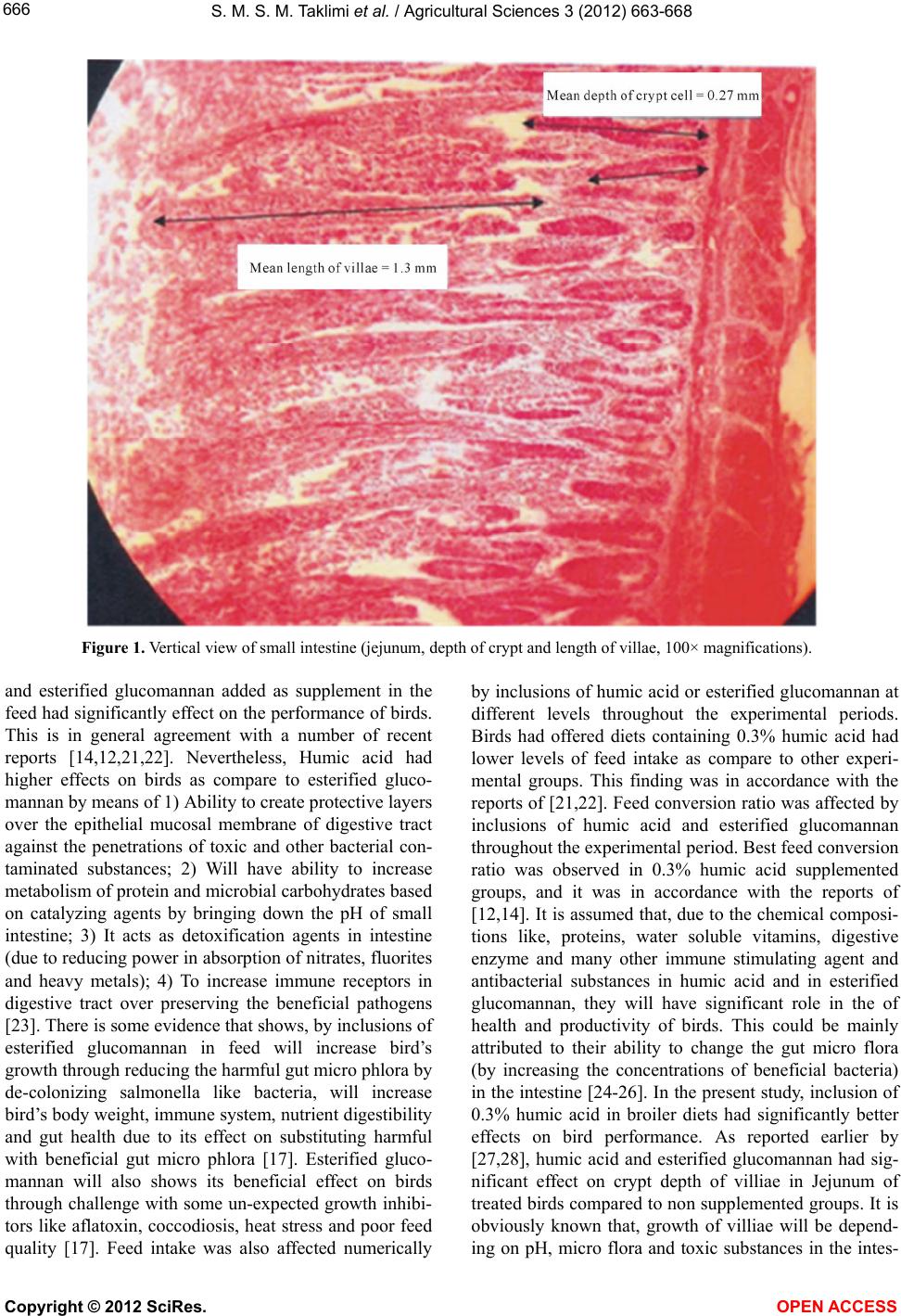 S. M. S. M. Taklimi et al. / Agricultural Sciences 3 (2012) 663-668 Copyright © 2012 SciRes. 666 Figure 1. Vertical view of small intestine (jejunum, depth of crypt and length of villae, 100× magnifications). and esterified glucomannan added as supplement in the feed had significantly effect on the performance of birds. This is in general agreement with a number of recent reports [14,12,21,22]. Nevertheless, Humic acid had higher effects on birds as compare to esterified gluco- mannan by means of 1) Ability to create protective layers over the epithelial mucosal membrane of digestive tract against the penetrations of toxic and other bacterial con- taminated substances; 2) Will have ability to increase metabolism of protein and microbial carbohydrates based on catalyzing agents by bringing down the pH of small intestine; 3) It acts as detoxification agents in intestine (due to reducing power in absorption of nitrates, fluorites and heavy metals); 4) To increase immune receptors in digestive tract over preserving the beneficial pathogens [23]. There is some evidence that shows, by inclusions of esterified glucomannan in feed will increase bird’s growth through reducing the harmful gut micro phlora by de-colonizing salmonella like bacteria, will increase bird’s body weight, immune system, nutrient digestibility and gut health due to its effect on substituting harmful with beneficial gut micro phlora [17]. Esterified gluco- mannan will also shows its beneficial effect on birds through challenge with some un-expected growth inhibi- tors like aflatoxin, coccodiosis, heat stress and poor feed quality [17]. Feed intake was also affected numerically by inclusions of humic acid or esterified glucomannan at different levels throughout the experimental periods. Birds had offered diets containing 0.3% humic acid had lower levels of feed intake as compare to other experi- mental groups. This finding was in accordance with the reports of [21,22]. Feed conversion ratio was affected by inclusions of humic acid and esterified glucomannan throughout the experimental period. Best feed conversion ratio was observed in 0.3% humic acid supplemented groups, and it was in accordance with the reports of [12,14]. It is assumed that, due to the chemical composi- tions like, proteins, water soluble vitamins, digestive enzyme and many other immune stimulating agent and antibacterial substances in humic acid and in esterified glucomannan, they will have significant role in the of health and productivity of birds. This could be mainly attributed to their ability to change the gut micro flora (by increasing the concentrations of beneficial bacteria) in the intestine [24-26]. In the present study, inclusion of 0.3% humic acid in broiler diets had significantly better effects on bird performance. As reported earlier by [27,28], humic acid and esterified glucomannan had sig- nificant effect on crypt depth of villiae in Jejunum of treated birds compared to non supplemented groups. It is obviously known that, growth of villiae will be depend- ing on pH, micro flora and toxic substances in the intes- OPEN ACCESS 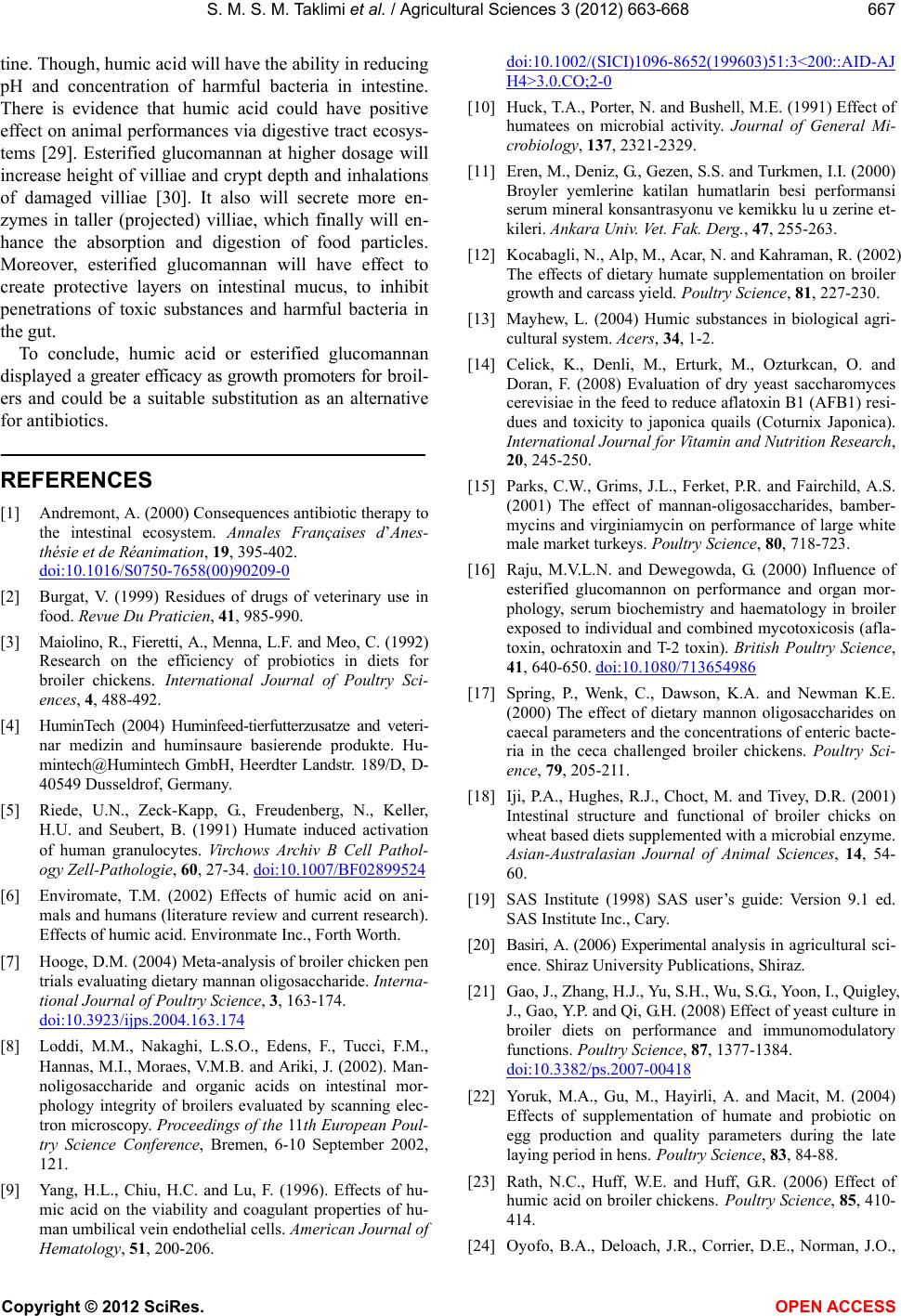 S. M. S. M. Taklimi et al. / Agricultural Sciences 3 (2012) 663-668 667 tine. Though, humic acid will have the ability in reducing pH and concentration of harmful bacteria in intestine. There is evidence that humic acid could have positive effect on animal performances via digestive tract ecosys- tems [29]. Esterified glucomannan at higher dosage will increase height of villiae and crypt depth and inhalations of damaged villiae [30]. It also will secrete more en- zymes in taller (projected) villiae, which finally will en- hance the absorption and digestion of food particles. Moreover, esterified glucomannan will have effect to create protective layers on intestinal mucus, to inhibit penetrations of toxic substances and harmful bacteria in the gut. To conclude, humic acid or esterified glucomannan displayed a greater efficacy as growth promoters for broil- ers and could be a suitable substitution as an alternative for antibiotics. REFERENCES [1] Andremont, A. (2000) Consequences antibiotic therapy to the intestinal ecosystem. Annales Françaises d’Anes- thésie et de Réanimation, 19, 395-402. doi:10.1016/S0750-7658(00)90209-0 [2] Burgat, V. (1999) Residues of drugs of veterinary use in food. Revue Du Praticien, 41, 985-990. [3] Maiolino, R., Fieretti, A., Menna, L.F. and Meo, C. (1992) Research on the efficiency of probiotics in diets for broiler chickens. International Journal of Poultry Sci- ences, 4, 488-492. [4] HuminTech (2004) Huminfeed-tierfutterzusatze and veteri- nar medizin and huminsaure basierende produkte. Hu- mintech@Humintech GmbH, Heerdter Landstr. 189/D, D- 40549 Dusseldrof, Germany. [5] Riede, U.N., Zeck-Kapp, G., Freudenberg, N., Keller, H.U. and Seubert, B. (1991) Humate induced activation of human granulocytes. Virchows Archiv B Cell Pathol- ogy Zell-Pathologie, 60, 27-34. doi:10.1007/BF02899524 [6] Enviromate, T.M. (2002) Effects of humic acid on ani- mals and humans (literature review and current research). Effects of humic acid. Environmate Inc., Forth Worth. [7] Hooge, D.M. (2004) Meta-analysis of broiler chicken pen trials evaluating dietary mannan oligosaccharide. Interna- tional Journal of Poultry Science, 3, 163-174. doi:10.3923/ijps.2004.163.174 [8] Loddi, M.M., Nakaghi, L.S.O., Edens, F., Tucci, F.M., Hannas, M.I., Moraes, V.M.B. and Ariki, J. (2002). Man- noligosaccharide and organic acids on intestinal mor- phology integrity of broilers evaluated by scanning elec- tron microscopy. Proceedings of the 11th European Poul- try Science Conference, Bremen, 6-10 September 2002, 121. [9] Yang, H.L., Chiu, H.C. and Lu, F. (1996). Effects of hu- mic acid on the viability and coagulant properties of hu- man umbilical vein endothelial cells. American Journal of Hematology, 51, 200-206. doi:10.1002/(SICI)1096-8652(199603)51:3<200::AID-AJ H4>3.0.CO;2-0 [10] Huck, T.A., Porter, N. and Bushell, M.E. (1991) Effect of humatees on microbial activity. Journal of General Mi- crobiology, 137, 2321-2329. [11] Eren, M., Deniz, G., Gezen, S.S. and Turkmen, I.I. (2000) Broyler yemlerine katilan humatlarin besi performansi serum mineral konsantrasyonu ve kemikku lu u zerine et- kileri. Ankara Univ. Vet. Fak. Derg., 47, 255-263. [12] Kocabagli, N., Alp, M., Acar, N. and Kahraman, R. (2002) The effects of dietary humate supplementation on broiler growth and carcass yield. Poultry Science, 81, 227-230. [13] Mayhew, L. (2004) Humic substances in biological agri- cultural system. Acers, 34, 1-2. [14] Celick, K., Denli, M., Erturk, M., Ozturkcan, O. and Doran, F. (2008) Evaluation of dry yeast saccharomyces cerevisiae in the feed to reduce aflatoxin B1 (AFB1) resi- dues and toxicity to japonica quails (Coturnix Japonica). International Journal for Vitamin and Nutrition Research, 20, 245-250. [15] Parks, C.W., Grims, J.L., Ferket, P.R. and Fairchild, A.S. (2001) The effect of mannan-oligosaccharides, bamber- mycins and virginiamycin on performance of large white male market turkeys. Poultry Science, 80, 718-723. [16] Raju, M.V.L.N. and Dewegowda, G. (2000) Influence of esterified glucomannon on performance and organ mor- phology, serum biochemistry and haematology in broiler exposed to individual and combined mycotoxicosis (afla- toxin, ochratoxin and T-2 toxin). British Poultry Science, 41, 640-650. doi:10.1080/713654986 [17] Spring, P., Wenk, C., Dawson, K.A. and Newman K.E. (2000) The effect of dietary mannon oligosaccharides on caecal parameters and the concentrations of enteric bacte- ria in the ceca challenged broiler chickens. Poultry Sci- ence, 79, 205-211. [18] Iji, P.A., Hughes, R.J., Choct, M. and Tivey, D.R. (2001) Intestinal structure and functional of broiler chicks on wheat based diets supplemented with a microbial enzyme. Asian-Australasian Journal of Animal Sciences, 14, 54- 60. [19] SAS Institute (1998) SAS user’s guide: Version 9.1 ed. SAS Institute Inc., Cary. [20] Basiri, A. (2006) Experimental analysis in agricultural sci- ence. Shiraz University Publications, Shiraz. [21] Gao, J., Zhang, H.J., Yu, S.H., Wu, S.G., Yoon, I., Quigley, J., Gao, Y.P. and Qi, G.H. (2008) Effect of yeast culture in broiler diets on performance and immunomodulatory functions. Poultry Science, 87, 1377-1384. doi:10.3382/ps.2007-00418 [22] Yoruk, M.A., Gu, M., Hayirli, A. and Macit, M. (2004) Effects of supplementation of humate and probiotic on egg production and quality parameters during the late laying period in hens. Poultry Science, 83, 84-88. [23] Rath, N.C., Huff, W.E. and Huff, G.R. (2006) Effect of humic acid on broiler chickens. Poultry Science, 85, 410- 414. [24] Oyofo, B.A., Deloach, J.R., Corrier, D.E., Norman, J.O., Copyright © 2012 SciRes. OPEN ACCESS  S. M. S. M. Taklimi et al. / Agricultural Sciences 3 (2012) 663-668 Copyright © 2012 SciRes. OPEN ACCESS 668 Ziprin R.L. and Mollenhauer, H.H. (1989) Prevention of Salmonella typhimurium colonization of broilers with D-mannose. Poultry Science, 68, 1357-1360. doi:10.3382/ps.0681357 [25] Savage, T.F., Nakaue, H.S. and Holms, Z.A. (1985) Ef- fects of feeding live yeast culture on market turkey per- formance and cooked meat characteristics. Nutrition Re- ports International, 31, 695-703. [26] Schepetkin, I.A., Khlebnikov, A.I., Ah, S.Y., Woo, S.B., Jeong, C.S., Klubachuk, O.N. and Kwon, B.S. (2003) Characterization and biological activities of humic sub- stances from mumie. Journal of Agricultural and Food Chemistry, 51, 5245-5254. doi:10.1021/jf021101e [27] Santin, E., Maiorka, A., Macari, M., Grecco, M., Okada, T.M. and Myasaka, A.M. (2001) Performance and intes- tinal mucosa development of broiler chickens fed diets containing Saccahromyces cerevisiae cell wall. The Jour- nal of Applied Poultry Research, 10, 236-244. [28] Zhang, A.W., Lee, B.D., Lee, S.K., An, G.H., Song, K.B. and Lee, C.H. (2005) Effects of yeast (Saccharomyces cerevisiae) cell components on growth performance, meat quality and ileal mucosa development of broiler chicks. Poultry Science, 84, 1015-1021. [29] Shermer, C.L., Maciorowski, K.G., Baily, C.A., Byers, F.M. and Ricke, S. (1998) Caecal metabolites and micro- bial populations in chickens consuming diets containing a mined humate compound. Journal of the Science of Food and Agriculture, 77, 479-486. doi:10.1002/(SICI)1097-0010(199808)77:4<479::AID-JS FA607>3.0.CO;2-L [30] Hampson, D.J. (1986) Alterations in piglet small intesti- nal structure at weaning. Research in Veterinary Science, 40, 32-40. |