

Paper Menu >>
Journal Menu >>
 Advances in Bioscience and Biotechnology, 2012, 3, 620-625 ABB http://dx.doi.org/10.4236/abb.2012.35080 Published Online September 2012 (http://www.SciRP.org/journal/abb/) Bile tolerance of Lactobacillus acidophilus LA-K as influenced by various pulsed electric field conditions Olga Cueva1, Kayanush J. Aryana1,2* 1School of Animal Sciences, Louisiana State University Agricultural Center, Baton Rouge, USA 2Department of Food Science, Louisiana State University Agricultural Center, Baton Rouge, USA Email: *[email protected] Received 15 June 2012; revised 20 July 2012; accepted 15 August 2012 ABSTRACT Lactobacillus acidophilus has several health benefits and is used as an adjunct bacterium in the manufac- ture of cultured dairy foods. Bile tolerance is an im- portant probiotic characteristic. Pulsed electric field (PEF) processing is non-thermal, hurdle technology which comprises of passing fluid foods between two electrodes and subjecting them to pulses of voltage for less than one second. Whether certain mild PEF conditions can enhance bile tolerance of Lactobacillus acidophilus is not known. The objective was to study the influence of certain PEF conditions on the, bile tolerance of Lactobacillus acidophilus LA-K. Lactoba- cillus acidophilus LA-K suspended in sterile peptone 0.1% w/v distilled water was treated with pulse widths of 3, 6 and 9 µs, pulse periods of 10,000; 20,000 and 30,000 µs and electric field strengths of 5, 15 and 25 kV/cm. The control did not receive any pulsed electric field condition. Bile tolerance was de- termined hourly for 16 hours. PROC GLM of the Statistical Analysis Systems (SAS) was used for data analysis. Significant differences were determined at p < 0.05. Three replications were conducted. Bipolar pulse width effect had a significant (p < 0.0001) in- fluence on the bile tolerance. Bile tolerance of the control was significantly higher than the bile toler- ance subjected to any of the bipolar pulse widths studied. There were no significant differences among the three different bipolar pulse widths. Pulse period had a significant (p < 0.0001) influence on the bile tolerance. The control and the three different pulse periods studied were significantly different from each other. The bile tolerance of the control was signifi- cantly the highest, followed by the bile tolerances subjected to 30,000 µs and 20,000 µs respect ively. The bile tolerance subjected to 10,000 µs was significantly the lowest. Electric field strength had a significant (p < 0.0001) influence on the bile tolerance. Bile toler- ance of the control and bile tolerance of Lactobacillus acidophilus LA-K subjected to 5 kV/cm were signifi- cantly the highest while the bile tolerance when sub- jected to 25 kV/cm was significantly the lowest. Keywords: Bile Tolerance; Lactobacillus acidophilus; Pulsed Electric Field; Probiotic 1. INTRODUCTION Application of high electric field strengths (typically 20 - 80 kV/cm) for short time periods (less than 1 second) to fluid foods places between two electrodes is what high intensity pulsed electric field (PEF) processing is [1]. There are several PEF factors that influence microbial inactivation, they are electric field strength, pulse wave shape, treatment time and treatment temperature. Electric field strength, is one of the main factors in- fluencing microbial inactivation, and is determined by the voltage (kV) across the electrodes and the distance between the electrodes (cm). Increasing the gap will re- quire higher voltage to obtain the desired electric field strength [2]. The microbial inactivation increases with an increase in the electric field intensity, above the critical transmembrane potential [3]. Pore formation will occur when a certain threshold value of the transmembrane potential formed is exceeded, which was found to be in the range of 1 V [4]. To achieve this transmembrane po- tential an electric field strength above 30 kV/cm is re- quired for most bacteria in liquid systems [5]. Pulse Waves shape can be in the form of exponential decaying pulses, square wave pulses, oscillatory pulses or bipolar pulses of electric fields. In terms of pulse shape, square wave pulses are more energy and lethally efficient than exponential decaying pulses [6]. Oscilla- tory pulses are the least efficient for microbial inactiva- tion because they prevent the cell from being continu- ously exposed to a high intensity electric field for an extended period of time [7]. In terms of pulse polariza- tion, bipolar pulses are more lethal than monopolar *Corresponding author. OPEN ACCESS  O. Cueva, K. J. Aryana / Advances in Bioscience and Biotechnology 3 (2012) 620-625 621 pulses. Bipolar pulses produce alternating changes in the movement of charged molecules, which cause a stress in the cell membrane and enhance its electric breakdown. Moreover, bipolar pulse reduces deposition of solids on the electrode surface, decreases food electrolysis, and is energy efficient [8]. Treatment time has been earlier defined as the product of the number of pulses and the pulse width [2]. The pulse width is defined as the time where the peak field is maintained for square wave pulses or the time until de- cay to 37% for exponential decay pulses. Pulse width influences microbial reduction by affecting the electric field intensity. Longer pulse widths decrease electric field intensity, which result in higher inactivation; how- ever, an increase in pulse width may also result in an unwanted food temperature increase. Hülsheger et al. [9] developed a mathematical model that relates microbial survival fraction with PEF treatment time. The inactiva- tion of microorganisms increases with an increase in treatment time [10]. The treatment time for the inactiva- tion kinetics of tomato juice lipoxygenase by pulsed electric field was calculated with the following formula: Treatment time = volume of 1 chamber (mL)/flow rate (mL/sec)*pulse per second*number of chambers*pulse width [11]. Treatment Temperature is influenced by constant elec- tric field strength. Constant electric field strength in- creases microbial inactivation as well as increases the temperature in foods. For this reason, proper cooling is necessary to maintain food temperatures far below those generated by thermal pasteurization. Vega-Mercado et al. [12] reported that E. coli reduction was observed to in- crease from 1 to 6.5 log reduction cycles with a tem- perature change from 32˚C to 55˚C. Several health benefits of Lactobacillus acidophilus have been reported earlier [13]. Any probiotic bacterium needs to survive the bile conditions in the gastrointestinal (GI) tract before establishing in the lower GI tract to confer the health benefits upon the host. It is not known if mild PEF conditions can enhance the bile tolerance of this health beneficial bacterium. The objective was to study the influence of pulsed width, pulse period and kV on the bile tolerance Lactobacillus acidophilus LA-K. 2. MATERIALS AND METHODS 2.1. Experimental Design Freshly thawed 1% (v/v) of Lactobacillus acidophilus (F-DVS LA-K, Chr. Hansen’s Laboratory, Milwaukee, WI, USA) in peptone water (0.1% wt/v) at room tem- perature (21˚C) was subjected to various PEF treatment conditions. The treatments were pulse widths of 3, 6, and 9 µs, pulse periods of 10,000, 20,000, and 30,000 µs, electric field strengths of 5, 10, and 15 kV/cm. Control was run through the PEF equipment at 60 mL/min with- out receiving any pulsed electric field treatment. Bile tolerances, were determined in the control and PEF treatment samples hourly over 16 hours of incubation. All experiments were repeated three times. 2.2. Bile Tolerance Test Bile tolerance of Lactobacillus acidophilus LA-K was conducted as described earlier [14] with slight modifica- tions. Lactobacillus acidophilus LA-K was evaluated for its ability to grow in MRS-THIO broth [MRS broth (Criterion™, Hardy Diagnostics, Santa Maria, CA) sup- plemented with 0.2% (wt/v) of sodium thioglycolate (Acros Organics, Fair Lawn, NJ)] with bile acids. So- dium thioglycolate was used in MRS broth as an oxygen scavenger to achieve microaerophilic conditions. Control and PEF treated samples were inoculated (10% [v/v]) into MRS-THIO broth with 0.3% (wt/v) oxgall (bovine bile) (USBiological, Swampscott, MA) at an initial OD650 of 0.200 ± 0.005, and incubated under anaerobic conditions at 37˚C for 16 hours. Absorbance in samples was measured hourly with an UV-Vis Spectrophotometer (Nicolet Evolution 100, Thermo Scientific; Madison, WI, USA) at 650 nm. The spectrophotometer was calibrated by using MRS-THIO broth with 0.3% oxgall as blank. An average of two readings per treatment was taken, that is two cuvettes per treatment. An estimate of bacterial counts (CFU/mL) was calculated from OD650 readings using a standard curve (Figure 1). 2.3. Statistical Analysis The General Linear Model (PROC GLM) of the Statisti- cal Analysis Systems (SAS) was used to analyze the data. Differences of least square means were used to deter- mine significant differences at p < 0.05 for main effects and interaction effects. Significant differences were de- termined at α = 0.05. 3. RESULTS AND DISCUSSION 3.1. Pulse Width The OD values at different bipolar pulse widths over the bile tolerance period of 16 hours are shown in Figure 2. Various treatments applied are shown in Table 1. condi- tions are in Bipolar pulse width*hour interaction effect was significant (p < 0.0001) (Table 2). From hours 4 to 16 there were significant differences between the control and the three different bipolar pulse widths. Bipolar pulse width effect had a significant (p < 0.0001) influ- ence on the bile tolerance (Table 2). The bile tolerance of the control was significantly higher than the bile tol- erance subjected at any of the bipolar pulse widths stud- ied. There were no significant differences among the three different bipolar pulse widths (Table 3). The bile Copyright © 2012 SciRes. OPEN ACCESS 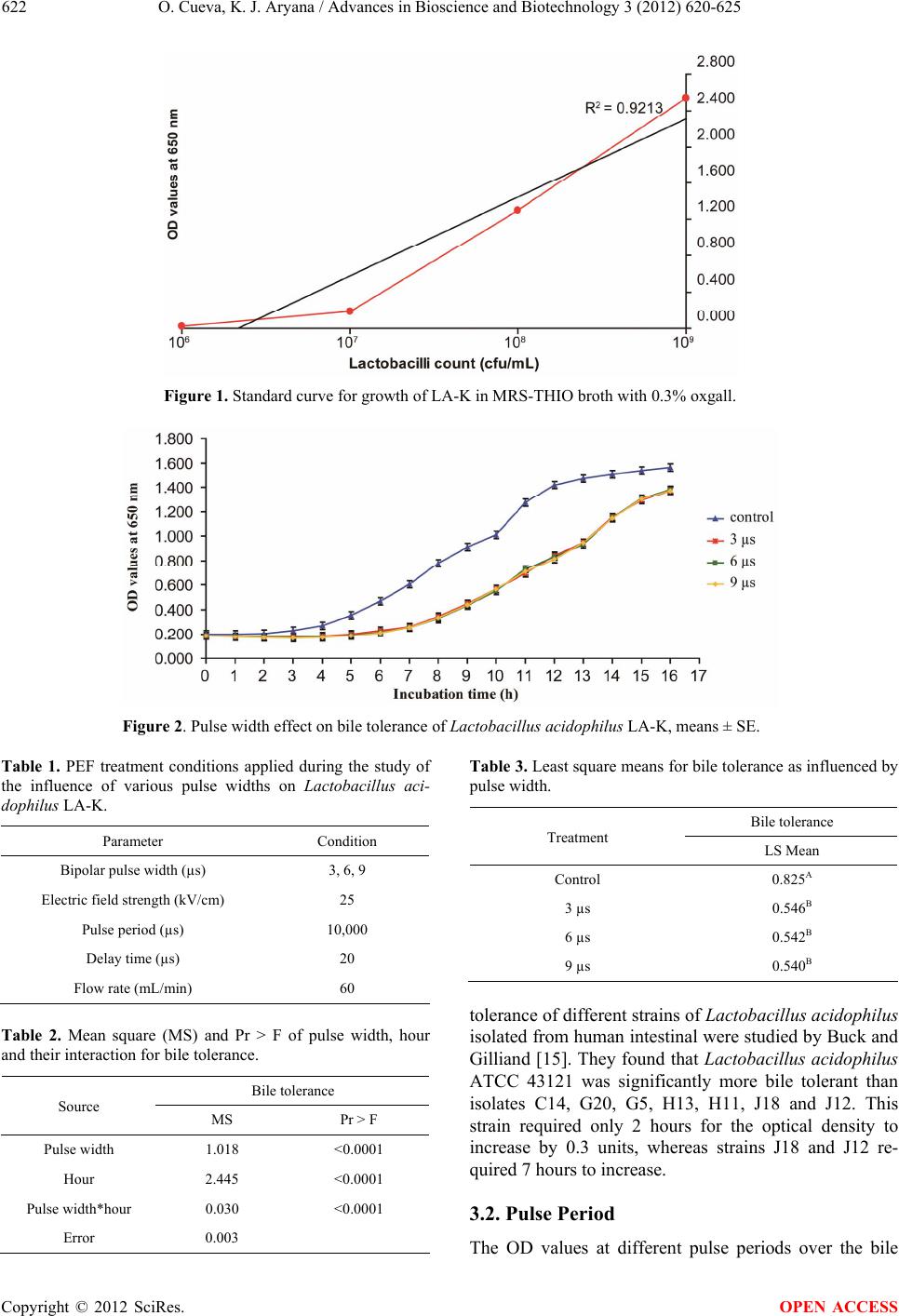 O. Cueva, K. J. Aryana / Advances in Bioscience and Biotechnology 3 (2012) 620-625 Copyright © 2012 SciRes. 622 Figure 1. Standard curve for growth of LA-K in MRS-THIO broth with 0.3% oxgall. Figure 2. Pulse width effect on bile tolerance of Lactobacillus acidophilus LA-K, means ± SE. Table 1. PEF treatment conditions applied during the study of the influence of various pulse widths on Lactobacillus aci- dophilus LA-K. Table 3. Least square means for bile tolerance as influenced by pulse width. Parameter Condition Bipolar pulse width (µs) 3, 6, 9 Electric field strength (kV/cm) 25 Pulse period (µs) 10,000 Delay time (µs) 20 Flow rate (mL/min) 60 Bile tolerance Treatment LS Mean Control 0.825A 3 µs 0.546B 6 µs 0.542B 9 µs 0.540B OPEN ACCESS Table 2. Mean square (MS) and Pr > F of pulse width, hour and their interaction for bile tolerance. Bile tolerance Source MS Pr > F Pulse width 1.018 <0.0001 Hour 2.445 <0.0001 Pulse width*hour 0.030 <0.0001 Error 0.003 tolerance of different strains of Lactobacillus acidophilus isolated from human intestinal were studied by Buck and Gilliand [15]. They found that Lactobacillus acidophilus ATCC 43121 was significantly more bile tolerant than isolates C14, G20, G5, H13, H11, J18 and J12. This strain required only 2 hours for the optical density to increase by 0.3 units, whereas strains J18 and J12 re- quired 7 hours to increase. 3.2. Pulse Period The OD values at different pulse periods over the bile 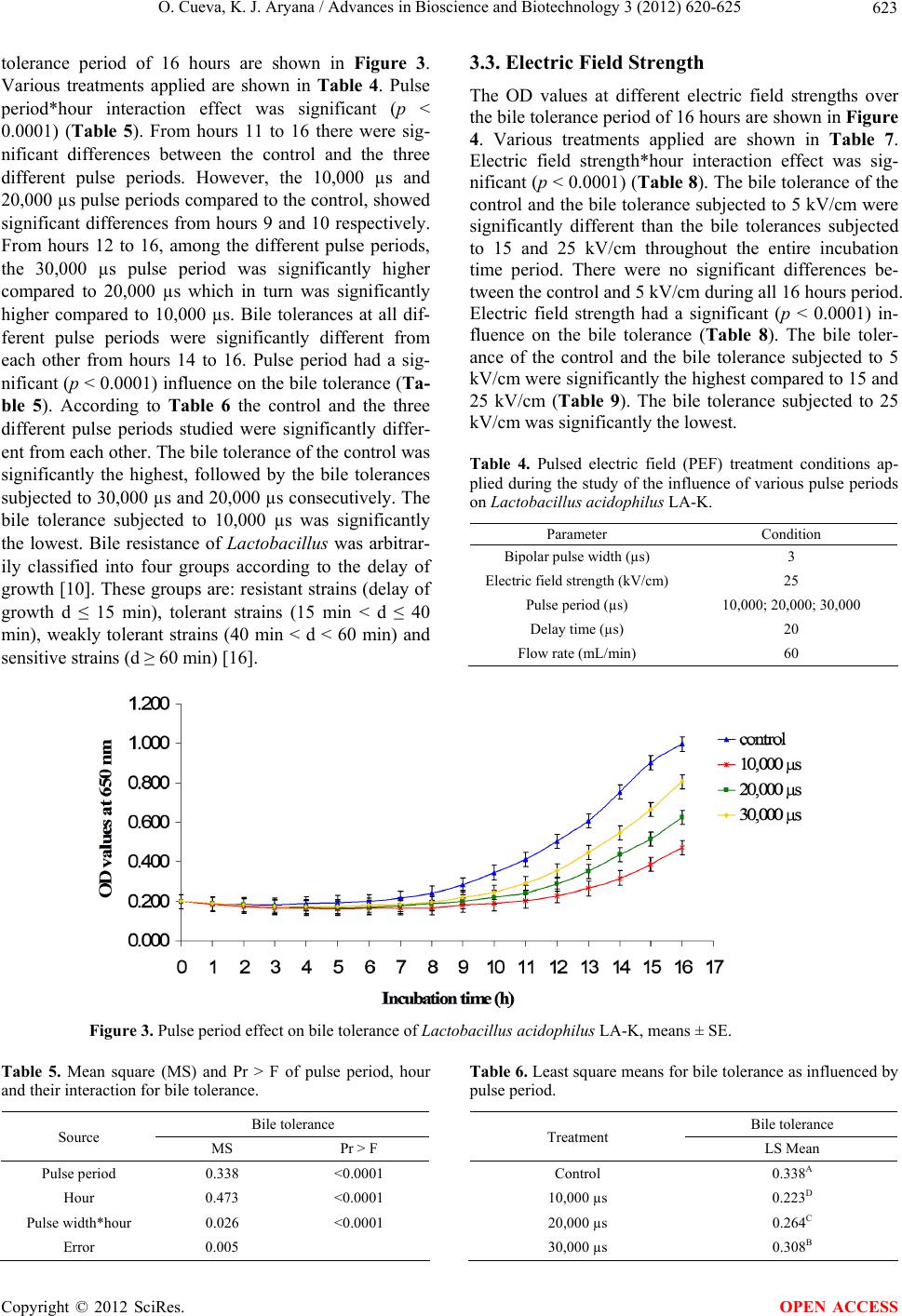 O. Cueva, K. J. Aryana / Advances in Bioscience and Biotechnology 3 (2012) 620-625 623 tolerance period of 16 hours are shown in Figure 3. Various treatments applied are shown in Table 4. Pulse period*hour interaction effect was significant (p < 0.0001) (Table 5). From hours 11 to 16 there were sig- nificant differences between the control and the three different pulse periods. However, the 10,000 µs and 20,000 µs pulse periods compared to the control, showed significant differences from hours 9 and 10 respectively. From hours 12 to 16, among the different pulse periods, the 30,000 µs pulse period was significantly higher compared to 20,000 µs which in turn was significantly higher compared to 10,000 µs. Bile tolerances at all dif- ferent pulse periods were significantly different from each other from hours 14 to 16. Pulse period had a sig- nificant (p < 0.0001) influence on the bile tolerance (Ta- ble 5). According to Table 6 the control and the three different pulse periods studied were significantly differ- ent from each other. The bile tolerance of the control was significantly the highest, followed by the bile tolerances subjected to 30,000 µs and 20,000 µs consecutively. The bile tolerance subjected to 10,000 µs was significantly the lowest. Bile resistance of Lactobacillus was arbitrar- ily classified into four groups according to the delay of growth [10]. These groups are: resistant strains (delay of growth d ≤ 15 min), tolerant strains (15 min < d ≤ 40 min), weakly tolerant strains (40 min < d < 60 min) and sensitive strains (d ≥ 60 min) [16]. 3.3. Electric Field Strength The OD values at different electric field strengths over the bile tolerance period of 16 hours are shown in Figure 4. Various treatments applied are shown in Table 7. Electric field strength*hour interaction effect was sig- nificant (p < 0.0001) (Table 8). The bile tolerance of the control and the bile tolerance subjected to 5 kV/cm were significantly different than the bile tolerances subjected to 15 and 25 kV/cm throughout the entire incubation time period. There were no significant differences be- tween the control and 5 kV/cm during all 16 hours period. Electric field strength had a significant (p < 0.0001) in- fluence on the bile tolerance (Table 8). The bile toler- ance of the control and the bile tolerance subjected to 5 kV/cm were significantly the highest compared to 15 and 25 kV/cm (Table 9). The bile tolerance subjected to 25 kV/cm was significantly the lowest. Table 4. Pulsed electric field (PEF) treatment conditions ap- plied during the study of the influence of various pulse periods on Lactobacillus acidophilus LA-K. Parameter Condition Bipolar pulse width (µs) 3 Electric field strength (kV/cm) 25 Pulse period (µs) 10,000; 20,000; 30,000 Delay time (µs) 20 Flow rate (mL/min) 60 Figure 3. Pulse period effect on bile tolerance of Lactobacillus acidophilus LA-K, means ± SE. Table 5. Mean square (MS) and Pr > F of pulse period, hour and their interaction for bile tolerance. Bile tolerance Source MS Pr > F Pulse period 0.338 <0.0001 Hour 0.473 <0.0001 Pulse width*hour 0.026 <0.0001 Error 0.005 Table 6. Least square means for bile tolerance as influenced by pulse period. Bile tolerance Treatment LS Mean Control 0.338A 10,000 µs 0.223D 20,000 µs 0.264C 30,000 µs 0.308B Copyright © 2012 SciRes. OPEN ACCESS  O. Cueva, K. J. Aryana / Advances in Bioscience and Biotechnology 3 (2012) 620-625 624 Figure 4. Electric field strength influence on bile tolerance of Lactobacillus acidophilus LA-K, means ± SE. Table 7. Pulsed electric field (PEF) treatment conditions ap- plied during the study of the influence of various electric field strengths on Lactobacillus acidophilus LA-K. Parameter Condition Bipolar pulse width (µs) 3 Electric field strength (kV/cm) 5, 15, 25 Pulse period (µs) 30,000 Delay time (µs) 20 Flow rate (mL/min) 60 Table 8. Mean square (MS) and Pr > F of electric field strength, hour and their interaction for bile tolerance. Bile tolerance Source MS Pr > F Electric field strength 0.582 <0.0001 Hour 0.746 <0.0001 Electric field strength*hour 0.021 <0.0001 Error 0.005 Table 9. Least square means for bile tolerance as influenced by electric field strength. Bile tolerance Treatment LS Mean Control 0.494A 5 kV/cm 0.497A 15 kV/cm 0.329B 25 kV/cm 0.296C 4. CONCLUSION Bipolar pulse width and pulse period significantly low- ered bile tolerance. Electric field strength significantly influenced bile tolerance. Bile tolerance of the control LA-K and LA-K subjected to 5 kV/cm were the highest while bile tolerance LA-K subjected to 25 kV/cm was the lowest. REFERENCES [1] Barbosa-Cánovas, G.V., Góngora Nieto, M.M., Pothaka- mury, U.R. and Swanson, B.G. (1999) Preservation of foods with pulsed electric fields. Academic Press, San Diego. [2] Zhang, Q., Barbosa-Cánovas, G.V. and Swanson, B.G. (1994) Engineering aspects of pulsed electric field pas- teurization. Journal of Food Engineering, 25, 261-281. doi:10.1016/0260-8774(94)00030-D [3] Qin, B.L., Barbosa-Cánovas, G.V., Swanson, B.G. and Pedrow, P.D. (1998) Inactivating microorganism using a pulsed electric field continuous treatment system. IEEE Transactions on Industry Applications, 34, 43-49. doi:10.1109/28.658715 [4] Zimmermann, U. and Neil, G.A. (1996) Electromanipula- tion of cells. CRC Press, Boca Raton. [5] Ulmer, H.M., Heinz, V., Gänzle, M.G., Knorr, D. and Vogel, R.F. (2002) Effects of pulsed electric fields on in- activation and metabolic activity of Lactobacillus planta- rum in model beer. Journal of Applied Microbiology, 93, 326-335. doi:10.1046/j.1365-2672.2002.01699.x [6] Qin, B.L., Zhang, Q. and Barbosa-Cánovas, G.V. (1994) Inactivation of microorganisms by pulsed electric fields of different voltage waveforms. IEEE Transactions of Dielectrics and Electrical Insulation, 1, 1047-1057. doi:10.1109/94.368658 [7] Jeyamkondan, S., Jayas, D.S. and Holley, R.A. (1999) Pulsed electric field processing of foods: A review. Jour- nal of Food Protection, 62, 1088-1096. [8] Barbosa-Cánovas, G.V., Góngora Nieto, M.M., Pothaka- mury, U.R. and Swanson, B.G. (1999) Preservation of foods with pulsed electric fields. Academic Press, San Diego. [9] Hülsheger, H., Pottel, J. and Niemann, E.G. (1981) Kill- ing of bacteria with electric pulses of high field strength. Radiation and Environmental Biophysics, 20, 53-65. doi:10.1007/BF01323926 Copyright © 2012 SciRes. OPEN ACCESS  O. Cueva, K. J. Aryana / Advances in Bioscience and Biotechnology 3 (2012) 620-625 625 [10] Hülsheger, H., Pottel, J. and Niemann, E.G. (1983) Elec- tric field effects on bacteria and yeast cells. Radiation and Environmental Biophysics, 22, 149-162. doi:10.1007/BF01338893 [11] Min, S., Min, S.K. and Zhang, H.Q. (2003) Inactivation kinetic of tomato juice lipoxygenase by pulse electric fields. Journal of Food Science, 68, 1995-2001. doi:10.1111/j.1365-2621.2003.tb07008.x [12] Vega-Mercado, H., Martin-Belloso, O., Chang, F.J., Bar- bosa-Cánovas, G.V. and Swanson, B.G. (1996) Inactiva- tion of Escherichia coli and Bacillus subtilis suspended in pea soup using pulsed electric fields. Journal of Food Processing and Preservation, 20, 501-510. doi:10.1111/j.1745-4549.1996.tb00762.x [13] Sanders, M.E. (2000) Considerations for use of probiotic bacteria to modulate human health. Journal of Nutrition, 130, 384S-390S. [14] Pereira, D.I.A. and Gibson, G.R. (2002) Cholesterol as- similation by lactic acid bacteria and bifidobacteria iso- lated from the human gut. Applied and Environmental Microbiology, 68, 4689-4693. doi:10.1128/AEM.68.9.4689-4693.2002 [15] Buck, L.M. and Gilliland, S.E. (1994) Comparison of freshly isolated strains of Lactobacillus acidophilus of human intestinal origin for ability to assimilate choles- terol during growth. Journal of Dairy Science, 77, 2925- 2933. doi:10.3168/jds.S0022-0302(94)77233-7 [16] Chateau, N., Deschamps, A.M. and Hadj Sassi, A. (1994) Heterogeneity of bile-salts resistance in the Lactobacillus isolates of a probiotic consortium. Letters in Applied Mi- crobiology, 18, 42-44. doi:10.1111/j.1472-765X.1994.tb00796.x Copyright © 2012 SciRes. OPEN ACCESS |