

Paper Menu >>
Journal Menu >>
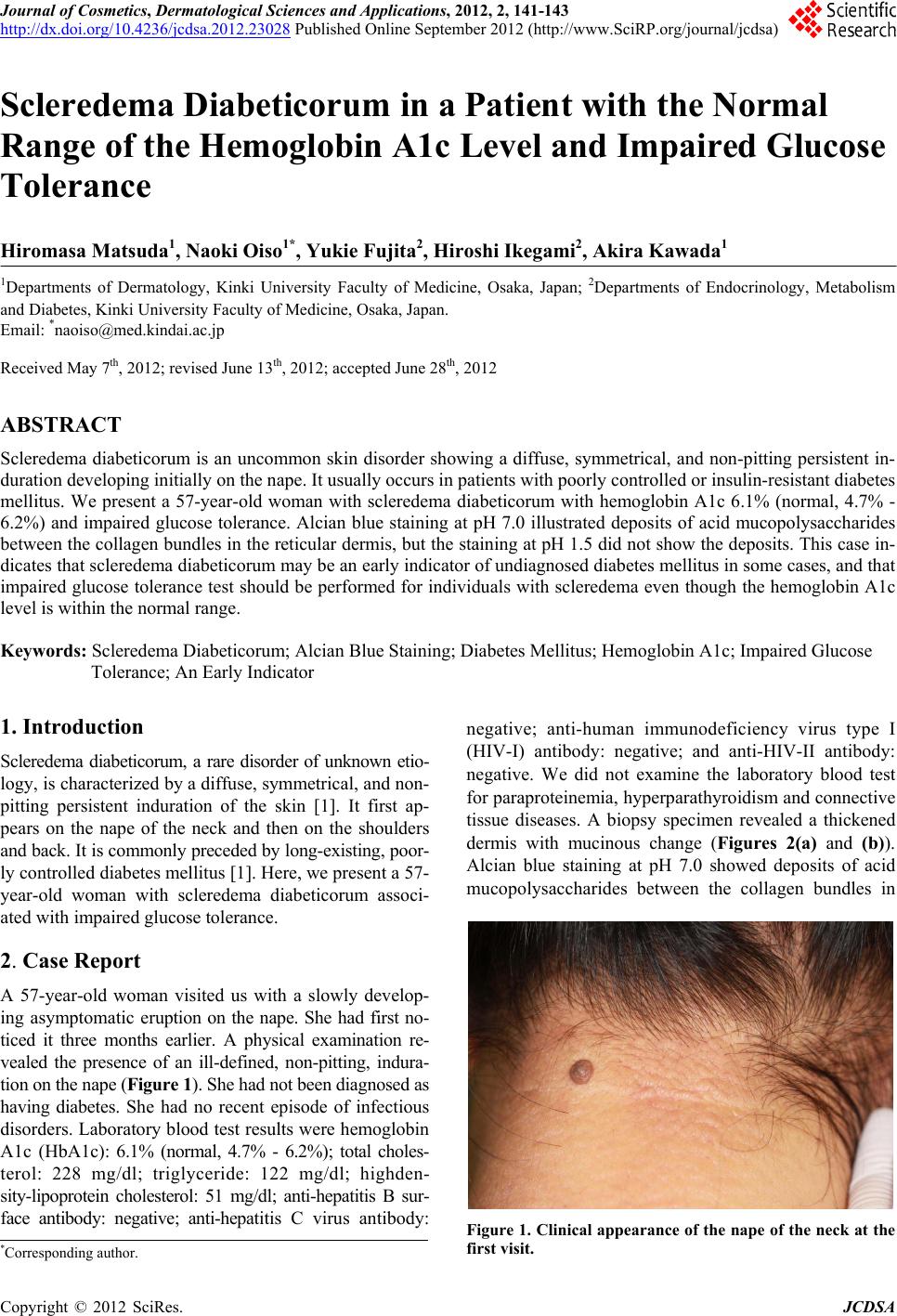 Journal of Cosmetics, Dermatological Sciences and Applications, 2012, 2, 141-143 http://dx.doi.org/10.4236/jcdsa.2012.23028 Published Online September 2012 (http://www.SciRP.org/journal/jcdsa) 141 Scleredema Diabeticorum in a Patient with the Normal Range of the Hemoglobin A1c Level and Impaired Glucose Tolerance Hiromasa Matsuda1, Naoki Oiso1*, Yukie Fujita2, Hiroshi Ikegami2, Akira Kawada1 1Departments of Dermatology, Kinki University Faculty of Medicine, Osaka, Japan; 2Departments of Endocrinology, Metabolism and Diabetes, Kinki University Faculty of Medicine, Osaka, Japan. Email: *[email protected] Received May 7th, 2012; revised June 13th, 2012; accepted June 28th, 2012 ABSTRACT Scleredema diabeticorum is an uncommon skin disorder showing a diffuse, symmetrical, and non-pitting persistent in- duration developing initially on the nape. It usually occurs in patients with poorly controlled or insulin-resistant diabetes mellitus. We present a 57-year-old woman with scleredema diabeticorum with hemoglobin A1c 6.1% (normal, 4.7% - 6.2%) and impaired glucose tolerance. Alcian blue staining at pH 7.0 illustrated deposits of acid mucopolysaccharides between the collagen bundles in the reticular dermis, but the staining at pH 1.5 did not show the deposits. This case in- dicates that scleredema diabeticorum may be an early indicator of undiagnosed diabetes mellitus in some cases, and that impaired glucose tolerance test should be performed for individuals with scleredema even though the hemoglobin A1c level is within the normal range. Keywords: Scleredema Diabeticorum; Alcian Blue Staining; Diabetes Mellitus; Hemoglobin A1c; Impaired Glucose Tolerance; An Early Indicator 1. Introduction Scleredema diabeticorum, a rare disorder of unknown etio- logy, is characterized by a diffuse, symmetrical, and non- pitting persistent induration of the skin [1]. It first ap- pears on the nape of the neck and then on the shoulders and back. It is commonly preceded by long-existing, poor- ly controlled diabetes mellitus [1]. Here, we present a 57- year-old woman with scleredema diabeticorum associ- ated with impaired glucose tolerance. 2. Case Report A 57-year-old woman visited us with a slowly develop- ing asymptomatic eruption on the nape. She had first no- ticed it three months earlier. A physical examination re- vealed the presence of an ill-defined, non-pitting, indura- tion on the nape (Figure 1). She had not been diagnosed as having diabetes. She had no recent episode of infectious disorders. Laboratory blood test results were hemoglobin A1c (HbA1c): 6.1% (normal, 4.7% - 6.2%); total choles- terol: 228 mg/dl; triglyceride: 122 mg/dl; highden- sity-lipoprotein cholesterol: 51 mg/dl; anti-hepatitis B sur- face antibody: negative; anti-hepatitis C virus antibody: negative; anti-human immunodeficiency virus type I (HIV-I) antibody: negative; and anti-HIV-II antibody: negative. We did not examine the laboratory blood test for paraproteinemia, hyperparathyroidism and connective tissue diseases. A biopsy specimen revealed a thickened dermis with mucinous change (Figures 2(a) and (b)). Alcian blue staining at pH 7.0 showed deposits of acid mucopolysaccharides between the collagen bundles in Figure 1. Clinical appearance of the nape of the neck at the first visit. *Corresponding author. Copyright © 2012 SciRes. JCDSA 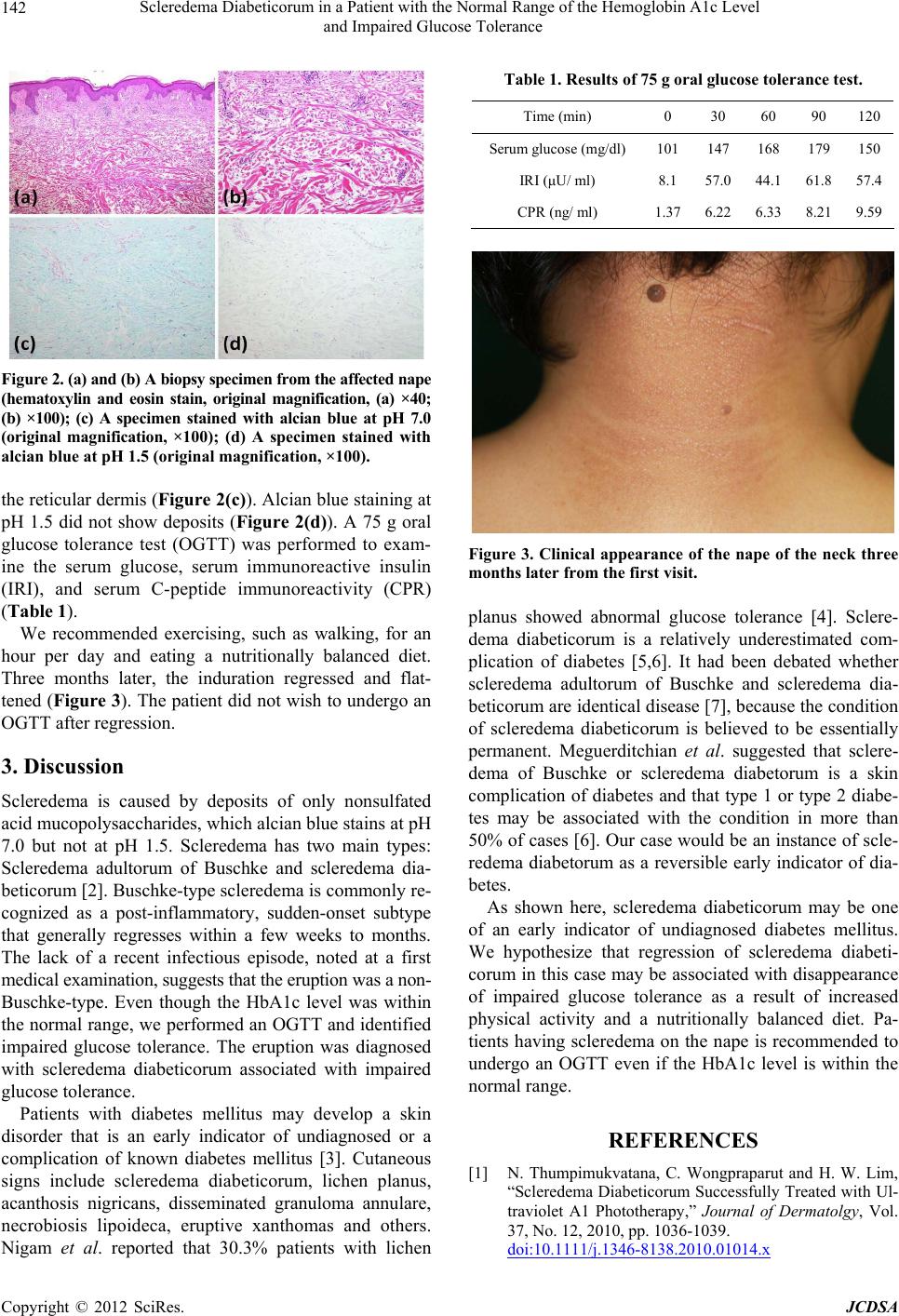 Scleredema Diabeticorum in a Patient with the Normal Range of the Hemoglobin A1c Level and Impaired Glucose Tolerance 142 Figure 2. (a) and (b) A biopsy specimen from the affected nape (hematoxylin and eosin stain, original magnification, (a) ×40; (b) ×100); (c) A specimen stained with alcian blue at pH 7.0 (original magnification, ×100); (d) A specimen stained with alcian blue at pH 1.5 (original magnification, ×100). the reticular dermis (Figure 2(c)). Alcian blue staining at pH 1.5 did not show deposits (Figure 2(d)). A 75 g oral glucose tolerance test (OGTT) was performed to exam- ine the serum glucose, serum immunoreactive insulin (IRI), and serum C-peptide immunoreactivity (CPR) (Table 1). We recommended exercising, such as walking, for an hour per day and eating a nutritionally balanced diet. Three months later, the induration regressed and flat- tened (Figure 3). The patient did not wish to undergo an OGTT after regression. 3. Discussion Scleredema is caused by deposits of only nonsulfated acid mucopolysaccharides, which alcian blue stains at pH 7.0 but not at pH 1.5. Scleredema has two main types: Scleredema adultorum of Buschke and scleredema dia- beticorum [2]. Buschke-type scleredema is commonly re- cognized as a post-inflammatory, sudden-onset subtype that generally regresses within a few weeks to months. The lack of a recent infectious episode, noted at a first medical examination, suggests that the eruption was a non- Buschke-type. Even though the HbA1c level was within the normal range, we performed an OGTT and identified impaired glucose tolerance. The eruption was diagnosed with scleredema diabeticorum associated with impaired glucose tolerance. Patients with diabetes mellitus may develop a skin disorder that is an early indicator of undiagnosed or a complication of known diabetes mellitus [3]. Cutaneous signs include scleredema diabeticorum, lichen planus, acanthosis nigricans, disseminated granuloma annulare, necrobiosis lipoideca, eruptive xanthomas and others. Nigam et al. reported that 30.3% patients with lichen Table 1. Results of 75 g oral glucose tolerance test. Time (min) 0 30 60 90 120 Serum glucose (mg/dl) 101 147 168 179150 IRI (μU/ ml) 8.1 57.0 44.1 61.857.4 CPR (ng/ ml) 1.37 6.22 6.33 8.219.59 Figure 3. Clinical appearance of the nape of the neck three months later from the first visit. planus showed abnormal glucose tolerance [4]. Sclere- dema diabeticorum is a relatively underestimated com- plication of diabetes [5,6]. It had been debated whether scleredema adultorum of Buschke and scleredema dia- beticorum are identical disease [7], because the condition of scleredema diabeticorum is believed to be essentially permanent. Meguerditchian et al. suggested that sclere- dema of Buschke or scleredema diabetorum is a skin complication of diabetes and that type 1 or type 2 diabe- tes may be associated with the condition in more than 50% of cases [6]. Our case would be an instance of scle- redema diabetorum as a reversible early indicator of dia- betes. As shown here, scleredema diabeticorum may be one of an early indicator of undiagnosed diabetes mellitus. We hypothesize that regression of scleredema diabeti- corum in this case may be associated with disappearance of impaired glucose tolerance as a result of increased physical activity and a nutritionally balanced diet. Pa- tients having scleredema on the nape is recommended to undergo an OGTT even if the HbA1c level is within the normal range. REFERENCES [1] N. Thumpimukvatana, C. Wongpraparut and H. W. Lim, “Scleredema Diabeticorum Successfully Treated with Ul- traviolet A1 Phototherapy,” Journal of Dermatolgy, Vol. 37, No. 12, 2010, pp. 1036-1039. doi:10.1111/j.1346-8138.2010.01014.x Copyright © 2012 SciRes. JCDSA  Scleredema Diabeticorum in a Patient with the Normal Range of the Hemoglobin A1c Level and Impaired Glucose Tolerance Copyright © 2012 SciRes. JCDSA 143 [2] F. Breuckmann, C. Appelhans, A. Harati, S. Rotterdam, P. Altmeyer and A. Kreuter, “Failure of Low-Dose Meth- otrexate in the Treatment of Scleredema Diabeticorum in Seven Cases,” Dermatology, Vol. 211, No. 3, 2005, pp. 299-301. doi:10.1159/000087031 [3] R. S. Gilgor and G. S. Lazarus, “Skin Manifestations of Diabetes Mellitus,” In: H. Rifkin and P. Raskin, Eds., Diabetes Mellitus, Brady Company, Bowie, 1981, pp. 313- 321. [4] P. K. Nigam, L. Sharma, J. K. Agrawal, G. Singh and S. K. Khurana, “Glucose Tolerance Studies in Lichen Pla- nus,” Dermatologica, Vol. 175, No. 6, 1987, pp. 284-289. doi:10.1159/000248835 [5] M. M. Seyger, F. H. van den Hoogen, S. de Mare, U. van Haelst and E. M. de Jong, “A Patient with a Severe Scler- oedema Diabeticorum, Partially Responding to Low-Dose Methotrexate,” Dermatology, Vol. 198, No. 2, 1999, pp. 177-179. doi:10.1159/000018103 [6] C. Meguerditchian, P. Jacquet, S. Béliard, T. Benderitter, R. Valéro, F. Carsuzza and B. Vialettes, “Scleredema Adul- torum of Buschke: An under Recognized Skin Complica- tion of Diabetes,” Diabetes & Metabolism, Vol. 32, No. 5, 2006, pp. 481-484. [7] A. Krakowski, J. Covo and C. Berlin, “Diabetic Sclerede- ma ,” Dermatologica, Vol. 146, No. 3, 1973, pp. 193-198. doi:10.1159/000251956 |