

Paper Menu >>
Journal Menu >>
 Journal of Cancer Therapy, 2012, 3, 435-441 http://dx.doi.org/10.4236/jct.2012.324056 Published Online September 2012 (http://www.SciRP.org/journal/jct) 435 Smoking Cause Specific Lung Cancer—Evidence from Non-Smoking Lung Adenocarcinoma Ning Li, Bin Qu, Kang Shao, Zhaoli Chen, Fengwei Tan, Xiaogang Tan, Baozhong Li, Jiwen Wang, Jie He* Department of Thoracic Surgery, Cancer Hospital and Institute, Chinese Academy of Medical Sciences, Beijing, China. Email: *[email protected] Received July 13th, 2012; revised August 25th, 2012; accepted September 16th, 2012 ABSTRACT Introduction: Smoking and non-smoking lung cancer have many differences in clinical feature. But those may be the result of interference due to differences in pathological type, as most smoking patients suffer squmous cell lung cancer and non-smokings tend to get adenocarcinoma. This study was conducted on the specific histological type—lung ade- nocarcinoma—to avoid histological bias and to reveal the true effect of smoking. Methods: A total of 2222 patients with lung adenocarcinoma confirmed by histological or cytological evidence were enrolled from January 1, 1999 to December 31, 2004. Differences in clinical features and prognosis between non-smoking and smoking patients were analyzed. Chi-square test was used for univariate comparisons. Univariate probability of survival was computed using Kaplan-Meier estimate and compared to using the log-rank test. Cox proportional hazards regression analysis was used to evaluate the risk of death. Results: There were 777 current smokers (34.96%), 197 former smokers (8.87%) and 1248 non-smoking patients (56.17%). 860 non-smoking patients (68.91%) were female, compared with 6.31% among current smokers and 4.06% among former smokers (p < 0.001). Non-smoking patients had an earlier age at diagnosis (p < 0.001) and a better response to chemotherapy (p < 0.001) compared to current smoking patients. Current smoking correlated with lower cell differentiation (p < 0.001) and worse prognosis (p = 0.0024). After multivariate analysis, smoking was identified as an independent negative prognostic factor (HR, 1.302; 95% CI, 1.011 - 1.6780, p = 0.041). No difference in prognosis was observed according to smoking conditions in smoking patients. Conclusions: Signifi- cent differences exist in clinical features and prognosis between non-smoking and smoking lung adenocarcinoma pa- tients. There is a strong evidence that non-smoking lung adenocarcinoma should be regard as different disease. Keywords: Lung Adenocarcinoma; Cigarette Smoke; Differentiation; Chemotherapy; Prognosis 1. Introduction Lung cancer is the most lethal cancer in the world with over 1 million deaths each year [1]. Cigarette smoking was regarded as the most important carcinogenic factor of lung cancer, which has been well established from epidemiological evidence [2]. However, over 50 percent of female and 15 percent of male lung cancer patients never smoke cigarette [3]. The incidence of lung cancer in non-smoker was even higher than several high inci- dence cancers, such as: cervix, pancreas and prostate cancer worldwide [3]. Smoking can not only increase the lung cancer inci- dence but also affect the lung cancer patient’s clinical feature and prognosis. Smoking lung cancer patients have many differences in gender distribution, clinical features, pathology result and molecular mechanism comparing to non-smoking lung cancer [4,5]. Smoking lung cancer patients tend to be diagnosed at older age, present with early stage, usually be afflicted with squamous cell lung cancer, and have a better prognosis [6-8]. Non-smoking lung cancer have a higher rate of mutation in Epidermal growth factor receptor (EGFR) and a better response to the EGFR Tyrosine Kinase Inhibitor: Gifitinib and Er- lotinib [9,10], while have less mutations in P53 com- pared with smoking lung cancer [4,11]. Therefore, many scholarssuggested that lung cancer in never smokers is a “different” disease, with a different aetiology and a dif- ferent natural history [5,6]. A small defect exists in the evidences of this hypothe- sis. Previous researches about clinical features and sur- vival analysis mostly focus on all categories of lung can- cer [7] or non-small cell lung cancer (NSCLC) [6,8,12]. Over 70 percent smoking patients suffer from squamous cell lung cancer and most non-smoking patients suffer from lung adenocarcinoma [13]. Many distinctions exist in clinical features between subtypes of lung cancer, and *Corresponding autho r . Copyright © 2012 SciRes. JCT 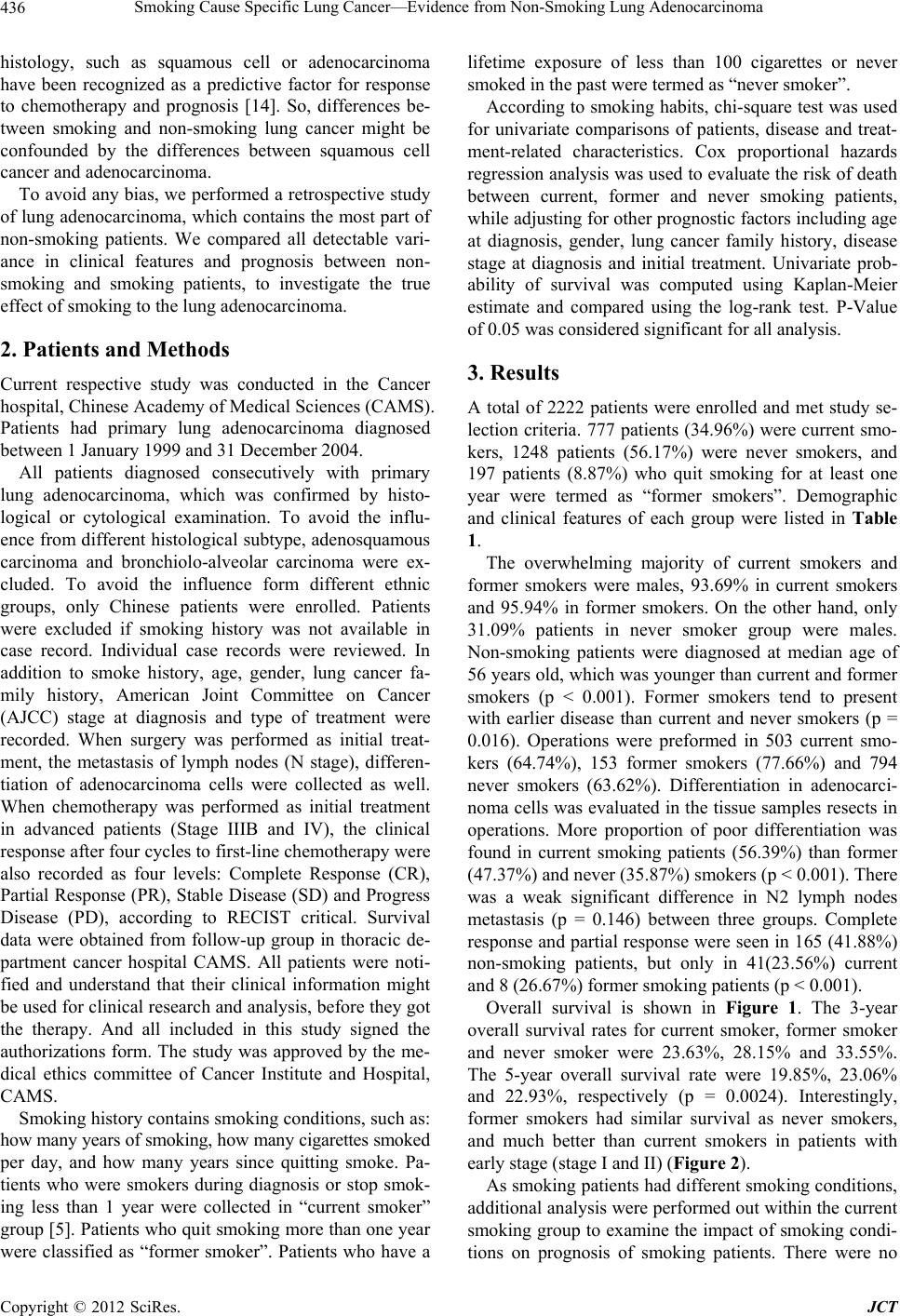 Smoking Cause Specific Lung Cancer—Evidence from Non-Smoking Lung Adenocarcinoma 436 histology, such as squamous cell or adenocarcinoma have been recognized as a predictive factor for response to chemotherapy and prognosis [14]. So, differences be- tween smoking and non-smoking lung cancer might be confounded by the differences between squamous cell cancer and adenocarcinoma. To avoid any bias, we performed a retrospective study of lung adenocarcinoma, which contains the most part of non-smoking patients. We compared all detectable vari- ance in clinical features and prognosis between non- smoking and smoking patients, to investigate the true effect of smoking to the lung adenocarcinoma. 2. Patients and Methods Current respective study was conducted in the Cancer hospital, Chinese Academy of Medical Sciences (CAMS). Patients had primary lung adenocarcinoma diagnosed between 1 January 199 9 a n d 3 1 December 2004. All patients diagnosed consecutively with primary lung adenocarcinoma, which was confirmed by histo- logical or cytological examination. To avoid the influ- ence from different histological subtype, adenosquamous carcinoma and bronchiolo-alveolar carcinoma were ex- cluded. To avoid the influence form different ethnic groups, only Chinese patients were enrolled. Patients were excluded if smoking history was not available in case record. Individual case records were reviewed. In addition to smoke history, age, gender, lung cancer fa- mily history, American Joint Committee on Cancer (AJCC) stage at diagnosis and type of treatment were recorded. When surgery was performed as initial treat- ment, the metastasis of lymph nodes (N stage), differen- tiation of adenocarcinoma cells were collected as well. When chemotherapy was performed as initial treatment in advanced patients (Stage IIIB and IV), the clinical response after four cycles to first-line chemotherapy were also recorded as four levels: Complete Response (CR), Partial Response (PR), Stable Disease (SD) and Progr ess Disease (PD), according to RECIST critical. Survival data were obtained from follow-up group in thoracic de- partment cancer hospital CAMS. All patients were noti- fied and understand that their clinical information might be used for clinical research and analysis, before they got the therapy. And all included in this study signed the authorizations form. The study was approved by the me- dical ethics committee of Cancer Institute and Hospital, CAMS. Smoking history contains smok ing condition s, such as: how many years of smoking, how many cigarettes smoked per day, and how many years since quitting smoke. Pa- tients who were smokers during diagnosis or stop smok- ing less than 1 year were collected in “current smoker” group [5]. Patients who quit smoking more than one year were classified as “former smoker”. Patients who have a lifetime exposure of less than 100 cigarettes or never smoked in the past were termed as “never smoker”. According to smoking habits, chi-square test was used for univariate comparisons of patients, disease and treat- ment-related characteristics. Cox proportional hazards regression analysis w as used to evaluate the risk of death between current, former and never smoking patients, while adjusting for othe r prognostic factors in cluding age at diagnosis, gender, lung cancer family history, disease stage at diagnosis and initial treatment. Univariate prob- ability of survival was computed using Kaplan-Meier estimate and compared using the log-rank test. P-Value of 0.05 was considered significant for all analysis. 3. Results A total of 2222 patients were enrolled and met study se- lection criteria. 777 patients (34.96%) were current smo- kers, 1248 patients (56.17%) were never smokers, and 197 patients (8.87%) who quit smoking for at least one year were termed as “former smokers”. Demographic and clinical features of each group were listed in Table 1. The overwhelming majority of current smokers and former smokers were males, 93.69% in current smokers and 95.94% in former smokers. On the other hand, only 31.09% patients in never smoker group were males. Non-smoking patients were diagnosed at median age of 56 years old, which was younger than current and former smokers (p < 0.001). Former smokers tend to present with earlier disease than current and never smokers (p = 0.016). Operations were preformed in 503 current smo- kers (64.74%), 153 former smokers (77.66%) and 794 never smokers (63.62%). Differentiation in adenocarci- noma cells was evaluated in the tissue samples resects in operations. More proportion of poor differentiation was found in current smoking patients (56.39%) than former (47.37%) and never (35.87%) smokers (p < 0.001). There was a weak significant difference in N2 lymph nodes metastasis (p = 0.146) between three groups. Complete response and partial response were seen in 165 (41.88%) non-smoking patients, but only in 41(23.56%) current and 8 (26.67%) former smoking patients (p < 0.001). Overall survival is shown in Figure 1. The 3-year overall survival rates for current smoker, former smoker and never smoker were 23.63%, 28.15% and 33.55%. The 5-year overall survival rate were 19.85%, 23.06% and 22.93%, respectively (p = 0.0024). Interestingly, former smokers had similar survival as never smokers, and much better than current smokers in patients with early stage (stage I and II) (Figure 2). As smoking patients had different smoking conditio ns, additional analysis were performed out within the current smoking group to examine the impact of smoking co ndi- tions on prognosis of smoking patients. There were no Copyright © 2012 SciRes. JCT 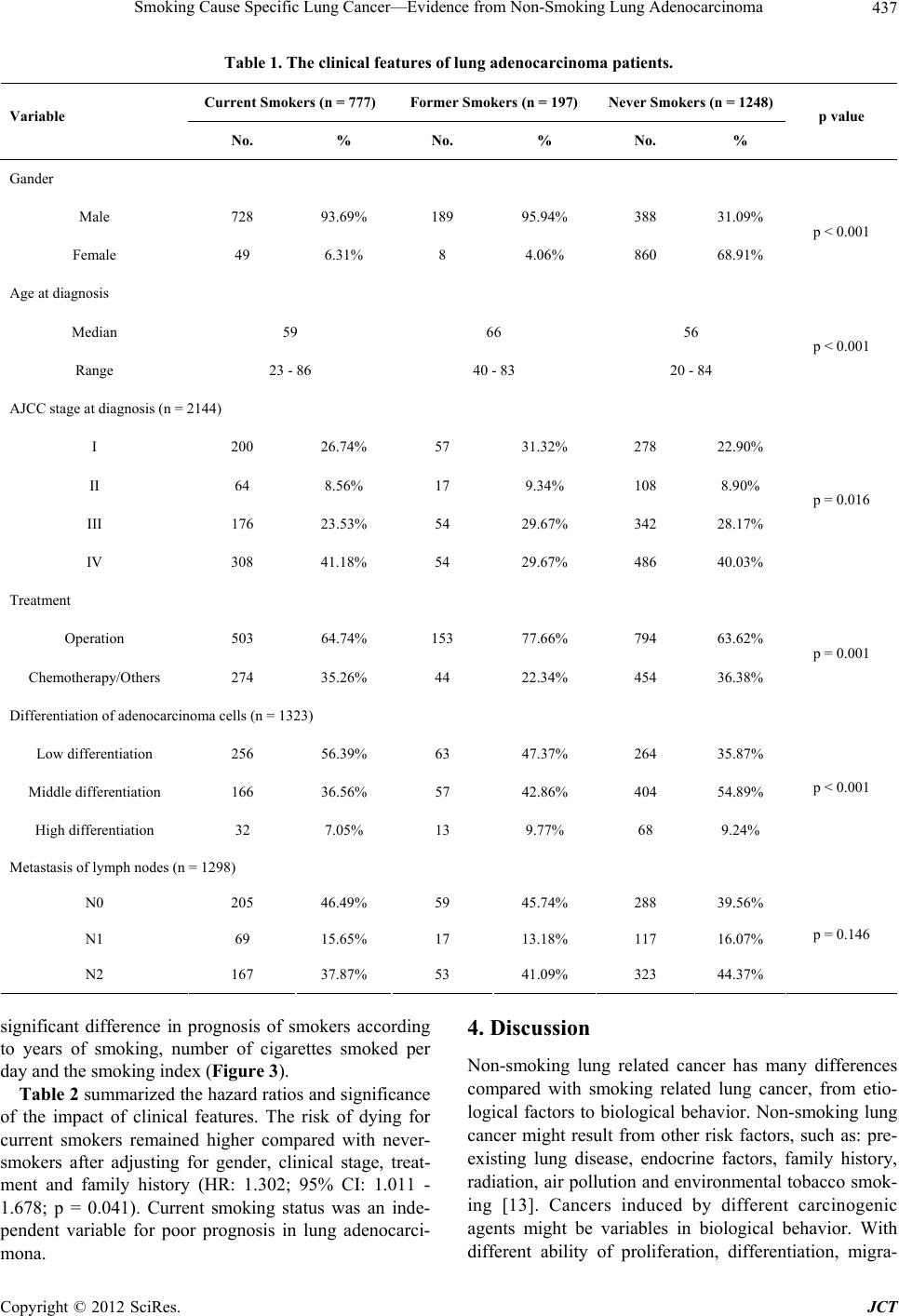 Smoking Cause Specific Lung Cancer—Evidence from Non-Smoking Lung Adenocarcinoma Copyright © 2012 SciRes. JCT 437 Table 1. The clinical features of lung adenocarcinoma patients. Current Smokers (n = 777) Former Smokers (n = 197) Never Smokers (n = 1248) Variable No. % No. % No. % p value Gander Male 728 93.69% 189 95.94% 388 31.09% Female 49 6.31% 8 4.06% 860 68.91% p < 0.001 Age at diagnosis Median 59 66 56 Range 23 - 86 40 - 83 20 - 84 p < 0.001 AJCC stage at diagnosis (n = 2144) I 200 26.74% 57 31.32% 278 22.90% II 64 8.56% 17 9.34% 108 8.90% III 176 23.53% 54 29.67% 342 28.17% IV 308 41.18% 54 29.67% 486 40.03% p = 0.016 Treatment Operation 503 64.74% 153 77.66% 794 63.62% Chemotherapy/Others 274 35.26% 44 22.34% 454 36.38% p = 0.001 Differentiation of adenocarcinoma cells (n = 1323) Low differentiation 256 56.39% 63 47.37% 264 35.87% Middle differentiatio n 166 36.56% 57 42.86% 404 54.89% High differentiation 32 7.05% 13 9.77% 68 9.24% p < 0.001 Metastasis of lymph nodes (n = 1298) N0 205 46.49% 59 45.74% 288 39.56% N1 69 15.65% 17 13.18% 117 16.07% N2 167 37.87% 53 41.09% 323 44.37% p = 0.146 significant difference in prognosis of smokers according to years of smoking, number of cigarettes smoked per day and the smoking index (Figure 3). Table 2 summarized the hazard ratios and significance of the impact of clinical features. The risk of dying for current smokers remained higher compared with never- smokers after adjusting for gender, clinical stage, treat- ment and family history (HR: 1.302; 95% CI: 1.011 - 1.678; p = 0.041). Current smoking status was an inde- pendent variable for poor prognosis in lung adenocarci- mona. 4. Discussion Non-smoking lung related cancer has many differences compared with smoking related lung cancer, from etio- logical factors to biological behavior. Non-smoking lung cancer might result from other risk factors, such as: pre- existing lung disease, endocrine factors, family history, radiation, air pollution and environmental tobacco smok- ing [13]. Cancers induced by different carcinogenic agents might be variables in biological behavior. With different ability of proliferation, differentiation, migra- 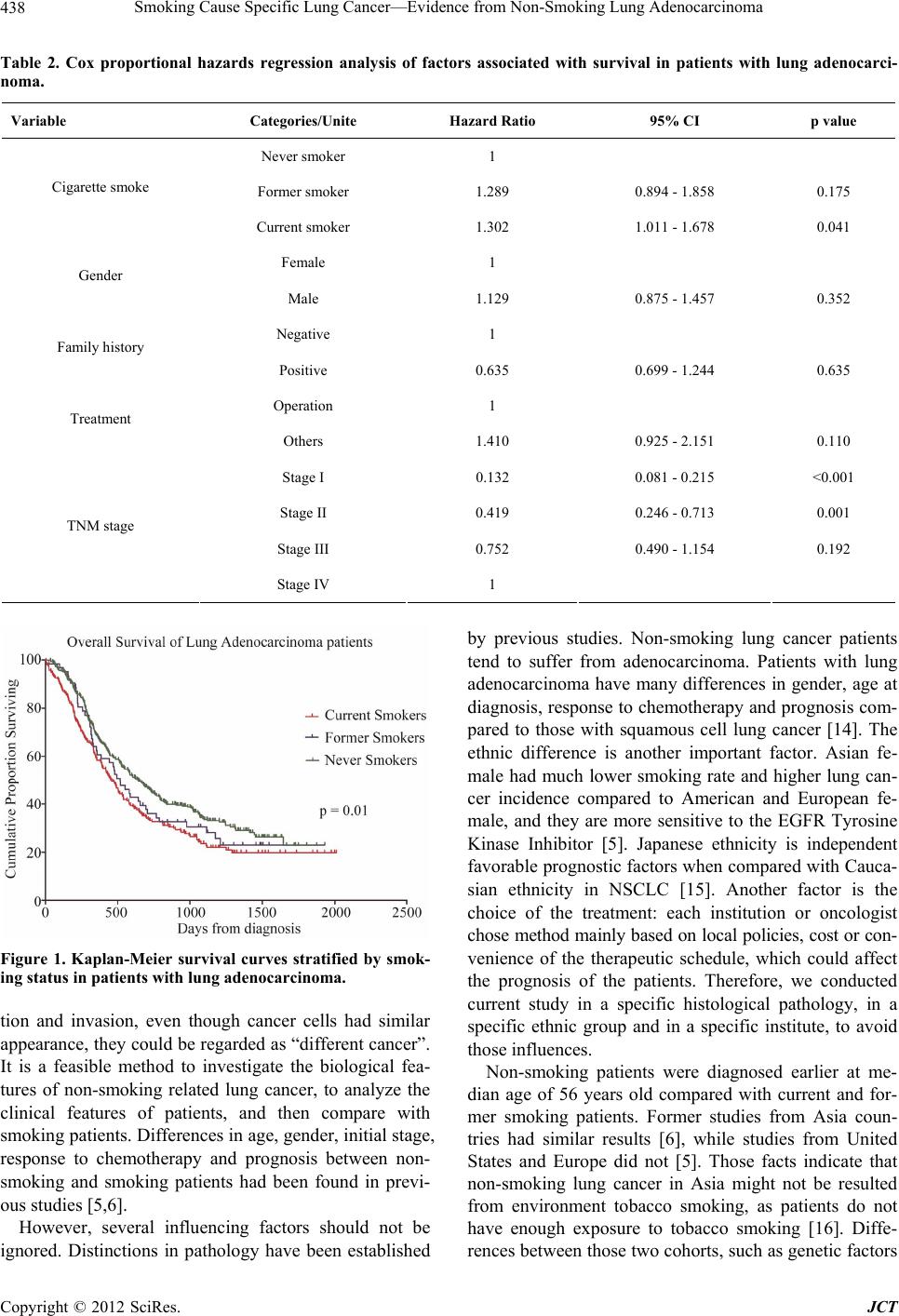 Smoking Cause Specific Lung Cancer—Evidence from Non-Smoking Lung Adenocarcinoma 438 Table 2. Cox proportional hazards regression analysis of factors associated with survival in patients with lung adenocarci- noma. Variable Cate g ories/UniteHazard Ratio 95% CI p value Never smoke r 1 Former smoker 1.289 0.894 - 1.858 0.175 Cigarette smoke Current smoker 1.302 1.011 - 1.678 0.041 Female 1 Gender Male 1.129 0.875 - 1.457 0.352 Negative 1 Family histor y Positive 0.635 0.699 - 1.244 0.635 Operation 1 Treatment Others 1.410 0 .925 - 2.151 0.110 Stage I 0.132 0.081 - 0.215 <0.001 Stage II 0.419 0 .246 - 0.713 0.001 Stage III 0.752 0 .490 - 1.154 0.192 TNM stage Stage IV 1 Figure 1. Kaplan-Meier survival curves stratified by smok- ing status in patients with lung adenocarcinoma. tion and invasion, even though cancer cells had similar appearance, they could be regarded as “different cancer”. It is a feasible method to investigate the biological fea- tures of non-smoking related lung cancer, to analyze the clinical features of patients, and then compare with smoking patients. Differences in age, gender, initial stage, response to chemotherapy and prognosis between non- smoking and smoking patients had been found in previ- ous studies [5,6]. However, several influencing factors should not be ignored. Distinctions in pathology have been established by previous studies. Non-smoking lung cancer patients tend to suffer from adenocarcinoma. Patients with lung adenocarcinoma have many differences in gender, age at diagnosis, response to chemotherapy and prognosis com- pared to those with squamous cell lung cancer [14]. The ethnic difference is another important factor. Asian fe- male had much lower smoking rate and higher lung can- cer incidence compared to American and European fe- male, and they are more sensitive to the EGFR Tyrosine Kinase Inhibitor [5]. Japanese ethnicity is independent favorable prognostic factors when compared with Cauca- sian ethnicity in NSCLC [15]. Another factor is the choice of the treatment: each institution or oncologist chose method mainly based on local policies, cost or con- venience of the therapeutic schedule, which could affect the prognosis of the patients. Therefore, we conducted current study in a specific histological pathology, in a specific ethnic group and in a specific institute, to avoid those influences. Non-smoking patients were diagnosed earlier at me- dian age of 56 years old compared with current and for- mer smoking patients. Former studies from Asia coun- tries had similar results [6], while studies from United States and Europe did not [5]. Those facts indicate that non-smoking lung cancer in Asia might not be resulted from environment tobacco smoking, as patients do not have enough exposure to tobacco smoking [16]. Diffe- rences between those two cohorts, such as genetic factors Copyright © 2012 SciRes. JCT  Smoking Cause Specific Lung Cancer—Evidence from Non-Smoking Lung Adenocarcinoma 439 Figure 2. Kaplan-Meier survival curves stratified by smok- ing status in patients with Stages I and II, III, and IV. and environment factors are important in lung cancer carcinogenesis. Most patients in never smoking group are female. Similar results were obtained in many previous studies [6], which indicated the female is more sensitive to carcinogen among non-smokers. Direct evidence comes from incidence investigation: incidence of female patients with non-smoking lung cancer is 14.4 - 20.8/100000, while 4.8 - 13.7/100000 in male [17,18]. Here we reported that histological differentiation of cancer cells is different among patients with diverse Figure 3. Kaplan-Meier survival curves stratified by smok- ing conditions in smoking patients. smoking conditions. Non-smoking patients usually had a better differentiation than smokers, which was a direct pathomorphological evidence for “different cancer”. The smoke of cigarette contains more than 4500 chemical compounds. Many of them affect the cell differentiation in vitro and in vivo [19], which could explain poorer dif- ferentia tion in smoking pati ents. We demonstrated patients in never smoker group had better response to front line chemotherapy than those in the other two groups. Tsao et al. had similar results. They analyzed 873 advanced non small cell lung cancer pa- tients who received chemotherapy, and found never- Copyright © 2012 SciRes. JCT 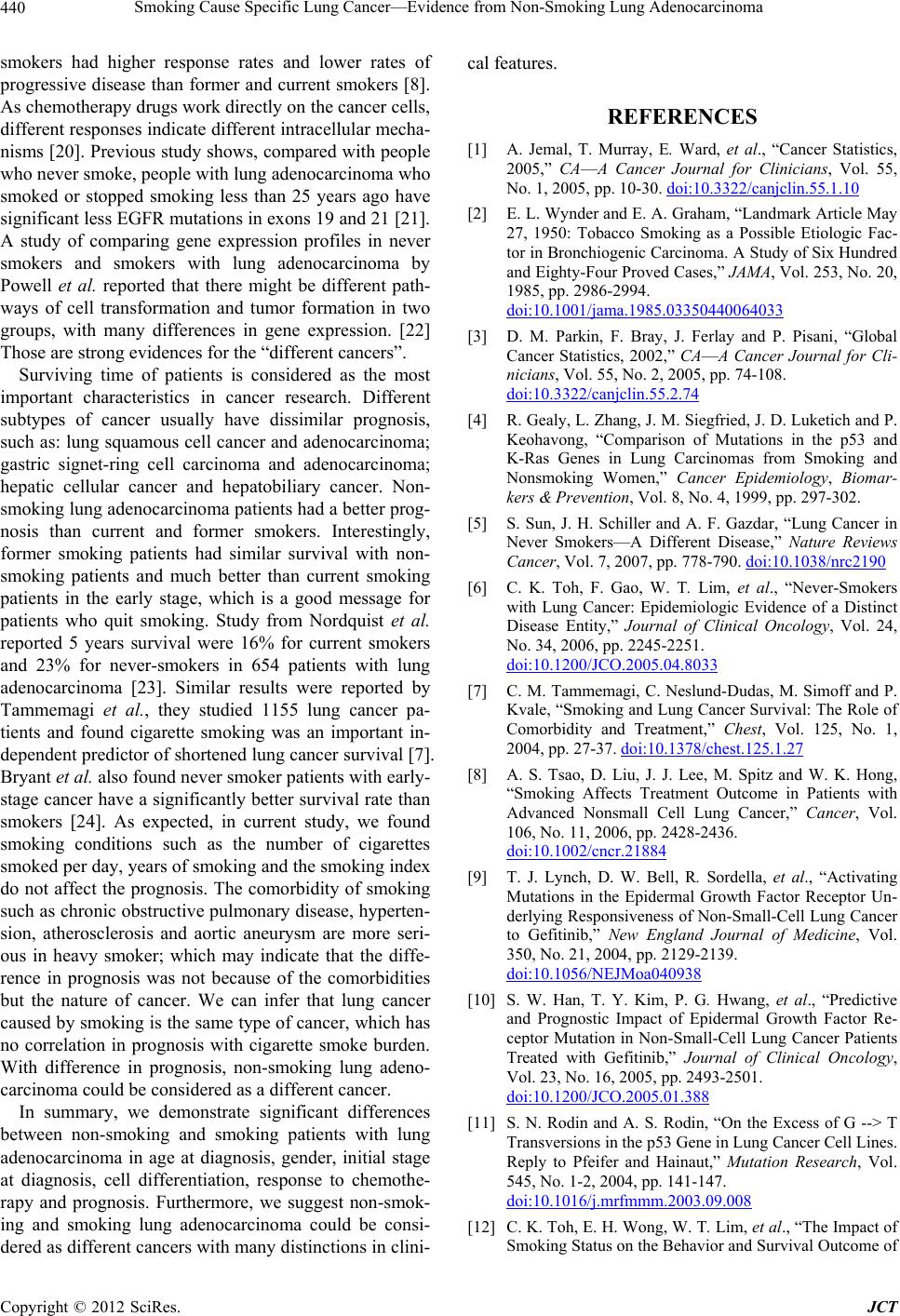 Smoking Cause Specific Lung Cancer—Evidence from Non-Smoking Lung Adenocarcinoma 440 smokers had higher response rates and lower rates of progressive disease than former and current smokers [8]. As chemotherapy drugs work directly on the cancer cells, different responses indicate different intracellular mecha- nisms [20]. Previous study shows, compared with people who never smoke, people with lung adenocarcinoma who smoked or stopped smoking less than 25 years ago have significant less EGFR mutations in exons 19 and 21 [21]. A study of comparing gene expression profiles in never smokers and smokers with lung adenocarcinoma by Powell et al. reported that there might be different path- ways of cell transformation and tumor formation in two groups, with many differences in gene expression. [22] Those are strong evidences for the “different cancers”. Surviving time of patients is considered as the most important characteristics in cancer research. Different subtypes of cancer usually have dissimilar prognosis, such as: lung squamous cell cancer and adenocarcinoma; gastric signet-ring cell carcinoma and adenocarcinoma; hepatic cellular cancer and hepatobiliary cancer. Non- smoking lung adenocarcinoma patients had a better prog- nosis than current and former smokers. Interestingly, former smoking patients had similar survival with non- smoking patients and much better than current smoking patients in the early stage, which is a good message for patients who quit smoking. Study from Nordquist et al. reported 5 years survival were 16% for current smokers and 23% for never-smokers in 654 patients with lung adenocarcinoma [23]. Similar results were reported by Tammemagi et al., they studied 1155 lung cancer pa- tients and found cigarette smoking was an important in- dependent pred ictor of shor tened lung can cer surviv al [7]. Bryant et al. also found never smoker patients with early- stage cancer have a significantly b etter survival rate than smokers [24]. As expected, in current study, we found smoking conditions such as the number of cigarettes smoked per day, years of smoking and the smoking index do not affect the prognosis. The comorbidity of smoking such as chronic obstructive pulmonary disease, hyperten- sion, atherosclerosis and aortic aneurysm are more seri- ous in heavy smoker; which may indicate that the diffe- rence in prognosis was not because of the comorbidities but the nature of cancer. We can infer that lung cancer caused by smoking is the same type of cancer, which has no correlation in prognosis with cigarette smoke burden. With difference in prognosis, non-smoking lung adeno- carcinoma could be considered as a different cancer. In summary, we demonstrate significant differences between non-smoking and smoking patients with lung adenocarcinoma in age at diagnosis, gender, initial stage at diagnosis, cell differentiation, response to chemothe- rapy and prognosis. Furthermore, we suggest non-smok- ing and smoking lung adenocarcinoma could be consi- dered as different cancers with many distinctions in clin i- cal features. REFERENCES [1] A. Jemal, T. Murray, E. Ward, et al., “Cancer Statistics, 2005,” CA—A Cancer Journal for Clinicians, Vol. 55, No. 1, 2005, pp. 10-30. doi:10.3322/canjclin.55.1.10 [2] E. L. Wynder and E. A. Graham, “Landmark Article May 27, 1950: Tobacco Smoking as a Possible Etiologic Fac- tor in Bronchiogenic Carcinoma. A Study of Six Hundred and Eighty-Four Proved Cases,” JAMA, Vol. 253, No. 20, 1985, pp. 2986-2994. doi:10.1001/jama.1985.03350440064033 [3] D. M. Parkin, F. Bray, J. Ferlay and P. Pisani, “Global Cancer Statistics, 2002,” CA—A Cancer Journal for Cli- nicians, Vol. 55, No. 2, 2005, pp. 74-108. doi:10.3322/canjclin.55.2.74 [4] R. Gealy, L. Zhang, J. M. Siegfried, J. D. Luketich and P. Keohavong, “Comparison of Mutations in the p53 and K-Ras Genes in Lung Carcinomas from Smoking and Nonsmoking Women,” Cancer Epidemiology, Biomar- kers & Prevention, Vol. 8, No. 4, 1999, pp. 297-302. [5] S. Sun, J. H. Schiller and A. F. Gazdar, “Lung Cancer in Never Smokers—A Different Disease,” Nature Reviews Cancer, Vol. 7, 2007, pp. 778-790. doi:10.1038/nrc2190 [6] C. K. Toh, F. Gao, W. T. Lim, et al., “Never-Smokers with Lung Cancer: Epidemiologic Evidence of a Distinct Disease Entity,” Journal of Clinical Oncology, Vol. 24, No. 34, 2006, pp. 2245-2251. doi:10.1200/JCO.2005.04.8033 [7] C. M. Tammemagi, C. Neslund-Dudas, M. Simoff and P. Kvale, “Smoking and Lung Cancer Survival: The Role of Comorbidity and Treatment,” Chest, Vol. 125, No. 1, 2004, pp. 27-37. doi:10.1378/chest.125.1.27 [8] A. S. Tsao, D. Liu, J. J. Lee, M. Spitz and W. K. Hong, “Smoking Affects Treatment Outcome in Patients with Advanced Nonsmall Cell Lung Cancer,” Cancer, Vol. 106, No. 11, 2006, pp. 2428-2436. doi:10.1002/cncr.21884 [9] T. J. Lynch, D. W. Bell, R. Sordella, et al., “Activating Mutations in the Epidermal Growth Factor Receptor Un- derlying Responsiveness of Non-Small-Cell Lung Cancer to Gefitinib,” New England Journal of Medicine, Vol. 350, No. 21, 2004, pp. 2129-2139. doi:10.1056/NEJMoa040938 [10] S. W. Han, T. Y. Kim, P. G. Hwang, et al., “Predictive and Prognostic Impact of Epidermal Growth Factor Re- ceptor Mutation in Non-Small-Cell Lung Cancer Patients Treated with Gefitinib,” Journal of Clinical Oncology, Vol. 23, No. 16, 2005, pp. 2493-2501. doi:10.1200/JCO.2005.01.388 [11] S. N. Rodin and A. S. Rodin, “On the Excess of G --> T Transversions in the p53 Gene in Lung Cancer Cell Lines. Reply to Pfeifer and Hainaut,” Mutation Research, Vol. 545, No. 1-2, 2004, pp. 141-147. doi:10.1016/j.mrfmmm.2003.09.008 [12] C. K. Toh, E. H. Wong, W. T. Lim, et al., “The Impact of Smoking Status on the Behavior and Survival Outcome of Copyright © 2012 SciRes. JCT 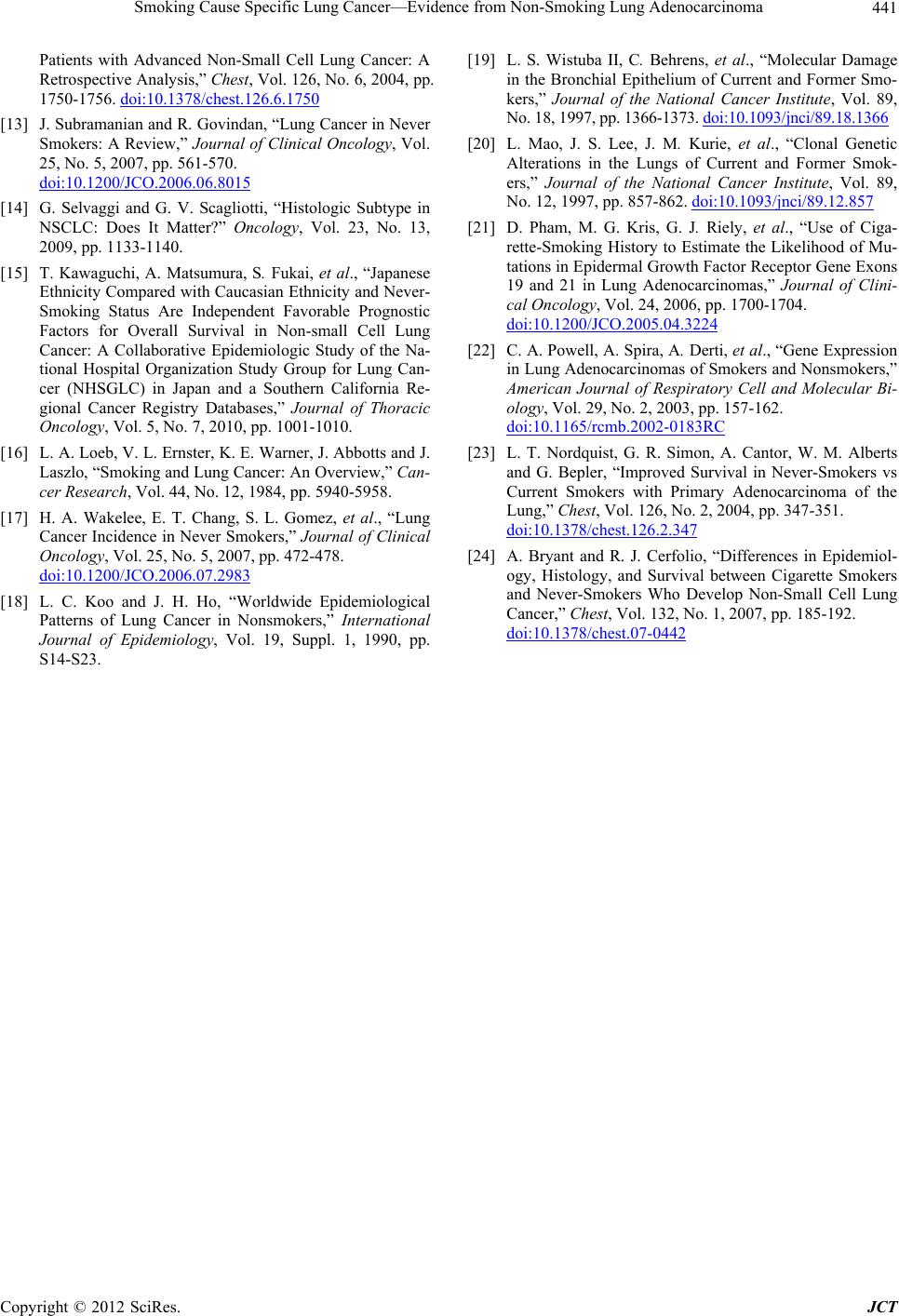 Smoking Cause Specific Lung Cancer—Evidence from Non-Smoking Lung Adenocarcinoma Copyright © 2012 SciRes. JCT 441 Patients with Advanced Non-Small Cell Lung Cancer: A Retrospective Analysis,” Chest, Vol. 126, No. 6, 2004, pp. 1750-1756. doi:10.1378/chest.126.6.1750 [13] J. Subramanian and R. Govindan, “Lung Cancer in Never Smokers: A Review,” Journal of Clinical Oncology, Vol. 25, No. 5, 2007, pp. 561-570. doi:10.1200/JCO.2006.06.8015 [14] G. Selvaggi and G. V. Scagliotti, “Histologic Subtype in NSCLC: Does It Matter?” Oncology, Vol. 23, No. 13, 2009, pp. 1133-1140. [15] T. Kawaguchi, A. Matsumura, S. Fukai, et al., “Japanese Ethnicity Compared with Caucasian Ethnicity and Never- Smoking Status Are Independent Favorable Prognostic Factors for Overall Survival in Non-small Cell Lung Cancer: A Collaborative Epidemiologic Study of the Na- tional Hospital Organization Study Group for Lung Can- cer (NHSGLC) in Japan and a Southern California Re- gional Cancer Registry Databases,” Journal of Thoracic Oncology, Vol. 5, No. 7, 2010, pp. 1001-1010. [16] L. A. Loeb, V. L. Ernster, K. E. Warner, J. Abbotts and J. Laszlo, “Smoking and Lung Cancer: An Overview,” Can- cer Research, Vol. 44, No. 12, 1984, pp. 5940-5958. [17] H. A. Wakelee, E. T. Chang, S. L. Gomez, et al., “Lung Cancer Incidence in Never Smokers,” Journal of Clinical Oncology, Vol. 25, No. 5, 2007, pp. 472-478. doi:10.1200/JCO.2006.07.2983 [18] L. C. Koo and J. H. Ho, “Worldwide Epidemiological Patterns of Lung Cancer in Nonsmokers,” International Journal of Epidemiology, Vol. 19, Suppl. 1, 1990, pp. S14-S23. [19] L. S. Wistuba II, C. Behrens, et al., “Molecular Damage in the Bronchial Epithelium of Current and Former Smo- kers,” Journal of the National Cancer Institute, Vol. 89, No. 18, 1997, pp. 1366-1373. doi:10.1093/jnci/89.18.1366 [20] L. Mao, J. S. Lee, J. M. Kurie, et al., “Clonal Genetic Alterations in the Lungs of Current and Former Smok- ers,” Journal of the National Cancer Institute, Vol. 89, No. 12, 1997, pp. 857-862. doi:10.1093/jnci/89.12.857 [21] D. Pham, M. G. Kris, G. J. Riely, et al., “Use of Ciga- rette-Smoking History to Estimate the Likelihood of Mu- tations in Epidermal Growth Factor Receptor Gene Exons 19 and 21 in Lung Adenocarcinomas,” Journal of Clini- cal Oncology, Vol. 24, 2006, pp. 1700-1704. doi:10.1200/JCO.2005.04.3224 [22] C. A. Powell, A. Spira, A. Derti, et al., “Gene Expression in Lung Adenocarcinomas of Smokers and Nonsmokers,” American Journal of Respiratory Cell and Molecular Bi- ology, Vol. 29, No. 2, 2003, pp. 157-162. doi:10.1165/rcmb.2002-0183RC [23] L. T. Nordquist, G. R. Simon, A. Cantor, W. M. Alberts and G. Bepler, “Improved Survival in Never-Smokers vs Current Smokers with Primary Adenocarcinoma of the Lung,” Chest, Vol. 126, No. 2, 2004, pp. 347-351. doi:10.1378/chest.126.2.347 [24] A. Bryant and R. J. Cerfolio, “Differences in Epidemiol- ogy, Histology, and Survival between Cigarette Smokers and Never-Smokers Who Develop Non-Small Cell Lung Cancer,” Chest, Vol. 132, No. 1, 2007, pp. 185-192. doi:10.1378/chest.07-0442 |