

Paper Menu >>
Journal Menu >>
 Open Journal of Obstetrics and Gynecology, 2012, 2, 239-243 OJOG http://dx.doi.org/10.4236/ojog.2012.23049 Published Online September 2012 (http://www.SciRP.org/journal/ojog/) Socio-demographic determinants of teenage pregnancy in the Niger Delta of Nigeria Ayuba Ibrahim Isa1*, Ibukun Olugbenga Owoeye Gani2 1Department of Ob s tetrics and Gynaec ology, College of Health Sciences, Niger Delta University, Amassoma, Nigeria 2Department of Community Medicine, College of Health Sciences, Niger Delta Unversity, Amassoma, Nigeria Email: *[email protected] Received 27 April 2012; revised 30 May 2012; accepted 13 June 2012 ABSTRACT Sub-Saharan Africa has the highest rates of maternal and neonatal mortality worldwide. Young maternal age at delivery has been proposed as risk factor for adverse pregnancy outcome, it occurs in all races, faiths, socioeconomic statuses, and regions. Teenage mothers are likely to be unmarried, poor and to sac- rifice education. Isolation, unstable marriages, stress, and guilt are among many social and psychological problems. The aim of this study is to determine the socio-demographic factors associated with teenage pregnancy in our environment, in order to proffer measures that can help curtail this continuing socio- medical problem. The records of all teenage mothers (aged 13 - 19) who had delivery at the Niger Delta University Teaching Hospital, Bayelsa State, Nigeria, over a period of 4 years (January 1 2007 to December 31 2010) were retrospectively reviewed. There were a total of 1341 deliveries during the study period, out which 83 were teenagers giving an incidence of 6.2%. The age of the patients ranged from 14 to 19 years with a mean age of (28.1 ± 5.7) years. Their parity ranged from zero to three, with a mean of 2.4 ± 1.9. About a third (20%/24.1%) were primigr avid ae, 3 3%/ 39.9% had at least secondary education and majority (48%/57.8%) were unbooked, unmarried (60%/72.3%), unemployed (62%/74.7%) and of low social class. Majority 71 (85.5%) of the teenage mothers had never used any form of modern contraceptive method and 45 (54.2%) of them had terminated at least one preg- nancy in the past. 26 (31.3%) had Caesarean sections, majority of which were emergencies 22 (84.6%). It was concluded that teenage mothers in the Niger Delta tend to have unfavorable socio-demographic and obstetric factors. Concrete measures must be put in place to address these. Keywords: Teenage Pregnancy; Socio-Demographic Factors; Niger Delta 1. INTRODUCTION Adolescence, according to WHO refers to the period between the ages of 10 and 19 years in which the indi- vidual progresses from the initial appearances of secon- dary sexual characteristics to full sexual maturity and during which psychological and emotional processes develop from those of a child to those of an adult. It also represents a transition from the state of socio-economic dependence to one of rela t i ve independence [1,2] . Adolescent pregnancy is defined as gestation in women before having reached the full somatic development. The percentage of childbearing adolescent women is region- ally highly variable depending on cultural, religious, po- litical, economic and other factors. Pregnancy in the very young is generally considered to be a high risk event because of the additional burden imposed by reproduc- tion on a still growing body [3-5]. Large epidemiologic studies on this topic were how- ever largely reported from high or medium income coun- tries showing conflicting results. Most importantly to date there is a lack of epidemiologic evidence from Sub- Saharan Africa [6-10]. Most of the pregnancies result from coitus with their first only partner, who often times is of similar age and no more advantaged socially. Adolescent pregnancies constitute major socio-medical and socio-econ omic prob- lems in both developed and developing countries and are becoming more prevalent in recent times [11]. The emergence of this adolescent problem has been attributed to various factors including early marriage, social permissiveness favouring early exposure to casual sexual activity, poor knowledge, availability and use of contraceptives, maternal deprivation, pre-existing psy- chosocial problems in the family and general non-func- tioning family unit among others [12-14]. In many developing countries, lack of resources makes contraception and reproductive advice inaccessible. This *Corresponding a uthor. OPEN ACCESS  A. Ibrahim Isa, I. O. Owoeye Gani / Open Journal of Obstetrics and Gynecology 2 (2012) 239-243 240 situation may be exacerbated by religious beliefs that disapprove of artificial birth control methods. The result is that many adolescents, both married and unmarried find it difficult to locate, or even seek help about sexual matters. There may be few facilities offering such sup- port, particularly in remote rural areas. The poorest often lack the resources to travel to these facilities and any fees charged for the services on offer would push them even further out of reach. In some cases, the ante-natal clinic is the only place where a young woman can obtain re- productive advice, but pregnancy is a pre-condition. Contraception may not be offered to married women until they have born e a child. There is an urgent need for “youth friendly” health services, as adolescents are unlikely to seek help about sexual matters from a service that is unsympathetic to their needs and anxieties. Girls aged 15 to 19 give birth to 15 million baby a year. Many of these girls give birth without attending an antenatal clinic or receiving the help of a professional midwife. It is essential to devise programs to reach girls in and out of marriage with reproductive advice and services [15]. Complications seen in adolescents during pregnancy include anaemia from malaria, infection and inadequate nutrition, spontaneous abortions, preterm labour and de- livery, pre-eclampsia and eclampsia, antepartium haem- orrhage and feto pelvic disproportion with its attendant risks of high operative intervention rates, obstructed la- bour and its sequalae notably genital fistulae. In the pu- erperium, puerperal sepsis, anaemia and other complica- tions resulting from obstructed labour are common [16, 17]. Evidence shows that infant mortality among the children is someti mes two times high er than among tho se of old peers. A stronger likelihood of low birth-weight in the infant has been recorded among adolescent mothers than among older peers. This is mainly associated with poor maternal nutrition. Low birth-weight babies are 5 - 30 times more likely to die than babies of normal weight [18,19]. If a mother is under 18, her baby’s chance of dying in the first year of life is 60 per cent higher than that of a baby born to a mother older than 19. Part of this heavy toll has more to do with poor socio-economic status and lack of ante-natal and obstetric care than physical maturity alone [20]. Cervical carcinoma, which is increasing in incidence and presenting at a younger age, is directly linked to the age of first intercourse and to the number of partners, and the spread of infection by human immunodeficiency vi- rus (HIV) is also linked to the number of sexual partners. These medical problems emphasize the risks associated with teenage intercourse, partic ularly if with a number of partners, in addition to the risks of the pregnancy itself. Pregnancy-related deaths are the leading cause of mor- tality for 15 - 19 year-old girls (married and unmarried) worldwide. Mothers in this age group face a 20 to 200 per cent greater chance of dying in pregnancy than women aged 20 to 24 [21]. The socio-economic conse- quences of adolescen t pregnancy include mor e unwanted pregnancies and out-of-wedlock children, greater marital instability, poor education, fewer assets and lower in- come later in life. The problems associated with adoles- cent pregnancy can be significantly reduced through sex education, provision of contraceptive counseling and services, education of women up to the University level and medical, social and psychological support for af- fected adolescents. Provision of good antenatal, intrana- tal and postnatal care for these adolescents is also em- phasized [22, 2 3] . 2. MATERIALS AND METHODS The study is a four year retrospective study of Teenage pregnancies managed at Niger Delta University Teaching Hospital (NDUTH) Okolobiri, a tertiary hospital in Bayelsa State, from January 1, 2007 to December 31, 2010. The sources of information were Antenatal, labour, and neonatal ward records, theater records, patient’s re- cords and case notes. The information obtained were coded and transferred onto a profoma already design for the study. Variables relating to the socio demographic character- istics of the women, antenatal an d intrapartum complica- tions and neonatal outcome were obtained. Statistical Analysis: Statistical analysis was performed with Statis- tical Package for Social Sciences (SPSS version 10). Ethical Consideration: Approval for this work was given by the Ethical Committee of the NDUTH. 3. RESULTS There were a total of 1341 deliveries, during the study period, out whi c h 83 were te enagers (6.2%) . The age of the patients ranged from 14 to 19 years with a mean age of (28.1 ± 5.7) years. Their parity ranged from zero to three, with a mean of 2.4 ± 1.9. About a third 20 (24.1%) w ere primigravidae, 33 (39.9%) had at least secondary education and majority 48 (57.8%) were unbooked and unmarried 60 (72.3%) (Table 1). Majority of the patients were of low social class, only 1 (4.3%) patient is of social class one (Table 2). The three commonest complications are preterm la- bour (51.8%), postpartum haemmorrhage (34.9%) and anaemia in pregnancy (22.9%) (Table 3). 26 (31.3%) of the teenage mothers delivered by cae- sarean section, (p = 0.014) maj ority of which were emer- gencies 22 (84.6%), 55 (66.2%) had spontaneous vaginal delivery, while 2 (2.5%) had instrumental vaginal de- livery (Table 4). There were 11 perinatal deaths with a perinatal mor- tality rate of 133/1000. There was no maternal mortality. Copyright © 2012 SciRes. OPEN ACCESS 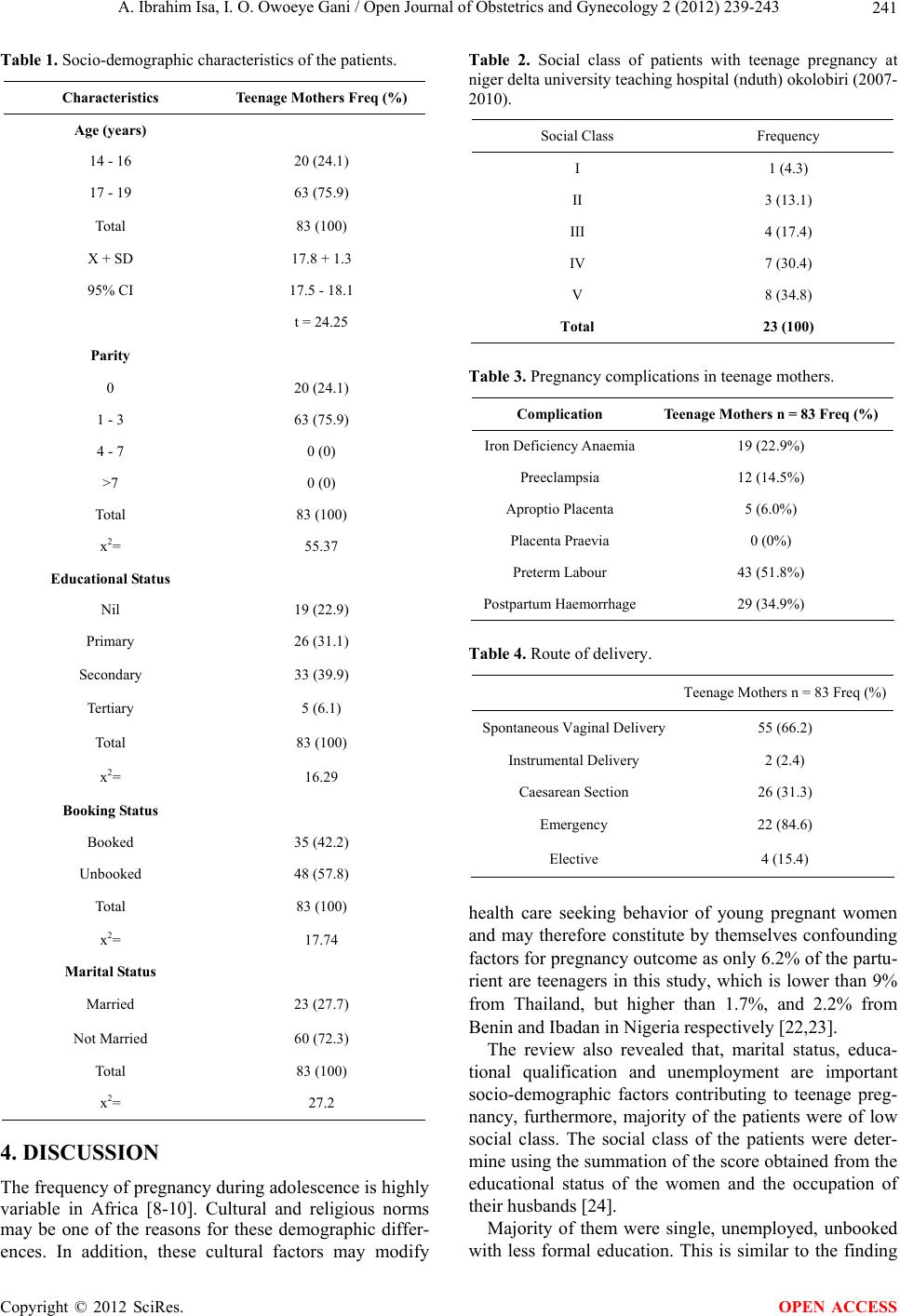 A. Ibrahim Isa, I. O. Owoeye Gani / Open Journal of Obstetrics and Gynecology 2 (2012) 239-243 241 Table 1. Soc io-demographic characteristics of the patients. Characteristics Teenage Mothers Freq (%) Age (years) 14 - 16 20 (24.1) 17 - 19 63 (75.9) Total 83 (100) X + SD 17.8 + 1.3 95% CI 17.5 - 18.1 t = 24.25 Parity 0 20 (24.1) 1 - 3 63 (75.9) 4 - 7 0 (0) >7 0 (0) Total 83 (100) x2= 55.37 Educational Status Nil 19 (22.9) Primary 26 (31.1) Secondary 33 (39.9) Tertiary 5 (6.1) Total 83 (100) x2= 16.29 Booking Status Booked 35 (42.2) Unbooked 48 (57.8) Total 83 (100) x2= 17.74 Marital Status Married 23 (27.7) Not Married 60 (72.3) Total 83 (100) x2= 27.2 4. DISCUSSION The frequency of pregnancy during adolescence is highly variable in Africa [8-10]. Cultural and religious norms may be one of the reasons for these demographic differ- ences. In addition, these cultural factors may modify Table 2. Social class of patients with teenage pregnancy at niger delta university teaching hospital (nduth) okolobiri (2007- 2010). Social Class Frequency I 1 (4.3) II 3 (13.1) III 4 (17.4) IV 7 (30.4) V 8 (34.8) Total 23 (100) Table 3. Pregnancy complications in teenage mothers. Complication Teenage Mothers n = 83 Freq (%) Iron Deficiency Anaemia19 (22.9%) Preeclampsia 12 (14 .5%) Aproptio Placenta 5 (6.0%) Placenta Praevia 0 ( 0%) Preterm Labour 43 ( 51.8%) Postpartum Haemorrhage29 (34.9%) Table 4. Route of delivery. Teenage Mothers n = 83 Freq (%) Spontaneous Vaginal Delivery55 (66.2) Instrumental Delivery 2 (2.4) Caesarean Section 26 (31.3) Emergency 22 (84.6) Elective 4 (15.4) health care seeking behavior of young pregnant women and may therefore constitute by themselves confounding factors for pregnancy outcome as on ly 6.2% of the partu- rient are teenagers in this study, which is lower than 9% from Thailand, but higher than 1.7%, and 2.2% from Benin and Ibadan in Nigeria respectively [22,23]. The review also revealed that, marital status, educa- tional qualification and unemployment are important socio-demographic factors contributing to teenage preg- nancy, furthermore, majority of the patients were of low social class. The social class of the patients were deter- mine using the su mmation of the score obtained from the educational status of the women and the occupation of their hus bands [24]. Majority of them were single, unemployed, unbooked with less formal education. This is similar to the finding Copyright © 2012 SciRes. OPEN ACCESS  A. Ibrahim Isa, I. O. Owoeye Gani / Open Journal of Obstetrics and Gynecology 2 (2012) 239-243 242 from the same region [23]. In a study from Zimbabwe, transport costs and costs for prenatal services have been characterized as major factors influencing adolescents late or non-utilization of prenatal services. In the same study the limited knowledge of young women about an- tenatal care programs and the fear of HIV testing have been further obstacles to efficient antenatal care [25]. Contraceptive utilization among the patients showed that 85.5% had never used any form of contraceptive. Other studies had shown that only 3% - 5% of married couples use a modern contraceptive method and 2% to 6% of the sexually active adolescents practice any form of contraception [26]. In Nigeria, family planning services are few and pro- viders tend to ignore or discriminate against single ado- lescents. 54.2% had the history of at least one previous termination of pregnancy. This finding is not surprising because of the significantly low prevalence of contracep- tive usage in our communities [26]. Anaemia in pregnancy, preeclampsia, preterm labour, and postpartum haemmoraghe, were some of the obstet- rics Complications documented among the teenagers seen in this review. This is similar to findings from pre- vious studies [5,23] most of these patients were referred from private and public primary and secondary health facilities both within and sometimes outside Bayelsa state. Several reasons for the high risk of delivering a low birth weight infant by adolescent mothers have been discussed in scientific literature. Anatomic immaturity and continued maternal growth may represent biologic growth barriers for the fetus. Moreover, adolescent moth- ers may represent a particularly d isadvantaged risk group characterized by low socioeconomic status, financial income and level of education as was found from this study [3,11, 2 0] . Vaginal delivery was the major route of delivery in the study group (66.2%), however, 31.3% had Caesarean section, of which 84.6% were emergencies, often times, and they had been in labour for more than 24 hours at other centres and often referred late in the night with varied reasons. This is the main reason why emergency procedures accounted for a larger proportion of the cases. This is similar to findings from previous studies [5,23]. In conclusion the socio-demographic factors and the medical problems associated with teenage pregnancy have been amply documented in this country and also by this study. Amidst the poor er social segments parenthood is seen as a sign of social status; however it is associated with adverse fetal and maternal outcomes. The adverse outcomes can be ameliorated by free and compulsory education for the girl child, education of the populace about the social and medical consequences of teenage pregnancy, making contraceptives available to teens, especially emergency contraceptives, quality antenatal care, and provision of essential obstetric care. REFERENCES [1] World Health Organization (1981). Report of a WHO meeting on adolescent sexuality and reproductive health. 21-23. [2] Sai, T.F. (2006) Adolescent sexuality and reproductive health. In: Mati, J. K.G., Ladipo, A. O, Burlema n, R.T., et al, Eds., Reproductive health in Africa, John Hopkins’ Programme for International Education in Gynaecology and Obstetrics, Bangkok, 16-30. [3] Scholl, T.O., Hediger, M.L., Salmon, R.W., Belsky, D.H. and Ances, I.G. (1989). Association between gynecologi- cal age and preterm birth. Paediatric and Perinatal Epi- demiology, 3, 357-366. doi:10.1111/j.1 36 5-3016.1989.tb00524.x [4] Paranjothy, S., Broughton, H., Adappa, R. and Fone, D. (2008) Teenage pregnancy: Who suffers? Archives of Disease in Childhood, 94, 239-245. doi:10.1136/adc.2007.115915 [5] Bacci, A., Manhica, G.M., Machungo, F., Bugalho, A. and Cuttini, M. (1993) Outcome of teenage pregnancy in Maputo, Mozambique. International Journal of Gynae- cology & Obstetrics, 40, 19-23. doi:10.1016/0020-7292(93)90767-Q [6] Chen, X., Wen, S.W., Fleming, N., et al. (2007) Teenage pregnancy and adverse birth outcomes: A large popula- tion based retrospective cohort study. International Journal of Epidemiology, 36, 368-373. doi:10.1093/ije/dyl284 [7] Kramer, M.S. (1987) Determinants of low birth weight: Methodological assessment and meta-analysis. Bulletin of the World Health Organization, 65, 663-737. [8] Adam, I., Babike r, S., Mohmmed, A.A., et al. (2007) Low body mass index, anaemia and poor perinatal outcome in a rural hospital in eastern Sudan. Journal of Tropical Pe- diatrics, 54, 202-204. [9] Feresu, S.A., Harlow, S.D., Welch, K. and Gillespie, B.W. (2004) Incidence of and socio-demographic risk factors for stillbirth, preterm birth and low birthweight among Zimbabwean women. Paediatric and Perinatal Epidemi- ology, 18, 154-163. doi:10.1111/j.1 36 5-3016.2003.00539.x [10] Elshibly, A.M. and Schmalisch, G. (2008) The effect of maternal anthropometric characteristics and social factors on gestational age and birth weight in Sudanese newborn infants. BMC Public Health, 8, 244. doi:10.1186/1471-2458-8-244 [11] Okpani, A.O.U., Ikimalo, J., John, C.T and Briggs, N.D. (1995) Teenage pregnancy. Tropical Journal of Obstetrics and Gynaecology, 12, 34-36. [12] Aboyeji, A. F. (1997) Obstetric performance of teenage primigraridae in Ilorin, Nigeria. Nigeria Medical Journal, 33, 56-59. [13] Beazley, J.M. (1996) Special circumstances affecting labour. In: Whitefield, C.R., Ed., Dewhurst’s textbook of Copyright © 2012 SciRes. OPEN ACCESS  A. Ibrahim Isa, I. O. Owoeye Gani / Open Journal of Obstetrics and Gynecology 2 (2012) 239-243 Copyright © 2012 SciRes. 243 OPEN ACCESS obstetrics and gynaecology for postgraduates, 5th Edition, 312-313. [14] Romans, S.E., Martins, J.H. and Morries, E.M. (1997) Risk factors for adolescent pregnancy: How important is child abuse? Otago women’s health study. The New Zea- land Medical Journal, 11 0, 30-33. [15] Rao Gupta, G. (1998), Claiming the future. Progress of Nations UNICEF, 12-13. [16] Ojengbede, O.A., Otolorin, E.O. and Fabanwo, W.O. (1987) Pregnancy performance of Nigerian women aged 16 years and below seen in Ibadan, Nigeria. African Jour- nal of Medicine and Medical Sciences, 16, 89-95. [17] United Nations (1989) Adolescent reproductive behavior: Evidence from developing countries, Vol. II. UN Popula- tion Studies, New York. [18] Second World Situation Report (1992) ACC/SCN, Ge- neva, 17. [19] UNICEF (1994) Too old for toys, too young for mother- hood. United Nations Children’s Fund, New York, 23-25. [20] Curtis, H.A., Lawrence, C.J and Tripp, J.H. (1988) Teen- age sexual intercourse and pregnancy. Archives of Dis- ease in Childhood, 63, 373- 379. doi:10.1136/adc.63.4.373 [21] Watcharaseranee, N., Pinchantra, P. and Piyaman, S. (2006) The incidence and complications of teenage preg- nancy at Chonburi Hospital. Journal of Medical Associa- tion of Thailand, 4, 118-123. [22] Ebeigbe, P.N. and Gharoro, E.P. (2007) Obstetric com- plications, intervention rates and maternofetal outcome in teenage nullipara in Benin City, Nigeria. Tropical Doctor, 37, 79-83. doi:10.1258/004947507780609356 [23] Adeyinka, D.A., Oladimeji, O., Ade ka nbi, T.I., Adeyinka, F.E., Falope, Y. and Aimakhu, C. (2010) Outcome of adolescent pregnancies in southwestern Nigeria: A case-con- trol study. Journal of Maternal-Fetal & Neo- natal Medicine, 8, 785-789. doi:10.3109/14767050903572166 [24] Olusanya, O., Okpere, E.E. and Ezimokhai, M. (1985) The importance of social class in voluntary fertility con- trol in a developing country. West African Journal of Medicine, 4, 205-207. [25] Chaibva, C.N., Ehlers, V.J. and Roos, J.H. (2009) Mid- wives’ perceptions about adolescents’ utilization of public prenatal services in Bulawayo, Zimbabwe. Midwivery, 10, 116-118. [26] Ibrahim, M.I. and Okolo, R.U. (1997) Profile of contra- ceptive acceptors in UDUTH, Sokoto, Nigeria. Nigeria Medical Practitioner, 13, 9-13. |