

Paper Menu >>
Journal Menu >>
 Open Journal of Obstetrics and Gynecology, 2012, 2, 192-196 OJOG http://dx.doi.org/10.4236/ojog.2012.23038 Published Online September 2012 (http://www.SciRP.org/journal/ojog/) Comparison the effect of ephedrine and phenylephrine in treatment of hypotension after spinal anesthesia during cesarean section Atashkhoyi Simin1*, Fardiazar Zahra2, Hatami Marandi Pouya3, Torab Reza3 1Department of Anesthesiology, Women’s Reproductive Research Center, Alzahra Hospital, Tabriz University of Medical Sciences, Tabriz, Iran 2Department of Obstetrics & Gynecology, Alzahra Hospital, Tabriz University of Medical Sciences, Tabriz, Iran 3Tabriz University of Medical Sciences, Tabriz, Iran Email: *[email protected] Received 24 June 2012; revised 27 July 2012; accepted 15 August 2012 ABSTRACT Background and Objective: The effectiveness of ephe- drine and/or phenylephrine, in treatment of hypoten- sion secondary to spinal anesthesia for cesarean sec- tion and their effects on fetal/neonatal outcome were studied. Methods and Materials: Sixty healthy partu- rients were randomly assigned to two groups; group E (n = 33) received boluses 5 mg/ml increments ephedrine and group P (n = 27) received a boluses of phenylephrine 100 µg/ml increments for treatment of hypotension after spinal block during cesarean sec- tion. Changes in maternal blood pressure and heart rate, and incidence of nausea-vomiting, neonatal Ap- gar score at 1 and 5 minutes of delivery, and umbili- cal arterial blood gas values were recorded. Results: There were no differences in treatment of hypoten- sion following sympathectomy after spinal block with two drugs. Neonatal outcome was similar in two groups. There were not significant differences in um- bilical arterial values in two groups. Conclusion: Ephedrine and phenylephrine are both effective vaso- pressores for treatment of hypotension associated to spinal block during cesarean section without adverse effects on inf ants/neonates. Keywords: Cesarean Section; Spinal Anesthesia; Hypotension; Ephedrine; Phenylephrine; Fetal/Neonatal Outcome 1. INTRODUCTION Hypotension is perhaps the most common complication of neuraxial anesthesia in obstetric patients [1]. It has been estimated to occur in approximately 30% - 90% of cases [2]. Maternal hypotension produces unpleasant symptoms such as nausea, vomiting, and lightheadedness. More importantly, when severe and sustained, hypotension can impair uterine and intervillous blood flow and ultimately result in fetal acidosis and neonatal depression [1-4]. Prevention measures include fluid preload, left lateral tilt, and use of vasopressors [1-6]. Traditionally, ephedrine “which has a strong β-adren- ergic and a weaker α-adrenergic effects” has been re- commended in this situation, but its position has been challenged because of potential complication that supra- ventricular tachycardia, tachyphylaxis, and most impor- tantly fetal acidosis [1-7]. Phenylephrine, an α-adrener- gic agonist, can be used for prevention and treatment of maternal hypotension. Moreover, phenylephrine reduces the incidence of nausea and vomiting as well as fetal acidosis, but it may cause maternal bradycardia [1,3-6]. Cooper and colleagues [7-9] in their studies and Lee et al. [10] in a quantitative and systematic review have re- ported that managing of maternal hypotension with phenylephrine has fewer propensities to depress fetal pH than ephedrine. Although recent studies have confirmed the beneficial fetal effects of phenylephrine [5-11], but there are a num- ber controversies in this concept. Present study compared ephedrine with phenylephrine in treatment (not prevention) of maternal hypotension induced spinal anesthesia regarding the maternal cardiac response to hypotension in terms maternal hemodynamic and fetal/neonatal status. 2. METHODS AND MATERIALS This was a prospective, double-blind, and case-control- led study. After the approval of the hospitals ethics Com- mittee and obtaining written informed consent, 60 partu- rients of ASA physical status I, age > 18 years, undergo- *Corresponding author. OPEN ACCESS 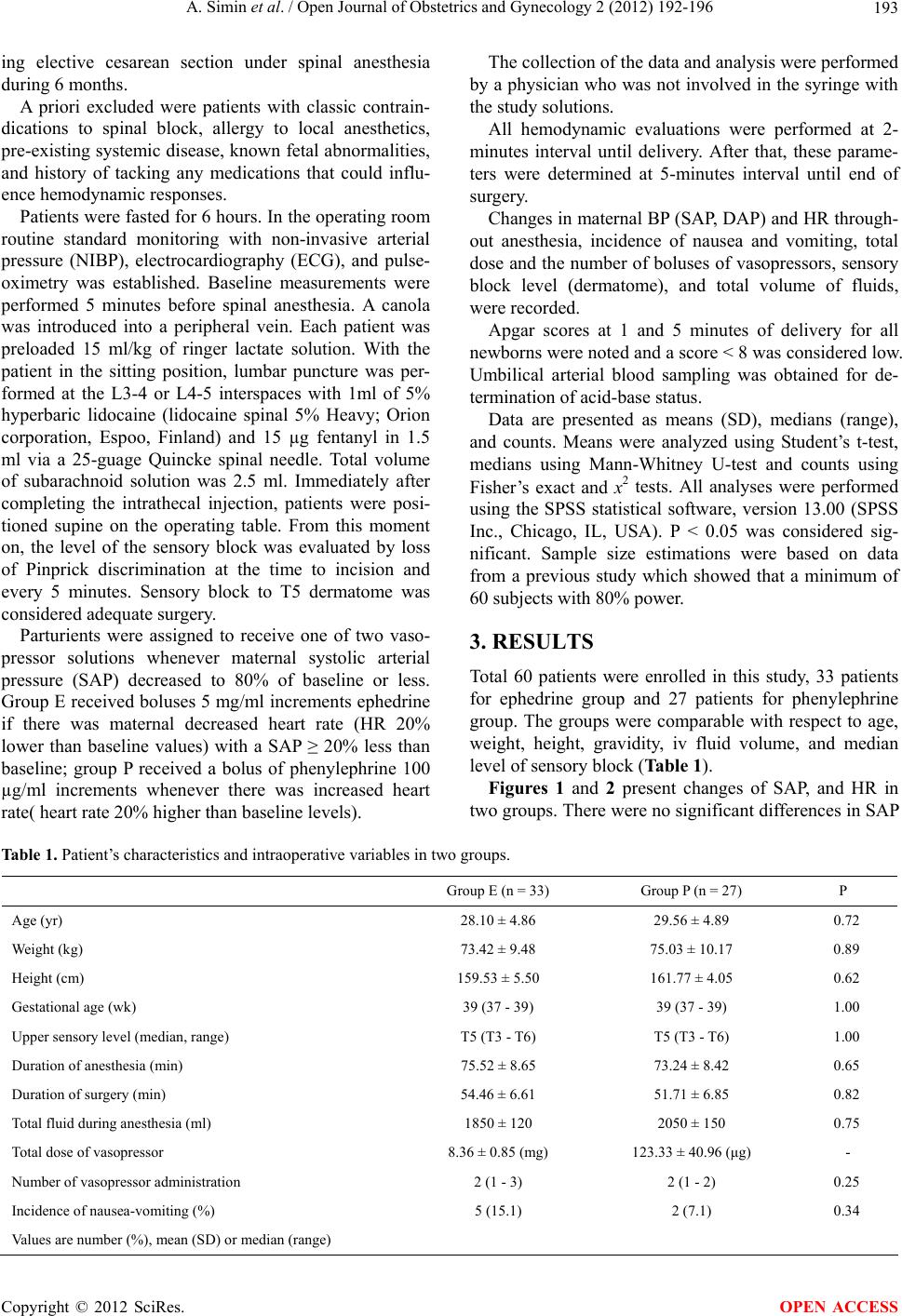 A. Simin et al. / Open Journal of Obstetrics and Gynecology 2 (2012) 192-196 193 ing elective cesarean section under spinal anesthesia during 6 months. A priori excluded were patients with classic contrain- dications to spinal block, allergy to local anesthetics, pre-existing systemic disease, known fetal abnormalities, and history of tacking any medications that could influ- ence hemodynamic responses. Patients were fasted for 6 hours. In the operating room routine standard monitoring with non-invasive arterial pressure (NIBP), electrocardiography (ECG), and pulse- oximetry was established. Baseline measurements were performed 5 minutes before spinal anesthesia. A canola was introduced into a peripheral vein. Each patient was preloaded 15 ml/kg of ringer lactate solution. With the patient in the sitting position, lumbar puncture was per- formed at the L3-4 or L4-5 interspaces with 1ml of 5% hyperbaric lidocaine (lidocaine spinal 5% Heavy; Orion corporation, Espoo, Finland) and 15 µg fentanyl in 1.5 ml via a 25-guage Quincke spinal needle. Total volume of subarachnoid solution was 2.5 ml. Immediately after completing the intrathecal injection, patients were posi- tioned supine on the operating table. From this moment on, the level of the sensory block was evaluated by loss of Pinprick discrimination at the time to incision and every 5 minutes. Sensory block to T5 dermatome was considered adequate surgery. Parturients were assigned to receive one of two vaso- pressor solutions whenever maternal systolic arterial pressure (SAP) decreased to 80% of baseline or less. Group E received boluses 5 mg/ml increments ephedrine if there was maternal decreased heart rate (HR 20% lower than baseline values) with a SAP ≥ 20% less than baseline; group P received a bolus of phenylephrine 100 µg/ml increments whenever there was increased heart rate( heart rate 20% higher than baseline levels). The collection of the data and analysis were performed by a physician who was not involved in the syringe with the study solutions. All hemodynamic evaluations were performed at 2- minutes interval until delivery. After that, these parame- ters were determined at 5-minutes interval until end of surgery. Changes in maternal BP (SAP, DAP) and HR through- out anesthesia, incidence of nausea and vomiting, total dose and the number of boluses of vasopressors, sensory block level (dermatome), and total volume of fluids, were recorded. Apgar scores at 1 and 5 minutes of delivery for all newborns were noted and a score < 8 was considered low. Umbilical arterial blood sampling was obtained for de- termination of acid-base status. Data are presented as means (SD), medians (range), and counts. Means were analyzed using Student’s t-test, medians using Mann-Whitney U-test and counts using Fisher’s exact and x2 tests. All analyses were performed using the SPSS statistical software, version 13.00 (SPSS Inc., Chicago, IL, USA). P < 0.05 was considered sig- nificant. Sample size estimations were based on data from a previous study which showed that a minimum of 60 subjects with 80% power. 3. RESULTS Total 60 patients were enrolled in this study, 33 patients for ephedrine group and 27 patients for phenylephrine group. The groups were comparable with respect to age, weight, height, gravidity, iv fluid volume, and median level of sensory block (Table 1). Figures 1 and 2 present changes of SAP, and HR in two groups. There were no significant differences in SAP Table 1. Patient’s characteristics and intraoperative variables in two groups. Group E (n = 33) Group P (n = 27) P Age (yr) 28.10 ± 4.86 29.56 ± 4.89 0.72 Weight (kg) 73.42 ± 9.48 75.03 ± 10.17 0.89 Height (cm) 159.53 ± 5.50 161.77 ± 4.05 0.62 Gestational age (wk) 39 (37 - 39) 39 (37 - 39) 1.00 Upper sensory level (median, range) T5 (T3 - T6) T5 (T3 - T6) 1.00 Duration of anesthesia (min) 75.52 ± 8.65 73.24 ± 8.42 0.65 Duration of surgery (min) 54.46 ± 6.61 51.71 ± 6.85 0.82 Total fluid during anesthesia (ml) 1850 ± 120 2050 ± 150 0.75 Total dose of vasopressor 8.36 ± 0.85 (mg) 123.33 ± 40.96 (μg) - Number of vasopressor administration 2 (1 - 3) 2 (1 - 2) 0.25 Incidence of nausea-vomiting (%) 5 (15.1) 2 (7.1) 0.34 Values are number (%), mean (SD) or median (range) Copyright © 2012 SciRes. OPEN ACCESS 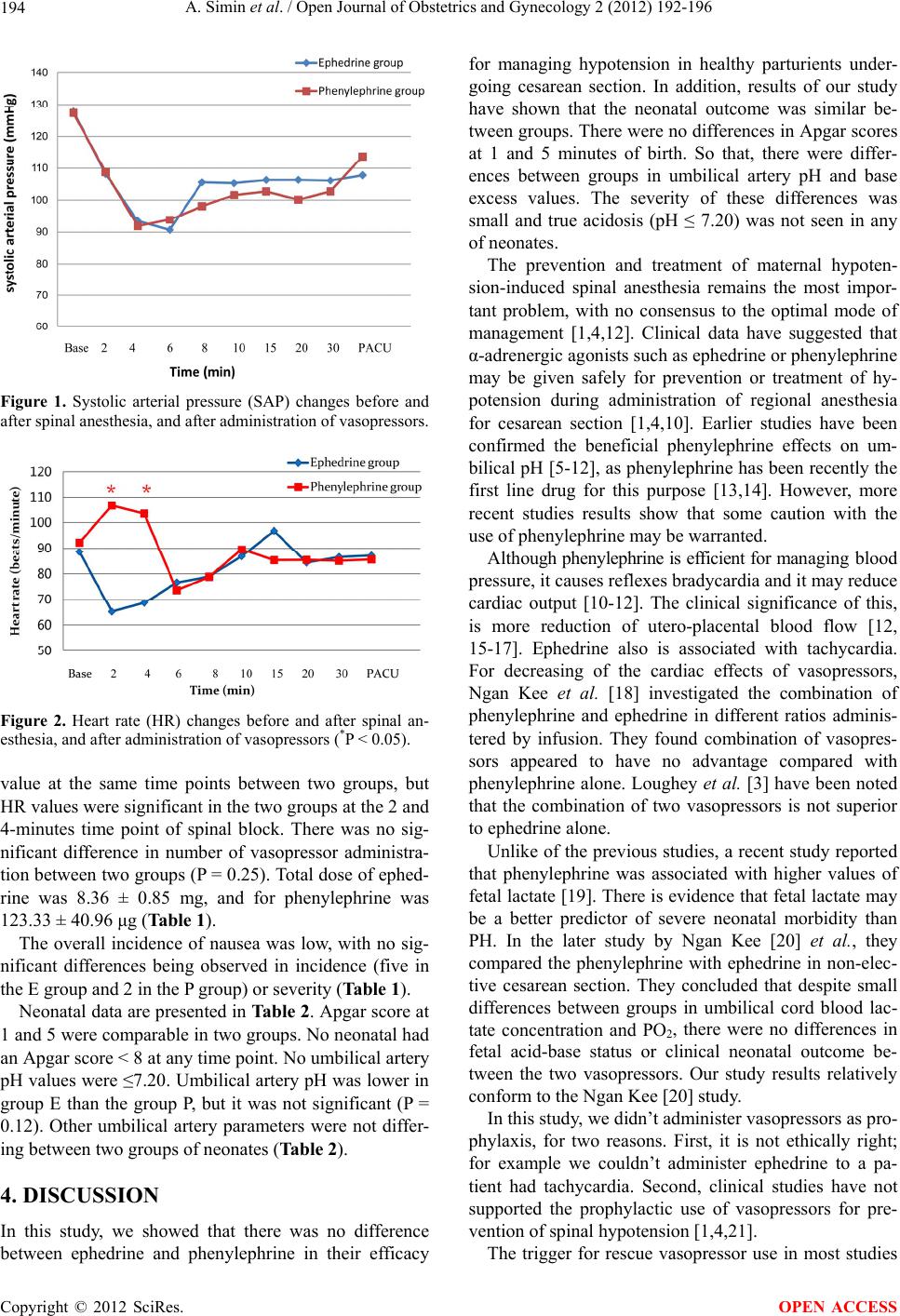 A. Simin et al. / Open Journal of Obstetrics and Gynecology 2 (2012) 192-196 194 Figure 1. Systolic arterial pressure (SAP) changes before and after spinal anesthesia, and after administration of vasopressors. Figure 2. Heart rate (HR) changes before and after spinal an- esthesia, and after administration of vasopressors (*P < 0.05). value at the same time points between two groups, but HR values were significant in the two groups at the 2 and 4-minutes time point of spinal block. There was no sig- nificant difference in number of vasopressor administra- tion between two groups (P = 0.25). Total dose of ephed- rine was 8.36 ± 0.85 mg, and for phenylephrine was 123.33 ± 40.96 μg (Table 1). The overall incidence of nausea was low, with no sig- nificant differences being observed in incidence (five in the E group and 2 in the P group) or severity (Table 1). Neonatal data are presented in Table 2. Apgar score at 1 and 5 were comparable in two groups. No neonatal had an Apgar score < 8 at any time point. No umbilical artery pH values were ≤7.20. Umbilical artery pH was lower in group E than the group P, but it was not significant (P = 0.12). Other umbilical artery parameters were not differ- ing between two groups of neonates (Table 2). 4. DISCUSSION In this study, we showed that there was no difference between ephedrine and phenylephrine in their efficacy for managing hypotension in healthy parturients under- going cesarean section. In addition, results of our study have shown that the neonatal outcome was similar be- tween groups. There were no differences in Apgar scores at 1 and 5 minutes of birth. So that, there were differ- ences between groups in umbilical artery pH and base excess values. The severity of these differences was small and true acidosis (pH ≤ 7.20) was not seen in any of neonates. The prevention and treatment of maternal hypoten- sion-induced spinal anesthesia remains the most impor- tant problem, with no consensus to the optimal mode of management [1,4,12]. Clinical data have suggested that α-adrenergic agonists such as ephedrine or phenylephrine may be given safely for prevention or treatment of hy- potension during administration of regional anesthesia for cesarean section [1,4,10]. Earlier studies have been confirmed the beneficial phenylephrine effects on um- bilical pH [5-12], as phenylephrine has been recently the first line drug for this purpose [13,14]. However, more recent studies results show that some caution with the use of phenylephrine may be warranted. Although phenylephrine is efficient for managing blood pressure, it causes reflexes bradycardia and it may reduce cardiac output [10-12]. The clinical significance of this, is more reduction of utero-placental blood flow [12, 15-17]. Ephedrine also is associated with tachycardia. For decreasing of the cardiac effects of vasopressors, Ngan Kee et al. [18] investigated the combination of phenylephrine and ephedrine in different ratios adminis- tered by infusion. They found combination of vasopres- sors appeared to have no advantage compared with phenylephrine alone. Loughey et al. [3] have been noted that the combination of two vasopressors is not superior to ephedrine alone. Unlike of the previous studies, a recent study reported that phenylephrine was associated with higher values of fetal lactate [19]. There is evidence that fetal lactate may be a better predictor of severe neonatal morbidity than PH. In the later study by Ngan Kee [20] et al., they compared the phenylephrine with ephedrine in non-elec- tive cesarean section. They concluded that despite small differences between groups in umbilical cord blood lac- tate concentration and PO2, there were no differences in fetal acid-base status or clinical neonatal outcome be- tween the two vasopressors. Our study results relatively conform to the Ngan Kee [20] study. In this study, we didn’t administer vasopressors as pro- phylaxis, for two reasons. First, it is not ethically right; for example we couldn’t administer ephedrine to a pa- tient had tachycardia. Second, clinical studies have not supported the prophylactic use of vasopressors for pre- vention of spinal hypotension [1,4,21]. The trigger for rescue vasopressor use in most studies Copyright © 2012 SciRes. OPEN ACCESS 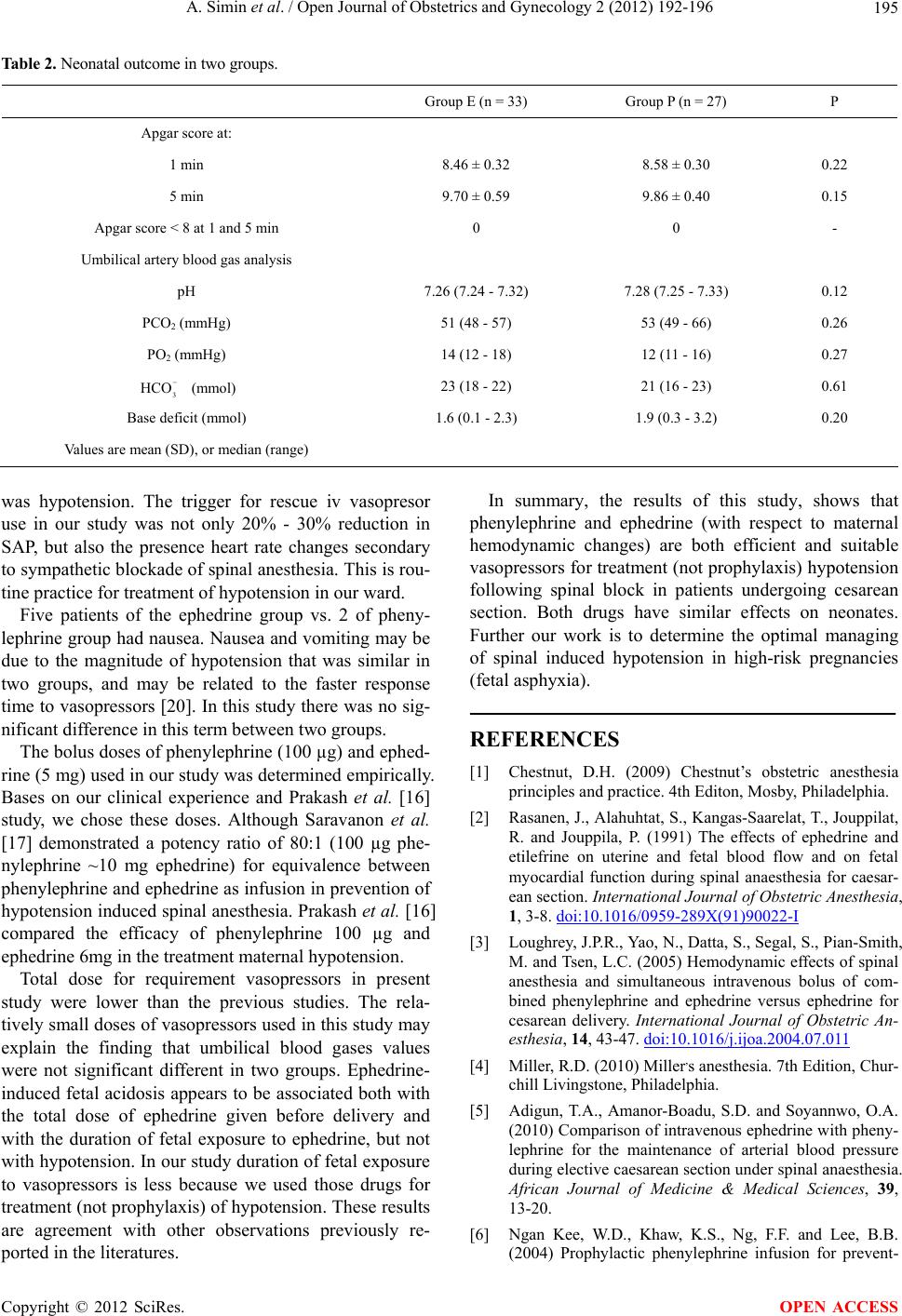 A. Simin et al. / Open Journal of Obstetrics and Gynecology 2 (2012) 192-196 195 Table 2. Neonatal outcome in two groups. Group E (n = 33) Group P (n = 27) P Apgar score at: 1 min 8.46 ± 0.32 8.58 ± 0.30 0.22 5 min 9.70 ± 0.59 9.86 ± 0.40 0.15 Apgar score < 8 at 1 and 5 min 0 0 - Umbilical artery blood gas analysis pH 7.26 (7.24 - 7.32) 7.28 (7.25 - 7.33) 0.12 PCO2 (mmHg) 51 (48 - 57) 53 (49 - 66) 0.26 PO2 (mmHg) 14 (12 - 18) 12 (11 - 16) 0.27 3 HCO (mmol) 23 (18 - 22) 21 (16 - 23) 0.61 Base deficit (mmol) 1.6 (0.1 - 2.3) 1.9 (0.3 - 3.2) 0.20 Values are mean (SD), or median (range) was hypotension. The trigger for rescue iv vasopresor use in our study was not only 20% - 30% reduction in SAP, but also the presence heart rate changes secondary to sympathetic blockade of spinal anesthesia. This is rou- tine practice for treatment of hypotension in our ward. Five patients of the ephedrine group vs. 2 of pheny- lephrine group had nausea. Nausea and vomiting may be due to the magnitude of hypotension that was similar in two groups, and may be related to the faster response time to vasopressors [20]. In this study there was no sig- nificant difference in this term between two groups. The bolus doses of phenylephrine (100 µg) and ephed- rine (5 mg) used in our study was determined empirically. Bases on our clinical experience and Prakash et al. [16] study, we chose these doses. Although Saravanon et al. [17] demonstrated a potency ratio of 80:1 (100 µg phe- nylephrine ~10 mg ephedrine) for equivalence between phenylephrine and ephedrine as infusion in prevention of hypotension induced spinal anesthesia. Prakash et al. [16] compared the efficacy of phenylephrine 100 µg and ephedrine 6mg in the treatment maternal hypotension. Total dose for requirement vasopressors in present study were lower than the previous studies. The rela- tively small doses of vasopressors used in this study may explain the finding that umbilical blood gases values were not significant different in two groups. Ephedrine- induced fetal acidosis appears to be associated both with the total dose of ephedrine given before delivery and with the duration of fetal exposure to ephedrine, but not with hypotension. In our study duration of fetal exposure to vasopressors is less because we used those drugs for treatment (not prophylaxis) of hypotension. These results are agreement with other observations previously re- ported in the literatures. In summary, the results of this study, shows that phenylephrine and ephedrine (with respect to maternal hemodynamic changes) are both efficient and suitable vasopressors for treatment (not prophylaxis) hypotension following spinal block in patients undergoing cesarean section. Both drugs have similar effects on neonates. Further our work is to determine the optimal managing of spinal induced hypotension in high-risk pregnancies (fetal asphyxia). REFERENCES [1] Chestnut, D.H. (2009) Chestnut’s obstetric anesthesia principles and practice. 4th Editon, Mosby, Philadelphia. [2] Rasanen, J., Alahuhtat, S., Kangas-Saarelat, T., Jouppilat, R. and Jouppila, P. (1991) The effects of ephedrine and etilefrine on uterine and fetal blood flow and on fetal myocardial function during spinal anaesthesia for caesar- ean section. International Journal of Obstetric Anesthesia, 1, 3-8. doi:10.1016/0959-289X(91)90022-I [3] Loughrey, J.P.R., Yao, N., Datta, S., Segal, S., Pian-Smith, M. and Tsen, L.C. (2005) Hemodynamic effects of spinal anesthesia and simultaneous intravenous bolus of com- bined phenylephrine and ephedrine versus ephedrine for cesarean delivery. International Journal of Obstetric An- esthesia, 14, 43-47. doi:10.1016/j.ijoa.2004.07.011 [4] Miller, R.D. (2010) Miller,s anesthesia. 7th Edition, Chur- chill Livingstone, Philadelphia. [5] Adigun, T.A., Amanor-Boadu, S.D. and Soyannwo, O.A. (2010) Comparison of intravenous ephedrine with pheny- lephrine for the maintenance of arterial blood pressure during elective caesarean section under spinal anaesthesia. African Journal of Medicine & Medical Sciences, 39, 13-20. [6] Ngan Kee, W.D., Khaw, K.S., Ng, F.F. and Lee, B.B. (2004) Prophylactic phenylephrine infusion for prevent- Copyright © 2012 SciRes. OPEN ACCESS  A. Simin et al. / Open Journal of Obstetrics and Gynecology 2 (2012) 192-196 196 ing hypotension during spinal anesthesia for cesarean de- livery. Anesthesia & Analgesia, 98, 815-821. doi:10.1213/01.ANE.0000099782.78002.30 [7] Cooper, D.W., Carpenter, M., Mowbray, P., Desira, W.R., Ryall, D.M. and Kokri, M.S. (2002) Fetal and maternal effects of phenylephrine and ephedrine during spinal an- esthesia for cesarean delivery. Anesthesiology, 97, 1582- 1590. doi:10.1097/00000542-200212000-00034 [8] Cooper, D.W. and Mowbray, P. (2004) Advantages of using a prophylactic phenylephrine infusion during spinal anaesthesia for caesarean section. International Journal of Obstetric Anesthesia, 13, 124-125. doi:10.1016/j.ijoa.2003.11.001 [9] Cooper, D.W., Gibb, S.C., Meek, T., Owen, S., Kokri, M.S., Malik, A.T. and Koneti, K.K. (2007) Efects of in- travenous vasopressor on spread of spinal anesthesia and fetal acid-base equilibrium. British Journal of Anaesthe- sia, 98, 649-656. doi:10.1093/bja/aem056 [10] Lee, A., Ngan Kee, W.D. and Gin, T. (2002) A Quantita- tive, systematic review of randomized controlled trials of ephedrine versus phenylephrine for the management of hypotension during spinal anesthesia for cesarean deli- very. Anesthesia & Analgesia, 94, 920-926. doi:10.1097/00000539-200204000-00028 [11] Magalhaes, E., Goveia, C.S., de Araujo Ladeira, L.C., Nascimento, B.G. and Kluthcouski, S.M. (2009) Ephed- rine versus phenylephrine: Prevention of hypotension during spinal block for cesarean section and effects on the fetus. Rev Bras Anestesiol, 59, 11-20. [12] Ayorinde, B.T., Buczkowski, P., Brown, J., Shah, J. and Buggy, D.J. (2001) Evaluation of pre-emptive intra- muscular phenylephrine and ephedrine for reduction of spinal anaesthesia-induced hypotension during caesarean section. British Journal of Anaesthesia, 86, 372-376. doi:10.1093/bja/86.3.372 [13] Tanaka, M., Balki, M., Parkes, R.K. and Carvalho, J.C.A. (2009) ED95 of phenylephrine to prevent spinal-induced hypotension and/or nausea at elective cesarean delivery. International Journal of Obstetric Anesthesia, 18, 125- 130. doi:10.1016/j.ijoa.2008.09.008 [14] Allen, T.K., Muir, H.A., George, R.B. and Habib, A.S. (2009) A survey of the management of spinal-induced hypotension for scheduled cesarean delivery. Interna- tional Journal of Obstetric Anesthesia, 18, 356-361. doi:10.1016/j.ijoa.2009.03.014 [15] Ngan Kee, W.D. (2010) Prevention of maternal hypo- tension after regional anaesthesia for caesarean section. Current Opinion in Anaesthesiology, 23, 304-309. doi:10.1097/ACO.0b013e328337ffc6 [16] Prakash, S., Pramanik, V., Chellani, H., Salhan, S. and Gogia, A.R. (2010) Maternal and neonatal effects of bolus administration of ephedrine and phenylephrine during spinal anaesthesia for caesarean delivery: A ran- domised study. International Journal of Obstetric Anes- thesia, 19, 24-30. doi:10.1016/j.ijoa.2009.02.007 [17] Saravanan, S., Kocarev, M., Wilson, R.C., Watkins, E., Columb, M.O. and Lyons, G. (2006) Equivalent dose of ephedrine and phenylephrine in the prevention of post- spinal hypotension in caesarean section. British Journal of Anaesthesia, 96, 95-99. doi:10.1093/bja/aei265 [18] Ngan Kee, W.D., Khaw, K.S. and Ng, F.F. (2005) Pre- vention of hypotension during spinal anesthesia for ce- sarean delivery: An effective technique using combina- tion phenylephrine infusion and crystalloid cohydration. Anesthesiology, 103, 744-750. [19] Erkinaro, T., Kavasmaa, T., Pakkila, M., Acharya, G., Makikallio, K., Alahuhta, S. and Rasanen, J. (2006) Ephedrine and phenylephrine for the treatment of ma- ternal hypotension in a chronic sheep model of increased placental vascular resistance. British Journal of An- aesthesia, 96, 231-237. doi:10.1093/bja/aei305 [20] Ngan Kee, W.D., Khaw, K.S., Lau, T.K., Ng, F.F., Chui, K. and Ng, K.L. (2008) Randomised double-blinded comparison of phenylephrine vs ephedrine for main- taining blood pressure anaesthesia for non-elective cae- sarean section. Anaesthesia, 63, 1319-1326. doi:10.1111/j.1365-2044.2008.05635.x [21] Thomas, D.G., Robson, S.C., Redfern, N., Hughes, D. and Boys, R.J. (1996) Randomized trial of bolus pheny- lephrine or ephedrine for maintenance of arterial pressure during spinal anaesthesia for caesarean section. British Journal of Anaesthesia, 76, 61-65. doi:10.1093/bja/76.1.61 Copyright © 2012 SciRes. OPEN ACCESS |