

Paper Menu >>
Journal Menu >>
 Open Journal of Metal, 2012, 2, 68-73 http://dx.doi.org/10.4236/ojmetal.2012.23010 Published Online September 2012 (http://www.SciRP.org/journal/ojmetal) Comparative Study of Corrosion Inhibition Efficiency of Naturally Occurring Ecofriendly Varieties of Holy Basil (Tulsi) for Tin in HNO3 Solution Nutan Kumpawat, Alok Chaturvedi*, Rajesh Kumar Upadhyay Department of Chemistry, Government College, Ajmer (Rajasthan), India Email: *[email protected] Received June 22, 2012; revised July 21, 2012; accepted August 10, 2012 ABSTRACT Weight loss technique has been used to study the corrosion inhibition efficiency of tin in HNO3 solution by using the leaves and stem extract of different varieties of Holy Basil viz. Ocimum basilicum (EB), Ocimum cannum (EC) and Ocimum sanctum (ES). The results show that all the varieties under study are good corrosion inhibitors, among which leaves extract of EB is the most effective. Corrosion inhibition efficiency increases with increasing concentration of in- hibitor and it also increases with increasing concentration of HNO3 solution. Inhibition efficiency was found maximum up to 96.19% for tin with 0.6% leaves extract. Keywords: Acid Solution; Inhibitors; Tin Metal, Weight Loss; Surface Coverage 1. Introduction Tin and its alloys are found useful for many engineering applications because of their lightness and strength, thermal and electrical conductivity, heat and light reflec- tivity and hygienic and non-toxic qualities. Tin is a reac- tive metal according to the electrochemical series (Eo = −0.14V), but it is non reactive in moisture due to the formation of a stable oxide film on its surface. Tin is not attacked by pure water but dissolves in aqueous acids with the liberation of hydrogen gas. Acids like hydro- chloric acid, sulphuric acid etc. are used for drilling op- eration, pickling and descaling. Many workers [1-4] have studied corrosion of tin in HNO3 solution. Holy basil is a very common plant in India. It is anti- bacterial, anti-fungal and is used as an air purifier and anti-malarial from ancient times in Indian homes. Pow- der of its stem and leaves is used as medicine in balanc- ing blood glucose management, to maintain a healthy digestive system, to encourage the efficient use of oxy- gen, to enhance the efficacy of many therapeutic treat- ments etc. The importance of the study lies in the fact that natural plant products are non-polluting, ecofriendly, economic, less toxic and easily available than synthetic organic compounds. They are biodegradable and so can be used without any side adverse effects. The chemical composition of Ocimum sanctum is highly complex, containing many vitamins like A and C, calcium, zinc, iron, chlorophyll along with many other phytonutri- ents which are present in the extract of Ocimum sanctum. The major chemical constituents responsible for phys- ico-chemical action of Ocimum sanctum are volatile oil (0.1% to 0.9% ), eugenol (60% - 70%), cavacrol (about 3.0%), eugenol methyl ether (20%) and other minor chemical constituents of Ocimum sanctum are like alka- loids, glycoside, saponin, tannin, maleic acid, ursolic acid, citric acid and tartaric acid. Eugenol *Corresponding author. Ursolic Acid C opyright © 2012 SciRes. OJMetal 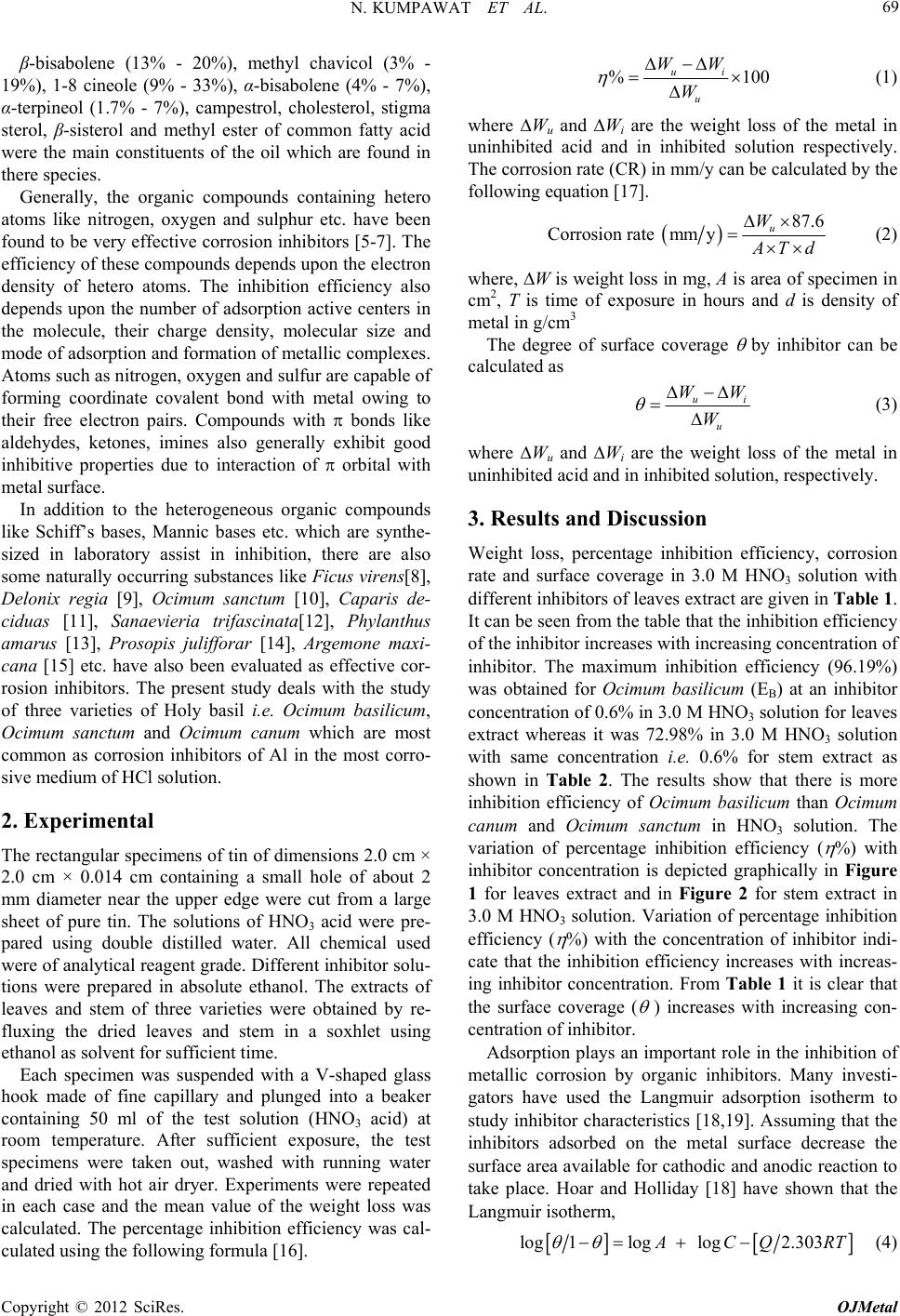 N. KUMPAWAT ET AL. 69 β-bisabolene (13% - 20%), methyl chavicol (3% - 19%), 1-8 cineole (9% - 33%), α-bisabolene (4% - 7%), α-terpineol (1.7% - 7%), campestrol, cholesterol, stigma sterol, β-sisterol and methyl ester of common fatty acid were the main constituents of the oil which are found in there species. Generally, the organic compounds containing hetero atoms like nitrogen, oxygen and sulphur etc. have been found to be very effective corrosion inhibitors [5-7]. The efficiency of these compounds depends upon the electron density of hetero atoms. The inhibition efficiency also depends upon the number of adsorption active centers in the molecule, their charge density, molecular size and mode of adsorption and formation of metallic complexes. Atoms such as nitrogen, oxygen and sulfur are capable of forming coordinate covalent bond with metal owing to their free electron pairs. Compounds with bonds like aldehydes, ketones, imines also generally exhibit good inhibitive properties due to interaction of orbital with metal surface. In addition to the heterogeneous organic compounds like Schiff’s bases, Mannic bases etc. which are synthe- sized in laboratory assist in inhibition, there are also some naturally occurring substances like Ficus virens[8], Delonix regia [9], Ocimum sanctum [10], Caparis de- ciduas [11], Sanaevieria trifascinata[12], Phylanthus amarus [13], Prosopis julifforar [14], Argemone maxi- cana [15] etc. have also been evaluated as effective cor- rosion inhibitors. The present study deals with the study of three varieties of Holy basil i.e. Ocimum basilicum, Ocimum sanctum and Ocimum canum which are most common as corrosion inhibitors of Al in the most corro- sive medium of HCl solution. 2. Experimental The rectangular specimens of tin of dimensions 2.0 cm × 2.0 cm × 0.014 cm containing a small hole of about 2 mm diameter near the upper edge were cut from a large sheet of pure tin. The solutions of HNO3 acid were pre- pared using double distilled water. All chemical used were of analytical reagent grade. Different inhibitor solu- tions were prepared in absolute ethanol. The extracts of leaves and stem of three varieties were obtained by re- fluxing the dried leaves and stem in a soxhlet using ethanol as solvent for sufficient time. Each specimen was suspended with a V-shaped glass hook made of fine capillary and plunged into a beaker containing 50 ml of the test solution (HNO3 acid) at room temperature. After sufficient exposure, the test specimens were taken out, washed with running water and dried with hot air dryer. Experiments were repeated in each case and the mean value of the weight loss was calculated. The percentage inhibition efficiency was cal- culated using the following formula [16]. % 100 ui u WW W (1) where Wu and Wi are the weight loss of the metal in uninhibited acid and in inhibited solution respectively. The corrosion rate (CR) in mm/y can be calculated by the following equation [17]. 87.6 Corrosion rate mmyu W A Td (2) where, W is weight loss in mg, A is area of specimen in cm2, T is time of exposure in hours and d is density of metal in g/cm3 The degree of surface coverage by inhibitor can be calculated as u u WW W i (3) where Wu and Wi are the weight loss of the metal in uninhibited acid and in inhibited solution, respectively. 3. Results and Discussion Weight loss, percentage inhibition efficiency, corrosion rate and surface coverage in 3.0 M HNO3 solution with different inhibitors of leaves extract are given in Table 1. It can be seen from the table that the inhibition efficiency of the inhibitor increases with increasing concentration of inhibitor. The maximum inhibition efficiency (96.19%) was obtained for Ocimum basilicum (EB) at an inhibitor concentration of 0.6% in 3.0 M HNO3 solution for leaves extract whereas it was 72.98% in 3.0 M HNO3 solution with same concentration i.e. 0.6% for stem extract as shown in Table 2. The results show that there is more inhibition efficiency of Ocimum basilicum than Ocimum canum and Ocimum sanctum in HNO3 solution. The variation of percentage inhibition efficiency ( %) with inhibitor concentration is depicted graphically in Figure 1 for leaves extract and in Figure 2 for stem extract in 3.0 M HNO3 solution. Variation of percentage inhibition efficiency ( %) with the concentration of inhibitor indi- cate that the inhibition efficiency increases with increas- ing inhibitor concentration. From Table 1 it is clear that the surface coverage ( ) increases with increasing con- centration of inhibitor. Adsorption plays an important role in the inhibition of metallic corrosion by organic inhibitors. Many investi- gators have used the Langmuir adsorption isotherm to study inhibitor characteristics [18,19]. Assuming that the inhibitors adsorbed on the metal surface decrease the surface area available for cathodic and anodic reaction to take place. Hoar and Holliday [18] have shown that the Langmuir isotherm, log1log log2.303 A CQ RT (4) Copyright © 2012 SciRes. OJMetal 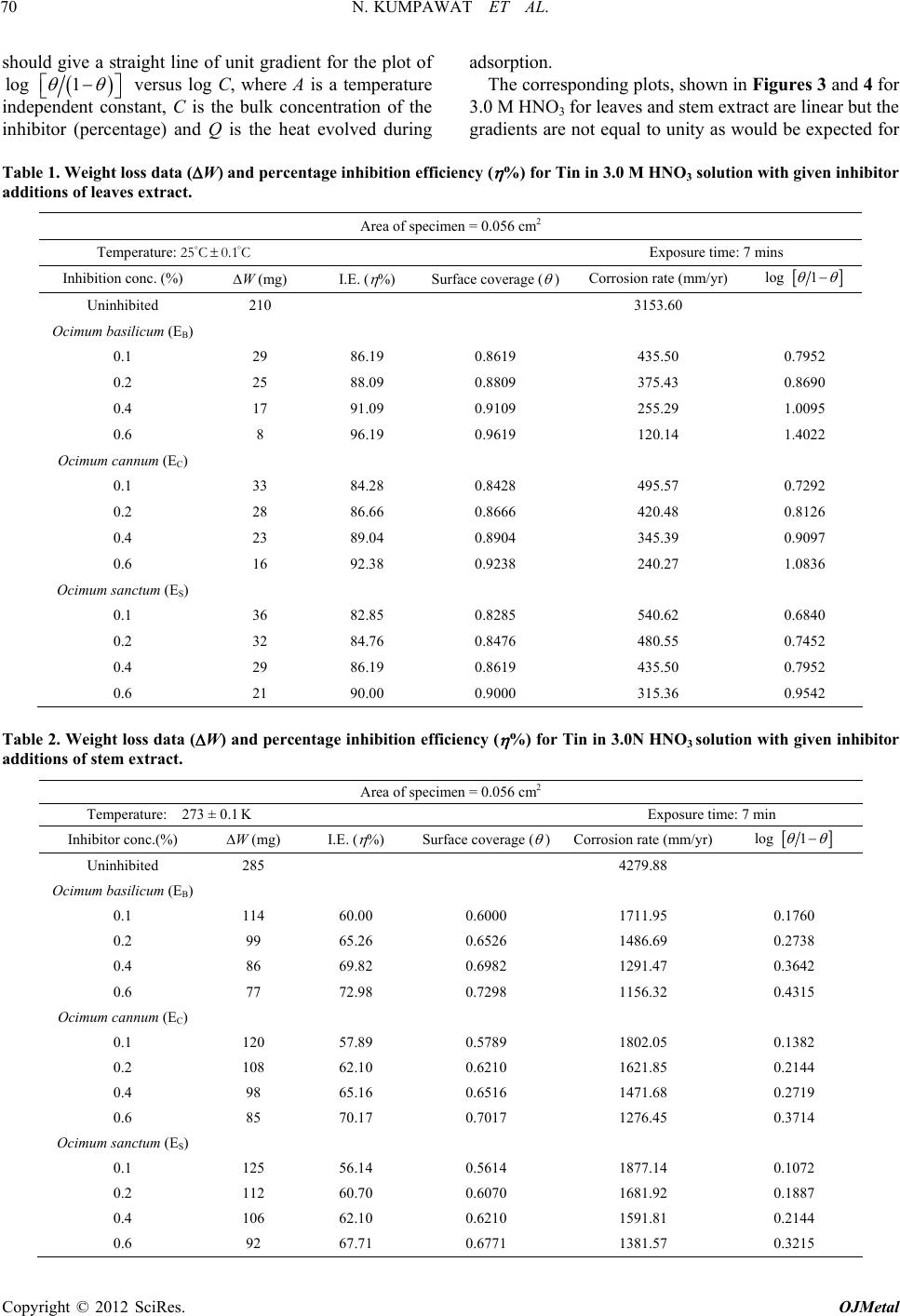 N. KUMPAWAT ET AL. Copyright © 2012 SciRes. OJMetal 70 should give a straight line of unit gradient for the plot of log 1 versus log C, where A is a temperature independent constant, C is the bulk concentration of the inhibitor (percentage) and Q is the heat evolved during adsorption. The corresponding plots, shown in Figures 3 and 4 for 3.0 M HNO3 for leaves and stem extract are linear but the gradients are not equal to unity as would be expected for Table 1. Weight loss data (W) and percentage inhibition efficiency ( %) for Tin in 3.0 M HNO3 solution with given inhibitor additions of leaves extract. Area of specimen = 0.056 cm2 Temperature: 25C0.1 C Exposure time: 7 mins Inhibition conc. (%) W (mg) I.E. ( %) Surface coverage ( )Corrosion rate (mm/yr) log 1 Uninhibited 210 3153.60 Ocimum basilicum (EB) 0.1 29 86.19 0.8619 435.50 0.7952 0.2 25 88.09 0.8809 375.43 0.8690 0.4 17 91.09 0.9109 255.29 1.0095 0.6 8 96.19 0.9619 120.14 1.4022 Ocimum cannum (EC) 0.1 33 84.28 0.8428 495.57 0.7292 0.2 28 86.66 0.8666 420.48 0.8126 0.4 23 89.04 0.8904 345.39 0.9097 0.6 16 92.38 0.9238 240.27 1.0836 Ocimum sanctum (ES) 0.1 36 82.85 0.8285 540.62 0.6840 0.2 32 84.76 0.8476 480.55 0.7452 0.4 29 86.19 0.8619 435.50 0.7952 0.6 21 90.00 0.9000 315.36 0.9542 Table 2. Weight loss data (W) and percentage inhibition efficiency ( %) for Tin in 3.0N HNO3 solution with given inhibitor additions of stem extract. Area of specimen = 0.056 cm2 Temperature: 273 ± 0.1 K Exposure time: 7 min Inhibitor conc.(%) W (mg) I.E. ( %) Surface coverage ( )Corrosion rate (mm/yr) log 1 Uninhibited 285 4279.88 Ocimum basilicum (EB) 0.1 114 60.00 0.6000 1711.95 0.1760 0.2 99 65.26 0.6526 1486.69 0.2738 0.4 86 69.82 0.6982 1291.47 0.3642 0.6 77 72.98 0.7298 1156.32 0.4315 Ocimum cannum (EC) 0.1 120 57.89 0.5789 1802.05 0.1382 0.2 108 62.10 0.6210 1621.85 0.2144 0.4 98 65.16 0.6516 1471.68 0.2719 0.6 85 70.17 0.7017 1276.45 0.3714 Ocimum sanctum (ES) 0.1 125 56.14 0.5614 1877.14 0.1072 0.2 112 60.70 0.6070 1681.92 0.1887 0.4 106 62.10 0.6210 1591.81 0.2144 0.6 92 67.71 0.6771 1381.57 0.3215 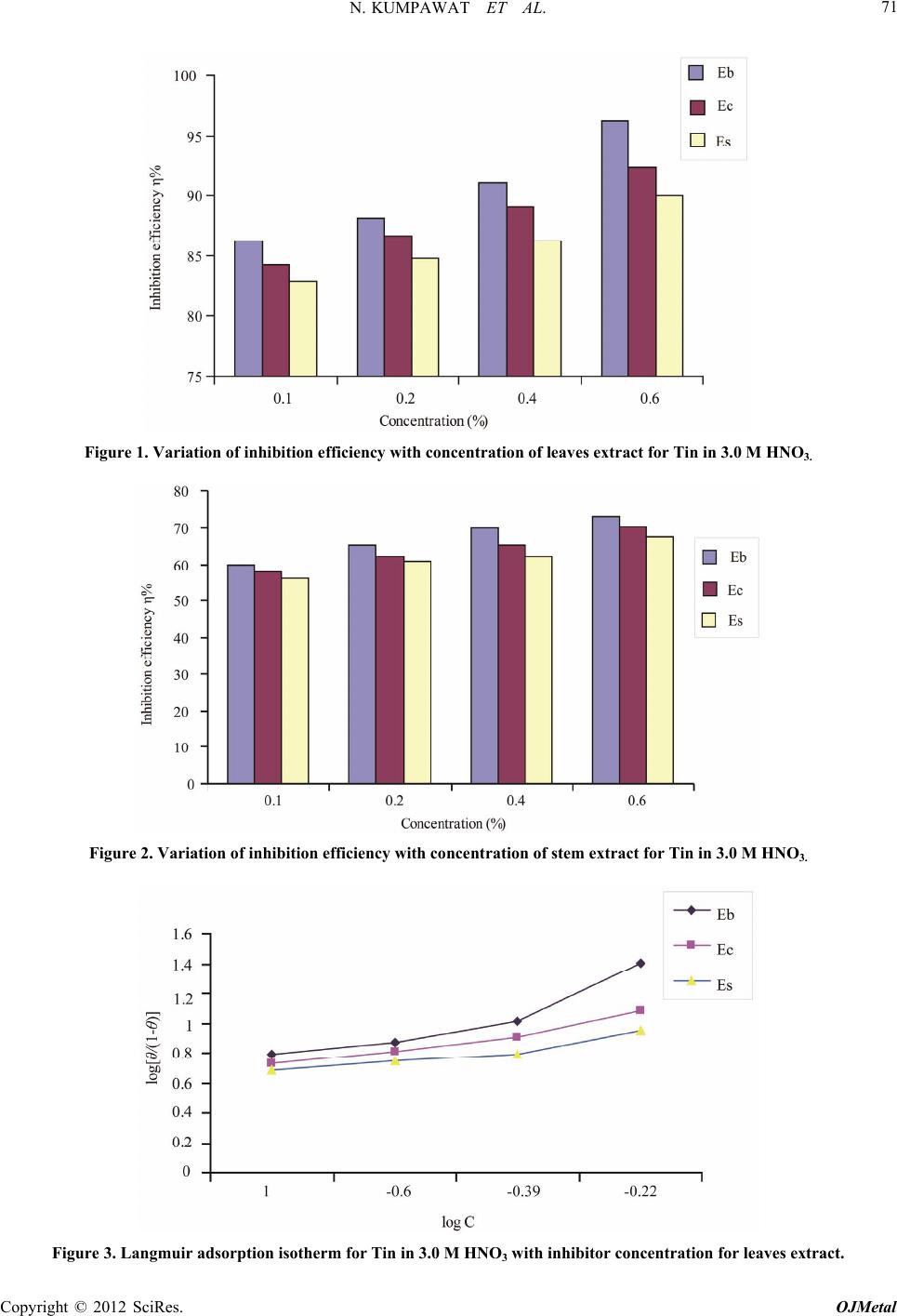 N. KUMPAWAT ET AL. 71 Figure 1. Variation of inhibition efficiency with concentration of leaves extract for Tin in 3.0 M HNO3. Figure 2. Variation of inhibition efficiency with concentration of stem extract for Tin in 3.0 M HNO3. Figure 3. Langmuir adsorption isotherm for Tin in 3.0 M HNO3 with inhibitor concentration for leaves extract. Copyright © 2012 SciRes. OJMetal  N. KUMPAWAT ET AL. Copyright © 2012 SciRes. OJMetal 72 Figure 4. Langmuir adsorption isotherm for Tin in 3.0 M HNO3 with inhibitor concentraction for stem extract. REFERENCES the ideal Langmuir adsorption isotherm equation. This deviation from unity may be explained on the basis of the interaction among the adsorbed species on the metal sur- face. It has been postulated in the derivation of the Langmuir isotherm equation that the adsorbed molecules do not interact with one another but this is not true in the case of organic molecule having polar atoms or groups which are adsorbed on the anodic and cathodic sites of the metal surface. Such adsorbed species may interact by mutual repulsion or attraction. Thus, it is also possible for inhibitor molecule those are adsorbed on anodic and cathodic sites to interact with metallic surface as well as with each other. [1] A. A. El. Warraky and El. Meleigt, “Electrochemical and Spectroscopic Investigation of Synergestic Effects in Corrosion Inhibition of Al Bronze Part 1-in Pure HCl,” Journal of British Corrosion, Vol. 37, No. 4, 2000, pp. 305- 310. [2] H. Ashassi-Sorkhabi, B. Shabani, B. Aligholipour and D. Seifzadeh, “The Effect of Some Schiff Bases on the Cor- rosion of Aluminum in Hydrochloric Acid Solution,” Ap- plied Surface Science, Vol. 252, No. 12, 2006, pp. 4039- 4047. doi:10.1016/j.apsusc.2005.02.148 [3] G. Berkt, A. Pinarbasi and C. Orgretir, “Benzimidazole-2- tione and Benzyoxazole-2-tione Derivatives as Corrosion Inhibitors for Al in HCl Acid,” Anticorrosion, Methods and Materials, Vol. 51, No. 4, 2004, pp. 282-293. [4] A. H. Ali Ahmed, A. H. Ahmed, T. A. Mohamed and B. H. Mohamed, “Chelates and Corrosion Inhibition of Newly Synthesized Schiff Bases Derived from o-tolidine,” Tran- sition Metal Chemistry, Vol. 32, No. 4, 2007, pp. 461-467. doi:10.1007/s11243-007-0184-8 4. Conculsions A study of three varieties of holy basil viz. Ocimum basilicum (EB), Ocimum cannum (EC) and Ocimum sanctum (ES) has shown them to be better corrosion in- hibitor for Tin metal in HNO3 solution. EB has proved to be an excellent inhibitor for Tin in HNO3 acid due to the presence of methyl eugenol terpenoid (75.69%). [5] A. Mozaleva APoznyok, I. Mozaleval and A. W. Hassel, “The Voltage—Time Behaviour for Porous Anodizing of Aluminium in a Fluoride-Containing Oxalic Acid Elec- trolyte,” Electrochemistry Communications, Vol. 3, No. 6, 2001, pp. 299-305. doi:10.1016/S1388-2481(01)00157-6 Weight loss method has shown that inhibition effi- ciency of holy basil increases with increasing inhibitor concentration over the range 0.1% to 0.6% the maximum inhibition efficiency was found up to 96.19% for tin in 3.0 M HNO3 acid at a concentration of 0.6% for leaves extract whereas it was 72.98% for stem extract with same concentration of acid strength. Thus, it was concluded that leaves extract is a better corrosion inhibitor than stem extract. [6] E. E. Ebenso, P. C. Okafor and U. G. Eppe, “Studies on the Inhibition of Al Corrosion by 2-Acetylphenothiazine in Chloroacetic Acids,” Anticorrosion, Methods and Ma- terials, Vol. 50, No. 6, 2003, pp. 414-421. [7] C. Blanc, S. Gastaud and G. Mankowski, “Mechanistic Studies of the Corrosion of 2024 Aluminum Alloy in Ni- trate Solutions,” Journal of the Electrochemical Society, Vol. 150, No. 8, 2003, pp. B396-B404. doi:10.1149/1.1590327 [8] T. Sethi, A. Chaturvedi, R. K. Upadhyay and S. P. Mathur, “Inhibition Effect of Nitrogen Containing Ligands on Corrosion of Aluminium in Acid Media with and without KCl,” Polish Journal of Chemistry, Vol. 82, No. 3, 2008, pp.591-598. 5. Acknowledgements One of the authors (Nutan Kumpawat) is grateful to R.G.N. fellowship from U.G.C. govt. of India as J.R.F. 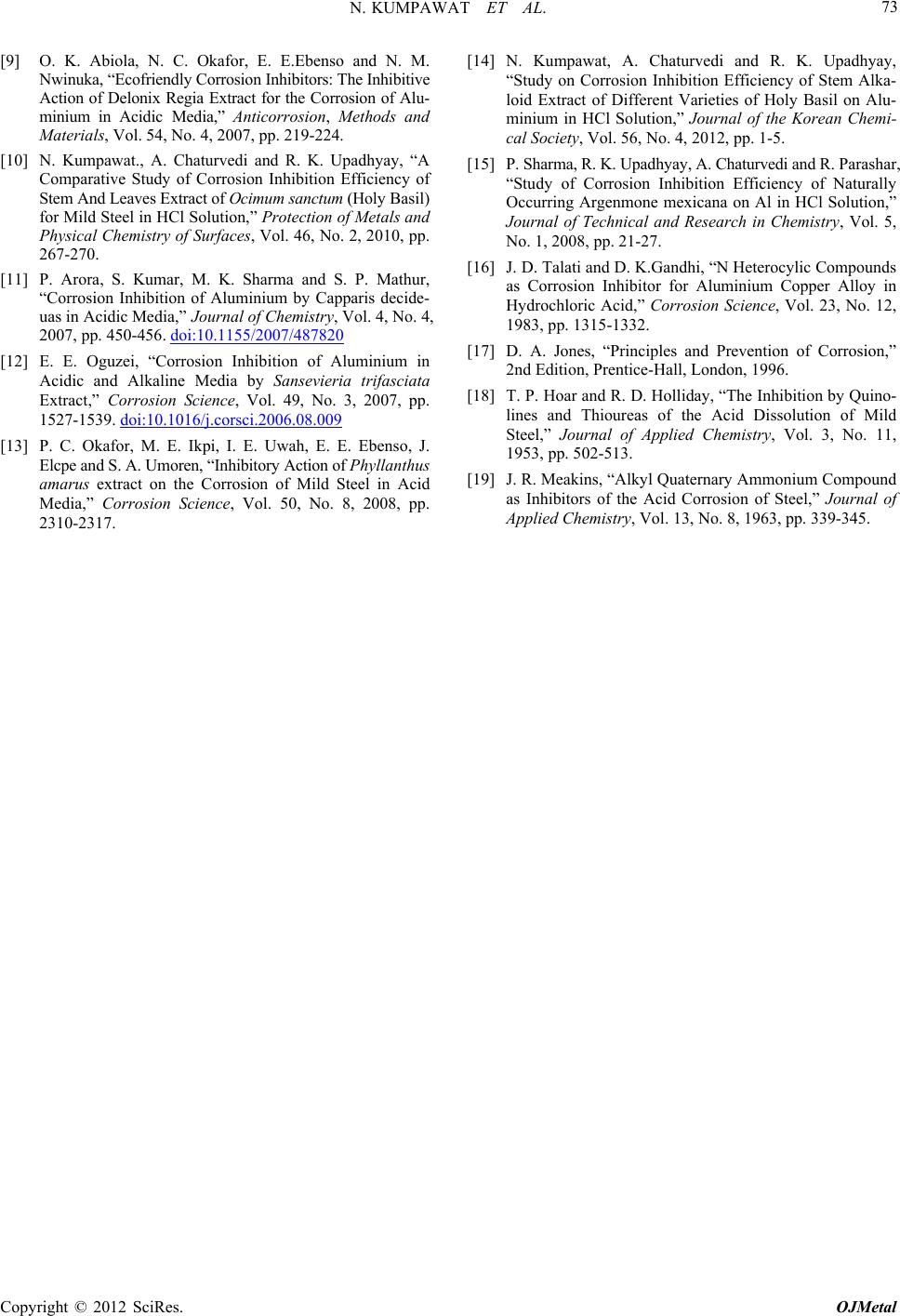 N. KUMPAWAT ET AL. 73 [9] O. K. Abiola, N. C. Okafor, E. E.Ebenso and N. M. Nwinuka, “Ecofriendly Corrosion Inhibitors: The Inhibitive Action of Delonix Regia Extract for the Corrosion of Alu- minium in Acidic Media,” Anticorrosion, Methods and Materials, Vol. 54, No. 4, 2007, pp. 219-224. [10] N. Kumpawat., A. Chaturvedi and R. K. Upadhyay, “A Comparative Study of Corrosion Inhibition Efficiency of Stem And Leaves Extract of Ocimum sanctum (Holy Basil) for Mild Steel in HCl Solution,” Protection of Metals and Physical Chemistry of Surfaces, Vol. 46, No. 2, 2010, pp. 267-270. [11] P. Arora, S. Kumar, M. K. Sharma and S. P. Mathur, “Corrosion Inhibition of Aluminium by Capparis decide- uas in Acidic Media,” Journal of Chemistry, Vol. 4, No. 4, 2007, pp. 450-456. doi:10.1155/2007/487820 [12] E. E. Oguzei, “Corrosion Inhibition of Aluminium in Acidic and Alkaline Media by Sansevieria trifasciata Extract,” Corrosion Science, Vol. 49, No. 3, 2007, pp. 1527-1539. doi:10.1016/j.corsci.2006.08.009 [13] P. C. Okafor, M. E. Ikpi, I. E. Uwah, E. E. Ebenso, J. Elcpe and S. A. Umoren, “Inhibitory Action of Phyllanthus amarus extract on the Corrosion of Mild Steel in Acid Media,” Corrosion Science, Vol. 50, No. 8, 2008, pp. 2310-2317. [14] N. Kumpawat, A. Chaturvedi and R. K. Upadhyay, “Study on Corrosion Inhibition Efficiency of Stem Alka- loid Extract of Different Varieties of Holy Basil on Alu- minium in HCl Solution,” Journal of the Korean Chemi- cal Society, Vol. 56, No. 4, 2012, pp. 1-5. [15] P. Sharma, R. K. Upadhyay, A. Chaturvedi and R. Parashar, “Study of Corrosion Inhibition Efficiency of Naturally Occurring Argenmone mexicana on Al in HCl Solution,” Journal of Technical and Research in Chemistry, Vol. 5, No. 1, 2008, pp. 21-27. [16] J. D. Talati and D. K.Gandhi, “N Heterocylic Compounds as Corrosion Inhibitor for Aluminium Copper Alloy in Hydrochloric Acid,” Corrosion Science, Vol. 23, No. 12, 1983, pp. 1315-1332. [17] D. A. Jones, “Principles and Prevention of Corrosion,” 2nd Edition, Prentice-Hall, London, 1996. [18] T. P. Hoar and R. D. Holliday, “The Inhibition by Quino- lines and Thioureas of the Acid Dissolution of Mild Steel,” Journal of Applied Chemistry, Vol. 3, No. 11, 1953, pp. 502-513. [19] J. R. Meakins, “Alkyl Quaternary Ammonium Compound as Inhibitors of the Acid Corrosion of Steel,” Journal of Applied Chemistry, Vol. 13, No. 8, 1963, pp. 339-345. Copyright © 2012 SciRes. OJMetal |