

Paper Menu >>
Journal Menu >>
 Journal of Signal and Information Processing, 2012, 3, 377-381 http://dx.doi.org/10.4236/jsip.2012.33049 Published Online August 2012 (http://www.SciRP.org/journal/jsip) 377 Robust Non-Fragile Control of 2-D Discrete Uncertain Systems: An LMI Approach Paramanand Sharma, Amit Dhawan Department of Electronics and Communication Engineering, Motilal Nehru National Institute of Technology, Allahabd, India. Email: [email protected], [email protected] Received December 23rd, 2011; revised January 31st, 2012; accepted February 20th, 2012 ABSTRACT This paper considers the problem of robust non-fragile control for a class of two-dimensional (2-D) discrete uncertain systems described by the Fornasini-Marchesini second local state-space (FMSLSS) model under controller gain varia- tions. The parameter uncertainty is assumed to be norm-bounded. The problem to be addressed is the design of non-fragile robust controllers via state feedback such that the resulting closed-loop system is asymptotically stable for all admissible parameter uncertainties and controller gain variations. A sufficient condition for the existence of such controllers is derived based on the linear matrix inequality (LMI) approach combined with the Lyapunov method. Fi- nally, a numerical example is illustrated to show the contribution of the main resu lt. Keywords: 2-D Discrete Systems; Fornasini-Marchesini Second Local State-Space Model; Non-Fragile Control; Linear Matrix Inequality; Lyapuno v Methods 1. Introduction In recent years, the research on two-dimensional (2-D) discrete systems have received considerable attention, since 2-D systems exist in many practical applications such as image data processing, seismographic data proc- essing, thermal processes, gas absorption, water stream heating, river pollution modeling, etc. [1-5]. The stability properties of 2-D discrete systems described by the For- nasini-Marchesini second local state-space (FMSLSS) model [6] have been studied in [7-15]. The asymptotic stability conditions for linear FMSLSS model based on 2-D Lyapunov equation approach have been established in [7-10]. Many publications related to stability analysis of 2-D discrete systems employing various finite word- length nonlinearities hav e appeared [10-1 4 ]. The prob lem of robust stability analysis and stabilization of 2-D dis- crete systems via the linear matrix inequality (LMI) ap- proach has been considered in [15]. Recently, there has been a growing interest in the study of robust non-fragile control problems. The aim of robust non-fragile control is to design a robust controller for a given uncertain system such that the controller is insensi- tive to som e amount of error with re gard to its gain. Based on this idea, many significant results have been obtained for one-dimensional case [16-22]. Robust non-fragile control for 2-D discrete uncertain systems in the FMSLSS setting is an important prob lem. This paper, therefore, deals with the problem of robust non-fragile control for a class of 2-D discrete uncertain systems described by the FMSLSS model. The paper is organized as follows. In Section 2, we formulate the problem of robust non-fragile control for a class of 2-D discrete uncertain systems described by the FMSLSS model and recall some useful results. The main result of the paper is presented in Section 3. In Section 4, a nu- merical example is given to illustrate the effectiveness of the proposed method. Notations denotes real vector space of dimension n, n R nm R is the set of nm real matrices, 0 denotes null matrix or null vector of appropriate dimension, I is the identity matrix of appropriate dimension, the superscript T stands for matrix transposition, () stands for the matrix G is symmetric and positive (negative) definite, and diag{···} stands for a block diagonal matrix. 0G0G 2. Problem Formulation and Preliminaries This paper studies the problem of robust non-fragile con- trol for a class of 2-D discrete uncertain systems de- scribed by the FMSLSS model [6]. Specifically, the sys- tem under consideration is given by 11 221 2 1, 11, ,1 1, ,1 ij ij iji jij , xAAx AAxBuBu (1a) where ,n ij Rx and ,m ij Ru are the state and Copyright © 2012 SciRes. JSIP 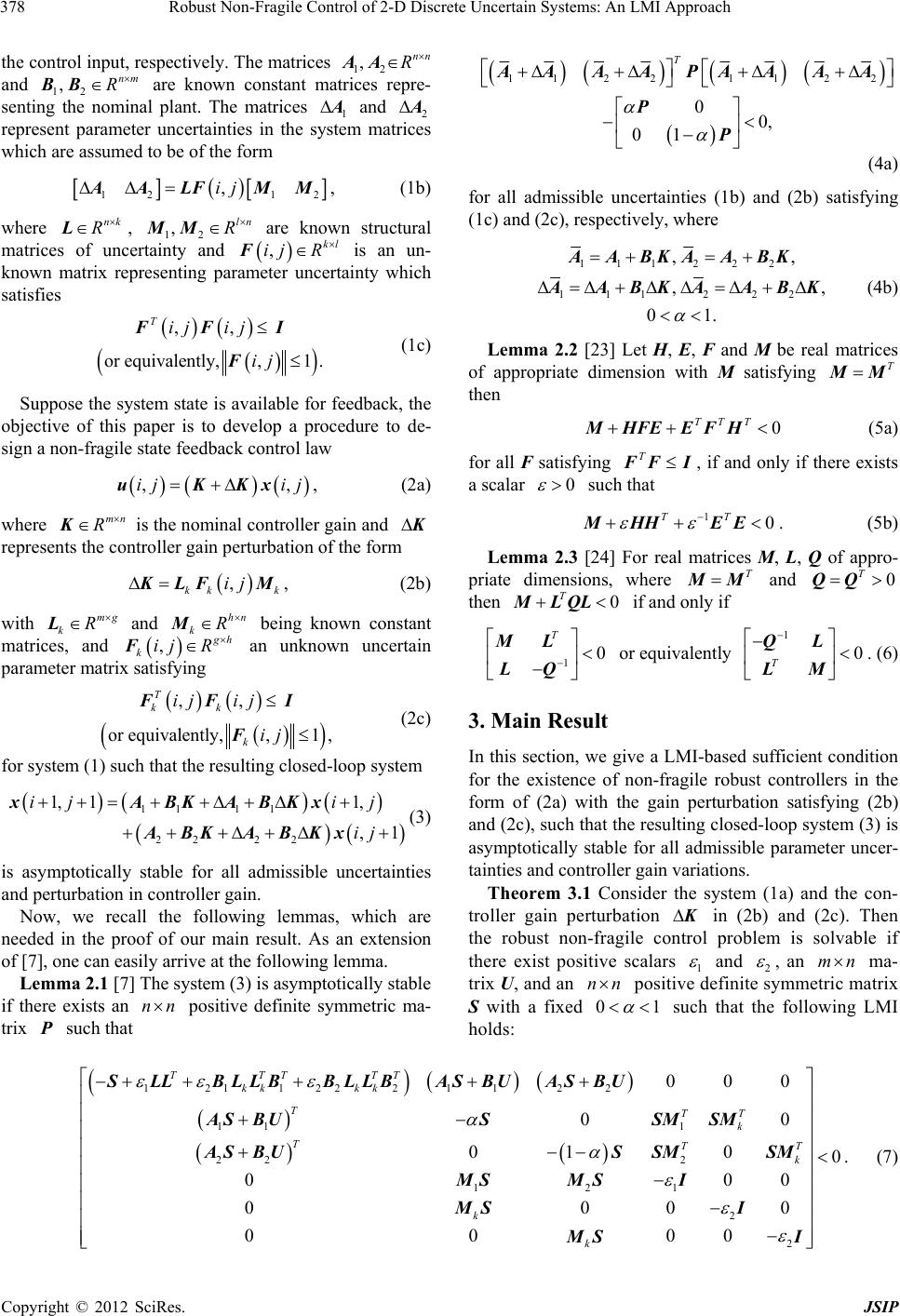 Robust Non-Fragile Control of 2-D Discrete Uncertain Systems: An LMI Approach 378 the control input, respectively. The matrices 12 , nn R AA A and 12 are known constant matrices repre- senting the nominal plant. The matrices 1 and 2 , nm R BB A represent parameter uncertainties in the system matrices which are assumed to be of the form 12 1 ,ij2 A ALF MM , (1b) where nk R L , 12 are known structural matrices of uncertainty and is an un- known matrix representing parameter uncertainty which satisfies , ln R MM F ,ijkl R , ,, valently, ,1 Tij ij ij FF I For equi mn R . (1c) Suppose the system state is available for feedback, the objective of this paper is to develop a procedure to de- sign a non-fragile state feedback control law ,ij ijuKKx , (2a) where K is the nominal controller gain and K represents the control l er gain perturbati on of the form , kk k ij K LF M, (2b) with and mg kR Lhn kR M , being known constant matrices, and g h ij R k an unknown uncertain parameter matrix satisfying F 1, ,1 ij ij Kx x ,, valently, , T kk k ij ij ij FF F or equi 1, 1ijxA P 1 , I B K (2c) for system (1) such that the resulting closed-loop system 11 11 22 22 BKA ABK AB(3) is asymptotically stable for all admissible uncertainties and perturbation in controller gain. Now, we recall the following lemmas, which are needed in the proof of our main result. As an extension of [7], one can easily arrive at the following lemma. Lemma 2.1 [7] The system (3) is asymptotically stable if there exists an positive definite symmetric ma- trix such that nn 112 2112 2 00, 01 T AA AAPAA AA P P (4a) for all admissible uncertainties (1b) and (2b) satisfying (1c) and (2c), respectively, where 1112 22 1112 22 ,, ,, 01. AABKAABK AABKAABK (4b) Lemma 2.2 [23] Let H, E, F and M be real matrices of appropriate dimension with M satisfying T MM then 0 TT T MHFEEFH (5a) for all F satisfying T F FI, if and only if there exists a scalar 0 such that 10 TT MHH EE. (5b) Lemma 2.3 [24] For real matrices M, L, Q of appro- priate dimensions, where and T MM 0 T QQ then 0 T MLQL if and only if 10 T ML LQ or equivalently 10 T QL LM . (6) 3. Main Result In this section, we give a LMI-based sufficient condition for the existence of non-fragile robust controllers in the form of (2a) with the gain perturbation satisfying (2b) and (2c), such that the resultin g closed-loop system (3) is asymptotically stable for all admissible parameter uncer- tainties and controller ga in variation s . Theorem 3.1 Consider the system (1a) and the con- troller gain perturbation K in (2b) and (2c). Then the robust non-fragile control problem is solvable if there exist positive scalars 1 and 2 , an mn ma- trix U, and an nn positive definite symmetric matrix S with a fixed 01 such that the following LMI holds: 222 T kk 121111 22 11 1 22 2 121 2 2 000 00 010 0 00 000 0000 TT T kk TTT k TTk k k T 0 0 T S LLBLLBASBUASBU AS BUSSMSM AS BUSSMSM MSMS I MS I MS I BLLB . (7) Copyright © 2012 SciRes. JSIP 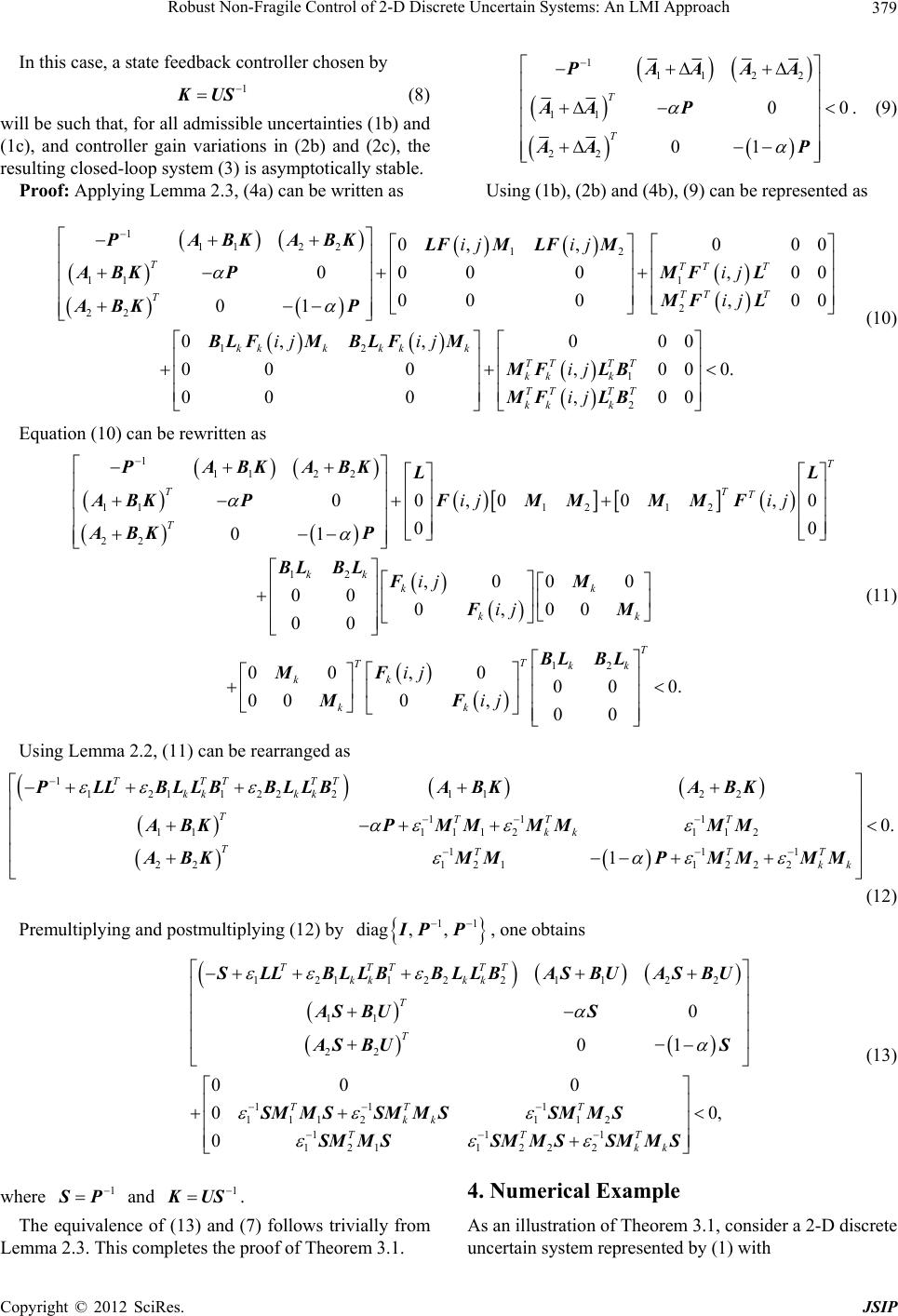 Robust Non-Fragile Control of 2-D Discrete Uncertain Systems: An LMI Approach 379 In this case, a state feedback controller chosen by 1 K US (8) will be such that, for all admissible un certainties (1b) and (1c), and controller gain variations in (2b) and (2c), the resulting closed-loop system (3) is asymptotically stable. Proof: Applying Lemma 2.3, (4a) can be written as 11122 11 22 00 01 T T PAAAA AA P AA P 0 0 0 . (9) Using (1b), (2b) and (4b), (9) can be represented as 1112 212 11 1 2 22 12 1 2 0,,0 0 000 0,0 00 0,0 01 0, ,000 000, 00 000, 00 TTT T TT T T kk kkk kTTTT kk k TT TT kk k ij ij ij ij ij ij ij ij PABKABKLFM LFM ABKPMF L MF L ABK P BLFMBLFM MF LB MF LB 0. (10) Equation (10) can be rewritten as 1112 2 11 12 12 22 12 12 00,0 0, 00 01 ,00 0 00 0,00 00 00,00 000 , T T TT T kk kk kk T Tkk kk kk ij ij ij ij ij ij 0 PABKABK L L ABKPFM MM MF ABK P BL BLFM FM BL BL MF MF 00. 00 T (11) Using Lemma 2.2, (11) can be rearranged as 11211222 1122 11 1 1 11112112 11 22121 1222 0. 1 TTT TT kk kk TTT T kk TTT kk PLLBLLBBLLBA BKABK A BKPMMMMMM A BKMMPMMMM 1T (12) Premultiplying and postmultiplying (12) by 11 diag ,, IP P, one obtains 121122211 22 11 22 11 1 1112 112 111 121 1222 0 01 00 0 00 0 TTT TT kk kk T T TTT kk TTT kk , S LLBLLBBLLBAS BUAS BU AS BUS AS BUS SM MSSM MSSM MS SM MSSM MSSM MS (13) where 1 S P and 1 K US . The equivalence of (13) and (7) follows trivially from Lemma 2.3. This completes the proof of Theorem 3.1. 4. Numerical Example As an illustration of Theorem 3.1, consider a 2-D discrete uncertain system represented by (1) with Copyright © 2012 SciRes. JSIP 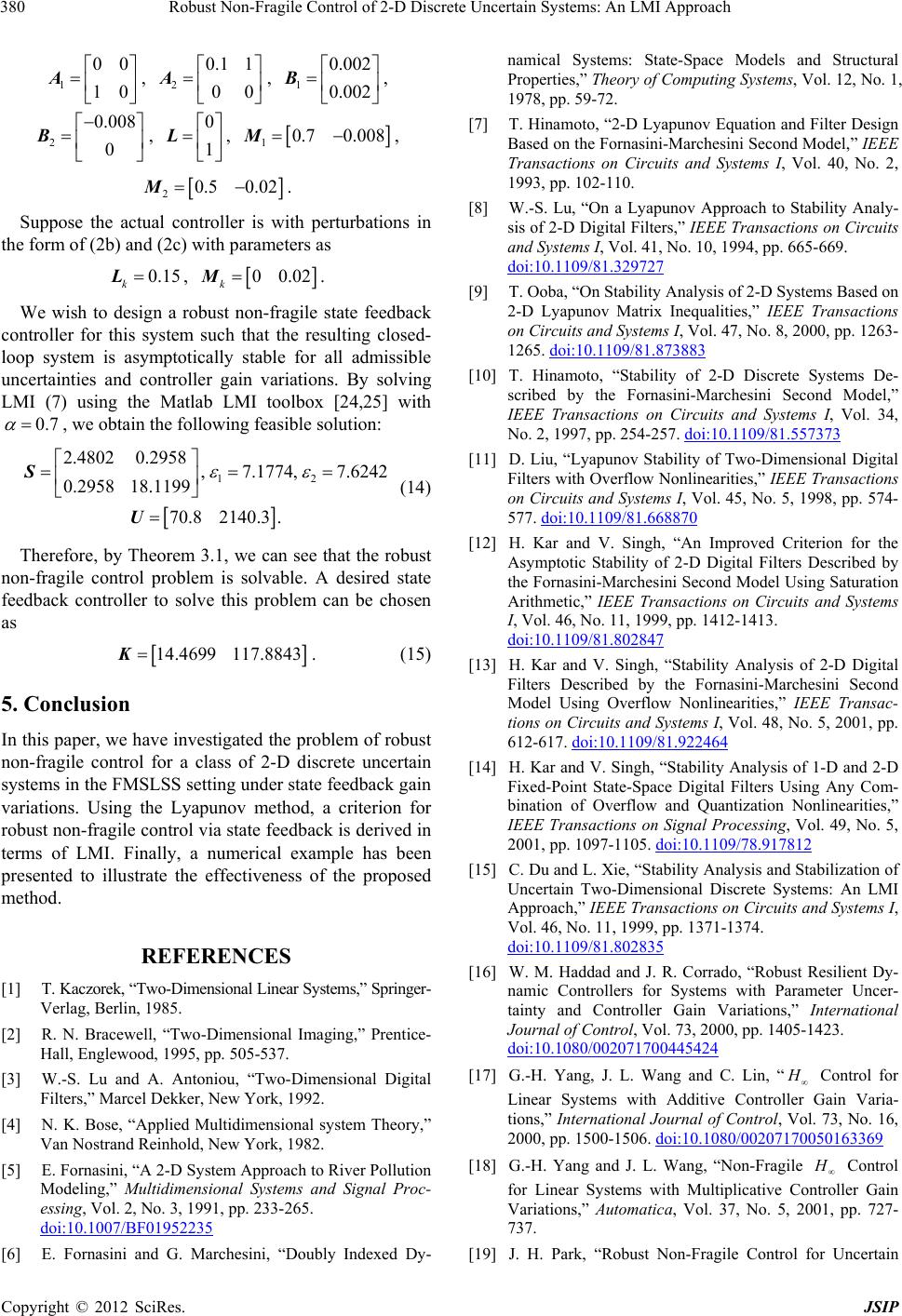 Robust Non-Fragile Control of 2-D Discrete Uncertain Systems: An LMI Approach 380 1 00 10 A 2 0.008 0 B , , , , , 2 0.1 1 00 A 0 1 L 1 0.002 0.002 B 1 M0.7 0.008, 20.5 0.02M. Suppose the actual controller is with perturbations in the form of (2b) and (2c) with parameters as 0.15 kL, 00.02 kM. We wish to design a robust non-fragile state feedback controller for this system such that the resulting closed- loop system is asymptotically stable for all admissible uncertainties and controller gain variations. By solving LMI (7) using the Matlab LMI toolbox [24,25] with 0.7 , we obtain the following feasible solution: 12 2.48020.2958 , 7.1774,7.6242 0.295818.1199 70.82140.3 . S U (14) Therefore, by Theorem 3.1, we can see that the robust non-fragile control problem is solvable. A desired state feedback controller to solve this problem can be chosen as 14.4699 117.8843K. (15) 5. Conclusion In this paper, we have investigated the problem of robust non-fragile control for a class of 2-D discrete uncertain systems in the FMSLSS setting under state feedback gain variations. Using the Lyapunov method, a criterion for robust non-fragile control via state feedback is derived in terms of LMI. Finally, a numerical example has been presented to illustrate the effectiveness of the proposed method. REFERENCES [1] T. Kaczorek, “Two-Dimensional Linear Systems,” Springer- Verlag, Berlin, 1985. [2] R. N. Bracewell, “Two-Dimensional Imaging,” Prentice- Hall, Englewood, 1995, pp. 505-537. [3] W.-S. Lu and A. Antoniou, “Two-Dimensional Digital Filters,” Marcel Dekker, New York, 1992. [4] N. K. Bose, “Applied Multidimensional system Theory,” Van Nostrand Reinhold, New York, 1982. [5] E. Fornasini, “A 2-D System Approach to River Pollution Modeling,” Multidimensional Systems and Signal Proc- essing, Vol. 2, No. 3, 1991, pp. 233-265. doi:10.1007/BF01952235 [6] E. Fornasini and G. Marchesini, “Doubly Indexed Dy- namical Systems: State-Space Models and Structural Properties,” Theory of Computing Systems, Vol. 12, No. 1, 1978, pp. 59-72. [7] T. Hinamoto, “2-D Lyapunov Equation and Filter Design Based on the Fornasini-Marchesini Second Model,” IEEE Transactions on Circuits and Systems I, Vol. 40, No. 2, 1993, pp. 102-110. [8] W.-S. Lu, “On a Lyapunov Approach to Stability Analy- sis of 2-D Digital Filters,” IEEE Transactions on Circuits and Systems I, Vol. 41, No. 10, 1994, pp. 665-669. doi:10.1109/81.329727 [9] T. Ooba, “On Stability Analysis of 2-D Systems Based on 2-D Lyapunov Matrix Inequalities,” IEEE Transactions on Circuits and Systems I, Vol. 47, No. 8, 2000, pp. 1263- 1265. doi:10.1109/81.873883 [10] T. Hinamoto, “Stability of 2-D Discrete Systems De- scribed by the Fornasini-Marchesini Second Model,” IEEE Transactions on Circuits and Systems I, Vol. 34, No. 2, 1997, pp. 254-257. doi:10.1109/81.557373 [11] D. Liu, “Lyapunov Stability of Two-Dimensional Digital Filters with Overflow Nonlinearities,” IEEE Transactions on Circuits and Systems I, Vol. 45, No. 5, 1998, pp. 574- 577. doi:10.1109/81.668870 [12] H. Kar and V. Singh, “An Improved Criterion for the Asymptotic Stability of 2-D Digital Filters Described by the Fornasini-Marchesini Second Model Using Saturation Arithmetic,” IEEE Transactions on Circuits and Systems I, Vol. 46, No. 11, 1999, pp. 1412-1413. doi:10.1109/81.802847 [13] H. Kar and V. Singh, “Stability Analysis of 2-D Digital Filters Described by the Fornasini-Marchesini Second Model Using Overflow Nonlinearities,” IEEE Transac- tions on Circuits and Systems I, Vol. 48, No. 5, 2001, pp. 612-617. doi:10.1109/81.922464 [14] H. Kar and V. Singh, “Stability Analysis of 1-D and 2-D Fixed-Point State-Space Digital Filters Using Any Com- bination of Overflow and Quantization Nonlinearities,” IEEE Transactions on Signal Processing, Vol. 49, No. 5, 2001, pp. 1097-1105. doi:10.1109/78.917812 [15] C. Du and L. Xie, “Stabili ty Analy sis and Stabilization of Uncertain Two-Dimensional Discrete Systems: An LMI Approach,” IEEE Transactions on Circuits and Systems I, Vol. 46, No. 11, 1999, pp. 1371-1374. doi:10.1109/81.802835 [16] W. M. Haddad and J. R. Corrado, “Robust Resilient Dy- namic Controllers for Systems with Parameter Uncer- tainty and Controller Gain Variations,” International Journal of Control, Vol. 73, 2000, pp. 1405-1423. doi:10.1080/002071700445424 [17] G.-H. Yang, J. L. Wang and C. Lin, “H Control for Linear Systems with Additive Controller Gain Varia- tions,” International Journal of Control, Vol. 73, No. 16, 2000, pp. 1500-1506. doi:10.1080/00207170050163369 [18] G.-H. Yang and J. L. Wang, “Non-Fragile H Control for Linear Systems with Multiplicative Controller Gain Variations,” Automatica, Vol. 37, No. 5, 2001, pp. 727- 737. [19] J. H. Park, “Robust Non-Fragile Control for Uncertain Copyright © 2012 SciRes. JSIP  Robust Non-Fragile Control of 2-D Discrete Uncertain Systems: An LMI Approach Copyright © 2012 SciRes. JSIP 381 Discrete-Delay Large-Scale Systems with a Class of Con- troller Gain Variations,” Applied Mathematics and Com- putation, Vol. 149, No. 1, 2004, pp. 147-164. doi:10.1016/S0096-3003(02)00962-1 [20] S. Xu, J. Lam, J. Wang and G. Yang, “Non-Fragile Posi- tive Real Control for Uncertain Linear Neutral Delay Systems,” Systems and Control Letters, Vol. 52, No. 1, 2004, pp. 59-74. doi:10.1016/j.sysconle.2003.11.001 [21] C. Lien, W. Cheng, C. Tsai and K. Yu, “Non-Fragile Observer-Based Controls of Linear System via LMI Ap- proach,” Chaos, Solitons and Fractals, Vol. 32, No. 4 2007, pp. 1530-1537. doi:10.1016/j.chaos.2005.11.092 [22] C. Lien, “H Non-Fragile Observer-Based Controls of Dynamical Systems via LMI Optimization Approach,” Chaos, Solitons and Fractals, Vol. 34, No. 2, 2007, pp. 428-436. doi:10.1016/j.chaos.2006.03.050 [23] L. Xie, “Output Feedback H Control of Systems with Parameter Uncertainty,” International Journal of Control, Vol. 63, No. 4, 1996, pp. 741-750. doi:10.1080/00207179608921866 [24] S. Boyd, L. El Ghaoui, E. Feron and V. Balakrishnan, “Linear Matrix Inequalities in System and Control The- ory,” SIAM, Philadelphia, 1994. doi:10.1137/1.9781611970777 [25] P. Gahinet, A. Nemirovski, A. J. Laub and M. Chilali, “LMI Control Toolbox-for Use with Matlab,” The MATH Works Inc., Natick, 1995. |