

Paper Menu >>
Journal Menu >>
 Journal of Intelligent Learning Systems and Applications, 2012, 4, 199-206 doi:10.4236/jilsa.2012.43020 Published Online August 2012 (http://www.SciRP.org/journal/jilsa) 1 Reversible Digital Image Watermarking Scheme Using Bit Replacement and Majority Algorithm Technique Koushik Pal1, Goutam Ghosh1, Mahua Bhattacharya2* 1Institute of Radio Physics and Electronics, University of Calcutta, Kolkata, India; 2Indian Institute of Information Technology and Management, Gwalior, India. Email: *[email protected] Received September 24th, 2011; revised May 17th, 2012; accepted May 25th, 2012 ABSTRACT The current paper presents a new digital watermarking method through bit replacement technology, which stores multi- ple copies of the same data that is to be hidden in a scrambled form in the cover image. In this paper an indigenous ap- proach is described for recovering the data from the damaged copies of the data under attack by applying a majority algorithm to find the closest twin of the embedded information. A new type of non-oblivious detection method is also proposed. The improvement in performance is supported through experimental results which show much enhancement in the visual and statistical invisibility o f hidden data. Keywords: Additive Noise; Salt and Pepper Noise; Compression; Filtering; Averaging; Multiple Watermarking; Majority Algorithm 1. Introduction Recent history has witnessed the rapid development in information technologies that has given an extended and easy access to digital information. Along with several developments it leads to the problem of illegal copying and redistribution of digital media. As a result, the integ- rit y and confidentiality of the digital information has come under immense threat. Digital watermarking, an e mergi ng technology, came in order to solve the problems [1]. Digital watermarking is a technique which allows an individual to add hidden copyright notices or other veri- fication messages or even classified information into digital media [2,3]. Watermarks can either be visible or invisible. Here in this paper we utilize the invisible watermarking tech- nique. This is used in public in formation settings such as digital image libraries, museums, and art galleries and also in defense communication where data security is of prime importance [4]. Watermark embedding utilizes two kinds of methods, one in the spatial domain and the other in th e transfor m domain. In th e spatial doma in the watermark is directly embedded into the image pixels whereas in the frequency domain the image is decom- posed into blocks and then mapped into the transform domain [5]. Watermarking is basically a process of hiding infor- mation in an image known as cover image. According to the behavior it is of two types: robust and fragile. Copy- right protection is achieved by robust watermarking [6] while image authentication is usually achieved b y fragile watermarking techniques [7-9]. Robust watermarking technique ensures the quality of the hidden information by several protection algorithms. In the fragile water- marking scheme if any alter ation of the message is found then the message breaks up by itself and can be easily detected as tampered by the provider of the watermark [1]. Invertible watermarking is a new process which en- ables the exact recovery of the original image upon ex- traction of the embedded info rmation. In the present paper the work implements both authen- tication and confidentiality in a reversible [10] manner without affecting the image in any way. Security of im- ages imposes three mandatory characteristics: confiden- tiality, reliability and availability [11]. Confidentiality means that only the entitled persons have access to the images. Reliability has two aspects: 1) Integrity—means the image has not been modified by a non-authorized person [12]; 2) Authentication corroborates that the im- age belongs indeed to the correct person and is issued from an authorized source. Availability is the capacity that an image is available to the entitled persons in the normal conditions of access and exercise [13]. 1.1. LSB Watermarking and Its Limitation The most straight-forward method of watermark embed- ding would be to embed the watermark into the least- *Corresponding a uthor. Copyright © 2012 SciRes. JILSA  Reversible Di gital Image Wate rmarking Scheme Using Bit Replacement and Majority Algorithm Technique 200 significant-bits (LSB) of the cover object [14]. Given the extraordinarily high channel capacity of using the entire cover for transmission in this method, a smaller object may be embedded multiple times [8]. Even if most of these are lost due to attacks, a single surviving water- mark would be considered as a success. LSB substitution, however, despite its simplicity brings a lot of drawbacks. Although it may survive from all these transformations such as cropping, addition of noise or lossy compression etc. A better attack would be to simply set the LSB bits of each pixel to defeat the watermark with negligible impact on the cover object. Furthermore, once the algo- rithm is discovered, the embedded watermark could be easily modified by an intermediate party. An improve- ment on basic LSB substitution would be to use a pseu- do-random number generator to determine the pixels to be used for embedding based on a given “seed” or key [1]. The algorithm however would still be vulnerable to replacing the LSB’s with a constant. Even locations that were not used for the watermarking bits, the impact of the substitution on the cover image would be negligible. LSB modification proves to be a simple and fairly power- ful tool for steganography [15], however, it lacks the basic robustness that watermarking applications require. 1.2. Attack and Distortion In practice, a watermarked image may be altered either on purpose or accidentally. The watermarking system should be robust enough to detect and extract the water- mark [16]. Different types of alterations or attacks can be done to degrade the image quality by adding distortions. The distortions are limited to those factors which do not produce excessive degradations; otherwise the trans- formed object would be unusable. These distortions also introduce degradation on the performance of the water- mark extraction algorithm [17,18]. Methods or a combi- nation of methods, considered unintentional are used intentionally as an attack on a watermarked image in order to render the watermark undetectable. Compression is a common attack, as data transferred via network is often compressed using JPEG. High qual- ity images are often converted to JPEG to reduce their size. Another method is deletion or shuffling of blocks. In images rows or columns of pixels may be deleted or shuffled without a noticeable degradation in image quality. These may render an existing watermark undetectable. Salt and pepper noise is another type of attack that re- places the intensity levels of some of the pixels of an image resulting in loss of information from those pixels. Some of the best known attacks are mentioned here; they may be intentional or unintentional, depending on the application. In this paper we have taken two very popular attacks known as Salt and pepper noise and image compression. 2. Proposed Watermarking Technique for Data Authentication Our proposed methodology for data hiding does not follow the conventional LSB technique because of the inherent limitations mentioned earlier. A new digital water- marking scheme described here, uses several bits of the cover image starting from the lower order to the higher order to hide the information logo. Several sets of the same data forming the information logo are hidden into the cover image. Thus, even if some of the information is lost due to attack, we can still collect the remaining information from the cover image and reconstruct the hidden information resembling the original one [19]. The detail algorithm for both the embedding scheme and the recovery scheme is given bellow. 2.1. Embedding the Digital Watermark Step 1: Two images are taken as input: First of all, the cover image and the message or information logo are taken as inputs. The cover image is taken to be a gray scale image. The logo or information is a binary image, basically a sequence of 0’s and 1’s. Step 2: The Size of the images is extracted: Next to make the program compatible to run for any size of the cover image and information logo keeping in mind the data carrying capacity of the cover image the dimensions of the respective images are extracted. Mc=size(cover_image,1);Nc=size(cover_image,2); Mm=size(logo,1);Nm=size(logo,2); Step 3: Normalizing and reshaping the logo: After normalizing the information logo it is reshaped in one dimension. logo_nor=logo/.256; Step 4: Transforming the cover image into wavelet domain using dwt: The cover image is transformed to the wavelet domain u sing discrete wavelet tran sform. W e use Haar transform to do the DWT. Here the 1st level DWT was used to obtain more capacity for hiding the information. The cover image is decomposed into 4 sub- domains as HH, HL, LH and LL according to the different frequencies of t he cover image. [HHi,HLi,LHi,LLi] = dwt2(cover_image,'haar'); Step 5: Calculating the length of the transformed cover image and 1d l og o: len_logo=length(logo_res); len_cover=Mc*Nc; Step 6: Calculating the size of each sub domain de- composed cover image and reshaping them in to 1d: cover_HL_size_m=size(HLi,1); cover_HL_size_n=size(HLi,2); HL1=reshape(HLi,1,cover_HL_size_m*cover_HL_siz e_n); Step 7: Det ermining th e maximum co efficient value Copyright © 2012 SciRes. JILSA  Reversible Di gital Image Wate rmarking Scheme Using Bit Replacement and Majority Algorithm Technique 201 of each of the 4 sub dom ains max_HL1=max(HL1); Step 8: Finding the position to hide the information logo into the transformed logo: The position for hiding the binary logo in each sub domain must be in between zero and t he maxim um coefficient val ue of t hat sub dom ain. c=1; for i = 1: 1 : cover_HL_size_m*cover_HL_size_n if(HL1(i)<(max_ HL1) && HL1(i)>(0)) pos_ HL1(c)=i; c=c+1; end end Step 9: Hiding a number of sets of the same infor- mation logo in hl and lh domain: More than one set of the same information is being hidden in HL and LH band or domain for easier and good quality recovery. The hid- ing process in each of these domains follows a specific formula. The formula is that the black dots in each set of 1d information logo is hidden in a position of informa- tion logo from where a constant value is subtracted. a=15 for i = 1: 1 : length_of_HL if logo_res(i)==0 w_HL1(pos_HL1_set_1(i))=HL1(pos_HL1_set_1(i))-a; end end Step10: Reshaping the decomposed image back to its normal dimension: w_cH1_reshape=reshape(w_cH1,cover_cH_size_m,co ver_cH_size_n); Step11: Writing the watermarked image to a file and displaying it. 2.2. Recovery of the Embedded Watermark We have assumed that the cover image hiding the wa- termark is available at the receiving end. So again, in the process of recovery we first take the original image used to hide the information. Along with it we also send the receiver of the message, 3 keys which essentially act as private keys. These keys are required to decrypt and to the extract the encrypted or embedded messages. Step 1: The watermarked and original images are taken as inputs. Step2: Finding the 1st level decomposition of both the inputs using DWT: [HHw,HLw,LHw,LLw]=dwt2(watermarked_image,'ha ar'); [HHi,HLi,LHi,LLi] = dwt2(orig_image,'haar'); Step 3: Finding the size of each sub domain of both the decomposed input images: orig_HL_size_m=size(HLi,1); orig_HL_size_n=size(HLi,2); watermarked_HL_size_m=size(HLw,1); watermarked_HL_size_n=size(HLw,2); Step 4: Reshaping each of the decomposition of both watermarked and original cover images into 1D: HLo=reshape(HLi,1,orig_HL_size_m*orig_HL_size_ n); HL1=reshape(HLw,1,watermarked_HL_size_m*water marked_HL_size_n); Step 5: Taking the two input keys equal to the di- mension of the logo to find the size o f the 4 decompo- sitions of the logo: key_M=input('Enter the no of rows KEY 1 :'); key_N=input('Enter the no of cols KEY 2:'); logo_HL_size_m=key_M/2; logo_HL_size_n=key_N/2; Step 6: Determining the maximum coefficient val- ues of the original cover image: max_cHo=max(cHo); Step 7: Finding the positions used to hide the logo for each decom posit ion: c=1; for i = 1: 1 : orig_HL_size_m*orig_cA_size_n if(HLo(i)<(max_HLo) && HLo(i)>(0)) pos_HLo(c)=i; c=c+1; end end Step 8: Extracting the positional sets for different sets of the logo from each decomposition: c=1; for i = 1 : 1 : len_set_HLo pos_HLo_set_1(i)=pos_HLo(c); c=c+1; Step 9: Recovery of the different sets of logo from each of the sub bands and construction of the final logo from the different recovered sets using majority algorithm: for i = 1: 1 : key_M*key_N if(rnd_HL1(pos_HLo_set_3(i))-rnd_HLo(pos_HLo_set_3 (i)))==0 rec_wmark_V_set_3(i)=1; else rec_wmark_V_set_3(i)=0; end end Step 10: After reshaping, displaying each of the re- covered sets of logo and the final constructed logo: res_rec_wmark_H_set_3=reshape(rec_wmark_H_set_ 3,key_M,key_N); if rec_wmark_V_set_3(i)==1 val_1=val_1+1; end rec_wmark_H_FINAL(i)=val; Copyright © 2012 SciRes. JILSA 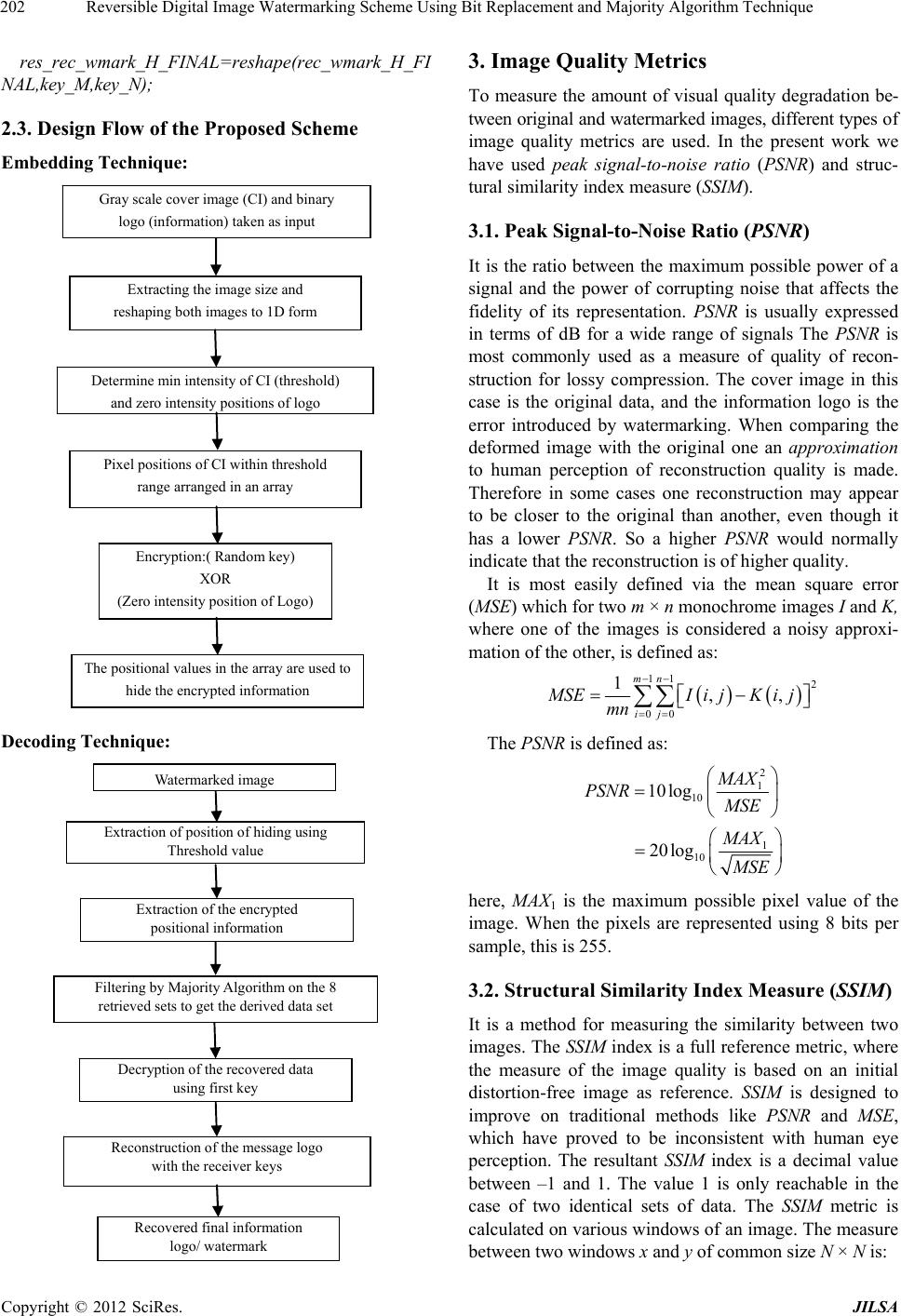 Reversible Di gital Image Wate rmarking Scheme Using Bit Replacement and Majority Algorithm Technique 202 res_rec_wmark_H_FINAL=reshape(rec_wmark_H_FI NAL,key_M,key_N); 2.3. Design Flow of the Proposed Scheme Embedding Technique: Gray scale co v er image (CI) and binary logo (information ) taken as input Extracting the image size and reshaping both images to 1D form Determine min intensity of CI (threshold) and zero intensity positions o f logo Pixel positions of CI within threshold range arranged in an array Encryption:( Random key) XOR (Zero intensity position of Logo) The positional values in the array are used to hide the encrypted information Decoding Technique: Extractio n of position of hiding using Threshold value Extraction of the encrypted positional information Filtering by Majority Algorithm on the 8 retrieved sets to get the derived data set Decryption of the rec ove r ed data using first key Reconstruction of the message logo with the receiver keys Watermarked image Recovered f i n a l information logo/ watermark 3. Image Quality Metrics To measure the amount of visual quality degradation be- tween origina l and watermarked images, diff erent types o f image quality metrics are used. In the present work we have used peak signal-to-noise ratio (PSNR) and struc- tural similarity index measure (SSIM). 3.1. Peak Signal-to-Noise Ratio (PSNR) It is the ratio between the maximum possible power of a signal and the power of corrupting noise that affects the fidelity of its representation. PSNR is usually expressed in terms of dB for a wide range of signals The PSNR is most commonly used as a measure of quality of recon- struction for lossy compression. The cover image in this case is the original data, and the information logo is the error introduced by watermarking. When comparing the deformed image with the original one an approximation to human perception of reconstruction quality is made. Therefore in some cases one reconstruction may appear to be closer to the original than another, even though it has a lower PSNR. So a higher PSNR would normally indicate that the reconstruction is of higher quality. It is most easily defined via the mean square error (MSE) which for two m × n monochrome images I and K, where one of the images is considered a noisy approxi- mation of the other, is defined as: 11 2 00 1,, mn ij M SEI i jK i j mn The PSNR is defined as: 2 1 10 1 10 10log 20log MAX PSNR M SE M AX M SE here, MAX1 is the maximum possible pixel value of the image. When the pixels are represented using 8 bits per sample, this is 255. 3.2. Structural Similarity Index Measure (SSIM) It is a method for measuring the similarity between two images. The SSIM index is a full reference metric, where the measure of the image quality is based on an initial distortion-free image as reference. SSIM is designed to improve on traditional methods like PSNR and MSE, which have proved to be inconsistent with human eye perception. The resultant SSIM index is a decimal value between –1 and 1. The value 1 is only reachable in the case of two identical sets of data. The SSIM metric is calculated on various w indows of an image. The measure between two windows x and y of common size N × N is: Copyright © 2012 SciRes. JILSA 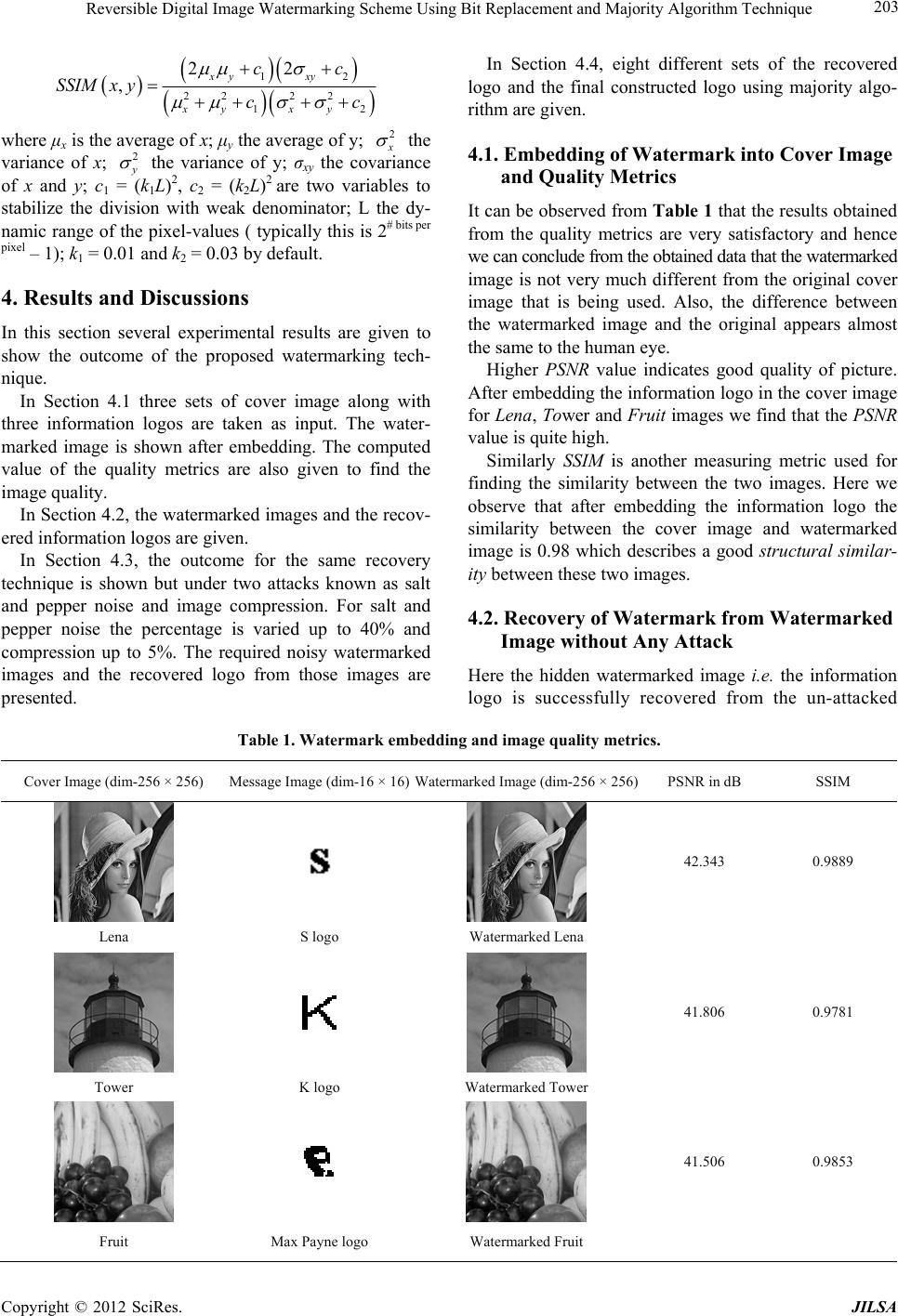 Reversible Di gital Image Wate rmarking Scheme Using Bit Replacement and Majority Algorithm Technique Copyright © 2012 SciRes. JILSA 203 12 22 22 12 22 ,xy xy xy xy cc SSIMx ycc In Section 4.4, eight different sets of the recovered logo and the final constructed logo using majority algo- rithm are given. where μx is the average of x; μy the average of y; 2 x the variance of x; 2 y the variance of y; σxy the covariance of x and y; c1 = (k1L)2, c2 = (k2L)2 are two variables to stabilize the division with weak denominator; L the dy- namic range of the pixel-values ( typically this is 2# bits per pixel – 1); k1 = 0.01 and k2 = 0.03 by default. 4.1. Embedding of Watermark into Cover Image and Quality Metrics It can be observed from Table 1 that the results obtained from the quality metrics are very satisfactory and hence we can conclude fr om the obtained dat a t hat t h e wat ermarked image is not very much different from the original cover image that is being used. Also, the difference between the watermarked image and the original appears almost the same to the human eye. 4. Results and Discussions In this section several experimental results are given to show the outcome of the proposed watermarking tech- nique. Higher PSNR value indicates good quality of picture. After embedding the information logo in the cover image for Lena, Tower and Fruit images we find that the PSNR value is quite high . In Section 4.1 three sets of cover image along with three information logos are taken as input. The water- marked image is shown after embedding. The computed value of the quality metrics are also given to find the image quality. Similarly SSIM is another measuring metric used for finding the similarity between the two images. Here we observe that after embedding the information logo the similarity between the cover image and watermarked image is 0.98 which describes a good structural similar- ity between these two images. In Section 4.2, the watermarked images and the recov- ered information logos are given. In Section 4.3, the outcome for the same recovery technique is shown but under two attacks known as salt and pepper noise and image compression. For salt and pepper noise the percentage is varied up to 40% and compression up to 5%. The required noisy watermarked images and the recovered logo from those images are presented. 4.2. Recovery of Watermark from Watermarked Image without Any Attack Here the hidden watermarked image i.e. the information logo is successfully recovered from the un-attacked Table 1. Watermark embedding and image quality metrics. Cover Image (dim-256 × 256) Message Image (dim-16 × 16)Watermarked Image (dim-256 × 256)PSNR in dB SSIM 42.343 0.9889 Lena S logo Watermarked Lena 41.806 0.9781 Tower K logo Watermarked Tower 41.506 0.9853 Fruit Max Payne logo Watermarked Fruit 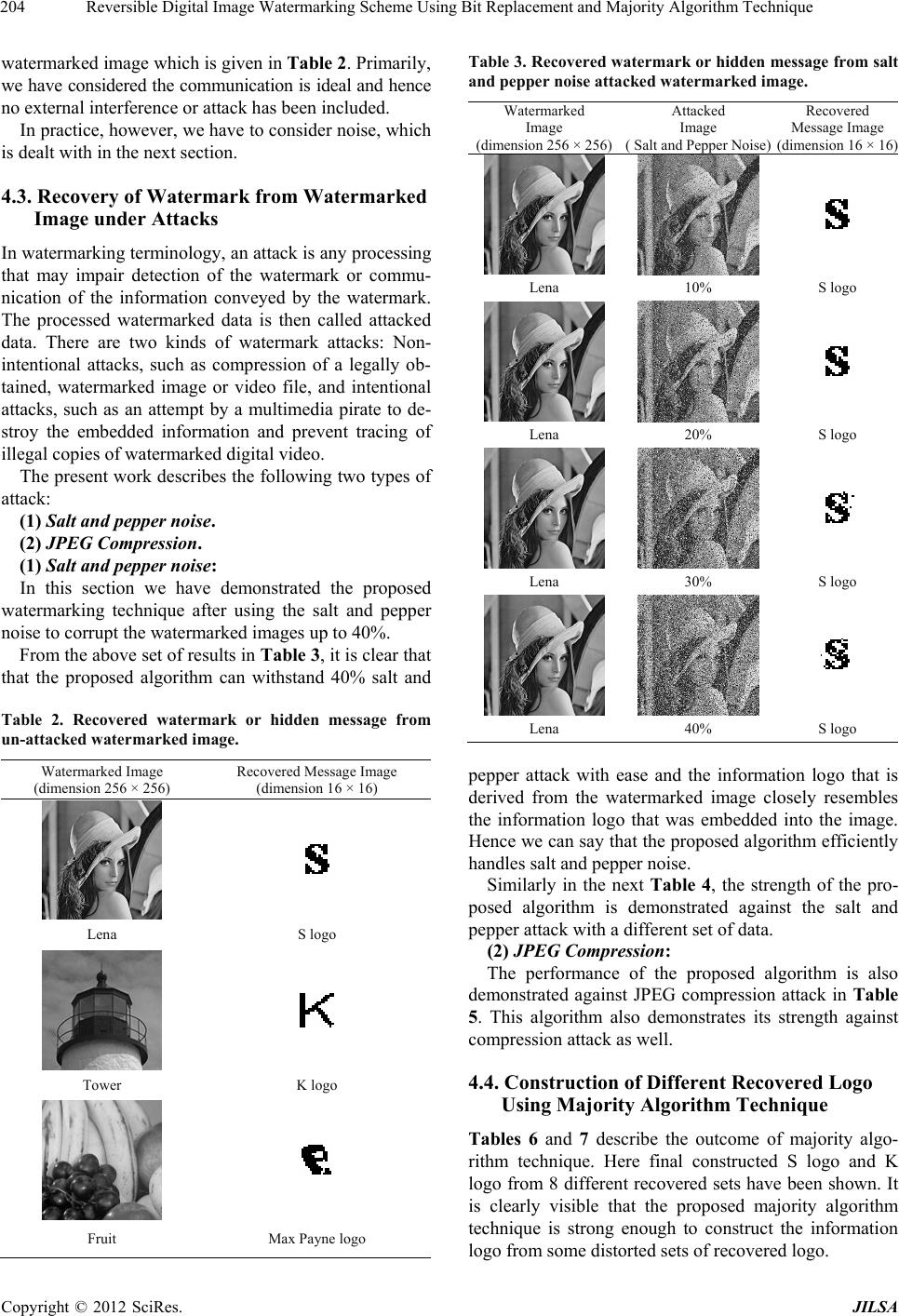 Reversible Di gital Image Wate rmarking Scheme Using Bit Replacement and Majority Algorithm Technique 204 watermarked image which is given in Table 2. Primarily, we have considered the communication is ideal and hence no external interference or attack has been included. In practice, however, we have to consider noise, which is dealt with in the next section. 4.3. Recovery of Watermark from Watermarked Image under Attacks In watermarking terminology, an attack is an y processing that may impair detection of the watermark or commu- nication of the information conveyed by the watermark. The processed watermarked data is then called attacked data. There are two kinds of watermark attacks: Non- intentional attacks, such as compression of a legally ob- tained, watermarked image or video file, and intentional attacks, such as an attempt by a multimedia pirate to de- stroy the embedded information and prevent tracing of illegal copies of watermarked digital video. The present work describes the following two types of attack: (1) Salt and pepper noise. (2) JPEG Compression. (1) Salt and pepper noise: In this section we have demonstrated the proposed watermarking technique after using the salt and pepper noise to corrupt the watermarked images up to 40%. From the above set of results in Table 3, it is clear that that the proposed algorithm can withstand 40% salt and Table 2. Recovered watermark or hidden message from un-attacked watermarked image. Watermarked Image (dimension 256 × 256) Recovered Message Image (dimension 16 × 16) Lena S logo Tower K logo Fruit Max Payne logo Table 3. Recovered watermark or hidden message from salt and pepper noise attacked watermarked image. Watermarked Image (dimension 256 × 256) Attacked Image ( Salt and Pepper Noise) Recovered Message Image (dimension 16 × 16) Lena 10% S logo Lena 20% S logo Lena 30% S logo Lena 40% S logo pepper attack with ease and the information logo that is derived from the watermarked image closely resembles the information logo that was embedded into the image. Hence we can say that the proposed algorithm efficiently handles salt and pepper noise. Similarly in the next Table 4, the strength of the pro- posed algorithm is demonstrated against the salt and pepper attack with a different set of data. (2) JPEG Compression: The performance of the proposed algorithm is also demonstrated against JPEG compression attack in Table 5. This algorithm also demonstrates its strength against compression attack as well. 4.4. Construction of Different Recovered Logo Using Majority Algorithm Technique Tables 6 and 7 describe the outcome of majority algo- rithm technique. Here final constructed S logo and K logo from 8 different recovered sets have been shown. It is clearly visible that the proposed majority algorithm technique is strong enough to construct the information logo from some distorted sets of recovered logo. Copyright © 2012 SciRes. JILSA 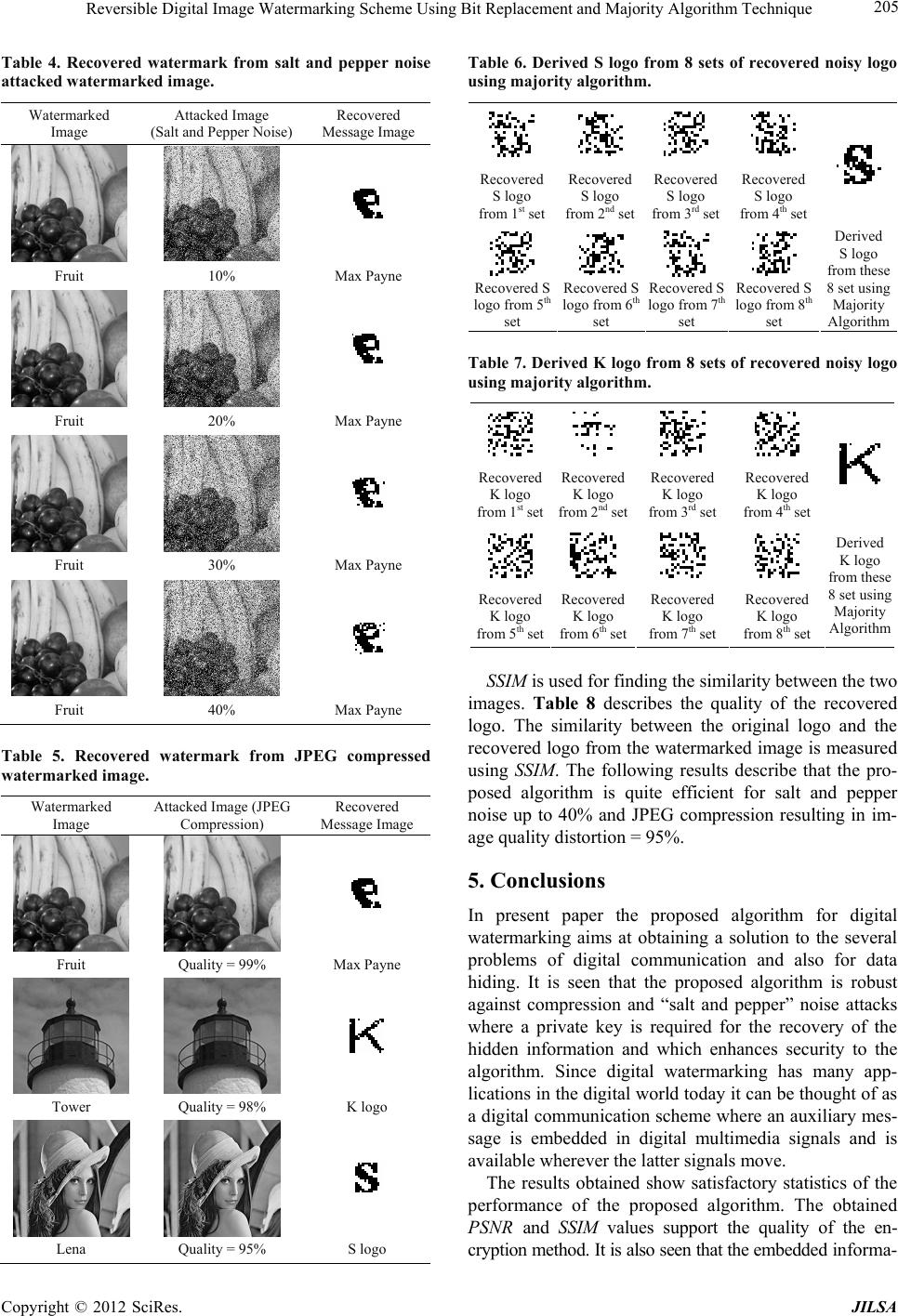 Reversible Di gital Image Wate rmarking Scheme Using Bit Replacement and Majority Algorithm Technique 205 Table 4. Recovered watermark from salt and pepper noise attacked watermarked image. Watermarked Image Attacked Image (Salt and Pepper Noise) Recovered Message Image Fruit 10% Max Payne Fruit 20% Max Payne Fruit 30% Max Payne Fruit 40% Max Payne Table 5. Recovered watermark from JPEG compressed watermarked image. Watermarked Image Attacked Image (JPEG Compression) Recovered Message Image Fruit Quality = 99% Max Payne Tower Quality = 98% K logo Lena Quality = 95% S logo Table 6. Derived S logo from 8 sets of recovered noisy logo using majority algorithm. Recovered S logo from 1st set Recovered S logo from 2nd set Recovered S logo from 3rd set Recovered S logo from 4th set Recovered S logo from 5th set Recovered S logo from 6th set Recovered S logo from 7th set Recovered S logo from 8th set Derived S logo from these 8 set using Majority Algorithm Table 7. Derived K logo from 8 sets of recovered noisy logo using majority algorithm. Recovered K logo from 1st set Recovered K logo from 2nd set Recovered K logo from 3rd set Recovered K logo from 4th set Recovered K logo from 5th set Recovered K logo from 6th set Recovered K logo from 7th set Recovered K logo from 8th set Derived K logo from these 8 set using Majority Algorithm SSIM is used for finding the similarity between the two images. Table 8 describes the quality of the recovered logo. The similarity between the original logo and the recovered logo from the watermarked image is measured using SSIM. The following results describe that the pro- posed algorithm is quite efficient for salt and pepper noise up to 40% and JPEG compression resulting in im- age quality distortion = 95%. 5. Conclusions In present paper the proposed algorithm for digital watermarking aims at obtaining a solution to the several problems of digital communication and also for data hiding. It is seen that the proposed algorithm is robust against compression and “salt and pepper” noise attacks where a private key is required for the recovery of the hidden information and which enhances security to the algorithm. Since digital watermarking has many app- lications in the digital world toda y it can be thought of as a digital communication scheme where an au xiliary mes- sage is embedded in digital multimedia signals and is available wherever the latter signals move. The results obtained show satisfactory statistics of the performance of the proposed algorithm. The obtained PSNR and SSIM values support the quality of the en- cryption method. It is also seen that the embedded inf orma- Copyright © 2012 SciRes. JILSA 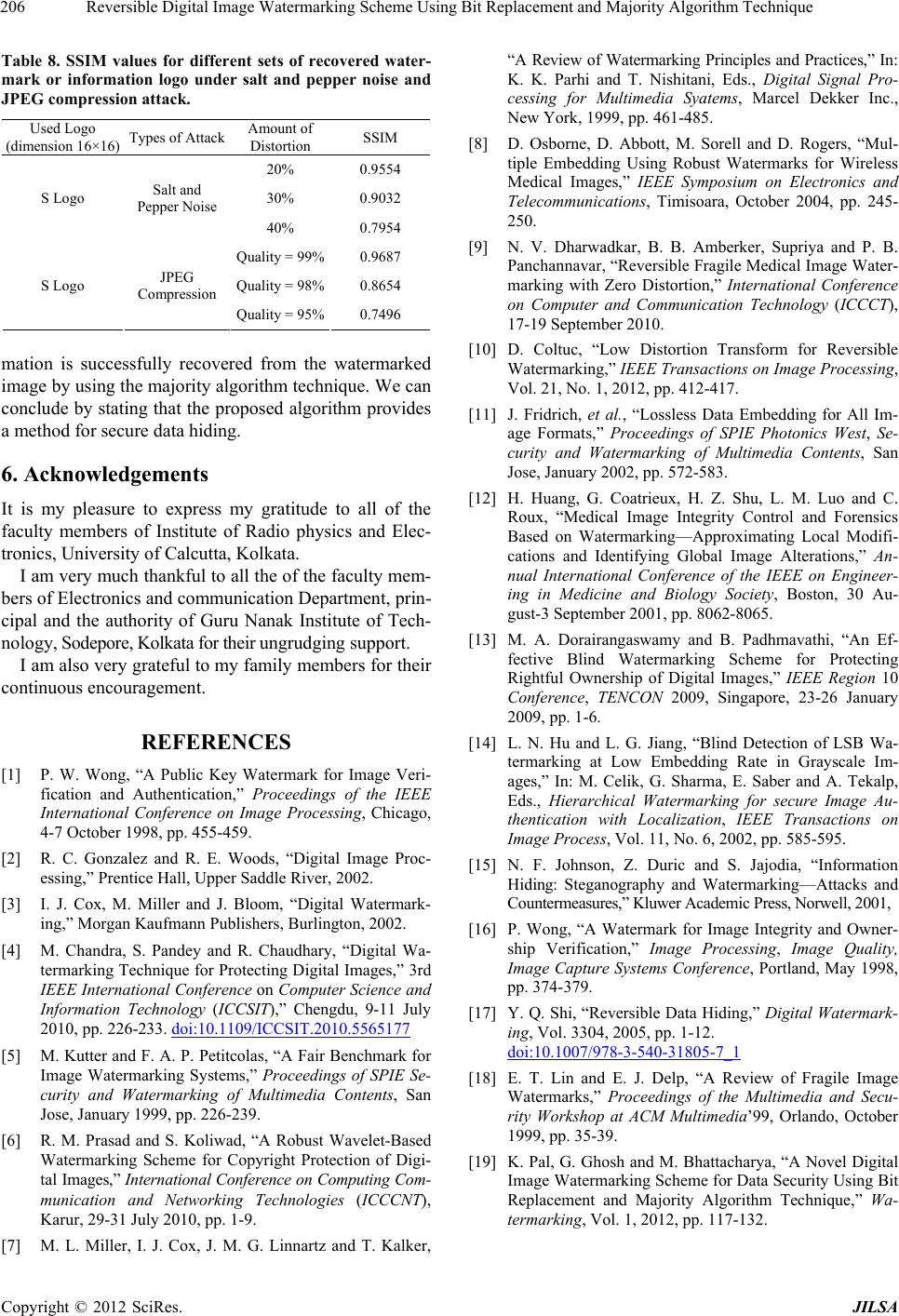 Reversible Di gital Image Wate rmarking Scheme Using Bit Replacement and Majority Algorithm Technique Copyright © 2012 SciRes. JILSA 206 Table 8. SSIM values for different sets of recovered water- mark or information logo under salt and pepper noise and JPEG compression attack. Used Logo (dimension 16×16) Types of AttackAmount of Distortion SSIM 20% 0.9554 30% 0.9032 S Logo Salt and Pepper Noise 40% 0.7954 Quality = 99% 0.9687 Quality = 98% 0.8654 S Logo JPEG Compression Quality = 95% 0.7496 mation is successfully recovered from the watermarked image by using the majority algorithm technique. We can conclude by stating that the proposed algorithm provides a method for secure data hiding. 6. Acknowledgements It is my pleasure to express my gratitude to all of the faculty members of Institute of Radio physics and Elec- tronics, University of Calcutta, Kolkata. I am very much thankful to all the of the facu lty mem- bers of Electronics and communication Department, prin- cipal and the authority of Guru Nanak Institute of Tech- nology, S o d e po r e , K o lk a t a f o r t h e i r un grudgi ng support. I am also very grateful to my fami ly memb er s fo r t he ir continuous encouragement. REFERENCES [1] P. W. Wong, “A Public Key Watermark for Image Veri- fication and Authentication,” Proceedings of the IEEE International Conference on Image Processing, Chicago, 4-7 October 1998, pp. 455-459. [2] R. C. Gonzalez and R. E. Woods, “Digital Image Proc- essing,” Prentice Hall, Upper Saddle River, 2002. [3] I. J. Cox, M. Miller and J. Bloom, “Digital Watermark- ing,” Morgan Kaufmann Publishers, Burlington, 2002. [4] M. Chandra, S. Pandey and R. Chaudhary, “Digital Wa- termarking Technique for Protecting Digital Images,” 3rd IEEE International Conference on Computer Science and Information Technology (ICCSIT),” Chengdu, 9-11 July 2010, pp. 226-233. doi:10.1109/ICCSIT.2010.5565177 [5] M. Kutter and F. A. P. Petitcolas, “A Fair Benchmark for Image Watermarking Systems,” Proceedings of SPIE Se- curity and Watermarking of Multimedia Contents, San Jose, January 1999, pp. 226-239. [6] R. M. Prasad and S. Koliwad, “A Robust Wavelet-Based Watermarking Scheme for Copyright Protection of Digi- tal Images,” International Conference on Computing Com- munication and Networking Technologies (ICCCNT), Karur, 29-31 July 2010, pp. 1-9. [7] M. L. Miller, I. J. Cox, J. M. G. Linnartz and T. Kalker, “A Review of Watermarking Principles and Practices,” In: K. K. Parhi and T. Nishitani, Eds., Digital Signal Pro- cessing for Multimedia Syatems, Marcel Dekker Inc., New York, 1999, pp. 461-485. [8] D. Osborne, D. Abbott, M. Sorell and D. Rogers, “Mul- tiple Embedding Using Robust Watermarks for Wireless Medical Images,” IEEE Symposium on Electronics and Telecommunications, Timisoara, October 2004, pp. 245- 250. [9] N. V. Dharwadkar, B. B. Amberker, Supriya and P. B. Panchannavar, “Reversible Fragile Medical Image Water- marking with Zero Distortion,” International Conference on Computer and Communication Technology (ICCCT), 17-19 September 2010. [10] D. Coltuc, “Low Distortion Transform for Reversible Watermarking,” IEEE Transactions on Image Processing, Vol. 21, No. 1, 2012, pp. 412-417. [11] J. Fridrich, et al., “Lossless Data Embedding for All Im- age Formats,” Proceedings of SPIE Photonics West, Se- curity and Watermarking of Multimedia Contents, San Jose, January 2002, pp. 572-583. [12] H. Huang, G. Coatrieux, H. Z. Shu, L. M. Luo and C. Roux, “Medical Image Integrity Control and Forensics Based on Watermarking—Approximating Local Modifi- cations and Identifying Global Image Alterations,” An- nual International Conference of the IEEE on Engineer- ing in Medicine and Biology Society, Boston, 30 Au- gust-3 September 2001, pp. 8062-8065. [13] M. A. Dorairangaswamy and B. Padhmavathi, “An Ef- fective Blind Watermarking Scheme for Protecting Rightful Ownership of Digital Images,” IEEE Region 10 Conference, TENCON 2009, Singapore, 23-26 January 2009, pp. 1-6. [14] L. N. Hu and L. G. Jiang, “Blind Detection of LSB Wa- termarking at Low Embedding Rate in Grayscale Im- ages,” In: M. Celik, G. Sharma, E. Saber and A. Tekalp, Eds., Hierarchical Watermarking for secure Image Au- thentication with Localization, IEEE Transactions on Image Process, Vol. 11, No. 6, 2002, pp. 585-595. [15] N. F. Johnson, Z. Duric and S. Jajodia, “Information Hiding: Steganography and Watermarking—Attacks and Countermeasur es,” K luwer A cad emic Press , Norwell, 2 001, [16] P. Wong, “A Watermark for Image Integrity and Owner- ship Verification,” Image Processing, Image Quality, Image Capture Systems Conference, Portland, May 1998, pp. 374-379. [17] Y. Q. Shi, “Reversible Data Hiding,” Digital Watermark- ing, Vol. 3304, 2005, pp. 1-12. doi:10.1007/978-3-540-31805-7_1 [18] E. T. Lin and E. J. Delp, “A Review of Fragile Image Watermarks,” Proceedings of the Multimedia and Secu- rity Workshop at ACM Multimedia’99, Orlando, October 1999, pp. 35-39. [19] K. Pal, G. Ghosh and M. Bhattacharya, “A Novel Digital Image Watermarking Scheme for Data Security Using Bi t Replacement and Majority Algorithm Technique,” Wa- termarking, Vol. 1, 2012, pp. 117-132. |