

Paper Menu >>
Journal Menu >>
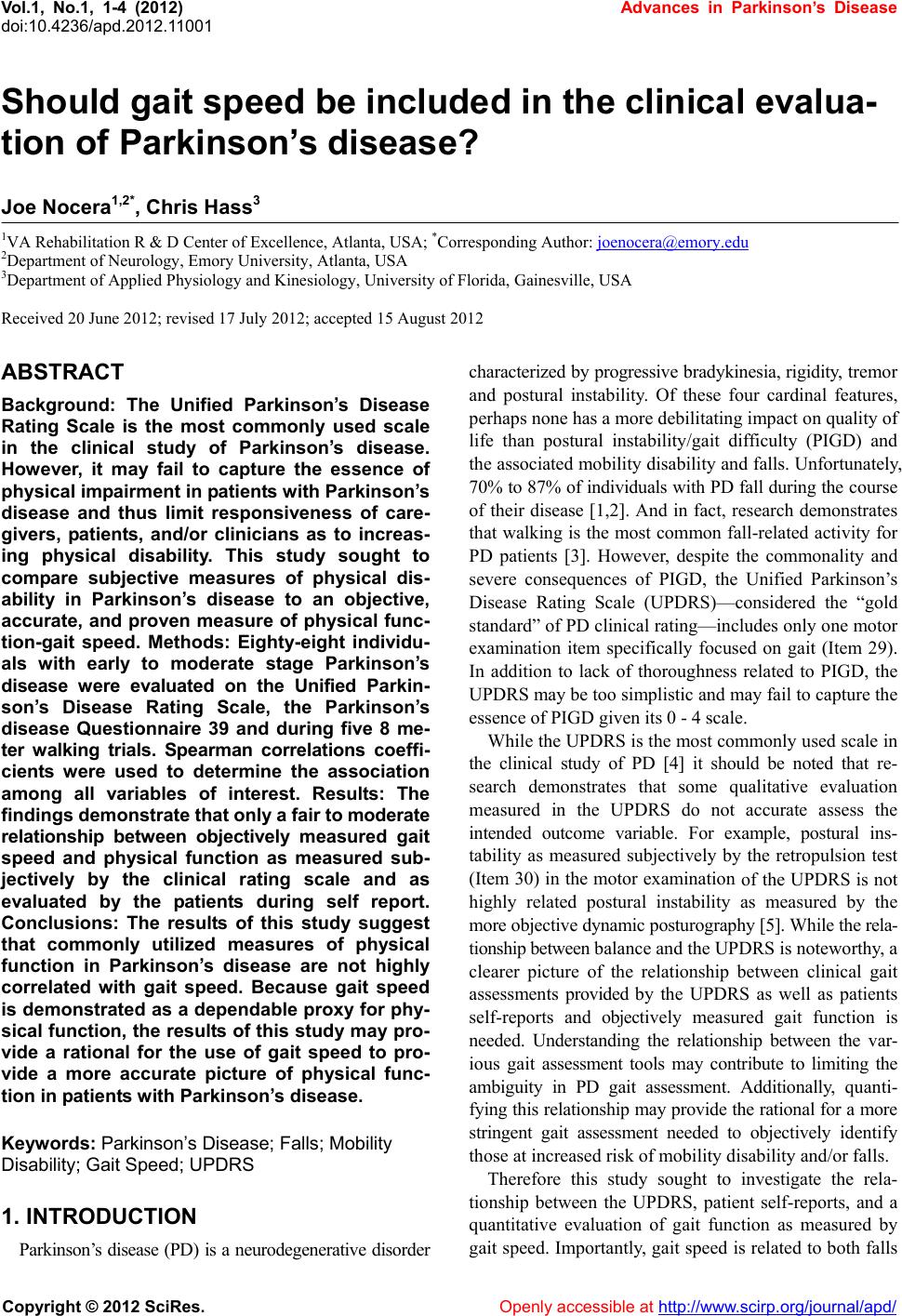 Vol.1, No.1, 1-4 (2012) Advances in Parkinson’s Disease doi:10.4236/apd.2012.11001 Should gait speed be included in the clinical evalua- tion of Parkinson’s disease? Joe Nocera1,2*, Chris Hass3 1VA Rehabilitation R & D Center of Excellence, Atlanta, USA; *Corresponding Author: [email protected] 2Department of Neurology, Emory University, Atlanta, USA 3Department of Applied Physiology and Kinesiology, University of Florida, Gainesville, USA Received 20 June 2012; revised 17 July 2012; accepted 15 August 2012 ABSTRACT Background: The Unified Parkinson’s Disease Rating Scale is the most commonly used scale in the clinical study of Parkinson’s disease. However, it may fail to capture the essence of physical impairment in patients with Parkinson’s disease and thus limit responsiveness of care- givers, patients, and/or clinicians as to increas- ing physical disability. This study sought to compare subjective measures of physical dis- ability in Parkinson’s disease to an objective, accurate, and proven measure of physical func- tion-gait speed. Methods: Eighty-eight individu- als with early to moderate stage Parkinson’s disease were evaluated on the Unified Parkin- son’s Disease Rating Scale, the Parkinson’s disease Questionnaire 39 and during five 8 me- ter walking trials. Spearman correlations coeffi- cients were used to determine the association among all variables of interest. Results: The findings demonstrate th at only a fair to m od er ate relationship between objectively measured gait speed and physical function as measured sub- jectively by the clinical rating scale and as evaluated by the patients during self report. Conclusions: The results of this study suggest that commonly utilized measures of physical function in Parkinson’s disease are not highly correlated with gait speed. Because gait speed is demonstrated as a dependable proxy for phy- sical function, the results of this study may pro- vide a rational for the use of gait speed to pro- vide a more accurate picture of physical func- on in patients with Parkinson’s disease. ti Keywords: P arkinson’s Disease; Falls; Mobility Disability; Gait Speed; UPDRS 1. INTRODUCTION Parkinson’s disease (PD) is a neurodegenerative disorder characterized by progressive bradykin esia, rigidity, tr emo r and postural instability. Of these four cardinal features, perhaps none has a more debilitating impact on quality o f life than postural instability/gait difficulty (PIGD) and the associated mobility disability an d falls. Unfortunately, 70% to 87% of individuals with PD fall during the cou rse of their disease [1,2]. And in fact, research demonstrates that walking is the most common fall-related activity for PD patients [3]. However, despite the commonality and severe consequences of PIGD, the Unified Parkinson’s Disease Rating Scale (UPDRS)—considered the “gold standard” of PD clinical rating—includes only one motor examination item specifically focused on gait (Item 29). In addition to lack of thoroughness related to PIGD, the UPDRS may be too simplistic and may fail to capture the essence of PIGD given its 0 - 4 scale. While the UPDRS is the most commonly used scale in the clinical study of PD [4] it should be noted that re- search demonstrates that some qualitative evaluation measured in the UPDRS do not accurate assess the intended outcome variable. For example, postural ins- tability as measured subjectively by the retropulsion test (Item 30) in the motor examination of the UPDRS is not highly related postural instability as measured by the more objective dynamic posturography [5]. While the rela- tionship between balance and the UPDRS is noteworthy, a clearer picture of the relationship between clinical gait assessments provided by the UPDRS as well as patients self-reports and objectively measured gait function is needed. Understanding the relationship between the var- ious gait assessment tools may contribute to limiting the ambiguity in PD gait assessment. Additionally, quanti- fying this relationship may provide the rational for a more stringent gait assessment needed to objectively identify those at increased risk of mobility disability and/or falls. Therefore this study sought to investigate the rela- tionship between the UPDRS, patient self-reports, and a quantitative evaluation of gait function as measured by gait speed. Importantly, gait sp eed is related to both falls Copyright © 2012 SciRes. Openly accessible at http://www.scirp.org/journal/apd/ 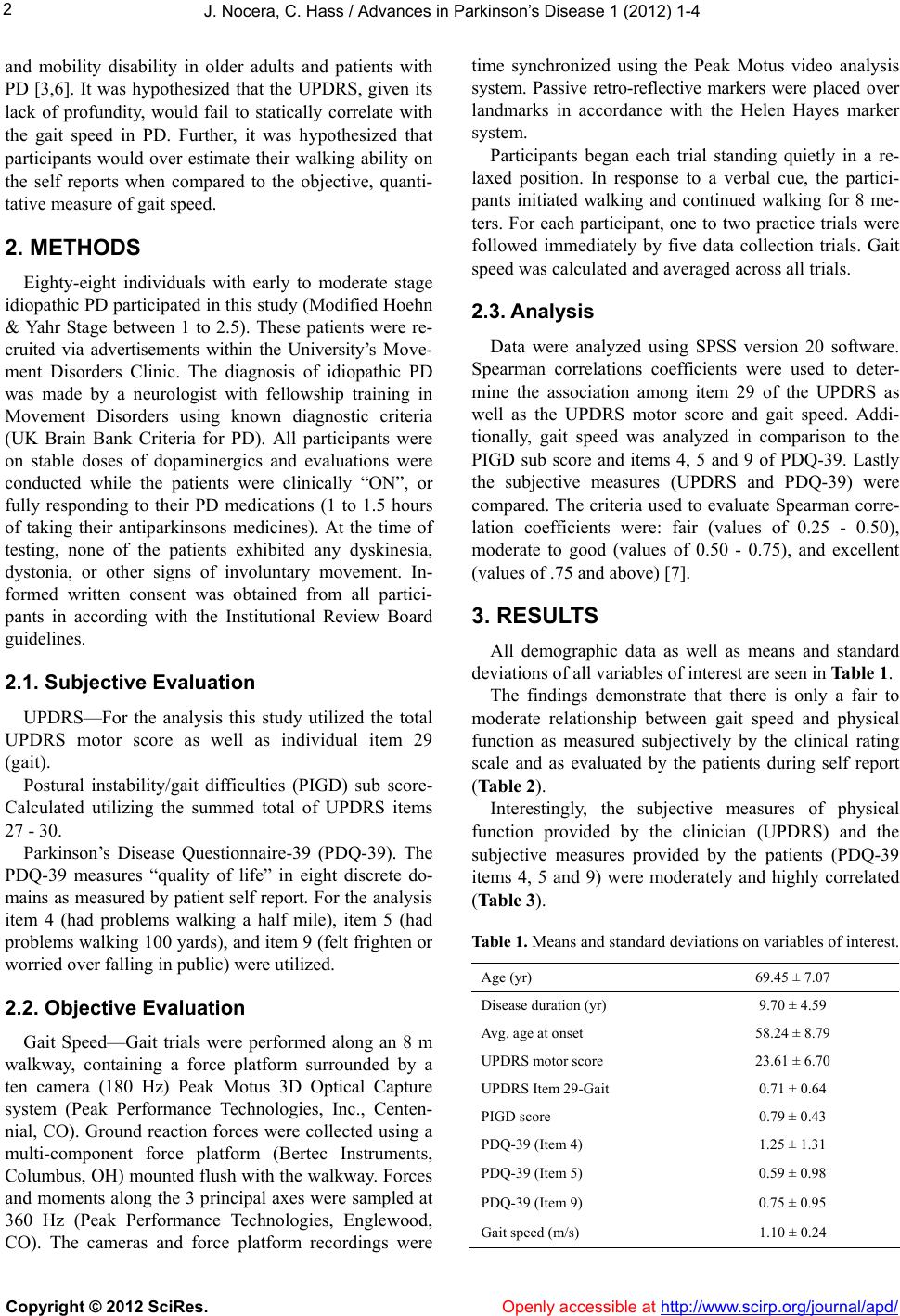 J. Nocera, C. Hass / Advances in Parkinson’s Disease 1 (2012) 1-4 2 and mobility disability in older adults and patients with PD [3,6]. It was hypothesized that the UPDRS, given its lack of profundity, would fail to statically correlate with the gait speed in PD. Further, it was hypothesized that participants would over estimate their walking ability on the self reports when compared to the objective, quanti- tative measure of gait speed. 2. METHODS Eighty-eight individuals with early to moderate stage idiopathic PD participated in this study (Modified Hoehn & Yahr Stage between 1 to 2.5). These patients were re- cruited via advertisements within the University’s Move- ment Disorders Clinic. The diagnosis of idiopathic PD was made by a neurologist with fellowship training in Movement Disorders using known diagnostic criteria (UK Brain Bank Criteria for PD). All participants were on stable doses of dopaminergics and evaluations were conducted while the patients were clinically “ON”, or fully responding to their PD medications (1 to 1.5 hours of taking their antiparkinsons medicines). At the time of testing, none of the patients exhibited any dyskinesia, dystonia, or other signs of involuntary movement. In- formed written consent was obtained from all partici- pants in according with the Institutional Review Board guidelines. 2.1. Subjective Evaluation UPDRS—For the analysis this study utilized the total UPDRS motor score as well as individual item 29 (gait). Postural instability/gait difficulties (PIGD) sub score- Calculated utilizing the summed total of UPDRS items 27 - 30. Parkinson’s Disease Questionnaire-39 (PDQ-39). The PDQ-39 measures “quality of life” in eight discrete do- mains as measured by patient self report. For the anal ysis item 4 (had problems walking a half mile), item 5 (had problems walking 100 yards), and item 9 (felt frighten or worried over falling in public) were utilized. 2.2. Objective Evaluation Gait Speed—Gait trials were performed along an 8 m walkway, containing a force platform surrounded by a ten camera (180 Hz) Peak Motus 3D Optical Capture system (Peak Performance Technologies, Inc., Centen- nial, CO). Grou nd reaction forces were collected using a multi-component force platform (Bertec Instruments, Columbus, OH) mounted flush with the walkway. Forces and moments along the 3 principal axes were sampled at 360 Hz (Peak Performance Technologies, Englewood, CO). The cameras and force platform recordings were time synchronized using the Peak Motus video analysis system. Passive retro-reflective markers were placed over landmarks in accordance with the Helen Hayes marker system. Participants began each trial standing quietly in a re- laxed position. In response to a verbal cue, the partici- pants initiated walking and continued walking for 8 me- ters. For each participant, one to two practice trials were followed immediately by five data collection trials. Gait speed was calculated and averaged across all trials. 2.3. Analysis Data were analyzed using SPSS version 20 software. Spearman correlations coefficients were used to deter- mine the association among item 29 of the UPDRS as well as the UPDRS motor score and gait speed. Addi- tionally, gait speed was analyzed in comparison to the PIGD sub score and items 4, 5 and 9 of PDQ-39. Lastly the subjective measures (UPDRS and PDQ-39) were compared. The criteria used to evaluate Spearman corre- lation coefficients were: fair (values of 0.25 - 0.50), moderate to good (values of 0.50 - 0.75), and excellent (values of .75 and above) [7]. 3. RESULTS All demographic data as well as means and standard deviations of all variab les of interest are seen in Table 1. The findings demonstrate that there is only a fair to moderate relationship between gait speed and physical function as measured subjectively by the clinical rating scale and as evaluated by the patients during self report (Table 2). Interestingly, the subjective measures of physical function provided by the clinician (UPDRS) and the subjective measures provided by the patients (PDQ-39 items 4, 5 and 9) were moderately and highly correlated (Table 3). Table 1. Means and standard deviations on variables of interest. Age (yr) 69.45 ± 7.07 Disease duration (yr) 9.70 ± 4.59 Avg. age at onset 58.24 ± 8.79 UPDRS motor score 23.61 ± 6. 7 0 UPDRS Item 29-Gait 0.71 ± 0.64 PIGD score 0.79 ± 0.43 PDQ-39 (Item 4) 1.25 ± 1.31 PDQ-39 (Item 5) 0.59 ± 0.98 PDQ-39 (Item 9) 0.75 ± 0.95 Gait speed (m/s) 1.10 ± 0.24 Copyright © 2012 SciRes. Openly accessible at http://www.scirp.org/journal/apd/ 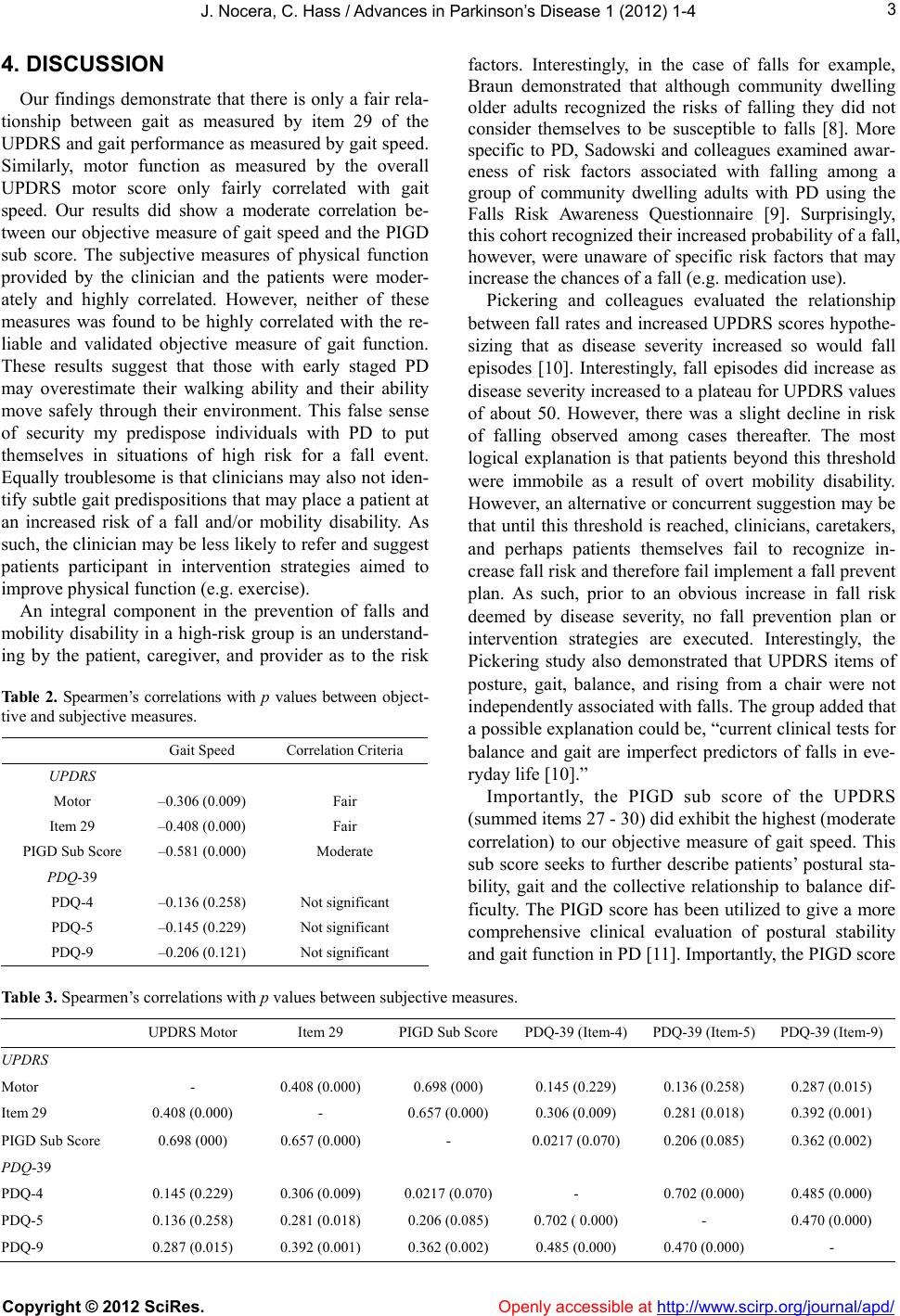 J. Nocera, C. Hass / Advanc es in Parkinson’s Disease 1 (2012) 1-4 Copyright © 2012 SciRes. http://www.scirp.org/journal/apd/Openly accessible at 3 4. DISCUSSION Our findings demonstrate that there is only a fair rela- tionship between gait as measured by item 29 of the UPDRS and gait performance as measured by gait speed. Similarly, motor function as measured by the overall UPDRS motor score only fairly correlated with gait speed. Our results did show a moderate correlation be- tween our objective measure of gait speed and the PIGD sub score. The subjective measures of physical function provided by the clinician and the patients were moder- ately and highly correlated. However, neither of these measures was found to be highly correlated with the re- liable and validated objective measure of gait function. These results suggest that those with early staged PD may overestimate their walking ability and their ability move safely through their environment. This false sense of security my predispose individuals with PD to put themselves in situations of high risk for a fall event. Equally troublesome is that clinicians may also not iden- tify subtle gait predispositions that may place a patient at an increased risk of a fall and/or mobility disability. As such, the clinician may be less likely to refer and suggest patients participant in intervention strategies aimed to improve physical function (e.g. exe rcis e). An integral component in the prevention of falls and mobility disability in a high-risk group is an understand- ing by the patient, caregiver, and provider as to the risk Ta b l e 2 . Spearmen’s correlations with p values between object- tive and subjective measures. Gait Speed Correlation Criteria UPDRS Motor –0.306 (0.009) Fair Item 29 –0.408 (0.000) Fair PIGD Sub Score –0.581 (0.000) Moderate PDQ-39 PDQ-4 –0.136 (0.258) Not significant PDQ-5 –0.145 (0.229) Not significant PDQ-9 –0.206 (0.121) Not significant factors. Interestingly, in the case of falls for example, Braun demonstrated that although community dwelling older adults recognized the risks of falling they did not consider themselves to be susceptible to falls [8]. More specific to PD, Sadowski and colleagues examined awar- eness of risk factors associated with falling among a group of community dwelling adults with PD using the Falls Risk Awareness Questionnaire [9]. Surprisingly, this cohort recognized their increased probab ility of a fall, however, were unaware of specific risk factors that may increase the chances of a fall (e.g. medication use). Pickering and colleagues evaluated the relationship between fall rates and increased UPDRS scores hypothe- sizing that as disease severity increased so would fall episodes [10]. Interestingly, fall episodes did increase as disease severity increased to a plateau for UPDRS values of about 50. However, there was a slight decline in risk of falling observed among cases thereafter. The most logical explanation is that patients beyond this threshold were immobile as a result of overt mobility disability. However, an alternative or concurrent suggestion may be that until this threshold is reached, clinicians, caretakers, and perhaps patients themselves fail to recognize in- crease fall risk and therefore fail implement a fall prevent plan. As such, prior to an obvious increase in fall risk deemed by disease severity, no fall prevention plan or intervention strategies are executed. Interestingly, the Pickering study also demonstrated that UPDRS items of posture, gait, balance, and rising from a chair were not independently associated with falls. The group added that a possible explanation could be, “current clinical tests for balance and gait are imperfect predictors of falls in eve- ryday life [10].” Importantly, the PIGD sub score of the UPDRS (summed items 27 - 30) did exhibit the highest (moderate correlation) to our objective measure of gait speed. This sub score seeks to further describe patients’ postural sta- bility, gait and the collective relationship to balance dif- ficulty. The PIGD score has been utilized to give a more comprehensive clinical evaluation of postural stability and gait function in PD [11]. Importantly, the PIGD score Table 3. Spearmen’s correlations with p values between subjective measures. UPDRS Motor Item 29 PIGD Sub ScorePDQ-39 (Item-4)PDQ-39 (Item-5) PDQ-39 (Item-9) UPDRS Motor - 0.408 (0.000) 0.698 (000) 0.145 (0.229) 0.136 (0.258) 0.287 (0.015) Item 29 0.408 (0.000) - 0.657 (0.000) 0.306 (0.009) 0.281 (0.018) 0.392 (0.001) PIGD Sub Score 0.698 (000) 0.657 (0.000) - 0.0217 (0.070) 0.206 (0.085) 0.362 (0.002) PDQ-39 PDQ-4 0.145 (0.229) 0.306 (0.009) 0.0217 (0.070) - 0.702 (0.000) 0.485 (0.000) PDQ-5 0.136 (0.258) 0.281 (0.018) 0.206 (0.085) 0.702 ( 0.000) - 0.470 (0.000) PDQ-9 0.287 (0.015) 0.392 (0.001) 0.362 (0.002) 0.485 (0.000) 0.470 (0.000) -  J. Nocera, C. Hass / Advances in Parkinson’s Disease 1 (2012) 1-4 4 has been shown to correlate with the Activities-Specific Balance Confidence scale (the ABC scale, a patient-rated questionnaire assessing balance confidence during ac- tivities of daily living, including walking) [11]. As such, in conjunction with our findings, although not com- pletely inclusive, this sub score may be viewed as a more compressive measure of physical function in PD. Although clinically the u se of motion analysis may not be practical, there are more “clinic-friendly” assessments that can provide a more robust examination of gait and physical function. For example, we have previously demonstrated that both the Functional Reach and the Six-Minute walk tests correlated with dynamic postural stability in patients with PD [12]. As such, more easily obtainable patient information, from a stopwatch for example, may be a valuable option for clinicians to pro- vide informative assessments. In conclusion, our findings suggest that subjective measures of the UPDRS may not adequately evaluate physical function when compared to an objective meas- ure of gait speed. As such, the ability of the UPDRS and patient self report may not adequately identify those that may be at risk for a falls and/or mobility disability. While the PIGD sub score of the UPDRS did moderately corre- late with our objective measure of gait speed, the results of this study suggest that a quantitative measure may provide a more accurate picture of physical function in patients with PD. Future research is needed to more de- finitively identify gait speeds at which PD patients are at risk for falls and mobility disability. REFERENCES [1] Hely, M.A., Reid, W.G., Adena, M,A., Halliday, G.M. and Morris, J.G. (2008) The Sydney multicenter study of Parkinson’s disease: The inevitability of dementia at 20 years. Movement Disorders, 23, 837-844. doi:10.1002/mds.21956 [2] Bloem, B.R., Hausdorff, J.M., Visser, J.E. and Giladi, N. (2004) Falls and freezing of gait in Parkinson’s disease: A review of two interconnected, episodic phenomena. Movement Disorders, 19, 871-884. doi:10.1002/mds.20115 [3] Mak, M.K. and Pang, M.Y. (2010) Parkinsonian single fallers versus recurrent fallers: Different fall characteris- tics and clinical features. Journal of Neuroscience, 257, 1543-1551. doi:10.1007/s00415-010-5573-9 [4] Ramaker, C., Marinus, J., Stiggelbout, A.M. and van Hilten, B.J. (2002) Systematic evaluation of rating scales for impairment and disability in Parkinson’s disease. Movement Disorders, 17, 867-876. doi:10.1002/mds.10248 [5] Bloem. B.R., Beckley, D.J., van Hilten, B.J. and Roos, R.A. (1998) Clinimetrics of postural instability in Park- inson’s disease. Journal of Neuroscience, 245, 669-673. doi:10.1007/s004150050265 [6] Hirsch, C.H., Buzková, P., Robbins, J.A., Patel, K.V. and Newman, A.B. (2012) Predicting late-life disability and death by the rate of decline in physical performance measures. Ag e Ageing, 41, 155-161. doi:10.1093/ageing/afr151 [7] Portney, L. and Watkins, M. (1993) Foundations of clini- cal research: Applications to practice. Appleton and Lange, Norwalk. [8] Braun, B.L. (1998) Knowledge and perception of fall- related risk factors and fall-reduction techniques among community-dwelling elderly individuals. Physical Therapy, 78, 1262-1276. [9] Sadowski, C.A., Jones, C.A., Gordon, B. and Feeny, D.H. (2007) Knowledge of risk factors for falling reported by patients with Parkinson disease. Journal of Neuroscience Nursing, 39, 336-341. doi:10.1097/01376517-200712000-00004 [10] Pickering, R.M., Grimbergen, Y.A., Rigney, U., Ashburn, A., Mazibrada, G., Wood, B., et al. (2007) A meta-analy- sis of six prospective studies of falling in Parkinson’s disease. Movement Disorders, 22, 1892-1900. doi:10.1002/mds.21598 [11] Adkin, A.L., Frank, J.S. and Jog, M.S. (2003) Fear of falling and postural control in Parkinson’s disease. Movement Disorders, 18, 496-502. doi:10.1002/mds.10396 [12] Nocera, J.R., Buckley, T., Waddell, D., Okun M. and Hass. C. (2010) Knee extensor strength, dynamic stability and function ambulation: Are they related in Parkinson’s dis- ease? Archives of Physical Medicine and Rehabilitation, 91, 589-595. doi:10.1016/j.apmr.2009.11.026 Copyright © 2012 SciRes. Openly accessible at http://www.scirp.org/journal/apd/ |