

Paper Menu >>
Journal Menu >>
 Vol.3, No.3, 259-268 (2012) Journal of Biophysical Chemistry http://dx.doi.org/10.4236/jbpc.2012.33031 Copyright © 2012 SciRes. OPEN ACCESS Vibrational spectra of distorted structure macro & nano molecules: An algebraic approach Srinivasa Rao Karumuri 1* , J. Vijayasekhar 2 , Velagapudi Uma Maheswara Rao 3 , Ganganagunta Srinivas 4 , Aappikatla Hanumaiah 5 1 Department of Electronics & Instrumentation, Lakireddy Bali Reddy College of Engineering, Mylavaram, India; * Corresponding Author: [email protected] 2 Department of Mathematics, GITAM University, Hyderabad, India 3 Department of Applied Mathematics, Andhra University, Vishakhapatnam, India 4 Department of Physics, KL University, Guntur, India 5 Department of Sciences & Humanities, Lara Vigyan Institute of Science & Technology, Vadlamudi, India Received 18 April 2012; revised 20 June 2012; accepted 10 July 2012 ABSTRACT Using the Lie algebraic method the vibrational frequencies of 97 resonances Raman lines (A 1g + B 1g + A 2g + B 2g ) and 38 infrared bands (E u ) of oc- taethylporphyrinato-Ni (II) and its mesodeuter- ated and 15 N-substituted derivates and Fullere- nes C 60 and C 70 of 7 vibrational bands are cal- culated using U(2) algebraic Hamiltonian with four fitting algebraic parameters. The results ob- tained by the algebraic technique have been com- pared with experimental data; and they show great accuracy. Keywords: Lie Algebra; Vibrational Spectra; Ni (OEP); Ni (OEP)-d 4 & Ni (OEP)-N 4 ; Fullerenes 1. INTRODUCTION Nanoscience is an interdisciplinary field that seeks to bring about nature nanotechnology. Focusing on the na- noscale intersection of fields such as Physics, Biology, Engineering, Chemistry, Computer Sciences and more, Nanoscience is rapidly expanding [1]. A comprehensive treatment and understanding of spectroscopic features of nano-size molecules is by far one of the most chal- lenging aspects of current studies in molecular spec- troscopy. On one side, experimental techniques are producing a rapidly increasing amount of data and clear evidence for intriguing mechanisms characterizing sev- eral aspects of molecular dynamics in nano-bio mole- cules [2]. On the other side, theoretical approaches are heavily pushed towards their intrinsic limits; in the at- tempt to provide reliable answers to hitherto unresolved questions concerning very complex situations of nano- bio molecules. The appearance of new experimental techniques to produce higher vibrational excitations in nano-bio polyatomic molecule requires reliable theo- retical methods for their interpretation. Two approa- ches have mostly been used so far in an analysis of experimental data: 1) the familiar Dunham like expan- sion of energy levels in terms of rotations-vibrations quantum numbers and 2) the solution of Schrodinger equation with potentials obtained either by appropri- ately modifying ab-initio calculations or by more phe- nomenological methods. In this article, we begin a sys- tematic analysis of vibrational spectra of bio-nano molecules in terms of novel approach; 3) Vibron model [3-6]. Recently Lie algebraic model introduction [7-18] could proved itself to be a successful model in the study of vibrational spectra of small, medium size and polya- tomic molecules [19,20]. The algebraic model is fully based on the dynamical symmetry and through the lan- guage of Lie algebra. For the triatomic, tetratomic, Tet- rahedral and poly-atomic Bio-molecules (i.e. metal- loporphyrins, Ni (OEP), Ni (TTP), Ni Porphyrin) we studied earlier [21-25] using algebraic model. Using the algebraic model in this study we have calculated the vibrational frequencies of octaethylporphyrinato-Ni(II) and its meso-deurated and N substituted derivatives for 97 vibrational bands each using U(2) algebraic model Hamiltonian. In our study we used four fitting parame- ters which provide better comparisons between the ex- perimental and theoretical calculations throughout the study. In this paper, we have considered only the In-Plane Vibrations of Nickel Octaethylporphyrin and its meso substituent and 15 N derivatives for 97 vibrational bands and fullerenes C 60 and C 70 for 7 vibrational bands (both stretching and bending) are calculated by using U(2) algebraic mode Hamiltonian.  S. R. Karumuri et al. / Journal of Biophysical Chemistry 3 (2012) 259-268 Copyright © 2012 SciRes. OPEN ACCESS 260 2. ALGEBRAIC FRAMEWORK A complete description of the theoretical foundations needed to formulate the algebraic model for a vibrating molecule. We apply the one-dimensional algebraic model, consisting of a formal replacement of the interatomic, bond coordinates with unitary algebras. To say it in dif- ferent words, the second-quantization picture suited to describe anharmonic vibrational modes, is specialized through an extended use of Lie group theory and dy- namical symmetries. By means of this formalism, one can attain algebraic expressions for eigenvalues and ei- genvectors of even complex Hamiltonian operators, in- cluding intermode coupling terms as well expectation values of any operator of interest (such as electric dipole and quadrupole interactions). Algebraic model are not ab-initio methods, as the Hamiltonian operator depends on a certain number of a priori undetermined parameters. As a consequence, algebraic techniques can be more con- vincingly compared with semi-empirical approaches mak- ing use of expansions over power and products of vi- brational quantum numbers, such as a Dunham-like se- ries. However, two noticeable advantages of algebraic expansions over conventional ones are that 1) algebraic modes lead to a (local) Hamiltonian formulation of the physical problem at issue (thus permitting a direct calcu- lation of eigenvectors in this same local basis) and 2) algebraic expansions are intrinsically anharmonic at their zero-order approximation. This fact allows one to reduce drastically the number of arbitrary parameters in com- parison to harmonic series, especially when facing me- dium- or large-size molecules. It should be however also noticed that, as a possible drawback of purely local Ha- miltonian formulations (either algebraic or not) com- pared with traditional perturbative approaches, the actual eigenvectors of the physical system. Yet, for very local situations, the aforementioned disadvantage is not a se- rious one. A further point of import here is found in the ease of accounting for proper symmetry adaptation of vibrational wave functions. This can be of great help in the systematic study of highly excited overtones of not-so-small molecules, such as the present one. Last but not least, the local mode picture of a molecule is en- hanced from the very beginning within the algebraic framework. This is an aspect perfectly lined up with the current tendencies of privileging local over normal mode pictures in the description of most topical situations. We address here the explicit problem of the construc- tion of the vibrational Hamiltonian operator for the po- lyatomic molecule. According to the general algebraic description for one-dimensional degrees of freedom, a dynamically-symmetric Hamiltonian operator for n in- teracting (not necessarily equivalent) oscillators cab written as 0 . iiijijijij H = E+AC+AC+M (1) In this expresssion, one finds three different classes of effective contributions. The first one, 1 n i A i C i is devoted to the description of n independent, anharmonic sequences of vibrational levels (associted wih n independent, local oscillator) in terms of the operators C i . The second one, 1 n ijij i A C leads to cross-anharmonicities between pairs of distinct local oscillators in terms of the operators C ij . The third one, 1 n ijij i M , describes anharmonic, non-diagonal interactions involving pairs of local oscil- lators in terms of the operators M ij . The C i , C ij operators are invariant (Casimir) operators of certain Lie algebras, whilst the M ij are invariant (Majorana) operators as- sociated with coupling schemes involving algebras na- turally arising from a systematic study of the algebraic formulation of the one-dimensional model for n inter- acting oscillators. We work in the local (uuncoupled os- cillaators) vibrational basis written as 123 ........ n In which the aforementioned operators have the following matrix elements !! !! ! ! 12 ! 11 12 ! 1 4 4 2δδ 11 δδ 11 δ iijj iijj i iiii ijiiijij ijiijjij ijiiijjj ijjjjiii CN CNN MNN MNN MNN ! 1 δ. ijj (2) We note, in particular, that the expressions above de- pend on the numbers N i (Vibron numbers). Such numbers have to be seen as predetermined parameters of well- defined physical meaning, as they relate to the intrinsic anharmonicity of a single, uncoupled oscillator through the simple relation. We report in Table the values of the Vibron numbers used in the present study. The general Hamiltonian operator 1) can be adapted to describe he internal, vibrational degrees of freedom of any polyatomic molecule in two distinct steps. First, we associate three mutually perpendicular one-dimensional anharmonic oscillators to each atom. This procedure even- tually leads to a redundant picture of the whole molecule, as it will include spurious (i.e. translational/rotational) degrees of freedom. It is however possible to remove easily such spurious modes through a technique de-  S. R. Karumuri et al. / Journal of Biophysical Chemistry 3 (2012) 259-268 Copyright © 2012 SciRes. OPEN ACCESS 261 scribed elsewhere [19-21]. One is thus left with a Ham- iltonian operator dealing only with true vibrations. Such modes are given in terms of coupled oscillators in the local basis; 2) The coupling is induced by the Majorana operators. A sensible use of these operators is such that the correct symmetries of vibrational wave functions are properly taken into account. As a second step, the alge- braic parameters A i , A ij , λ ij of Eq.1 need to be calibrated to reproduce the observed spectrum. The algebraic theory of polyatomic molecules consists in the separate quantization of rotations and vibrations in terms of vector coordinates r 1 , r 2 , r 3 , . quantized through the algebra 123 222GUUU For the stretching vibrations of polyatomic molecules correspond to the quantization of anharmonic Morse os- cillators, with classical Hamiltonian 2 2 ,= 2+1exp ss H pspDs (3) For each oscillator i, states are characterized by repre- sentations of 22 ii ii UO Nm (4) with m i = N i , N i – 2, , 1 or 0 (N i —odd or even). The Morse Hamiltonian (3) can be written, in the algebraic approach, simply as 0iiii H=ε+AC, (5) where C i is the invariant operator of O i (2), with eigen values 22 0 –. iiiii ε= ε+AmN Introducing the vibrational quantum number –2 iii Nm , [20] one has 2 0 4 iiiiii εεANνν (6) For non-interacting oscillators the total Hamiltonian is i i H H with eigen-values 2 0 4 iiiii ii E=EANvv (7) 2.1. Hamiltonian for Stretching Vibrations The interaction potential can be written as ,1exp1exp, ijijiijj Vsskαsαs (8) which reduces to the usual harmonic force field when the displacements are small , ijijij Vss kss . Interaction of the type Eq.8 can be taken into account in the algebraic approach by introducing two terms. One of these terms is the Casimir operator, C ij , of the com- bined 22 ij OO algebra. The matrix elements of this operator in the basis Eq.2 are given by 2 ? 4 . ii ;jjijii ;j j ijijij N,νN,νCN,νN,ν NN (9) The operator C ij is diagonal and the vibrational quan- tum numbers ν i have been used instead of m i . In practical calculations, it is sometime convenient to substract from C ij a contribution that can be absorbed in the Casimir operators of the individual modes i and j, thus consider- ing an operator ' ij C whose matrix elements are 2 2 2 ,;,;, 4 4 4. iijjijiijj ijijij ijiiii ijijjj NνNνCN,νNν NN NNNNvv NNNNvv (10) The second term is the Majorana operator, M ij . This operator has both diagonal and off-diagonal matrix ele- ments 12 12 ,;,;, 2 ,+1; ,1,; , 11 ,1;,1,;, 11. iijjijiijj ijjiij ii jjijiijj jiiijj ii jjijiijj ijjjji NνNνMN,νNν NvNv NνNνMNνNν νν+NνNν+ NνNνMNνNν νν+NνNν+ (11) The Majorana operators M ij annihilâtes one quantum of vibration in bond i and create one in bond j, or vice versa. 2.2. Symmetry-Adapted Operators In polyatomic molecules, the geometric point group symmetry of the molecule plays an important role. States must transform according to representations of the point symmetry group. In the absence of the Majorana opera- tors M ij , states are degenerate. The introduction of the Majorana operators has two effects: 1) It splits the de- 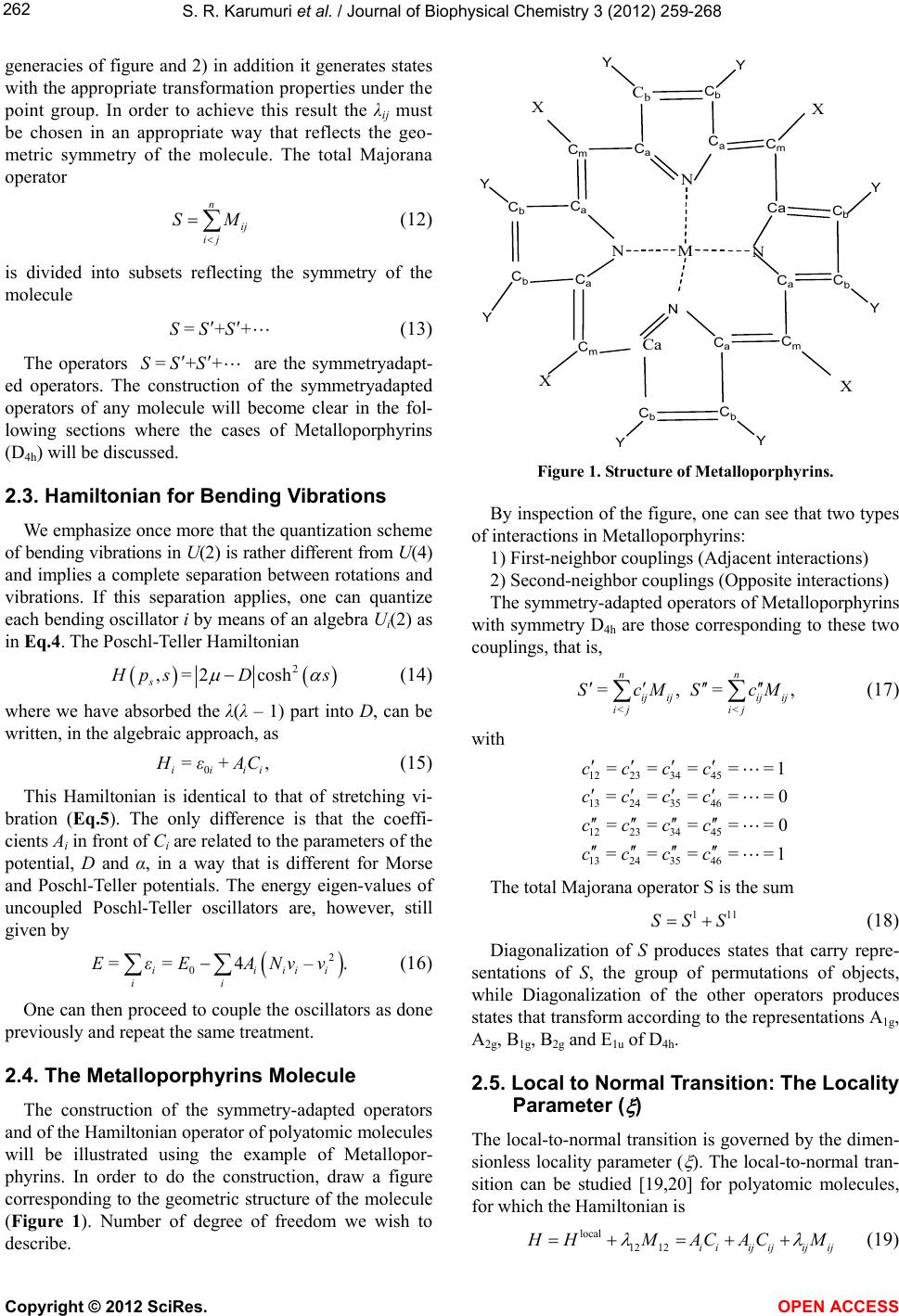 S. R. Karumuri et al. / Journal of Biophysical Chemistry 3 (2012) 259-268 Copyright © 2012 SciRes. OPEN ACCESS 262 generacies of figure and 2) in addition it generates states with the appropriate transformation properties under the point group. In order to achieve this result the λ ij must be chosen in an appropriate way that reflects the geo- metric symmetry of the molecule. The total Majorana operator n ij ij SM (12) is divided into subsets reflecting the symmetry of the molecule =++S SS (13) The operators =++S SS are the symmetryadapt- ed operators. The construction of the symmetryadapted operators of any molecule will become clear in the fol- lowing sections where the cases of Metalloporphyrins (D 4h ) will be discussed. 2.3. Hamiltonian for Bending Vibrations We emphasize once more that the quantization scheme of bending vibrations in U(2) is rather different from U(4) and implies a complete separation between rotations and vibrations. If this separation applies, one can quantize each bending oscillator i by means of an algebra U i (2) as in Eq.4. The Poschl-Teller Hamiltonian 2 ,=2cosh s H ps Ds (14) where we have absorbed the λ(λ – 1) part into D, can be written, in the algebraic approach, as 0 , iiii H=ε+AC (15) This Hamiltonian is identical to that of stretching vi- bration ( Eq.5). The only difference is that the coeffi- cients A i in front of C i are related to the parameters of the potential, D and α, in a way that is different for Morse and Poschl-Teller potentials. The energy eigen-values of uncoupled Poschl-Teller oscillators are, however, still given by 2 0 4. iiiii ii E=ε=EA Nν–ν (16) One can then proceed to couple the oscillators as done previously and repeat the same treatment. 2.4. The Metalloporphyrins Molecule The construction of the symmetry-adapted operators and of the Hamiltonian operator of polyatomic molecules will be illustrated using the example of Metallopor- phyrins. In order to do the construction, draw a figure corresponding to the geometric structure of the molecule ( Figure 1). Number of degree of freedom we wish to describe. C b C b C a Y Y C a C m C m N Ca C b C b C a N C m C a C b C b M C a C b C b C a N C m Y Y Y Y Y Y Ca X X X X N Figure 1. Structure of Metalloporphyrins. By inspection of the figure, one can see that two types of interactions in Metalloporphyrins: 1) First-neighbor couplings (Adjacent interactions) 2) Second-neighbor couplings (Opposite interactions) The symmetry-adapted operators of Metalloporphyrins with symmetry D 4h are those corresponding to these two couplings, that is, ,, nn ijijijij i<ji<j S=cMS=cM (17) with 12233445 13243546 12233445 13243546 1 0 0 1 c=c=c=c== c=c=c=c== c=c=c=c== c=c=c=c== The total Majorana operator S is the sum 111 SSS (18) Diagonalization of S produces states that carry repre- sentations of S, the group of permutations of objects, while Diagonalization of the other operators produces states that transform according to the representations A 1g , A 2g , B 1g , B 2g and E 1u of D 4h . 2.5. Local to Normal Transition: The Locality Parameter ( ) The local-to-normal transition is governed by the dimen- sionless locality parameter ( ). The local-to-normal tran- sition can be studied [19,20] for polyatomic molecules, for which the Hamiltonian is local 1212 iiijijijij H HMACACM (19) 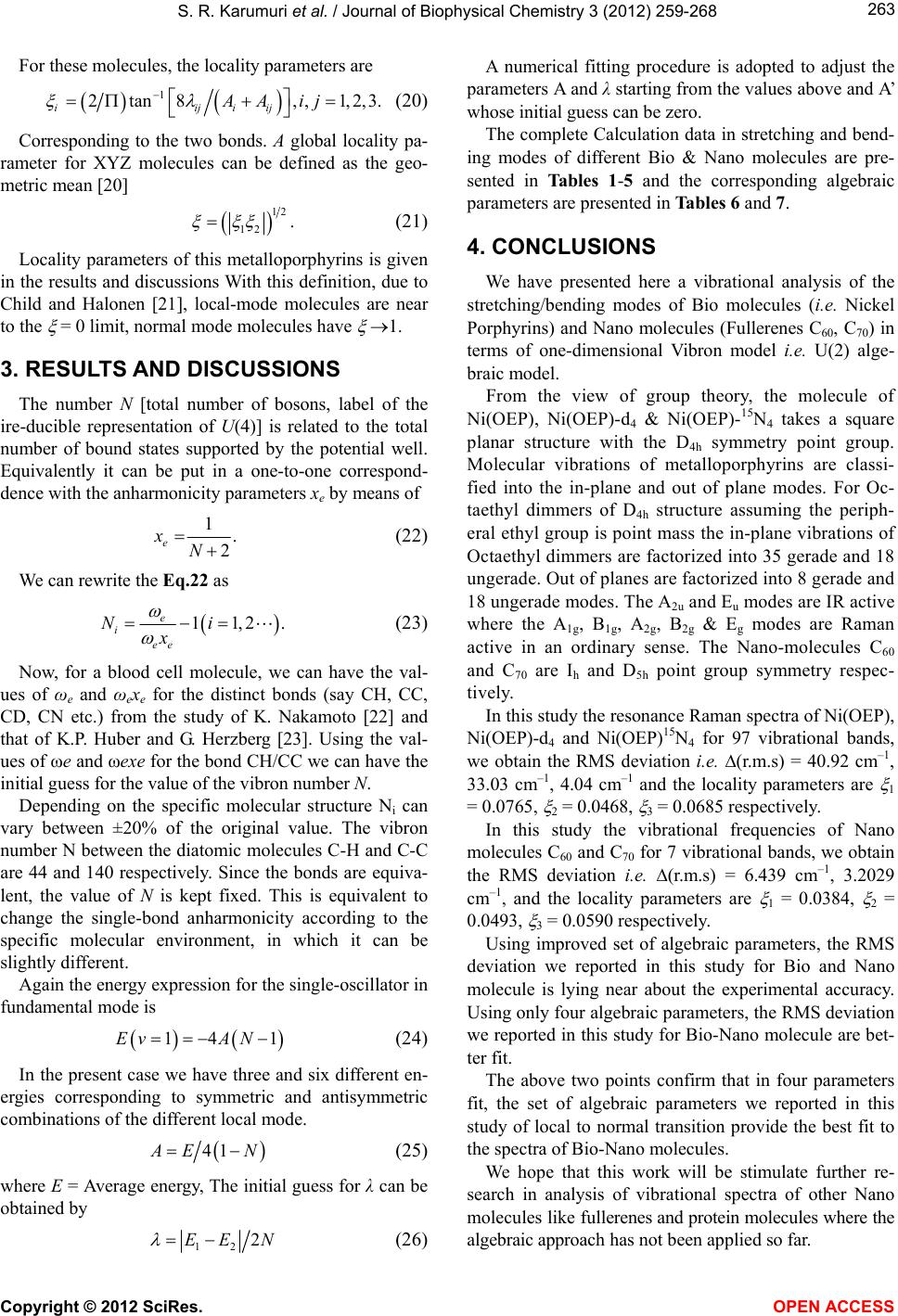 S. R. Karumuri et al. / Journal of Biophysical Chemistry 3 (2012) 259-268 Copyright © 2012 SciRes. OPEN ACCESS 263 For these molecules, the locality parameters are 1 2tan8,,1,2,3. iijiij AAij (20) Corresponding to the two bonds. A global locality pa- rameter for XYZ molecules can be defined as the geo- metric mean [20] 12 12 . (21) Locality parameters of this metalloporphyrins is given in the results and discussions With this definition, due to Child and Halonen [21], local-mode molecules are near to the = 0 limit, normal mode molecules have 1. 3. RESULTS AND DISCUSSIONS The number N [total number of bosons, label of the ire-ducible representation of U(4)] is related to the total number of bound states supported by the potential well. Equivalently it can be put in a one-to-one correspond- dence with the anharmonicity parameters x e by means of 1 . 2 e x N (22) We can rewrite the Eq.22 as 11,2. e i ee Ni x (23) Now, for a blood cell molecule, we can have the val- ues of ω e and ω e x e for the distinct bonds (say CH, CC, CD, CN etc.) from the study of K. Nakamoto [22] and that of K.P. Huber and G. Herzberg [23]. Using the val- ues of ωe and ωexe for the bond CH/CC we can have the initial guess for the value of the vibron number N. Depending on the specific molecular structure N i can vary between ±20% of the original value. The vibron number N between the diatomic molecules C-H and C-C are 44 and 140 respectively. Since the bonds are equiva- lent, the value of N is kept fixed. This is equivalent to change the single-bond anharmonicity according to the specific molecular environment, in which it can be slightly different. Again the energy expression for the single-oscillator in fundamental mode is 141EvAN (24) In the present case we have three and six different en- ergies corresponding to symmetric and antisymmetric combinations of the different local mode. 41 A EN (25) where E = Average energy, The initial guess for λ can be obtained by 12 2EEN (26) A numerical fitting procedure is adopted to adjust the parameters A and λ starting from the values above and A’ whose initial guess can be zero. The complete Calculation data in stretching and bend- ing modes of different Bio & Nano molecules are pre- sented in Tables 1-5 and the corresponding algebraic parameters are presented in Tables 6 and 7. 4. CONCLUSIONS We have presented here a vibrational analysis of the stretching/bending modes of Bio molecules (i.e. Nickel Porphyrins) and Nano molecules (Fullerenes C 60 , C 70 ) in terms of one-dimensional Vibron model i.e. U(2) alge- braic model. From the view of group theory, the molecule of Ni(OEP), Ni(OEP)-d 4 & Ni(OEP)- 15 N 4 takes a square planar structure with the D 4h symmetry point group. Molecular vibrations of metalloporphyrins are classi- fied into the in-plane and out of plane modes. For Oc- taethyl dimmers of D 4h structure assuming the periph- eral ethyl group is point mass the in-plane vibrations of Octaethyl dimmers are factorized into 35 gerade and 18 ungerade. Out of planes are factorized into 8 gerade and 18 ungerade modes. The A 2u and E u modes are IR active where the A 1g , B 1g , A 2g , B 2g & E g modes are Raman active in an ordinary sense. The Nano-molecules C 60 and C 70 are I h and D 5h point group symmetry respec- tively. In this study the resonance Raman spectra of Ni(OEP), Ni(OEP)-d 4 and Ni(OEP) 15 N 4 for 97 vibrational bands, we obtain the RMS deviation i.e. ∆(r.m.s) = 40.92 cm –1 , 33.03 cm –1 , 4.04 cm –1 and the locality parameters are 1 = 0.0765, 2 = 0.0468, 3 = 0.0685 respectively. In this study the vibrational frequencies of Nano molecules C 60 and C 70 for 7 vibrational bands, we obtain the RMS deviation i.e. ∆(r.m.s) = 6.439 cm –1 , 3.2029 cm –1 , and the locality parameters are 1 = 0.0384, 2 = 0.0493, 3 = 0.0590 respectively. Using improved set of algebraic parameters, the RMS deviation we reported in this study for Bio and Nano molecule is lying near about the experimental accuracy. Using only four algebraic parameters, the RMS deviation we reported in this study for Bio-Nano molecule are bet- ter fit. The above two points confirm that in four parameters fit, the set of algebraic parameters we reported in this study of local to normal transition provide the best fit to the spectra of Bio-Nano molecules. We hope that this work will be stimulate further re- search in analysis of vibrational spectra of other Nano molecules like fullerenes and protein molecules where the algebraic approach has not been applied so far. 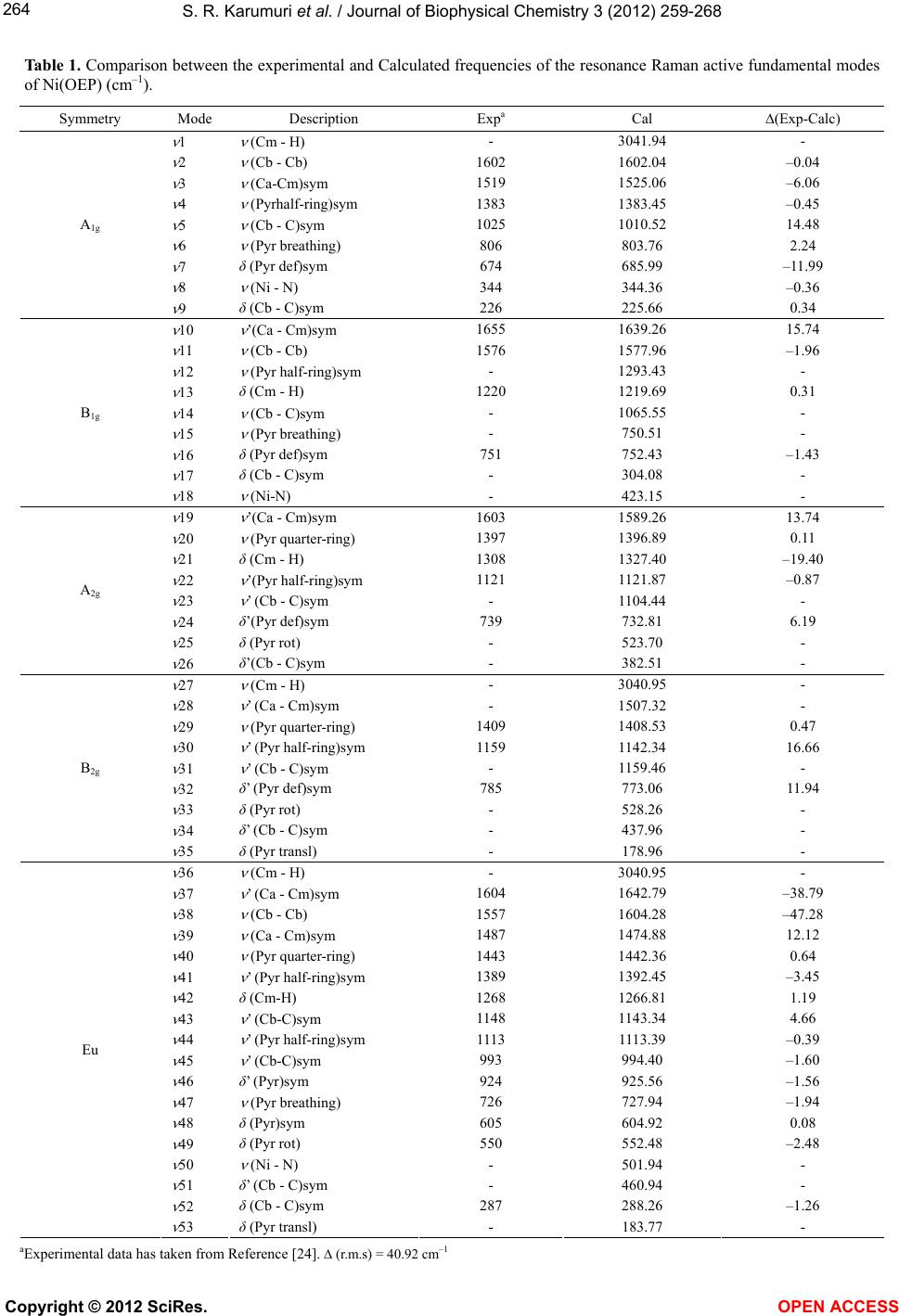 S. R. Karumuri et al. / Journal of Biophysical Chemistry 3 (2012) 259-268 Copyright © 2012 SciRes. OPEN ACCESS 264 Table 1. Comparison between the experimental and Calculated frequencies of the resonance Raman active fundamental modes of Ni(OEP) (cm –1 ). Symmetry Mode Description Exp a Cal (Exp-Calc) 1 (Cm - H) - 3041.94 - 2 (Cb - Cb) 1602 1602.04 –0.04 3 (Ca-Cm)sym 1519 1525.06 –6.06 4 (Pyrhalf-ring)sym 1383 1383.45 –0.45 5 (Cb - C)sym 1025 1010.52 14.48 6 (Pyr breathing) 806 803.76 2.24 7 δ (Pyr def)sym 674 685.99 –11.99 8 (Ni - N) 344 344.36 –0.36 A 1g 9 δ (Cb - C)sym 226 225.66 0.34 10 ’(Ca - Cm)sym 1655 1639.26 15.74 11 (Cb - Cb) 1576 1577.96 –1.96 12 (Pyr half-ring)sym - 1293.43 - 13 δ (Cm - H) 1220 1219.69 0.31 14 (Cb - C)sym - 1065.55 - 15 (Pyr breathing) - 750.51 - 16 δ (Pyr def)sym 751 752.43 –1.43 17 δ (Cb - C)sym - 304.08 - B 1g 18 (Ni-N) - 423.15 - 19 ’(Ca - Cm)sym 1603 1589.26 13.74 20 (Pyr quarter-ring) 1397 1396.89 0.11 21 δ (Cm - H) 1308 1327.40 –19.40 22 ’(Pyr half-ring)sym 1121 1121.87 –0.87 23 ’ (Cb - C)sym - 1104.44 - 24 δ’(Pyr def)sym 739 732.81 6.19 25 δ (Pyr rot) - 523.70 - A 2g 26 δ’(Cb - C)sym - 382.51 - 27 (Cm - H) - 3040.95 - 28 ’ (Ca - Cm)sym - 1507.32 - 29 (Pyr quarter-ring) 1409 1408.53 0.47 30 ’ (Pyr half-ring)sym 1159 1142.34 16.66 31 ’ (Cb - C)sym - 1159.46 - 32 δ’ (Pyr def)sym 785 773.06 11.94 33 δ (Pyr rot) - 528.26 - 34 δ’ (Cb - C)sym - 437.96 - B 2g 35 δ (Pyr transl) - 178.96 - 36 (Cm - H) - 3040.95 - 37 ’ (Ca - Cm)sym 1604 1642.79 –38.79 38 (Cb - Cb) 1557 1604.28 –47.28 39 (Ca - Cm)sym 1487 1474.88 12.12 40 (Pyr quarter-ring) 1443 1442.36 0.64 41 ’ (Pyr half-ring)sym 1389 1392.45 –3.45 42 δ (Cm-H) 1268 1266.81 1.19 43 ’ (Cb-C)sym 1148 1143.34 4.66 44 ’ (Pyr half-ring)sym 1113 1113.39 –0.39 45 ’ (Cb-C)sym 993 994.40 –1.60 46 δ’ (Pyr)sym 924 925.56 –1.56 47 (Pyr breathing) 726 727.94 –1.94 48 δ (Pyr)sym 605 604.92 0.08 49 δ (Pyr rot) 550 552.48 –2.48 50 (Ni - N) - 501.94 - 51 δ’ (Cb - C)sym - 460.94 - 52 δ (Cb - C)sym 287 288.26 –1.26 Eu 53 δ (Pyr transl) - 183.77 - a Experimental data has taken from Reference [24]. ∆ (r.m.s) = 40.92 cm –1 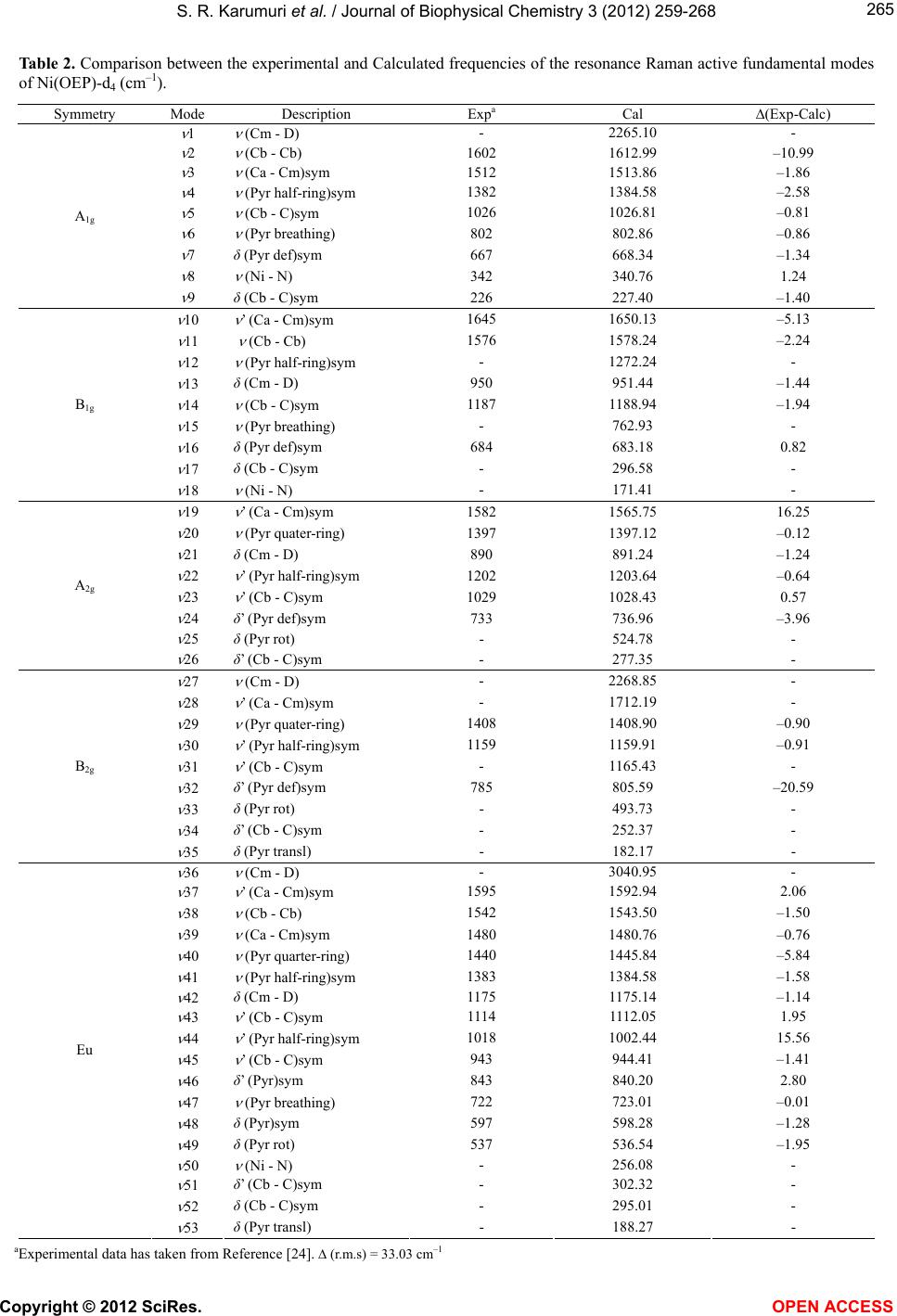 S. R. Karumuri et al. / Journal of Biophysical Chemistry 3 (2012) 259-268 Copyright © 2012 SciRes. OPEN ACCESS 265 Table 2. Comparison between the experimental and Calculated frequencies of the resonance Raman active fundamental modes of Ni(OEP)-d 4 (cm –1 ). Symmetry Mode Description Exp a Cal (Exp-Calc) 1 (Cm - D) - 2265.10 - 2 (Cb - Cb) 1602 1612.99 –10.99 3 (Ca - Cm)sym 1512 1513.86 –1.86 4 (Pyr half-ring)sym 1382 1384.58 –2.58 5 (Cb - C)sym 1026 1026.81 –0.81 6 (Pyr breathing) 802 802.86 –0.86 7 δ (Pyr def)sym 667 668.34 –1.34 8 (Ni - N) 342 340.76 1.24 A 1g 9 δ (Cb - C)sym 226 227.40 –1.40 10 ’ (Ca - Cm)sym 1645 1650.13 –5.13 11 (Cb - Cb) 1576 1578.24 –2.24 12 (Pyr half-ring)sym - 1272.24 - 13 δ (Cm - D) 950 951.44 –1.44 14 (Cb - C)sym 1187 1188.94 –1.94 15 (Pyr breathing) - 762.93 - 16 δ (Pyr def)sym 684 683.18 0.82 17 δ (Cb - C)sym - 296.58 - B 1g 18 (Ni - N) - 171.41 - 19 ’ (Ca - Cm)sym 1582 1565.75 16.25 20 (Pyr quater-ring) 1397 1397.12 –0.12 21 δ (Cm - D) 890 891.24 –1.24 22 ’ (Pyr half-ring)sym 1202 1203.64 –0.64 23 ’ (Cb - C)sym 1029 1028.43 0.57 24 δ’ (Pyr def)sym 733 736.96 –3.96 25 δ (Pyr rot) - 524.78 - A 2g 26 δ’ (Cb - C)sym - 277.35 - 27 (Cm - D) - 2268.85 - 28 ’ (Ca - Cm)sym - 1712.19 - 29 (Pyr quater-ring) 1408 1408.90 –0.90 30 ’ (Pyr half-ring)sym 1159 1159.91 –0.91 31 ’ (Cb - C)sym - 1165.43 - 32 δ’ (Pyr def)sym 785 805.59 –20.59 33 δ (Pyr rot) - 493.73 - 34 δ’ (Cb - C)sym - 252.37 - B 2g 35 δ (Pyr transl) - 182.17 - 36 (Cm - D) - 3040.95 - 37 ’ (Ca - Cm)sym 1595 1592.94 2.06 38 (Cb - Cb) 1542 1543.50 –1.50 39 (Ca - Cm)sym 1480 1480.76 –0.76 40 (Pyr quarter-ring) 1440 1445.84 –5.84 41 (Pyr half-ring)sym 1383 1384.58 –1.58 42 δ (Cm - D) 1175 1175.14 –1.14 43 ’ (Cb - C)sym 1114 1112.05 1.95 44 ’ (Pyr half-ring)sym 1018 1002.44 15.56 45 ’ (Cb - C)sym 943 944.41 –1.41 46 δ’ (Pyr)sym 843 840.20 2.80 47 (Pyr breathing) 722 723.01 –0.01 48 δ (Pyr)sym 597 598.28 –1.28 49 δ (Pyr rot) 537 536.54 –1.95 50 (Ni - N) - 256.08 - 51 δ’ (Cb - C)sym - 302.32 - 52 δ (Cb - C)sym - 295.01 - Eu 53 δ (Pyr transl) - 188.27 - a Experimental data has taken from Reference [24]. ∆ (r.m.s) = 33.03 cm –1 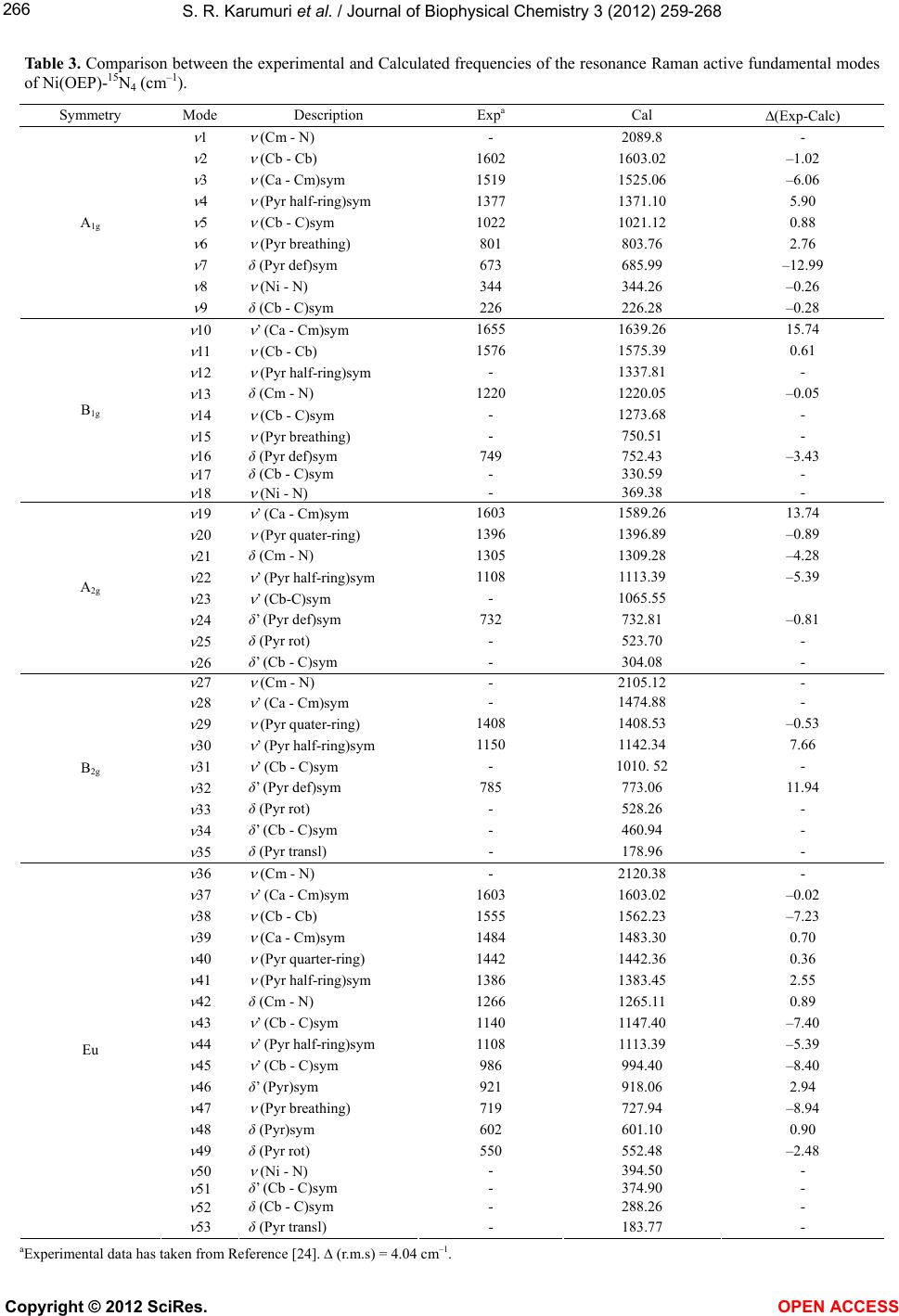 S. R. Karumuri et al. / Journal of Biophysical Chemistry 3 (2012) 259-268 Copyright © 2012 SciRes. OPEN ACCESS 266 Table 3. Comparison between the experimental and Calculated frequencies of the resonance Raman active fundamental modes of Ni(OEP)- 15 N 4 (cm –1 ). Symmetry Mode Description Exp a Cal (Exp-Calc) 1 (Cm - N) - 2089.8 - 2 (Cb - Cb) 1602 1603.02 –1.02 3 (Ca - Cm)sym 1519 1525.06 –6.06 4 (Pyr half-ring)sym 1377 1371.10 5.90 5 (Cb - C)sym 1022 1021.12 0.88 6 (Pyr breathing) 801 803.76 2.76 7 δ (Pyr def)sym 673 685.99 –12.99 8 (Ni - N) 344 344.26 –0.26 A 1g 9 δ (Cb - C)sym 226 226.28 –0.28 10 ’ (Ca - Cm)sym 1655 1639.26 15.74 11 (Cb - Cb) 1576 1575.39 0.61 12 (Pyr half-ring)sym - 1337.81 - 13 δ (Cm - N) 1220 1220.05 –0.05 14 (Cb - C)sym - 1273.68 - 15 (Pyr breathing) - 750.51 - 16 δ (Pyr def)sym 749 752.43 –3.43 17 δ (Cb - C)sym - 330.59 - B 1g 18 (Ni - N) - 369.38 - 19 ’ (Ca - Cm)sym 1603 1589.26 13.74 20 (Pyr quater-ring) 1396 1396.89 –0.89 21 δ (Cm - N) 1305 1309.28 –4.28 22 ’ (Pyr half-ring)sym 1108 1113.39 –5.39 23 ’ (Cb-C)sym - 1065.55 24 δ’ (Pyr def)sym 732 732.81 –0.81 25 δ (Pyr rot) - 523.70 - A 2g 26 δ’ (Cb - C)sym - 304.08 - 27 (Cm - N) - 2105.12 - 28 ’ (Ca - Cm)sym - 1474.88 - 29 (Pyr quater-ring) 1408 1408.53 –0.53 30 ’ (Pyr half-ring)sym 1150 1142.34 7.66 31 ’ (Cb - C)sym - 1010. 52 - 32 δ’ (Pyr def)sym 785 773.06 11.94 33 δ (Pyr rot) - 528.26 - 34 δ’ (Cb - C)sym - 460.94 - B 2g 35 δ (Pyr transl) - 178.96 - 36 (Cm - N) - 2120.38 - 37 ’ (Ca - Cm)sym 1603 1603.02 –0.02 38 (Cb - Cb) 1555 1562.23 –7.23 39 (Ca - Cm)sym 1484 1483.30 0.70 40 (Pyr quarter-ring) 1442 1442.36 0.36 41 (Pyr half-ring)sym 1386 1383.45 2.55 42 δ (Cm - N) 1266 1265.11 0.89 43 ’ (Cb - C)sym 1140 1147.40 –7.40 44 ’ (Pyr half-ring)sym 1108 1113.39 –5.39 45 ’ (Cb - C)sym 986 994.40 –8.40 46 δ’ (Pyr)sym 921 918.06 2.94 47 (Pyr breathing) 719 727.94 –8.94 48 δ (Pyr)sym 602 601.10 0.90 49 δ (Pyr rot) 550 552.48 –2.48 50 (Ni - N) - 394.50 - 51 δ’ (Cb - C)sym - 374.90 - 52 δ (Cb - C)sym - 288.26 - Eu 53 δ (Pyr transl) - 183.77 - a Experimental data has taken from Reference [24]. ∆ (r.m.s) = 4.04 cm –1 . 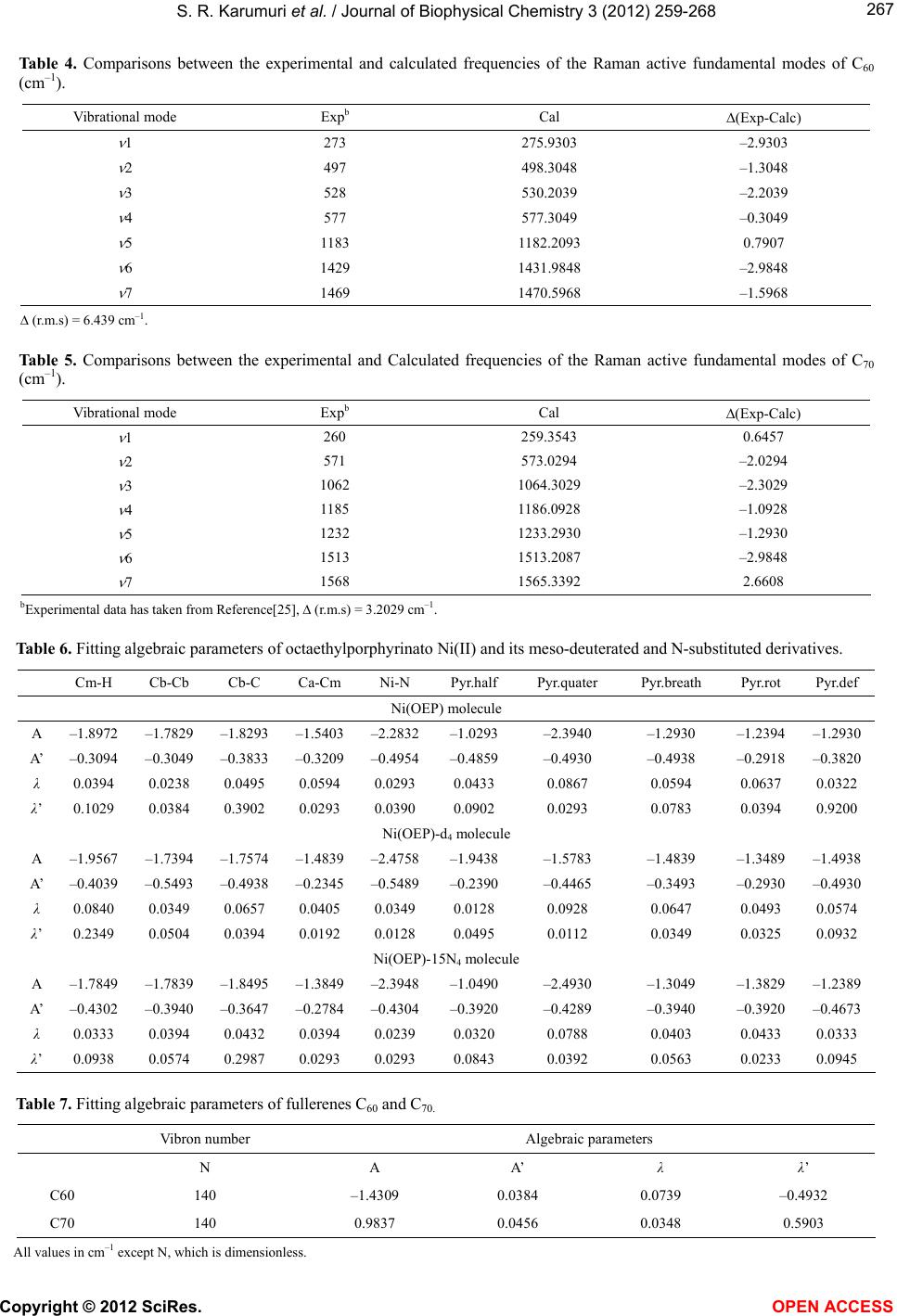 S. R. Karumuri et al. / Journal of Biophysical Chemistry 3 (2012) 259-268 Copyright © 2012 SciRes. OPEN ACCESS 267 Table 4. Comparisons between the experimental and calculated frequencies of the Raman active fundamental modes of C 60 (cm –1 ). Vibrational mode Exp b Cal (Exp-Calc) 1 273 275.9303 –2.9303 2 497 498.3048 –1.3048 3 528 530.2039 –2.2039 4 577 577.3049 –0.3049 5 1183 1182.2093 0.7907 6 1429 1431.9848 –2.9848 7 1469 1470.5968 –1.5968 ∆ (r.m.s) = 6.439 cm –1 . Table 5. Comparisons between the experimental and Calculated frequencies of the Raman active fundamental modes of C 70 (cm –1 ). Vibrational mode Exp b Cal (Exp-Calc) 1 260 259.3543 0.6457 2 571 573.0294 –2.0294 3 1062 1064.3029 –2.3029 4 1185 1186.0928 –1.0928 5 1232 1233.2930 –1.2930 6 1513 1513.2087 –2.9848 7 1568 1565.3392 2.6608 b Experimental data has taken from Reference[25], ∆ (r.m.s) = 3.2029 cm –1 . Table 6. Fitting algebraic parameters of octaethylporphyrinato Ni(II) and its meso-deuterated and N-substituted derivatives. Cm-H Cb-Cb Cb-C Ca-Cm Ni-N Pyr.half Pyr.quater Pyr.breath Pyr.rot Pyr.def Ni(OEP) molecule A –1.8972 –1.7829 –1.8293 –1.5403 –2.2832–1.0293 –2.3940 –1.2930 –1.2394 –1.2930 A’ –0.3094 –0.3049 –0.3833 –0.3209 –0.4954–0.4859 –0.4930 –0.4938 –0.2918 –0.3820 λ 0.0394 0.0238 0.0495 0.0594 0.0293 0.0433 0.0867 0.0594 0.0637 0.0322 λ’ 0.1029 0.0384 0.3902 0.0293 0.0390 0.0902 0.0293 0.0783 0.0394 0.9200 Ni(OEP)-d 4 molecule A –1.9567 –1.7394 –1.7574 –1.4839 –2.4758–1.9438 –1.5783 –1.4839 –1.3489 –1.4938 A’ –0.4039 –0.5493 –0.4938 –0.2345 –0.5489–0.2390 –0.4465 –0.3493 –0.2930 –0.4930 λ 0.0840 0.0349 0.0657 0.0405 0.0349 0.0128 0.0928 0.0647 0.0493 0.0574 λ’ 0.2349 0.0504 0.0394 0.0192 0.0128 0.0495 0.0112 0.0349 0.0325 0.0932 Ni(OEP)-15N 4 molecule A –1.7849 –1.7839 –1.8495 –1.3849 –2.3948–1.0490 –2.4930 –1.3049 –1.3829 –1.2389 A’ –0.4302 –0.3940 –0.3647 –0.2784 –0.4304–0.3920 –0.4289 –0.3940 –0.3920 –0.4673 λ 0.0333 0.0394 0.0432 0.0394 0.0239 0.0320 0.0788 0.0403 0.0433 0.0333 λ’ 0.0938 0.0574 0.2987 0.0293 0.0293 0.0843 0.0392 0.0563 0.0233 0.0945 Table 7. Fitting algebraic parameters of fullerenes C 60 and C 70. Vibron number Algebraic parameters N A A’ λ λ’ C60 140 –1.4309 0.0384 0.0739 –0.4932 C70 140 0.9837 0.0456 0.0348 0.5903 All values in cm –1 except N, which is dimensionless. 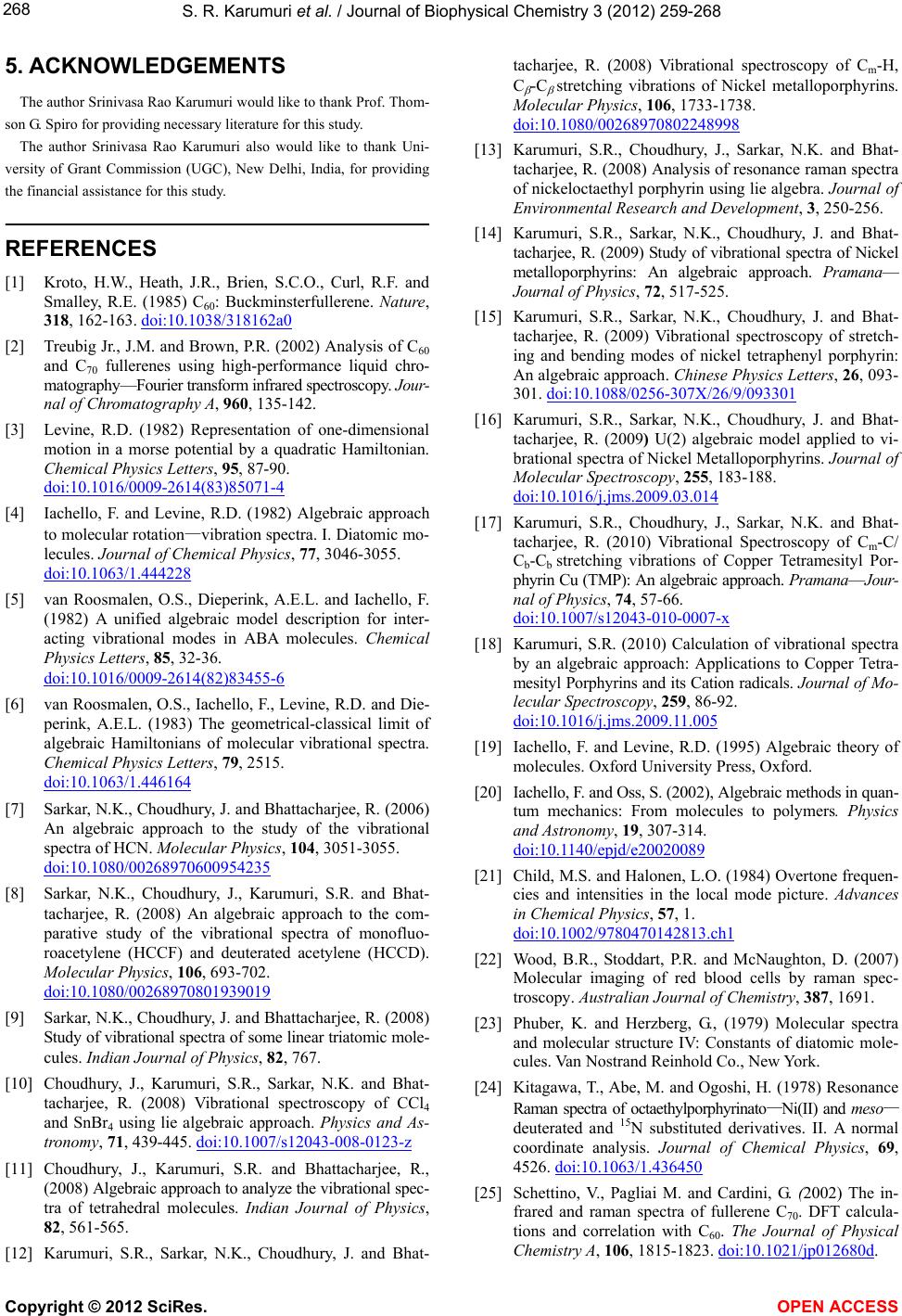 S. R. Karumuri et al. / Journal of Biophysical Chemistry 3 (2012) 259-268 Copyright © 2012 SciRes. OPEN ACCESS 268 5. ACKNOWLEDGEMENTS The author Srinivasa Rao Karumuri would like to thank Prof. Thom- son G. Spiro for providing necessary literature for this study. The author Srinivasa Rao Karumuri also would like to thank Uni- versity of Grant Commission (UGC), New Delhi, India, for providing the financial assistance for this study. REFERENCES [1] Kroto, H.W., Heath, J.R., Brien, S.C.O., Curl, R.F. and Smalley, R.E. (1985) C 60 : Buckminsterfullerene. Nature, 318 , 162-163. doi:10.1038/318162a0 [2] Treubig Jr., J.M. and Brown, P.R. (2002) Analysis of C 60 and C 70 fullerenes using high-performance liquid chro- matography—Fourier transform infrared spectroscopy. Jour- nal of Chromatography A , 960, 135-142. [3] Levine, R.D. (1982) Representation of one-dimensional motion in a morse potential by a quadratic Hamiltonian. Chemical Physics Letters, 95, 87-90. doi:10.1016/0009-2614(83)85071-4 [4] Iachello, F. and Levine, R.D. (1982) Algebraic approach to molecular rotation —vibration spectra. I. Diatomic mo- lecules. Journal of Chemical Physics, 77, 3046-3055. doi:10.1063/1.444228 [5] van Roosmalen, O.S., Dieperink, A.E.L. and Iachello, F. (1982) A unified algebraic model description for inter- acting vibrational modes in ABA molecules. Chemical Physics Letters , 85, 32-36. doi:10.1016/0009-2614(82)83455-6 [6] van Roosmalen, O.S., Iachello, F., Levine, R.D. and Die- perink, A.E.L. (1983) The geometrical-classical limit of algebraic Hamiltonians of molecular vibrational spectra. Chemical Physics Letters, 79, 2515. doi:10.1063/1.446164 [7] Sarkar, N.K., Choudhury, J. and Bhattacharjee, R. (2006) An algebraic approach to the study of the vibrational spectra of HCN. Molecular Physics, 104, 3051-3055. doi:10.1080/00268970600954235 [8] Sarkar, N.K., Choudhury, J., Karumuri, S.R. and Bhat- tacharjee, R. (2008) An algebraic approach to the com- parative study of the vibrational spectra of monofluo- roacetylene (HCCF) and deuterated acetylene (HCCD). Molecular Physics, 106, 693-702. doi:10.1080/00268970801939019 [9] Sarkar, N.K., Choudhury, J. and Bhattacharjee, R. (2008) Study of vibrational spectra of some linear triatomic mole- cules. Indian Journal of Physics, 82, 767. [10] Choudhury, J., Karumuri, S.R., Sarkar, N.K. and Bhat- tacharjee, R. (2008) Vibrational spectroscopy of CCl 4 and SnBr 4 using lie algebraic approach. Physics and As- tronomy , 71, 439-445. doi:10.1007/s12043-008-0123-z [11] Choudhury, J., Karumuri, S.R. and Bhattacharjee, R., (2008) Algebraic approach to analyze the vibrational spec- tra of tetrahedral molecules. Indian Journal of Physics, 82, 561-565. [12] Karumuri, S.R., Sarkar, N.K., Choudhury, J. and Bhat- tacharjee, R. (2008) Vibrational spectroscopy of C m -H, C -C stretching vibrations of Nickel metalloporphyrins. Molecular Physics, 106, 1733-1738. doi:10.1080/00268970802248998 [13] Karumuri, S.R., Choudhury, J., Sarkar, N.K. and Bhat- tacharjee, R. (2008) Analysis of resonance raman spectra of nickeloctaethyl porphyrin using lie algebra. Journal of Environmental Research and Development , 3, 250-256. [14] Karumuri, S.R., Sarkar, N.K., Choudhury, J. and Bhat- tacharjee, R. (2009) Study of vibrational spectra of Nickel metalloporphyrins: An algebraic approach. Pramana— Journal of Physics, 72, 517-525. [15] Karumuri, S.R., Sarkar, N.K., Choudhury, J. and Bhat- tacharjee, R. (2009) Vibrational spectroscopy of stretch- ing and bending modes of nickel tetraphenyl porphyrin: An algebraic approach. Chinese Physics Letters, 26, 093- 301. doi:10.1088/0256-307X/26/9/093301 [16] Karumuri, S.R., Sarkar, N.K., Choudhury, J. and Bhat- tacharjee, R. (2009 ) U(2) algebraic model applied to vi- brational spectra of Nickel Metalloporphyrins. Journal of Molecular Spectroscopy , 255, 183-188. doi:10.1016/j.jms.2009.03.014 [17] Karumuri, S.R., Choudhury, J., Sarkar, N.K. and Bhat- tacharjee, R. (2010) Vibrational Spectroscopy of C m -C/ C b -C b stretching vibrations of Copper Tetramesityl Por- phyrin Cu (TMP): An algebraic approach. Pramana—Jour- nal of Physics , 74, 57-66. doi:10.1007/s12043-010-0007-x [18] Karumuri, S.R. (2010) Calculation of vibrational spectra by an algebraic approach: Applications to Copper Tetra- mesityl Porphyrins and its Cation radicals. Journal of Mo- lecular Spectroscopy , 259, 86-92. doi:10.1016/j.jms.2009.11.005 [19] Iachello, F. and Levine, R.D. (1995) Algebraic theory of molecules. Oxford University Press, Oxford. [20] Iachello, F. and Oss, S. (2002), Algebraic methods in quan- tum mechanics: From molecules to polymers . Physics and Astronomy , 19, 307-314. doi:10.1140/epjd/e20020089 [21] Child, M.S. and Halonen, L.O. (1984) Overtone frequen- cies and intensities in the local mode picture. Advances in Chemical Physics , 57, 1. doi:10.1002/9780470142813.ch1 [22] Wood, B.R., Stoddart, P.R. and McNaughton, D. (2007) Molecular imaging of red blood cells by raman spec- troscopy. Australian Journal of Chemistry, 387, 1691. [23] Phuber, K. and Herzberg, G., (1979) Molecular spectra and molecular structure IV: Constants of diatomic mole- cules. Van Nostrand Reinhold Co., New York. [24] Kitagawa, T., Abe, M. and Ogoshi, H. (1978) Resonance Raman spectra of octaethylporphyrinato —Ni(II) and meso— deuterated and 15 N substituted derivatives. II. A normal coordinate analysis. Journal of Chemical Physics, 69, 4526. doi:10.1063/1.436450 [25] Schettino, V., Pagliai M. and Cardini, G. (2002) The in- frared and raman spectra of fullerene C 70 . DFT calcula- tions and correlation with C 60 . The Journal of Physical Chemistry A , 106, 1815-1823. doi:10.1021/jp012680d. |