

Paper Menu >>
Journal Menu >>
 Open Journal of Ophthalmology, 2012, 2, 60-63 http://dx.doi.org/10.4236/ojoph.2012.23013 Published Online August 2012 (http://www.SciRP.org/journal/ojoph) Contrast Sensitivity and Eye Drops Theodosios Chatzibalis1, Konstantinos Stamoulas1, Athanasios Karamitsos1, Diamantis Almaliotis1, Vasiliki Mirtsou-Fidani2, Nikolaos Georgiadis3, Vasileios Karampatakis1 1Laboratory of Experimental Ophthalmology, Medical School, Aristotle University of Thessaloniki, Thessaloniki, Greece; 2Laboratory of Pharmacology, Medical School, Aristotle University of Thessaloniki, Thessaloniki, Greece; 31st Eye Clinic, Medical School, Aris- totle University of Thessaloniki, Thessaloniki, Greece. Email: almaliotis[email protected] Received March 13th, 2012; revised April 16th, 2012; accepted May 10th, 2012 ABSTRACT Purpose: To evaluate the influence of commonly used eye drops on contrast sensitivity (CS). Design: Prospective study. Participants: One hundred twenty volunteers were enrolled. Methods: The CS of ophthalmologically healthy indi- viduals was evaluated at baseline examination before the instillation, 20 and 40 minutes after the instillation of di- clofenac sodium and commonly used anti-glaucoma eye drops (latanoprost, brimonidine tartrate, combination of dor- zolamide hydrochloride and timolol maleate). CS was assessed at 7 spatial frequencies varying from 1.5 c/d to 20 c/d by the use of Mentor B-VAT II-SG video acuity tester. Results: Diclofenac sodium induced a mild, however statistically significant decrease on the CS in 4 out of 30 subjects 20 minutes after instillation at the spatial frequency of 1.5 c/d and 3 c/d (p < 0.05 for both frequencies). Latanoprost induced a decrease in CS in 1 out of 30 subjects and combination of dorzolamide hydrochloride and timolol maleate in 2 out of 30 at low spatial frequencies (1.5 c/d and 3 c/d) 20 minutes after the instillation and this decrease was not statistically significant for any of these drugs (p > 0.05). Brimonidine tartrate decreased CS in 4 out of 30 subjects 20 minutes after the instillation at a high spatial frequency (20 c/d) yet this decrease was marginally statistically significant (p = 0.057). CS returned to baseline scores 40 minutes after the instilla- tion for all drugs. Conclusions: Diclofenac sodium eye drops had a mild temporal effect on the low spatial frequencies of 1.5 c/d and 3 c/d in some individuals. Latanoprost and dorzolamide/timolol had a non-statistically significant effect on the same spatial frequencies. Brimonidine eye drops had a temporal effect on the high spatial frequency of 20 c/d with marginal statistical significance. The CS scores returned to normal, in all cases, within the next 40 minutes after the instillation. Ophthalmologists should be aware of the fact that some eye drops may have an influence on CS. Keywords: Cornea; Ocular Surface; External Disease 1. Introduction Despite the growing number of drugs used as anti-in- flammatory agents in ophthalmology, diclofenac remains a reasonable choice when treating a variety of ocular con- ditions. Owing its anti-inflammatory activity to cycloxy- genase inhibition which in turn leads to reduction in pros- taglandin synthesis, this non-steroidal anti-inflammatory drug (NSAID) is commonly used for prophylaxis and treatment of postoperative inflammation. Yet diclofenac exhibits certain adverse effects after topical instillation, burning and stinging being the most frequent [1]. Blurred vision has also been reported. Topical beta-blockers, carbonic anhydrase inhibitors such as dorzolamide, latanoprost, usually in combination with beta-blockers, and brimonidine, may have various side effects, among them blurring of vision. CS is a parameter used to assess the visual function at different levels of contrast, usually altered before any severe change in visual acuity is noticed [2]. There are various studies correlating the ability of individuals to fulfill complex tasks, such as driving performance [3] or computer task accuracy [4], or even accomplish everyday activities with their CS function. A decrease in the qual- ity of life has also been shown in relation to the deterio- ration of visual function [5], including CS. Because all of the aforementioned drugs included in our study are widely used in every day practice and some patients report vision blurring after their instillation, the purpose of the present study was to evaluate the effect that these drugs have on CS and consequently on the quality of vision. 2. Materials and Methods The aim of this study was to evaluate the blurring of vi- sion, which is related to the instillation of commonly used eye drops. Copyright © 2012 SciRes. OJOph  Contrast Sensitivity and Eye Drops 61 Healthy volunteers without any ocular disease were recruited for this study. Personal medical history was recorded and all subjects were free of medication. Indi- viduals reporting symptoms of dry eye or using any other ophthalmic eye drops (natural tears included) and contact lenses were excluded from the study. Written informed consent was obtained from each participant. After a short explanation of the procedure about to be followed sub- jects were examined by an ophthalmologist under a slit lamp. Individuals with abnormal findings from the ante- rior segment or the fundus were also excluded. All indi- viduals had Snellen visual acuity of 10/10. A total of one hundred and twenty volunteers were el- igible for inclusion and were finally enrolled in the study. All participants had best-corrected visual acuity of 10/10 or better. The study adhered to the tenets of the Declara- tion of Helsinki and the procedure followed a standard protocol that was consistent across the examination. The participants were randomly divided in four groups. Each group consisted of 30 subjects, 15 males and 15 females. The CS function of each subject was assessed with the Mentor B-VAT II-SG video acuity tester (Men- tor O & O, Norwell, Mass). This monitor has been used for the evaluation of visual function in several conditions [6,7]. Apart from its other features, the monitor uses si- nusoidal gratings of different spatial frequencies and contrast levels for CS function measurements. In specific, sixteen spatial frequencies are available from 1.5 c/d to 40 c/d yet we examined the CS function of our subjects at 1.5 c/d, 3.0 c/d, 4.6 c/d, 6.0 c/d, 8.5 c/d, 12 c/d and 20 c/d. For every spatial frequency there are available thirty two contrast levels varying from 98% to 0.1% of contrast. From 98% to 16% contrast levels can be changed in steps of 0.1 log CS units whilst from 10% to 0.1% contrast level the log CS units are allocated at regular intervals of 0.2 log units. The psychophysical method used was the three alter- native forced choice. Subjects were left to adapt to me- sopic conditions wearing their best-spectacle correction. The test luminance was automatically calibrated to 85 cd/m2 and the sinusoidal gratings were presented by the examiner for approximately 5 seconds using a hand held controller. Grating’s orientation could be vertical, –14˚ to the left or +14˚ to the right from vertical. The orientation varied randomly between the trials. The measurements advanced gradually from a higher to a lower contrast level. At each level the subject was asked to identify the grating’s orientation at four different trials. When three out of four responses were correct (at random sequence) the contrast level was considered to be passed and the examiner advanced to a lower one. The last contrast level they passed was defined as the contrast threshold of the eye and was recorded. The measurements obtained were converted to log CS for the statistical analysis. The test was performed at a 3-meter distance. CS was recorded for both eyes at baseline examination before the instillation of the drugs. After an initial assessment of CS in the 1st group of patients (mean age 30.83 ± 10.13 years) diclofenac so- dium eye drops were instilled, in the 2nd group (mean age 31.73 ± 10.95 years) latanoprost eye drops, in the 3rd group (mean age 32.60 ± 10.08 years) dorzolamide hy- drochloride/timolol maleate and in the 4th group (mean age 32.43 ± 8.86 years) brimonidine tartrate. After the baseline CS examination the test was re- peated 20 and 40 minutes after the instillation. The data obtained were analyzed using paired-samples t-test to assess the CS changes 20 minutes after the in- stillation, given that the scores returned to baseline levels 40 minutes after the drug instillation for all groups and at any spatial frequency. All statistical analyses were per- formed using SPSS version 18.0 software (SPSS Inc., Chicago, IL); p < 0.05 was judged as statistically signifi- cant. 3. Results The log CS was recorded for all groups 20 and 40 min- utes after the eye drop instillation. As regards the first group (diclofenac sodium), a mild CS decrease by 0.2 log units was observed in 4 out of 30 subjects (13.33%) 20 minutes after the instillation at spa- tial frequencies of 1.5 c/d and 3 c/d (p < 0.05, p = 0.043, paired samples t-test). Concerning the second group (latanoprost), log CS was decreased by 0.2 log units in only 1 out of 30 sub- jects (3.33%) 20 minutes after the instillation at spatial frequencies of 1.5 c/d and 3 c/d. This change was not statistically significant (p = 0.326, paired samples t-test). In the third group (dorzolamide/timolol) 2 out of 30 subjects (6.66%) showed also a decrease in CS by 0.2 log units at spatial frequencies of 1.5 c/d and 3 c/d 20 min- utes after the instillation. Though this change was not found to be statistically significant (p = 0.161, paired samples t-test) in the group of the examined subjects. In the fourth group (brimonidine) 4 out of 30 subjects (13.33%) showed a decrease in CS by 0.2 log units (in one subject 0.4 log units) 20 minutes after the eye drop instillation at the spatial frequency of 20 c/d. The re- corded scores were approaching a statistically significant difference at this time point (p = 0.057, paired samples t-test). No change was observed at the other spatial frequencies examined for any of the eye drops instilled. Concerning the spatial frequencies in which a change was recorded, all scores returned to baseline examination levels 40 mi- utes after the instillation for all of the drugs used. n Copyright © 2012 SciRes. OJOph 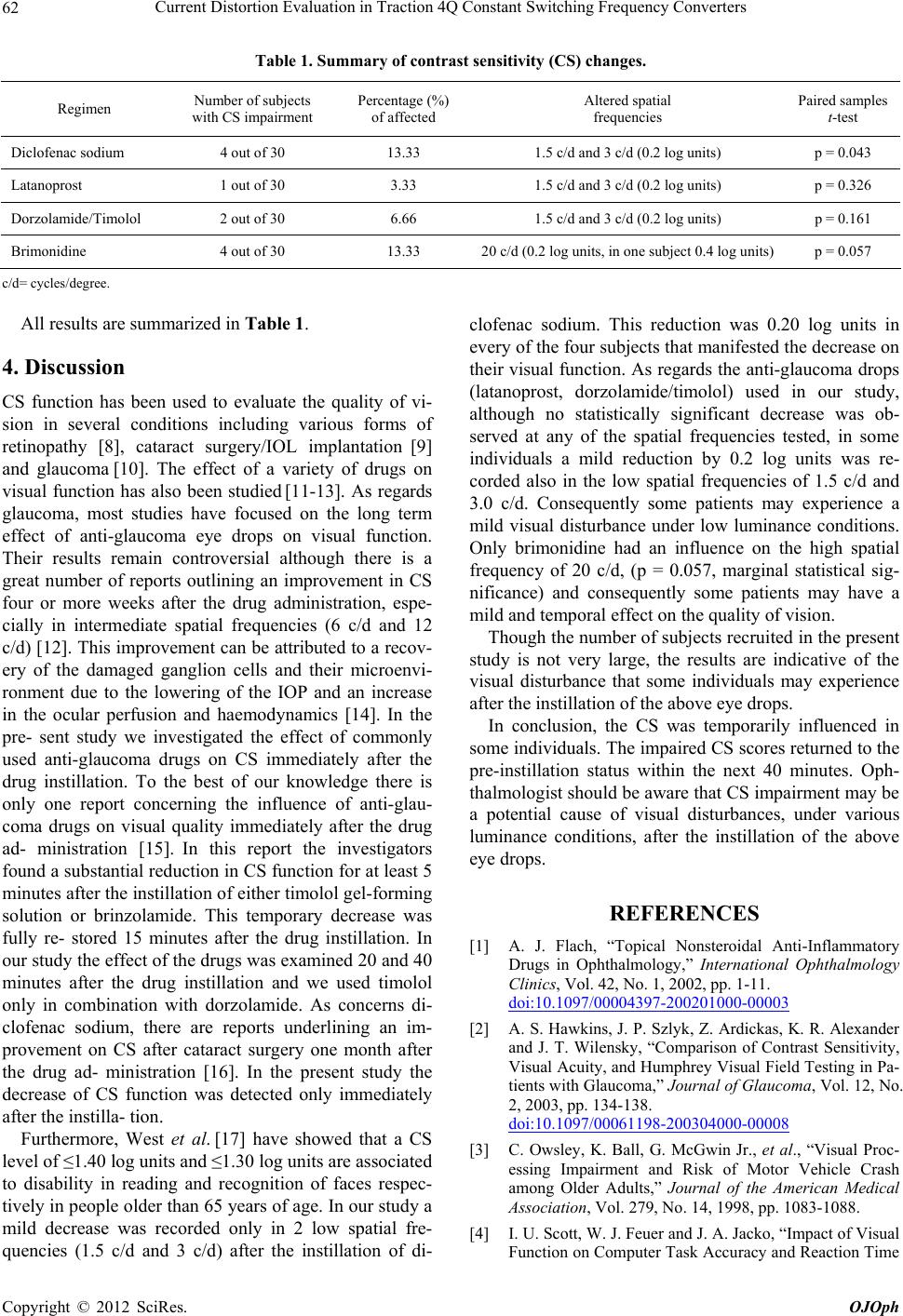 Current Distortion Evaluation in Traction 4Q Constant Switching Frequency Converters 62 Table 1. Summary of contrast sensitivity (CS) changes. Regimen Number of subjects with CS impairment Percentage (%) of affected Altered spatial frequencies Paired samples t-test Diclofenac sodium 4 out of 30 13.33 1.5 c/d and 3 c/d (0.2 log units) p = 0.043 Latanoprost 1 out of 30 3.33 1.5 c/d and 3 c/d (0.2 log units) p = 0.326 Dorzolamide/Timolol 2 out of 30 6.66 1.5 c/d and 3 c/d (0.2 log units) p = 0.161 Brimonidine 4 out of 30 13.33 20 c/d (0.2 log units, in one subject 0.4 log units) p = 0.057 c/d= cycles/degree. All results are summarized in Table 1. 4. Discussion CS function has been used to evaluate the quality of vi- sion in several conditions including various forms of retinopathy [8], cataract surgery/IOL implantation [9] and glaucoma [10]. The effect of a variety of drugs on visual function has also been studied [11-13]. As regards glaucoma, most studies have focused on the long term effect of anti-glaucoma eye drops on visual function. Their results remain controversial although there is a great number of reports outlining an improvement in CS four or more weeks after the drug administration, espe- cially in intermediate spatial frequencies (6 c/d and 12 c/d) [12]. This improvement can be attributed to a recov- ery of the damaged ganglion cells and their microenvi- ronment due to the lowering of the IOP and an increase in the ocular perfusion and haemodynamics [14]. In the pre- sent study we investigated the effect of commonly used anti-glaucoma drugs on CS immediately after the drug instillation. To the best of our knowledge there is only one report concerning the influence of anti-glau- coma drugs on visual quality immediately after the drug ad- ministration [15]. In this report the investigators found a substantial reduction in CS function for at least 5 minutes after the instillation of either timolol gel-forming solution or brinzolamide. This temporary decrease was fully re- stored 15 minutes after the drug instillation. In our study the effect of the drugs was examined 20 and 40 minutes after the drug instillation and we used timolol only in combination with dorzolamide. As concerns di- clofenac sodium, there are reports underlining an im- provement on CS after cataract surgery one month after the drug ad- ministration [16]. In the present study the decrease of CS function was detected only immediately after the instilla- tion. Furthermore, West et al. [17] have showed that a CS level of ≤1.40 log units and ≤1.30 log units are associated to disability in reading and recognition of faces respec- tively in people older than 65 years of age. In our study a mild decrease was recorded only in 2 low spatial fre- quencies (1.5 c/d and 3 c/d) after the instillation of di- clofenac sodium. This reduction was 0.20 log units in every of the four subjects that manifested the decrease on their visual function. As regards the anti-glaucoma drops (latanoprost, dorzolamide/timolol) used in our study, although no statistically significant decrease was ob- served at any of the spatial frequencies tested, in some individuals a mild reduction by 0.2 log units was re- corded also in the low spatial frequencies of 1.5 c/d and 3.0 c/d. Consequently some patients may experience a mild visual disturbance under low luminance conditions. Only brimonidine had an influence on the high spatial frequency of 20 c/d, (p = 0.057, marginal statistical sig- nificance) and consequently some patients may have a mild and temporal effect on the quality of vision. Though the number of subjects recruited in the present study is not very large, the results are indicative of the visual disturbance that some individuals may experience after the instillation of the above eye drops. In conclusion, the CS was temporarily influenced in some individuals. The impaired CS scores returned to the pre-instillation status within the next 40 minutes. Oph- thalmologist should be aware that CS impairment may be a potential cause of visual disturbances, under various luminance conditions, after the instillation of the above eye drops. REFERENCES [1] A. J. Flach, “Topical Nonsteroidal Anti-Inflammatory Drugs in Ophthalmology,” International Ophthalmology Clinics, Vol. 42, No. 1, 2002, pp. 1-11. doi:10.1097/00004397-200201000-00003 [2] A. S. Hawkins, J. P. Szlyk, Z. Ardickas, K. R. Alexander and J. T. Wilensky, “Comparison of Contrast Sensitivity, Visual Acuity, and Humphrey Visual Field Testing in Pa- tients with Glaucoma,” Journal of Glaucoma, Vol. 12, No. 2, 2003, pp. 134-138. doi:10.1097/00061198-200304000-00008 [3] C. Owsley, K. Ball, G. McGwin Jr., et al., “Visual Proc- essing Impairment and Risk of Motor Vehicle Crash among Older Adults,” Journal of the American Medical Association, Vol. 279, No. 14, 1998, pp. 1083-1088. [4] I. U. Scott, W. J. Feuer and J. A. Jacko, “Impact of Visual Function on Computer Task Accuracy and Reaction Time Copyright © 2012 SciRes. OJOph  Contrast Sensitivity and Eye Drops 63 in a Cohort of Patients with Age-Related Macular Degen- eration,” American Journal of Ophthalmology, Vol. 133, No. 3, 2002, pp. 350-357. doi:10.1016/S0002-9394(01)01406-4 [5] G. C. Brown, “Vision and Quality-of-Life,” Transactions of the American Ophthalmological Society, Vol. 97, 1999, pp. 473-511. [6] D. Eisenmann, R. Wagner, B. Dick and K. W. Jacobi, “Effect of Corneal Astigmatism on Contrast Sensitivity in Mono- And Multifocal Pseudophakia—A Theoretical Study of the Physical Eye,” Klin Monbl Augenheilkd, Vol. 209, No. 2-3, 1996, pp.125-131. doi:10.1055/s-2008-1035291 [7] K. R. Alexander, D. J. Derlacki and G. A. Fishman, “Contrast Thresholds for Letter Identification in Retinitis Pigmentosa,” Investigative Ophthalmology & Visual Sci- ence, Vol. 33, No. 6, 1992, pp. 1846-1852. [8] G. Trick, R. Burde, M. Gordon, J. Santiago and C. Kilo, “The Relationship between Hue Discrimination and Con- trast Sensitivity Deficits in Patients with Diabetes Melli- tus,” Ophthalmology, Vol. 95, No. 5, 1988, pp. 693-698. [9] J. Jay, H. Chakrabarti and J. Morrison, “Quality of Vision through Diffractive Bifocal Intraocular Lenses,” British Journal of Ophthalmology, Vol. 75, No. 6, 1991, pp. 359- 366. doi:10.1136/bjo.75.6.359 [10] R. L. Stamper, “Psychophysical Changes in Glaucoma,” Survey of Ophthalmology, Vol. 33, 1989, pp.309-318. [11] B. E. Klein, R. Klein, M. D. Knudtson, K. E. Lee, L. G. Danforth, J. O. Reinke and A. M. Adler, “Associations of Selected Medications and Visual Function: The Beaver Dam Eye Study,” British Journal of Ophthalmology, Vol. 87, No. 4, 2003, pp. 403-408. doi:10.1136/bjo.87.4.403 [12] T. S. Prata, M. V. Piassi and L. Melo Jr., “Changes in Visual Function after Intraocular Pressure Reduction Us- ing Antiglaucoma Medications,” Eye, Vol. 23, 2009, pp. 1081-1085. doi:10.1038/eye.2008.226 [13] O. Arend, A. Harris, P. Wolter and A. Remky, “Evalua- tion of Retinal Haemodynamics and Retinal Function af- ter Application of Dorzolamide, Timolol and Latanoprost in Newly Diagnosed Open-Angle Glaucoma Patients,” Acta Ophthalmologica Scandinavica, Vol. 81, No. 5, 2003, pp. 474-479. doi:10.1034/j.1600-0420.2003.00122.x [14] D. W. Evans, S. L. Hosking, D. Gherghel and J. D. Bart- lett, “Contrast Sensitivity Improves after Brimonidine Therapy in Primary Open Angle Glaucoma: A Case for Neuroprotection,” British Journal of Ophthalmology, Vol. 87, No. 12, 2003, pp. 1463-1465. doi:10.1136/bjo.87.12.1463 [15] T. Hiraoka, D. Masakazu, O. Fumiki, K. Takahiro and O. Tetsuro, “Contrast Sensitivity and Optical Quality of the Eye after Instillation of Timolol Maleate Gel-Forming Solution and Brinzolamide Ophthalmic Suspension,” Ophthalmology, Vol. 117, No. 11, 2010, pp. 2080-2087. doi:10.1016/j.ophtha.2010.03.028 [16] L. Rossetti, E. Bujtar, D. Castoldi, C. Torrazza and N. Orzalesi, “Effectiveness of Diclofenac Eyedrops in Re- ducing Inflammation and the Incidence of Cystoid Macu- lar Edema after Cataract Surgery,” Journal of Cataract & Refractive Surgery, Vol. 22, No. 1, 1996, pp. 794-799. [17] S. K. West, G. S. Rubin, A. T. Broman, B. Munoz, K. Bandeen-Roche and K. Turano, “How Does Visual Im- pairement Affect Performance on Tasks of Everyday Life,” Archives of Ophthalmology, Vol. 120, No. 6, 2002, pp. 774-780. doi:10.1001/archopht.120.6.774 Copyright © 2012 SciRes. OJOph |