

Paper Menu >>
Journal Menu >>
 Materials Sciences and Applications, 2012, 3, 575-579 http://dx.doi.org/10.4236/msa.2012.38082 Published Online August 2012 (http://www.SciRP.org/journal/msa) 575 PET Oligomer Waste to Modify CAP Characteristics L. C. Mendes*, M. L. Dias, P. S. C. Pereira, L. M. R. Albuquerque Centro de Tecnologia, Instituto de Macromoléculas Professora Eloisa Mano-IMA, Universidade Federal do Rio de Janeiro-UFRJ, Rio de Janeiro, Brazil. Email: *[email protected] Received May 16th, 2012; revised June 10th, 2012; accepted July 12th, 2012 ABSTRACT To develop an improved method of reusing poly(ethylene terephthalate) (PET) waste in the production chain, it was chemically modified with pentaerythritol (PENTE), resulting in PET/PENTE (60/40) oligomer. This was added to petroleum asphalt cement (CAP) in different proportions—5, 10 and 20 wt%—as a modifier of bitumen characteristics. The mixture was evaluated by thermogravimetry (TG/DTG), differential scanning calorimetry (DSC), infrared spec- troscopy (FT-IR), optical microscopy (OM) and the adhesion-peel test. The oligomer enhanced substantially the asphalt thermal stability-Tonset. OM images showed strong compatibility between components and PET’s amorphization. PET oligomer increased CAP’s wettability and the mixture presented cohesive fracture through the peel test. The mixture has excellent potential as paving material. Keywords: PET Waste; Pentaerythritol; CAP; Recycling 1. Introduction In recent years, the growing use of polymers in everyday products has generated an enormous amount of munici- pal solid waste. This has brought many environmental problems. In general, these wastes take long time to un- dergo spontaneous degradation and release toxic gases if they are burned [1,2]. The majority of discarded polymer materials are from packaging. Taking into account the huge potential of plastics and the problems caused by pollution from waste, there is a growing worldwide trend to recycle them [3]. When reused, PET packages show several advantages—lower consumption of water and energy and environmental and social benefits, among others [4]. Waste disposal is a main concern of society, prompting actions by industry and research centers [5-7]. Recently, an article on PET waste oligomerization through the action of polyfunctional alcohol—pentaerythritol was published [8]. Polymers have been studied as modifiers of asphalt mainly to overcome some deficiencies of asphalt cement and to improve its properties, such as reducing perma- nent thermal deformation and cracking. As modifier agents, polymers are compatible and increase asphalt de- gradation at high temperatures. The asphalt’s characteris- tics as well as the type and amount of polymer have a large influence on the appropriate asphaltic mixture [9, 10]. Asphalt cement can be formed naturally, through eva- poration of surface oil deposits, but the majority comes from the heavy fraction of petroleum from distillation at refineries. Petroleum asphalt cement (CAP) consists of 90% - 95% hydrocarbons—saturated and aromatic—and 5% - 10% of structures with hetero atoms (oxygen, sulfur, nitrogen) and metals, such as vanadium, nickel and iron. Brazilian CAPs have low sulfur and metals content but high levels of nitrogen. Asphaltenes and maltenes are the main asphalt components. They are complex mixtures consisting of condensed aromatic rings, resins and satu- rated and aromatic compounds. The ratio between as- phaltenes and maltenes has a significant effect on asphalt performance [11-14]. The reuse of plastics as additives for CAP increases the possibility of using urban plastic waste in the productive chain [15,16]. This work intended to develop a new material from plastic arising from municipal solid waste. The discarded PET was oligomerized by a polyfunctional alcohol. The PET oligomer was mixed with CAP in different propor- tions to evaluate its influence on the CAP’s thermal, ad- hesive and morphological characteristics. 2. Experimental 2.1. Materials Flakes of poly (ethylene terephthalate) (PET) waste with 24% crystallinity degree were supplied by CPR Ltd. (Rio de Janeiro, Brazil). Commercial pentaerythritol, here *Corresponding author. Copyright © 2012 SciRes. MSA 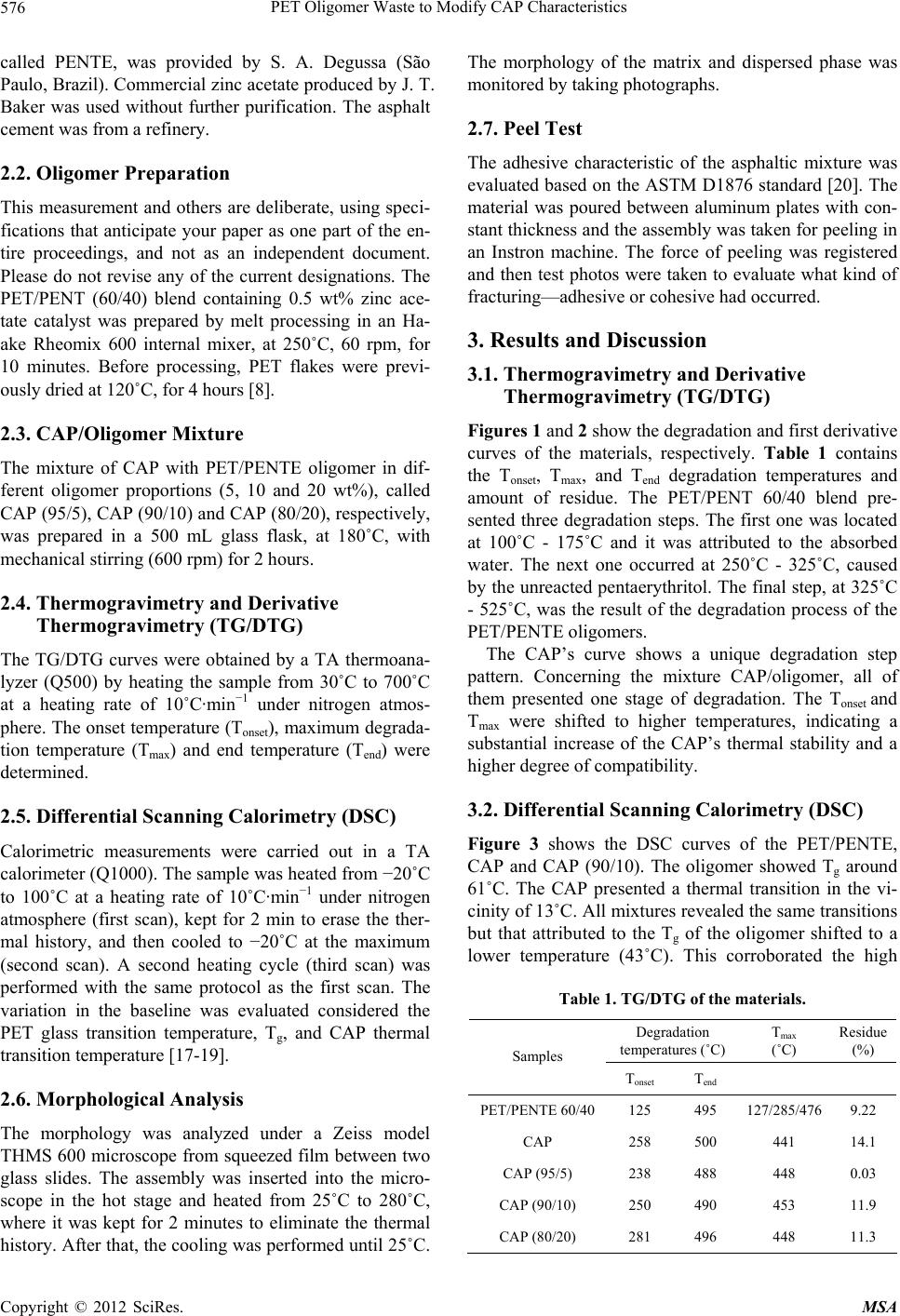 PET Oligomer Waste to Modify CAP Characteristics 576 called PENTE, was provided by S. A. Degussa (São Paulo, Brazil). Commercial zinc acetate produced by J. T. Baker was used without further purification. The asphalt cement was from a refinery. 2.2. Oligomer Preparation This measurement and others are deliberate, using speci- fications that anticipate your paper as one part of the en- tire proceedings, and not as an independent document. Please do not revise any of the current designations. The PET/PENT (60/40) blend containing 0.5 wt% zinc ace- tate catalyst was prepared by melt processing in an Ha- ake Rheomix 600 internal mixer, at 250˚C, 60 rpm, for 10 minutes. Before processing, PET flakes were previ- ously dried at 120˚C, for 4 hours [8]. 2.3. CAP/Oligomer Mixture The mixture of CAP with PET/PENTE oligomer in dif- ferent oligomer proportions (5, 10 and 20 wt%), called CAP (95/5), CAP (90/10) and CAP (80/20), respectively, was prepared in a 500 mL glass flask, at 180˚C, with mechanical stirring (600 rpm) for 2 hours. 2.4. Thermogravimetry and Derivative Thermogravimetry (TG/DTG) The TG/DTG curves were obtained by a TA thermoana- lyzer (Q500) by heating the sample from 30˚C to 700˚C at a heating rate of 10˚C·min −1 under nitrogen atmos- phere. The onset temperature (Tonset), maximum degrada- tion temperature (Tmax) and end temperature (Tend) were determined. 2.5. Differential Scanning Calorimetry (DSC) Calorimetric measurements were carried out in a TA calorimeter (Q1000). The sample was heated from −20˚C to 100˚C at a heating rate of 10˚C·min −1 under nitrogen atmosphere (first scan), kept for 2 min to erase the ther- mal history, and then cooled to −20˚C at the maximum (second scan). A second heating cycle (third scan) was performed with the same protocol as the first scan. The variation in the baseline was evaluated considered the PET glass transition temperature, Tg, and CAP thermal transition temperature [17-19]. 2.6. Morphological Analysis The morphology was analyzed under a Zeiss model THMS 600 microscope from squeezed film between two glass slides. The assembly was inserted into the micro- scope in the hot stage and heated from 25˚C to 280˚C, where it was kept for 2 minutes to eliminate the thermal history. After that, the cooling was performed until 25˚C. The morphology of the matrix and dispersed phase was monitored by taking photographs. 2.7. Peel Test The adhesive characteristic of the asphaltic mixture was evaluated based on the ASTM D1876 standard [20]. The material was poured between aluminum plates with con- stant thickness and the assembly was taken for peeling in an Instron machine. The force of peeling was registered and then test photos were taken to evaluate what kind of fracturing—adhesive or cohesive had occurred. 3. Results and Discussion 3.1. Thermogravimetry and Derivative Thermogravimetry (TG/DTG) Figures 1 and 2 show the degradation and first derivative curves of the materials, respectively. Table 1 contains the Tonset, Tmax, and Tend degradation temperatures and amount of residue. The PET/PENT 60/40 blend pre- sented three degradation steps. The first one was located at 100˚C - 175˚C and it was attributed to the absorbed water. The next one occurred at 250˚C - 325˚C, caused by the unreacted pentaerythritol. The final step, at 325˚C - 525˚C, was the result of the degradation process of the PET/PENTE oligomers. The CAP’s curve shows a unique degradation step pattern. Concerning the mixture CAP/oligomer, all of them presented one stage of degradation. The Tonset and Tmax were shifted to higher temperatures, indicating a substantial increase of the CAP’s thermal stability and a higher degree of compatibility. 3.2. Differential Scanning Calorimetry (DSC) Figure 3 shows the DSC curves of the PET/PENTE, CAP and CAP (90/10). The oligomer showed Tg around 61˚C. The CAP presented a thermal transition in the vi- cinity of 13˚C. All mixtures revealed the same transitions but that attributed to the Tg of the oligomer shifted to a lower temperature (43˚C). This corroborated the high Table 1. TG/DTG of the materials. Degradation temperatures (˚C) Tmax (˚C) Residue (%) Samples Tonset T end PET/PENTE 60/40125 495 127/285/4769.22 CAP 258 500 441 14.1 CAP (95/5) 238 488 448 0.03 CAP (90/10) 250 490 453 11.9 CAP (80/20) 281 496 448 11.3 Copyright © 2012 SciRes. MSA 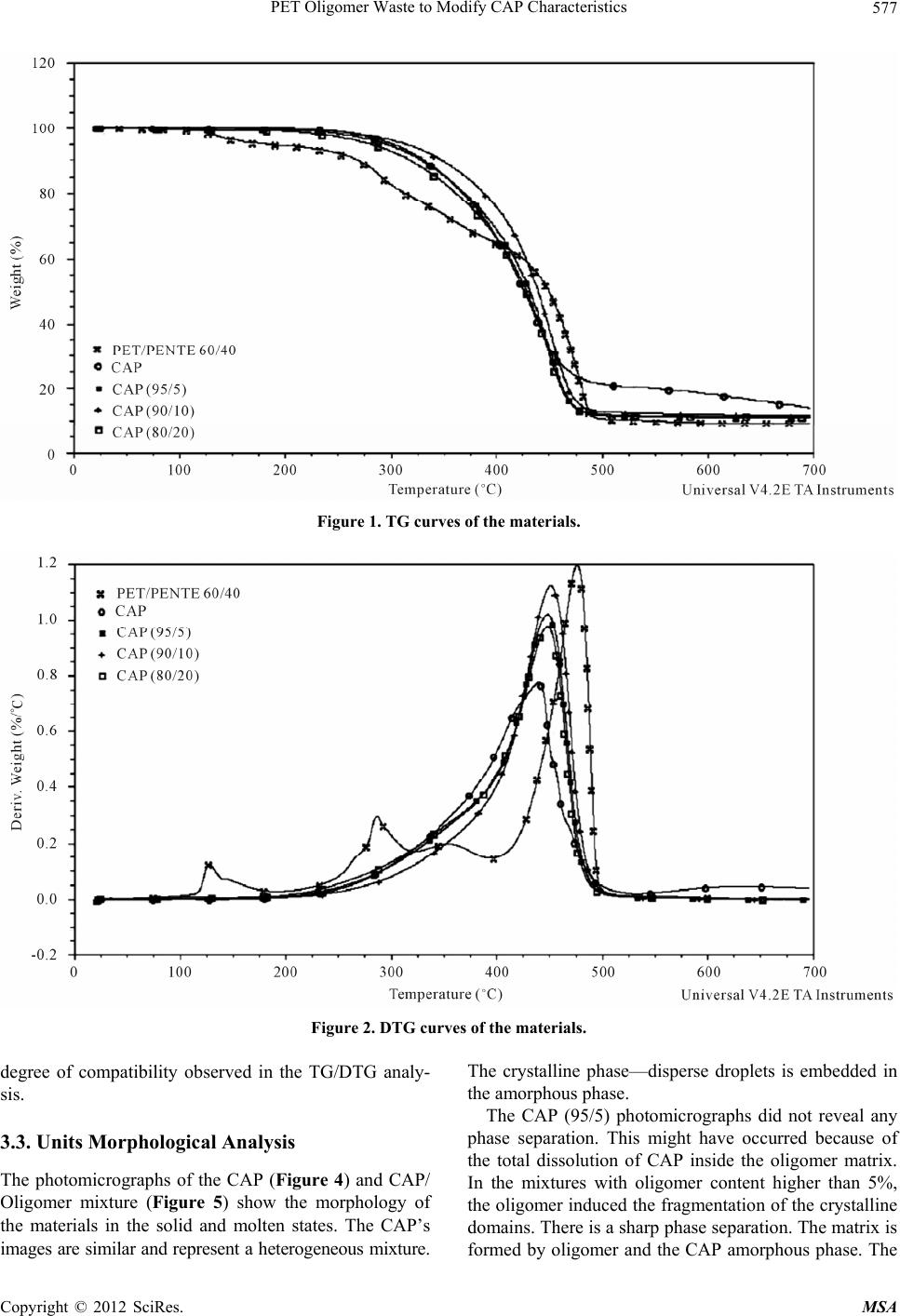 PET Oligomer Waste to Modify CAP Characteristics Copyright © 2012 SciRes. MSA 577 Figure 1. TG curves of the materials. Figure 2. DTG curves of the materials. The crystalline phase—disperse droplets is embedded in the amorphous phase. degree of compatibility observed in the TG/DTG analy- sis. The CAP (95/5) photomicrographs did not reveal any phase separation. This might have occurred because of the total dissolution of CAP inside the oligomer matrix. In the mixtures with oligomer content higher than 5%, the oligomer induced the fragmentation of the crystalline domains. There is a sharp phase separation. The matrix is formed by oligomer and the CAP amorphous phase. The 3.3. Units Morphological Analysis The photomicrographs of the CAP (Figure 4) and CAP/ Oligomer mixture (Figure 5) show the morphology of the materials in the solid and molten states. The CAP’s images are similar and represent a heterogeneous mixture. 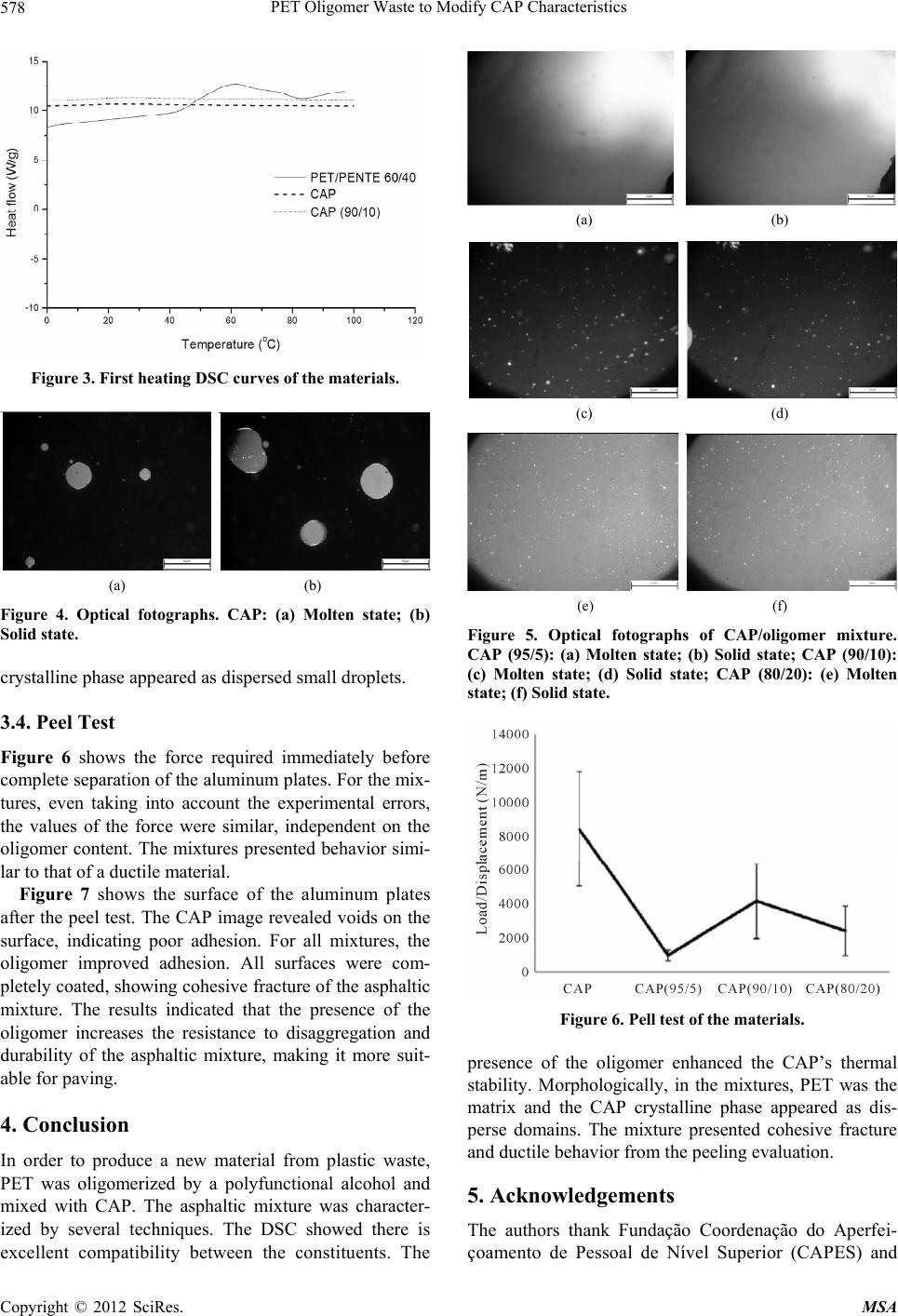 PET Oligomer Waste to Modify CAP Characteristics 578 Figure 3. First heating DSC curves of the materials. (a) (b) Figure 4. Optical fotographs. CAP: (a) Molten state; (b) Solid state. crystalline phase appeared as dispersed small droplets. 3.4. Peel Test Figure 6 shows the force required immediately before complete separation of the aluminum plates. For the mix- tures, even taking into account the experimental errors, the values of the force were similar, independent on the oligomer content. The mixtures presented behavior simi- lar to that of a ductile material. Figure 7 shows the surface of the aluminum plates after the peel test. The CAP image revealed voids on the surface, indicating poor adhesion. For all mixtures, the oligomer improved adhesion. All surfaces were com- pletely coated, showing cohesive fracture of the asphaltic mixture. The results indicated that the presence of the oligomer increases the resistance to disaggregation and durability of the asphaltic mixture, making it more suit- able for paving. 4. Conclusion In order to produce a new material from plastic waste, PET was oligomerized by a polyfunctional alcohol and mixed with CAP. The asphaltic mixture was character- ized by several techniques. The DSC showed there is excellent compatibility between the constituents. The (a) (b) (c) (d) (e) (f) Figure 5. Optical fotographs of CAP/oligomer mixture. CAP (95/5): (a) Molten state; (b) Solid state; CAP (90/10): (c) Molten state; (d) Solid state; CAP (80/20): (e) Molten state; (f) Solid state. Figure 6. Pell test of the materials. presence of the oligomer enhanced the CAP’s thermal stability. Morphologically, in the mixtures, PET was the matrix and the CAP crystalline phase appeared as dis- perse domains. The mixture presented cohesive fracture and ductile behavior from the peeling evaluation. 5. Acknowledgements The authors thank Fundação Coordenação do Aperfei- çoamento de Pessoal de Nível Superior (CAPES) and Copyright © 2012 SciRes. MSA 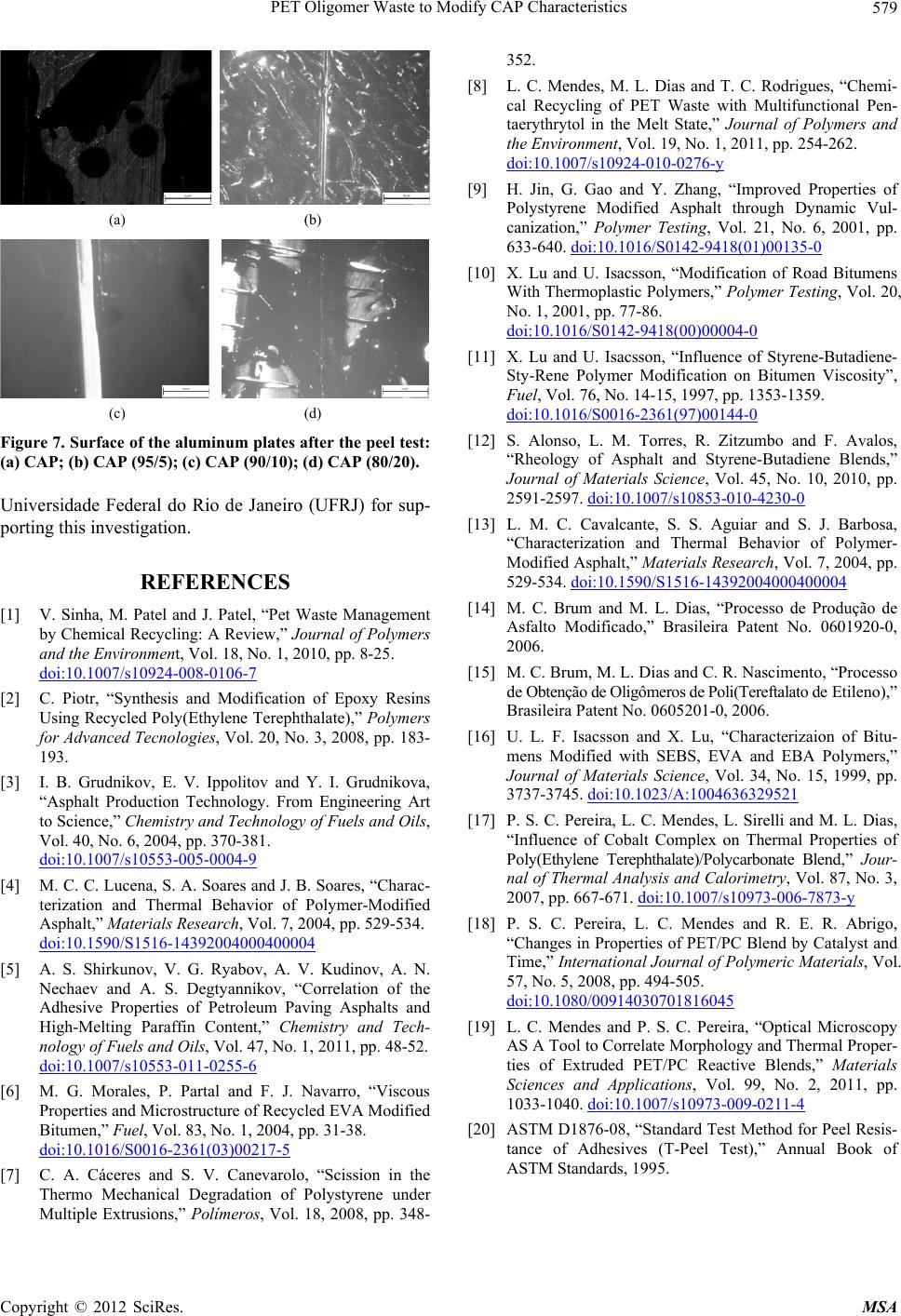 PET Oligomer Waste to Modify CAP Characteristics Copyright © 2012 SciRes. MSA 579 (a) (b) (c) (d) Figure 7. Surface of the aluminum plates after the peel test: (a) CAP; (b) CAP (95/5); (c) CAP (90/10); (d) CAP (80/20). Universidade Federal do Rio de Janeiro (UFRJ) for sup- porting this investigation. REFERENCES [1] V. Sinha, M. Patel and J. Patel, “Pet Waste Management by Chemical Recycling: A Review,” Journal of Polymers and the Environment, Vol. 18, No. 1, 2010, pp. 8-25. doi:10.1007/s10924-008-0106-7 [2] C. Piotr, “Synthesis and Modification of Epoxy Resins Using Recycled Poly(Ethylene Terephthalate),” Polymers for Advanced Tecnologies, Vol. 20, No. 3, 2008, pp. 183- 193. [3] I. B. Grudnikov, E. V. Ippolitov and Y. I. Grudnikova, “Asphalt Production Technology. From Engineering Art to Science,” Chemistry and Technology of Fuels and Oils, Vol. 40, No. 6, 2004, pp. 370-381. doi:10.1007/s10553-005-0004-9 [4] M. C. C. Lucena, S. A. Soares and J. B. Soares, “Charac- terization and Thermal Behavior of Polymer-Modified Asphalt,” Materials Research, Vol. 7, 2004, pp. 529-534. doi:10.1590/S1516-14392004000400004 [5] A. S. Shirkunov, V. G. Ryabov, A. V. Kudinov, A. N. Nechaev and A. S. Degtyannikov, “Correlation of the Adhesive Properties of Petroleum Paving Asphalts and High-Melting Paraffin Content,” Chemistry and Tech- nology of Fuels and Oils, Vol. 47, No. 1, 2011, pp. 48-52. doi:10.1007/s10553-011-0255-6 [6] M. G. Morales, P. Partal and F. J. Navarro, “Viscous Properties and Microstructure of Recycled EVA Modified Bitumen,” Fuel, Vol. 83, No. 1, 2004, pp. 31-38. doi:10.1016/S0016-2361(03)00217-5 [7] C. A. Cáceres and S. V. Canevarolo, “Scission in the Thermo Mechanical Degradation of Polystyrene under Multiple Extrusions,” Polímeros, Vol. 18, 2008, pp. 348- 352. [8] L. C. Mendes, M. L. Dias and T. C. Rodrigues, “Chemi- cal Recycling of PET Waste with Multifunctional Pen- taerythrytol in the Melt State,” Journal of Polymers and the Environment, Vol. 19, No. 1, 2011, pp. 254-262. doi:10.1007/s10924-010-0276-y [9] H. Jin, G. Gao and Y. Zhang, “Improved Properties of Polystyrene Modified Asphalt through Dynamic Vul- canization,” Polymer Testing, Vol. 21, No. 6, 2001, pp. 633-640. doi:10.1016/S0142-9418(01)00135-0 [10] X. Lu and U. Isacsson, “Modification of Road Bitumens With Thermoplastic Polymers,” Polymer Testing, Vol. 20, No. 1, 2001, pp. 77-86. doi:10.1016/S0142-9418(00)00004-0 [11] X. Lu and U. Isacsson, “Influence of Styrene-Butadiene- Sty-Rene Polymer Modification on Bitumen Viscosity”, Fuel, Vol. 76, No. 14-15, 1997, pp. 1353-1359. doi:10.1016/S0016-2361(97)00144-0 [12] S. Alonso, L. M. Torres, R. Zitzumbo and F. Avalos, “Rheology of Asphalt and Styrene-Butadiene Blends,” Journal of Materials Science, Vol. 45, No. 10, 2010, pp. 2591-2597. doi:10.1007/s10853-010-4230-0 [13] L. M. C. Cavalcante, S. S. Aguiar and S. J. Barbosa, “Characterization and Thermal Behavior of Polymer- Modified Asphalt,” Materials Research, Vol. 7, 2004, pp. 529-534. doi:10.1590/S1516-14392004000400004 [14] M. C. Brum and M. L. Dias, “Processo de Produção de Asfalto Modificado,” Brasileira Patent No. 0601920-0, 2006. [15] M. C. Brum, M. L. Dias and C. R. Nascimento, “Processo de Obtenção de Oligômeros de Poli(Tereftalato de Etileno),” Brasileira Patent No. 0605201-0, 2006. [16] U. L. F. Isacsson and X. Lu, “Characterizaion of Bitu- mens Modified with SEBS, EVA and EBA Polymers,” Journal of Materials Science, Vol. 34, No. 15, 1999, pp. 3737-3745. doi:10.1023/A:1004636329521 [17] P. S. C. Pereira, L. C. Mendes, L. Sirelli and M. L. Dias, “Influence of Cobalt Complex on Thermal Properties of Poly(Ethylene Terephthalate)/Polycarbonate Blend,” Jour- nal of Thermal Analysis and Calorimetry, Vol. 87, No. 3, 2007, pp. 667-671. doi:10.1007/s10973-006-7873-y [18] P. S. C. Pereira, L. C. Mendes and R. E. R. Abrigo, “Changes in Properties of PET/PC Blend by Catalyst and Time,” International Journal of Polymeric Materials, Vol. 57, No. 5, 2008, pp. 494-505. doi:10.1080/00914030701816045 [19] L. C. Mendes and P. S. C. Pereira, “Optical Microscopy AS A Tool to Correlate Morphology and Thermal Proper- ties of Extruded PET/PC Reactive Blends,” Materials Sciences and Applications, Vol. 99, No. 2, 2011, pp. 1033-1040. doi:10.1007/s10973-009-0211-4 [20] ASTM D1876-08, “Standard Test Method for Peel Resis- tance of Adhesives (T-Peel Test),” Annual Book of ASTM Standards, 1995. |