

Paper Menu >>
Journal Menu >>
 Open Journal of Rheumatology and Autoimmune Diseases, 2012, 2, 73-76 http://dx.doi.org/10.4236/ojra.2012.23014 Published Online August 2012 (http://www.SciRP.org/journal/ojra) 73 Disability Work among Argentinean Patients with Rheumatoid Arthritis Tamborenea Maria Natalia, Silvia Moyano Caturelli, Jackeline Spengler, Grisel Olivera Roulet Servicio Nacional de Rehabilitación (SNR), Buenos Aires, Argentina. Email: [email protected] Received March 20th, 2012; revised April 27th, 2012; accepted May 9th, 2012 ABSTRACT Objective: 1) To analyze the prevalence of Work Disab ility (WD) in RA Argentinian patients who are attending at the National Rehabilitation Service (NRS); 2) To measure general, socioeconomics and disease ch aracteristics in this popu- lation; 3) To characterize the associated factors of work disability in this group. Methods: Design cross section obser- vational study. RA patients attending the NRS were included in consecutive form. Clinical, demographic and radio- logical data were collected. All patients answered about their employment status. WD was defined if the work status was unemployed due to RA, retirement prior to the normal age, or disabled pension. Comparing analysis among pa- tients with and without paid work was done. Housewives, retired patients and students were excluded from the compar- ing analysis. Results: Three hundred and eleven patients were included (n = 311). Th e prevalence of WD wa s 44.05% (n = 137). During the study 85 (27.3%) patients were in paid employment, 48 (15.3%) were retired, 39 (12.5%) were housewives, and 2 (0.6%) patients were students. Factor associated to WD were female sex, more than 5 years of dis- ease duration, have health insurance, education beyond high school, and greater functional limitation: HAQ > 1 and function class 3 - 4. In the multivariable logistic regression model female sex was a significant and independ ent predic- tor of WD. Having health insurance; and more than high school education were protector factors of WD in this model. Conclusion: WD prevalence in this sample was higher than other countries. Socio economics factors more than diseases factors were significant predictors of productivity loss in this sample. Keywords: HAQ; Work Disability; Rheumatoid Arthritis 1. Introduction Rheumatoid Arthritis is a chronic disabling cond ition that may affect the lives of individual patients in many ways. One of most important outcomes may be work disability [1,2]. Participation in paid employment is a major life role for most adults. People with arthritis can expect to be employed fewer years than the general population [3,4] and withdrawal from paid employment, or work disabil- ity, is a relatively common outcome of RA. It results in lost income for the patien t and less productivity for so ci- ety [5]. Research into WD has been reported from USA and from European countries, rates of this outcome reported range from 22% to 85% [6]. Variations in estimated rates are likely due to differ- ences in methods, subject selection, time, available treat- ments and definitions of work disability. National Rehabilitation Service (NRS) in Argentina, evaluate patients with Rheumatoid Arthritis diagnosis who request Disability Certification according to 22431 law. This law establishes the conditions for grant the disability certificate. It is a public document issued by an interdisciplinary team that performs a biopsychosocial evaluation. The National Disability Certificate is the admission key to the health system and the principal tool for the access to complete coverage of medication and rehabili- tation. In this study we analyze the prevalence of WD in RA patients who are attending at the National Rehabilitation Service (NRS) in Argentina and determine the associated factors to this outcome in this group. 2. Patients and Methods RA patients are attending at the NRS for tramit the Na- tional Disability Certificate. They ask for this certificate in voluntary way and the population are from Buenos Aires province and rest of the all country. From May 2008 to August 2008 RA patients were in- cluded in consecutive form in this cross section observa- tional study. Copyright © 2012 SciRes. OJRA 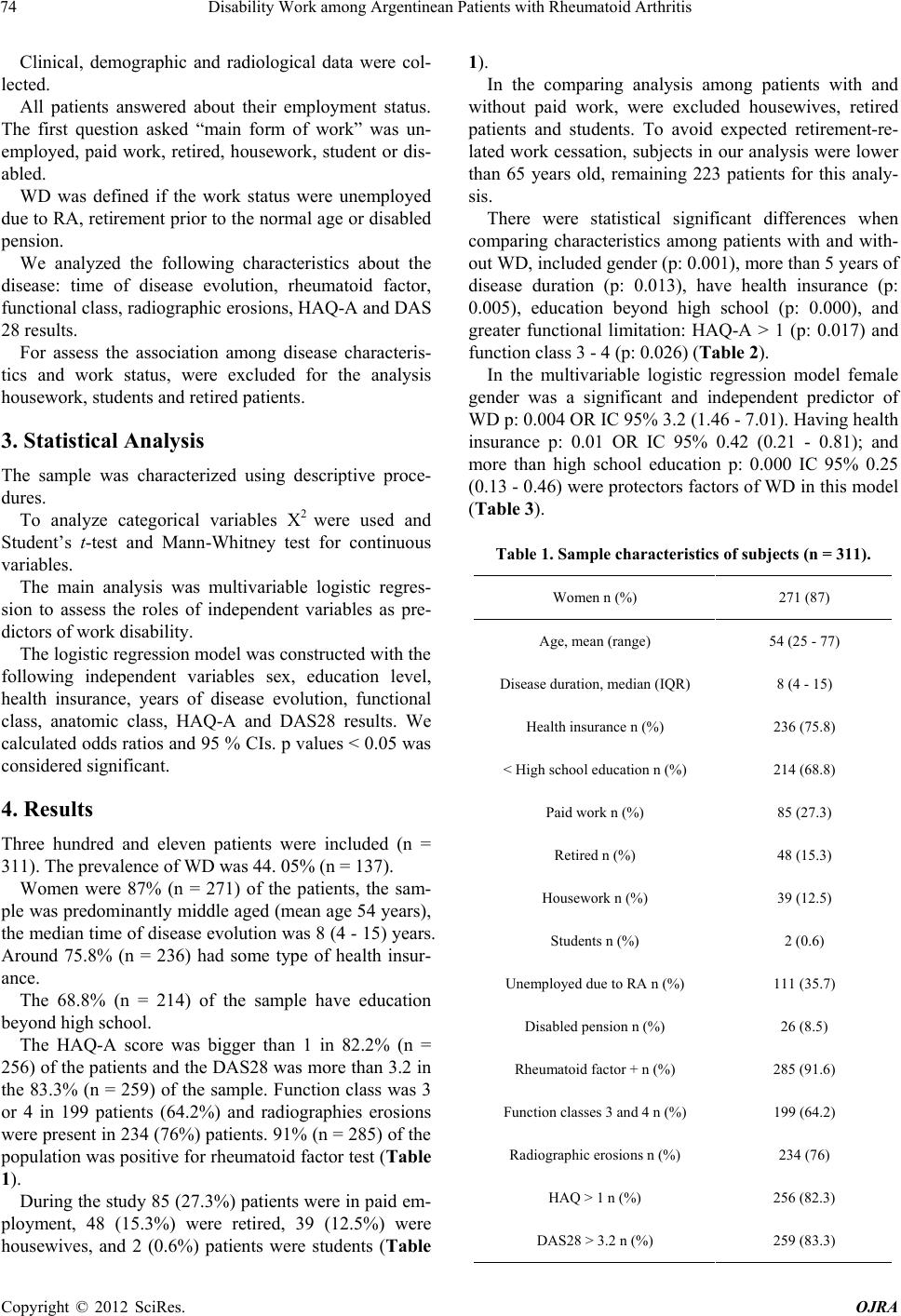 Disability Work among Argentinean Patients with Rheumatoid Arthritis 74 Clinical, demographic and radiological data were col- lected. All patients answered about their employment status. The first question asked “main form of work” was un- employed, paid work, retired, housework, student or dis- abled. WD was defined if the work status were unemployed due to RA, retirement prior to the normal age or disabled pension. We analyzed the following characteristics about the disease: time of disease evolution, rheumatoid factor, functional class, radiographic erosions, HAQ-A and DAS 28 results. For assess the association among disease characteris- tics and work status, were excluded for the analysis housework, students and retired patients. 3. Statistical Analysis The sample was characterized using descriptive proce- dures. To analyze categorical variables X2 were used and Student’s t-test and Mann-Whitney test for continuous variables. The main analysis was multivariable logistic regres- sion to assess the roles of independent variables as pre- dictors of work disability. The logistic regression model was constru cted with the following independent variables sex, education level, health insurance, years of disease evolution, functional class, anatomic class, HAQ-A and DAS28 results. We calculated odds ratios and 95 % CIs. p values < 0.05 was considered significant. 4. Results Three hundred and eleven patients were included (n = 311). The prevalence of WD was 44. 05% (n = 137). Women were 87% (n = 271) of the patients, the sam- ple was predominantly middle aged (mean age 54 years), the median time of disease evolution was 8 (4 - 15) years. Around 75.8% (n = 236) had some type of health insur- ance. The 68.8% (n = 214) of the sample have education beyond high school. The HAQ-A score was bigger than 1 in 82.2% (n = 256) of the patients and the DAS28 was more than 3.2 in the 83.3% (n = 259) of the sample. Function class was 3 or 4 in 199 patients (64.2%) and radiographies erosions were present in 234 (76%) patients. 91% (n = 285) of the population was positive for rheu matoid factor test (Table 1). During the study 85 (27.3%) patients were in paid em- ployment, 48 (15.3%) were retired, 39 (12.5%) were housewives, and 2 (0.6%) patients were students (Table 1). In the comparing analysis among patients with and without paid work, were excluded housewives, retired patients and students. To avoid expected retirement-re- lated work cessation, subj ects in our analysis were lower than 65 years old, remaining 223 patients for this analy- sis. There were statistical significant differences when comparing characteristics among patients with and with- out WD, included gender (p: 0.001), more than 5 years of disease duration (p: 0.013), have health insurance (p: 0.005), education beyond high school (p: 0.000), and greater functional limitation: HAQ-A > 1 (p: 0.017) and function class 3 - 4 (p: 0.026) (Table 2). In the multivariable logistic regression model female gender was a significant and independent predictor of WD p: 0.004 OR IC 95% 3.2 (1.46 - 7.01). Having health insurance p: 0.01 OR IC 95% 0.42 (0.21 - 0.81); and more than high school education p: 0.000 IC 95% 0.25 (0.13 - 0.46) were protectors factors of WD in this model (Table 3). Table 1. Sample characteristics of subjects (n = 311). Women n (%) 271 (87) Age, mean (range) 54 (25 - 77) Disease duration, median (IQR) 8 (4 - 15) Health insurance n (%) 236 (75.8) < High school education n (%) 214 (68.8) Paid work n (%) 85 (27.3) Retired n (%) 48 (15.3) Housework n (%) 39 (12.5) Students n (%) 2 (0.6) Unemployed due to RA n (%) 111 (35.7) Disabled pension n (%) 26 (8.5) Rheumatoid factor + n (%) 285 (91.6) Function classes 3 and 4 n (%) 199 (64.2) Radiographic erosions n (%) 234 (76) HAQ > 1 n (%) 256 (82.3) DAS28 > 3.2 n (%) 259 (83.3) Copyright © 2012 SciRes. OJRA 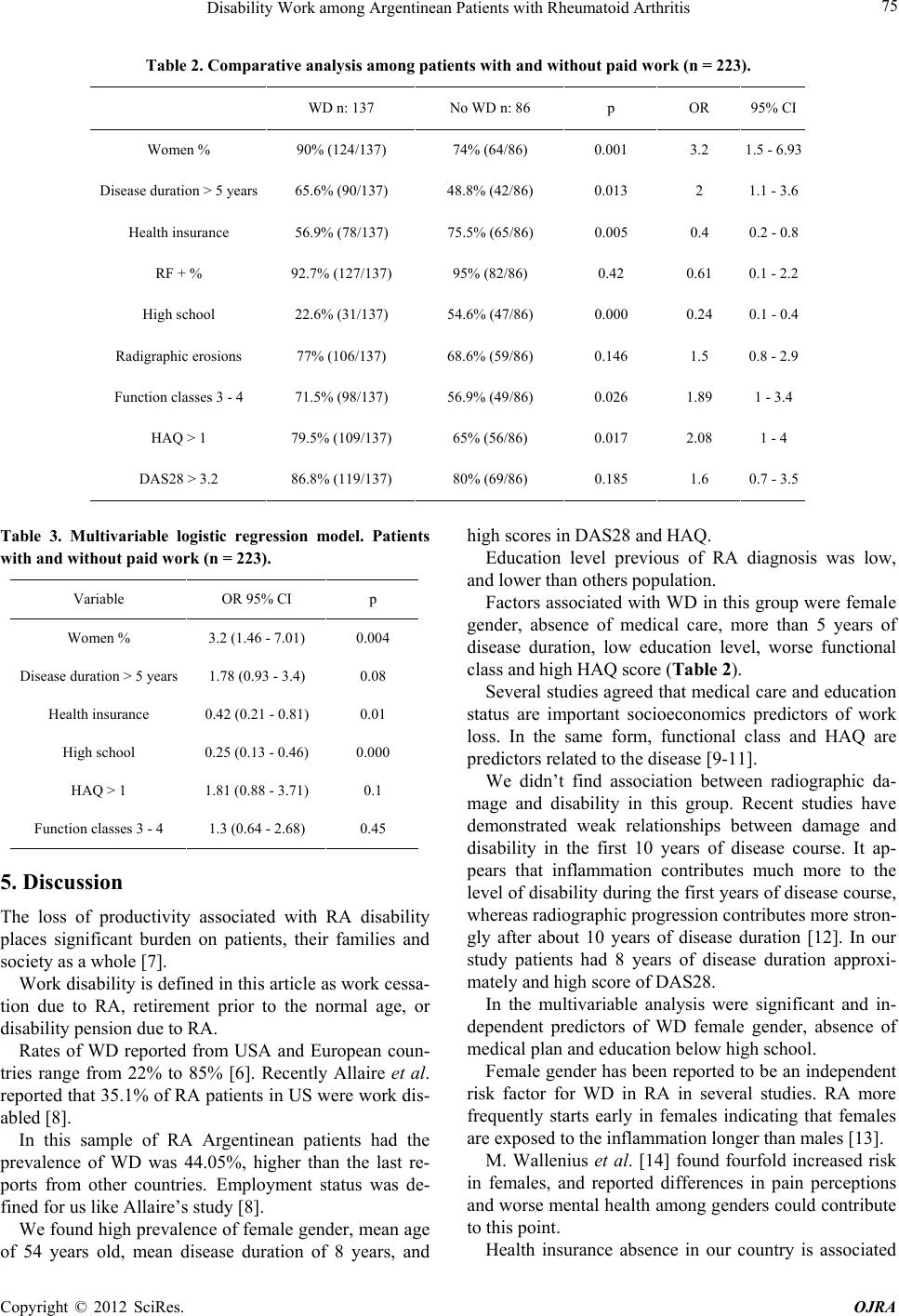 Disability Work among Argentinean Patients with Rheumatoid Arthritis Copyright © 2012 SciRes. OJRA 75 Table 2. Comparative analysis among patients with and without paid work (n = 223). WD n: 137 No WD n: 86 p OR 95% CI Women % 90% (124/13 7) 74% (64/86) 0.001 3.2 1.5 - 6.93 Disease duration > 5 years 65.6% (90/137) 48.8% (42/86) 0.013 2 1.1 - 3.6 Health insurance 56.9% (78/137) 75.5% (65/86) 0.005 0.4 0.2 - 0.8 RF + % 92.7% (127/137) 95% (82/86) 0.42 0.61 0.1 - 2.2 High school 22.6% (31/137) 54.6% (47/86) 0.000 0.24 0.1 - 0.4 Radigraphic erosions 77% (106/137) 68.6% (59/86) 0.146 1.5 0.8 - 2.9 Function classes 3 - 4 71.5% (98/137) 56.9% (49/86) 0.026 1.89 1 - 3.4 HAQ > 1 79.5% (109/137) 65% (56/86) 0.017 2.08 1 - 4 DAS28 > 3.2 86.8% (119/137) 80% (69/86) 0.185 1.6 0.7 - 3.5 Table 3. Multivariable logistic regression model. Patients with and without paid work (n = 223). Variable OR 95% CI p Women % 3.2 (1.46 - 7. 01) 0.004 Disease duration > 5 years 1.78 (0.93 - 3.4) 0.08 Health insurance 0.42 (0.21 - 0.81) 0.01 High school 0.25 (0.13 - 0.46) 0 .000 HAQ > 1 1.81 (0.88 - 3.71) 0.1 Function classes 3 - 4 1.3 (0.64 - 2.68) 0.45 5. Discussion The loss of productivity associated with RA disability places significant burden on patients, their families and society as a whole [7]. Work disability is defin ed in this article as work cessa- tion due to RA, retirement prior to the normal age, or disability pension du e to RA. Rates of WD reported from USA and European coun- tries range from 22% to 85% [6]. Recently Allaire et al. reported that 35.1% of RA patients in US were work dis- abled [8]. In this sample of RA Argentinean patients had the prevalence of WD was 44.05%, higher than the last re- ports from other countries. Employment status was de- fined for us like Allaire’s study [8]. We found high prevalence of female gender, mean age of 54 years old, mean disease duration of 8 years, and high scores in DAS28 and HAQ. Education level previous of RA diagnosis was low, and lower than others population. Factors associated with WD in this group were female gender, absence of medical care, more than 5 years of disease duration, low education level, worse functional class and high HAQ score (Table 2). Several studies agreed that medical care and education status are important socioeconomics predictors of work loss. In the same form, functional class and HAQ are predictors related to the disease [9 -11]. We didn’t find association between radiographic da- mage and disability in this group. Recent studies have demonstrated weak relationships between damage and disability in the first 10 years of disease course. It ap- pears that inflammation contributes much more to the level of disability during the first years of disease course, whereas radiographic progression contributes more stron- gly after about 10 years of disease duration [12]. In our study patients had 8 years of disease duration approxi- mately and high score of DAS28. In the multivariable analysis were significant and in- dependent predictors of WD female gender, absence of medical plan and education below high school. Female gender has been reported to be an independent risk factor for WD in RA in several studies. RA more frequently starts early in females indicating that females are exposed to the inflammation longer than males [13]. M. Wallenius et al. [14] found fourfold increased risk in females, and reported differences in pain perceptions and worse mental health among genders could contribute to this point. Health insurance absence in our country is associated 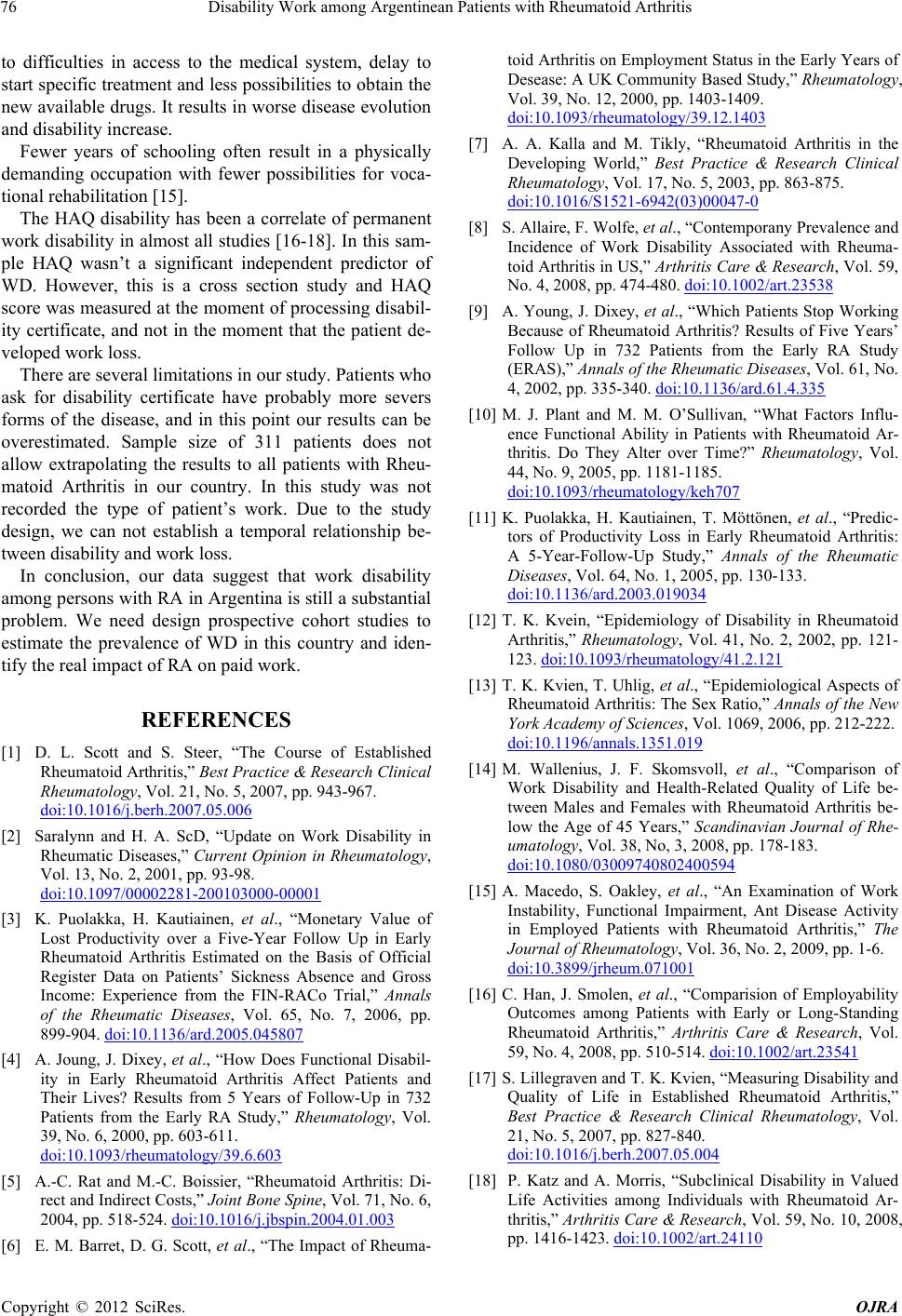 Disability Work among Argentinean Patients with Rheumatoid Arthritis 76 to difficulties in access to the medical system, delay to start specific treatment and less possibilities to obtain the new available drugs. It results in worse disease evolution and disability increase. Fewer years of schooling often result in a physically demanding occupation with fewer possibilities for voca- tional rehabilitatio n [15]. The HAQ disability has been a correlate of permanent work disability in almost all studies [16-18]. In this sam- ple HAQ wasn’t a significant independent predictor of WD. However, this is a cross section study and HAQ score was measured at the moment of processing disabil- ity certificate, and not in the moment that the patient de- veloped work loss. There are several limitations in our study. Patients who ask for disability certificate have probably more severs forms of the disease, and in this point our results can be overestimated. Sample size of 311 patients does not allow extrapolating the results to all patients with Rheu- matoid Arthritis in our country. In this study was not recorded the type of patient’s work. Due to the study design, we can not establish a temporal relationship be- tween disability and work loss. In conclusion, our data suggest that work disability among persons with RA in Argentina is still a substantial problem. We need design prospective cohort studies to estimate the prevalence of WD in this country and iden- tify the real impact of RA on paid work. REFERENCES [1] D. L. Scott and S. Steer, “The Course of Established Rheumatoid Arthritis,” Best Practice & Research Clinical Rheumatology, Vol. 21, No. 5, 2007, pp. 943-967. doi:10.1016/j.berh.2007.05.006 [2] Saralynn and H. A. ScD, “Update on Work Disability in Rheumatic Diseases,” Current Opinion in Rheumatology, Vol. 13, No. 2, 2001, pp. 93-98. doi:10.1097/00002281-200103000-00001 [3] K. Puolakka, H. Kautiainen, et al., “Monetary Value of Lost Productivity over a Five-Year Follow Up in Early Rheumatoid Arthritis Estimated on the Basis of Official Register Data on Patients’ Sickness Absence and Gross Income: Experience from the FIN-RACo Trial,” Annals of the Rheumatic Diseases, Vol. 65, No. 7, 2006, pp. 899-904. doi:10.1136/ard.2005.045807 [4] A. Joung, J. Dixey, et al., “How Does Functional Disabil- ity in Early Rheumatoid Arthritis Affect Patients and Their Lives? Results from 5 Years of Follow-Up in 732 Patients from the Early RA Study,” Rheumatology, Vol. 39, No. 6, 2000, pp. 603-611. doi:10.1093/rheumatology/39.6.603 [5] A.-C. Rat and M.-C. Boissier, “Rheumatoid Arthritis: Di- rect and Indirect Costs,” Joint Bone Spine, Vol. 71, No. 6, 2004, pp. 518-524. doi:10.1016/j.jbspin.2004.01.003 [6] E. M. Barret, D. G. Scott, et al., “The Impact of Rheuma- toid Arthritis on Employment Status in the Early Years of Desease: A UK Community Based Study,” Rheumatology, Vol. 39, No. 12, 2000, pp. 1403-1409. doi:10.1093/rheumatology/39.12.1403 [7] A. A. Kalla and M. Tikly, “Rheumatoid Arthritis in the Developing World,” Best Practice & Research Clinical Rheumatology, Vol. 17, No. 5, 2003, pp. 863-875. doi:10.1016/S1521-6942(03)00047-0 [8] S. Allaire, F. Wolfe, et al., “Contemporany Prevalence and Incidence of Work Disability Associated with Rheuma- toid Arthritis in US,” Arthritis Care & Research, Vol. 59, No. 4, 2008, pp. 474-480. doi:10.1002/art.23538 [9] A. Young, J. Dixey, et al., “Which Patients Stop Working Because of Rheumatoid Arthritis? Results of Five Years’ Follow Up in 732 Patients from the Early RA Study (ERAS),” Annals of the Rheumatic Diseases, Vol. 61, No. 4, 2002, pp. 335-340. doi:10.1136/ard.61.4.335 [10] M. J. Plant and M. M. O’Sullivan, “What Factors Influ- ence Functional Ability in Patients with Rheumatoid Ar- thritis. Do They Alter over Time?” Rheumatology, Vol. 44, No. 9, 2005, pp. 1181-1185. doi:10.1093/rheumatology/keh707 [11] K. Puolakka, H. Kautiainen, T. Möttönen, et al., “Predic- tors of Productivity Loss in Early Rheumatoid Arthritis: A 5-Year-Follow-Up Study,” Annals of the Rheumatic Diseases, Vol. 64, No. 1, 2005, pp. 130-133. doi:10.1136/ard.2003.019034 [12] T. K. Kvein, “Epidemiology of Disability in Rheumatoid Arthritis,” Rheumatology, Vol. 41, No. 2, 2002, pp. 121- 123. doi:10.1093/rheumatology/41.2.121 [13] T. K. Kvien, T. Uhlig, et al., “Epidemiological Aspects of Rheumatoid Arthritis: The Sex Ratio,” Annals of the New York Academy of Sciences, Vol. 1069, 2006, pp. 212-222. doi:10.1196/annals.1351.019 [14] M. Wallenius, J. F. Skomsvoll, et al., “Comparison of Work Disability and Health-Related Quality of Life be- tween Males and Females with Rheumatoid Arthritis be- low the Age of 45 Years,” Scandinavian Journal of Rhe- umatology, Vol. 38, No, 3, 2008, pp. 178-183. doi:10.1080/03009740802400594 [15] A. Macedo, S. Oakley, et al., “An Examination of Work Instability, Functional Impairment, Ant Disease Activity in Employed Patients with Rheumatoid Arthritis,” The Journal of Rheumatology, Vol. 36, No. 2, 2009, pp. 1-6. doi:10.3899/jrheum.071001 [16] C. Han, J. Smolen, et al., “Comparision of Employability Outcomes among Patients with Early or Long-Standing Rheumatoid Arthritis,” Arthritis Care & Research, Vol. 59, No. 4, 2008, pp. 510-514. doi:10.1002/art.23541 [17] S. Lillegraven and T. K. Kvien, “Measuring Disability and Quality of Life in Established Rheumatoid Arthritis,” Best Practice & Research Clinical Rheumatology, Vol. 21, No. 5, 2007, pp. 827-840. doi:10.1016/j.berh.2007.05.004 [18] P. Katz and A. Morris, “Subclinical Disability in Valued Life Activities among Individuals with Rheumatoid Ar- thritis,” Arthritis Care & Research, Vol. 59, No. 10, 2008, pp. 1416-1423. doi:10.1002/art.24110 Copyright © 2012 SciRes. OJRA |