

Paper Menu >>
Journal Menu >>
 Journal of Minerals and Materials Characterization and Engineering, 2012, 11, 848-852 Published Online August 2012 (http://www.SciRP.org/journal/jmmce) Comparative Phosphorus Removal Capabilities of Eurotium herbarorium and Clostridium Species on Nigeria’s Agbaja Iron Ore Obotowo William Obot1, Charles Nwachukwu Anyakwo2 1Department of Me ch an ical Engin e er in g, Faculty of Engineering, University of Uyo, Uyo, Nigeria 2Department of Metallurgical and Materials Engineering, Federal University of Technology, Owerri, Nigeria Email: [email protected], [email protected] Received July 1, 2012; revised July 31, 2012; accepted August 15, 2012 ABSTRACT A study of phosphorus removal capabilities of Eurotium herbarorium and Clostridium species from Nigeria’s Agbaja iron ore was carried out. Iron ore sample was crushed, sieved to obtain 0.50 mm/0.25 mm particle size distribution and cultured with mineral oil medium to facilitate microbial growth. Fungi and bacteria that concurrently grew were sub- cultured in Sabouard dextrose agar and nutrient agar solutions that support fungal and bacterial growth, respectively, and characterized using standard procedures. Ore was exposed to these microbes to effect phosphorus removal in stan- dard media and later analyzed at weekly interval using the standard volumetric ammonium phospho-molybdate method. The fermentation broth media were analyzed for iron, copper, cadmium, zinc, nickel, manganese and lead using the atomic absorption spectrophotometer. The microorganisms markedly removed phosphorus from the ore with 61.48% and 69.20%, respectively. For the fungus pH remained in the acidic region and basic for the bacterium. Trace elements analyses of the initial and final ore-co ntaining media recorded marked reduction in the concen tration of these elements. A plausible explanation that is supported by literature is that the microorganisms accumulated them. This probably ac- counts for the drastic decrease in fungal biomass and bacterial density with the concomitant decrease in phosphorus removal observed towards the end. Keywords: Microbes; Culture; Biodegradation; Trace; Metal; Biomass 1. Introduction The Nigeria’s Agbaja iron ore reserve with its rich iron content 47.5% - 51.50% Fe [1] is the country’s largest but had long been abandoned due to its high phosphor- ru s status which researchers variously estimated at about 0.76 - 0.89 wt% [2,3]. The mineralogy of Agbaja iron ore revealed abundant goethite with minute magnetite and some hematite, pyrite, siderite and chlorite also identi- fied Uwadiale [4]. A successful removal of phosphorus to a metallurgical acceptable level, therefore, from the over 1.2 billion tonnes of ore reserve Uwadiale [5] can mean an economic boom for the country with quite sub- stantial multiplier effects in the areas of job and wealth creation for the downstream sectors of iron and steel in- dustry. The negative effects of phosphorus in high quality steels namely: the effect of steel brittleness coupled with the effect of strong primary segregation during solidifi- cation of castings and the formation of high phosphorus brittle streaks between metal gr ains which impede plastic deformation are undesirable and therefore should be minimized as much as possible. Thus, for high quality steels, the phosphorus acceptable level is in the range of 0.020 - 0.030 wt % or e ven less Kudrin [6] . A flurry of research activities into the removal of phosphorus from the Nigeria’s Agbaja iron ore com- menced in the eighties. Researchers predominantly ap- plied the conventional froth flotation technique for the removal of phosphorus but failed because the phosphorus is not associated with the gangue but is in bonding with the iron [3,7]. An evolving trend in mineral processing currently gaining popularity is the use of microbes and the works of researchers in this regards are well docu- mented [8-10 ]. The current work th erefore intends to adopt the micro- bial degradation approach for comparative investigations of the phosphorus removal capabilities of Eurotium her- barorium and Clostridium species on Nigeria’s Agbaja iron ore. This approach is cheap, environmental friendly and has a potential for easy incorporation into existing iron and steel making technologies. Copyright © 2012 SciRes. JMMCE 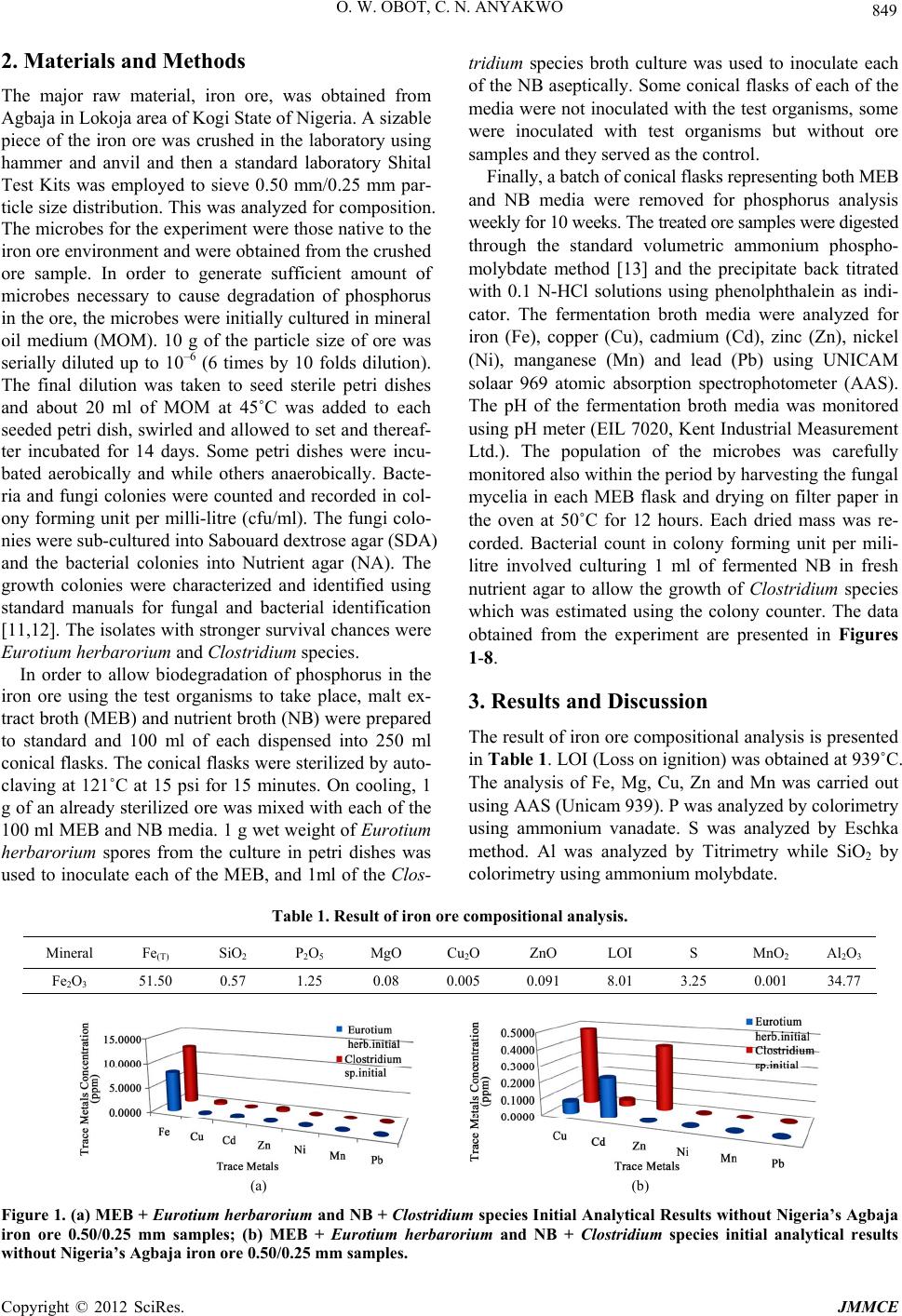 O. W. OBOT, C. N. ANYAKWO 849 2. Materials and Methods The major raw material, iron ore, was obtained from Agbaja in Lokoja area of Kogi State of Nigeria. A sizable piece of the iron ore was crushed in the laboratory using hammer and anvil and then a standard laboratory Shital Test Kits was employed to sieve 0.50 mm/0.25 mm par- ticle size distribution. This was an alyzed for composition. The microbes for the experiment were those native to the iron ore environment and were obtained from the crushed ore sample. In order to generate sufficient amount of microbes necessary to cause degradation of phosphorus in the ore, the microbes were initially cultured in mineral oil medium (MOM). 10 g of the particle size of ore was serially diluted up to 10–6 (6 times by 10 folds dilution). The final dilution was taken to seed sterile petri dishes and about 20 ml of MOM at 45˚C was added to each seeded petri d ish, swirled and allowed to set and thereaf- ter incubated for 14 days. Some petri dishes were incu- bated aerobically and while others anaerobically. Bacte- ria and fungi colonies were counted and recorded in col- ony forming unit per milli-litre (cfu/ml). The fungi colo- nies were sub-cultured into Sabouard dextrose agar (SDA) and the bacterial colonies into Nutrient agar (NA). The growth colonies were characterized and identified using standard manuals for fungal and bacterial identification [11,12]. The isolates with stronger survival chances were Eurotium herbarorium and Clostridium species. In order to allow biodegradation of phosphorus in the iron ore using the test organisms to take place, malt ex- tract broth (MEB) and nutrient broth (NB) were prepared to standard and 100 ml of each dispensed into 250 ml conical flasks. The conical flasks were sterilized by auto- claving at 121˚C at 15 psi for 15 minutes. On cooling, 1 g of an already sterilized ore was mixed with each of the 100 ml MEB and NB media. 1 g wet weight of Eurotium herbarorium spores from the culture in petri dishes was used to inoculate each of the MEB, and 1ml of the Clos- tridium species broth culture was used to inoculate each of the NB aseptically. Some conical flasks of each of the media were not inoculated with the test organisms, some were inoculated with test organisms but without ore samples and they served as the control. Finally, a batch of conical fl asks represent i ng bot h M EB and NB media were removed for phosphorus analysis weekly for 10 weeks. The treated ore samples were digested through the standard volumetric ammonium phospho- molybdate method [13] and the precipitate back titrated with 0.1 N-HCl solutions using phenolphthalein as indi- cator. The fermentation broth media were analyzed for iron (Fe), copper (Cu), cadmium (Cd), zinc (Zn), nickel (Ni), manganese (Mn) and lead (Pb) using UNICAM solaar 969 atomic absorption spectrophotometer (AAS). The pH of the fermentation broth media was monitored using pH meter (EIL 70 20, Kent Industrial Measurement Ltd.). The population of the microbes was carefully monitored also within the period by harvesting the fungal mycelia in each MEB flask and drying on filter paper in the oven at 50˚C for 12 hours. Each dried mass was re- corded. Bacterial count in colony forming unit per mili- litre involved culturing 1 ml of fermented NB in fresh nutrient agar to allow the growth of Clostridium species which was estimated using the colony counter. The data obtained from the experiment are presented in Figures 1-8. 3. Results and Discussion The result of iron ore co mpositional analysis is presen ted in Table 1. LOI (Lo ss on ign ition) was obtained at 939˚C. The analysis of Fe, Mg, Cu, Zn and Mn was carried out using AAS (Unicam 939). P was analyzed by colorimetry using ammonium vanadate. S was analyzed by Eschka method. Al was analyzed by Titrimetry while SiO2 by colorimetry using ammonium molybdate. Table 1. Result of iron ore compositional analysis. Mineral Fe(T) SiO2 P 2O5 MgO Cu2O ZnO LOI S MnO2 Al2O3 Fe2O3 51.50 0.57 1.25 0.08 0.005 0.091 8.01 3.25 0.001 34.77 (a) (b) Figure 1. (a) MEB + Eurotium herbarorium and NB + Clostridium species Initial Analytical Results without Nigeria’s Agbaja iron ore 0.50/0.25 mm samples; (b) MEB + Eurotium herbarorium and NB + Clostridium species initial analytical results without Nigeria’s Agbaja iron ore 0.50/0.25 mm samples. Copyright © 2012 SciRes. JMMCE  O. W. OBOT, C. N. ANYAKWO 850 Figure 1(a) presents the result of initial analyses of MEB + Eurotium herbarorium and NB + Clostridium species without the iron ore samples. It shows the con- centration of the trace metals in the broth cultures in the presence of the microorganisms. The MEB does not contain Zn, Ni, MN and Pb but has some amounts of Fe, Cu and Cd ions. On the other hand, NB contains Fe, Cu, Cd and Zn but no Ni, Mn and Pb ions. Figure 1(b) is a scale up modification of Figure 1(a) without values for Fe ions concentration to give better visualization of amounts of the other very insignificant trace metals. Figures 2(a) and (b) present the initial analytical re- sults of MEB + Eurotium herbarorium and NB + Clos- tridium species cultures with the ore sample. Figure 2(b) is a scale up modification of Figure 2(a) without values for Fe concentration, again for visualization effect. Com- paring Figures 1 and 2 shows that the introduction of iron ore sample into both MEB and NB cultures, resulted in increase in the trace metals concentration. For MEB inoculated with Eurotium herbarorium, Zn, Mn and Pb ions increased 31%, 317% and 105%, respectively. NB inoculated with Clostridium species during the same in- terval recorded 5.5% and 424% increase for Ni and Pb, respectively. The trace metals increase is expected with the introduction of the ore as this has increased whatev er concentration of trace metals that came with the MEB medium. However, it is observed that in the MEB culture, the concentration of Fe and Cd decreased by 11% and 80% respectively. It is possible that the decrease in trace metals is due to bio-accumulation by the microbes. (a) (b) Figure 2. (a) Concentration of trace metals in broth media during phosphorus removal from Nigeria’s Agbaja iron ore by Eurotium herbarorium and Clostridiumn species for 10 weeks; (b) Initial concentration of trace metals in broth media during phosphorus removal from Nigeria’s Agbaja iron ore by Eurotium herbarorium and Clostridium species. Comparing Figures 2 and 3 shows trace metals sharp decrease. It is possible that in the MEB culture Eurotium herbarorium accumulated 100% of Cu, Cd and Pb; 68% Fe, 49% Zn and 89% Mn ions at the end of 10 weeks experimentation. During the same period Clostridium species in NB culture possibly also accumulated 100% Fe and Cd, also 60% Zn and 79% Pb. In NB culture 87% Cu, 92% Ni and 38% Mn ions were released back. It is confirmed in literature that the microorganisms can ac- cumulate trace metals under favourable conditions and also release same back to the environment if the condi- tions change. It is equally known that the over-accumu- lation of trace metals disrupt the normal functioning cells due to toxicity [14]. The reduction in cells population observed in Figure 5, especially towards the end of ex- perimentation with its concomitant reduction in phos- phorus removal capability of the microbes about the same period, may be facts to show why the stagnation noticed from the 7th week till the end of the experiment occurred. It is most probable that the microbes having over-accumulated trace metals especially Pb, simply died and this could have aff ected this route of processing iron ore to reduce phosphorus. The removal of phosphorus in the ore by Eurotium herbarorium and Clostridium species for 10 weeks is presented in Figure 4. During this period, the initial phosphorus con tent in the ore 0 .89 wt% reduced to 0.339 wt% and 0.271 wt%, respectively. Figure 3. Concentration of trace metals in broth media during phosphorus removal from Nigeria’s Agbaja iron ore by Eurotium herbarorium and Clostridium species at end of 10 weeks. Figure 4. Variation of wt% P content during phosphorus removal by Eurotium herbarorium and Clostridium species from Nigeria’s Agbaja iron ore 0.50/0.25 mm for 10 weeks. Copyright © 2012 SciRes. JMMCE  O. W. OBOT, C. N. ANYAKWO 851 The variation of the biomass weight of Eurotium her- barorium in MEB and the log of the density of Clostrid- ium species in NB submerged media bearing the iron ore with time is shown in Figur e 5. initia %P %P The variation of the pH of the MEB and NB cultures with time during the experimentation period is shown in Figure 6. Figure 7 presents the percent phosphorus reduced by Eurotium herbarorium and Clostridium species in 10 weeks. The percent phosphorus reduced from the ore was calculated using Equation (1): initial % PP final initial %% %100 PP (1) Figure 5. Growth of Enrotitum herharorium and Clostridium species during phosphorus removal from Nigeria’s Agbaja iron ore 0.50/0.25 mm for 10 weeks. Figure 6. Curve of subsr ates pH vs time during phosphorus removal from Nigeria’s Agbaja iron ore 0.50/0.25 mm by Eurotiu m herbar orium and Clostridium species for 10 weeks. Figure 7. Curve of % phosphorus removed vs time for Ni- geria’s Agbaja iron ore by Eurotium herbarorium and Clos- tridium sp e cies for 10 weeks . l —The final wt% phosphorus in treated ore. —The initial wt% phosphorus content in ore final Figure 8(a) shows that in the first week, an initial rapid drop in biomass weight that also corresponded to a rapid drop in ore’s phosphorus concentration occurred. Thereafter for a period of two weeks a marked increase in biomass weight that peaked at the third week took place while phosphorus intake by the fungus continued to take place. Beyond this point the biomass weight began to decrease rapidly while phosphorus intake also contin- ued. It is however seen that when the biomass weight dropped to 1 g dry weight, phosphorus removal attained its lowest value and below this value no further phos- phorus removal effectively continued. The highest per- cent cumulative removal for Eurotium herbarorium was 61.48%. Removal occurred in an increasing acidity cul- ture attaining a pH value 2.30 in 10 weeks. Figure 8(b) shows on the other hand, a gradual phos- phorus removal in the ore occurring throughout the pe- riod thus lowering its content from an initial value of 0.890 wt% to 0.271 wt%. The same period experienced rapid cells multiplication from an initial log of cfu/ml 5.531 to a climax 7.92 2 in the 4th week and then a grad- ual reduction in cells population. During this period the substrates pH value increased from 7.13 to 9.61. The (a) (b) Figure 8. (a) Variation of iron ore phosphorus content, sub- strates pH and biomass weight during phosphorus removal from Nigeria’s Agbaja iron ore 0.50/0.25 mm by Eurotium herbarorium for 10 weeks; (b) Variation of iron ore phos- phorus content, substrates pH and log of density during phosphorus removal from Nigeria’s Agbaja iron ore 0.50/ 0.25 mm by Clostridium species for 10 weeks. Copyright © 2012 SciRes. JMMCE  O. W. OBOT, C. N. ANYAKWO Copyright © 2012 SciRes. JMMCE 852 period of a steady phosphorus removal was also coinci- dent with the time of maximum cells growth. The highest phosphorus cumulative removal attained was 69.20%. 4. Conclusion and Recommendation The comparative phosphorus removal capability of Eu- rotium herbarorium and Clostridium species on Nige- ria’s Agbaja iron ore was investigated with 61.48% and 69.20% cumulative removal respectively attained in 10 weeks. The initial rapid removal capacity shown in the fermentation broths till about the 6th and 7th weeks, re- spectively for the two organisms apparently could not be sustained due to over-accumulation of trace metals and other toxic waste products of biodegradation and this probably adversely affected the further phosphorus re- moval. It is recommended that further studies on the chemistry of metabolic broth wastes be considered as this may reveal the interacting parameters which can be ad- vantageously harnessed for a continuous bio-degradation that is possible with microorganisms. 5. Acknowledgements We thank all those who in one way or the other sup- ported this work especially, the staff of the Departments of Microbiology and Chemical Eng ineering of Univ ersity of Uyo, also the staff of the Ministry of Science and Technology, Akwa Ibom State. Deserving special appre- ciation is Dr. A. O. Ano of the Nigerian Root Crops Re- search Institute, Umuahia, Abia state, for lending equip- ment worth millions of naira free of charge in order to complete this research. And finally, Engr. Peter Asan- gausung, the Senior Technologist in-charge of the Chemical Engineering Laboratory where the bulk of this work was done, we thank for his resourcefulness and demonstrated concern. REFERENCES [1] N. J. Amadi, A. A. Odunaike and G. P. Marthur, “Pre- liminary Bench Scale Beneficiation Studies with Three Lumps of Iron Ore Sample from Agbaja,” Technical Re- port, Central Metallurgical Research and Development Institute, Jos, 1982. [2] G. G. O. O. Uwadiale, “Electrolytic Coagulation and Se- lective Flocculation of Agbaja Iron Ore,” Journal of Min- ing and Geology, Vol. 27, No. 1, 1991, pp. 77-85. [3] G. G. O. O. Uwadiale and M. A. U. Nwoke, “Benefici- ation of Agbaja Iron Ore by Reduction Roasting-Mag- netic Separation: Semi Pilot Plant Scale-Up and Estab- lishment of Residence Point of Phosphorus,” National Steel Council, Metallurgical Research and Tests Division, Jos, 1983. [4] G. G. O. O. Uwadiale, “Beneficiation Studies of Agbaja Iron Ore,” Ph.D. Thesis, University of Strathclyde, Glas- gow, 1984. [5] G. G. O. O. Uwadiale and R. J. Whewell, “Effect of Tem- perature on Magnetizing Reduction of Agbaja Iron Ore,” Metallurgical and Materials Transaction B, Vol. 19, No. 5, 1988, pp. 731-735. [6] V. Kudrin, “Steel Making,” MIR Publishers, Moscow, 1985, pp. 82-83. [7] G. G. O. O. Uwadiale and O. Emeka, “Petrology of Ag- baja Ironstone, National Steel Council, Metallurgical Re- search and Tests Division,” Jos, 1 983. [8] P. Delvasto, et al., “Exploring the Possibilities of Bio- logical Beneficiation of Iron-Ores: The Phosphorus Prob- lem,” Proceedings of the 15th Steelmaking Conference, 5th Ironmaking Conference & 1st Environment and Re- cycling Symposium IAS (CD-ROM), Argentinean Steel- making Institute (IAS), San Nicolás, 7-10 November 2005, pp. 71-82. [9] N. Pradhan, et al., “Beneficiation of Iron Ore Slime Using Aspergillus niger and Bacillus circulans,” Bioresource Technology, Vol. 97, No. 15, 2006, pp. 1876-1879. doi:10.1016/j.biortech.2005.08.010 [10] C. N. Anyakwo and O. W. Obot, “Phosphorus Removal from Nigeria’s Agbaja Iron Ore by Aspergillus niger,” International Research Journal in Engineering, Science & Technology, Vol. 5, No. 1, 2008, pp. 54-58. [11] H. L. Barnett and B. B. Hunter, “Illustrated Genera of Imperfect Fungi,” 4th Edition, Macmillan Publishing Coy, New York, Collier Macmillan Publishers, London, 1987. [12] J. G. Holt, N. R. Krieg, P. H. A.Sneath, J. T. Stanley and S. T. Williams, “Bergy’s Manual of Determinative Bacte- riology,” 9th Edition, Lippincott Williams and Wilkins, Maryland, 1994. [13] S. K. Jain, “An Introduction to Metallurgical Analysis: Chemical and Instrumental,” Vikas Publishing House, New Delhi, 1982. [14] P. K. Mohapatra, “Textbook of Environmental Microbi- ology,” I. K. International Publishing House Pvt Ltd., New Delhi, 2008. |