

Paper Menu >>
Journal Menu >>
 Journal of Minerals and Materials Characterization and Engineering, 2012, 11, 807-812 Published Online August 2012 (http://www.SciRP.org/journal/jmmce) Effect of Cenosphere Conc entration on the Mechanical, Thermal, Rheological and Morphologica l P ropert i e s of Nylon 6 Parag A. Wasekar, Pravin G. Kadam, Shashank T. Mhaske* Department of Polymer and Surface Engineering, Institute of Chemical Technology, Mumbai, India Email: *[email protected] Received April 14, 2012; revised May 28, 2012; accepted June 17, 2012 ABSTRACT Cenospheres are widely used as filler in thermoset plastics and concrete mainly for density reduction of the material. But there is no work noted of using cenosphere as filler in thermoplastics. In this paper cenosphere concentration was varied from 0 to 10 phr of nylon 6 and the effect of the same on the mechanical, thermal, rheological and morphological properties of the composite were studied. Elongation was found to have increased by 83% and impact strength by 44% at 2.5 phr loading of cenosphere. Flexural strength increased upto 25% at 10 phr content of cenosphere. Keywords: Nylon 6; Cenosphere; Crystallinity; Reinforcing Agent 1. Introduction In the previous studies use of cenosphere is noted to de- crease the density of the material, due to its micro- spherical nature. Cenosphere is a hydrophilic material and found in fly ash [1]. So, for its use as filler in poly- mers like PP, HDPE, PS, it is surface treated to induce hydrophobicity gi ving bet ter com patibil ity wit h the matri x. Abdullah et al. utilized amine containing silicone as toughening agent and hollow cenosphere as filler in ep- oxy resin. Their study was to understand the microstruc- ture formed and its influence on mechanical properties and free volume measurements of the composite. Tensile strength increased and tensile modulus decreased with increase in cenosphere content up to 30%, due to low density of the filler [2]. Gu et al. studied epoxy filled with cenosphere surface treated with different chemicals. Surface modified cenosphere were observed to have dis- tributed uniformerly into the epoxy matrix. Surface modified cenosphere had a wider glass transition tem- perature region and a higher loss factor, and had rela- tively higher impact toughness [3]. Deepthi et al. studied the mechanical and thermal properties of high density polyethylene filled with cenosphere. They used ceno- sphere as filler after silane treatment, and also with a compatibilizer [4]. Cardoso et al. studied the effect of particle size and surface treatment o f cenosphere as filler on the properties of polyester resin [5]. Huo et al. studied the preparation of poly-o-phenylenediamine (POPD)/ TiO2/fly ash cenosphere composite and its photo-degra- dation properties [6]. Chaliven dra et al. studied the proc- essing and mechanical characterization of lightweight polyurethane composites using cenosphere. Polyurethane was loaded with cenosphere upto 40% and was tested for mechanical properties to estimate the fracture toughness of the material. Cenosphere decreased the density of the composite. The high strain rate constitutive behavior of 100% polyurethane showed monotonic stiffening whereas the composite at higher cenosphere volume fractions (40%) exhibited a stiffening-softening-stiffening behavior, due to easy flowability induced by cenosphere micros pheres [7]. In this paper, cenosphere was used as reinforcing agent in nylon 6 matrix. Cenosphere and nylon 6 both are hy- drophilic materials, so they possessed good compatibilit y requiring no use of compatibilizer or surface treatment of cenosphere. Cenosphere obtained was used as such and loaded as 2.5 phr, 5 phr, 7.5 phr and 10 phr in the nylon matrix, and tested for mechanical, thermal, rheological and morphological properties. As cenosphere was used in very low concentration to affect the density of the matrix material, density measurement was not done. 2. Experimental 2.1. Materials Nylon 6 for was obtained from Next Polymers Ltd., Mumbai, India. Cenosphere was procured from Nasik thermal power plant (India) having chemical composition as shown in the Table 1. Cenosphere was used as ob- *Corresponding author. Copyright © 2012 SciRes. JMMCE  P. A. WASEKAR ET AL. 808 tained without any purification or chemical modification or surface treatment. Finalux G3 (wetting agent) was obtained fr o m Fine Organics Ltd., M umbai, India. 2.2. Preparation of Composite Concentration of cenosphere was varied upto 10 phr into the nylon matrix. Firstly, dry blending of cenosphere and nylon 6 was done in tumbler mixer for 15 - 20 min, using finalux G3 as the wetting agent. Then the mix was melt blended in a twin screw co-rotating extruder (Lab Tech Engineering Co. Ltd., Germany) having L/D ratio of 32:1 and temperature profile from the hopper to the die as 170˚C, 190˚C, 200˚C, 210˚C, 220˚C, 230˚C, 240˚C and 250˚C. Extruded strands were water cooled at 30˚C and pelettized. Pellets obtained were used for injection mold- ing after pre-drying at 80˚C for 8 - 10 hrs. Injection molding (Boolani machineries India ltd, Mumbai, India) was done maintaining temperature profile as 210˚C, 230˚C and 250˚C from the hopper to the ejection nozzle. Standard ASTM based samples for tensile, flexural and impact testing were obtained from injection molding. Samples for impact testing were notch cut before testing. 2.3. Characterization and Testing 2.3.1. Mechanica l Pro p e rties Tensile properties; tensile strength and elongation at break and flexural properties; flexural strength and flex- ural modulus, were measured at ambient condition using a universal testing machine (LR-50K, Lloyds Instrument, UK), according to ASTM procedures D638 and D790; at a crosshead speed of 50 mm/min and 2.8 mm/min re- spectively. The notch for impact test was made using a motorized notch-cutting machine (Polytest model 1, Ray Ran, UK). Notched Izod impact strength was determined at ambient condition according to ASTM D256 standard, using impact tester (Avery Denison, UK) having striking velocity of 3.46 m/s employing a 2.7 J striker. 2.3.2. Thermal Properties Differential scanning calorimetry (Q 100 DSC, TA in- struments Ltd., India) characterization was done to in- vestigate the crystallization and melting behaviour of the composite. Two consecutive heating scans were found to minimize the influence of possible residual stresses in the material due to any specific thermal history. Scanning rate of 10˚C/min was maintained for both heating and cooling cycle; whereas nitrogen gas purge rate main- tained at 50 ml/min. Melting temperature was determined from the second heating scan while the crystallization temperature (Tc) from cooling scan. 2.3.3. Rheological Properties The melt viscosity was measured using rotational rheometer (MCR101, Anton Paar, India) with parallel plate assem- bly having diameter of 35 mm. Samples were predried before analysis. Viscosity was determined for sh ear rates from 0.01 s–1 to 100 s–1 at the constant temperature of 250˚C. 2.3.4. M orp hologica l Properties Scanning electron microscope (SEM) analysis was per- formed with JEOL 6380 LA (Japan). Samples were frac- tured under liquid nitrogen to avoid any disturbance to the molecular structure and then coated with gold before imaging. 2.3.5. X-Ray Diffr ac tion The XRD analysis was carried out to determine the per- centage crystallinity of the prepared co mposite. A normal focus copper X-ray tube was operated at 30 kV and 15 mA. Sample scanning was done from 2.00˚ to 80.00˚ at the rate of 3.00˚/min. The data processing was done us- ing Jade 6.0 software. 2.4. Formulation The formulations prepared are as shown in the Table 2. Concentration of cenosphere was varied from 0 to 10 phr of nylon 6, while concentration of wetting agent was maintained constan t at 5 phr of nylon 6. Table 1. Chemical composition of cenosphere obtained from Nasik thermal power plant. Components Al2O3 SiO2 P 2O5 SO3 K 2O CaO TiO2 V 2O5 Fe2O3 wt% 24.559 50.300 0.409 0.060 6.765 1.109 5.129 0.102 11.566 Table 2. Formulation of cenosphere/nylon 6 composites. Sr. No. Sample Name Nylon 6 (gm) Cenosphere (phr, gm) Wetting Agent (phr, gm) 1 VNY 500 0.0, 0.0 5, 25 2 NC 2.5 500 2.5, 12.5 5, 25 3 NC 5 500 5.0, 25.0 5, 25 4 NC 7.5 500 7.5, 37.5 5, 25 5 NC 10 500 10.0, 50.0 5, 25 Copyright © 2012 SciRes. JMMCE 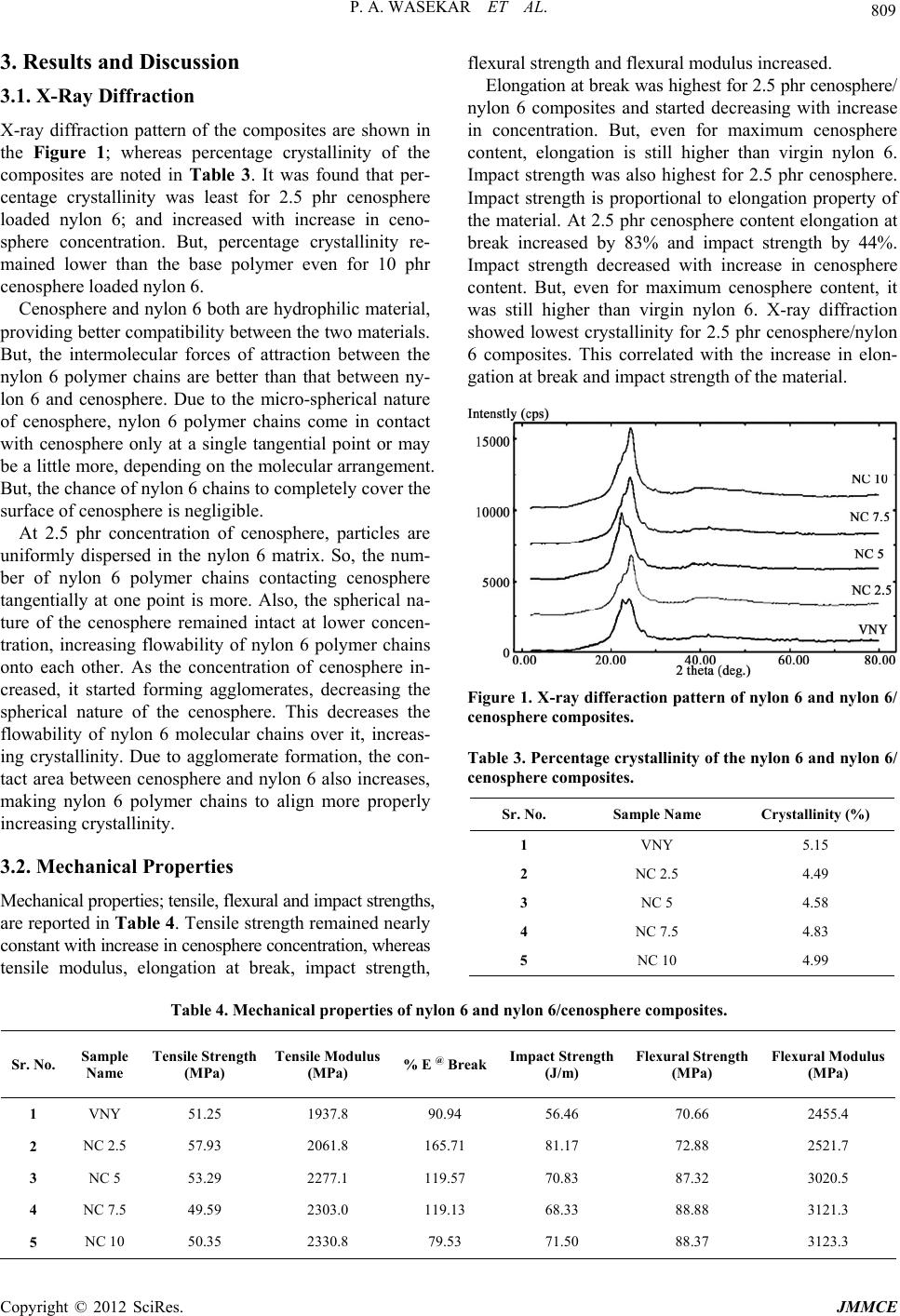 P. A. WASEKAR ET AL. 809 3. Results and Discussion 3.1. X-Ray Diffrac tio n X-ray diffraction pattern of the composites are shown in the Figure 1; whereas percentage crystallinity of the composites are noted in Table 3. It was found that per- centage crystallinity was least for 2.5 phr cenosphere loaded nylon 6; and increased with increase in ceno- sphere concentration. But, percentage crystallinity re- mained lower than the base polymer even for 10 phr cenosphere loaded nylon 6. Cenosphere and nylon 6 both are hydrophilic material, providing better compatib ility between the two materials. But, the intermolecular forces of attraction between the nylon 6 polymer chains are better than that between ny- lon 6 and cenosphere. Due to the micro-spherical nature of cenosphere, nylon 6 polymer chains come in contact with cenosphere only at a single tangential point or may be a little more, depending on the molecular arrange ment. But, the chance of nylon 6 chains to completely cover the surface of cenosphere is negligible. At 2.5 phr concentration of cenosphere, particles are uniformly dispersed in the nylon 6 matrix. So, the num- ber of nylon 6 polymer chains contacting cenosphere tangentially at one point is more. Also, the spherical na- ture of the cenosphere remained intact at lower concen- tration, increasing flowability of nylon 6 polymer chains onto each other. As the concentration of cenosphere in- creased, it started forming agglomerates, decreasing the spherical nature of the cenosphere. This decreases the flowability of nylon 6 molecular chains over it, increas- ing crystallinity. Due to agglomerate formation, the con- tact area between cenosphere and nylon 6 also increases, making nylon 6 polymer chains to align more properly increasing crystallinity. 3.2. Mechanical Properties Mechanical properties; tensile, flexural and impact strengths, are reported in Table 4. Tensile strength remained nearly constant with incre ase in ceno sph ere con cen tr ation, where as tensile modulus, elongation at break, impact strength, flexural strength and flexural modulus increased. Elongation at break was highest for 2.5 phr cenosphere/ nylon 6 composites and started decreasing with increase in concentration. But, even for maximum cenosphere content, elongation is still higher than virgin nylon 6. Impact strength was also highest for 2.5 phr cenosphere. Impact strength is proportional to elongation property of the material. At 2.5 phr cenosphere content elongation at break increased by 83% and impact strength by 44%. Impact strength decreased with increase in cenosphere content. But, even for maximum cenosphere content, it was still higher than virgin nylon 6. X-ray diffraction showed lowest crystallinity for 2.5 phr cenosphere/nylon 6 composites. This correlated with the increase in elon- gation at break and impact strength of the material. Figure 1. X-r ay differaction pattern of nylon 6 and nylon 6/ cenosphere composites. Table 3. Percentage crystallinity of the ny lon 6 a nd nyl on 6/ cenosphere composites. Sr. No. Sample Name Crystallinity (%) 1 VNY 5.15 2 NC 2.5 4.49 3 NC 5 4.58 4 NC 7.5 4.83 5 NC 10 4.99 Table 4. Mechanical properties of nylon 6 and nylon 6/cenosphere composites. Sr. No. Sample Name Tensile Strength (MPa) Tensile Modulus (MPa) % E @ BreakImpact Strength (J/m) Flexural Strength (MPa) Flexural Modulus (MPa) 1 VNY 51.25 1937.8 90.94 56.46 70.66 2455.4 2 NC 2.5 57.93 2061.8 165.71 81.17 72.88 2521.7 3 NC 5 53.29 2277.1 119.57 70.83 87.32 3020.5 4 NC 7.5 49.59 2303.0 119.13 68.33 88.88 3121.3 5 NC 10 50.35 2330.8 79.53 71.50 88.37 3123.3 Copyright © 2012 SciRes. JMMCE 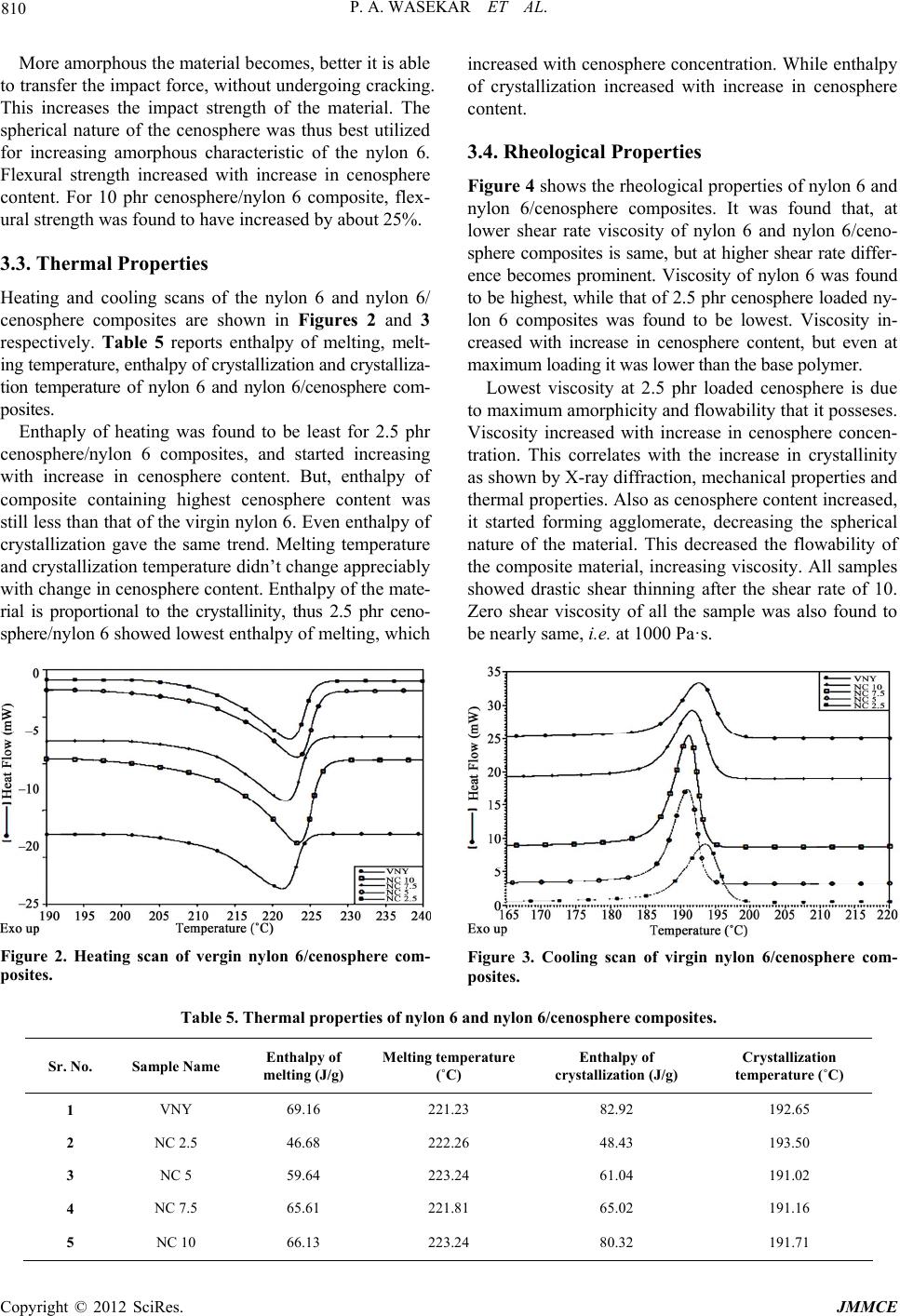 P. A. WASEKAR ET AL. 810 More amorphous the material b ecomes, better it is able to transfer the impact force, without undergoing cracking. This increases the impact strength of the material. The spherical nature of the cenosphere was thus best utilized for increasing amorphous characteristic of the nylon 6. Flexural strength increased with increase in cenosphere content. For 10 phr cenosphere/nylon 6 composite, flex- ural strength was found to have increased by about 25%. 3.3. Thermal Properties Heating and cooling scans of the nylon 6 and nylon 6/ cenosphere composites are shown in Figures 2 and 3 respectively. Table 5 reports enthalpy of melting, melt- ing temperature, enthalpy of crystallization and crystalliza- tion temperature of nylon 6 and nylon 6/cenosphere com- posites. Enthaply of heating was found to be least for 2.5 phr cenosphere/nylon 6 composites, and started increasing with increase in cenosphere content. But, enthalpy of composite containing highest cenosphere content was still less than that of the virgin nylon 6. Even en thalpy of crystallization gave the same trend. Melting temperature and crystallization temperature didn’t change appreciably with change in cenosphere content. Enthalpy of the mate- rial is proportional to the crystallinity, thus 2.5 phr ceno- sphere/nylon 6 showed lowest enthalpy of melting, which increased with cenosphere concentration. While enthalpy of crystallization increased with increase in cenosphere content. 3.4. Rheological Properties Figure 4 shows the rheological properties of nylon 6 and nylon 6/cenosphere composites. It was found that, at lower shear rate viscosity of nylon 6 and nylon 6/ceno- sphere composites is same, but at higher shear rate differ- ence becomes prominent. Viscosity of nylon 6 was found to be highest, while that of 2.5 phr cenosphere loaded ny- lon 6 composites was found to be lowest. Viscosity in- creased with increase in cenosphere content, but even at maximum loading it was lower than the base polymer. Lowest viscosity at 2.5 phr loaded cenosphere is due to maximum amorphicity and flowability th at it posseses. Viscosity increased with increase in cenosphere concen- tration. This correlates with the increase in crystallinity as shown by X-ray diffraction, mechanical properties and thermal properties. Also as cen osph ere con tent in crea sed, it started forming agglomerate, decreasing the spherical nature of the material. This decreased the flowability of the composite material, increasing viscosity. All samples showed drastic shear thinning after the shear rate of 10. Zero shear viscosity of all the sample was also found to be nearly same, i.e. at 1000 Pa·s. Figure 2. Heating scan of vergin nylon 6/cenosphere com- posites. Figure 3. Cooling scan of virgin nylon 6/cenosphere com- posites. Table 5. Thermal properties of nylon 6 and nylon 6/cenosphere composites. Sr. No. Sample Name Enthalpy of melting (J/g) Melting temperature (˚C) Enthalpy of crystallization (J/g) Crystallization temperature (˚C) 1 VNY 69.16 221.23 82.92 192.65 2 NC 2.5 46.68 222.26 48.43 193.50 3 NC 5 59.64 223.24 61.04 191.02 4 NC 7.5 65.61 221.81 65.02 191.16 5 NC 10 66.13 223.24 80.32 191.71 Copyright © 2012 SciRes. JMMCE  P. A. WASEKAR ET AL. 811 Figure 4. Viscosity vs shear rate graph of nylon 6/ceno- sphere composites. Figure 5. SEM image of 2.5 phr cenosphere loaded nylon 6 at 5000× showing particle size distribution. (a) (b) (c) (d) Figure 6. Showing particle size of (a) SEM image of 2.5 phr cenosphere loaded nylon 6 at 20000×; (b) SEM image of 5 phr cenosphere loaded nylon 6 at 5000×; (c) SEM image of 7.5 phr cenosphere loaded nylon 6 at 5000×; (d) SEM image of 10 phr cenosphere loaded nylon 6 at 5000×. 3.5. Morphological Properties Morphological properties of the cenosphere/nylon 6 composites were found using scanning electron micros- copy (SEM). SEM images of 2.5 phr cenosphere/nylon 6 lon 6 composites showing cenosphere particle size, 5 phr composites showing dispersion, 2.5 phr cenosphere/ r cenosphere/ny- here/nylon 6 com- pectively. 3.9 to 4.2 µm, as nosphere content, ny- cenosphere/nylon 6 composites, 7.5 ph lon 6 composites and 10 phr cenosp posites are show n in Figures 5 and 6 res Particle size of cenosphere is about evident from Figure 6. At 2.5 phr ce Copyright © 2012 SciRes. JMMCE  P. A. WASEKAR ET AL. 812 cenosphere are un iformly distributed in th e nylon matrix, giving better flowability to the nylon 6 matrix. As the cenosphere content increases in the nylon 6 matrix, it forms agglomerate, increasing particle size. Increase in pa agent in nylon 6. By use of cenosphere as n nylon 6 matrix, elongation at break pact strength by 44%; at 2.5 phr NCES Materials Charing, Vol. 1, No. 1, rticle size is gradual with increase in cenosphere con- centration. 4. Conclusion Cenosphere has always been used as a material to reduce the density of the material due to its micro-spherical na- ture. However, cenosphere can be effectively used as reinforcing reinforcing agent i increased by 83%, im content. Flexural strength increased with increase in cenosphere content. Flexural strength increased by 25% at 10 phr cenosphere content. Cenosphere decreased crys- tallinity and also increased flowability of nylon 6. No change in tensile strength of the composites was ob- served with change in cenosphere content. 5. Acknowledgements The authors gratefully acknowledge the financial support from The University Grant Commission under the SAP scheme for their financial support. REFERE [1] J. Y. Hwang, X. Sun and Z. Li, “Unburned Carbon from Fly Ash for Mercury Adsorption: I. Separation and Char- acterization of Unburned Carbon,” Journal of Minerals & racterization & Enginee 2002, pp. 39-60. [2] M. A. M. Abdullah, H. B. Ravikumar and C. Rangana- thaiah, “Influence of Free Volume on the Mechanical Properties of Epoxy Based Composites: A Correlation Study,” Physica Status Solidi (c), Vol. 6, No. 11, 2009, pp. 2401-2403. [3] J. Gu, G. Wu and X. Zhao, “Effect of Surface-Modifica- tion on the Dynamic Behaviors of Fly Ash Cenospheres Filled Epoxy Composites,” Polymer Composites, Vol. 30, No. 2, 2009, pp. 232-238. doi:10.1002/pc.20562 [4] M. V. Deepthi, M. Sharma, R. R. N. Sailaja, P. Anantha, P. Sampathkumaran and S. Seetharamu, “Mechanical and Thermal Characteristics of High Density Polyethylene— Fly Ash Cenospheres Composites,” Materials & Design, Vol. 31, No. 4, 2010, pp. 2051-2060. doi:10.1016/j.matdes.2009.10.014 [5] R. J. Cardoso, A. Shukla and A. Bose, “Effect of Particle Size and Surface Treatment on Constitutive Properties of Polyester-Cenosphere Composites,” Journal of Material Science, Vol. 37, No. 3, 2002, pp. 603 doi:10.1023/A:1013781927227 -613. [6] P. Huo, Y. Yan, S. Li, H. Li and W. Huang, “Preparation and Characterization of Cobalt Sulfophthalocyanine/TiO2/ Fly Ash Cenospheres Photocatalyst and Study on Degra- dation Activity under Visible Light,” Applied Surface Science, Vol. 255, No. 15, 2009, pp. 6941-6917. [7] V. B. Chalivendra, A. Shukla, A. Bose and V. Parames- waran, “Processing and Mechanical Characterization of Lightweight Polyurethane Composites,” Journal of Mate- rial Science, Vol. 38, No. 8, 2003, pp. 1631-1643. doi:10.1023/A:1023203121299 Copyright © 2012 SciRes. JMMCE |