

Paper Menu >>
Journal Menu >>
 Creative Education 2012. Vol.3, No.4, 581-587 Published Online August 2012 in SciRes (http://www.SciRP.org/journal/ce) http://dx.doi.org/10.4236/ce.2012.34085 Copyright © 2012 SciRes. 581 Community Participatory Training Model for the Conservation of Medicinal Plants Biodiversity at Doijedee Mountain Tourist Attraction, Northeastern Thailand* Kong Khemkratoke1, Penkhae Thamsenanupap1, Napat Noinumsai2 1Department of Environmental Education, Faculty of Environment and Resource Studies, Mahasarakham University, Maha Sarakham, Thailand 2Technology of Environmental management Program, Faculty of Sciences and Technology, Nakhon Ratchasima Rajabhat University, Nakhon Ratchasima, Thailand Email: [email protected] Received June 11th, 2012; revised July 13th, 2012; accepted July 27th, 2012 Recently, the biodiversity are changing and incessantly decreasing, especially the medicinal plants, and the problem related to the way of life of people. To solve this problem, knowledge of the people is very important and thus it is a must to build knowledge by various methods. Therefore, this research was aimed to develop the community participatory training model to conserve medicinal plants species diver- sity. The research framework was divided into two stages. The first stage was the development of the training model consisted of nine plans and the second was the application of the model and the data was collected from questionnaires of the knowledge levels, opinions and behaviors of biodiversity, in-depth interview and participatory observation. The period of 12 months was spent on research operation and assumption test by Paired t-test and F-test (two-way MANCOVA). The results of the study were as fol- lows: 1) The community participatory training model consisted of 6 plans namely a) problems affecting biodiversity study; b) problem analysis; c) data collection of pre-training; d) planning organization using up A-I-C; e) planning implementation and using Deming cycle (P-D-C-A) to analyze and improve in 3 spirals and each spiral was one month away; and f) data collection of post-training. Samples group both in general and with identified gender and age in post training had the knowledge levels, opinions and be- haviors of the biodiversity increased significantly (p < .05). 2) After training, no difference was found in terms of knowledge levels, opinions and behaviors of the biodiversity of the samples group with different genders and ages. The gender and age factors did not influence the operational results (p > .05). 3) In terms of the result of follow-up, one month after the training, the samples group benefit from Doijedee Mountain tourist attraction and they still play the active role as community committee. In conclusion, the community participatory training model for the conservation of the medicinal plant species diversity from this operation can enhance the knowledge levels, opinions and behaviors of the biodiversity and self-help group to preserve the medicinal plants biodiversity. Thus, it is necessary to promote this model to be ap- plied according to the community’s potential. Keywords: Medicinal Plant; Biodiversity; Community Participation; Training Model Introduction The data in the year 2010 indicated that the world has lost biodiversity and this tremendously affected the rapid distinction of plants and animals. The deforestation also affected the change of biodiversity. Additionally, biodiversity is one of the important elements in human’s living (Office of Natural Re- sources and Environmental Policy and Planning, 2006: p. 25) and is also significant in the environment and ecosystems (Baimai. 2005: pp. 65-69). Similarly, Thailand faced this difficulty. In the year 2005, the plant survey revealed that there was the tendency in the distinc- tion of the 1407 plants in 135 families, 764 types of Endemic, 15 types of Semi-endemic and the rest was non-endemic, par- ticularly the Orchidaceae in 173 types. In 2010, there were continuous deforestations and deterioration of the soil in 35,976,997 Rai (estimately 1,422,577 Acres which is 11.24% of the total area in Thailand) (Office of Natural Resources and Environmental Policy and Planning, 2006). Doijedee Mountain tourist attraction, Teparak District, Na- khon Ratchasima Province faced the similar problem on the decrease of the biodiversity. Regarding the results of the ques- tionnaire from 30 respondents whose residence is in Doijedee, it was found that locals harvested the medical plants at 62.2 percent and 48.7 percent thought that their behaviors affected the decrease in biodiversity. Doijedee Mountain is the eco- tourist attraction that has variety of biodiversity. The area cov- ers 5700 Rai and it is approximately 320 meters above the sea level (Local Administration Organization Office of Bungprue, 2006). The area was categorized into 3 types: highland, moder- ate land and plateau. A variety of plants were found i.e. Shorea siamensis Miq., S. obtusa Wall, wild orchid, fern and medicinal *Research objective: This study aimed to develop community partici- p atory training model t o conserve the species diversity of medicinal p lants at Doijedee tourist attraction, Teparak District, Nakhon Ratcha- sima Province.  K. KHEMKRATOKE ET AL. plants. The last type of plants could be used as the medicine, supplementary, cosmetic and food (Goleniowski et al., 2006). These medicinal plants were, for example, Patumma and Ste- mona collinsae Craib. However, the change in nature and hu- man’s way of life also led to the decrease in the biodiversity. According to the data gathered from the questionnaire con- structed by the researchers, it was found that deforestation, raising animals and collecting the medical plants were the ma- jor factors to such decrease. The natural change of the envi- ronment was also considered one factor but man-made change seemed to be of prior influence. Results from the questionnaire also indicated that 79.6 percent of the respondents wanted to have rules and activities to recover and conserve all the natural resources in a concrete manner. The preventions and resolutions to these problems on the natural resources should necessarily be from the local participa- tion (Walaisathien et al., 2003), particularly with the problem of biodiversity (Samleekaeow, 2002). These problems directly related to locals’ living; the solution should be related to both locals’ way of living and appropriate with the context. From the reviews of related literatures, the communal participation ap- proach was one of the effective and sustainable solutions (Men- doza and Prabhu, 2007), especially with the co-consideration with environmental concept that would enhance the community to critically and thoroughly think and be responsible for all the activities (Nopkesorn, 2006: pp. 33-34). This integrated concept is pertinent to the biodiversity convention that aimed to protect, acknowledge and conserve the biodiversity based on the tradi- tion, custom and communal way of living, and to encourage the community’s knowledge and local wisdom with the emphasis on community’s participation (Office of Natural Resources and Environmental Policy and Planning, 2006: p. 22). The integra- tion of the participatory approach in the present study’s research instruments and operational guide line would, therefore, be appropriate (Ritzema et al., 2010). All the activities were from the community’s participation; the procedures could be adapted in relation to the community’s context (Karnchanarangsi, 2004). Therefore, this research was conducted in two phases, there were: 1) the development of the community participatory train- ing model and 2) training model application. The results of this study yielded the community participatory training model on the biodiversity conservation of the medicinal plants at Doijedee tourist attraction and this model can be integrated to other plans to resolve and prevent as well as deal with the decrease of other biodiversity. Methodology This research was conducted using participatory action re- search design based on environmental study, adult’s learning, participation and participatory workshop concepts. Study Area Doijedee Mountain is the natural tourist attraction. It is the origin of an important water source, Chiang Grai River, that meets with Moon River on one end while the other meets with Lam Phaya Klang River in Lopburi Province and eventually with Pa Sak River. The mountain is 280 - 320 meters above the sea level. Majority of the locals immigrated from other areas (Local Administration Organization Office of Bungprue). The area was categorized into 3 types: highland, moderate land and plateau. Due to the slope of the lands, soil erosions were fre- quently occurred. Consequently, the fertility in the soil was decreased and this led to the use of agricultural chemical sub- stances. Moreover, manmade fire in forests as well as farmland, the invasion of the public forest, deforestation, wildlife hunting, and rare plants collection have affected the decrease of diversity in resources including medicinal plants that were used by the community. Research Procedures The research procedures consisted of two phases. The first phase was the development of the community participatory training model to conserve the species of medicinal plant bio- diversity. The sample group was 60 volunteers. The activities in this model were developed from the concepts of participation, environmental study, participatory workshop (A-I-C), Deming quality improvement cycle (P-D-C-A) and adult’s learning concept. The effectiveness of the model was measured from the comparison of knowledge, attitudes and action in biodiversity conservation of the medicinal plants both before and after the operation. The second phase was the pilot test of the model with 74 volunteers. The pilot tested model was measured on its effec- tiveness from the comparison of knowledge, attitudes and action in biodiversity conservation of the medicinal plants both before and after the training. The analysis of the sustainability of the operation one month after the training was applied. This study took twelve months. Data Collection and Analysis Phase I Instruments: there were two research instruments in this study, the activity instruments for the model development and data collection instruments. The activity instruments were composed of nine stages and the data collection instrument was the ques- tionnaire on the knowledge, attitudes and action in biodiversity conservation of the medicinal plants. The questionnaire was administered to the sample group. Cronbach’s alpha coefficient formula was calculated to find the reliability of the instruments (Wanichbancha, 2007) and the values were at .80, .82, and .88 respectively for each aspect of the instruments. Data collection: the data was collected from the questionnaire before and after the activities. Data analysis: descriptive statistics were applied with the data from the questionnaire and Paired t-test was used to compare the knowledge, attitudes and action in biodiversity conservation of the medicinal plants. Phase II Instruments: there were two types of instruments: activity in- struments based on community participatory training model that developed from the first phase and the data collection instrument. For the second type of instrument, there was questionnaire on the knowledge, attitudes and action in biodiversity conservation of the medicinal plants. This also included in-depth interview and participatory observation. Data collection: questionnaire on the knowledge, attitudes and action in biodiversity conservation of the medicinal plants was administered with the sample group before and after the training, in-depth interview before the training, and the participatory Copyright © 2012 SciRes. 582 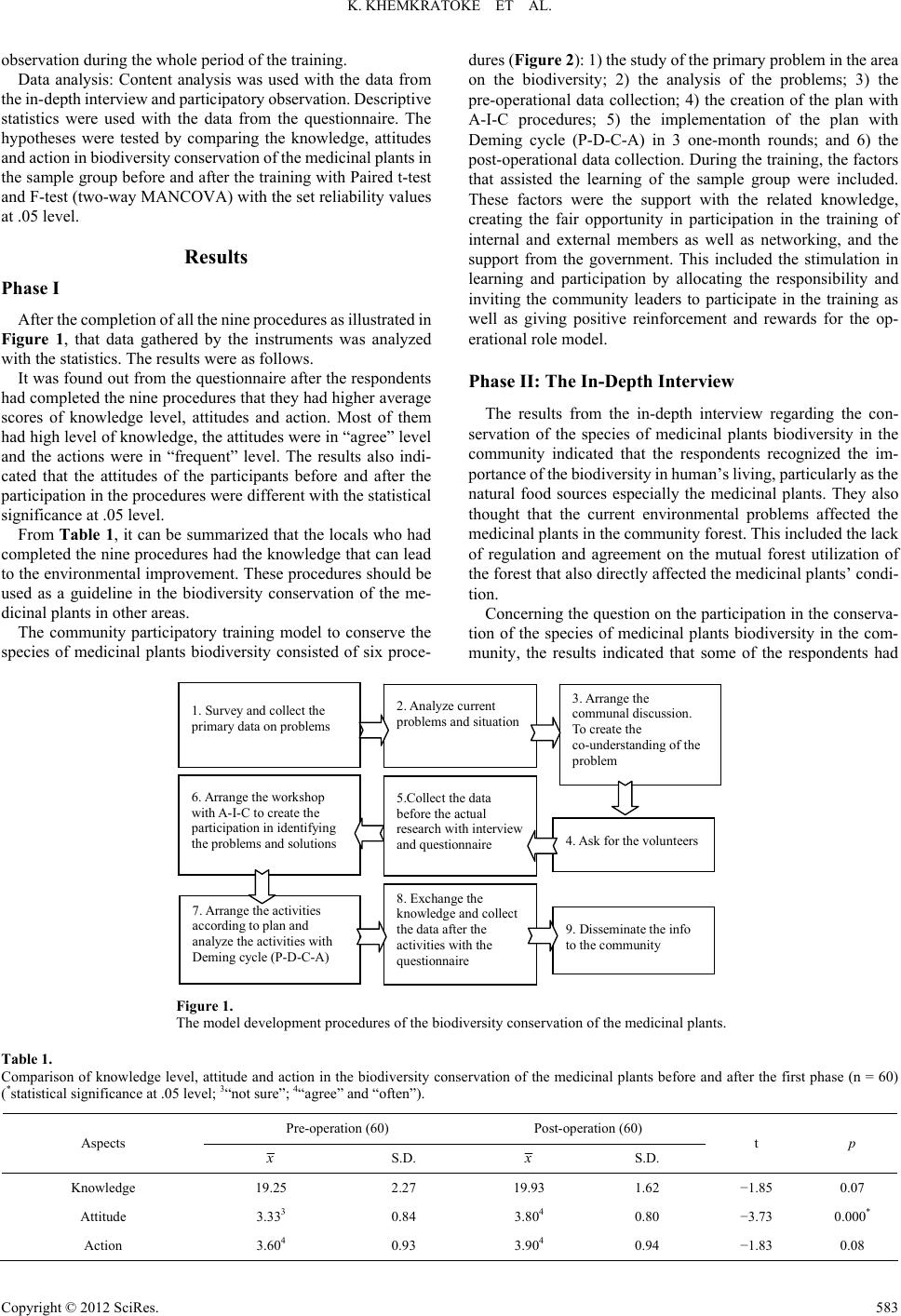 K. KHEMKRATOKE ET AL. Copyright © 2012 SciRes. 583 observation during the whole period of the training. dures (Figure 2): 1) the study of the primary problem in the area on the biodiversity; 2) the analysis of the problems; 3) the pre-operational data collection; 4) the creation of the plan with A-I-C procedures; 5) the implementation of the plan with Deming cycle (P-D-C-A) in 3 one-month rounds; and 6) the post-operational data collection. During the training, the factors that assisted the learning of the sample group were included. These factors were the support with the related knowledge, creating the fair opportunity in participation in the training of internal and external members as well as networking, and the support from the government. This included the stimulation in learning and participation by allocating the responsibility and inviting the community leaders to participate in the training as well as giving positive reinforcement and rewards for the op- erational role model. Data analysis: Content analysis was used with the data from the in-depth interview and participatory observation. Descriptive statistics were used with the data from the questionnaire. The hypotheses were tested by comparing the knowledge, attitudes and action in biodiversity conservation of the medicinal plants in the sample group before and after the training with Paired t-test and F-test (two-way MANCOVA) with the set reliability values at .05 level. Results Phase I After the completion of all the nine procedures as illustrated in Figure 1, that data gathered by the instruments was analyzed with the statistics. The results were as follows. It was found out from the questionnaire after the respondents had completed the nine procedures that they had higher average scores of knowledge level, attitudes and action. Most of them had high level of knowledge, the attitudes were in “agree” level and the actions were in “frequent” level. The results also indi- cated that the attitudes of the participants before and after the participation in the procedures were different with the statistical significance at .05 level. Phase II: The In-Depth Interview The results from the in-depth interview regarding the con- servation of the species of medicinal plants biodiversity in the community indicated that the respondents recognized the im- portance of the biodiversity in human’s living, particularly as the natural food sources especially the medicinal plants. They also thought that the current environmental problems affected the medicinal plants in the community forest. This included the lack of regulation and agreement on the mutual forest utilization of the forest that also directly affected the medicinal plants’ condi- tion. From Table 1, it can be summarized that the locals who had completed the nine procedures had the knowledge that can lead to the environmental improvement. These procedures should be used as a guideline in the biodiversity conservation of the me- dicinal plants in other areas. Concerning the question on the participation in the conserva- tion of the species of medicinal plants biodiversity in the com- munity, the results indicated that some of the respondents had The community participatory training model to conserve the species of medicinal plants biodiversity consisted of six proce- 3. Arrange the communal discussion. To create the co-understanding of the problem 6. Arrange the workshop with A-I-C to create the participation in identifying the problems and solutions 1. Survey and collect the primary data on problems 2. Analyze current problems and situation 4. Ask for the volunteers 9. Disseminate the info to the community 5.Collect the data before the actual research with interview and questionnaire 7. Arrange the activities according to plan and analyze the activities with Deming cycle (P-D-C-A) 8. Exchange the knowledge and collect the data after the activities with the questionnaire Figure 1. The model development procedures of the biodiversity conservation of the medicinal plants. Table 1. Comparison of knowledge level, attitude and action in the biodiversity conservation of the medicinal plants before and after the first phase (n = 60) (*statistical significance at .05 level; 3“not sure”; 4“agree” and “often”). Pre-operation (60) Post-operation (60) Aspects x S.D. x S.D. t p Knowledge 19.25 2.27 19.93 1.62 −1.85 0.07 Attitude 3.333 0.84 3.804 0.80 −3.73 0.000* Action 3.604 0.93 3.904 0.94 −1.83 0.08 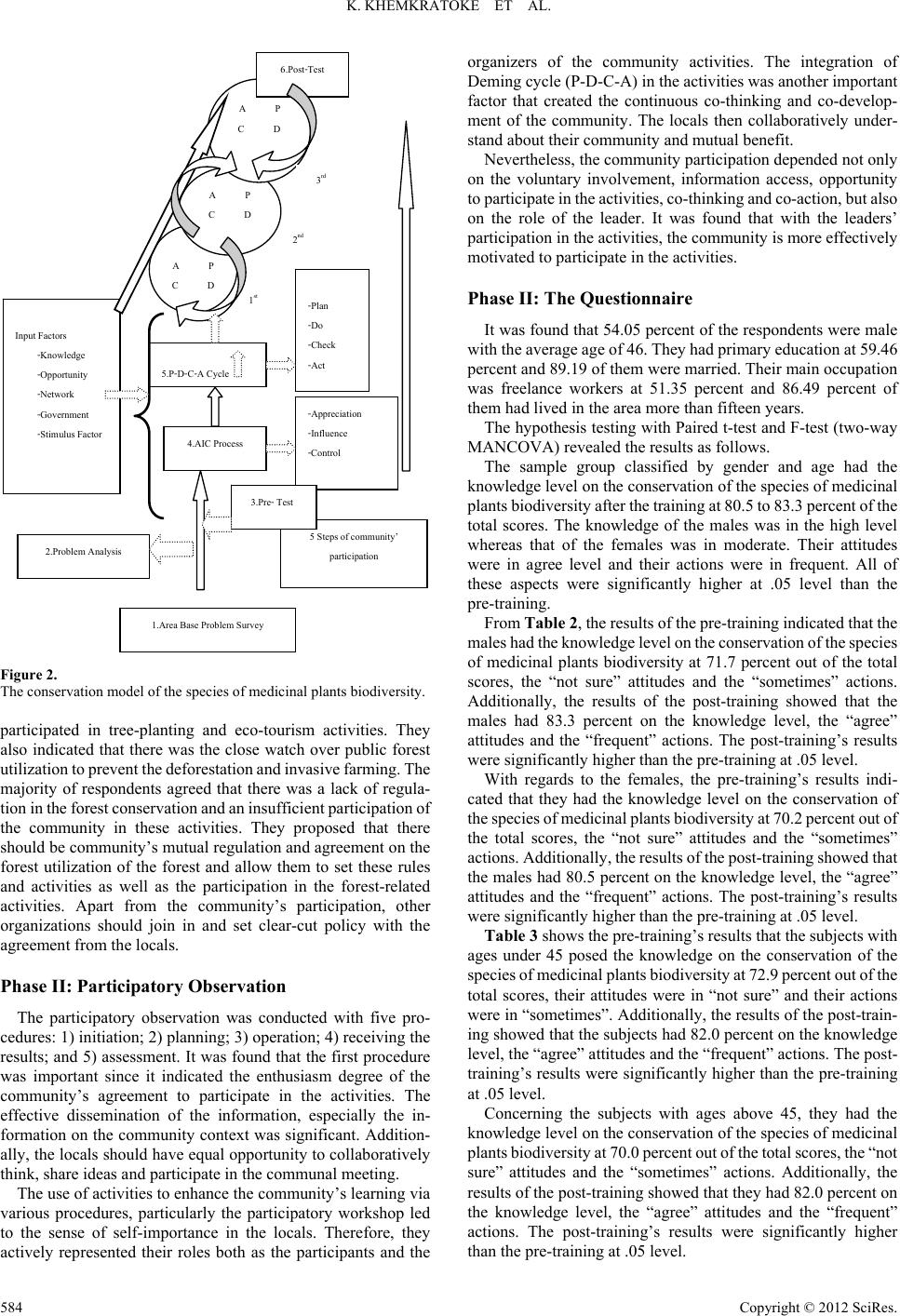 K. KHEMKRATOKE ET AL. 1.Area Base Problem Survey 4.AIC Process 5.P-D-C-A Cycle Input Factors -Knowledge -Opportunity -Network -Government -Stimulus Factor -Plan -Do -Check -Act -Appreciation -Influence -Control A P C D A P C D A P C D 6.Pos t -Test 1s t 2nd 3rd 5 Steps of community’ participation 2.Problem Analysis 3.Pre- Test Figure 2. The conservation model of the species of medicinal plants biodiversity. participated in tree-planting and eco-tourism activities. They also indicated that there was the close watch over public forest utilization to prevent the deforestation and invasive farming. The majority of respondents agreed that there was a lack of regula- tion in the forest conservation and an insufficient participation of the community in these activities. They proposed that there should be community’s mutual regulation and agreement on the forest utilization of the forest and allow them to set these rules and activities as well as the participation in the forest-related activities. Apart from the community’s participation, other organizations should join in and set clear-cut policy with the agreement from the locals. Phase II: Participatory Observation The participatory observation was conducted with five pro- cedures: 1) initiation; 2) planning; 3) operation; 4) receiving the results; and 5) assessment. It was found that the first procedure was important since it indicated the enthusiasm degree of the community’s agreement to participate in the activities. The effective dissemination of the information, especially the in- formation on the community context was significant. Addition- ally, the locals should have equal opportunity to collaboratively think, share ideas and participate in the communal meeting. The use of activities to enhance the community’s learning via various procedures, particularly the participatory workshop led to the sense of self-importance in the locals. Therefore, they actively represented their roles both as the participants and the organizers of the community activities. The integration of Deming cycle (P-D-C-A) in the activities was another important factor that created the continuous co-thinking and co-develop- ment of the community. The locals then collaboratively under- stand about their community and mutual benefit. Nevertheless, the community participation depended not only on the voluntary involvement, information access, opportunity to participate in the activities, co-thinking and co-action, but also on the role of the leader. It was found that with the leaders’ participation in the activities, the community is more effectively motivated to participate in the activities. Phase II: The Questionnaire It was found that 54.05 percent of the respondents were male with the average age of 46. They had primary education at 59.46 percent and 89.19 of them were married. Their main occupation was freelance workers at 51.35 percent and 86.49 percent of them had lived in the area more than fifteen years. The hypothesis testing with Paired t-test and F-test (two-way MANCOVA) revealed the results as follows. The sample group classified by gender and age had the knowledge level on the conservation of the species of medicinal plants biodiversity after the training at 80.5 to 83.3 percent of the total scores. The knowledge of the males was in the high level whereas that of the females was in moderate. Their attitudes were in agree level and their actions were in frequent. All of these aspects were significantly higher at .05 level than the pre-training. From Table 2, the results of the pre-training indicated that the males had the knowledge level on the conservation of the species of medicinal plants biodiversity at 71.7 percent out of the total scores, the “not sure” attitudes and the “sometimes” actions. Additionally, the results of the post-training showed that the males had 83.3 percent on the knowledge level, the “agree” attitudes and the “frequent” actions. The post-training’s results were significantly higher than the pre-training at .05 level. With regards to the females, the pre-training’s results indi- cated that they had the knowledge level on the conservation of the species of medicinal plants biodiversity at 70.2 percent out of the total scores, the “not sure” attitudes and the “sometimes” actions. Additionally, the results of the post-training showed that the males had 80.5 percent on the knowledge level, the “agree” attitudes and the “frequent” actions. The post-training’s results were significantly higher than the pre-training at .05 level. Table 3 shows the pre-training’s results that the subjects with ages under 45 posed the knowledge on the conservation of the species of medicinal plants biodiversity at 72.9 percent out of the total scores, their attitudes were in “not sure” and their actions were in “sometimes”. Additionally, the results of the post-train- ing showed that the subjects had 82.0 percent on the knowledge level, the “agree” attitudes and the “frequent” actions. The post- training’s results were significantly higher than the pre-training at .05 level. Concerning the subjects with ages above 45, they had the knowledge level on the conservation of the species of medicinal plants biodiversity at 70.0 percent out of the total scores, the “not sure” attitudes and the “sometimes” actions. Additionally, the results of the post-training showed that they had 82.0 percent on the knowledge level, the “agree” attitudes and the “frequent” actions. The post-training’s results were significantly higher han the pre-training at .05 level. t Copyright © 2012 SciRes. 584 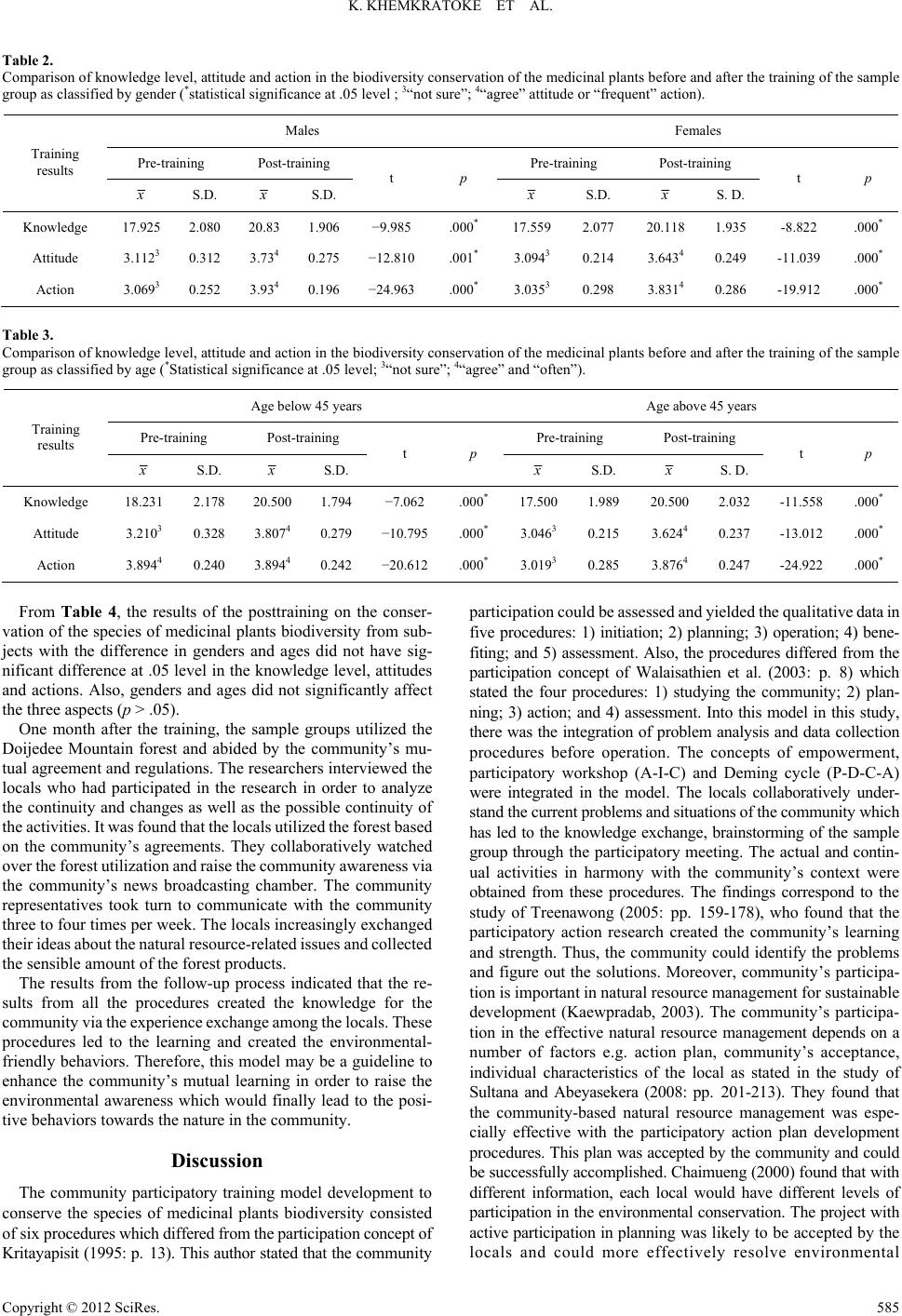 K. KHEMKRATOKE ET AL. Table 2. Comparison of knowledge level, attitude and action in the biodiversity conservation of the medicinal plants before and after the training of the sample group as classified by gender (*statistical significance at .05 level ; 3“not sure”; 4“agree” attitude or “frequent” action). Males Females Pre-training Post-training Pre-training Post-training Training results x S.D. x S.D. t p x S.D. x S. D. t p Knowledge 17.925 2.080 20.83 1.906 −9.985 .000* 17.559 2.077 20.118 1.935 -8.822 .000* Attitude 3.1123 0.312 3.734 0.275 −12.810 .001* 3.0943 0.214 3.6434 0.249 -11.039 .000* Action 3.0693 0.252 3.934 0.196 −24.963 .000* 3.0353 0.298 3.8314 0.286 -19.912 .000* Table 3. Comparison of knowledge level, attitude and action in the biodiversity conservation of the medicinal plants before and after the training of the sample group as classified by age (*Statistical significance at .05 level; 3“not sure”; 4“agree” and “often”). Age below 45 years Age above 45 years Pre-training Post-training Pre-training Post-training Training results x S.D. x S.D. t p x S.D. x S. D. t p Knowledge 18.231 2.178 20.500 1.794 −7.062 .000* 17.500 1.989 20.500 2.032 -11.558 .000* Attitude 3.2103 0.328 3.8074 0.279 −10.795 .000* 3.0463 0.215 3.6244 0.237 -13.012 .000* Action 3.8944 0.240 3.8944 0.242 −20.612 .000* 3.0193 0.285 3.8764 0.247 -24.922 .000* From Table 4, the results of the posttraining on the conser- vation of the species of medicinal plants biodiversity from sub- jects with the difference in genders and ages did not have sig- nificant difference at .05 level in the knowledge level, attitudes and actions. Also, genders and ages did not significantly affect the three aspects (p > .05). One month after the training, the sample groups utilized the Doijedee Mountain forest and abided by the community’s mu- tual agreement and regulations. The researchers interviewed the locals who had participated in the research in order to analyze the continuity and changes as well as the possible continuity of the activities. It was found that the locals utilized the forest based on the community’s agreements. They collaboratively watched over the forest utilization and raise the community awareness via the community’s news broadcasting chamber. The community representatives took turn to communicate with the community three to four times per week. The locals increasingly exchanged their ideas about the natural resource-related issues and collected the sensible amount of the forest products. The results from the follow-up process indicated that the re- sults from all the procedures created the knowledge for the community via the experience exchange among the locals. These procedures led to the learning and created the environmental- friendly behaviors. Therefore, this model may be a guideline to enhance the community’s mutual learning in order to raise the environmental awareness which would finally lead to the posi- tive behaviors towards the nature in the community. Discussion The community participatory training model development to conserve the species of medicinal plants biodiversity consisted of six procedures which differed from the participation concept of Kritayapisit (1995: p. 13). This author stated that the community participation could be assessed and yielded the qualitative data in five procedures: 1) initiation; 2) planning; 3) operation; 4) bene- fiting; and 5) assessment. Also, the procedures differed from the participation concept of Walaisathien et al. (2003: p. 8) which stated the four procedures: 1) studying the community; 2) plan- ning; 3) action; and 4) assessment. Into this model in this study, there was the integration of problem analysis and data collection procedures before operation. The concepts of empowerment, participatory workshop (A-I-C) and Deming cycle (P-D-C-A) were integrated in the model. The locals collaboratively under- stand the current problems and situations of the community which has led to the knowledge exchange, brainstorming of the sample group through the participatory meeting. The actual and contin- ual activities in harmony with the community’s context were obtained from these procedures. The findings correspond to the study of Treenawong (2005: pp. 159-178), who found that the participatory action research created the community’s learning and strength. Thus, the community could identify the problems and figure out the solutions. Moreover, community’s participa- tion is important in natural resource management for sustainable development (Kaewpradab, 2003). The community’s participa- tion in the effective natural resource management depends on a number of factors e.g. action plan, community’s acceptance, individual characteristics of the local as stated in the study of Sultana and Abeyasekera (2008: pp. 201-213). They found that the community-based natural resource management was espe- cially effective with the participatory action plan development procedures. This plan was accepted by the community and could be successfully accomplished. Chaimueng (2000) found that with different information, each local would have different levels of participation in the environmental conservation. The project with active participation in planning was likely to be accepted by the locals and could more effectively resolve environmental Copyright © 2012 SciRes. 585 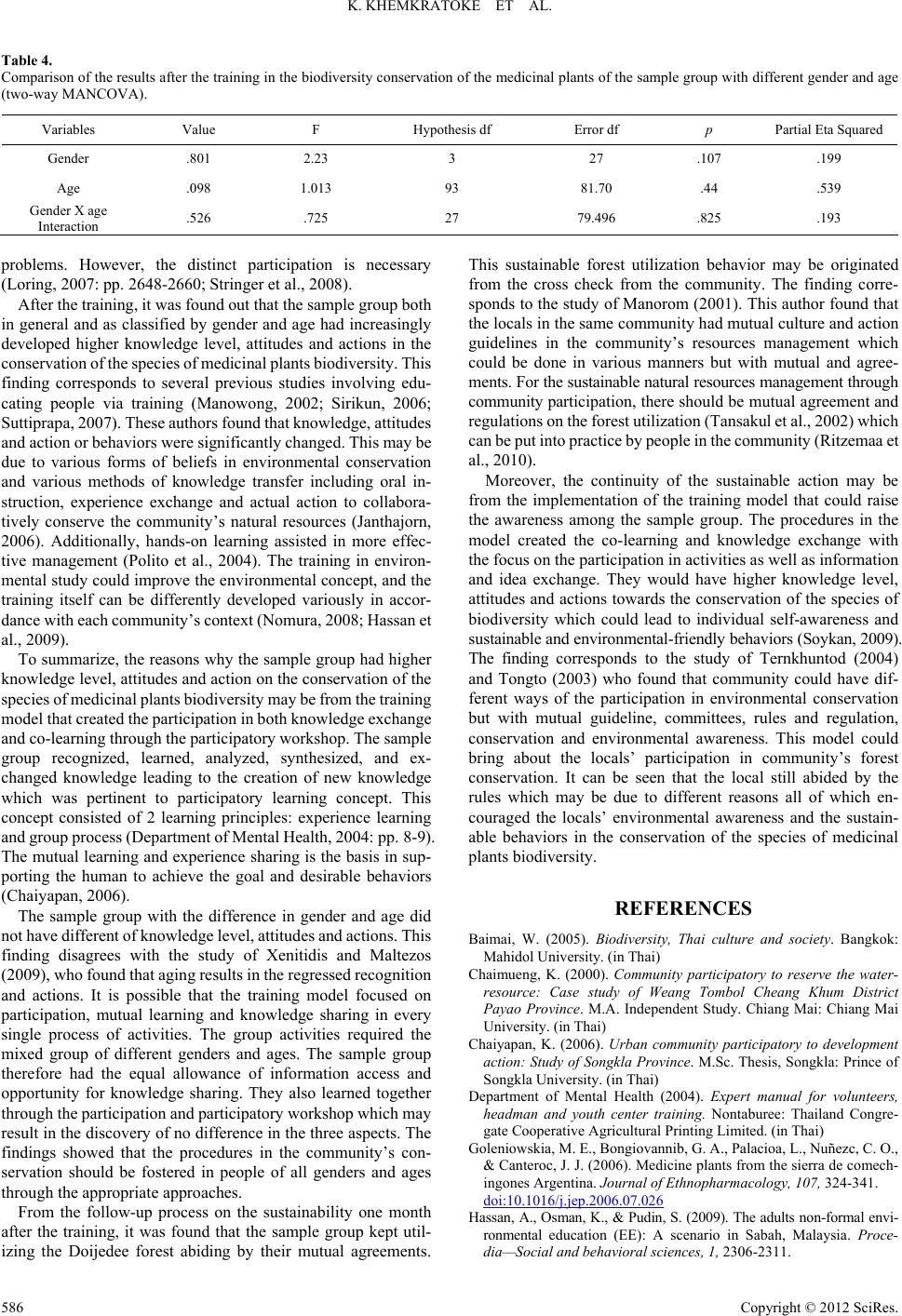 K. KHEMKRATOKE ET AL. Table 4. Comparison of the results after the training in the biodiversity conservation of the medicinal plants of the sample group with different gender and age (two-way MANCOVA). Variables Value F Hypothesis df Error df p Partial Eta Squared Gender .801 2.23 3 27 .107 .199 Age .098 1.013 93 81.70 .44 .539 Gender X age Interaction .526 .725 27 79.496 .825 .193 problems. However, the distinct participation is necessary (Loring, 2007: pp. 2648-2660; Stringer et al., 2008). After the training, it was found out that the sample group both in general and as classified by gender and age had increasingly developed higher knowledge level, attitudes and actions in the conservation of the species of medicinal plants biodiversity. This finding corresponds to several previous studies involving edu- cating people via training (Manowong, 2002; Sirikun, 2006; Suttiprapa, 2007). These authors found that knowledge, attitudes and action or behaviors were significantly changed. This may be due to various forms of beliefs in environmental conservation and various methods of knowledge transfer including oral in- struction, experience exchange and actual action to collabora- tively conserve the community’s natural resources (Janthajorn, 2006). Additionally, hands-on learning assisted in more effec- tive management (Polito et al., 2004). The training in environ- mental study could improve the environmental concept, and the training itself can be differently developed variously in accor- dance with each community’s context (Nomura, 2008; Hassan et al., 2009). To summarize, the reasons why the sample group had higher knowledge level, attitudes and action on the conservation of the species of medicinal plants biodiversity may be from the training model that created the participation in both knowledge exchange and co-learning through the participatory workshop. The sample group recognized, learned, analyzed, synthesized, and ex- changed knowledge leading to the creation of new knowledge which was pertinent to participatory learning concept. This concept consisted of 2 learning principles: experience learning and group process (Department of Mental Health, 2004: pp. 8-9). The mutual learning and experience sharing is the basis in sup- porting the human to achieve the goal and desirable behaviors (Chaiyapan, 2006). The sample group with the difference in gender and age did not have different of knowledge level, attitudes and actions. This finding disagrees with the study of Xenitidis and Maltezos (2009), who found that aging results in the regressed recognition and actions. It is possible that the training model focused on participation, mutual learning and knowledge sharing in every single process of activities. The group activities required the mixed group of different genders and ages. The sample group therefore had the equal allowance of information access and opportunity for knowledge sharing. They also learned together through the participation and participatory workshop which may result in the discovery of no difference in the three aspects. The findings showed that the procedures in the community’s con- servation should be fostered in people of all genders and ages through the appropriate approaches. From the follow-up process on the sustainability one month after the training, it was found that the sample group kept util- izing the Doijedee forest abiding by their mutual agreements. This sustainable forest utilization behavior may be originated from the cross check from the community. The finding corre- sponds to the study of Manorom (2001). This author found that the locals in the same community had mutual culture and action guidelines in the community’s resources management which could be done in various manners but with mutual and agree- ments. For the sustainable natural resources management through community participation, there should be mutual agreement and regulations on the forest utilization (Tansakul et al., 2002) which can be put into practice by people in the community (Ritzemaa et al., 2010). Moreover, the continuity of the sustainable action may be from the implementation of the training model that could raise the awareness among the sample group. The procedures in the model created the co-learning and knowledge exchange with the focus on the participation in activities as well as information and idea exchange. They would have higher knowledge level, attitudes and actions towards the conservation of the species of biodiversity which could lead to individual self-awareness and sustainable and environmental-friendly behaviors (Soykan, 2009). The finding corresponds to the study of Ternkhuntod (2004) and Tongto (2003) who found that community could have dif- ferent ways of the participation in environmental conservation but with mutual guideline, committees, rules and regulation, conservation and environmental awareness. This model could bring about the locals’ participation in community’s forest conservation. It can be seen that the local still abided by the rules which may be due to different reasons all of which en- couraged the locals’ environmental awareness and the sustain- able behaviors in the conservation of the species of medicinal plants biodiversity. REFERENCES Baimai, W. (2005). Biodiversity, Thai culture and society. Bangkok: Mahidol University. (in Thai) Chaimueng, K. (2000). Community participatory to reserve the water- resource: Case study of Weang Tombol Cheang Khum District Payao Province. M.A. Independent Study. Chiang Mai: Chiang Mai University. (in Thai) Chaiyapan, K. (2006). Urban community participatory to development action: Study of Songkla Province. M.Sc. Thesis, Songkla: Prince of Songkla University. (in Thai) Department of Mental Health (2004). Expert manual for volunteers, headman and youth center training. Nontaburee: Thailand Congre- gate Cooperative Agricultural Printing Limited. (in Thai) Goleniowskia, M. E., Bongiovannib, G. A., Palacioa, L., Nuñezc, C. O., & Canteroc, J. J. (2006). Medicine plants from the sierra de comech- ingones Argentina. Journal of Ethnopharmacolog y, 107, 324-341. doi:10.1016/j.jep.2006.07.026 Hassan, A., Osman, K., & Pudin, S. (2009). The adults non-formal envi- ronmental education (EE): A scenario in Sabah, Malaysia. Proce- dia—Social and behav i o ral sciences, 1, 2306-2311. Copyright © 2012 SciRes. 586  K. KHEMKRATOKE ET AL. Janthajorn, S. (2006). Intellect broadcast about land water and forest resource of Kaleang ethic. Maha Sarakham: Research Institute of Art and Esan Cultural. (in Thai) Kaewpradap, S. (2003). Authority’s community to management about the natural resource and environment for sustainable development: From local culture to Thai politics reform. M.PA. Thesis, Bangkok: Julalongkorn University. (in Thai) Karnchanarangsi, K. (2004). Community plan, counter balance to rein- force of community management. Uttaradit: Uttaradit Rajabhat Uni- versity. (in Thai) Kritayapisit, T. (1995). Participation of the village and community leaders in Nong Jok District on the activity development project based on “Borom” and “Bovorn” to create the golden land ideology. M.Sc. Thesis, Bangkok: Thammasat University. (in Thai) Lagabrielle, E., Bottac, A., Daréd, W., Davide, D., Aubertf, S., & Fab- ricius, C. (2010). Modeling with stakeholders to integrate biodiver- sity in to land-use planning-lessons learned in Reunion island (West- ern Indian Ocean). Environmental Modeling & Software, 25, 1413- 1427. Local Administration Organization Office of Bungprue (2006). Bung- prue sub district tourism data, Teparak District Nakhonrajsima Province. URL (last checked October 2006). http://www.bungprue.go.th (in Thai) Loring, J. M. (2007). Wind energy planning in England, Wales and Denmark: Factors influencing project success. Energy Policy, 35, 2648-2660. doi:10.1016/j.enpol.2006.10.008 Manorom, K. (2001). Culture for development and reduce community economics: Case study of the communities that have impact from Pakmoon dam. M.S. Thesis, Ubonratchatani: Ubonratchatani Uni- versity. (in Thai) Mendoza, G. A., & Prabhu, R. (2006). Participatory modeling and analysis for sustainable forest management: Overview of soft system dynamics models and applications. Forest Policy and Economics, 9, 179-196. doi:10.1016/j.forpol.2005.06.006 Nomura, K. (2009). Perspective on education for sustainable develop- ment: Historical development of environmental education in Indone- sia. International Journal of Educational Development, 29, 621-627. doi:10.1016/j.ijedudev.2008.12.002 Nopkesorn, T. (2006). Qualitative research methodology 1. Nakhon Ratchasima: Chokcharoen Marketing. (in Thai) Office of Natural Resources and Environmental Policy and Planning (2006). 2010 goal and operation to achieve the goal on the strategic plan of biodiversity convention. Bangkok: Ministry of Natural Re- sources and Environment. (in Thai) Polito, T., Kros, J., & Watsan, K. (2004). Improving operation man- agement concept recollection via the zero experiential learning activ- ity. Journal of Education for Busin e s s, 79, 283-286. doi:10.3200/JOEB.79.5.283-286 Ritzemaa, H., Froebricha, J., Rajub, R., Sreenivasc, C., & Kselik, R. (2010). Using participatory modeling to compensate for data scarcity in environmental planning: A case study from India. Environmental Modelling & Software, 2 5 , 1450-1458. doi:10.1016/j.envsoft.2010.03.010 Samleekaeow, S. (2002). Local course development: The conservation of mangrove forest for Secondary Education 5. M.Ed. Thesis, Bang- kok: Silpakorn University. (in Thai) Sirikhun, S. (2006). Participatory to change behavior for protect pesti- cide effect of tomato occupational worker in Muang District, Sakon- nakhorn Province. M.PH. Thesis, Khon Kaen: Khonkaen University. (in Thai) Soykan, A. (2009). Ecology—Based environmental education in years between 1999-2008 in protected areas of Turkey: Aims and objec- tives, problems and suggestions. Procedia—Social and Behavioral Sciences, 1, 1704-1708. Stringera, L. C., Scrieciub, S. S., & Reed, M. S. (2009). Biodiversity, land degradation, and climate change: Participatory planning in Ro- mania. Applied Geography, 29, 77-90. doi:10.1016/j.apgeog.2008.07.008 Sultana, P., & Abeyasekera, S. (2008). Effectiveness of participatory planning for community management of fisheries in Bangladesh. Journal of Environm e ntal Management, 86, 201-213. doi:10.1016/j.jenvman.2006.12.027 Suttiprapa, T. (2007). Participatory learning to reduce health and environments impact from pesticide used and change behavior of pesticide user. Ph.D. Dissertation, Maha Sarakham: Mahasarakham University. (in Thai) Tansakul, R. et al. (2002). Coast resource management based on com- munity participatory in Thajana bay, Surajtanee Province, Thailand. Bangkok: Feangfa Printing. (in Thai) Ternkhuntod, M. (2004). Community’s participatory to development of region organization: Case study of region organizations in Samut Prakan Province. M.PH. Thesis, Bangkok: Huachiew Chalerm- prakiet University. (in Thai) Tongto, K. (2003). Community participation to reserve Fai forest, Khong Khoun Sub District Nadoon District Mahasarakham Province. M.S. Thesis, Maha Sarakham: Mahasarakham University. (in Thai) Treenawong, S. (2005). Participatory to development of Sub-District plan: Case study of Sam Bundit sub-District, Uthai-District, Ayut- taya Province. M.A. Thesis, Ayuttaya: Ayuttaya Rajabhat University. (in Thai) Walaisathien, P. et al. (2003). Process and working technical of devel- opment worker. Bangkok: Learning for healthy Community Project. (in Thai) Wanichbancha, K. (2007). Multivariate analysis (2nd ed.). Bangkok: Thammasarn Co. Ltd. (in Thai) Xenitidis, K., & Maltezis, S. (2009). Attention deficit hyperactivity disorder in adults with learning disabilities. Psychiatry, 8, 402-404. doi:10.1016/j.mppsy.2009.06.021 Copyright © 2012 SciRes. 587 |