

Paper Menu >>
Journal Menu >>
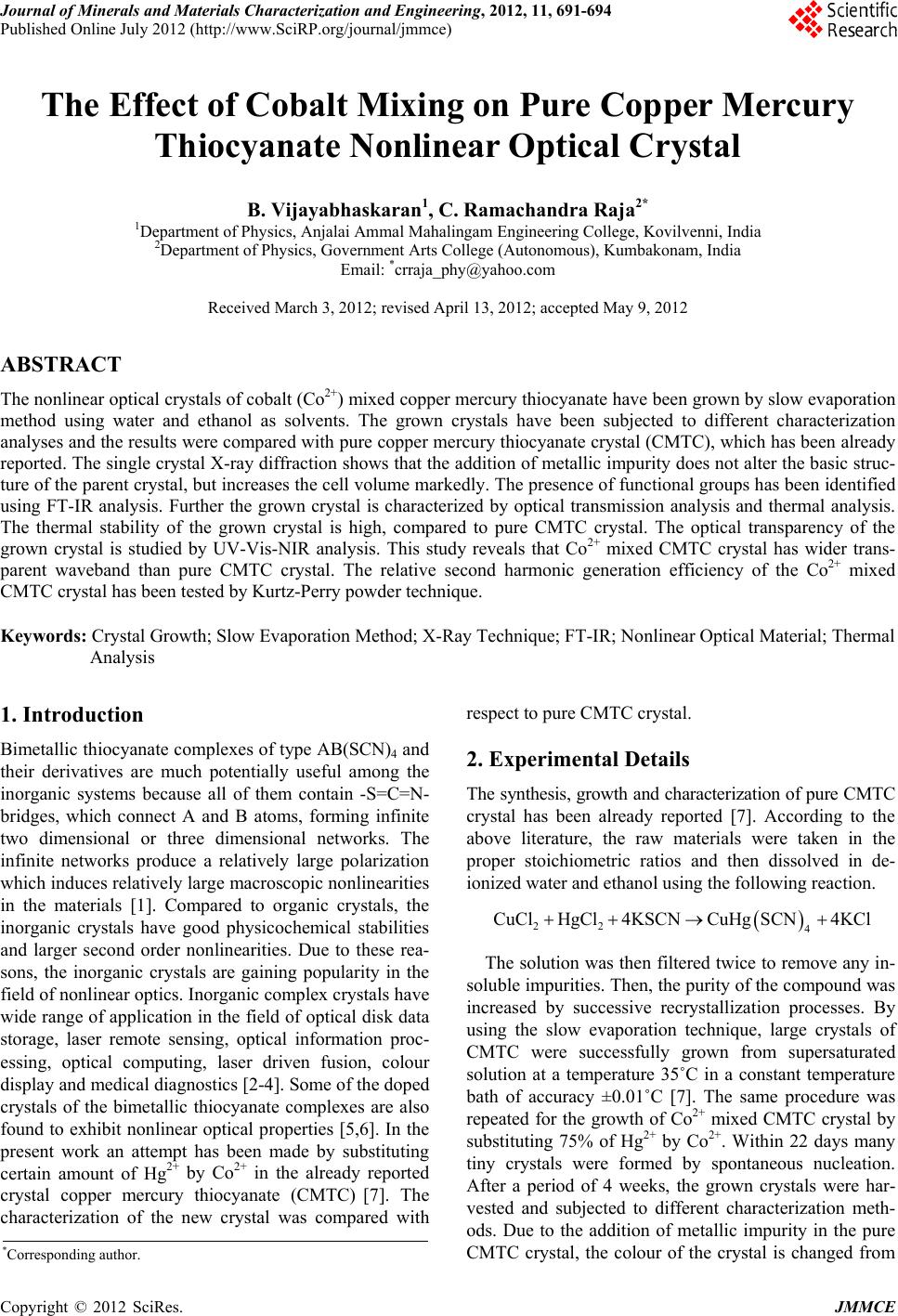 Journal of Minerals and Materials Characterization and Engineering, 2012, 11, 691-694 Published Online July 2012 (http://www.SciRP.org/journal/jmmce) The Effect of Cobalt Mixing on P u re Copper Me rcury Thiocyanate Nonlinear Optical Crystal B. Vijayabhaskaran1, C. Ramachandra Raja2* 1Department of Physics, Anjalai Ammal Mahalingam Engineering College, Kovilvenni, India 2Department of Physics, Government Arts College (Autonomous), Kumbakonam, India Email: *[email protected] Received March 3, 2012; revised April 13, 2012; accepted May 9, 2012 ABSTRACT The nonlinear optical crystals of cobalt (Co2+) mixed copper mercury thiocyanate have been grown by slow evaporation method using water and ethanol as solvents. The grown crystals have been subjected to different characterization analyses and the results were compared with pure copper mercury thiocyanate crystal (CMTC), which has been already reported. The single crystal X-ray diffraction shows that the addition of metallic impurity does not alter the basic struc- ture of the parent crystal, but increases the cell volume markedly. The presence of functional groups has been identified using FT-IR analysis. Further the grown crystal is characterized by optical transmission analysis and thermal analysis. The thermal stability of the grown crystal is high, compared to pure CMTC crystal. The optical transparency of the grown crystal is studied by UV-Vis-NIR analysis. This study reveals that Co2+ mixed CMTC crystal has wider trans- parent waveband than pure CMTC crystal. The relative second harmonic generation efficiency of the Co2+ mixed CMTC crystal has been tested by Kurtz-Perry powder technique. Keywords: Crystal Growth; Slow Evaporation Method; X-Ray Technique; FT-IR; Nonlinear Optical Material; Thermal Analysis 1. Introduction Bimetallic thiocyanate complexes of type AB(SCN)4 and their derivatives are much potentially useful among the inorganic systems because all of them contain -S=C=N- bridges, which connect A and B atoms, forming infinite two dimensional or three dimensional networks. The infinite networks produce a relatively large polarization which induces relatively large macroscopic nonlinearities in the materials [1]. Compared to organic crystals, the inorganic crystals have good physicochemical stabilities and larger second order nonlinearities. Due to these rea- sons, the inorganic crystals are gaining popularity in the field of nonlinear optics. Inorganic complex crystals have wide range of application in the field of optical disk data storage, laser remote sensing, optical information proc- essing, optical computing, laser driven fusion, colour display and medical diagnostics [2-4]. Some of the doped crystals of the bimetallic thiocyanate complexes are also found to exhibit nonlinear optical properties [5,6]. In the present work an attempt has been made by substituting certain amount of Hg2+ by Co2+ in the already reported crystal copper mercury thiocyanate (CMTC) [7]. The characterization of the new crystal was compared with respect to pure CMTC crystal. 2. Experimental Details The synthesis, growth and characterization of pure CMTC crystal has been already reported [7]. According to the above literature, the raw materials were taken in the proper stoichiometric ratios and then dissolved in de- ionized water and ethanol using the following reaction. 22 4 CuClHgCl4KSCNCuHg SCN4KCl The solution was then filtered twice to remove any in- soluble impurities. Then, the purity of the compound was increased by successive recrystallization processes. By using the slow evaporation technique, large crystals of CMTC were successfully grown from supersaturated solution at a temperature 35˚C in a constant temperature bath of accuracy ±0.01˚C [7]. The same procedure was repeated for the growth of Co2+ mixed CMTC crystal by substituting 75% of Hg2+ by Co2+. Within 22 days many tiny crystals were formed by spontaneous nucleation. After a period of 4 weeks, the grown crystals were har- vested and subjected to different characterization meth- ods. Due to the addition of metallic impurity in the pure CMTC crystal, the colour of the crystal is changed from *Corresponding author. Copyright © 2012 SciRes. JMMCE 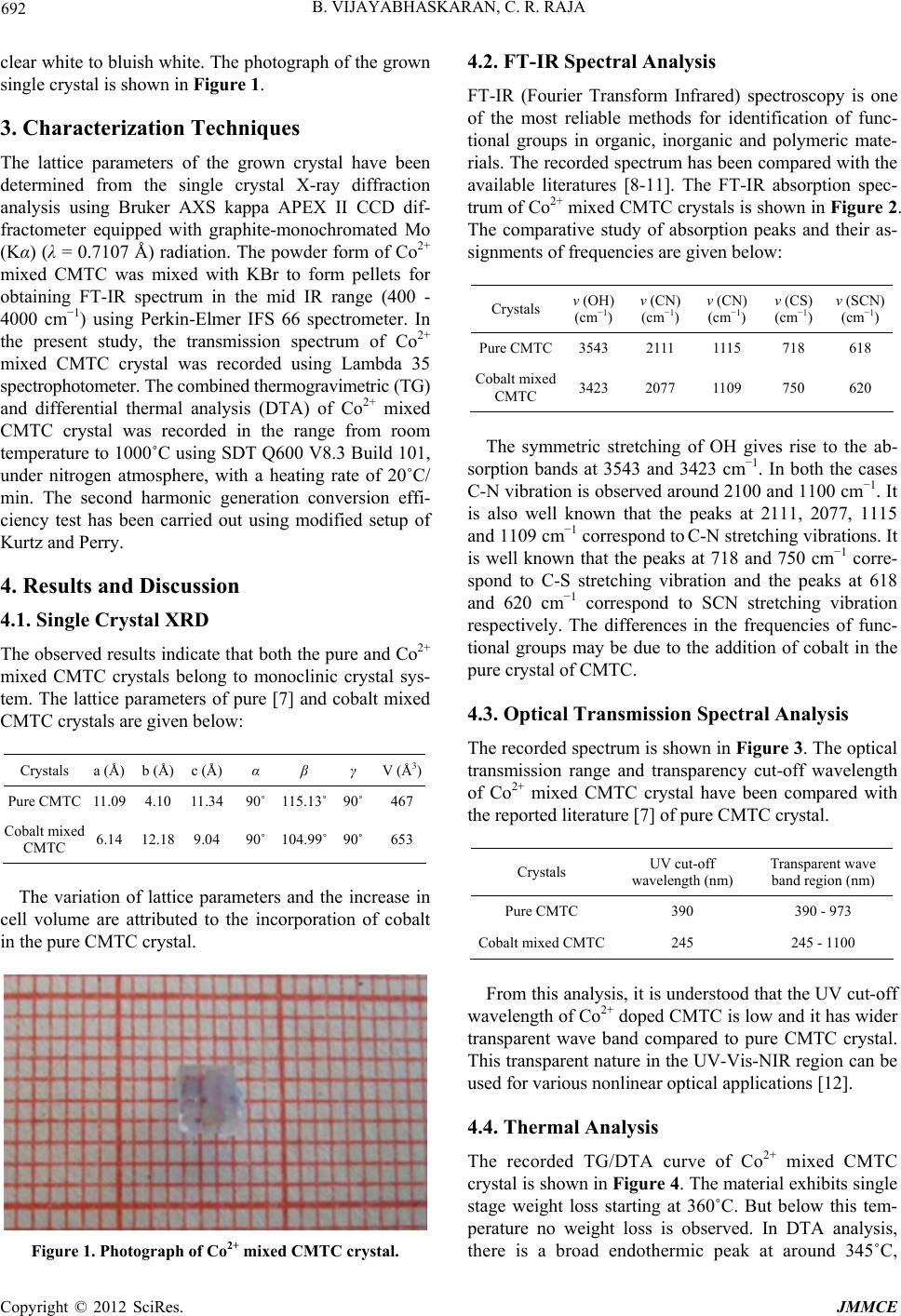 B. VIJAYABHASKARAN, C. R. RAJA 692 clear white to bluish white. The photograph of the grown single crystal is shown in Figure 1. 3. Characterization Techniques The lattice parameters of the grown crystal have been determined from the single crystal X-ray diffraction analysis using Bruker AXS kappa APEX II CCD dif- fractometer equipped with graphite-monochromated Mo (Kα) (λ = 0.7107 Å) radiation. The powder form of Co2+ mixed CMTC was mixed with KBr to form pellets for obtaining FT-IR spectrum in the mid IR range (400 - 4000 cm−1) using Perkin-Elmer IFS 66 spectrometer. In the present study, the transmission spectrum of Co2+ mixed CMTC crystal was recorded using Lambda 35 spectrophotometer. The combined thermogravimetric (TG) and differential thermal analysis (DTA) of Co2+ mixed CMTC crystal was recorded in the range from room temperature to 1000˚C using SDT Q600 V8.3 Build 101, under nitrogen atmosphere, with a heating rate of 20˚C/ min. The second harmonic generation conversion effi- ciency test has been carried out using modified setup of Kurtz and Perry. 4. Results and Discussion 4.1. Single Crystal XRD The observed results indicate that both the pure and Co2+ mixed CMTC crystals belong to monoclinic crystal sys- tem. The lattice parameters of pure [7] and cobalt mixed CMTC crystals are given below: Crystals a (Å) b (Å) c (Å)α β γ V (Å3) Pure CMTC 11.09 4.10 11.3490˚ 115.13˚ 90˚467 Cobalt mixed CMTC 6.14 12.18 9.0490˚ 104.99˚ 90˚653 The variation of lattice parameters and the increase in cell volume are attributed to the incorporation of cobalt in the pure CMTC crystal. Figure 1. Photograph of Co2+ mixed CMTC crystal. 4.2. FT-IR Spectral Analysis FT-IR (Fourier Transform Infrared) spectroscopy is one of the most reliable methods for identification of func- tional groups in organic, inorganic and polymeric mate- rials. The recorded spectrum has been compared with the available literatures [8-11]. The FT-IR absorption spec- trum of Co2+ mixed CMTC crystals is shown in Figure 2. The comparative study of absorption peaks and their as- signments of frequencies are given below: Crystals ν (OH) (cm−1) ν (CN) (cm−1) ν (CN) (cm−1) ν (CS) (cm−1) ν (SCN) (cm−1) Pure CMTC3543 2111 1115 718 618 Cobalt mixed CMTC 3423 2077 1109 750 620 The symmetric stretching of OH gives rise to the ab- sorption bands at 3543 and 3423 cm−1. In both the cases C-N vibration is observed around 2100 and 1100 cm−1. It is also well known that the peaks at 2111, 2077, 1115 and 1109 cm−1 correspond to C-N stretching vibrations. It is well known that the peaks at 718 and 750 cm−1 corre- spond to C-S stretching vibration and the peaks at 618 and 620 cm−1 correspond to SCN stretching vibration respectively. The differences in the frequencies of func- tional groups may be due to the addition of cobalt in the pure crystal of CMTC. 4.3. Optical Transmission Spectral Analysis The recorded spectrum is shown in Figure 3. The optical transmission range and transparency cut-off wavelength of Co2+ mixed CMTC crystal have been compared with the reported literature [7] of pure CMTC crystal. Crystals UV cut-off wavelength (nm) Transparent wave band region (nm) Pure CMTC 390 390 - 973 Cobalt mixed CMTC245 245 - 1100 From this analysis, it is understood that the UV cut-off wavelength of Co2+ doped CMTC is low and it has wider transparent wave band compared to pure CMTC crystal. This transparent nature in the UV-Vis-NIR region can be used for various nonlinear optical applications [12]. 4.4. Thermal Analysis The recorded TG/DTA curve of Co2+ mixed CMTC crystal is shown in Figure 4. The material exhibits single stage weight loss starting at 360˚C. But below this tem- perature no weight loss is observed. In DTA analysis, there is a broad endothermic peak at around 345˚C, Copyright © 2012 SciRes. JMMCE 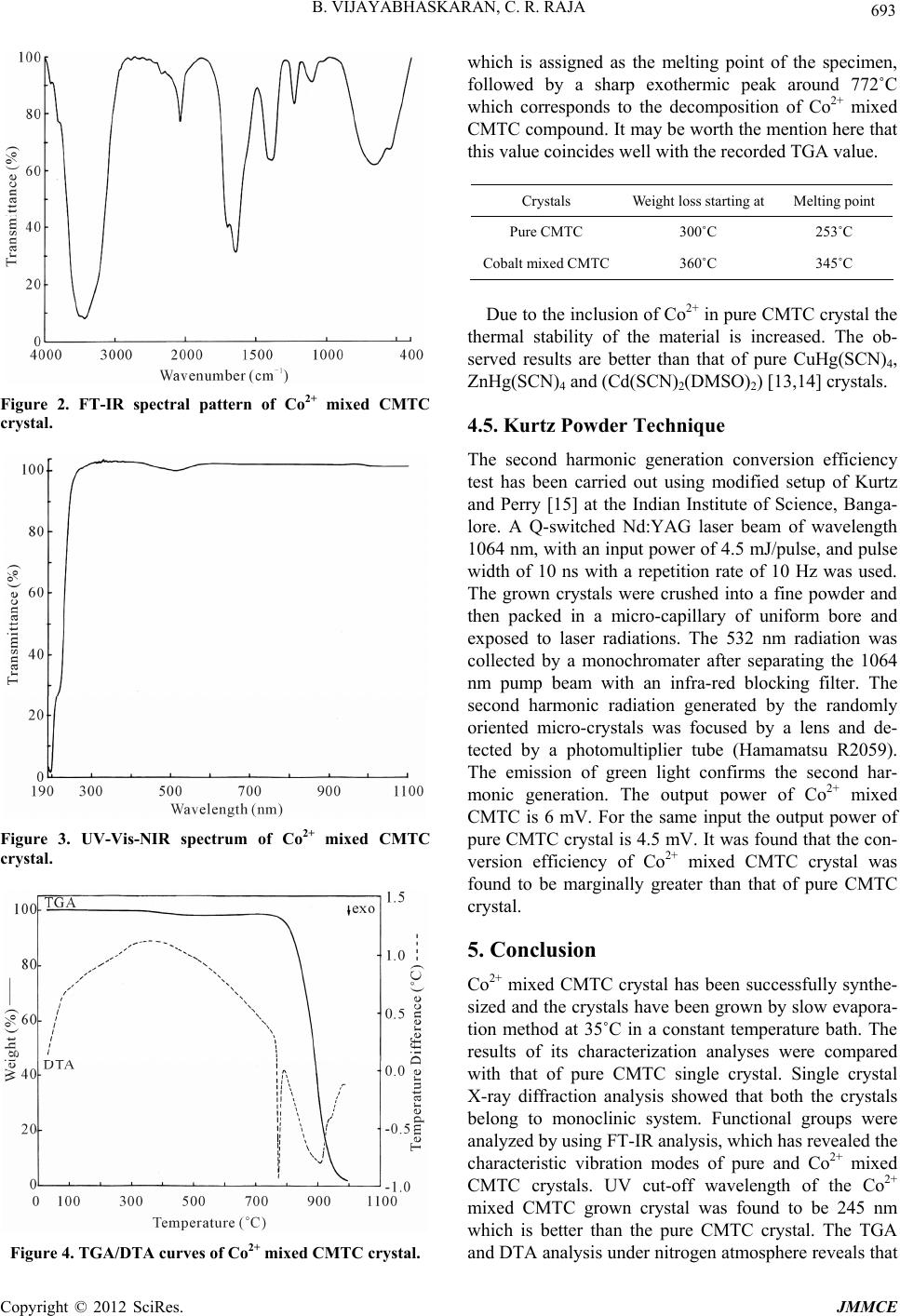 B. VIJAYABHASKARAN, C. R. RAJA 693 Figure 2. FT-IR spectral pattern of Co2+ mixed CMTC crystal. Figure 3. UV-Vis-NIR spectrum of Co2+ mixed CMTC crystal. Figure 4. TGA/DTA curves of Co2+ mixed CMTC crystal. which is assigned as the melting point of the specimen, followed by a sharp exothermic peak around 772˚C which corresponds to the decomposition of Co2+ mixed CMTC compound. It may be worth the mention here that this value coincides well with the recorded TGA value. Crystals Weight loss starting at Melting point Pure CMTC 300˚C 253˚C Cobalt mixed CMTC360˚C 345˚C Due to the inclusion of Co2+ in pure CMTC crystal the thermal stability of the material is increased. The ob- served results are better than that of pure CuHg(SCN)4, ZnHg(SCN)4 and (Cd(SCN)2(DMSO)2) [13,14] crystals. 4.5. Kurtz Powder Technique The second harmonic generation conversion efficiency test has been carried out using modified setup of Kurtz and Perry [15] at the Indian Institute of Science, Banga- lore. A Q-switched Nd:YAG laser beam of wavelength 1064 nm, with an input power of 4.5 mJ/pulse, and pulse width of 10 ns with a repetition rate of 10 Hz was used. The grown crystals were crushed into a fine powder and then packed in a micro-capillary of uniform bore and exposed to laser radiations. The 532 nm radiation was collected by a monochromater after separating the 1064 nm pump beam with an infra-red blocking filter. The second harmonic radiation generated by the randomly oriented micro-crystals was focused by a lens and de- tected by a photomultiplier tube (Hamamatsu R2059). The emission of green light confirms the second har- monic generation. The output power of Co2+ mixed CMTC is 6 mV. For the same input the output power of pure CMTC crystal is 4.5 mV. It was found that the con- version efficiency of Co2+ mixed CMTC crystal was found to be marginally greater than that of pure CMTC crystal. 5. Conclusion Co2+ mixed CMTC crystal has been successfully synthe- sized and the crystals have been grown by slow evapora- tion method at 35˚C in a constant temperature bath. The results of its characterization analyses were compared with that of pure CMTC single crystal. Single crystal X-ray diffraction analysis showed that both the crystals belong to monoclinic system. Functional groups were analyzed by using FT-IR analysis, which has revealed the characteristic vibration modes of pure and Co2+ mixed CMTC crystals. UV cut-off wavelength of the Co2+ mixed CMTC grown crystal was found to be 245 nm which is better than the pure CMTC crystal. The TGA and DTA analysis under nitrogen atmosphere reveals that Copyright © 2012 SciRes. JMMCE 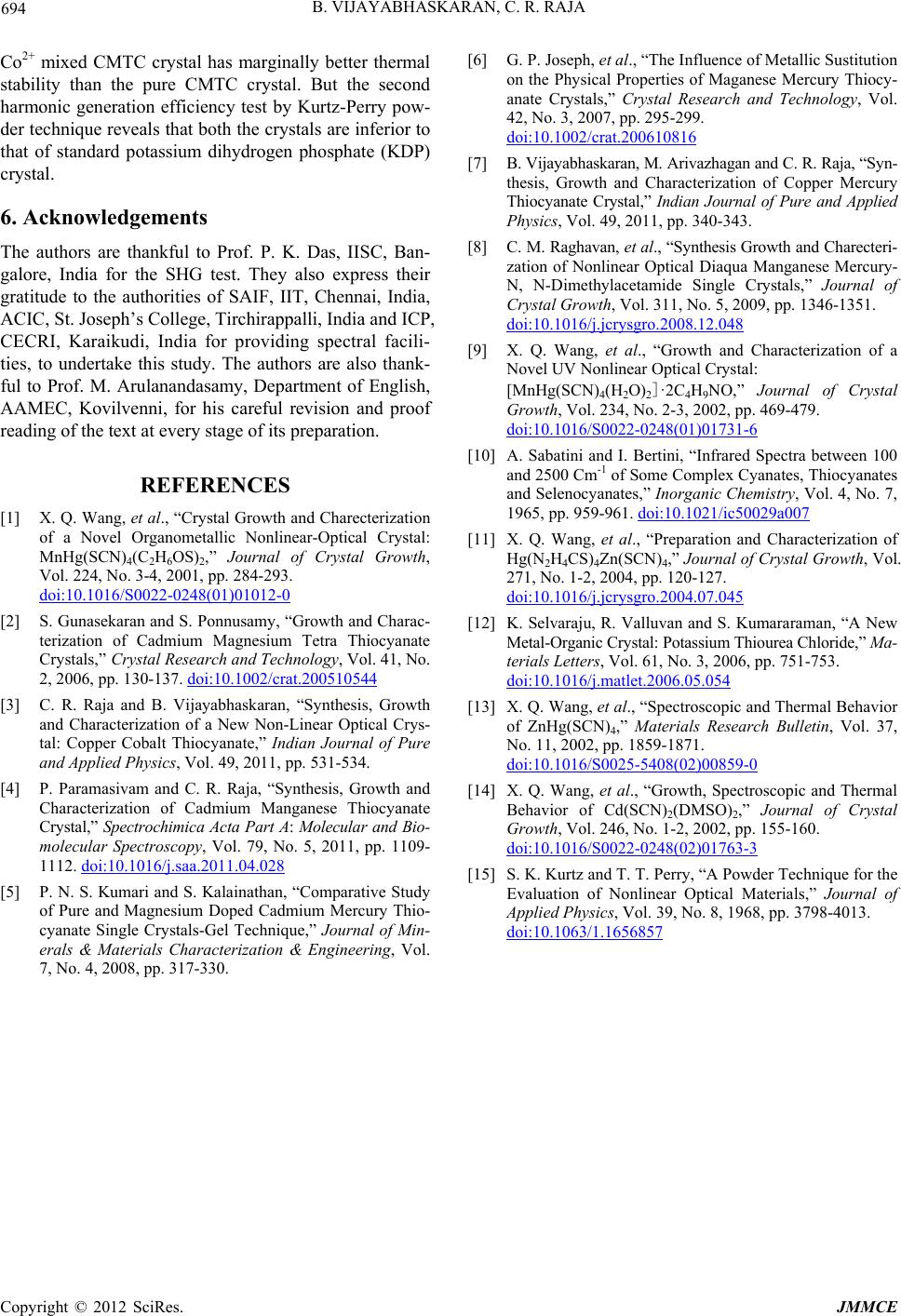 B. VIJAYABHASKARAN, C. R. RAJA Copyright © 2012 SciRes. JMMCE 694 Co2+ mixed CMTC crystal has marginally better thermal stability than the pure CMTC crystal. But the second harmonic generation efficiency test by Kurtz-Perry pow- der technique reveals that both the crystals are inferior to that of standard potassium dihydrogen phosphate (KDP) crystal. 6. Acknowledgements The authors are thankful to Prof. P. K. Das, IISC, Ban- galore, India for the SHG test. They also express their gratitude to the authorities of SAIF, IIT, Chennai, India, ACIC, St. Joseph’s College, Tirchirappalli, India and ICP, CECRI, Karaikudi, India for providing spectral facili- ties, to undertake this study. The authors are also thank- ful to Prof. M. Arulanandasamy, Department of English, AAMEC, Kovilvenni, for his careful revision and proof reading of the text at every stage of its preparation. REFERENCES [1] X. Q. Wang, et al., “Crystal Growth and Charecterization of a Novel Organometallic Nonlinear-Optical Crystal: MnHg(SCN)4(C2H6OS)2,” Journal of Crystal Growth, Vol. 224, No. 3-4, 2001, pp. 284-293. doi:10.1016/S0022-0248(01)01012-0 [2] S. Gunasekaran and S. Ponnusamy, “Growth and Charac- terization of Cadmium Magnesium Tetra Thiocyanate Crystals,” Crystal Research and Technology, Vol. 41, No. 2, 2006, pp. 130-137. doi:10.1002/crat.200510544 [3] C. R. Raja and B. Vijayabhaskaran, “Synthesis, Growth and Characterization of a New Non-Linear Optical Crys- tal: Copper Cobalt Thiocyanate,” Indian Journal of Pure and Applied Physics, Vol. 49, 2011, pp. 531-534. [4] P. Paramasivam and C. R. Raja, “Synthesis, Growth and Characterization of Cadmium Manganese Thiocyanate Crystal,” Spectrochimica Acta Part A: Molecular and Bio- molecular Spectroscopy, Vol. 79, No. 5, 2011, pp. 1109- 1112. doi:10.1016/j.saa.2011.04.028 [5] P. N. S. Kumari and S. Kalainathan, “Comparative Study of Pure and Magnesium Doped Cadmium Mercury Thio- cyanate Single Crystals-Gel Technique,” Journal of Min- erals & Materials Characterization & Engineering, Vol. 7, No. 4, 2008, pp. 317-330. [6] G. P. Joseph, et al., “The Influence of Metallic Sustitution on the Physical Properties of Maganese Mercury Thiocy- anate Crystals,” Crystal Research and Technology, Vol. 42, No. 3, 2007, pp. 295-299. doi:10.1002/crat.200610816 [7] B. Vijayabhaskaran, M. Arivazhagan and C. R. Raja, “Syn- thesis, Growth and Characterization of Copper Mercury Thiocyanate Crystal,” Indian Journal of Pure and Applied Physics, Vol. 49, 2011, pp. 340-343. [8] C. M. Raghavan, et al., “Synthesis Growth and Charecteri- zation of Nonlinear Optical Diaqua Manganese Mercury- N, N-Dimethylacetamide Single Crystals,” Journal of Crystal Growth, Vol. 311, No. 5, 2009, pp. 1346-1351. doi:10.1016/j.jcrysgro.2008.12.048 [9] X. Q. Wang, et al., “Growth and Characterization of a Novel UV Nonlinear Optical Crystal: [MnHg(SCN)4(H2O)2]·2C4H9NO,” Journal of Crystal Growth, Vol. 234, No. 2-3, 2002, pp. 469-479. doi:10.1016/S0022-0248(01)01731-6 [10] A. Sabatini and I. Bertini, “Infrared Spectra between 100 and 2500 Cm-1 of Some Complex Cyanates, Thiocyanates and Selenocyanates,” Inorganic Chemistry, Vol. 4, No. 7, 1965, pp. 959-961. doi:10.1021/ic50029a007 [11] X. Q. Wang, et al., “Preparation and Characterization of Hg(N2H4CS)4Zn(SCN)4,” Journal of Crystal Growth, Vol. 271, No. 1-2, 2004, pp. 120-127. doi:10.1016/j.jcrysgro.2004.07.045 [12] K. Selvaraju, R. Valluvan and S. Kumararaman, “A New Metal-Organic Crystal: Potassium Thiourea Chloride,” Ma- terials Letters, Vol. 61, No. 3, 2006, pp. 751-753. doi:10.1016/j.matlet.2006.05.054 [13] X. Q. Wang, et al., “Spectroscopic and Thermal Behavior of ZnHg(SCN)4,” Materials Research Bulletin, Vol. 37, No. 11, 2002, pp. 1859-1871. doi:10.1016/S0025-5408(02)00859-0 [14] X. Q. Wang, et al., “Growth, Spectroscopic and Thermal Behavior of Cd(SCN)2(DMSO)2,” Journal of Crystal Growth, Vol. 246, No. 1-2, 2002, pp. 155-160. doi:10.1016/S0022-0248(02)01763-3 [15] S. K. Kurtz and T. T. Perry, “A Powder Technique for the Evaluation of Nonlinear Optical Materials,” Journal of Applied Physics, Vol. 39, No. 8, 1968, pp. 3798-4013. doi:10.1063/1.1656857 |