

Paper Menu >>
Journal Menu >>
 Journal of Minerals and Materials Characterization and Engineering, 2012, 11, 685-690 Published Online July 2012 (http://www.SciRP.org/journal/jmmce) Effect of Electrode Materials on Electric Discharge Machining of 316 L and 17-4 PH Stainless Steels Subramanian Gopalakannan*, Thiagarajan Senthilvelan 1Department of Mechanical Engineering, Adhiparasakthi Engineering College, Melmaruvathur, India 2Department of Mechanical Engineering, Pondicherry Engineering College, Pondicherry, India Email: *[email protected] Received February 27, 2012; revised April 5, 2012; accepted May 2, 2012 ABSTRACT Electric Discharge Machining (EDM) is one of the most efficiently employed non-traditional machining processes for cutting hard-to-cut materials, to geometrically complex shapes that are difficult to machine by conventional machines. In the present work, an experimental investigation has been carried out to study the effect of pulsed current on material removal rate, electrode wear, surface roughness and diameteral overcut in corrosion resistant stainless steels viz., 316 L and 17-4 PH. The materials used for the work were machined with different electrode materials such as copper, cop- per-tungsten and graphite. It is observed that the output parameters such as material removal rate, electrode wear and surface roughness of EDM increase with increase in pulsed current. The results reveal that high material removal rate have been achieved with copper electrode whereas copper-tungsten yielded lower electrode wear, smooth surface finish and good dimensional accuracy. Keywords: Electric Discharge Machining; Material Removal Rate; Electrode Wear; Surface Roughness; Stainless Steel 1. Introduction Electric discharge machining (EDM) is one of the most widely employed non-traditional machining processes because it has been accepted as a standard process to manufacture mould and dies of aerospace, automotive, nuclear, surgical, petroleum and marine components. Since EDM does not make direct contact between the electrode and the work material, it eliminates mechanical stresses, chatter and vibration problems during machin- ing. Hence, very hard and brittle materials can also be machined easily and also to the desired form. It removes electrically conductive materials by means of rapid, re- petitive spark discharges from a pulsating direct-current power supply with dielectric flow between the work piece and the electrode. Pulse current is one of the pri- mary input parameters of an EDM process and together with discharge duration and relatively constant voltage for the given tool and workpiece materials. Pulse current is representative of the energy per pulse expended in the spark gap region. It thus controls the material removal rate to the expected level. Considering the challenges brought by advanced technology, the EDM is one of the best alternatives for machining an ever increasing num- ber of high strength, wear resistant and corrosion resis- tant materials. Further, EDM is relatively simple method to machine very complex geometry with very fine and high precision. In EDM process the performance is determined by Material removal rate (MRR), Electrode wear (EW), Surface roughness (SR), Surface quality (SQ) and Di- mensional accuracy (DA). A series of investigations has been conducted by Soni and Chakraverthi studied the surface quality, material removal rate, electrode wear rate, and dimensional accuracy of die steels and alloy steels in EDM [1]. The effect of the machining parameters on material removal rate, relative wear ratio, and surface roughness in EDM of tungsten carbide had been studied using different electrode materials and concluded that copper tungsten yields the better results than copper and brass [2]. Ho and Newman reported that research areas in EDM could be classified into three major categories: 1) Machining performance measures; 2) The effect of proc- ess parameter; and 3) Design and manufacture of elec- trode [3]. They also concluded that machining perform- ance depends on the wear and surface quality. The effect of machining parameters on material removal rate, elec- trode wear rate, surface quality and diametric over-cut on tool steels were investigated in detail and concluded that copper and graphite electrode resulted in the best ma- chining rate [4]. Mohd Abbas et al. presented the current research trends on machining and modeling techniques in predicting EDM performances [5]. Luis et al. had re- *Corresponding author. Copyright © 2012 SciRes. JMMCE 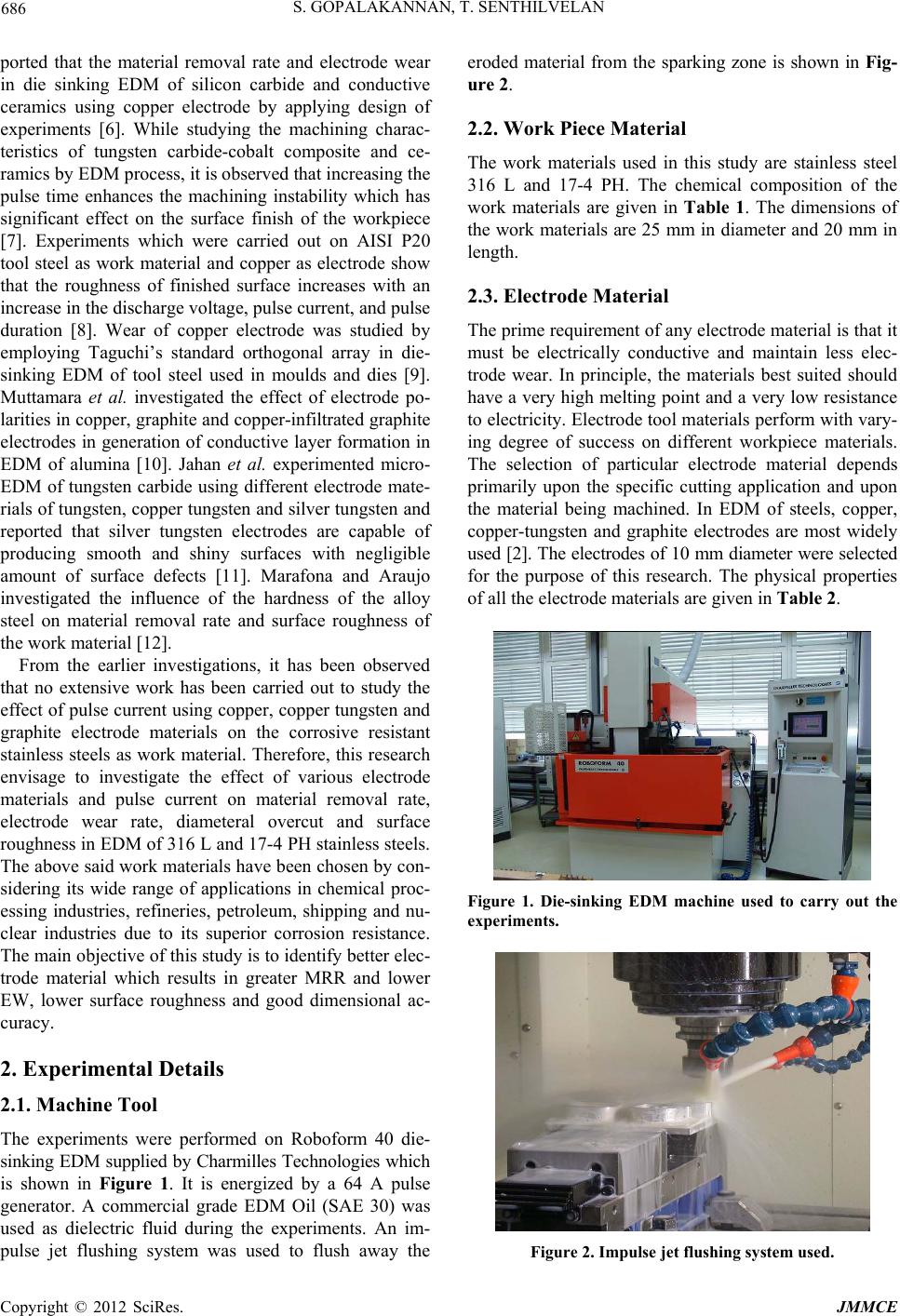 S. GOPALAKANNAN, T. SENTHILVELAN 686 ported that the material removal rate and electrode wear in die sinking EDM of silicon carbide and conductive ceramics using copper electrode by applying design of experiments [6]. While studying the machining charac- teristics of tungsten carbide-cobalt composite and ce- ramics by EDM process, it is observed that increasing the pulse time enhances the machining instability which has significant effect on the surface finish of the workpiece [7]. Experiments which were carried out on AISI P20 tool steel as work material and copper as electrode show that the roughness of finished surface increases with an increase in the discharge voltage, pulse current, and pulse duration [8]. Wear of copper electrode was studied by employing Taguchi’s standard orthogonal array in die- sinking EDM of tool steel used in moulds and dies [9]. Muttamara et al. investigated the effect of electrode po- larities in copper, graphite and copper-infiltrated graphite electrodes in generation of conductive layer formation in EDM of alumina [10]. Jahan et al. experimented micro- EDM of tungsten carbide using different electrode mate- rials of tungsten, copper tungsten and silver tungsten and reported that silver tungsten electrodes are capable of producing smooth and shiny surfaces with negligible amount of surface defects [11]. Marafona and Araujo investigated the influence of the hardness of the alloy steel on material removal rate and surface roughness of the work material [12]. From the earlier investigations, it has been observed that no extensive work has been carried out to study the effect of pulse current using copper, copper tungsten and graphite electrode materials on the corrosive resistant stainless steels as work material. Therefore, this research envisage to investigate the effect of various electrode materials and pulse current on material removal rate, electrode wear rate, diameteral overcut and surface roughness in EDM of 316 L and 17-4 PH stainless steels. The above said work materials have been chosen by con- sidering its wide range of applications in chemical proc- essing industries, refineries, petroleum, shipping and nu- clear industries due to its superior corrosion resistance. The main objective of this study is to identify better elec- trode material which results in greater MRR and lower EW, lower surface roughness and good dimensional ac- curacy. 2. Experimental Details 2.1. Machine Tool The experiments were performed on Roboform 40 die- sinking EDM supplied by Charmilles Technologies which is shown in Figure 1. It is energized by a 64 A pulse generator. A commercial grade EDM Oil (SAE 30) was used as dielectric fluid during the experiments. An im- pulse jet flushing system was used to flush away the eroded material from the sparking zone is shown in Fig- ure 2. 2.2. Work Piece Material The work materials used in this study are stainless steel 316 L and 17-4 PH. The chemical composition of the work materials are given in Table 1. The dimensions of the work materials are 25 mm in diameter and 20 mm in length. 2.3. Electrode Material The prime requirement of any electrode material is that it must be electrically conductive and maintain less elec- trode wear. In principle, the materials best suited should have a very high melting point and a very low resistance to electricity. Electrode tool materials perform with vary- ing degree of success on different workpiece materials. The selection of particular electrode material depends primarily upon the specific cutting application and upon the material being machined. In EDM of steels, copper, copper-tungsten and graphite electrodes are most widely used [2]. The electrodes of 10 mm diameter were selected for the purpose of this research. The physical properties of all the electrode materials are given in Table 2. Figure 1. Die-sinking EDM machine used to carry out the experiments. Figure 2. Impulse jet flushing syste m used. Copyright © 2012 SciRes. JMMCE 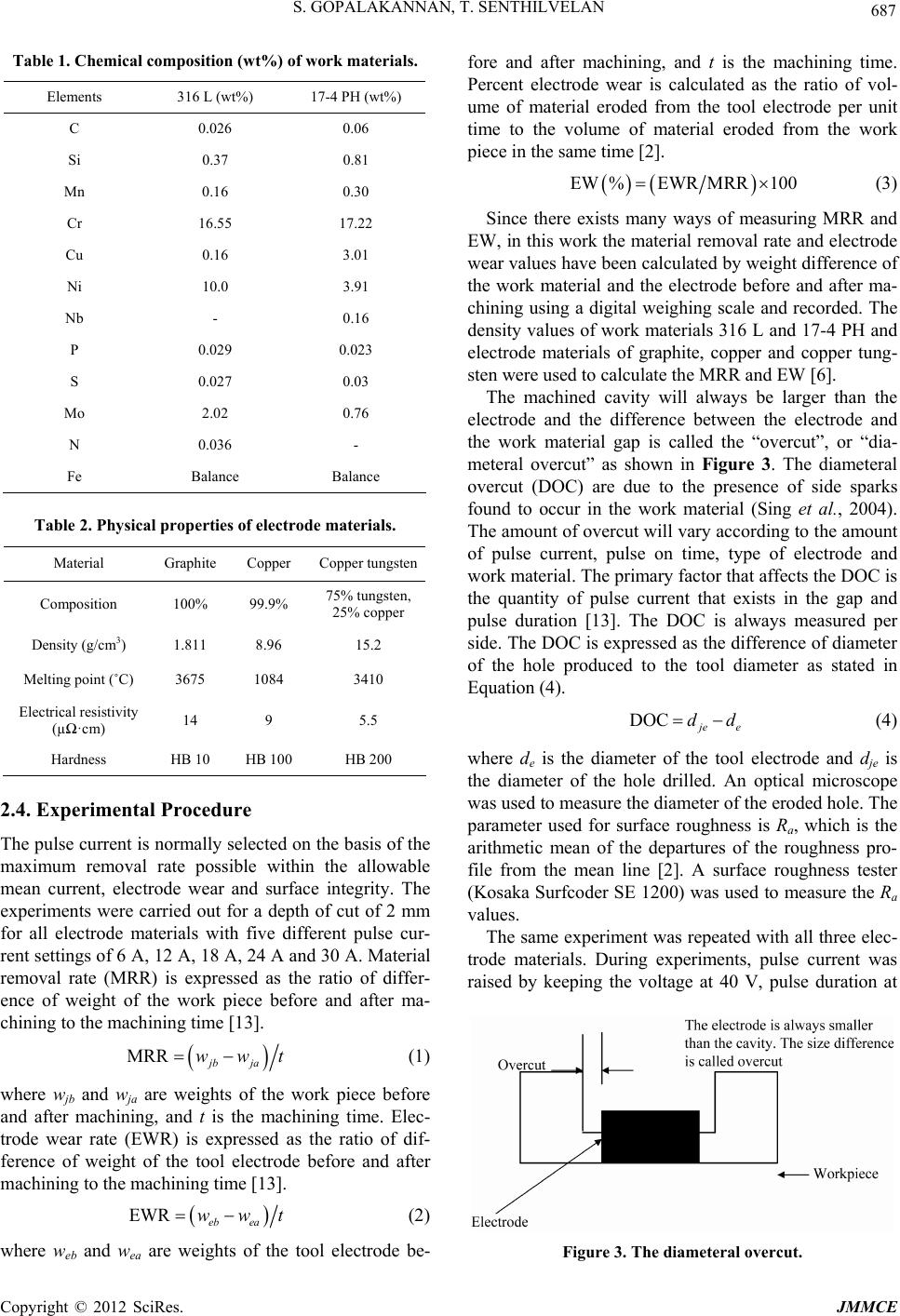 S. GOPALAKANNAN, T. SENTHILVELAN 687 Table 1. Chemical composition (wt%) of work materials. Elements 316 L (wt%) 17-4 PH (wt%) C 0.026 0.06 Si 0.37 0.81 Mn 0.16 0.30 Cr 16.55 17.22 Cu 0.16 3.01 Ni 10.0 3.91 Nb - 0.16 P 0.029 0.023 S 0.027 0.03 Mo 2.02 0.76 N 0.036 - Fe Balance Balance Table 2. Physical properties of electrode material s. Material Graphite Copper Copper tungsten Composition 100% 99.9% 75% tungsten, 25% copper Density (g/cm3) 1.811 8.96 15.2 Melting point (˚C) 3675 1084 3410 Electrical resistivity (µΩ·cm) 14 9 5.5 Hardness HB 10 HB 100 HB 200 2.4. Experimental Procedure The pulse current is normally selected on the basis of the maximum removal rate possible within the allowable mean current, electrode wear and surface integrity. The experiments were carried out for a depth of cut of 2 mm for all electrode materials with five different pulse cur- rent settings of 6 A, 12 A, 18 A, 24 A and 30 A. Material removal rate (MRR) is expressed as the ratio of differ- ence of weight of the work piece before and after ma- chining to the machining time [13]. MRR jb ja ww t (1) where wjb and wja are weights of the work piece before and after machining, and t is the machining time. Elec- trode wear rate (EWR) is expressed as the ratio of dif- ference of weight of the tool electrode before and after machining to the machining time [13]. EWR eb ea ww t (2) where web and wea are weights of the tool electrode be- fore and after machining, and t is the machining time. Percent electrode wear is calculated as the ratio of vol- ume of material eroded from the tool electrode per unit time to the volume of material eroded from the work piece in the same time [2]. EW%EWR MRR100 (3) Since there exists many ways of measuring MRR and EW, in this work the material removal rate and electrode wear values have been calculated by weight difference of the work material and the electrode before and after ma- chining using a digital weighing scale and recorded. The density values of work materials 316 L and 17-4 PH and electrode materials of graphite, copper and copper tung- sten were used to calculate the MRR and EW [6]. The machined cavity will always be larger than the electrode and the difference between the electrode and the work material gap is called the “overcut”, or “dia- meteral overcut” as shown in Figure 3. The diameteral overcut (DOC) are due to the presence of side sparks found to occur in the work material (Sing et al., 2004). The amount of overcut will vary according to the amount of pulse current, pulse on time, type of electrode and work material. The primary factor that affects the DOC is the quantity of pulse current that exists in the gap and pulse duration [13]. The DOC is always measured per side. The DOC is expressed as the difference of diameter of the hole produced to the tool diameter as stated in Equation (4). DOC j e dd e (4) where de is the diameter of the tool electrode and dje is the diameter of the hole drilled. An optical microscope was used to measure the diameter of the eroded hole. The parameter used for surface roughness is Ra, which is the arithmetic mean of the departures of the roughness pro- file from the mean line [2]. A surface roughness tester (Kosaka Surfcoder SE 1200) was used to measure the Ra values. The same experiment was repeated with all three elec- trode materials. During experiments, pulse current was raised by keeping the voltage at 40 V, pulse duration at Figure 3. The diameteral overcut. Copyright © 2012 SciRes. JMMCE 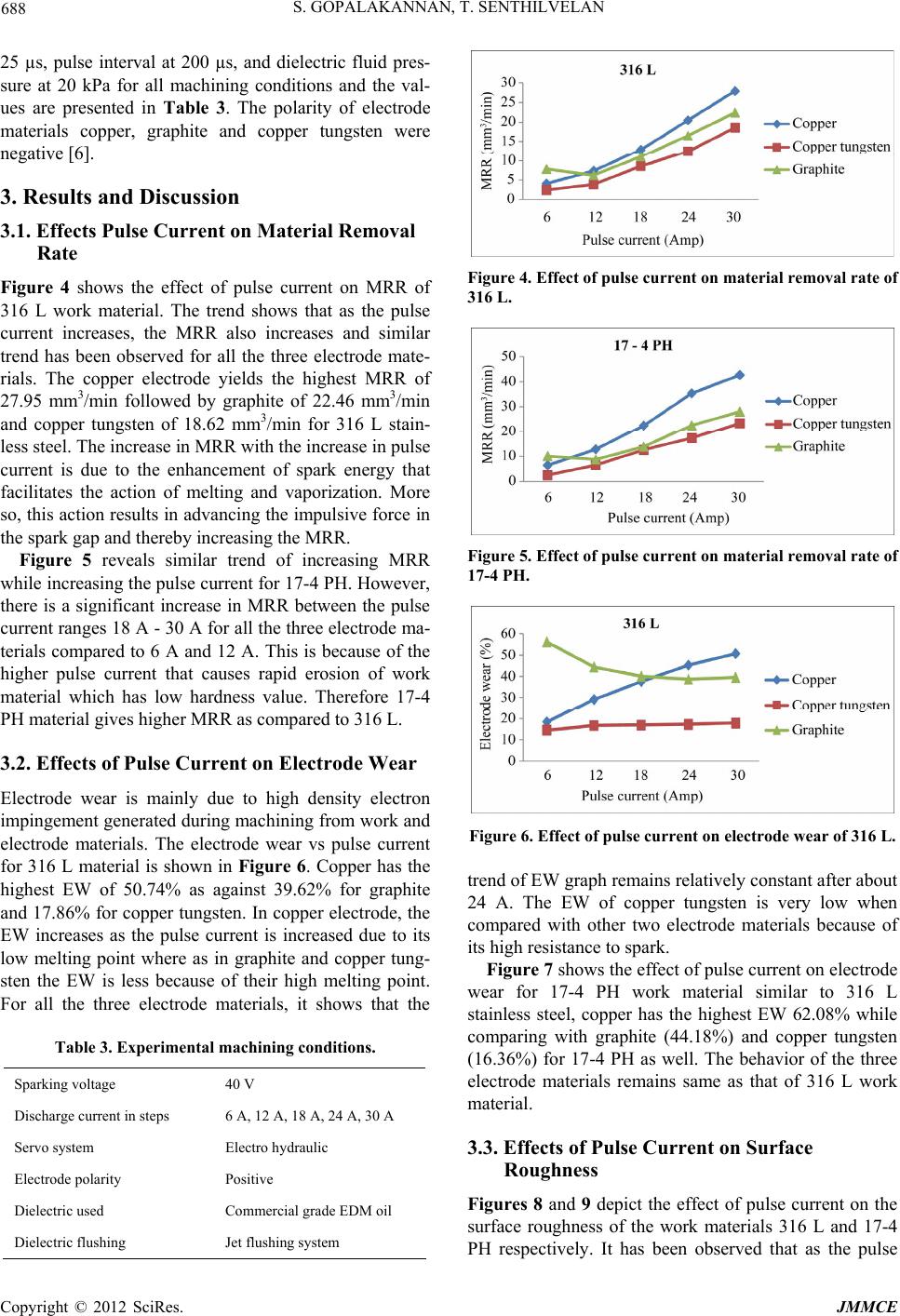 S. GOPALAKANNAN, T. SENTHILVELAN 688 25 µs, pulse interval at 200 µs, and dielectric fluid pres- sure at 20 kPa for all machining conditions and the val- ues are presented in Table 3. The polarity of electrode materials copper, graphite and copper tungsten were negative [6]. 3. Results and Discussion 3.1. Effects Pulse Current on Material Removal Rate Figure 4 shows the effect of pulse current on MRR of 316 L work material. The trend shows that as the pulse current increases, the MRR also increases and similar trend has been observed for all the three electrode mate- rials. The copper electrode yields the highest MRR of 27.95 mm3/min followed by graphite of 22.46 mm3/min and copper tungsten of 18.62 mm3/min for 316 L stain- less steel. The increase in MRR with the increase in pulse current is due to the enhancement of spark energy that facilitates the action of melting and vaporization. More so, this action results in advancing the impulsive force in the spark gap and thereby increasing the MRR. Figure 5 reveals similar trend of increasing MRR while increasing the pulse current for 17-4 PH. However, there is a significant increase in MRR between the pulse current ranges 18 A - 30 A for all the three electrode ma- terials compared to 6 A and 12 A. This is because of the higher pulse current that causes rapid erosion of work material which has low hardness value. Therefore 17-4 PH material gives higher MRR as compared to 316 L. 3.2. Effects of Pulse Current on Electrode Wear Electrode wear is mainly due to high density electron impingement generated during machining from work and electrode materials. The electrode wear vs pulse current for 316 L material is shown in Figure 6. Copper has the highest EW of 50.74% as against 39.62% for graphite and 17.86% for copper tungsten. In copper electrode, the EW increases as the pulse current is increased due to its low melting point where as in graphite and copper tung- sten the EW is less because of their high melting point. For all the three electrode materials, it shows that the Table 3. Experimental machining conditions. Sparking voltage 40 V Discharge current in steps 6 A, 12 A, 18 A, 24 A, 30 A Servo system Electro hydraulic Electrode polarity Positive Dielectric used Commercial grade EDM oil Dielectric flushing Jet flushing system Figure 4. Effect of pulse current on material removal rate of 316 L. Figure 5. Effect of pulse current on material removal rate of 17-4 PH. Figure 6. Effect of pulse current on electrode wear of 316 L. trend of EW graph remains relatively constant after about 24 A. The EW of copper tungsten is very low when compared with other two electrode materials because of its high resistance to spark. Figure 7 shows the effect of pulse current on electrode wear for 17-4 PH work material similar to 316 L stainless steel, copper has the highest EW 62.08% while comparing with graphite (44.18%) and copper tungsten (16.36%) for 17-4 PH as well. The behavior of the three electrode materials remains same as that of 316 L work material. 3.3. Effects of Pulse Current on Surface Roughness Figures 8 and 9 depict the effect of pulse current on the surface roughness of the work materials 316 L and 17-4 PH respectively. It has been observed that as the pulse Copyright © 2012 SciRes. JMMCE  S. GOPALAKANNAN, T. SENTHILVELAN 689 Figure 7. Effect of pulse current on electrode wear of 17-4 PH. Figure 8. Effect of pulse current on surface roughness of 316 L. Figure 9. Effect of pulse current on surface roughness of 17- 4 PH. current is increased the surface roughness increased. The results of the above mentioned two work materials indi- cate that for the range of pulse current used i.e., between 6 A and 30 A, copper tungsten exhibits better surface finish while the graphite shows the poorest. The surface roughness value of copper electrode is in between the graphite and copper tungsten. The surface roughness of copper and graphite are high due to the fact that higher MRR is accompanied by larger and deeper craters. This causes low pulse currents and spark energy which leads to the formation of small craters on the machined surface and thereby improving surface finish [14]. Therefore, formation of small craters results in good surface finish. The only difference between these two materials is that for same pulse currents values, 316 L offers better sur- face finish than 17-4 PH because of higher MRR in 17-4 PH material than 316 L. 3.4. Effects of Pulse Current on Diameteral Overcut Dimensional accuracy becomes more important when close tolerance components are required to be produced in aerospace industries, marine industries, and also in tools, dies and moulds for press work, plastic molding and die casting. The diameteral overcut is low at low pulse current and hence the erosion is low. Figures 10 and 11 show the diameteral overcut of work materials 316 L and 17-4 PH respectively. The copper tungsten electrode gives low and consistent diameteral overcut of 0.1 mm for both materials at high pulse current. In con- trast, graphite electrode yields the poor dimensional ac- curacy which results in higher diameteral overcut for both materials at higher pulse current. The diameteral overcut of copper is between 0.12 mm (316 L) and 0.16 mm (17-4 PH) in the pulse current range of 12 A to 24 A and good dimensional accuracy also has been obtained. The graphite results in high overcut due to its high spark dispersing effects. The overcut not only depends on the pulse current and also depends on gap voltage and chip size. 4. Conclusions An experimental study has been conducted to investigate the effect of electrode materials on machining character- istics in EDM of corrosive resistant stainless steels 316 L Figure 10. Effect of pulse current on diameteral overcut 316 L. Figure 11. Effect of pulse current on diameteral overcut of 17-4 PH. Copyright © 2012 SciRes. JMMCE  S. GOPALAKANNAN, T. SENTHILVELAN Copyright © 2012 SciRes. JMMCE 690 and 17-4 PH. The following inferences are arrived at: 1) For 316 L and 17-4 PH work materials copper elec- trode gives the better MRR than graphite whereas the copper-tungsten yields the lowest MRR value. The MRR obtained by three electrodes in 17-4 PH is higher than 316 L because of its low hardness; 2) Copper-tungsten offers comparatively low electrode wear for the tested materials whereas the performances of copper and graphite electrodes are high and almost similar; 3) Graphite and copper electrodes produce compara- tively high surface roughness for the tested materials at higher values of pulse current. The copper-tungsten elec- trode offers low values of surface roughness at high dis- charge current which yields good surface finish for both work materials; 4) Copper-tungsten and copper electrodes performed consistently at high values of pulse current and copper- tungsten offers low diameteral overcut and good dimen- sional accuracy than copper; 5) Copper electrode has been preferred for higher MRR whereas copper-tungsten is preferred for low elec- trode wear, good surface finish and good dimensional accuracy. REFERENCES [1] J. S. Soni and G. Chakraverti, “Effect of Electrode Mate- rial Properties on Surface Roughness and Dimensional Accuracy in Electric-Discharge Machining of High Car- bon High Chromium Die Steel,” Journal of Industrial and Engineering, Vol. 76, 1995, pp. 46-51. [2] S. H. Lee and X. P. Li, “Study of the Effect of Machining Parameters on Machining Characteristics in Electric Dis- charge Machining of Tungsten Carbide,” Journal of Ma- terials Processing Technology, Vol. 115, No. 3, 2001, pp. 344-358. doi:10.1016/S0924-0136(01)00992-X [3] K. H. Ho and S. T. Newman, “State of the Art Electrical Discharge Machining (EDM),” International Journal of Machine Tools and Manufacture, Vol. 43, No. 13, 2003, pp. 1287-1300. doi:10.1016/S0890-6955(03)00162-7 [4] S. Singh, S. Maheshwari and P. C. Pandey, “Some Inves- tigations into the Electric Discharge Machining of Hard- ened Tool Steel Using Different Electrode Materials,” Journal of Materials Processing Technology, Vol. 149, No. 1-3, 2004, pp. 272-277. doi:10.1016/j.jmatprotec.2003.11.046 [5] N. M. Abbas, D. G. Solomon and M. F. Bahari, “A Re- view on Current Research Trends in Electric Discharge Machining,” International Journal of Machine Tools and Manufacture, Vol. 47, No. 7-8, 2006, pp. 1214-1228. doi:10.1016/j.ijmachtools.2006.08.026 [6] C. J. Luis, I. Puertas and G. Villa, “Material Removal Rate and Electrode Wear Study on the EDM of Silicon Carbide,” Journal of Materials Processing Technology, Vol. 164-165, 2005, pp. 889-896. doi:10.1016/j.jmatprotec.2005.02.045 [7] B. V. M. Kumar, J. Ramkumar, B. Basu and S. Kang, “Electro Discharge Machining Performance of TiCN-Based Cerments,” International Journal of Refractory Metals and Hard Materials, Vol. 25, No. 4, 2007, pp. 293-299. doi:10.1016/j.ijrmhm.2006.07.001 [8] B. Bhattacharya, S. Gangopadhyay and B. R. Sarkar, “Mod- eling and Analysis of EDMED Job Surface Integrity,” Journal of Materials Processing Technology, Vol. 189, No. 1-3, 2007, pp. 169-177. doi:10.1016/j.jmatprotec.2007.01.018 [9] K. D. Chattopadhyay, S. Verma, P. S. Satsangi and P. C. Sharma, “Development of Empirical Model for Different Process Parameters during Rotary Electrical Discharge Machining of Copper-Steel (EN-8) System,” Journal of Materials Processing Technology, Vol. 209, No. 3, 2009, pp. 1454-1465. doi:10.1016/j.jmatprotec.2008.03.068 [10] A. Muttamara, Y. Fukuzawa, N. Mohri and T. Tani, “Ef- fect of Electrode Material on Electric Discharge Machin- ing of Alumina,” Journal of Materials Processing Tech- nology, Vol. 115, No. 3, 2009, pp. 344-358. [11] M. P. Jahan, Y. S. Wong and M. Rahman, “A Study on the Fine-Finish Die-Sinking Micro-EDM of Tungsten Carbide Using Different Electrode Materials,” Journal of Materials Processing Technology, Vol. 209, No. 8, 2009, pp. 3956-3967. doi:10.1016/j.jmatprotec.2008.09.015 [12] M. J. Duarte and A. Arlindo, “Influence of Workpiece Hardness on EDM Performance,” International Journal of Machine Tools and Manufacture, Vol. 49, No. 9, 2009, pp. 744-748. doi:10.1016/j.ijmachtools.2009.03.002 [13] S. Dhar, R. Purohit, N. Saini and G. H. Kumar, “Mathe- matical Modeling of Electric Discharge Machining of Cast Al-4Cu-6Si Alloy-10 wt% SiCp Composites,” Jour- nal of Materials Processing Technology, Vol. 194, No. 1-3, 2007, pp. 24-29. [14] M. Kiyak and O. Cakir, “Examination of Machining Pa- rameters on Surface Roughness in EDM of Tool Steel,” Journal of Materials Processing Technology, Vol. 191, No. 1-3, 2007, pp. 141-144. doi:10.1016/j.jmatprotec.2007.03.008 |