

Paper Menu >>
Journal Menu >>
 Modern Research in Catalysis, 2012, 1, 23-27 http://dx.doi.org/10.4236/mrc.2012.12004 Published Online July 2012 (http://www.SciRP.org/journal/mrc) Exploring the Catalytic Activity of Zirconia, Zirconia Supported Metals and Metal Oxides for Oxidation of Phenol Mohammad Sadiq1,2*, Mohammad Ilyas2 1Department of Chemistr y, University of Malakand, Chakdara, Dir (Lower), Khyber Pakhtunkhwa, Pakistan 2National Centre of Excellence in Physical Chemistry, University of Peshawar, Peshawar, Pakistan Email: *[email protected], *[email protected] Received May 2, 2012; revised June 18, 2012; accepted July 10, 2012 ABSTRACT Catalytic oxidation/degradation of phenol with molecular oxygen in aqueous medium by Zirconia, zirconia supported metals and metal oxides at low temperature were studied in a three necked batch reactor. The catalysts prepared were characterized by modern techniques like XRD, SEM and EDX. The activities of different catalysts for the oxidation of phenol in aqueous medium were found to be in the order; Pt-Pd/ZrO2 > Bi-Pt/ZrO2 > Bi-Pd/ZrO2 > Pt/ZrO2 > Pd/ZrO2 > Cu/ZrO2 > Mn/ZrO2 > Bi/ZrO2. The enhanced catalytic activity of Bi-Pt/ZrO2 is attributed to Bi which in contact with Pt particles promotes its catalytic activity. In short, catalytic ox idation was found to be an effective tool, for the removal of phenol, f rom indus trial wast e water. Keywords: Oxidation; Phenol; Bismuth; Platinum; Zirconia 1. Introduction Undesired phenol wastes are produced by many indus- tries including the chemicals, plastics and resins, coke, steel, and petroleum industries. Phenol is one of the EPA’s Priority Pollutants. Under Section 313 of the Emergency Planning and Community Right to Know Act of 1986 (EPCRA), release of more than one pound of phenol into the air, water and land must be reported, an- nually, and entered into the Toxic Release Inventory (TRI). Phenol has a high oxygen demand and can thus readily deplete oxygen in the receiving water, with det- rimental effects on those organisms that extract dissolved oxygen from water, for their metabolism. It is also well known that even low phenol level, in the parts p er billion ranges, imparts disagreeable taste and odor to water. Therefore, it is necessary to elimin ate maxi mum p oss ible quantity of pheno l from the wastewater before it is being discharged. Phenol may be treated by chemical oxidation, bio-oxidation and adsorption. Chemical oxidation such as with hydrogen peroxide or chlorine dioxide has a low capital but a high operating cost. Bio-oxidation has a high capital and a low operating cost. Adsorption has both high capital and operating costs. The appropriate- ness of any one of these methods depends on a combina- tion of factors; the most important of which are the phe- nol concentration and any other chemical pollutant that may be present in the wastewater. Depending on these variables, a sing le or a combination of treatmen ts may be used. Currently, phenol removal is accomplished with chemical oxidants, the most commonly used, being chlo- rine dioxide, hydrogen peroxide and potassium perman- ganate. Heterogeneous catalytic oxidation, of dissolved organic compounds, is a potential mean for the remedia- tion of contaminated ground and surface waters, indus- trial effluents and other wastewater streams. The ability to carry out the process at substan tially milder condition s of temperature and pressure, in comparison to supercriti- cal water oxidation and wet air oxidation, is achieved through the use of an extremely active supported noble metal catalyst. Catalytic Wet Air Oxidation (CWAO) appears as one of the most promising processes but only at elevated conditions of pressure and temperature in the presence of metal oxide and supported metal oxide [1]. Although homo geneous copper catalysts are effective for the wet oxidation of industrial effluents but the removal of toxic catalyst has made the process debatable [2]. Re- cently, Leitenburg et al. have reported that the activities of mixed-metal oxides such as of ZrO2, MnO2, or CuO for the oxidation of acetic acid can be enhanced by add- ing ceria as a promoter [3]. Imamura et al. have studied the catalytic activities of supported noble metal catalysts for the wet oxidation of phenol and the other model pol- *Corresponding a uthor. C opyright © 2012 SciRes. MRC  M. SADIQ ET AL. 24 lutant compounds. Ruthenium, Platinum and Rhodium supported on CeO2 were found to be more active than a homogeneous copper catalyst [1]. Atwater et al. have shown that several classes of aqueous organic contami- nants, can be deeply oxidized, using dissolved oxygen over supported noble metal catalysts (5% Ru-20% Pt/C), at a temperature 393 - 433 K and pressure between 2.3 and 6 atmospheres [4]. Carlo et al. [5] hav e reported th at lanthanum strontium manganites are very active catalysts for the catalytic wet oxidation of phenol. Castro et al. [6] have reported that polymer-supported metal complexes have been used as catalysts for the catalytic wet hydro- gen peroxide oxidation of Phenol with high yield; how- ever the unacceptable point was leaching of the metal. In the present work, we explored the effectiveness of zirco- nia-supported noble metals (Pt and Pd) and bismuth promoted zirconia supported noble metals for the oxida- tion of phenol in aqueous solution. 2. Experimental 2.1. Materials ZrOCl2·8H2O (Merck, 8917), NH4OH (BDH, 27140), AgNO3 (Merck, 1512), PtCl4 (Acros, 19540), Palladium (II) chloride (Scharlau, Pa 0 025), phenol (Acros, 41717), alizarin (Acros, 400480250), Potassium Iodide (BDH, 102123B) and 2, 4-Dinitro phenyl hydrazine (BDH, 100099) were used as received. H2 (99.999%) was pre- pared using hydrogen generator (GCD-300, BAIF). Ni- trogen and Oxygen were supplied by BOC Pakistan Ltd. and were further purified by passing through traps (C.R.S.Inc.202268), to remove traces of water and oil. Traces of oxygen from nitrogen gas were removed by using specific ox ygen traps (C.R.S.Inc.202223). 2.2 Catalyst Preparation Zirconia was prepared using an aqueous solution of zir- conyl chloride [7-9] with a drop wise addition of NH4OH for 4 hours (pH: 10 - 12) and continuou s stirring all along. The precipitate was washed with triply distilled water for 24 hours, using a Soxhlet’s apparatus, until the chloride ion test with AgNO3 was found to be negative. Precipi- tate was dried at 110˚C for 24 hour s. After drying, it was calcined with programmable heating at a rate of 0.5 Cmin to achieve a temperature of 950˚C, which was then maintained, for 4 hours. Nabertherm C-19 pro- grammed control furnace was used for calcination. 2.3. Metals and Metals Oxides Supported on Zirconia Supported Catalysts {i. Pt(2wt%)/ZrO2 ii. Pd(2wt%)/ZrO2 iii. Pd(1wt%) and Pt(1wt%)/ZrO2 iv. Bi(0.5wt%) Pt(2wt%)/ZrO2 v. Bi(0.5wt%)Pd(2wt%)/ZrO2} were prepared, by incipient wetness technique. For this pur- pose, calculated amount (wt%) of the precursor com- pound (PdCl4 or PtCl4) wa s taken in a cr ucible and triply distilled water was added to it, to make a paste. Then the required amoun t of the suppor t (ZrO2) was mixed with it. The paste was thoroughly mixed and dried in an oven at 110˚C for 24 hours and then ground. The catalyst was sieved and 80 - 100 mesh portions were used for further treatment. The ground catalyst was calcined again, at a rate of 0.5˚C/min, to achieve a temperature of 950˚C, which was then maintained, for 4 hours, followed by a reduction in H2 flow (40 mL/min), at 280˚C, for 4 hours. The supported multi-component catalysts, were prepared by successive incipient wetness impregnation of the support with bismuth and precious metals, followed by drying and calcination. Bismuth was first added to zirco- nia support by the incipient wetness impregnation pro- cedure. After drying and calcination, Bi/zirconia was then impregnated with the active metals such as Pd or Pt. The final sample was then passed through the same dry- ing and calcination procedures. The metal loading of the catalyst was calculated from the weight of chemicals used for impregnation. 2.4. Morphological Study XRD analyses were performed using a JEOL (JDX-3532) diffractometer with CuKa radiation (kα = 1.5406 Å) oper- ated at 40 kV and 20 mA. SEM and EDX measurements were performed using scanning electron microscope of Joel 50 H super prob 733. 2.5. Oxidation of Phenol Oxidation of phenol in aqueous medium was carried out, in a magnetically stirred, Pyrex glass double walled flat bottom three-necked batch reactor, equipped with a re- flux co ndenser and a mercury thermometer. The reaction temperature was maintained, by using water circulator (WiseCircu, Fuzzy control system). A predetermined quantity of the substrate solution (20 mL) was taken in the reactor and a desired amount (0.2 g) of catalyst was added to it. The reaction during heating period was neg- ligible since no direct contact existed between oxygen and the catalyst. O2 and N2 gases at atmospheric pressure were allowed to pass through the reaction mixture at a flow rate of 40 mL/min at a fixed temperature. When the temperature and pressure reached the desired values, the stirrer was set at 900 rpm and turned on. The reaction mixture was analyzed by GC (Clarus 500, Perkin Elmer equipped with (FID and TCD) and capillary column (Elite-5, L 30 m, ID 0.25, DF 0.25), UV spectropho- tometer (UV-160, Shamidzo, Japan) and COD was measured by the potassium dichromate method [10]. Copyright © 2012 SciRes. MRC  M. SADIQ ET AL. 25 3. Results and Discussion 3.1. Characterization of Catalyst X-ray diffraction pattern of the sample, reported in Fig- ure 1, confirms the monoclinic structure of zirconia. The major peaks indicating the monoclinic structur e of zirco- nia appear at 2 = 28.18˚ and 31.38˚ while no peak, characteristic for tetragonal phase (2 = 30.94˚), appears suggesting that zirconia is purely present in monoclinic phase. The reflections were observed for Pd at 2θ = 40.4˚ and 46.9˚ and for Pt at 2θ = 39.79˚ and 46.28˚ respec- tively. For Bi2O3, the peaks appear at 2θ = 27.7˚, 30.5˚, 33˚, 42.4˚ and 47.2˚ while for MnO2 major peak appears at 2θ = 26.1˚, 28.9˚. In all these catalysts zirconia main- tains its monoclinic phase. SEM micrographs of fresh samples, reported in Figure 2, show the homogeneity of the crystal size of monoclinic zirconia. The micrographs of Pt/ZrO2, Pd/ZrO2, Pt-Pd/ZrO2 and Bi2O3/ZrO2 reveal that the active metals are well dispersed on the support. Figure 3 shows the EDX analysis results for fresh and used Bi(0.5wt%) Pt(2wt%)/ZrO2 and Bi(0.5wt%) Pd(2wt%)/ZrO2 samples. The results show the presence of carbon in the used samples which probably comes from the total oxidation of the organic substrate. Many researcher have reported the presence of chlorine and carbon in the EDX analysis of freshly prepared samples [7,8], suggesting that chlorine comes form the matrix of zirconia while carbon from ethylene diamine. In our case, we did not use ethylene diamine and no carbon was ob- served, in the EDX analysis of fresh samples. Also, no chlorine was found in our studies, because of careful washing of the samples. 3.2. Catalytic oxidation of phenol Oxidation of phenol was significantly higher over (2 wt%) Pt/ZrO2 catalyst. Combination of (1wt%) Pd and (1wt%) Pt on ZrO2 gave an activity, comparatively higher than that of the (2wt%) Pd/ZrO2 or (2wt%) Pt/ZrO2 catalysts. Adding 0.5% Bismuth significantly increased the activity of the (2wt%) Pt/ZrO2, which shows promising activity for destructive oxidation of organic pollutants in the effluents at 333 K and 101 kPa in the liquid phase. Addition of 0.5% Bismuth however, inhibited the activity of the ZrO2 supported (2wt%) Pd catalyst. 3.3. Effects of Different Parameters Alterations in different parameters of the reaction have significant effect on the catalytic oxidation of phenol, in aqueous medium. In comparison to homogeneous cata- lytic oxidation of phenol, heterogeneous catalytic oxida- tion appears to be less sen sitive to pH and more efficient [9]. The conversion of the phen ol with time is reported in Figure 1. XRD of different catalysts (m: peaks for mono- clinic ZrO2). Figure 2. SEM of different catalyst; (a) ZrO2; (b) Pt/ZrO2; (c) Pd/ZrO2; (d) Pt-Pd/ZrO2; (e) Bi2O3; (f) Bi2O3/ZrO2. Figure 3. EDX of different cataly sts (fr esh and used). Copyright © 2012 SciRes. MRC  M. SADIQ ET AL. 26 Figure 4 for Bi promoted zirconia supported platinum catalyst. In the blank experiment, no conversion is ob- tained after 3 hours while nearly total conversion is achieved with Bi-Pt/ZrO2 in 3 h. Bismuth promoted zir- conia-supported platinum catalyst shows a very good specific activity for phenol conversion (Figure 4). Leaching of the catalyst was checked and the reaction was found purely heterogeneous. The activities of dif- ferent catalysts were found in the order Pt-Pd/ZrO2 > Bi-Pt/ZrO2 > Bi-Pd/ZrO 2 > Pt/ZrO2> Pd/ZrO2> Cu/ZrO2> Mn/ZrO2 > Bi/ZrO2. Bi-Pt/ZrO2 is the most active cata- lyst which suggests that Bi in contact with Pt particles promotes metal activity as shown in Figure 5. However, although very high conversions can be obtained (~91%), total mineralization of phenol is never observed. It is reported that organic intermediates are still present in the solution [11]. Platinum and palladium loading influence the catalytic activity. An in crease in Pt loading improves the activity significantly and the conversion of phenol increases linearly with increase in Pt loading. In contrast to platinum, an increase in Pd loading improves the ac- tivity not very significantly [12]. The influence of bismu- th o n cata l ytic activities of Pt/ZrO2 catalysts is reported in Figure 4. Time profile study. Reaction Conditions: Temp; 333 K, Cat; 0.2 g {Bi(0.5wt%)Pt(2wt%)/ZrO2}, substrate solution; 20 mL (Conc; 10 g·dm–3) of phenol in water, pO2; 760 Torr and agitation; 900 rpm. Figure 5. Comparison of different catalysts. Reaction Con- ditions: Temp; 333 K, Cat; 0.2 g, substrate solution; 20 mL (10 g·dm–3) of phenol in water, pO2; 760 Torr and agitation; 900 rpm. Figure 6. Adding 0.5wt% Bi improves the activity of Pt/ZrO2 catalyst, with a (1 and 2wt% Pt) loading. In con- trast to supported Pt catalyst, the activity of supported Pd catalyst with a (1wt%) Pd loading, decreases, by the ad- dition of Bi to zirconia. The profound inhibiting effect was observed with a Bi loading of 0.5wt%(2wt%) Pd/ZrO2. Bi as an active metal supported on zirconia has very poor activity while as a promoter shows remarkable activity. High catalytic activity was obtained for reduced catalysts as shown in Figure 7. Pt/ZrO2 was more reac- tive than PtO/ZrO2. Similarly reduced Pd/ZrO2 were found to be more reactive than the unreduced Pd sup- ported on zirconia. This increase in catalytic activity with reduction is attributed to the transformation of a fraction of tetragonal zirconia into monoclinic phase. Further- more, monoclinic zirconia is more active for oxidation than tetragonal zirconia is [13,14]. Figure 8 reveals that with increase in temperature, the conversion of phenol increases, reaching a maximum conversion at 333 K. The apparent activation energy is ~68.3 kJ mol. The value of activation energy in the present case where the agita- tion speed was kept 1200rpm shows that the reaction is probably free of mass transfer limitation [15]. Figure 6. Effect of promoter Bi (0.5wt%) on catalytic activ- ity of Pt(2wt%)/ZrO2 and Pt(1wt%)/ZrO2. Reaction Condi- tions: Temp 333 K, Cat 0.2 g, substrate solution 20 ml (conc; 10 g·dm–3) of phenol in water, pO2 760 Torr and agitation 900 rpm. Figure 7. Comparison of reduced (H2 flow at 280˚C for 4 hours) and unreduced cataly sts. Reaction Conditions: Temp 333 K, Cat 0.2 g, substrate solution 20 mL (conc; 10 g·dm–3) of phenol in water, pO 2 760 Torr and agitation 900 rpm. Copyright © 2012 SciRes. MRC 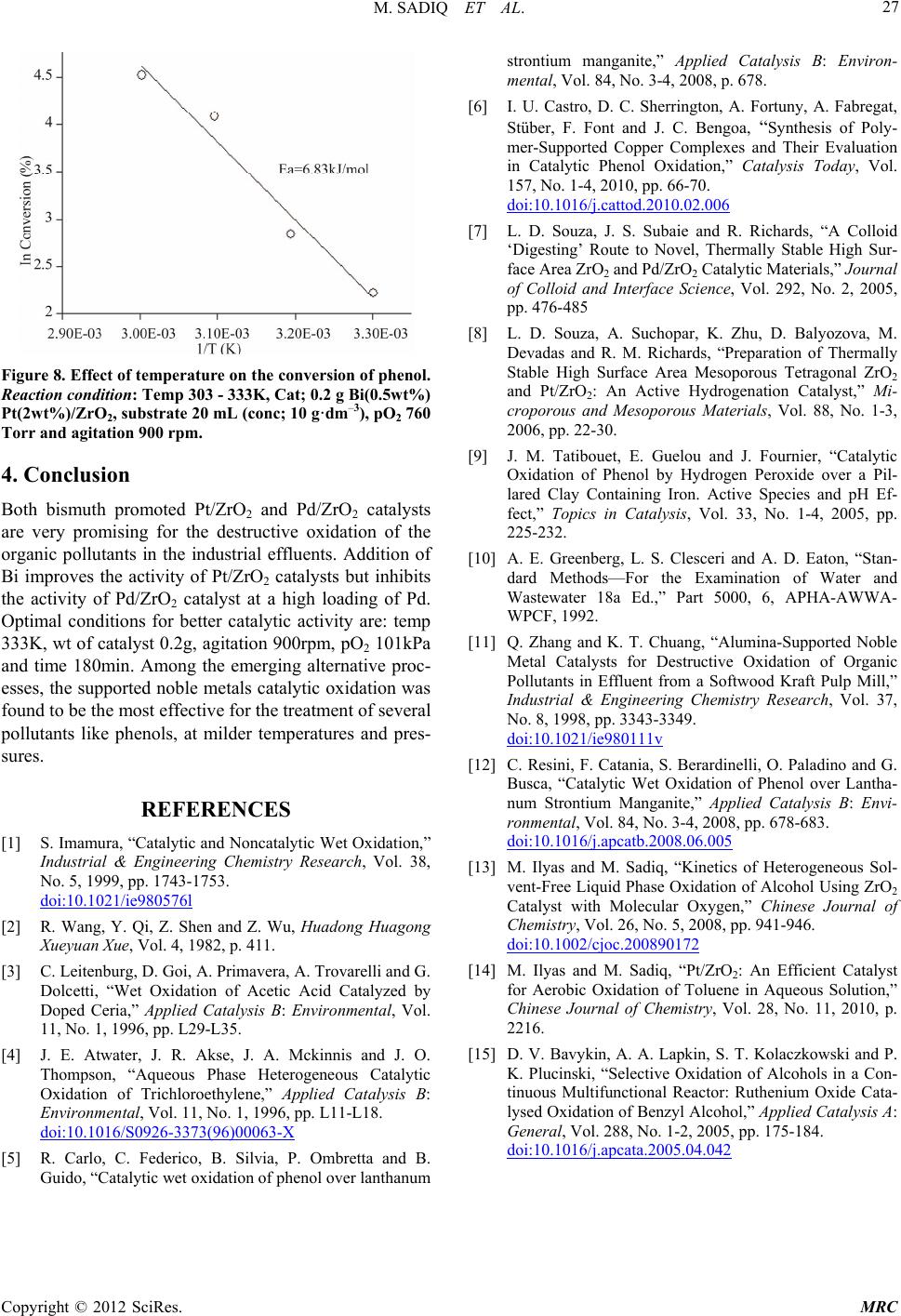 M. SADIQ ET AL. Copyright © 2012 SciRes. MRC 27 Figure 8. Effect of temperature on the conversion of phenol. Reaction condition: Temp 303 - 333K, Cat; 0.2 g Bi(0.5wt%) Pt(2wt%)/ZrO2, substrate 20 mL (conc; 10 g·dm–3), pO2 760 Torr and agitation 900 rpm. 4. Conclusion Both bismuth promoted Pt/ZrO2 and Pd/ZrO2 catalysts are very promising for the destructive oxidation of the organic pollutants in the industrial effluents. Addition of Bi improves the activity of Pt/ZrO2 catalysts but inhibits the activity of Pd/ZrO2 catalyst at a high loading of Pd. Optimal conditions for better catalytic activity are: temp 333K, wt of catalyst 0.2g, agitation 900rpm, pO2 101kPa and time 180min. Among the emerging alternative proc- esses, the supported noble metals catalytic o xidation was found to be the most effective for the treatment of several pollutants like phenols, at milder temperatures and pres- sures. REFERENCES [1] S. Imamura, “Catalytic and Noncatalytic Wet Oxidation,” Industrial & Engineering Chemistry Research, Vol. 38, No. 5, 1999, pp. 1743-1753. doi:10.1021/ie980576l [2] R. Wang, Y. Qi, Z. Shen and Z. Wu, Huadong Huagong Xueyuan Xue, Vol. 4, 1982, p. 411. [3] C. Leitenburg, D. Goi, A. Primavera, A. Trovarelli and G. Dolcetti, “Wet Oxidation of Acetic Acid Catalyzed by Doped Ceria,” Applied Catalysis B: Environmental, Vol. 11, No. 1, 1996, pp. L29-L35. [4] J. E. Atwater, J. R. Akse, J. A. Mckinnis and J. O. Thompson, “Aqueous Phase Heterogeneous Catalytic Oxidation of Trichloroethylene,” Applied Catalysis B: Environmental, Vol. 11, No. 1, 1996, pp. L11-L18. doi:10.1016/S0926-3373(96)00063-X [5] R. Carlo, C. Federico, B. Silvia, P. Ombretta and B. Guido, “Catalytic wet oxidation of phenol over lanthanum strontium manganite,” Applied Catalysis B: Environ- mental, Vol. 84, No. 3-4, 2008, p. 678. [6] I. U. Castro, D. C. Sherrington, A. Fortuny, A. Fabregat, Stüber, F. Font and J. C. Bengoa, “Synthesis of Poly- mer-Supported Copper Complexes and Their Evaluation in Catalytic Phenol Oxidation,” Catalysis Today, Vol. 157, No. 1-4, 2010, pp. 66-70. doi:10.1016/j.cattod.2010.02.006 [7] L. D. Souza, J. S. Subaie and R. Richards, “A Colloid ‘Digesting’ Route to Novel, Thermally Stable High Sur- face Area ZrO2 and Pd/ZrO2 Catalytic Materials,” Journal of Colloid and Interface Science, Vol. 292, No. 2, 2005, pp. 476-485 [8] L. D. Souza, A. Suchopar, K. Zhu, D. Balyozova, M. Devadas and R. M. Richards, “Preparation of Thermally Stable High Surface Area Mesoporous Tetragonal ZrO2 and Pt/ZrO2: An Active Hydrogenation Catalyst,” Mi- croporous and Mesoporous Materials, Vol. 88, No. 1-3, 2006, pp. 22-30. [9] J. M. Tatibouet, E. Guelou and J. Fournier, “Catalytic Oxidation of Phenol by Hydrogen Peroxide over a Pil- lared Clay Containing Iron. Active Species and pH Ef- fect,” Topics in Catalysis, Vol. 33, No. 1-4, 2005, pp. 225-232. [10] A. E. Greenberg, L. S. Clesceri and A. D. Eaton, “Stan- dard Methods—For the Examination of Water and Wastewater 18a Ed.,” Part 5000, 6, APHA-AWWA- WPCF, 1992. [11] Q. Zhang and K. T. Chuang, “Alumina-Supported Noble Metal Catalysts for Destructive Oxidation of Organic Pollutants in Effluent from a Softwood Kraft Pulp Mill,” Industrial & Engineering Chemistry Research, Vol. 37, No. 8, 1998, pp. 3343-3349. doi:10.1021/ie980111v [12] C. Resini, F. Catania, S. Berardinelli, O. Paladino and G. Busca, “Catalytic Wet Oxidation of Phenol over Lantha- num Strontium Manganite,” Applied Catalysis B: Envi- ronmental, Vol. 84, No. 3-4, 2008, pp. 678-683. doi:10.1016/j.apcatb.2008.06.005 [13] M. Ilyas and M. Sadiq, “Kinetics of Heterogeneous Sol- vent-Free Liquid Phase Oxidation of Alcohol Using ZrO2 Catalyst with Molecular Oxygen,” Chinese Journal of Chemistry, Vol. 26, No. 5, 2008, pp. 941-946. doi:10.1002/cjoc.200890172 [14] M. Ilyas and M. Sadiq, “Pt/ZrO2: An Efficient Catalyst for Aerobic Oxidation of Toluene in Aqueous Solution,” Chinese Journal of Chemistry, Vol. 28, No. 11, 2010, p. 2216. [15] D. V. Bavykin, A. A. Lapkin, S. T. Kolaczkowski and P. K. Plucinski, “Selective Oxidation of Alcohols in a Con- tinuous Multifunctional Reactor: Ruthenium Oxide Cata- lysed Ox idatio n of Benzyl Alc ohol, ” Applied Catalysis A: General, Vol. 288, No. 1-2, 2005, pp. 175-184. doi:10.1016/j.apcata.2005.04.042 |