

Paper Menu >>
Journal Menu >>
 Journal of Modern Physics, 2012, 3, 604-609 http://dx.doi.org/10.4236/jmp.2012.37082 Published Online July 2012 (http://www.SciRP.org/journal/jmp) Nonlinear Propagation of Dust-Ion-Acoustic Waves in a Degenerate Dense Plasma M. S. Zobaer, N. Roy, A. A. Mamun Department of Physics, Jahangirnagar University, Dhaka, Bangladesh Email: [email protected], niparo[email protected], [email protected] Received April 28, 2012; revised May 25, 2012; accepted June 16, 2012 ABSTRACT Nonlinear propagation of dust-ion-acoustic waves in a degenerate dense plasma (with the constituents being degenerate, for both the limits non-relativistic or ultra-relativistic) have been investigated by the reductive perturbation method. The Korteweg de-Vries (K-dV) equation and Burger’s equation have been derived, and the numerical solutions of those equations have been analyzed to identify the basic features of electrostatic solitary and shock structures that may form in such a degenerate dense plasma. The implications of our results in compact astrophysical objects, particularly, in white dwarfs, have been briefly discussed. Keywords: Degenerate Plasma; Dust-Ion-Acoustic Waves; K-dV Equation; Burzer’s Equation In present days, most theoretical concerns are to under- stand the environment of the compact objects having their interiors supporting themselves via degenerate pre- ssure. The degenerate pressure, which arises due to the combine effect of Pauli’s exclusion principle (Wolfgang Ernst Pauli, 1925) and Heisenberg’s uncertainty principle (Werner Heisenberg, 1927), depends only on the fermion number density, but not on it’s temperature. This dege- nerate pressure has a vital role to study the electrostatic perturbation in matters existing in extreme conditions [1-7]. The extreme conditions of matter are caused by significant compression of the interstellar medium. High density of degenerate matter in these compact objects (which are, in fact, “relics of stars”) is one of these extreme conditions. These interstellar compact objects, having ceased burning thermonuclear fuel and thereby no longer generate thermal pressure, are contracted signi- ficantly, and as a result, the density of their interiors becomes extremely high to provide non-thermal pressure through degenerate pressure of their constituent particles and particle-particle interaction. The observational evi- dence and theoretical analysis imply that these compact objects support themselves against gravitational collapse by degenerate pressure. The degenerate electron number density in such a compact object is so high (e.g. in white dwarfs it can be of the order of 1030 cm−3, even more [8]) that the electron Fermi energy is comparable to the electron mass energy and the electron speed is comparable to the speed of light in vacuum. The equation of state for degenerate electrons in such interstellar compact objects are mathematically explained by Chandrasekhar [4] for two limits, namely non-relativistic and ultra-relativistic limits. The inter- stellar compact objects provide us cosmic laboratories for studying the properties of the medium (matter), as well as waves and instabilities [9-22] in such a medium at extremely high densities (degenerate state) for which quantum as well as relativistic effects become important [9,21]. The quantum effects on linear [16,18,22] and nonlinear [17,20] propagation of electrostatic and elec- tromagnetic waves have been investigated by using the quantum hydrodynamic (QHD) model [9,21], which is an extension of classical fluid model in a plasma, and by using the quantum magneto-hydrodynamic (QMHD) model [16-20], which involve spin 1 2 and one-fluid MHD equations. Recently, a number of theoretical investigations have also been made of the nonlinear propagation of electro- static waves in degenerate quantum plasma by a number of authors, e.g. Hass [23], Misra and Samanta [24], Mistra et al. [25] etc. However, these investigations are based on the electron equation of state valid for the non- relativistic limit. Some investigations have been made of the nonlinear propagation of electrostatic waves in a degenerate dense plasma based on the degenerate elec- tron equation of state valid for ultra-relativistic limit [8]. To the best of our knowledge, no theoretical investiga- tion has been developed to study the extreme condition of matter for both non-relativistic and ultra-relativistic limits. Therefore, in our present investigation, we con- sider a degenerate dense plasma containing non-rela- C opyright © 2012 SciRes. JMP 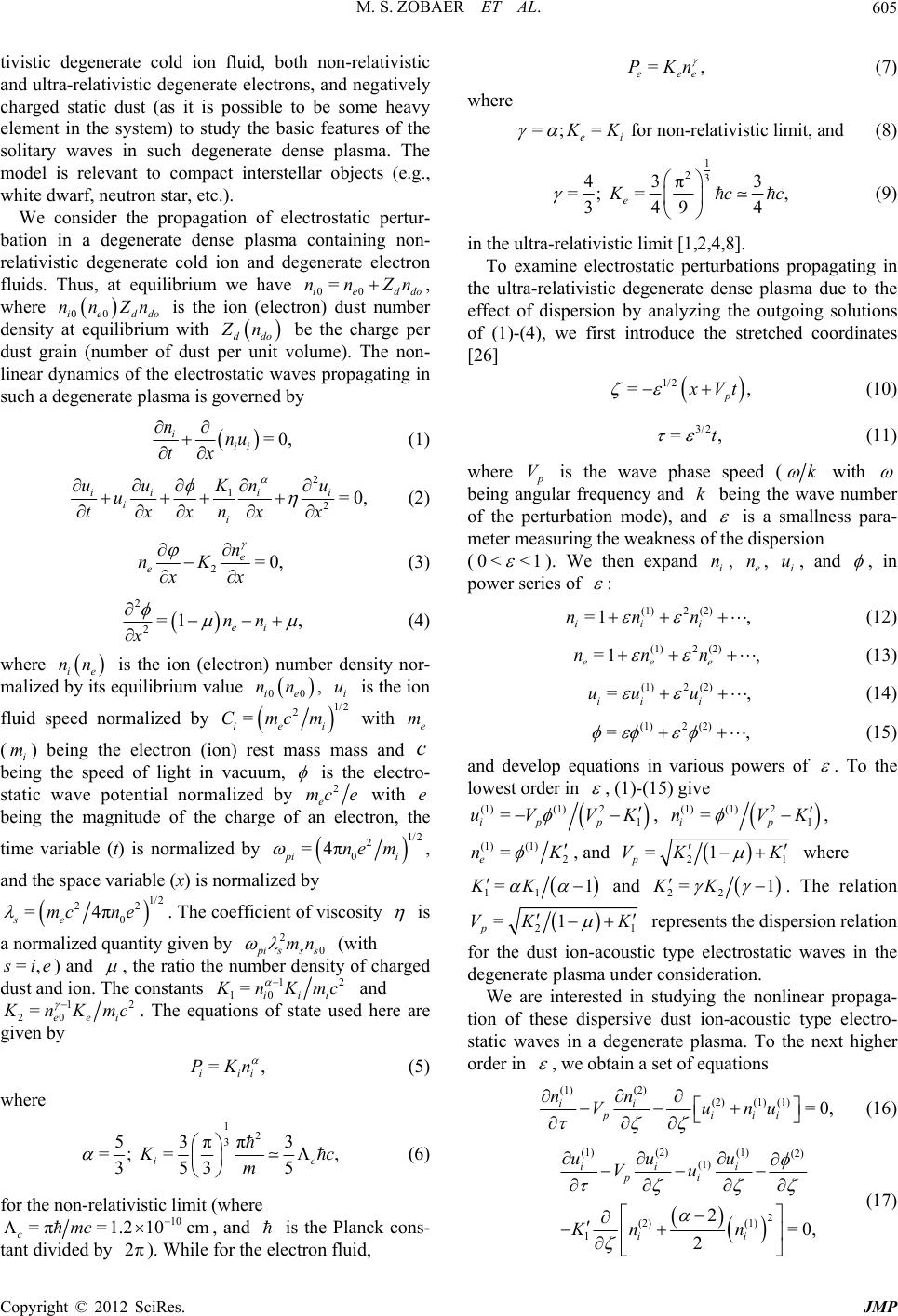 M. S. ZOBAER ET AL. 605 tivistic degenerate cold ion fluid, both non-relativistic and ultra-relativistic degenerate electrons, and negatively charged static dust (as it is possible to be some heavy element in the system) to study the basic features of the solitary waves in such degenerate dense plasma. The model is relevant to compact interstellar objects (e.g., white dwarf, neutron star, etc.). We consider the propagation of electrostatic pertur- bation in a degenerate dense plasma containing non- relativistic degenerate cold ion and degenerate electron fluids. Thus, at equilibrium we have 00ieddo =nnZn , where 00ie ddo is the ion (electron) dust number density at equilibrium with nnZn ddo Z n be the charge per dust grain (number of dust per unit volume). The non- linear dynamics of the electrostatic waves propagating in such a degenerate plasma is governed by =0, ii nu tx i n (1) 2 2=0, i i n u xx 1 ii i i uu K u txxn (2) 2=0, e n nK e x x (3) 2 , ei nn 2=1 x nn 00ie nn i u (4) where ie is the ion (electron) number density nor- malized by its equilibrium value , is the ion fluid speed normalized by 1/2 2 iei Cmcm e m c = with (i m) being the electron (ion) rest mass mass and being the speed of light in vacuum, is the electro- static wave potential normalized by 2ee e with being the magnitude of the charge of an electron, the mc time variable (t) is normalized by 1/2 2 0 πi ne m=4 pi , and the space variable (x) is normalized by 1/2 22 0 =4πne se mc . The coefficient of viscosity is a normalized quantity given by 0 2 p is ss (with mn =, s ie ) and , the ratio the number density of charged dust and ion. The constants 12 = 10iii K nKmc and 1 =2 i20ee K nKm =, iii PKn c . The equations of state used here are given by (5) where 123, 5 ic 3 53ππ =; = 353 K c m (6) for the non-relativistic limit (where 10 =π=1.210 cmmc 2π =, eee PKn c, and is the Planck cons- tant divided by ). While for the electron fluid, (7) where =;= for non-relativistic limit, and ei KK (8) 1 23 43π3 =; =, 349 4 e K cc 1/2 =, p (9) in the ultra-relativistic limit [1,2,4,8]. To examine electrostatic perturbations propagating in the ultra-relativistic degenerate dense plasma due to the effect of dispersion by analyzing the outgoing solutions of (1)-(4), we first introduce the stretched coordinates [26] x Vt 3/ 2 =,t (10) (11) where p V is the wave phase speed (k with being angular frequency and being the wave number of the perturbation mode), and k is a smallness para- meter measuring the weakness of the dispersion (0< <1 ). We then expand , , , and i ne ni u , in power series of : (1)2 (2) =1 , iii nnn (1)2 (2) =1 , eee nnn (12) (1)2 (2) =, ii i uu u (13) (1)2 (2) =, (14) (15) and develop equations in various powers of . To the lowest order in , (1)-(15) give (1)(1) 2 1 = ip p uV VK (1) (1)2 1 = ip nVK , , (1) (1) 2 = e nK 21 =1 p VK K , and where 11 =1KK and 22 =1KK . The relation 21 =1 p VKK nlinear propaga- tio represents the dispersion relation for the dust ion-acoustic type electrostatic waves in the degenerate plasma under consideration. We are interested in studying the no n of these dispersive dust ion-acoustic type electro- static waves in a degenerate plasma. To the next higher order in , we obtain a set of equations (1) (2) nn(2) (1) (1)=0, ii piii Vu nu (16) (1)(2)(1) (2) (1) 2 (2) (1) 1 2=0, 2 ii i pi ii uu u Vu Kn n (17) Copyright © 2012 SciRes. JMP  M. S. ZOBAER ET AL. 606 2 (1) =0 , ee n (18) (2) (2) 2 2 2 Kn (2) (2) . ei nn (19) we deduce a Kort Vries equation 2(1) 2=1 Now, combining (16)-(19)eweg-de (1) (1) (1) 3 (1) AB w 3=0, (20) here 2 2 VK 2 11 32 21 1 32 12 =, 2 pp pp VK AVK VK (21) 2 2 1 =. 2 p p VK V (22) Thlitary wave solution of (20) is B e stationary so (1) 2 =s , mech ere the special coordi (23) whnate, 0 =u , the amplitude, 0 =3uA, and the width, m 1/ 2 0 =4Bu. It is obvi- ous from (21)e degenerate plasma under consideration ressive e waves which a positive potential. It is amplitud and (32) that t pports comp are associated h su with e lectrostatic solitary obvious from (21)-(32) that the [m ] of these solitary structures depends on thrameter e density pa , i.e., the ratio of electron to ion number density. The electrostatic solitary profiles are shown in Figures 1-2. This is obvious that the profiles are quite different from those obtained from the previous investigation [8]. And the potential for non-relativistic degenerate ion fluid and ultra-relativistic degenerate electron fluid is different from that when both the particles follow the same limit. We now turn to (20) with the term (1) which changes proportionally with the parameter . We have numerically solved (20), and have studied the effects of on electrostatic solitary structures in both non-rela- tivistic and ultra-relativistic degenerate electrons (ion alwe reays being non-relativistic degenerate). Thsults of the first case are depicted in Figures 1 and 2. To examine electrostatic perturbations propagating in the relativistic degenerate dense plasma due to the effect of dissipation by analyzing the outgoing solutions of (1)- (4), we now introduce the new set of stretched coor- dinates [26] =, p x Vt (24) 2 =,t (25) (1) Figure 1. The solitary profiles represented by (32) with u0 = 1 and both the constituent particles non-r e l ativistic . (1) Figure 2. (Colour online) The solitary profiles represented by (32) with u0 = 0.1 and both the constituent particles non-relativistic. To the lowest order in , (1)-(9), (24), (25), and (12)- (15) give the same results as we have had for the solitary waves. To the next higher order in , we obtain a set of equations (1) (2) (2)(1) (1)=0, ii piii nn Vunu (26) (1)(2)(1) (2) 2 2 (2) (1) 1 2=0, 2 (1) (1) 2 ii i p ii uu u Vu u ii Kn n (27) (2) 2 (2) (1) 2 2=0, 2 ee Kn n (28) (2) (2) 0= 1. ei nn (29) Now, combining (26)-(29) we deduce a Burger’s equa- tion Copyright © 2012 SciRes. JMP  M. S. ZOBAER ET AL. 607 (1) ( (1) 1)2 (1) 2 =,AC whervalue of (30) e the A is the same give as before and C is n by 0 2ii mn =.C (31) The stationary shock wave solution of (30) is (1) =1tan,h 32) ( (1) 0 where (1) 00 =uA and 0 =2Cu . e proock wave c between nonlinearity and dissipation are shown in Fi 4 that there is no effect of η (the value of η was chosen from the experimental evidences [27] and it was with our present investigation) on potential of the shock ut a signifect of 0 uhown in Figures 5 Th files of shaused by the balance gures 3-6. It is observed from Figures 3 and made coincided wave, bant eff (s an ic d 6). The potential of wave profile for non-relativistic degenerate ion fluid and ultra-relativistic degenerate electron fluid is very small compared to that of for both (1) Figure 3. The effect of the variation of μ and η on the potential of shock wave for both electron-ion being non- relativistic degenerate with u0 = 10. (1) Figure 5. The effect of the variation of μ and u0 on the potential of shock wave for both electron-ion being non- relativistic degenerate. F pote igure 6. The effect of the variation of μ and u0 on the ntial of shock wave for electron being ultra-relativistic and ion being non-relativistic degenera te . non-relativistic electron-ion fluid (from Figures 3-6). The existence of the nonlinear structures (both solitary and shock waves) have been verified using the standard values of different parameters related to our present sit- uation [8]. The effect of some parameters on the plas- ma system have been studied directly from this inves- tigation. To summarize, we have investigated electrostatic soli- tary and shock waves in a degenerate dense plasma, which is relevant to interstellar compact objects [6,28 33]. The degenerate dense plasma is found to suppo width, and speed ty, - rt solitary structures whose basic features (amplitude, width, speed, etc.) depend only on the plasma number density. It as been shown here that the amplitude, h increase with the increase of the plasma number densi particularly, the maximum number of the light particles (electrons). This work is very much effective and quite different from others and is more general than the relevant previous works [8]. We hope that our present investigation will be helpful for understanding the basic Figure 4. The effect of the variation of μ and η on the potential of shock wave for electron being ultra-relativistic and ion being non-relativistic degener ate wi th u0 = 10. Copyright © 2012 SciRes. JMP 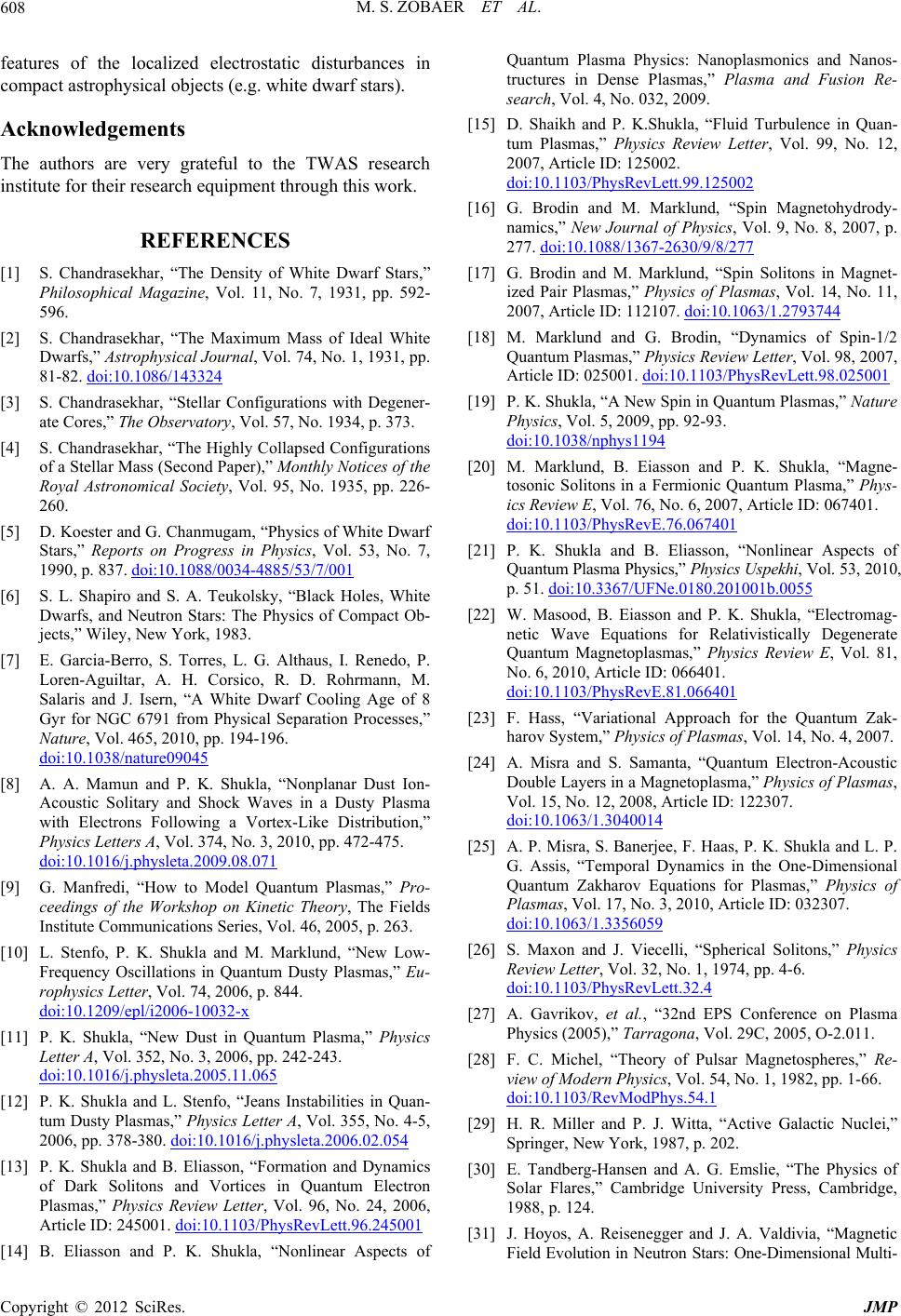 M. S. ZOBAER ET AL. 608 features of the localized electrostatic disturbances in compact astrophysical objects (e.g. white dwarf stars). Acknowledgements The authors are very grateful to the TWAS research institute for their research equipment through this work. REFERENCES [1] S. Chandrasekhar, “The Density of White Dwarf Stars,” Philosophical Magazine, Vol. 11, No. 7, 1931, pp. 592- 596. [2] S. Chandrasekhar, “The Maximum Mass of Ideal White Dwarfs,” Astrophysical Journal, Vol. 74, No. 1, 1931, pp. 81-82. doi:10.1086/143324 [3] S. Chandrasekhar, “Stellar Configurations with Degener- ate Cores,” The Observatory, Vol. 57, No. 1934, p. 373. [4] S. Chandrasekhar, “The Highly Collapsed Configurations nd Paper),” Monthly Notices of t ciety, Vol. 95, No. 1935, pp. 226- Stars,” Reports on Progress in Physics, Vol. 53, No. 1990, p. 837. d 3/7/001 of a Stellar Mass (Seco Royal Astronomical So he 260. [5] D. Koester and G. Chanmugam, “Physics of White Dwarf 7, oi:10.1088/0034-4885/5 [6] S. L. Shapiro lack Holes, White rcia-Berro, S. Torres, L. G. Althaus, I. Renedo, P ysical Separation Processes,” and S. A. Teukolsky, “B Dwarfs, and Neutron Stars: The Physics of Compact Ob- jects,” Wiley, New York, 1983. [7] E. Ga. Loren-Aguiltar, A. H. Corsico, R. D. Rohrmann, M. Salaris and J. Isern, “A White Dwarf Cooling Age of 8 Gyr for NGC 6791 from Ph Nature, Vol. 465, 2010, pp. 194-196. doi:10.1038/nature09045 [8] A. A. Mamun and P. K. Shukla, “Nonplanar Dust Ion- Acoustic Solitary and Shock Waves in a Dusty Plasma with Electrons Following a Vortex-Like Distribution,” Physics Letters A, Vol. 374, No. 3, 2010, pp. 472-475. doi:10.1016/j.physleta.2009.08.071 [9] G. Manfredi, “How to Model Quantum Plasmas,” Pro- ceedings of the Workshop on Kinetic Theory, The Fields Institute Communications Series, Vol. 46, 2005, p. 263. [10] L. Stenfo, P. K. Shukla and M. Marklund, “New Low- Frequency Oscillations in Quantum Dusty Plasmas,” Eu- rophysics Letter, Vol. 74, 2006, p. 844. doi:10.1209/epl/i2006-10032-x [11] P. K. Shukla, “New Dust in Quantum Plasma,” Physics Letter A, Vol. 352, No. 3, 2006, pp. 242-243. doi:10.1016/j.physleta.2005.11.065 [12] P. K. Shukla and L. Stenfo, “Jeans Instabilities in Quan- tum Dusty Plasmas,” Physics Letter A, Vol. 355, No. 4-5, 2006, pp. 378-380. doi:10.1016/j.physleta.2006.02.054 [13] P. K. Shukla and B. Eliasson, “Formation and Dynamics of Dark Solitons and Vortices in Quantum Electr Plasmas,” Physics Review Letter, V on ol. 96, No. 24, 2006, Article ID: 245001. doi:10.1103/PhysRevLett.96.245001 [14] B. Eliasson and P. K. Shukla, “Nonlinear Aspects of Quantum Plasma Physics: Nanoplasmonics and Nanos- bulence in Quan- , Vol. 99, No. 12, tructures in Dense Plasmas,” Plasma and Fusion Re- search, Vol. 4, No. 032, 2009. [15] D. Shaikh and P. K.Shukla, “Fluid Tur tum Plasmas,” Physics Review Letter 2007, Article ID: 125002. doi:10.1103/PhysRevLett.99.125002 [16] G. Brodin and M. Marklund, “Spin Magnetohydrody- namics,” New Journal of Physics, Vol. 9, No. 8, 2007, p. 277. doi:10.1088/1367-2630/9/8/277 [17] G. Brodin and M. Marklund, “Spin Solitons in Magnet- ized Pair Plasmas,” Physics of Plasmas, Vol. 14, No. 11, 2007, Article ID: 112107. doi:10.1063/1.2793744 [18] M. Marklund and G. Brodin, “Dynamics of Spin-1/2 Quantum Plasmas,” Physics Review Letter, Vol. 98, 2007, Article ID: 025001. doi:10.1103/PhysRevLett.98.025001 [19] P. K. Shukla, “A New Spin in Quantum Plasmas,” Nature Physics, Vol. 5, 2009, pp. 92-93. doi:10.1038/nphys1194 [20] M. Marklund, B. Eiasson and P. K. Shukla, “Magne- tosonic Solitons in a Fermionic Quantum Plasma,” Phys- ics Review E, Vol. 76, No. 6, 2007, Article ID: 067401. doi:10.1103/PhysRevE.76.067401 [21] P. K. Shukla and B. Eliasson, “Nonlinear Aspects of Quantum Plasma Physics,” Physics Uspekhi, Vol. 53, 2010, p. 51. doi:10.3367/UFNe.0180.201001b.0055 ol. 81, [22] W. Masood, B. Eiasson and P. K. Shukla, “Electromag- netic Wave Equations for Relativistically Degenerate Quantum Magnetoplasmas,” Physics Review E, V No. 6, 2010, Article ID: 066401. doi:10.1103/PhysRevE.81.066401 [23] F. Hass, “Variational Approach for the Quantum Zak- harov System,” Physics of Plasmas, Vol. 14, No. 4, 2007. [24] A. Misra and S. Samanta, “Quan Double Layers in a Magn tum Electron-Acoustic etoplasma,” Physics of Plasmas, Vol. 15, No. 12, 2008, Article ID: 122307. doi:10.1063/1.3040014 [25] A. P. Misra, S. Banerjee, F. Haas, P. K. Shukla and L. P G. Assis, “Temporal Dynamics in . the One-Dimensional Quantum Zakharov Equations for Plasmas,” Physics of Plasmas, Vol. 17, No. 3, 2010, Article ID: 032307. doi:10.1063/1.3356059 [26] S. Maxon and J. Viecelli, “Spherical Solitons,” Physics Review Letter, Vol. 32, No. 1, 1974, pp. 4-6. doi:10.1103/PhysRevLett.32.4 [27] A. Gavrikov, et al., “32nd EPS Physics (2005),” Tarragona, Vol. 2 Conference on Plasma 9C, 2005, O-2.011. [28] F. C. Michel, “Theory of Pulsar Magnetospheres,” Re- view of Modern Physics, Vol. 54, No. 1, 1982, pp. 1-66. doi:10.1103/RevModPhys.54.1 [29] H. R. Miller and P. J. Witta, “Active Galactic Nuclei,” Springer, New York, 1987, p. 202. [30] E. Tandberg-Hansen and A. G. Emslie, “The Physics of ulti- Solar Flares,” Cambridge University Press, Cambridge, 1988, p. 124. [31] J. Hoyos, A. Reisenegger and J. A. Valdivia, “Magnetic Field Evolution in Neutron Stars: One-Dimensional M Copyright © 2012 SciRes. JMP  M. S. ZOBAER ET AL. Copyright © 2012 SciRes. JMP 609 y and Astrophysics, Vol. 487, No. Fluid Model,” Astronom 3, 2008, pp. 789-803. doi:10.1051/0004-6361:200809466 [32] F. Asenjo, V. Munoz, J. A. Valdivia and S. M. Hahajan, cle “A Hydrodynamical Model for Relativistic Spin Quantum Plasmas,” Physics of Plasmas, Vol. 18, No. 1, 2011, Arti- ID: 012107. doi:10.1063/1.3533448 [33] F. A. Asenjo, V. Munoz, J. A. Valdivia and T. Hada, “Circularly Polarized Wave Propagation in Magnetofluid Dynamics for Relativistic Electron-Positron Plasmas,” Physics of Plasmas, Vol. 16, No. 12, 2009, Article ID: 122108. doi:10.1063/1.3272667 |