

Paper Menu >>
Journal Menu >>
 Journal of Minerals & Materials Characterization & Engineering, Vol. 11, No.2 pp.153-158, 2012 jmmce.org Printed in the USA. All rights reserved 1087 Corrosion-Wear of ST60-Mn Ste el in Cas sava Juice * M. A. Bodude, W.A. Ayoola , D. E. Esezobor and, A. A. Agbeleye Department of Metallurgical and Materials Engineering, University of Lagos, Nigeria *Corresponding Author: [email protected] ABSTRACT Steels are used widely for production of machine components due to their versatility, low cost, ease of production and modification of their properties through heat-treatment. ST60Mn Steel is one of the common high strength steel produced in Nigeria and utilized for machine building purposes. Components made from this materials failed by wear, corrosion or both mechanism. The aim of this paper is to determine the influence of austempering heat-treatment on the corrosion-wear resistance of ST60Mn steel in cassava juice. The heat-treatment was performed by varying the austenitizing temperature, austempering temperature and time. The corrosion wear resistance was investigated under an instrumented pin-on-disc wear testing machine with the steel samples dipped in the cassava juice. The results obtained showed that the austempered ST60Mn steel has a wear rate of 3.0µg/cycle. While, the un-heat-treatment sample possess 70.1µg/cycle. This is a tremendous improvement in corrosion wear rate through the austempering heat treatment. Keywords: Corrosion, wear, Austempering, Heat-treatment, Cassava-juice. 1. INTRODUCTION ST60Mn Steel is a common medium carbon steel produced in Nigeria. It has strength comparable to those of imported machine building steels and is used for the production of components such as shafts, gears, bolts and nuts and other machine components that are subjected to rubbing actions in a corrosive medium as well as non-corrosive medium. Greater abrasive resistance for low bainite matrix, with the same hardness, under a pin-on-disc test has been reported [1]. In recent time, heat treatment of steels with bainite structure ensures a good complex of mechanical properties has been observed [2]. Evidence showed that the  154 M. A. Bodude, W.A. Ayoola Vol.11, N o.2 ST60Mn steel reliability in these applications in terms of wear characteristic is lower than its imported counterparts [3]. The wear failures of steels depend on the intrinsic parameters such as chemical composition, microstructure, and smoothness of the mating surfaces as well as the ex trinsic parameters like the applied load, sliding velocity, sliding distance or number of c ycles. The failure also depends on the service environment such as the presence of corrosive agents. The presence of liquid or solid films on mating (rubbing) surfaces have marked influence on their wear rate has also be noted [4]. The simultaneous actions of corrosion and wear often lead to rapid deterioration of component. This is due to the continuous Mechanical removal of oxidized metal as a result of which a protective layer can not be sustained. Machine components steels are required to have a bainite microstructure. The institution of Metallurgist [5] reported that an austempered bainitic steel consisting of two phase matrix of mixed bainitic ferrite and retained austenite superior wear resistance. The positive mechanical strength and corrosion re s i st ance of bain it e s tru cture dep en d on number o f factors such as b ainite ferrite grain size, dislocation density, internal stress and carbide dispersion. 2. MATERIAL AND METHODOLOGY The ST60Mn steel sample hot rolled 12mm diameter rod used was obtained from Osogbo Steel rolling Mill, Osun State, Nigeria. The Steel has chemical composition: C(0.35-0.42), Si (0.20- 0.30), Mn (0.90-1.20), P(0.04), CU(0.25), S(0.04), Cr(010). Sixty-five test specimens of 14mm length and 12mm diameter were cut from the as-received steel samples. Five of the test specimens were retained as the as-received specimen while the rest were su bj e cted to aus tem peri ng h ea t -tre at ment u nder di fferent aus temp ering conditions. The steel specimens austempered using different austenitizing temperature TS(780, 820, 860 and 9000C), soaked for one hour, were quenched isothermally in salt bath containing 55% KNO3 and 45% NaNO3 at different transformation temperatures TT (340, 400, 480 and 5000C) and transformation times tT (1, 15, 45 and 60 minut es ). The sam pl es w ere th en air cooled to ambient temperat u re. Macro hardness test was conducted on the as-received and the austempered specimens using the Rockwell component of Briro V.A. (0-7300) universal hardness machine. The hardness values were read after a 1200 diamond cone indenter was pressed on the samples with a load of 1400N for about 15 minutes. Prior to exposing samples to cassava juice, their weights were measured on PB 153 Meltler Toledo digital weighing balance. The cassava juice which was used as a corrosive medium was obtained by pressing a freshly harvested and ground cassava tubers obtained from a research farm using a screw press with a bucket underneath to collect the cassava juice that was later preserved in a refrigerator. The pH 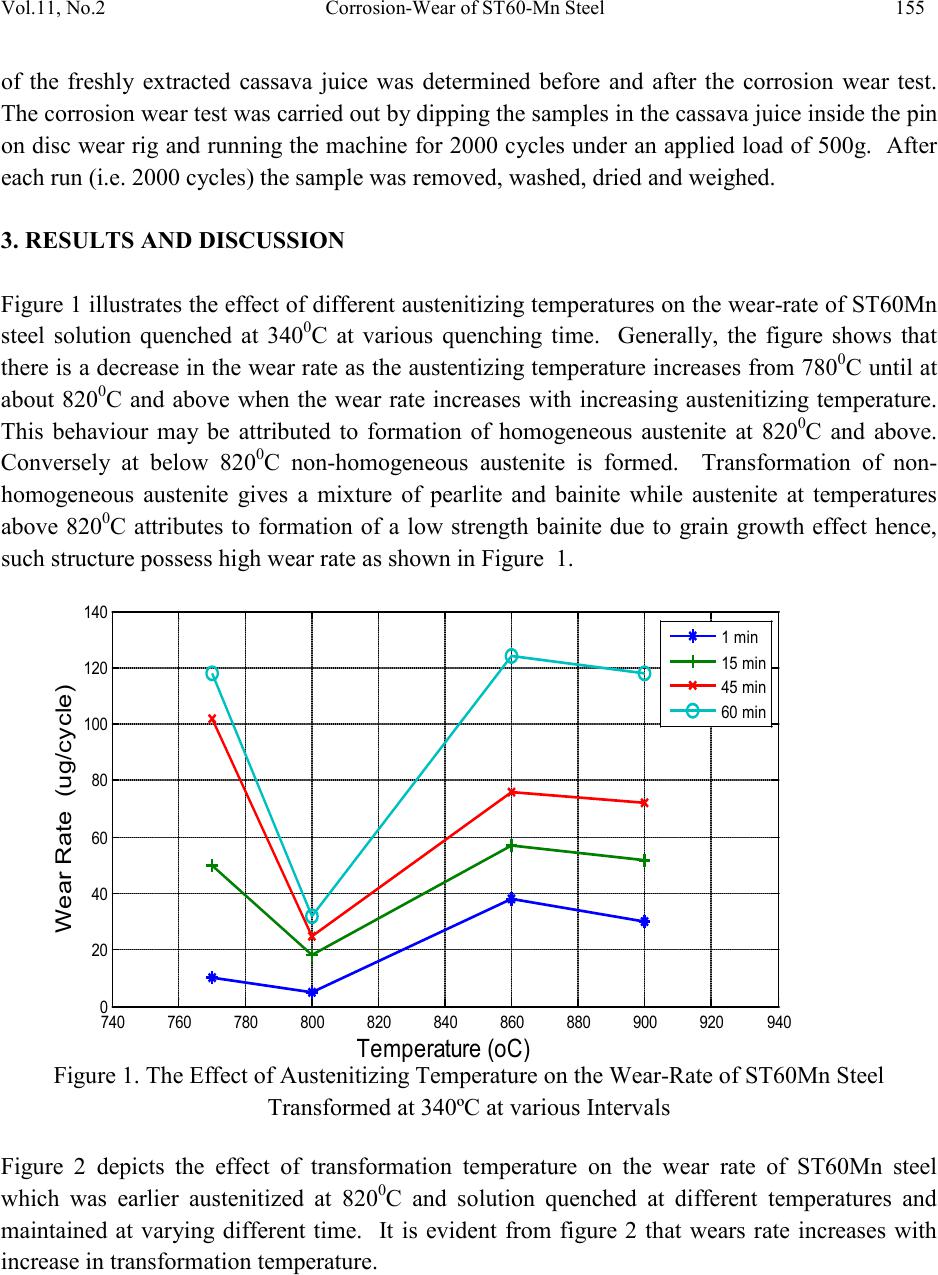 Vol.11, No.2 Corrosion-Wear of ST60-Mn Steel 155 of the freshly extracted cassava juice was determined before and after the corrosion wear test. The corrosion wear test was carried out by dipping the samples in t he cas sav a ju ice i ns id e th e pin on disc wear rig and running the machine for 2000 c ycles under an applied load of 500 g. After each run (i.e. 2000 cycles) the sample was removed, washed, dried and weighed. 3. RESULTS AND DISCUSSION Figure 1 illustrates the effect of di fferent aus teniti zing temperatures on the w ear-rate of ST60Mn steel solution quenched at 3400C at various quenching time. Generally, the figure shows that there is a decreas e in the wear rate as the austentizing temperature increas es from 780 0C until at about 8200C and above when the wear rate increases with increasing austenitizing temperature. This behaviour may be attributed to formation of homogeneous austenite at 8200C and above. Conversely at below 8200C non-homogeneous austenite is formed. Transformation of non- homogeneous austenite gives a mixture of pearlite and bainite while austenite at temperatures above 8200C attributes to formation of a low strength bainite due to grain growth effect hence, such structure possess high wear rate as shown in Figure 1. 740 760 780 800 820 840 860 880 900 920 940 0 20 40 60 80 100 120 140 Temperatur e (oC) Wear Rate (ug/cycle) 1 m in 15 m in 45 m in 60 m in Figure 1. The Effect of Austenitizing Temperature on the Wear-Rate of ST60Mn Steel Transformed at 340ºC at various Intervals Figure 2 depicts the effect of transformation temperature on the wear rate of ST60Mn steel which was earlier aus t enitized at 8200C and solution quenched at different temperatures and maintained at varying different time. It is evident from figure 2 that wears rate increases with increase in transformation temperature. 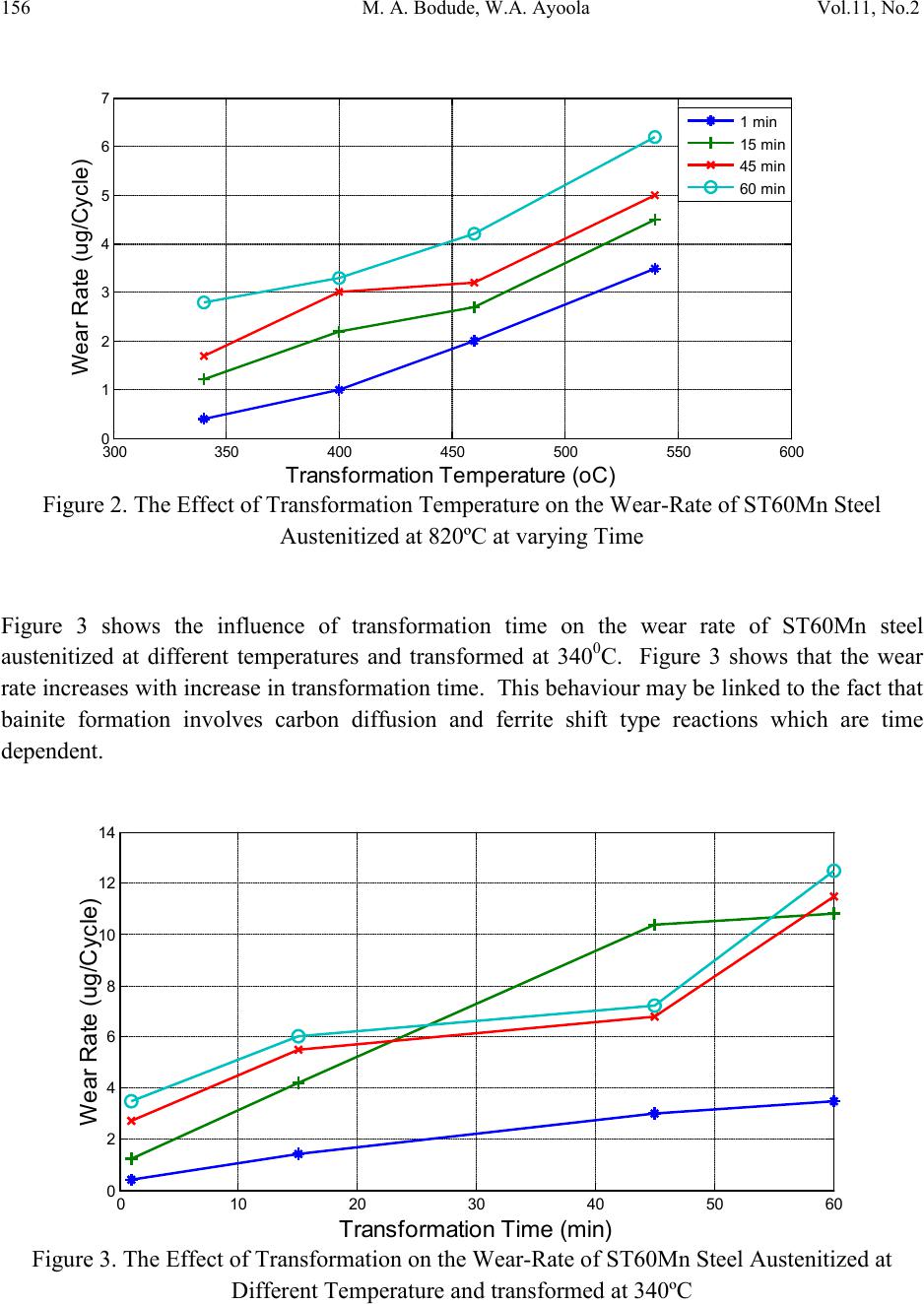 156 M. A. Bodude, W.A. Ayoola Vol.11, N o.2 300350 400 450 500 550 600 0 1 2 3 4 5 6 7 Transfor m at ion Tem perature ( oC) Wear Rate (ug/ Cycle) 1 mi n 15 mi n 45 mi n 60 mi n Figure 2. The Effect of Transformation Temperature on the Wear-Rate of ST60Mn Steel Austenitized at 820ºC at varying Time Figure 3 shows the influence of transformation time on the wear rate of ST60Mn steel austeni tiz ed at different temperatures and transformed at 3400C. Figure 3 shows that the wear rate incr eas es wi t h i ncrea s e in tran sfo rmat i on t ime . This behaviour ma y be linked to the fact that bainite formation involves carbon diffusion and ferrite shift type reactions which are time dependent. 010 20 30 40 50 60 0 2 4 6 8 10 12 14 Tr ansformation Time (min) Wear Rate (ug/ C ycle) Figure 3. The Effect of Transformation on the Wear-Rate of ST60Mn Steel Austenitized at Different Temperature and transformed at 340ºC 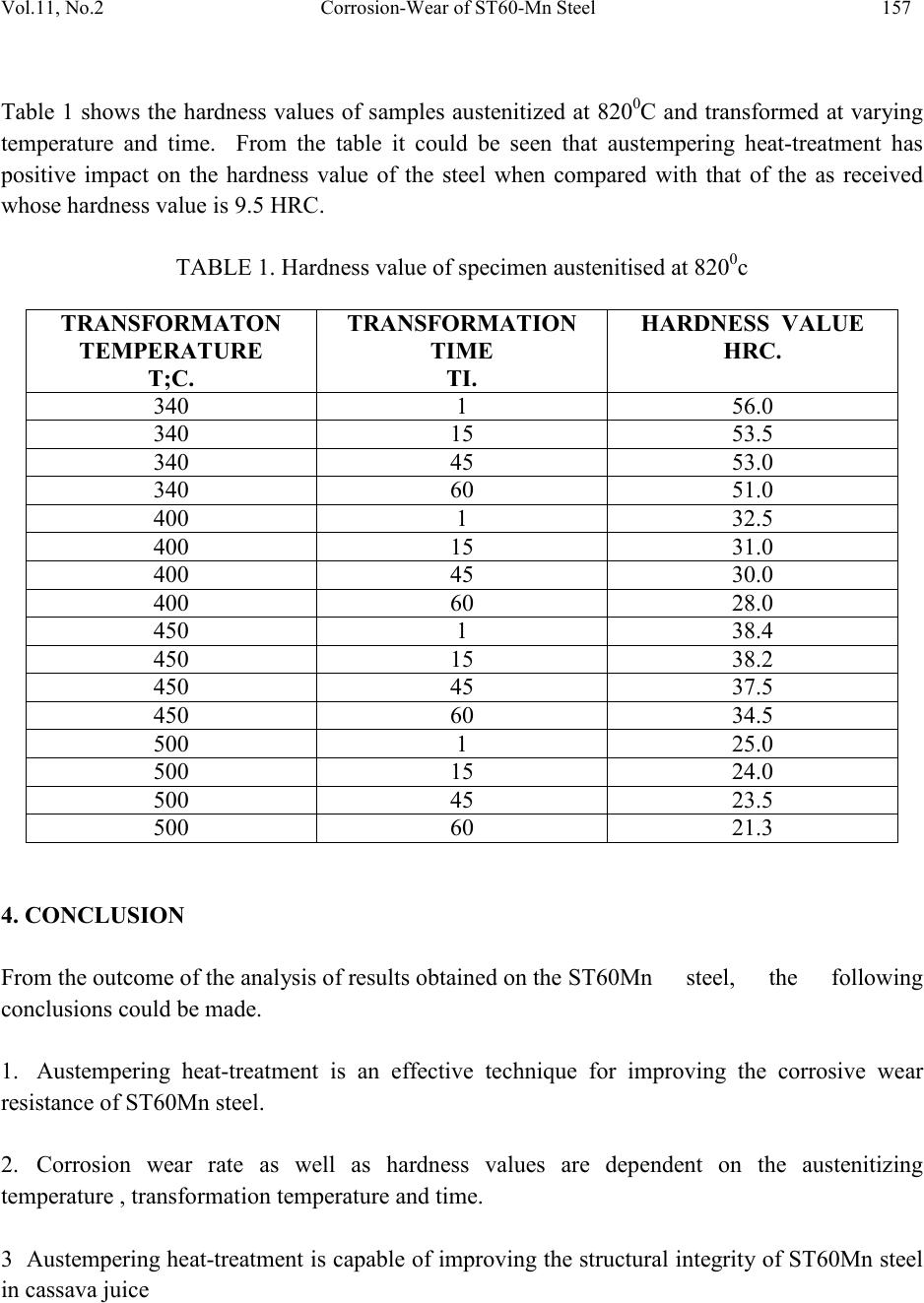 Vol.11, No.2 Corrosion-Wear of ST60-Mn Steel 157 Table 1 shows the hardness values of samples austenitiz ed at 8200C and transformed at varying temperature and time. From the table it could be seen that austempering heat-treatment has positive impact on the hardness value of the steel when compared with that of the as received whose hardness value is 9.5 HRC. TABLE 1. Hardness value of specimen austenitised at 8200c TRANSFORMATON TEMPERATUR E T;C. TRANSFORMATION TIME TI. HARDNESS VALUE HRC. 340 1 56.0 340 15 53.5 340 45 53.0 340 60 51.0 400 1 32.5 400 15 31.0 400 45 30.0 400 60 28.0 450 1 38.4 450 15 38.2 450 45 37.5 450 60 34.5 500 1 25.0 500 15 24.0 500 45 23.5 500 60 21.3 4. CONCLUSION From the outcome of the analysis of results obtained on the ST60Mn steel, the following conclusions could be made. 1. Austempering heat-tr eatmen t is an effective technique for improving the corrosive wear resistance of ST60Mn steel . 2. Corrosion wear rate as well as hardness values are dependent on the austenitizing temperature , transformation temperature and time. 3 Austempering heat-treatment is capable of improving the structural integrity of ST60Mn steel in cassava juice  158 M. A. Bodude, W.A. Ayoola Vol.11, N o.2 REFERENCES 1. Zum -G ah r K. H., (1982): Relation between abrasive wear rate and the microstructure of metals, proceedings of the International Conference on wear of Materials, Reston. 2. Kaleten, A. Y; Lyzhkov, A. G. (2007): Alloying and heat treatment of steels with baintic structure. Metal Science and Heat-treatment. Vol. November 10 pp. 731 – 735. 3. Umorus, L.E.; A. O. Akinola and M. O. Adeoye (2006): Corrosion-wear. Journal of Applied Sciences Research Vol. 2. No. 9 pp. 529 – 532. 4. Williams, K. (2000): Plant Engineering Hardbook 2nd ed. McGr aw – Hill Book Cop y pp. 5 – 44. 5. Institution of Metallurgists (1984): Development for future foundry property. The metallurgists and Material s Technologists, Vol. 16 No. 9 pp. 433. |