

Paper Menu >>
Journal Menu >>
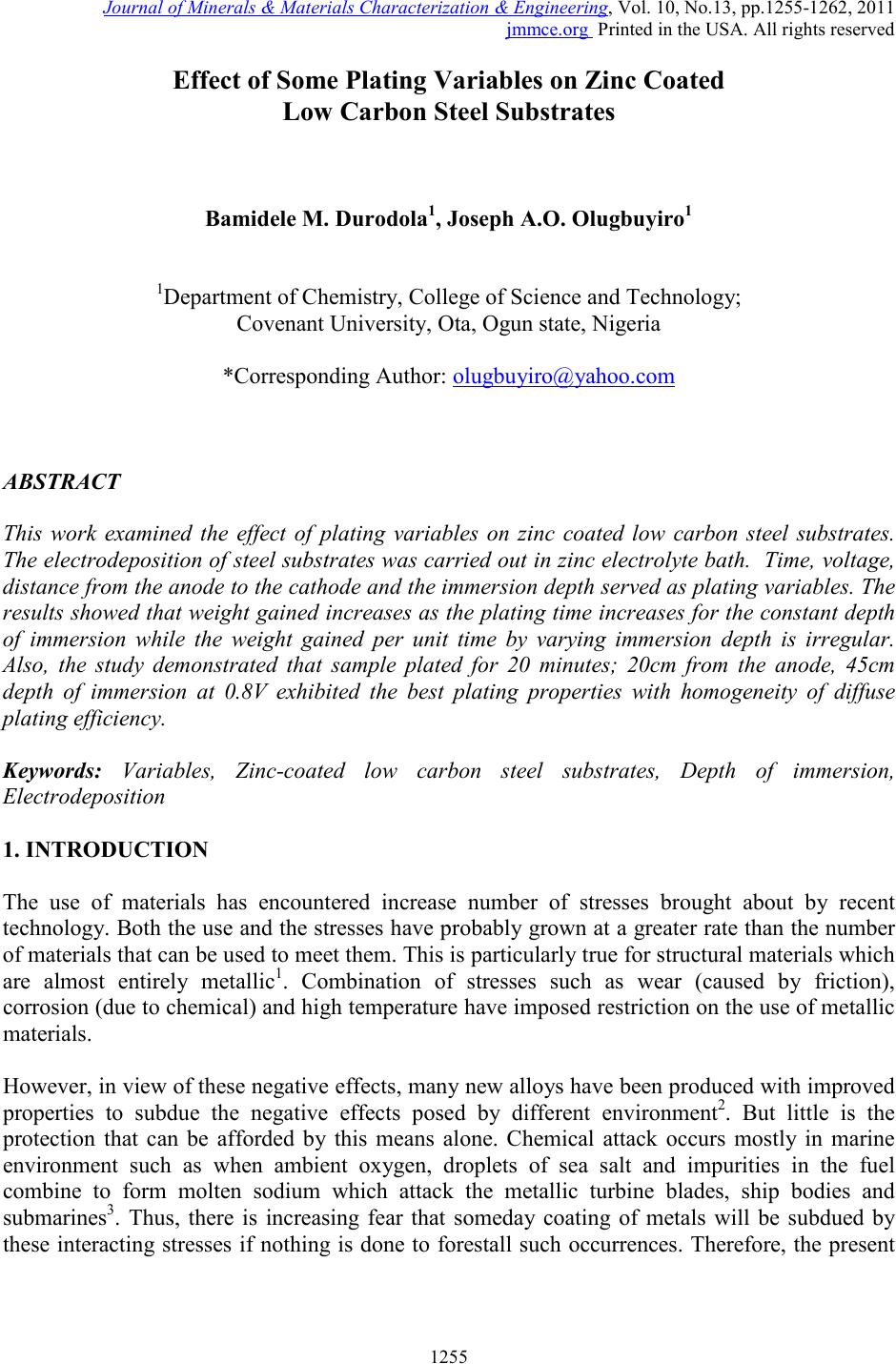 Journal of Minerals & Materials Characterization & Engineering, Vol. 10, No.13, pp.1255-1262, 2011 jmmce.org Printed in the USA. All rights reserved 1255 Effect of Som e Plating Variables on Zinc Coate d Low Carbon Steel S ubstrates Bamidele M. Durodola1, Joseph A.O. Olugbuyiro1 1Department of Chemistry, College of Science and Technology; Covenant University, Ota, Ogun state, Nigeria *Corresponding Author: [email protected] ABSTRACT This work examined the effect of plating variables on zinc coated low carbon steel substrates. The electrodeposition of steel substrates was carried out in zinc electrolyte bath. Time, voltage, distance from the anode to the cathode and the immersion depth served as plating variables. The results showed that weight gained increases as the plating time increases for the constant depth of immersion while the weight gained per unit time by varying immersion depth is irregular. Also, the study demonstrated that sample plated for 20 minutes; 20cm from the anode, 45cm depth of immersion at 0.8V exhibited the best plating properties with homogeneity of diffuse plating efficiency. Keywor d s: Variables, Zinc-coated low carbon steel substrates, Depth of immersion, Electrodeposition 1. INTRODUCTIO N The use of materials has encountered increase number of stresses brought about by recent technology. Both the use and the stresses have probabl y grown at a greater rate than the number of materials that can be used to meet them. This is particularly true for structural materials which are almost entirely metallic1. Combination of stresses such as wear (caused by friction), corrosion (due to chemical) and high temperature have imposed restriction on the use of metallic materials. However, in view of these negative effects, many new alloys have been produced with improved properties to subdue the negative effects posed by different environmen t2. But little is the protection that can be afforded by this means alone. Chemical attack occurs mostly in marine environment such as when ambient oxygen, droplets of sea salt and impurities in the fuel combine to form molten sodium which attack the metallic turbine blades, ship bodies and submarines3. Thus, there is increasing fear that someday coating of metals will be subdued by these interacting stresses if nothing is done to forestall such occurrences. Therefore, the present 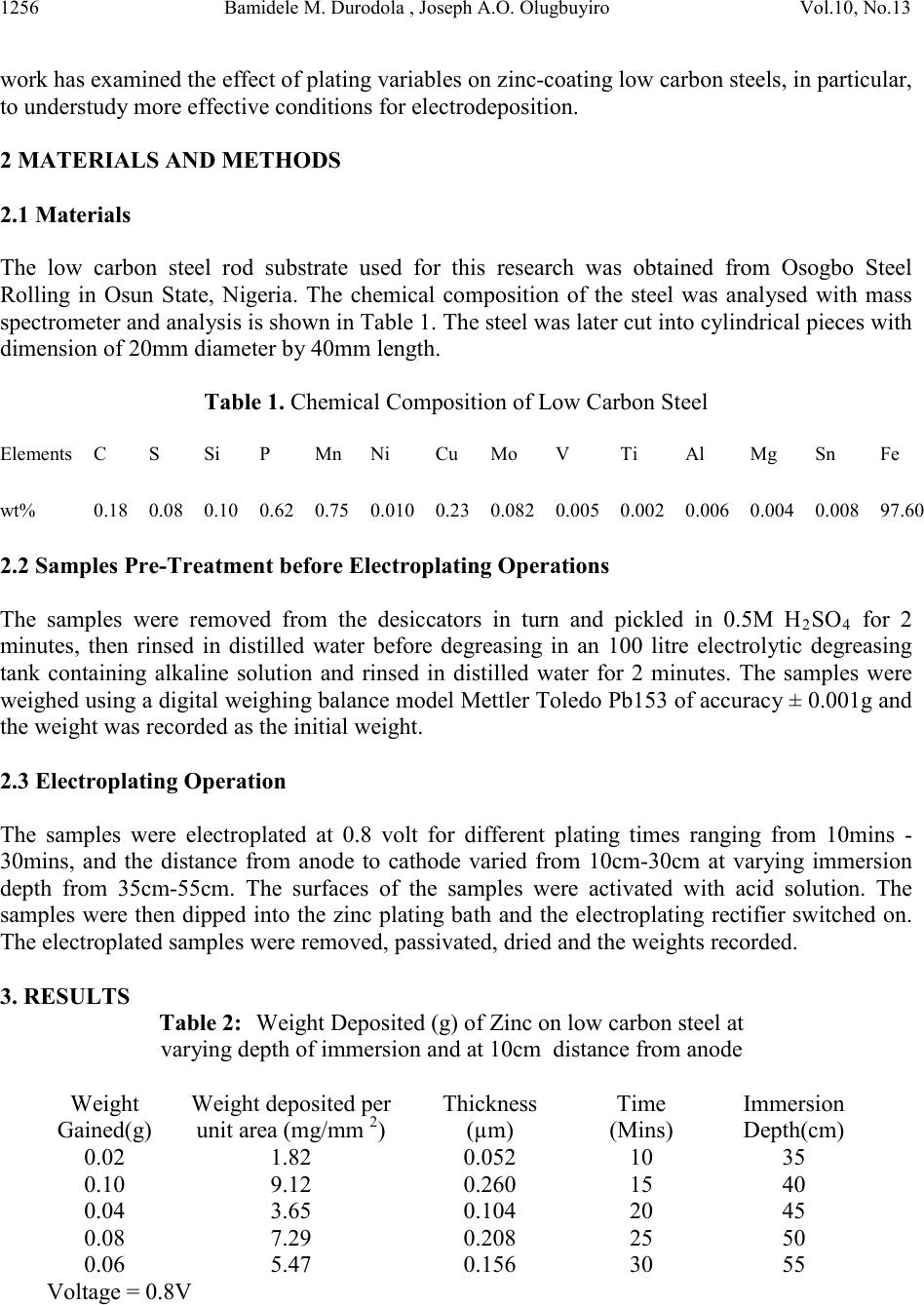 1256 Bamidele M. Durodo la , Jo seph A.O . Ol ugbuyiro Vol.10, No.13 work has examined the effect of plating variables on zinc-coating low carbon steels, in particular, to understudy more effective conditions for electrodeposition. 2 MATERIALS AND METHODS 2.1 Material s The low carbon steel rod substrate used for this research was obtained from Osogbo Steel Rolling in Osun State, Nigeria. The chemical composition of the steel was analysed with mass spectrometer and analysis is shown in Table 1. The steel was later cut into cylindrical pieces with dimension of 20mm diameter by 40mm length. Table 1. Chemical Composition of Low Carbon Steel Elements C S Si P Mn Ni Cu Mo V Ti Al Mg Sn Fe wt% 0.18 0.08 0.10 0.62 0.75 0.010 0.23 0.082 0.005 0.002 0.006 0.004 0.008 97.60 2.2 Samples Pre-Treatment before Electroplating Operations The samples were removed from the desiccators in turn and pickled in 0.5M H2SO4 for 2 minutes, then rinsed in distilled water before degreasing in an 100 litre electrolytic degreasing tank containing alkaline solution and rinsed in distilled water for 2 minutes. The samples were weighed using a digital weighing balance model Mettler Toledo Pb153 of accuracy ± 0.001g and the weight was recorded as the initial weight. 2.3 Electroplating Operation The samples were electroplated at 0.8 volt for different plating times ranging from 10mins - 30mins, and the distance from anode to cathode varied from 10cm-30cm at varying immersion depth from 35cm-55cm. The surfaces of the samples were activated with acid solution. The samples were then dipped into the zinc plating bath and the electroplating rectifier switched on. The electroplated samples were removed, passivated, dried and the weights recorded. 3. RESULTS Table 2: Weight Deposited (g) of Zinc on low carbon steel at v arying depth of immersion and at 10cm distance from anode Weight Gained(g) Weight deposited per unit area (mg/mm 2 ) Thickness (µm) Time (Mins) Immersion Depth(cm ) 0.02 1.82 0.052 10 35 0.10 9.12 0.260 15 40 0.04 3.65 0.104 20 45 0.08 7.29 0.208 25 50 0.06 5.47 0.156 30 55 Voltage = 0.8V 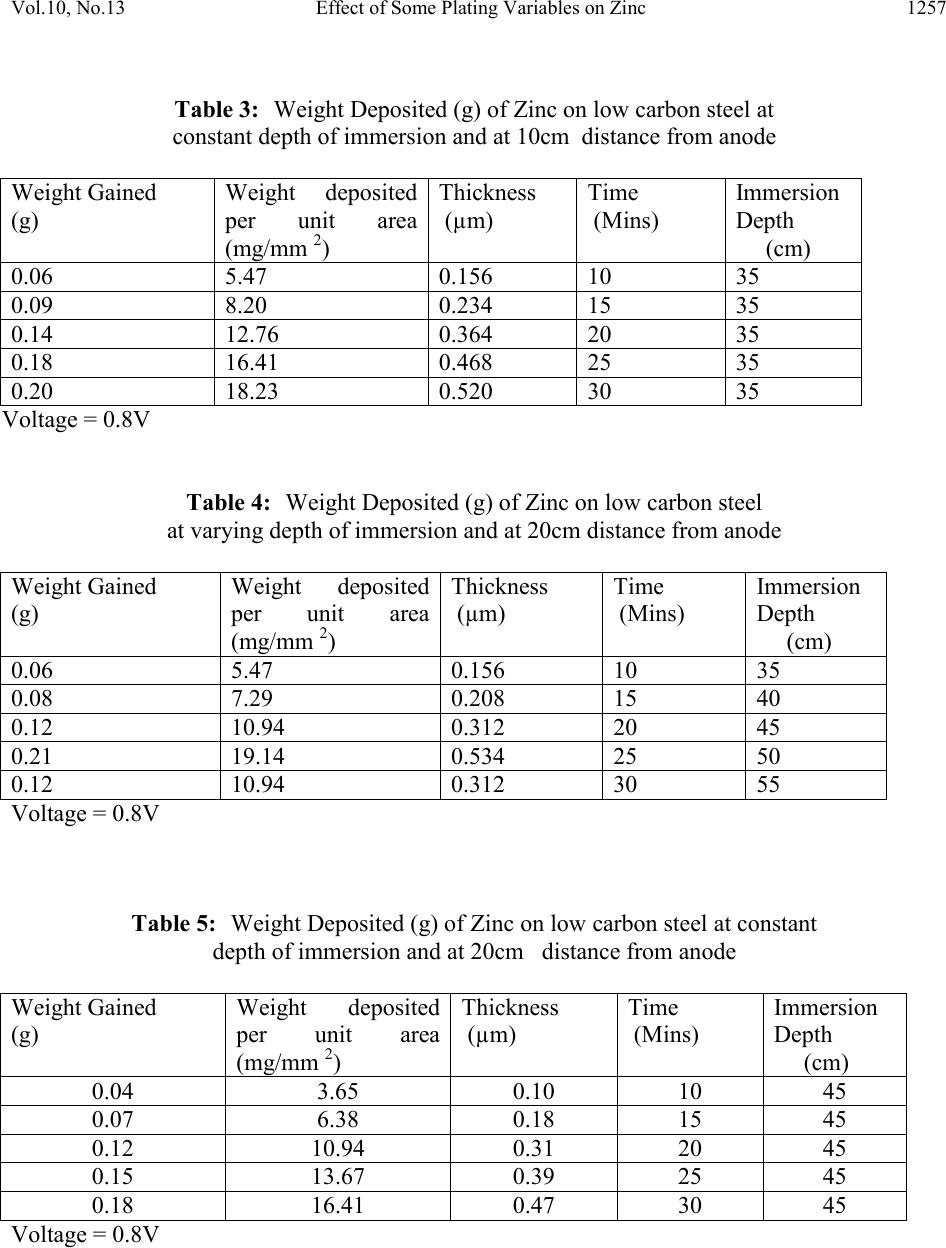 Vol.10, No.13 Effect of Some Plating Variables on Zinc 1257 Table 3: Weight Deposited (g) of Zinc on low carbon steel at constant depth of immersion and at 10cm distance from anode Weight Gained (g) Weight deposited per unit area (mg/mm 2 ) Thickness (µm) Time (Mins) Immersion Depth (cm) 0.06 5.47 0.156 10 35 0.09 8.20 0.234 15 35 0.14 12.76 0.364 20 35 0.18 16.41 0.468 25 35 0.20 18.23 0.520 30 35 Voltage = 0.8V Table 4: Weight Deposited (g) of Zinc on low carbon steel at varying depth of immersion and at 20cm distance from anode Weight Gained (g) Weight deposited per unit area (mg/mm 2 ) Thickness (µm) Time (Mins) Immersion Depth (cm) 0.06 5.47 0.156 10 35 0.08 7.29 0.208 15 40 0.12 10.94 0.312 20 45 0.21 19.14 0.534 25 50 0.12 10.94 0.312 30 55 Voltage = 0.8V Table 5: Weight Deposited (g) of Zinc on low carbon steel at constant depth of immersion and at 20cm distance from anode Weight Gained (g) Weight deposited per unit area (mg/mm 2 ) Thickness (µm) Time (Mins) Immersion Depth (cm) 0.04 3.65 0.10 10 45 0.07 6.38 0.18 15 45 0.12 10.94 0.31 20 45 0.15 13.67 0.39 25 45 0.18 16.41 0.47 30 45 Voltage = 0.8V 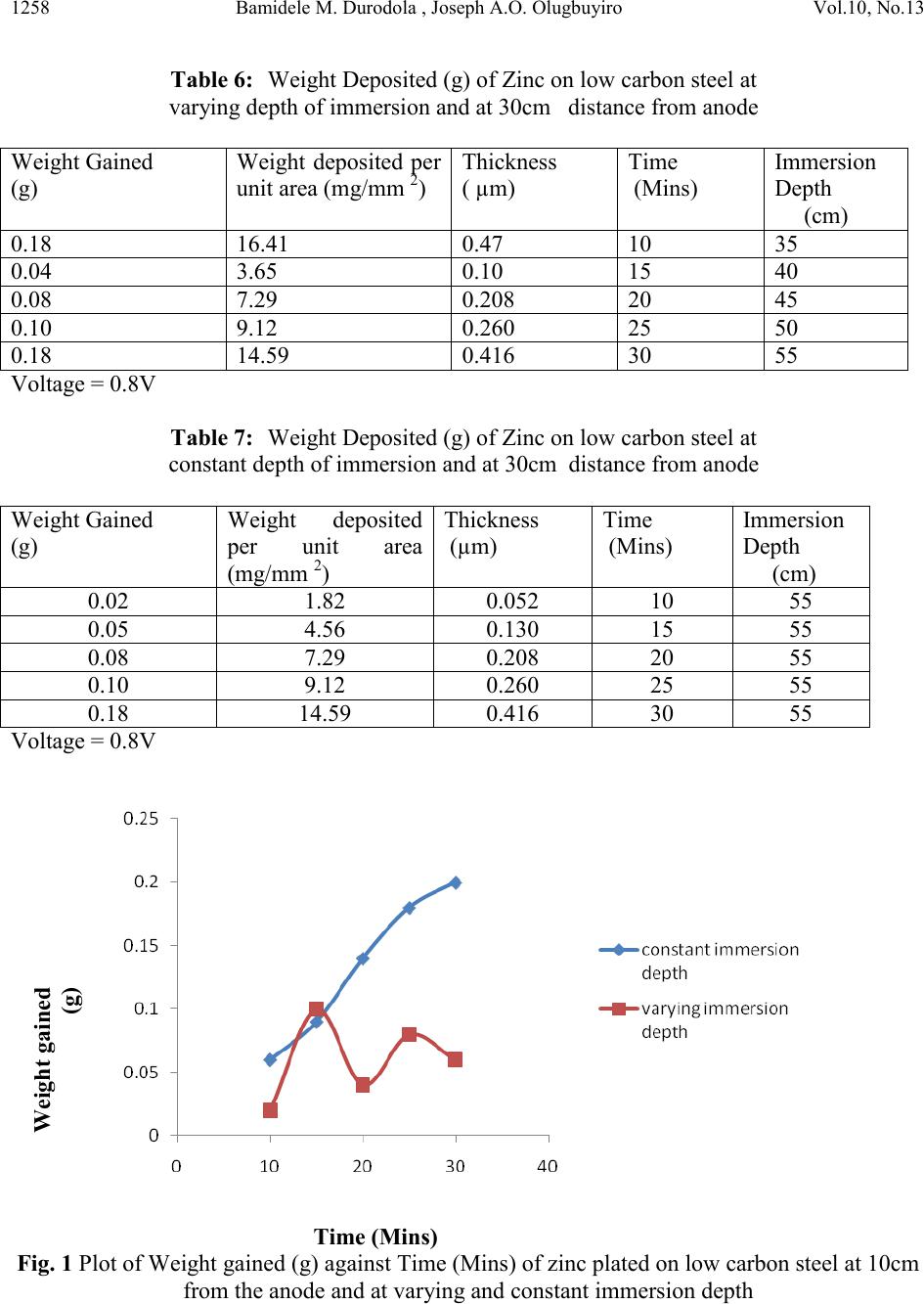 1258 Bamidele M. Durodo la , Jo seph A.O . Ol ugbuyiro Vol.10, No.13 Table 6: Weight Deposited (g) of Zinc on low carbon steel at varying depth of immersion and at 30cm distance from anode Weight Gained (g) Weight deposited per unit area (mg/mm 2) Thickness ( µm) Time (Mins) Immersion Depth (cm) 0.18 16.41 0.47 10 35 0.04 3.65 0.10 15 40 0.08 7.29 0.208 20 45 0.10 9.12 0.260 25 50 0.18 14.59 0.416 30 55 Voltage = 0.8V Table 7: Weight Deposited (g) of Zinc on low carbon steel at constant depth of immersion and at 30cm distance from anode Weight Gained (g) Weight deposited per unit area (mg/mm 2 ) Thickness (µm) Time (Mins) Immersion Depth (cm) 0.02 1.82 0.052 10 55 0.05 4.56 0.130 15 55 0.08 7.29 0.208 20 55 0.10 9.12 0.260 25 55 0.18 14.59 0.416 30 55 Voltage = 0.8V Weight gained (g) Time (Mins) Fig. 1 Plot of Weight gained (g) against Time (Mins) of zinc plated on low carbon steel at 10cm from the anode and at varying and constant immersion depth 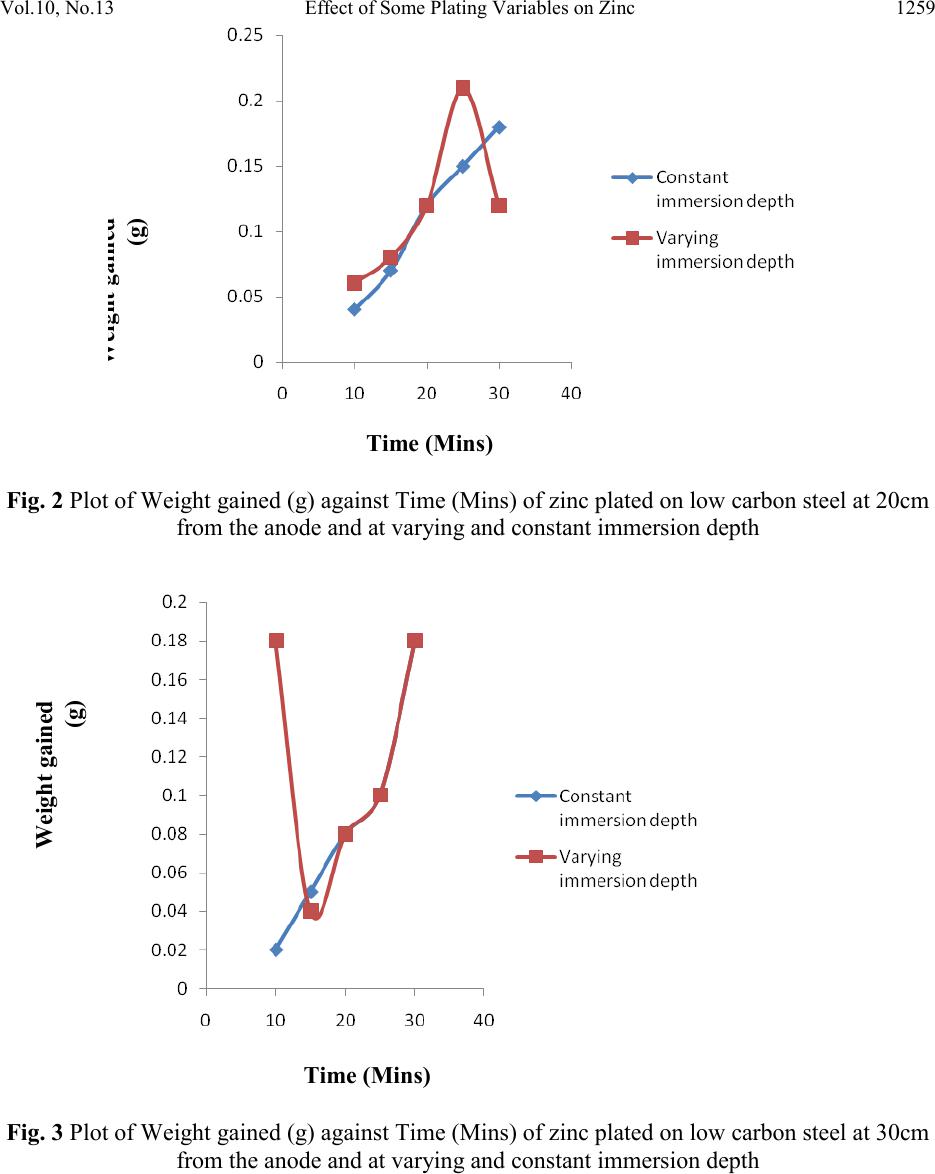 Vol.10, No.13 Effect of Some Plating Variables on Zinc 1259 Weight gained (g) Time (Mins) Fig. 2 Plot of Weight gained (g) against Time (Mins) of zinc plated on low carbon steel at 20cm from the anode and at varying and constant immersion depth Weight gained (g) Time (Mins) Fig. 3 Plot of Weight gained (g) against Time (Mins) of zinc plated on low carbon steel at 30cm from the anode and at varying and constant immersion depth 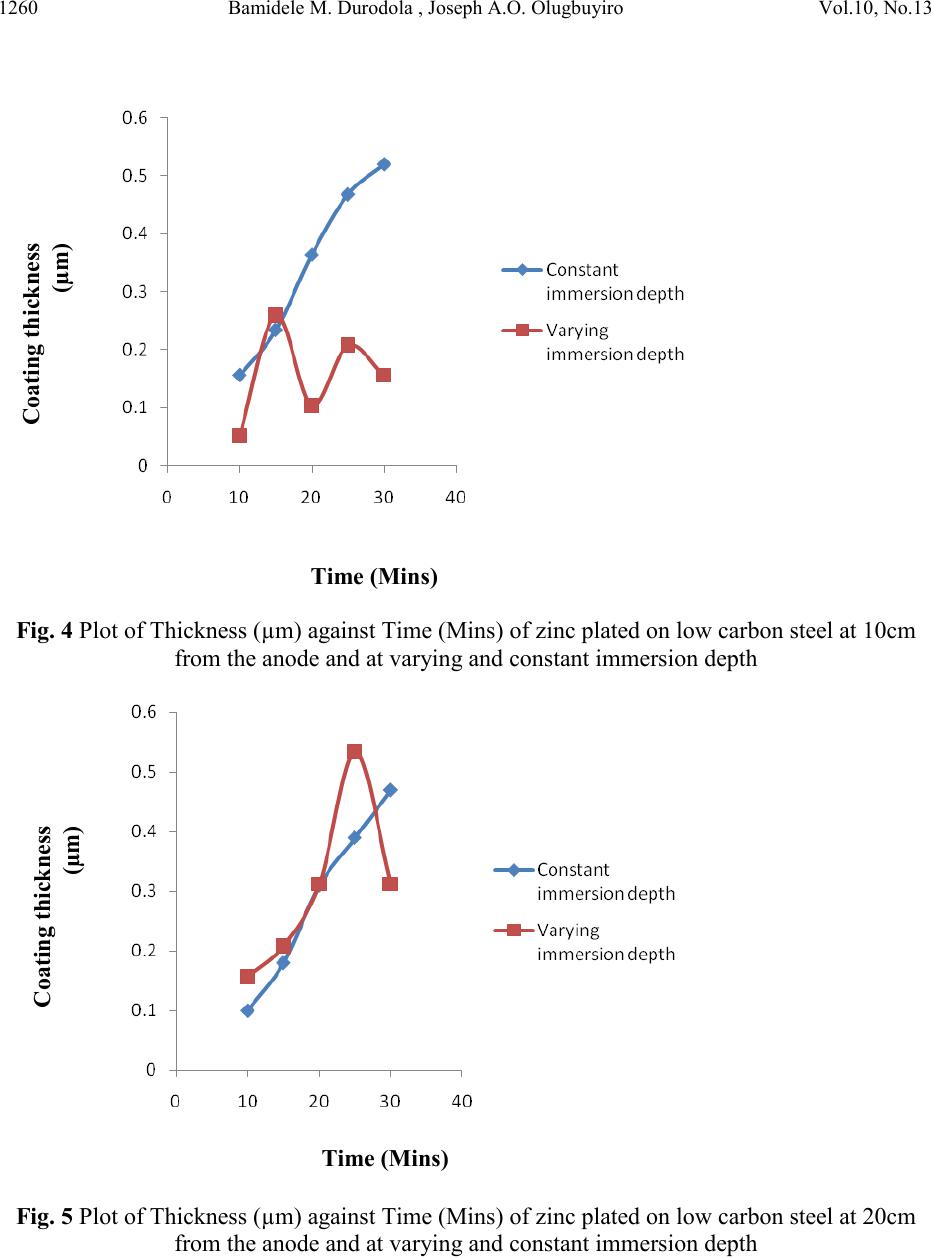 1260 Bamidele M. Durodo la , Jo seph A.O . Ol ugbuyiro Vol.10, No.13 Coating thickness (µm) Time (Mins) Fig. 4 Plot of Thickness (µm) against Time (Mins) of zinc plated on low carbon steel at 10cm from the anode and at varying and constant immersion depth Coating thickness (µm) Time (Mins) Fig. 5 Plot of Thickness (µm) against Time (Mins) of zinc plated on low carbon steel at 20cm from the anode and at varying and constant immersion depth 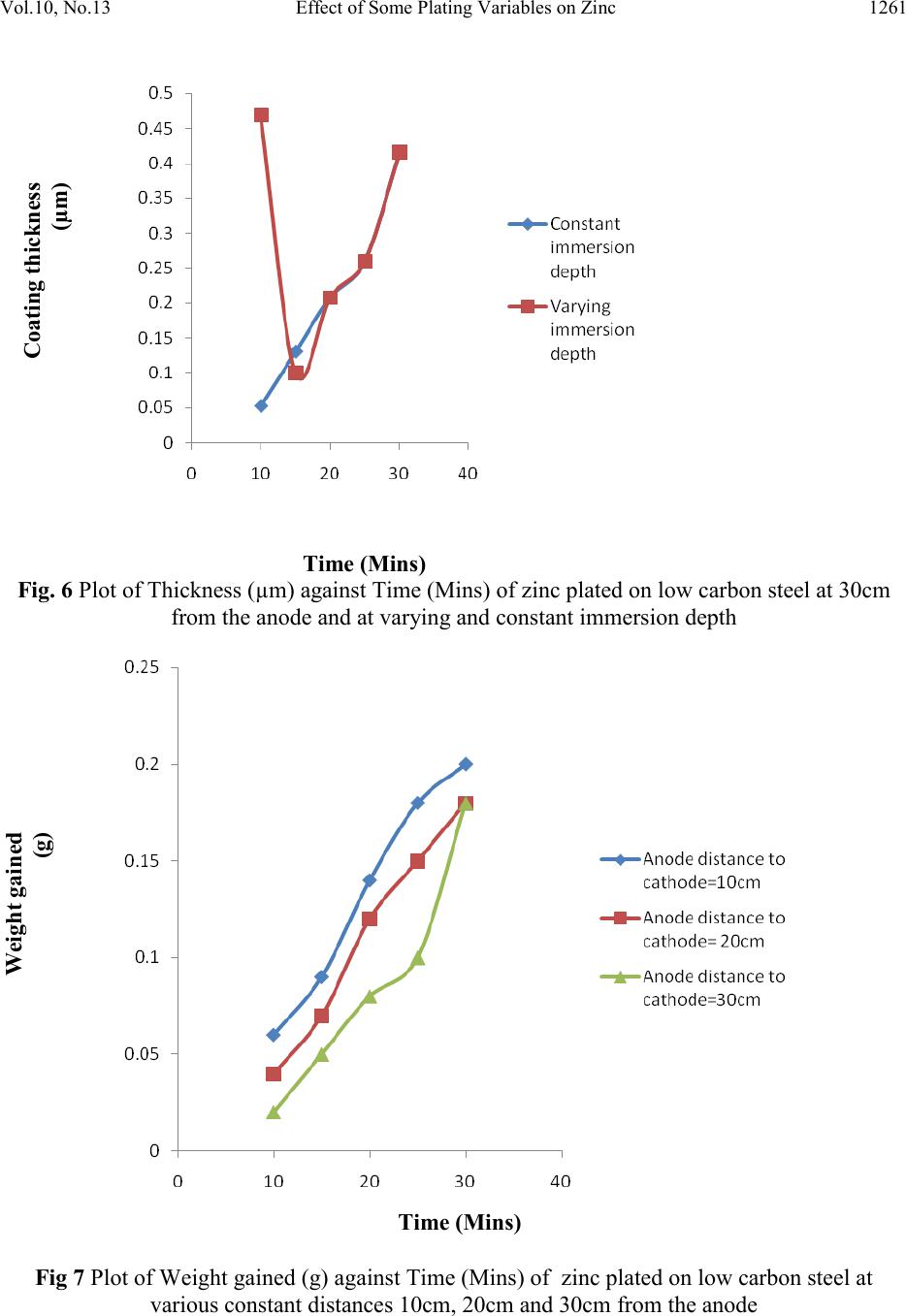 Vol.10, No.13 Effect of Some Plating Variables on Zinc 1261 Coating thickness (µm) Time (Mins) Fig. 6 Plot of Thickness (µm) against Time (Mins) of zinc plated on low carbon steel at 30cm from the anode and at varying and constant immersion depth Weight gained (g) Time (Mins) Fig 7 Plot of Weight gained (g) against Time (Mins) of zinc plated on low carbon steel at various constant distances 10cm, 20cm and 30cm from the anode 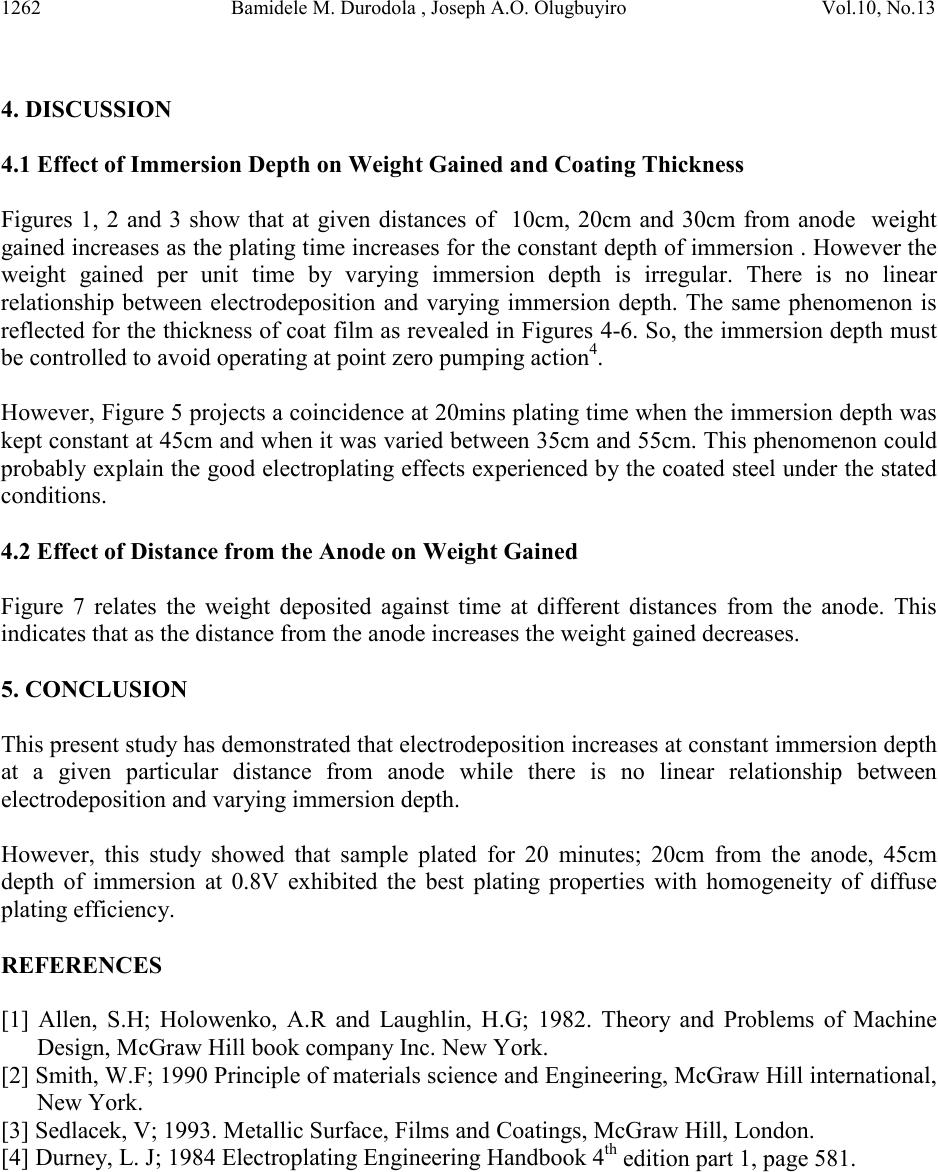 1262 Bamidele M. Durodo la , Jo seph A.O . Ol ugbuyiro Vol.10, No.13 4. DISCUSS IO N 4.1 Effect of Immersion Depth on Weight Gained and Coating Thickness Figures 1, 2 and 3 show that at given distances of 10cm, 20cm and 30cm from anode weight gained i ncreases as the p lating ti me incre ases for the cons tant dept h of im mersion . However t he weight gained per unit time by varying immersion depth is irregular. There is no linear relationship between electrodeposition and varying immersion depth. The same phenomenon is reflect ed for the th ickness o f coat film as reveale d in Figures 4-6. So, the immersion depth must be controlled to avoid operating at point zero pumping action4. However, Figure 5 projects a coincidence at 20mins plating time when the immersion depth was kept constant at 45cm and when it was varied between 35cm and 55cm. This phenomenon could probably explain the goo d electropl ating eff ects exp erienced b y the coated steel und er the stated conditions. 4.2 Effect of Distance from the Anode on Weight Gained Figure 7 relates the weight deposited against time at different distances from the anode. This indicates that as the distance from the anode increases the weight gained decreases. 5. CONCLUSIO N This present study has demonstrated that electrodeposition increases at constant immersion depth at a given particular distance from anode while there is no linear relationship between electrodeposition and varying immersion depth. However, this study showed that sample plated for 20 minutes; 20cm from the anode, 45cm depth of immersion at 0.8V exhibited the best plating properties with homogeneity of diffuse plating efficiency. REFERENCES [1] Allen, S.H; Holowenko, A.R and Laughlin, H.G; 1982. Theory and Problems of Machine Design, McGraw Hill book company Inc. New York. [2] Smith, W.F; 1990 Principle of materials science and Engineering, McGraw Hill international, New York. [3] Sedlacek, V; 1993. Metallic Surface, Films and Coatings, McGraw Hill, London. [4] Durney, L. J; 1984 Electroplating Engineering Handbook 4th edition part 1, page 581. |