

Paper Menu >>
Journal Menu >>
 Journal of Minerals & Materials Characterization & Engineering, Vol. 10, No.13, pp.1225-1231, 201 1 jmmce.org Printed in the USA. All rights reserved 1225 Optical Conductivity and Dielectr ic Response of an Organic Aminopyridine NLO Single C rystal T. Arumanayagam, P. Murugakoothan* PG and Research Department of Physics, Pachiyappa’s College, Chennai, India. *Corresponding author: [email protected] Abstract This paper explores the correlation of electro-optical properties with dielectric properties of an organic single crystal. The optical constants of the organic aminopyridine single crystal have been studied. The second harmonic generation efficiency of the grown crystal, based on powder measurement, is 2.9 times higher than that of KDP. The real and imaginary part of the complex refractive index and dielectric constant of the crystal were determined. The optical and electrical conductivity of the grown crystal were studied. Keywords: Nonlinear optical materials, Optical conductivity, Dielectric Properties, 1. INTRODUCTION In recent years, researchers devoted much attention to nonlinear photonic crystals as their use in photonic band gap materials for controlling and molding the flow of light. The growth of research in nonlinear optics (NLO) is closely linked to the rapid technological advances that have occurred in related fields such as ultra-fast phenomena, optical communication and optical storage devices [1]. Organic nonlinear optical crystals which possess a good second harmonic generation efficiency due to their high optical band gap and low dielectric constant are in rich demand in optical storage devices, colour display units and optical communication systems etc [2]. It has been already reported that the pyridinium acceptor shows large second harmonic nonlinearity [3]. Recently optical properties of aminopyridine complexes and its suitability for the optoelectronic devices fabrications were reported [4, 5]. In the present work, we have made an analysis of electro-optical properties correlated with dielectric properties of 2-aminopyridine 4-aminobenzoate single crystal. 2. EXPERIMENTS The high optical quality 2-aminopyridine 4-aminobenzoate (APAB) single crystal was grown by slow evaporation technique. The compound was prepared by the reaction of 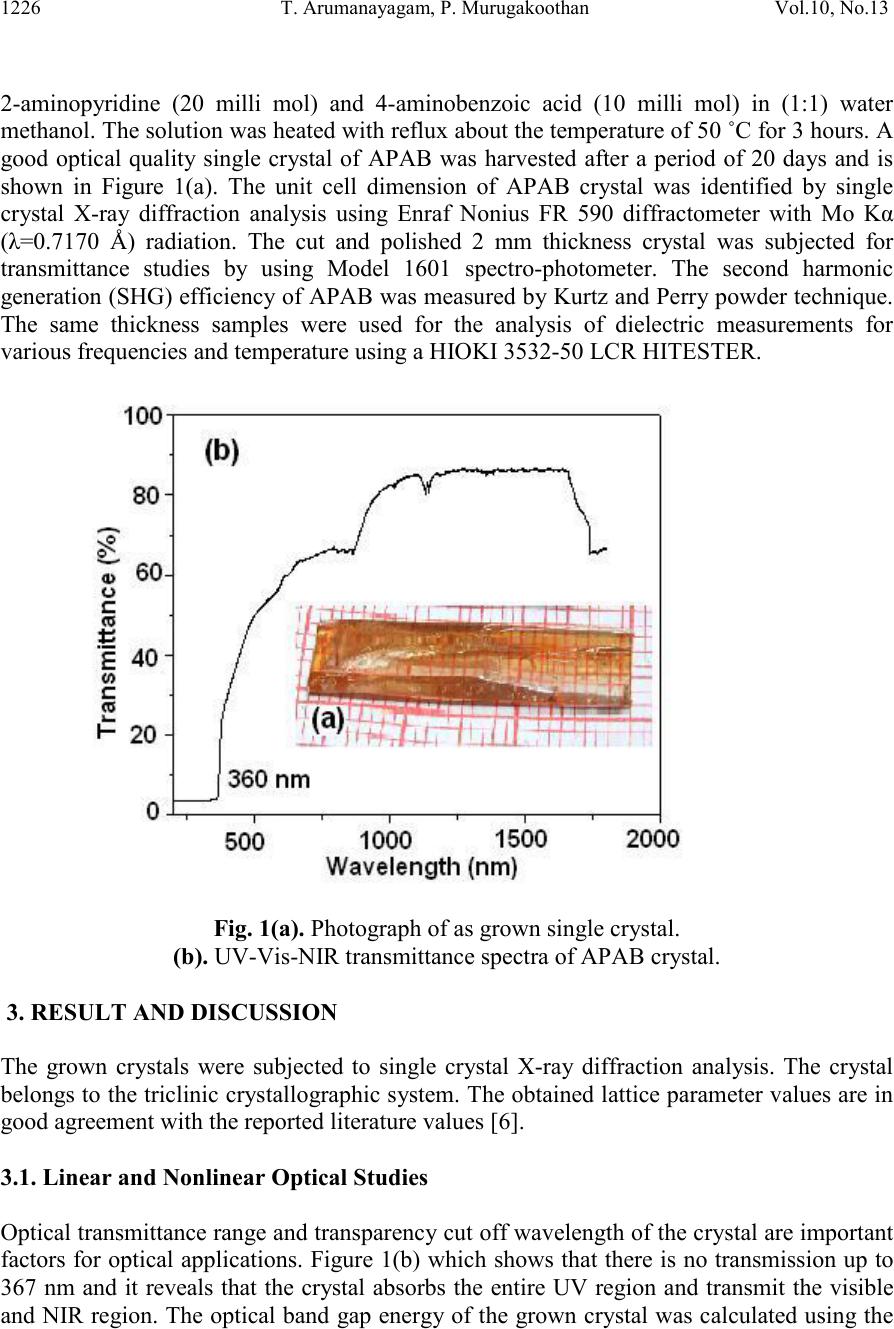 1226 T. Arumanayagam, P. Murugakoot han Vol.10, No.13 2-aminopyridine (20 milli mol) and 4-aminobenzoic acid (10 milli mol) in (1:1) water methanol. The solution w as h e ated with reflux about the temperature of 50 ˚C for 3 hours. A good optical quality single crystal of APAB was harvested after a period of 20 days and is shown in Figure 1(a ). The unit cell dimension of APAB crystal was identified by single crystal X-ray diffraction analysis using Enraf Nonius FR 590 diffractometer with Mo Kα (λ=0.7170 Å) radiation. The cut and polished 2 mm thickness crystal was subjected for transmittance studies by using Model 1601 spectro-photometer. The second harmonic generati o n (SHG) efficienc y of APAB was m easured by Kurtz and Perr y powder technique. The same thickness samples were used for the analysis of dielectric measurements for various frequencies and temperature using a HIOKI 3532-50 LCR HITESTER. Fig. 1(a). Photograph of as grown single crystal. (b). UV-Vis-NIR transmittance spectra of APAB crystal. 3. RESULT AND DISCUSSION The grown crystals were subjected to single crystal X-ray diffraction analysis. The crystal belongs to the triclinic crystallographic system. The obtained latt ice paramet er values a re in good agreement with the reported literature values [6]. 3.1. Linear and Nonlinear Optical Studies Optical transm itt ance ran ge an d tr anspar enc y cut off wav elen gth of the c r ystal are i mport ant factors for optical applications. Figure 1(b) which shows that there is no transmission up to 367 nm and it reveals that the crystal absorbs the entire UV region and transmit the visible and NIR region. The optical band gap energy of the grown cr ystal was calculated using the  Vol.10, No.11 Optical Conductivity and Dielectric 1227 formula Eg = 1240/ λ (nm) in eV, where λ is the lower cut off wavelength (367 nm). The band gap of the APAB crystal is found to be 3.37 eV. As this crystal exhibits wide transmission range, starting from 367 nm onwards, it can be used for optical applications including the second harmonic generation of Nd: YAG laser of fundamental wavelength λ=1064 nm. It is also interesting to note from the spectrum that this crystal absorbs UV radiati on and henc e APAB cr ystal can be used as an effect ive UV sh elter [ 7]. The measured transmittance (T) data was used to calculate the absorption coefficient (α) from the following relation, α = (1) where t is the thickness of the crystal. The dependence of absorption coefficient on photon energy was analyzed in the absorption regions to obtain the detailed information about the energ y band gap of the c rystal. Fi gure 2(a) shows the variation of absorption coefficient (α) as a function of photon energy at room temperature. From the graph it is evident that the absorption coefficient varies from 6.5-16.4 cm-1 with increasing photon energy of 3.2-3.5 eV. The optical constants such as the refractive index (n) and the extinction coeffi cien t (k ) have al so been es ti m ated us in g the for mu la as repo rted ea rli er [ 8]. Figure 2 (b) shows the plot of refractive index as a function of wavelength and it could be noticed that the refractive index decreases abruptly as the wavelength increases and gets saturated beyond the wavelength of 450 nm. The refractive index of grown APAB crystal for longer wavelen gth ( vi si ble re gio n ) was cal cul at ed t o be 2.36. From th e calcu lat ed values o f n and k, the real and imaginary functions of dielect rics wer e also det ermined . The complex dielectric constant (ε = εr+εi) char a ct eri z es t he o pt ical pro pe rt ies of t he crystals an d is calculated using the expressions as report ed earl ier [9]. The real and i m aginary parts of t he di el ectri c con st ant of the grown crystal were determined and shown in Figure 3(a). From the graph it is clear that both real and imaginary part of dielectric constant increases with increase of photon energy. The real part of the dielectric constant increases linearly with higher value than the imaginary part. The lower value of dielectric constant with wide band gap of APAB crystal suggests the suitability of optoelectronic devices. The optical conductivity is one of the powerful tools for studying the electronic states in materials. The frequency dependence of dielectric reflects the fact that a material’s polarization does not respond instantaneously to an applied field. For this reason, dielectric constant is often treated as complex function of the frequenc y of the applied field. A perfect dielect ric is a material that has no conductivit y. However the grown crystals associated with low dielectric loss inhibit the propagation of electromagnetic energy which aided conductivity. According to the one component or anomalous Drude model, both the carrier relax at ion time and its effective mass of the charges are assumed to be as the functions of photon frequency (ω). But for alternative, multi component model, the real part of the optical conductivity (σ) of the crystal was calculated using the following relations [10, 11]: σ = Im (ε) (2)  1228 T. Arumanayagam, P. Murugakoot han Vol.10, No.13 where the value of Im (ε) is given by, Im (ε) = . (3) where μr is the relative permeability. For most crystalline materials μr is very close to 1 at optical frequencies. On substuting the value of Im (ε) in Eq. (2) σ = (4) where c is the velocity of light. The plot between the optical conductivity against photon energy (hν) was depicted in Figure 3(b). The spectrum indicates that the optical conductance increases with the increase of photon energy. Fig. 2(a). Plot of absorption coefficient against photon energy. (b). Plot of refractive index against wavelength for APAB crystal. For the second ha rmonic generation efficiency, a fundamental beam of wavelength 1064 nm with a pulse duration of 10 ns and frequenc y repetition of 10 Hz from Q-switched Nd:YAG laser was used as the source and passed through the powder sample [12]. The SHG behavior was confirmed from the output of the laser beam which had bright green emission (λ=532 nm) from the powder sample. The second harmonic signal of 32 mV was obtained for an input energy of 31 mJ/pulse, while the standard KDP crystal gives a SHG signal of 11 mV for the same input energy. It shows that the SHG efficiency of APAB is 2.9 times that of standard NLO material, KDP. 2.8 3.0 3.2 3.4 3.6 3.8 4.0 4 8 12 16 400600800 1000 0 20 40 60 80 100 120 (a) α (cm -1 ) hν (eV) (b) Refractive index, n wavelength (nm ) 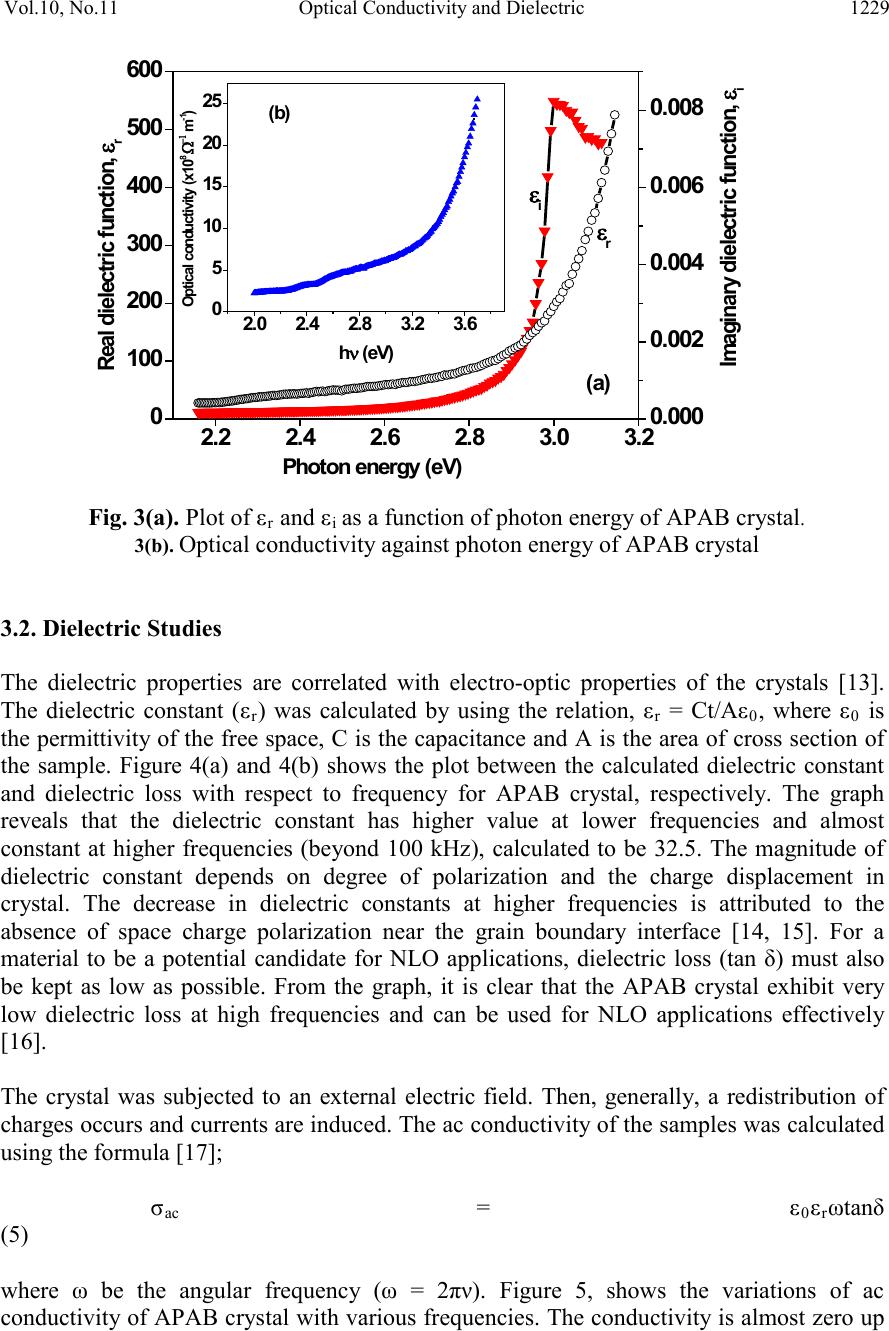 Vol.10, No.11 Optical Conductivity and Dielectric 1229 Fig. 3(a). Plot of εr and εi as a function of photon energy of APAB crystal. 3(b). Optical conductivity against photon energy of APAB crystal 3.2. Dielectric Studies The dielectric properties are correlated with electro-optic properties of the crystals [13]. The dielectric constant (εr) was calculated by using the relation, εr = Ct/Aε0, where ε0 is the permittivity of the free space, C is the capacitance and A is the area of cross section of the sample. Figure 4(a) and 4(b) shows the plot between the calculated dielectric constant and dielectric loss with respect to frequency for APAB crystal, respectively. The graph reveals that the dielectric constant has higher value at lower frequencies and almost constant at higher frequencies (beyond 100 kHz), calculated to be 32.5. The magnitude of dielectric constant depends on degree of polarization and the charge displacement in crystal. The decrease in dielectric constants at higher frequencies is attributed to the absence of space charge polarization near the grain boundary interface [14, 15]. For a material to be a potential candidate for NLO applications, dielectric loss (tan δ) must also be kept as low as possible. From the graph, it is clear that the APAB crystal exhibit very low dielectric loss at high frequencies and can be used for NLO applications effectively [16]. The crystal was subjected to an external electric field. Then, generally, a redistribution of charges occurs and currents are induced. The ac conductivit y of the samples was calculated using the formula [17]; σac = ε 0εr ωtanδ (5) where ω be the angular frequency (ω = 2πν). Figure 5, shows the variations of ac conductivity of APAB crystal with various frequencies. The conductivity is almost zero up 0.000 0.002 0.004 0.006 0.008 2.2 2.42.6 2.8 3.0 3.2 0 100 200 300 400 500 600 2.0 2.4 2.8 3.2 3.6 0 5 10 15 20 25 Im aginary dielectric function, ε i Real dielectric functio n, ε r (a) ε i ε r Photon energy (eV ) (b) Optical condu ctivity (x10 8 Ω −1 m -1 ) hν (eV) 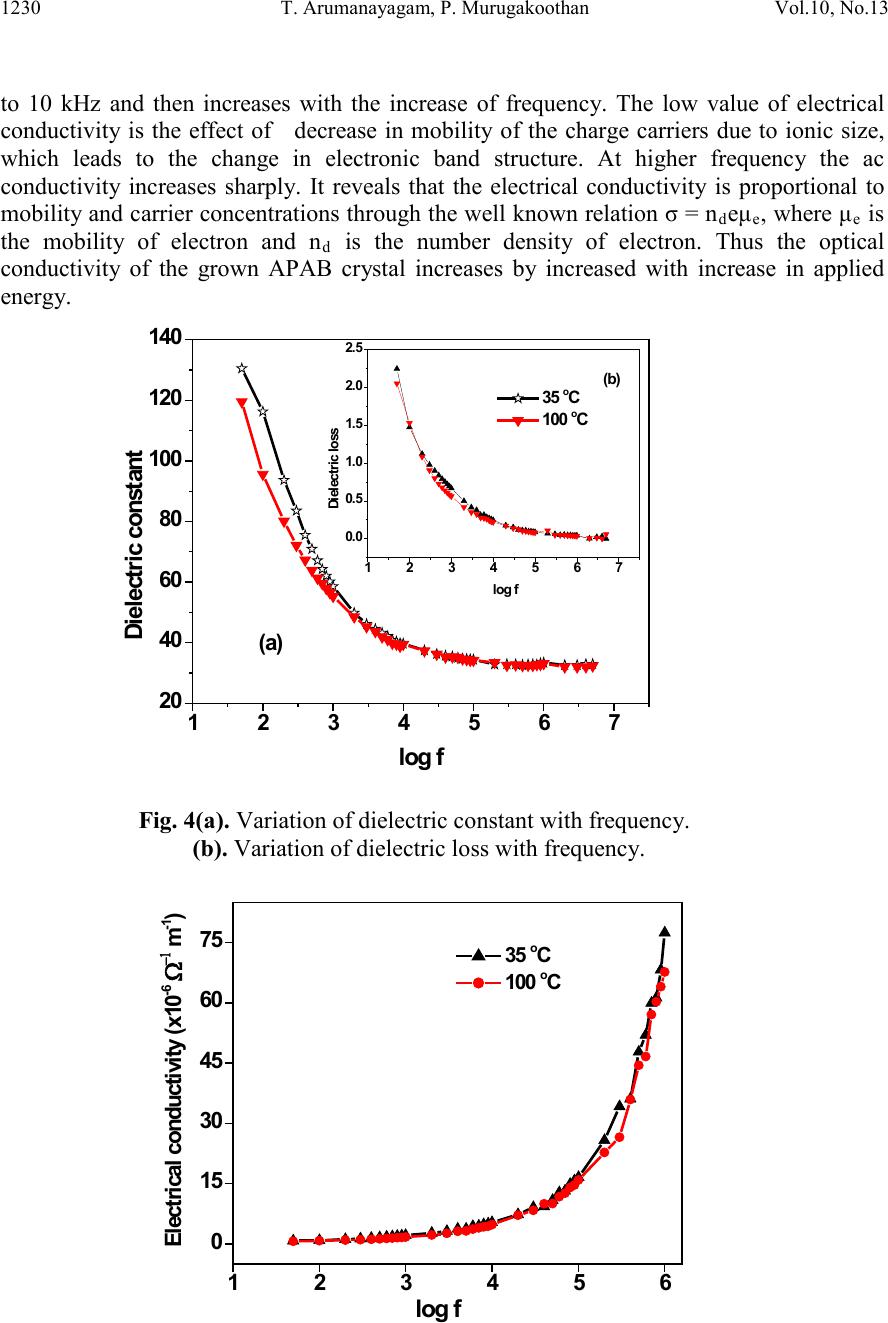 1230 T. Arumanayagam, P. Murugakoot han Vol.10, No.13 to 10 kHz and then increases with the increase of frequency. The low value of electrical conductivity is the effect of decrease in mobility of the charge carriers due to ionic size, which leads to the change in electronic band structure. At higher frequency the ac conductivity increases sharply. It reveals that the electrical conductivity is proportional to mobility and carrier concentrations through the well known relation σ = ndeμe, where μe is the mobility of electron and nd is the number density of electron. Thus the optical conductivity of the grown APAB crystal increases by increased with increase in applied energy. Fig. 4(a). Variation of dielectric constant with frequency. (b). Variation of dielectric loss with frequency. 1234567 20 40 60 80 100 120 140 1234567 0. 0 0. 5 1. 0 1. 5 2. 0 2. 5 (a) 35 o C 100 o C Dielectric constant log f ( b) Dielectric loss log f 1 2 3 4 5 6 0 15 30 45 60 75 35 oC 100 oC Electrical conductivity (x10 -6 Ω −1 m -1 ) log f  Vol.10, No.11 Optical Conductivity and Dielectric 1231 Fig. 5. Plot of electrical conductivity versus frequency of APAB crystal. 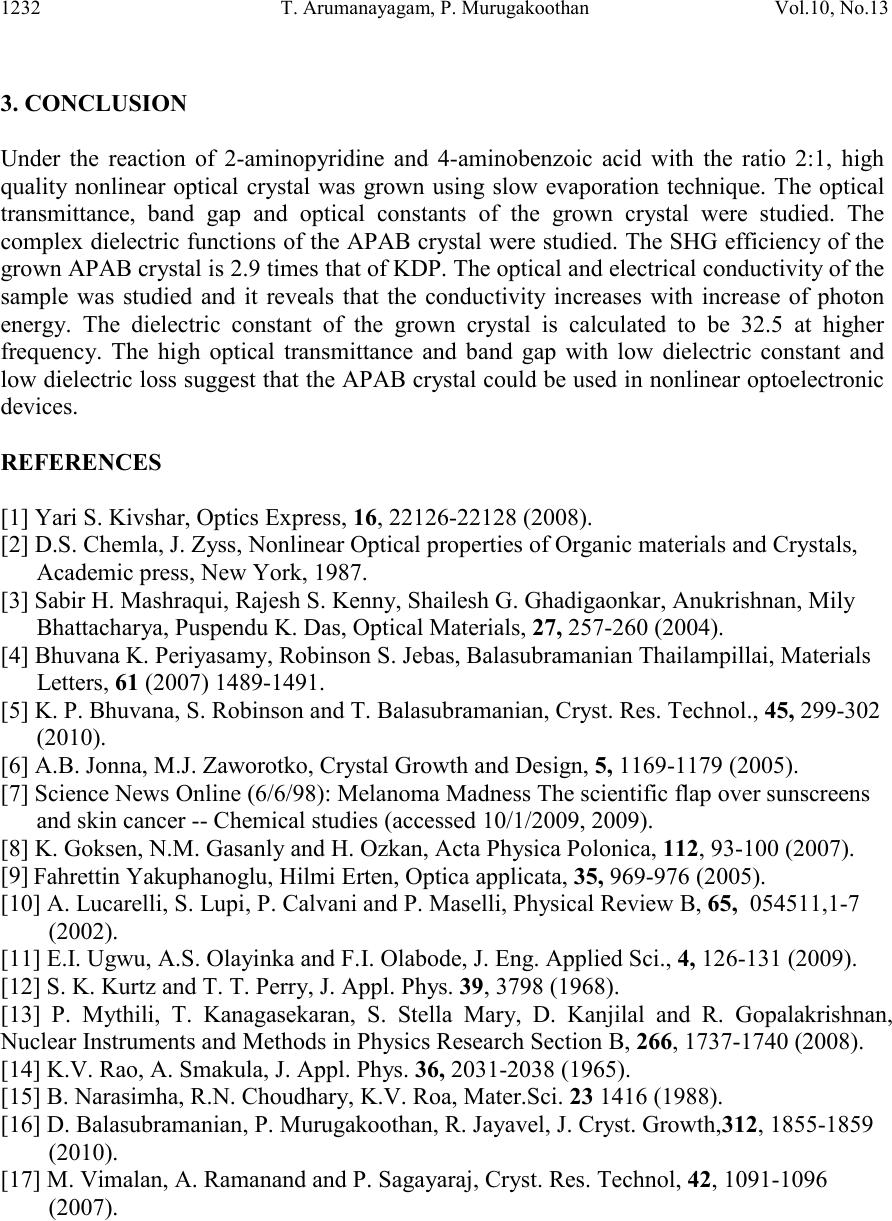 1232 T. Arumanayagam, P. Murugakoot han Vol.10, No.13 3. CONCLUSION Under the reaction of 2-aminopyridine and 4-aminobenzoic acid with the ratio 2:1, high quality nonlinear optical crystal was grown using slow evaporation technique. The optical transmittance, band gap and optical constants of the grown crystal were studied. The complex dielectric functions of the APAB crystal were studied. The SHG efficienc y of the grown APAB crystal is 2.9 times that of KDP. The optical and electr ical conductivi t y of the sample was studied and it reveals that the conductivity increases with increase of photon energy. The dielectric constant of the grown crystal is calculated to be 32.5 at higher frequen cy. The high optical transmittance and band gap with low dielectric constant and low dielectric loss suggest that the APAB crystal could be used in nonlinear optoelectronic devices. REFERENCES [1] Yari S. Kivshar, Optics Express, 16, 22126-22128 (2008). [2] D.S. Chemla, J. Zyss, Nonlinear Optical properties of Organic materials and Crystals, Academic press, New York, 1987. [3] Sabir H. Mashraqui, Rajesh S. Kenny, Shailesh G. Ghadigaonkar, Anukrishnan, Mily Bhattacharya, Puspendu K. Das, Optical Materials, 27, 257-260 (2004). [4] Bhuvana K. Periyasamy, Robinson S. Jebas, Balasubramanian Thailampillai, Materials Letters, 61 (2007) 1489-1491. [5] K. P. Bhuvana, S. Robinson and T. Balasubramanian, Cryst. Res. Technol., 45, 299-302 (2010). [6] A.B. Jonna, M.J. Zaworotko, Crystal Growth and Design, 5, 1169-1179 (2005). [7] Science News Online (6/6/98): Melanoma Madness The scientific flap over sunscreens and skin cancer -- Chemical studies (accessed 10/1/2009, 2009). [8] K. Goksen, N.M. Gasanly and H. Ozkan, Acta Physica Polonica, 112, 93-100 (2007). [9] Fahrettin Yakuphanoglu, Hilmi Erten, Optica applicata, 35, 969-976 (2005). [10] A. Lucarelli, S. Lupi, P. Calvani and P. Maselli, Physical Review B, 65, 054511,1-7 (2002). [11] E.I. Ugwu, A.S. Olayinka and F.I. Olabode, J. Eng. Applied Sci., 4, 126-131 (2009). [12] S. K. Kurtz and T. T. Perry, J. Appl. Phys. 39, 3798 (1968). [13] P. Mythili, T. Kanagasekaran, S. Stella Mary, D. Kanjilal and R. Gopalakrishnan, Nuclear Instruments and Methods in Physics Research Section B, 266, 1737-1740 (2008). [14] K.V. Rao, A. Smakula, J. Appl. Phys. 36, 2031-2038 (1965). [15] B. Narasimha, R.N. Choudhary, K.V. Roa, Mater.Sci. 23 1416 (1988). [16] D. Balasubramanian, P. Murugakoothan, R. Jayavel, J. Cryst. Growth,312, 1855-1859 (2010). [17] M. Vimalan, A. Ramanand and P. Sagayaraj, Cryst. Res. Technol, 42, 1091-1096 (2007). |