

Paper Menu >>
Journal Menu >>
 Sociology Mind 2012. Vol.2, No.3, 302-305 Published Online July 2012 in SciRes (http://www.SciRP.org/journal/sm) http://dx.doi.org/10.4236/sm.2012.23040 Copyright © 2012 SciRes. 302 Multi-Agent Based Social Integrity Simulation and Its Evolution Yu Wang, Wangjing Zhu, Hua Gen, Haiyang Wang Information and Engineering College, Yangzhou University, Yangzhou, China Email: [email protected] Received March 4th, 2012; revised April 5th, 2012; accepted May 12th, 2012 The Computer simulation has played an important in complex science. As the research on Multi-Agent becomes popular, method of modeling and simulation based on Multi-Agent has been applied on the field of social science, forming a new inter-discipline called Agent Based Social Simulation. According to this methodology, a social integrity simulation model of mixed strategy game is introduced, which is aimed to interpret the problem of lacking social integrity. And through analysis of the model, a new approach is provided to study the social integrity problem. Keywords: Agent; Game; Computer Simulation; Social Integrity Introduction Credit system is a necessary prerequisite for the formation of human society, the cornerstone for social development and harmonious society. The construction of social credit system is a long and difficult project that requires a joint effort of the government, financial institutions, enterprises, individuals and the whole society. When building a harmonious society, the importance of social integrity becomes increasingly prominent, but the phenomenon of lack of integrity is prevalent: telling lies, making fake diplomas and fake invoices, tax evasion, unreal advertising, sale of counterfeits, contract fraud, unfair competi- tion, it would inevitably lead to a serious consequences. There- fore, taking the integrity or dishonesty as a research topic has a strong theoretical and practical significance. In the study of social integrity, many domestic scholars have done some research with modern economic theories, including the asymmetric information theory, game theory and transac- tion cost theory and etc. Wei Zhong (2009) analyzed the integrity problem between individuals, company and government by using symmetric and asymmetric evolutionary game theory under limited rationality; Lin Hongxi (2010) established a social integrity model accord- ing to the evolutionary game, concluding that the root cause of the lack of social integrity is that the possible loss of cheaters is relative small to his earnings. Wang Zheng (2006) used re- peated games theory to explain how to establish a integrity society; Wang Meiqin’s research (2010) tried to speed up the construction of social credit system from three aspects, personal archive management, archival information development and utilization, legal construction of personal archive; Liu Zengzhi (2010) proposed to establish the institutional basis, the cultural construction of social integrity. The above researches made a policy support against social integrity through analysis of phenomenon, but their common drawback is that they mostly based on theoretical analysis of qualitative, and are not from a quantitative point of view to give some explanation, can not reflect the a process of integrity for- mation. In some articles that using the Game Theory to analyze social integrity, the pure strategies models are used, which cannot represent the true nature of human being when people make a choice. We point out that people based on certain prob- ability to make a choice, which called a mixed strategy. Then, on the basis of the previous research, we proposed a hybrid strategy simulation model of social integrity, in the hope of studying social integrity from a quantitative point. Multi-Agent Model and Artificial Society Traditional social science concerns cooperation, coordination, organizational behavior, social dynamics, the evolution of cus- toms and morals and other social phenomena. How to study the complexity of social phenomena better has been the focus of domestic and foreign scholars. Traditional methods, such as mathematics and statistics, establish models from macro-level abstraction. These models contain a lot of high-level assump- tions, must be limited to near-stringent restrictions, and often repeated. In the late 1990s, as complex adaptive systems (CAS) theory develops, Agent-based computer simulation methods have been widely applied to the simulation of sociology, whose feature is that it starts to analyze the problem from the perspec- tive of individual rather than the whole. Axelrod was one of the first men using Agent-Based Simula- tion of sociological. In 1984, he held a special “prisoner’s di- lemma” game computer programming competition. The 1990s, Builder and Bankes consciously brought up the concept “Arti- ficial Societies” for the first time at their report to Rand com- pany: “Artificial Societies: A Concept for Basic Research on Societal Impact of Information Technology”. “Artificial society” is a new method to study social science. It is a complex Multi-Agent Model, in which Agents on behalf of individuals or social groups and can be created through com- puter programming, and then let them follow a certain simple Agent rule to interaction. Finally, we find out the laws by ob- serving the emergence of Agent’s mutual interact, and use these laws to explain and understand the reality of human society in the macro-phenomenon. The main difference between Multi-Agent Models created by 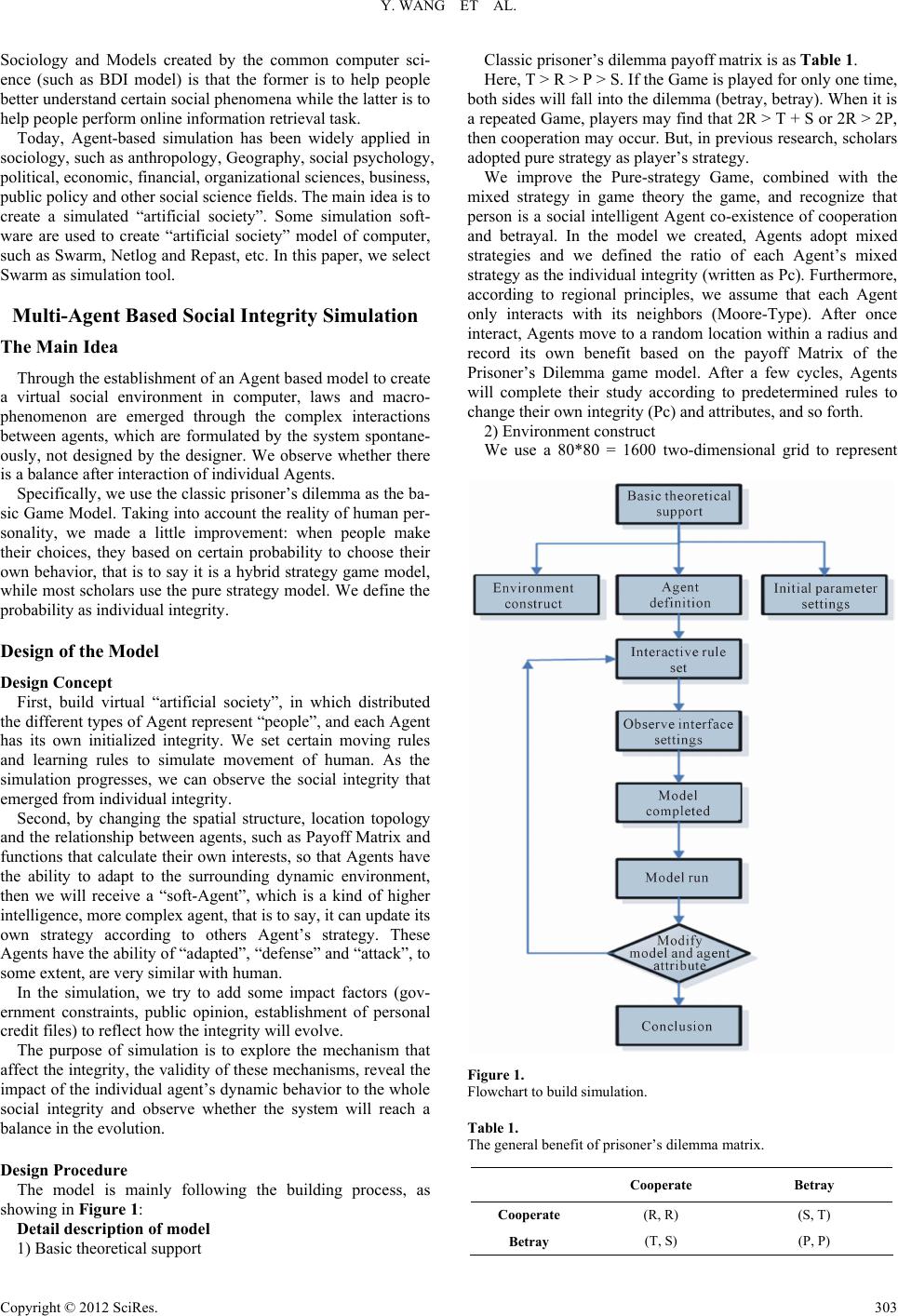 Y. WANG ET AL. Sociology and Models created by the common computer sci- ence (such as BDI model) is that the former is to help people better understand certain social phenomena while the latter is to help people perform online information retrieval task. Today, Agent-based simulation has been widely applied in sociology, such as anthropology, Geography, social psychology, political, economic, financial, organizational sciences, business, public policy and other social science fields. The main idea is to create a simulated “artificial society”. Some simulation soft- ware are used to create “artificial society” model of computer, such as Swarm, Netlog and Repast, etc. In this paper, we select Swarm as simulation tool. Multi-Agent Based Social Integrity Simulation The Main Idea Through the establishment of an Agent based model to create a virtual social environment in computer, laws and macro- phenomenon are emerged through the complex interactions between agents, which are formulated by the system spontane- ously, not designed by the designer. We observe whether there is a balance after interaction of individual Agents. Specifically, we use the classic prisoner’s dilemma as the ba- sic Game Model. Taking into account the reality of human per- sonality, we made a little improvement: when people make their choices, they based on certain probability to choose their own behavior, that is to say it is a hybrid strategy game model, while most scholars use the pure strategy model. We define the probability as individual integrity. Design of the Model Design Concept First, build virtual “artificial society”, in which distributed the different types of Agent represent “people”, and each Agent has its own initialized integrity. We set certain moving rules and learning rules to simulate movement of human. As the simulation progresses, we can observe the social integrity that emerged from individual integrity. Second, by changing the spatial structure, location topology and the relationship between agents, such as Payoff Matrix and functions that calculate their own interests, so that Agents have the ability to adapt to the surrounding dynamic environment, then we will receive a “soft-Agent”, which is a kind of higher intelligence, more complex agent, that is to say, it can update its own strategy according to others Agent’s strategy. These Agents have the ability of “adapted”, “defense” and “attack”, to some extent, are very similar with human. In the simulation, we try to add some impact factors (gov- ernment constraints, public opinion, establishment of personal credit files) to reflect how the integrity will evolve. The purpose of simulation is to explore the mechanism that affect the integrity, the validity of these mechanisms, reveal the impact of the individual agent’s dynamic behavior to the whole social integrity and observe whether the system will reach a balance in the evolution. Design Procedure The model is mainly following the building process, as showing in Figure 1: Detail description of model 1) Basic theoretical support Classic prisoner’s dilemma payoff matrix is as Table 1. Here, T > R > P > S. If the Game is played for only one time, both sides will fall into the dilemma (betray, betray). When it is a repeated Game, players may find that 2R > T + S or 2R > 2P, then cooperation may occur. But, in previous research, scholars adopted pure strategy as player’s strategy. We improve the Pure-strategy Game, combined with the mixed strategy in game theory the game, and recognize that person is a social intelligent Agent co-existence of cooperation and betrayal. In the model we created, Agents adopt mixed strategies and we defined the ratio of each Agent’s mixed strategy as the individual integrity (written as Pc). Furthermore, according to regional principles, we assume that each Agent only interacts with its neighbors (Moore-Type). After once interact, Agents move to a random location within a radius and record its own benefit based on the payoff Matrix of the Prisoner’s Dilemma game model. After a few cycles, Agents will complete their study according to predetermined rules to change their own integrity (Pc) and attributes, and so forth. 2) Environment construct We use a 80*80 = 1600 two-dimensional grid to represent Figure 1. Flowchart to build simulation. Table 1. The general benefit of prisoner’s dilemma matrix. Cooperate Betray Cooperate (R, R) (S, T) Betray (T, S) (P, P) Copyright © 2012 SciRes. 303 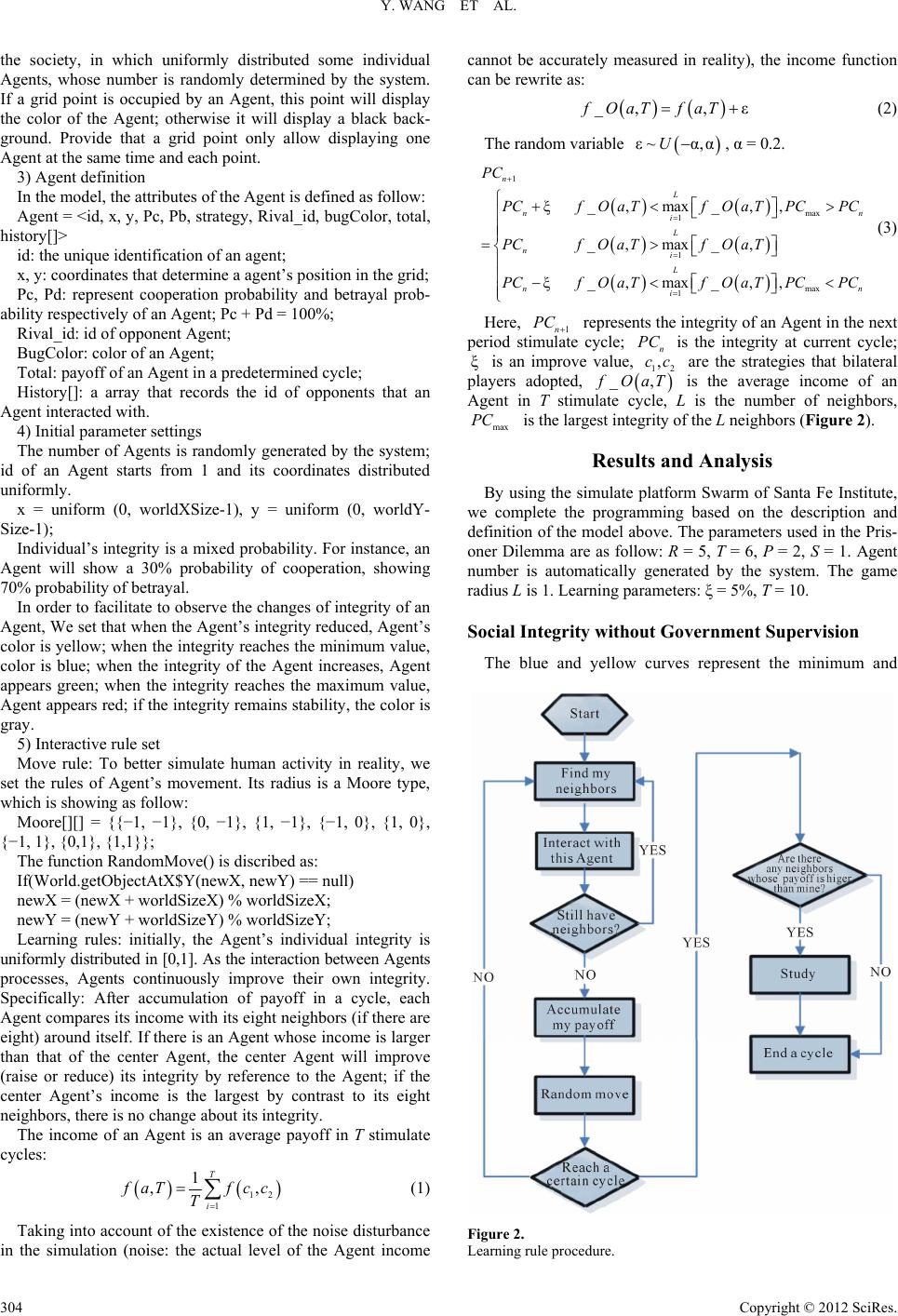 Y. WANG ET AL. the society, in which uniformly distributed some individual Agents, whose number is randomly determined by the system. If a grid point is occupied by an Agent, this point will display the color of the Agent; otherwise it will display a black back- ground. Provide that a grid point only allow displaying one Agent at the same time and each point. 3) Agent definition In the model, the attributes of the Agent is defined as follow: Agent = <id, x, y, Pc, Pb, strategy, Rival_id, bugColor, total, history[]> id: the unique identification of an agent; x, y: coordinates that determine a agent’s position in the grid; Pc, Pd: represent cooperation probability and betrayal prob- ability respectively of an Agent; Pc + Pd = 100%; Rival_id: id of opponent Agent; BugColor: color of an Agent; Total: payoff of an Agent in a predetermined cycle; History[]: a array that records the id of opponents that an Agent interacted with. 4) Initial parameter settings The number of Agents is randomly generated by the system; id of an Agent starts from 1 and its coordinates distributed uniformly. x = uniform (0, worldXSize-1), y = uniform (0, worldY- Size-1); Individual’s integrity is a mixed probability. For instance, an Agent will show a 30% probability of cooperation, showing 70% probability of betrayal. In order to facilitate to observe the changes of integrity of an Agent, We set that when the Agent’s integrity reduced, Agent’s color is yellow; when the integrity reaches the minimum value, color is blue; when the integrity of the Agent increases, Agent appears green; when the integrity reaches the maximum value, Agent appears red; if the integrity remains stability, the color is gray. 5) Interactive rule set Move rule: To better simulate human activity in reality, we set the rules of Agent’s movement. Its radius is a Moore type, which is showing as follow: Moore[][] = {{−1, −1}, {0, −1}, {1, −1}, {−1, 0}, {1, 0}, {−1, 1}, {0,1}, {1,1}}; The function RandomMove() is discribed as: If(World.getObjectAtX$Y(newX, newY) == null) newX = (newX + worldSizeX) % worldSizeX; newY = (newY + worldSizeY) % worldSizeY; Learning rules: initially, the Agent’s individual integrity is uniformly distributed in [0,1]. As the interaction between Agents processes, Agents continuously improve their own integrity. Specifically: After accumulation of payoff in a cycle, each Agent compares its income with its eight neighbors (if there are eight) around itself. If there is an Agent whose income is larger than that of the center Agent, the center Agent will improve (raise or reduce) its integrity by reference to the Agent; if the center Agent’s income is the largest by contrast to its eight neighbors, there is no change about its integrity. The income of an Agent is an average payoff in T stimulate cycles: 12 1 1 , T i , f aTfc c T (1) Taking into account of the existence of the noise disturbance in the simulation (noise: the actual level of the Agent income cannot be accurately measured in reality), the income function can be rewrite as: _,, εfOaT faT (2) The random variable ε~α,αU, α = 0.2. 1 max 1 1 max 1 ξ_, max_,, _, max_, ξ_, max_,, n L n n i L ni L n n i PC P Cf OaTf OaTPCPC PC fOaTfOaT P CfOaT fOaTPCP C Here, 1n PC represents the integrity of an Agent in the next period stimulate cycle; is the integrity at current cycle; is an improve value, are the strategies that bilateral players adopted, n PC 12 ,ccξ _ , f OaT is the average income of an Agent in T stimulate cycle, L is the number of neighbors, is the largest integrity of the L neighbors (Figure 2). max PC Results and Analysis By using the simulate platform Swarm of Santa Fe Institute, we complete the programming based on the description and definition of the model above. The parameters used in the Pris- oner Dilemma are as follow: R = 5, T = 6, P = 2, S = 1. Agent number is automatically generated by the system. The game radius L is 1. Learning parameters: ξ = 5%, T = 10. Social Integrity withou t Government Supervision The blue and yellow curves represent the minimum and Figure 2. Learning rule procedure. Copyright © 2012 SciRes. 304 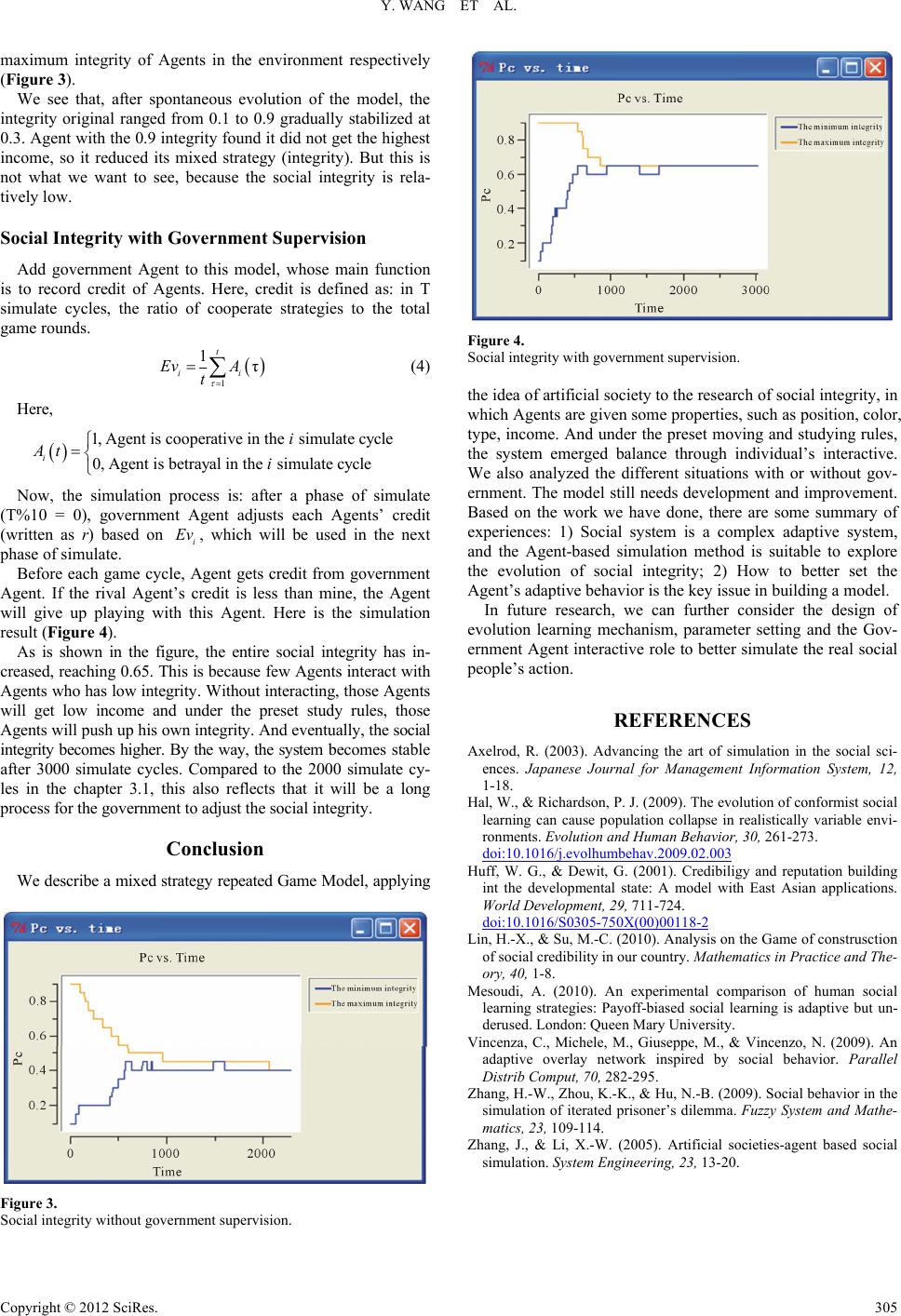 Y. WANG ET AL. Copyright © 2012 SciRes. 305 maximum integrity of Agents in the environment respectively (Figure 3). We see that, after spontaneous evolution of the model, the integrity original ranged from 0.1 to 0.9 gradually stabilized at 0.3. Agent with the 0.9 integrity found it did not get the highest income, so it reduced its mixed strategy (integrity). But this is not what we want to see, because the social integrity is rela- tively low. Social Inte gr it y with Govern m en t S up e rvision Add government Agent to this model, whose main function is to record credit of Agents. Here, credit is defined as: in T simulate cycles, the ratio of cooperate strategies to the total game rounds. Figure 4. Social integrity with government supervision. 1 1τ t ii Ev A t (4) the idea of artificial society to the research of social integrity, in which Agents are given some properties, such as position, color, type, income. And under the preset moving and studying rules, the system emerged balance through individual’s interactive. We also analyzed the different situations with or without gov- ernment. The model still needs development and improvement. Based on the work we have done, there are some summary of experiences: 1) Social system is a complex adaptive system, and the Agent-based simulation method is suitable to explore the evolution of social integrity; 2) How to better set the Agent’s adaptive behavior is the key issue in building a model. Here, 1,Agent is cooperative in the simulate cycle 0, Agent is betrayal in the simulate cycle i i At i Now, the simulation process is: after a phase of simulate (T%10 = 0), government Agent adjusts each Agents’ credit (written as r) based on i E v, which will be used in the next phase of simulate. Before each game cycle, Agent gets credit from government Agent. If the rival Agent’s credit is less than mine, the Agent will give up playing with this Agent. Here is the simulation result (Figure 4). In future research, we can further consider the design of evolution learning mechanism, parameter setting and the Gov- ernment Agent interactive role to better simulate the real social people’s action. As is shown in the figure, the entire social integrity has in- creased, reaching 0.65. This is because few Agents interact with Agents who has low integrity. Without interacting, those Agents will get low income and under the preset study rules, those Agents will push up his own integrity. And eventually, the social integrity becomes higher. By the way, the system becomes stable after 3000 simulate cycles. Compared to the 2000 simulate cy- les in the chapter 3.1, this also reflects that it will be a long process for the government to adjust the social integrity. REFERENCES Axelrod, R. (2003). Advancing the art of simulation in the social sci- ences. Japanese Journal for Management Information System, 12, 1-18. Hal, W., & Richardson, P. J. (2009). The evolution of conformist social learning can cause population collapse in realistically variable envi- ronments. Evolution and Human Behavior, 30, 261-273. doi:10.1016/j.evolhumbehav.2009.02.003 Conclusion Huff, W. G., & Dewit, G. (2001). Credibiligy and reputation building int the developmental state: A model with East Asian applications. World Development, 29, 711-724. doi:10.1016/S0305-750X(00)00118-2 We describe a mixed strategy repeated Game Model, applying Lin, H.-X., & Su, M.-C. (2010). Analysis on the Game of construsction of social credibility in our country. Mathematics in Practice and The- ory, 40, 1-8. Mesoudi, A. (2010). An experimental comparison of human social learning strategies: Payoff-biased social learning is adaptive but un- derused. London: Queen Mary University. Vincenza, C., Michele, M., Giuseppe, M., & Vincenzo, N. (2009). An adaptive overlay network inspired by social behavior. Parallel Distrib Comput, 70, 282-295. Zhang, H.-W., Zhou, K.-K., & Hu, N.-B. (2009). Social behavior in the simulation of iterated prisoner’s dilemma. Fuzzy System and Mathe- matics, 23, 109-114. Zhang, J., & Li, X.-W. (2005). Artificial societies-agent based social simulation. System Engineering, 23, 13-20. Figure 3. Social integrity without government supervision. |